Diomedes and Aeneas

In Calydon, Oeneus made his offerings to the gods, and in the counting of names he forgot Artemis (Ov. Met. 8).

The first fruits rise in smoke to Zeus, Hera, the household powers, the immortals who tolerate men so long as men remember them. It is the old economy of reciprocity, the one James Frazer would later detail: the king as ritual hinge, the harvest as contract, the sacred as maintenance rather than belief. And Oeneus, for reasons no one remembers, left out Artemis.

It is not sacrilege. It is worse: it is carelessness. A god does not forgive being treated as an afterthought.

So Artemis sent a boar. Monstrously large, with a bristling ridge along its back like spears lifted for battle; its shoulders heaved, its jaws frothed, and it came ravaging Calydon.

The boar is divine judgment. It tramples vines and uproots young trees as if it resents the very idea of human order. Men go out with spears and come back in pieces. Dogs break their teeth on its hide. The thing is impenetrable, as Artemis herself is impenetrable: not merely untouched, but unclaimable: a parthenos (παρθένος), belonging to no hearth, no husband, no bargain. Untouchable. Unbending. And when she is slighted, she becomes purity sharpened into punishment.

Oeneus does what kings always do when their power fails: he calls for help and offers glory as payment. Calydon’s salvation becomes a competition. The best men of Greece arrive as if they can fix a divine insult with excellent posture and sharp bronze.

The heroes come: Theseus, Castor and Pollux, Peleus, and Meleager among them, depending on the teller’s roll call. And among them comes Atalanta, the sole female, fast, clean-eyed, a woman whose competence unsettles the men who thought excellence was their inheritance.

Some bristle at her presence; others stare too long. Meleager sees her and the myth shifts. His attention is immediate and fatal, the way desire is in old stories. He wants her admired. He wants her honored.

Atalanta’s arrow strikes first. It is a small wound, but it lands like a prophecy. The men see it and feel their pride slip on the wet stone of reality: the hunt is no longer theirs alone. The beast bleeds at a woman’s hand. The world has failed to respect the boundaries men drew on it. Artemis smiles.

Meleager is exhilarated. Others are offended. And the offended men begin, quietly, to prepare the argument that will follow victory: even if she helped, she must not be rewarded. They are not thinking about justice. They are thinking about precedent.

Meleager kills the boar, the myth grants him the climax. The monstrous body collapses into the earth, returning to the god who sent it. Calydon is saved.

And then Meleager does the thing that makes the story irreversible: he awards the spoils to Atalanta. The hide, the tusks, the trophy of salvation, he offers them to her as public fact: she mattered. In that moment, he tries to rewrite the law of the heroic world. He tries to make honor obey merit rather than gender and bloodline.

Atalanta’s later “taming” belongs to a different story-cycle, but it throws a shadow backward: the fastest woman alive will one day be defeated not by speed, but by distraction, three golden apples (Ov. Met. 10). Conquered by luxury. That future does not explain Calydon, but it deepens it: excellence may win the hunt, yet still lose to the older machinery of desire, status, and social capture.

Meleager’s is a noble gesture. It is also suicide. Men will forgive a boar for being monstrous. They will not forgive a hero for changing the rules.

Meleager’s own family, his mother’s brothers, protest believing the prize belongs to them by right of male entitlement and clan dignity. The argument is not really about hide and tusks. It is about who gets to define reality. Anthropologically, the protest has the shape of a matrilineal tension: the maternal uncles act as if they are the rightful arbiters of prestige, as if the mother’s line retains authority over the male heir and the distribution of honor.

Meleager, hot with youth and certainty, answers insult the only way a Greek hero knows how: with killing. His uncles fall. The hunt’s victory is now stained with family blood.

And somewhere, offstage, Artemis watches with the serene patience of a god who understands that men will finish the curse themselves.

Althaea, Meleager’s mother, receives the news. The story tightens. In Greece, motherhood is not a soft role, it is a sacred jurisdiction. She is mother to her son, yes, but she is also sister to the men he has killed. Both relationships claim her. Both demand a verdict.

Here the myth reveals its cruel genius: Meleager’s life has been bound since birth to a firebrand, a piece of wood that will determine the length of his breath. Althaea holds the brand. She hesitates. She trembles between love and vengeance, and the trembling itself becomes a kind of prayer. Then she commits. She burns it. And Meleager dies not in battle, not in heroic spectacle, but because the household could not survive its own moral arithmetic.

This is the first true lesson in Diomedes’ lineage: the house does not collapse because enemies attack. It collapses because it turns upon itself.

Oeneus survives. That is not mercy. It is continuity. Old kings often live long enough to watch their mistakes become institutions. Calydon continues, but it does not heal. In later telling, Oeneus is displaced by kin, usurped, pushed aside, turned into a living relic of a reign that began with a forgotten goddess and ended with a dead son (Paus. Descr. 2).

He becomes what Greek myth loves most: the fallen patriarch. And he will, in some versions, find refuge not in Calydon but with Diomedes who will later suffer the same disease of homecoming.

Tydeus comes from the house of Oeneus, an Etolian prince of Calydon’s bloodline, whether son or later branch, carrying forward the same inherited violence. His inheritance is not merely royal blood; it is the family’s habit of solving moral problems with violence (Apollod. Bibl.). He grows into a man built like a spear point: sharp, narrow, and meant to enter things.

And like so many men in Greek story, he is exiled. The reasons vary, kin-slaying, quarrels, violated guest-right, but the essence is the same: Tydeus cannot be contained by his own city. He is too dangerous to keep, too valuable to kill. So he becomes a wandering asset.

He arrives in Argos and is taken in by Adrastus, king of political instincts. Adrastus sees what every ruler sees in such men: the state can use them. It can point the spear.

This is the second lesson in Diomedes’ line: cities adopt violent men when they need them, then pretend they were always civilized.

Adrastus binds Tydeus into the Argive order through marriage. And soon enough the marriage alliances embroil Thebes, because the Greek imagination cannot leave Thebes alone. Thebes is where family curses are not private tragedies but public infrastructure. Thebes is the city where your genealogy can kill you (Aesch. Sept.).

Tydeus becomes one of the Seven who march against it. They march because honor has hardened into law, and the law no longer has a human face.

Tydeus fights like the man he is: ferocious, competent, impossible to negotiate with. In later tradition, after he is mortally wounded, Athena comes to grant him immortality, an astonishing offer for a man so stained with violence (schol. Il.; later mythographic tradition). But Tydeus, still hungry, still enslaved to the old law of savagery, commits an act that disqualifies him: he tears into the skull of his enemy and eats the brains (schol. Il.).

It is not merely gore. It is the collapse of the boundary between hero and beast. Athena recoils. Immortality is withdrawn. She can tolerate violence. She does not tolerate the celebration of it.

This is the third lesson: the gods have standards for what kind of monster gets eternity.

Diomedes is Tydeus’ son, but he is not Tydeus repeated. He is the improved model: same steel, better tempering. Where Tydeus is rage, Diomedes is will. Where Tydeus is excess, Diomedes is discipline (Hom. Il. 5).

In Troy, he becomes the perfect Greek instrument. Athena favors him, not with love like she gives Odysseus, but with tactical sponsorship. She lends him vision, clarity, permission. In Book 5 of the Iliad, he rises into that rare state where a mortal seems briefly to outrank mortality.

He meets Aeneas on the field. Aeneas is brave, competent, and in Homer’s world he is still killable. Diomedes crushes him with a stone. Aeneas falls. The end is imminent. But the gods intervene.

Aphrodite herself descends to lift her son away, and Diomedes wounds her. The goddess bleeds. The boundary between human and divine is violated. A mortal hand draws blood from Love. It is the greatest mortal overreach in Homer and it is also the seed of later ruin. No one wounds Aphrodite for free.

Diomedes survives Troy. He returns. And here the story performs its oldest trick: the battlefield does not kill him; the household does. He wins the war but not the peace.

In later tradition his wife Aegialeia turns against him, through infidelity, conspiracy, hostility, rumor (Apollod. Bibl.). Sometimes the cause is framed as Aphrodite’s revenge; other versions make it more human and therefore more frightening: Diomedes is undone by politics, resentment, and the way a city forgets what it owes its protectors.

Either way, the result is exile. The hero who stood against gods cannot hold his own hearth. He leaves Argos, the way his father left Calydon. The pattern repeats.

Diomedes goes west. The story becomes colonial and local, as myths do when they settle into landscapes. He founds places, or is credited with founding them. The man becomes a landmark (Strab. Geog.; Plin. Nat. Hist.).

This is how Greek myth handles displaced greatness: it preserves it by scattering it. He is no longer a king. He is a legend with a coastline.

And now, at last, the Roman turn.

Aeneas survives Troy, bearing the gods and the household fire, carrying his people like a burden that cannot be put down (Verg. Aen. 2; 3). He comes to Italy not as a conqueror but as a destiny looking for ground (Verg. Aen. 7).

The Italians, threatened by this newcomer, look for old weapons. They remember Diomedes. They send to him: you fought Trojans; you almost killed their prince; come do it again. And Diomedes refuses (Verg. Aen. 11).

This refusal is the final refinement of the arc. It is the moment when the Homeric hero, who once wounded gods, becomes a man who will not fight the future. He has learned what war actually purchases. He has learned that even victory can be a curse. He has learned, perhaps, that some lines are protected not by skill but by narrative inevitability.

And Virgil, smiling like a priest of history, lets the old Greek hero step aside so that Rome can be born.

KAIROS AND THE GEOMETRY OF TIMING

Book Five of the Iliad contains the most outrageous act of combat in all of Greek myth: a mortal wounds a god.

Homer opens the Iliad with the anger of Achilles and his retreat from the field of battle. His mother, Thetis, bargains with Zeus, and the war is no longer a simple contest of men but a stage of resentments managed by the gods. Book 3 tries to impose a political solution through a duel between the aggrieved parties, Menelaus and Paris, but Paris is spared death by Aphrodite. Book 4 shows that oaths, sacrifices, and truces are temporary at best. The gods hold counsel, and Athena persuades Pandarus to shoot Menelaus, breaking the truce. The ensuing battle of Book 4 is of equal measure: “For on that day many men of the Achaians and Trojans lay sprawled in the dust face downward beside one another.”

Into this deadlock Homer introduces Diomedes, son of Tydeus. “There to Tydeus’ son Diomedes Pallas Athene granted strength and daring, that he be conspicuous among all the Argives and win the glory of valour” (Iliad, Lattimore, Book 5). So opens the aristeia. Homer shows Diomedes seething through the ranks: “but you could not have told on which side Tydeus’ son was fighting.” He is like a “winter-swollen river” that exceeds the confines of the dikes and destroys “the many lovely works of the young men [that] crumble beneath it.” Even when Pandarus strikes him in the shoulder with an arrow, he is undaunted, crying out to Athena: “if ever before in kindliness you stood by my father through the terror of fighting, be my friend now also.” Athena heeds his prayer and lifts the veil from his sight so he can see the gods on the battlefield. She warns him not to engage the immortals, except Aphrodite: “her at least you may stab with the sharp bronze.”

Fighting continues. Diomedes slaughters Trojans and nearly kills Aeneas until Aphrodite intervenes to carry her son from the field. Outraged, Diomedes pursues her: “Now as, following her through the thick crowd, he caught her, lunging, [he] made a thrust against the soft hand with the bronze spear… and blood immortal flowed from the goddess.” Aphrodite shrieks and drops Aeneas. Apollo takes him up, and Diomedes has the temerity to press the attack “though he saw how Apollo himself held his hands over [Aeneas].” Three times Diomedes assaults the god’s protection and three times is rebuffed, until Apollo warns him: “Take care, give back, son of Tydeus, and strive no longer to make yourself like the gods.” Diomedes yields but “only a little.”

Apollo then calls on Ares to halt this mortal who has become too dangerous. Ares enters the fight beside Hector, “made play in his hands with the spear gigantic,” and the balance of the battle swings violently. Diomedes, still seeing the gods, warns: “Friends… there goes ever some god beside [Hector]… Ares goes with him.” With Ares in the line, Hector ravages through the Greeks until Hera protests the slaughter and Athena, cool, sly, and tactical, asks Zeus whether she may drive Ares out with “painful strokes.” Zeus accedes. Athena goes directly to Diomedes, reminds him of her support for his father, and assures him: “no longer be thus afraid of Ares… such a helper shall I be standing beside you.” She takes control of his chariot and drives Diomedes straight at the war god. Ares lunges; Athena directs the spear aside and she leans behind Diomedes’ thrust and guides it “into the depth of the belly where the war belt girt him.” Ares bellows “with a sound as great as nine thousand men make, or ten thousand.”

What makes Book Five useful is that it’s diagnostic. Homer shows us what happens when a moment is so narrow and so structurally correct that the impossible becomes briefly possible. Diomedes doesn’t “beat” Aphrodite or Ares in any modern sense. He doesn’t outclass them, and Homer goes out of his way to make that clear (Apollo stops him cold). His wounding Ares is a triumph of alignment: Athena clears perception, defines the boundary, grants permission, and then physically guides the point. In other words, the feat is not raw violence. It is violence delivered at the exact instant the encounter becomes bindable.

The Greeks called it kairos: the right moment as a real opening that exists only when the world’s geometry allows it.[1]

I read ki-musubi into this mythopoetic framing. Homer knew the agency of Athena provided the framework of potential, but the actions all had to crystalize appropriately. Each participant had their role and had to play it correctly. This is where the potential of ki-musubi and Aikido becomes more honest. The goal isn’t “blending” or “harmonizing” in a soft, therapeutic sense. The goal is to create the moment when the encounter is tied so that two bodies stop being two independent systems and become one shared constraint. When the axis is established, the opponent’s options collapse not because you are stronger, but because the structure no longer permits escape without cost. Timing, then, isn’t “speed.” It’s not even initiative in the aggressive sense. It’s the ability to enter at the instant the opponent’s intention has fixed. When the line becomes predictable, when the door is briefly open, when the technique is no longer a choice but the only coherent outcome. Diomedes is a mythic diagram of that principle: not “man wounds god,” but “a moment arrives in which the strike becomes inevitable.”

Kairos (καιρός) is a descriptive Greek term meaning the right moment: the critical opening; the decisive “now.” Philologically, it carries a semantic range that includes a critical point, due measure, and even a kind of vulnerable seam. Later Greek writers apply it to rhetoric, medicine, and ethics: the right dosage, the right word, the right intervention. But the underlying structure is consistent: there exists a moment when the situation becomes actionable; outside that moment, action becomes waste. The “right time” is not abstract time. It is situational time.

I selected Diomedes because it is one of the most dramatic encounters, but, honestly, it is almost too supernatural. The agency and actions of the gods, Athena specifically, I read not as divine intervention but rather as a means to emphasize how spectacularly important those moments are. They exist as if the intervention of a deity is required. Thus an interpretive extension of kairos as “a deed normally beyond your innate ability” that kind of “one chance to do the impossible.”

But kairos is the opening as a whole: the opponent’s intent, posture, balance, attention, commitment, environment, your position, your readiness, and the moral/psychological permission to act all converging into a brief window where action becomes inevitable if you’re competent. Thus, almost any combat scene in the Illiad provides descriptions of kairos: heroes wait for their opponent’s weight to shift, they exploit overreach or fixity of position.

These combat realities are difficult to describe but many of the men in Homer’s audience would have had direct combat experience. Much like contemporaries of George Silver, Munenori and Musashi, the audience viscerally knew what the author was trying to capture.

As we explored in the earlier post, in Japanese combative theory, sen is usually taught as “initiative,” but initiative is also a slippery modern word. Merging lexicons clarifies the martial point. In Japanese combative theory, sen is often taught as “initiative,” but properly understood it is your relationship to the opponent’s action-cycle: acting before the opponent’s intent fully manifests, entering as it begins, or responding after commitment. Most students read these as timing categories. A better way to read them is as strategies for manufacturing or exploiting kairos. Kairos is the opening. Sen is how you arrive there. And when you succeed, when the encounter ties and becomes one system under constraint centered on an axis, that is what Aikido names as ki-musubi.

_________________________

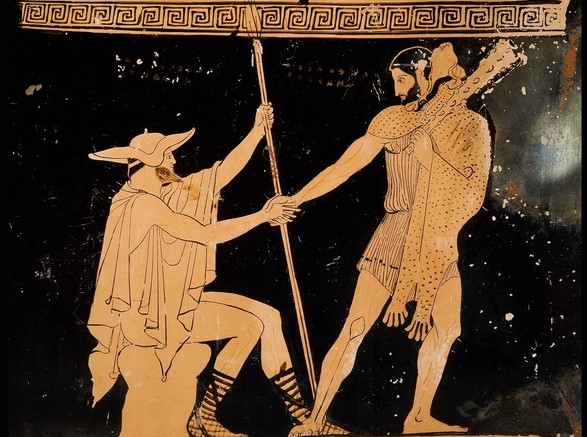
Banner image is the Duel of Diomedes and Aeneas from an Attic Red Figure Calyx ca 490 BCE in the Museum of Fine Arts, Boston.

[1] The Wikipedia entry prefers the framing of kairos as it pertains to archery and weaving, in the sense of a timed entry into an opening, which is adjacent to the earliest extant instance where καιρός appears as a noun meaning a “right or proper time” and is generally traced to Hesiod (8th–7th century BCE) in Works and Days. Although its meaning there is still developing (more “fitting time” than the rich purposeful sense it will later take), it’s the first literary occurrence in that abstract sense. In Homeric epic, the noun καιρός in the sense of a decisive time-moment does not appear; instead, a related adjectival form (καιρίος / kairios, meaning something like “fatal” or “critical”) and καίριον as a vulnerable spot on the body does occur in Homeric poetry. This usage refers to a critical location that, if struck, can be fatal; a “critical point” in space rather than a moment in time. This spatial sense connects to the later metaphorical sense of an “opening” or opportunity. A rich exploration is Kairos as a Figuration of Time by Dietrich Boschung, 2013.

In archery, kairos maps cleanly to archery as “the right moment to release.” (And very reminiscent of what I recall from Zen in the Art of Archery by Eugen Herrigel). Kairos can be framed as the moment when the shot must be released because the conditions have converged. It’s not “time” in the neutral sense (chronos), but time as the instant when alignment, draw, aim, breath, and target relationship become true. You don’t “decide” to shoot as much as you recognize when the system has become shootable. Outside that window, release becomes either premature (you confess your intent and miss) or late (you chase a moment that has already passed).

The philological thread becomes richer when the language of aim and timing crosses into the moral domain. When Ecclesiastes 3:1 (“To everything there is a season…”) was translated into Greek in the Septuagint, the translator paired καιρὸς (kairos) alongside χρόνος (chronos). In that line:

τοῖς πᾶσιν χρόνος, καὶ καιρὸς τῷ παντὶ πράγματι
For everything there is chronos, and kairos for every matter under heaven.

Chronos marks ordinary duration; kairos marks the appointed or fitting moment when a particular action becomes right. The distinction is not merely semantic. It implies that the world is not composed of identical minutes, but of moments with different moral weights: times when action is not only possible, but demanded.

This archery logic returns, unexpectedly, in the language of failure. The primary New Testament Greek term for “sin” is ἁμαρτία (hamartia), derived from a verb meaning to miss the mark, fail, or err, a word that can carry the image of a thrown spear or loosed arrow that does not land true. The point is not that moral failure is a technical mistake, but that the metaphor is structurally exact: there is a target, there is a right line, and there is a moment when action must be taken correctly. In that sense, kairos and hamartia describe opposite ends of the same geometry: the opening in which the shot becomes true, and the failure that occurs when it is loosed outside the conditions that make it real.

INITIATIVE: TERMS AND CONCEPTS

Timing and initiative are related concepts, especially once one steps onto the mat and is required to embody them rather than merely discuss them abstractly.

In my earlier article, Jo v Bokken article, I deliberately used traditional budō terminology, rather than exclusively use concepts from George Silver, Bruce Lee and John Boyd. That choice was intentional: the traditional terms deserve to be understood on their own terms before they are translated into other lexicons. What follows is an attempt to do exactly that.

The vocabulary of initiative emerges most clearly in early Edo-period sword theory, especially in the writings of Yagyū Munenori, recorded in Heihō Kadensho (c. 1632), and in the later tactical reflections of Miyamoto Musashi in Gorin no Sho (c. 1645).

Several points are immediately clear from these sources: Sen is not synonymous with speed. Acting early is often condemned as error. Initiative is taken after the opponent’s intention has fixed, not before it has formed.

Munenori repeatedly warns against premature action. The swordsman who moves too soon reveals intent without consequence; the swordsman who waits for fixation acts with inevitability. Musashi likewise emphasizes rhythm (hyōshi) and the breaking of rhythm to dominate the moment of decision.

What is notably absent in these texts is a clean taxonomy. The distinctions are present, but they are descriptive and situational, not codified into a pedagogical system.

The modern fourfold system (sen, sen-no-sen, go-no-sen, sensen-no-sen) is largely a pedagogical consolidation, refined through late kendo instruction.

TermCommon Explanation
SenTaking initiative
Sen-no-senActing as the opponent acts
Go-no-senActing after the opponent
Sensen-no-senActing before the opponent

It is useful, but only if understood descriptively, not prescriptively. It does not tell you what to do. It describes when you when you are doing it.

Sen (先) Initiative Proper

At its root, sen simply means initiative. In classical usage, this refers to the moment the opponent’s commitment becomes readable and binding.

It is not attacking first, or moving quickly (speed), or forcing action. It is recognizing when the opponent has demonstrated intent and started along a trajectory and thus acting because the opponent can no longer recover safely (or change vectors).

Sen-no-Sen (先の先) Acting at the Moment of Commitment

Sen-no-sen describes action taken as the opponent’s initiative manifests.

Traditionally, this is the ideal timing: It is not preemptive, nor reactive, but coincident with fixation.

Structurally, this is the moment when the opponent’s attack is real, but its outcome is not yet decided.

In classical weapon systems, this timing preserves defense while seizing control. In budō, it became the model of “simultaneity,” though that term often obscures its precision.

Go-no-Sen (後の先) Initiative After Initiative

Go-no-sen describes action taken after the opponent has already initiated.

Classically, this timing accepts that the opponent has already seized advantage, and larger movements and compensation are required.

Both Munenori and Musashi acknowledge this timing as necessary, but inferior. The swordsman who relies on go-no-sen is already behind the decision curve.

Sensen-no-Sen (先先の先) Preemptive Disruption

Sensen-no-sen refers to acting before the opponent’s initiative fully forms.

In classical contexts, this often meant applying psychological pressure, threat, or provocation. (Watch early videos of O’Sensei and you will see numerous instances.)

Critically, because no commitment yet exists, this timing is structurally fragile. It relies on judgment, deception, or intimidation rather than inevitability. Used improperly, it puts you at risk, by moving first you show your intent and could over-commit.

So a fourfold system emerges that simply describes when one acts relative to the opponent’s irreversible commitment:

Sensen-no-sen — before commitment

Sen-no-sen — at commitment

Go-no-sen — after commitment

Sen — the condition of initiative itself

Again: this is not a tactical prescription. It is a descriptive ordering.

In Aikido, initiative correlates not to victory, but to the emergence of the axis of the encounter. The axis is the dynamic line of force, balance, and intent that emerges only at the moment uke commits and only where nage intersects that commitment.

Rather than seeking to end the fight, Aikido seeks to perfect the encounter. This requires a different emphasis for timing and initiative. Seen this way:

Sensen-no-sen occurs before an axis exists. There is no binding yet.

Go-no-sen occurs after the axis is already controlled by uke. Nage must compensate.

Sen-no-sen occurs at the birth of the axis. This is where Aikido’s internal logic is strongest. At that moment posture can be preserved (shizentai), movement becomes mutually constrained, and ki-musubi becomes perceptible.

Because these are descriptive labels and not prescriptive maxims, they are more neutral than other lexicons developed by fighters like George Silver, John Boyd, and Bruce Lee.

I discuss George Silver in an early post, but to provide a summary and contrast:

Silver does not speak of initiative. He speaks of combative safety. Silver’s “times” are not abstract tempos. They are priority rules of mass and threat:

ElementWhy it matters
HandLeast mass, fastest threat projection
BodyAdds structure and power
FootCommits total mass, hardest to retract

I frequently use Silver’s maxims in class, but his logic is what matters:

Actions that commit greater mass before threat is established are unsafe.

Thus:

Hand–Body–Foottrue time (threat first, commitment last)

Foot–Body–Handfalse time (telegraphed, unsafe)

This is exactly right. But why? Because Silver cares about survivability, not initiative.

Silver TermWhat it Actually Describes
True TimeCorrect sequencing of threat → mass
False TimePremature commitment
MeasureWhether contact can occur safely
JudgmentRecognition of opponent’s commitment

Silver does not care who “goes first.” He cares who cannot safely change.

ConceptSilverBudōAxis Model
CommitmentMass sequenceInitiativeIrreversible posture
TimingTrue vs falseSen categoriesAxis emergence
SafetyDefense preservedHarmony impliedShared constraint
ErrorDeathTechnique failureCompensation

Silver and Col. Cooper speak the same language: employ the body with proper tactics. Budō speaks more abstractly. The axis model attempts to restore structural accountability without (necessarily) reintroducing lethality.

When in doubt, shoot

Perhaps the more interesting integration is an overly of Bruce Lee’s analysis of the Five-Types of Speed. In Tao of Jeet Kune Do, Bruce Lee breaks speed into five distinct but interrelated functions. These are not attributes of technique; they are failure points in perception and action.

  1. Perceptual Speed
    How quickly one recognizes what is actually happening.
  2. Mental Speed
    How quickly one decides once perception is clear.
  3. Initiation Speed
    How quickly one begins action after decision.
  4. Performance Speed
    How quickly the body executes the chosen action.
  5. Alteration Speed
    How quickly one can change or abort action when conditions shift.

Lee’s taxonomy maps almost perfectly onto Boyd’s OODA loop, but at the scale of a physical encounter.

Boyd (OODA)Bruce LeeFunction
ObservePerceptual SpeedSeeing what is actually happening
OrientMental SpeedInterpreting without distortion
DecideInitiation SpeedCommitting without hesitation
ActPerformance SpeedExecuting physically
Re-orientAlteration SpeedAdapting mid-action

Lee’s genius was recognizing that most fighters fail before action: They see late, interpret poorly, hesitate, and then try to compensate with physical speed. Boyd would say the same thing (just with jets instead of fists).