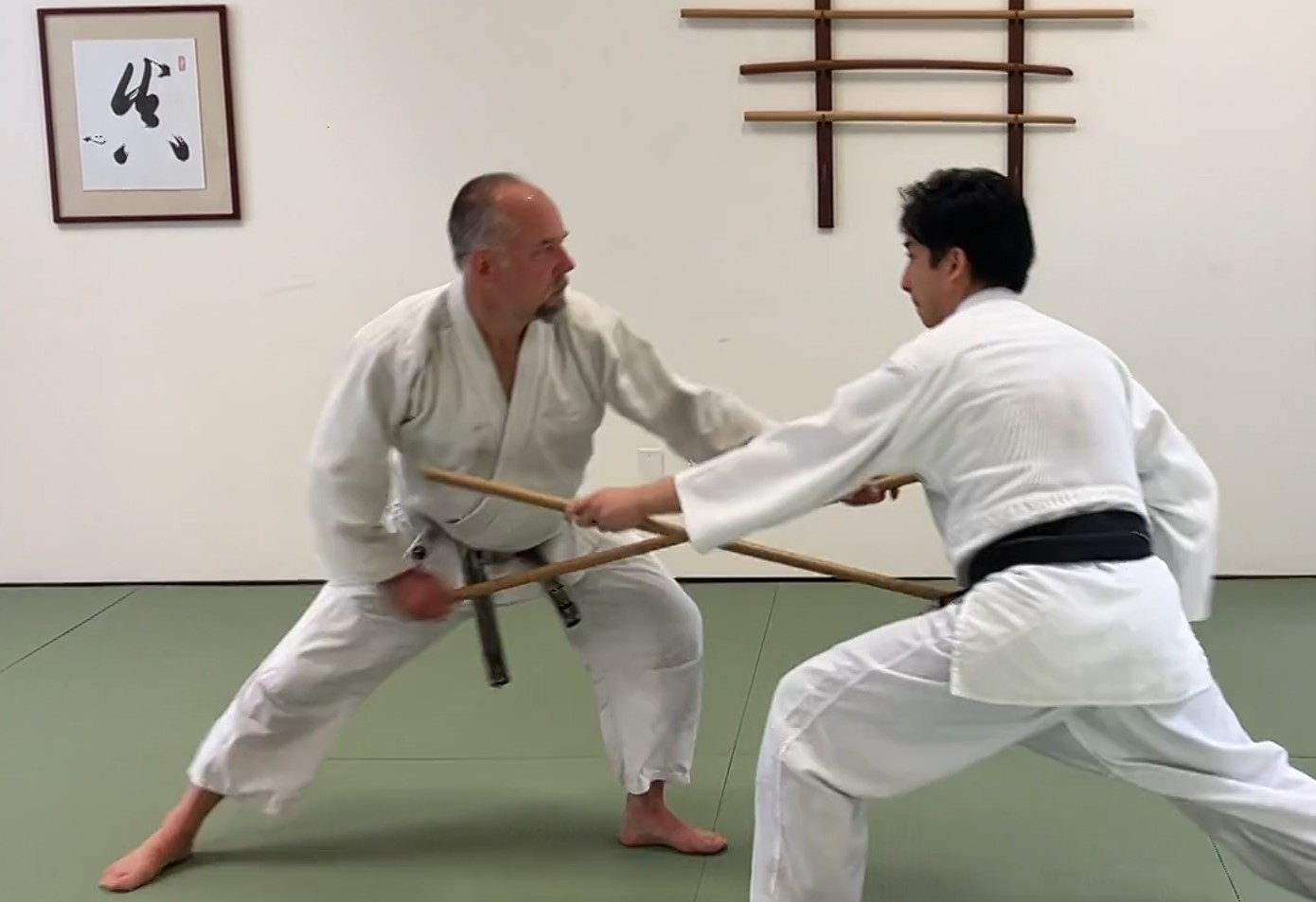
8 1/2 COUNT KUMIJO

This is a refinement of the kihon 8 count kumi by Takumi Suzuki.

jodo inspiration

The purpose of the refinements are pedagogical as well as practical.

Contrast the explication of the kihon version (linked above) and the refinements are evident. The traditional sequence (and its bunkai) is as follows:

  1. Junte chudan tsuki
  2. Cover
  3. Yokomen (#1)
  4. Hasso
  5. Yokomen (#2)
  6. Stab to the rear
  7. Strike leg / block
  8. Strike hand

Reset to start the sequence again.

Takumi adds the measure (a full count in actuality) of makiotoshi after step 2 – hence the somewhat whimsical designation “8 1/2 count:”

  1. Junte chudan tsuki
  2. Cover
  3. Makiotoshi
  4. Yokomen (#1)
  5. Hasso
  6. Yokomen (#2)
  7. Stab to the rear
  8. Strike leg
  9. Strike the center

Reset to start the sequence again.

Why add the makiotoshi? Specifically to help students understand that the “flow” of a covering action to a counter-yokomen is not achieved by “helicoptering” the around the head. Inserting the mackiotoshi requires that both players cover their centerline, drop with a camming action on the , then raise up their centerline before executing the yokomen – now as a discrete attacking action.

The form now forces the proper attack and eliminates a “false flow” signal that the traditional form can impart.

Yokomen with the should be tight so as to allow the strike to be delivered even when close to a wall – review the “magic wall” exercise. To do so requires that the remain in a protective orientation along the practitioner’s centerline and to deliver the strike with the hands in front of one’s forehead – a forward snap, not a pulling from behind. It is a sharp attack that keeps the tip of the accelerating and descending in a tight arc – no expansive circles, no “helicoptering.”

But there are other subtleties to attend to:

1. Tsuki. The initial thrust is delivered from the tip by driving forward with the back hand, which explicitly is not drawn back. No telegraphing wind up, but rather a sliding advance with the front foot to augment the thrust. This action will also drive both practitioners much closer than is rational, but that is intentional and forces a fully integrated body to move to the second step;

2. Cover. Because the initial move closed the maai, the covering action must start with a deep sliding retreat to open the distance. This is a matched action, but one that must keep the centerline covered and keep both players oriented toward each other.

3. Makiotoshi. Inserted as a pedagogical step, it also has the benefit of forcing the practitioners to keep in alignment with proper center line cover on both the ascending line (step 2) as well as the descending line (step 3). The forced addition of time and connection breaks the habit of rote repetition. Pay attention to your hand rotations on each phase – rising and lowering – to feel the camming. Feel what the weapon is telling your body to do!

4. Yokomen (#1). The proper delivery of this strike is critical – study the arc to really understand the path of least resistance. Geometry is sacred!

5. Hasso. My earlier post and in-class explication of the application (the bunkai) of this step is to “clear” an on-coming low-line attack. However, in this presentation, the focus is on the lead hand extending toward the opponent – tip control – prior to the back hand initiating the driving arc to hasso. The line of the is more linear – less focus on an outward sweep or clearing action. Explicitly, the goal is to keep the orientation on the opponent and to keep the potential of the leading end of the an imminent threat – do not immediately run to a defensive use of the .

6. Yokomen (#2). As in the traditional presentation, the second yokomen from hasso requires a hand change and delivery from the shoulder rather than the top of the head so the biomechanics are different. From the connecting strikes, both players then;

7. Stab to the rear; an action which is clear: The driving action of the rear-stab, initiates by extending the lead hand (closest to the opponent in front of you) to then drive the precipitously down and back at an angle that follows the line determined by your forward yokomen.

8. Strike the leg. Note that the linked concept of “blocking” is eliminated from the description because the refinement is of an older spirit – “all offense, all the time.” From the rear low-line strike, nage now delivers a forward low-line strike. That requires the practitioner to raise the top hand along his sternum (centerline) while turning briskly toward the front, then delivering the down strike from the top hand. The to contact in now incidental and not a focus of connecting. The simultaneous delivery of a precise strike will create the connection – do not seek it as an end.

9. Strike the center. Again, notice the description is different – “center” not “hand.” From the low-line connection where the strike was the goal, but a mutual block was the result, each player simultaneously tries to strike the center of his opponent. Because this is a training exercise, each player slides back while executing the strike – but the spirit and the intention should be to hit the opponent’s forehead as a primary target and the hand as a secondary. By focusing on the opponent’s head, nage will default to a stronger (extending) strike, rather than the contracting “choking” strike that results from focusing too closely to one’s body.

The differences may seem trivial if one simply learns the kata as choreography. They are not. By inserting a single step in a traditional kata/kumi, Takumi has added a level of richness that should force a re-examination of once familiar movements.


Measure 114

I was in Monaco – France actually – when the ruling was announced. Bastille Day in France, but a sad travesty of interpretation in Oregon.

Immergut appears to be a textualist in the spirit of Scalia, but without his subtlety and intelligence. Her ruling that “large capacity” (more than 10 round) “magazines” (note her semantic analysis!) are not commonly used in self-defense and therefore not protected is absolutely inane. The second amendment – in historical context – was purposefully written so that the citizen soldier (a militia) has the right to own weapons equal to those possessed by their potential oppressors (the government). Why do lawyers so stupidly ignore the historical context and very reason for articulating that right? All the horse-shit discussion about the technology of arms when the Constitution was written results from lawyers who don’t know history and who obfuscated the very principle of the 2nd Amendment: The citizen soldier had just committed treason! The nascent Americans had just effected a military coup against the legitimate legal authority. They prevailed only because the Founding Fathers had a will to win and the average citizen owned weapons of equal power and capacity to those used by the government. To believe that the right to own firearms extant at the time of the writing would be akin to limiting freedom of speech to the technology of the quill, parchment, and horse-delivered mail.

Any quibbling on the rights of the government or need for public safety are so much blathering and legal shenanigans. This ruling is a failure and will have no material impact on the safety of the general public (criminals will of course immediately comply with this ruling: not! It has just made law abiding citizens potential criminals). It is an over-reach, and a dangerous step to disarmament.

Oregon Public Broadcasting covered the story well:

_______________________________

Federal judge says Oregon’s new gun rules don’t violate US Constitution

By Conrad Wilson (OPB) and Jonathan Levinson (OPB)

July 14, 2023 6:09 p.m.

A federal judge says Oregon’s new, stricter gun safety rules are constitutional.

In a 122-page written order issued late Friday, U.S. District Court Judge Karin Immergut found banning large capacity magazines and requiring a permit to purchase a firearm are in keeping with “the nation’s history and tradition of regulating uniquely dangerous features of weapons and firearms to protect public safety.”

Immergut’s order comes after a weeklong trial in early June testing the constitutionality of Oregon’s new gun laws, which voters approved last fall. It follows a U.S. Supreme Court ruling last year, in which the court’s conservative majority decided that no one should need special permission to exercise their Second Amendment right to carry firearms outside their home.

Large capacity magazines “are not commonly used for self-defense, and are therefore not protected by the Second Amendment,” Immergut wrote. “The Second Amendment also allows governments to ensure that only law-abiding, responsible citizens keep and bear arms.”

She ruled that Ballot Measure 114′s permitting system does not violate the Second Amendment and therefore does not deprive Oregonians of their liberty.

Immergut, a former U.S. attorney for Oregon, was appointed by then-President Donald Trump in 2019. Oregon Sens. Ron Wyden and Jeff Merkley, both Democrats, supported her nomination.

Related: Multnomah County Judge Karin Immergut confirmed to federal bench

Ballot Measure 114 passed in November with 50.6% of the vote. Since its passage, firearms groups, sheriffs and gun store owners filed lawsuits challenging the law. In January, a state court judge blocked the law from going into effect.

The law would ban future purchases of so-called “large capacity magazines” that can carry more than 10 rounds of ammunition. It also requires those wishing to buy a firearm to get a permit first. Permits will require applicants to complete a safety class and a federal background check.

In this July 2022 file photo, backers of the initiative that would require individuals to secure permits to buy firearms and ban large-capacity magazines deliver the signatures of thousands of voters to state election offices in Salem, Ore. After the initiative passed as Measure 114, it quickly faced challenges in court.
In this July 2022 file photo, backers of the initiative that would require individuals to secure permits to buy firearms and ban large-capacity magazines deliver the signatures of thousands of voters to state election offices in Salem, Ore. After the initiative passed as Measure 114, it quickly faced challenges in court.Andrew Selsky / AP

The federal trial focused almost exclusively on the magazine restriction portion of the law. Days before the trial, Immergut set aside the aspects of the case that dealt with Measure 114′s permitting process, calling arguments against it “unripe” because any potential harm was in the future.

Plaintiffs argued regulating magazine capacity infringed on the rights granted by the Second Amendment. Attorneys pointed to the Supreme Court’s 6-3 ruling in New York State Rifle and Pistol Association v. Bruen, which – among other things – states lower courts can no longer consider whether a law restricting firearms serves public interests, such as enhancing public safety. Rather, the Court ruled they should look to the text of the Second Amendment.

“These are our rights, endowed by our Creator and they belong to us and it’s not something for the government to give or take away as a privilege any time they see fit,” the National Shooting Sports Foundation’s Mark Oliva said prior to Immergut’s ruling. The group is among the plaintiffs arguing the state’s tighter gun laws infringe on the Second Amendment.

The Supreme Court’s Bruen ruling also states firearms regulations must be “consistent with this nation’s historical tradition of firearm regulation.” That has set off a new interest in Revolutionary War era historians and firearms experts who can explain the laws that governed firearms and the state of firearm technology in the late 18th Century.

In a 23-page section on the history and tradition of firearms regulations, Immergut said that at the time of the nation’s founding, “magazine” referred to ammunition depots. Rather, she wrote that the cartridge boxes which held individual rounds of ammunition were called “accoutrements” and were not considered arms.

Immergut said that magazines are necessary to operate many firearms but magazines holding more than 10 rounds “are never necessary to render firearms operable.”

Attorneys defending Measure 114 include lawyers for the state as well as the nonprofit Oregon Alliance for Gun Safety. They argued magazine capacity can be regulated because a magazine is not part of a firearm, but rather an accessory. Throughout the trial they called experts who testified about revolutionary history and types of firearms that were common at the time of the nation’s founding. Firearms that could fire more than one round without reloading were extremely uncommon, several experts testified. Historians also testified that deadly weapons – such as Bowie knives – had a history of being regulated when they posed threats to society.

The defense also stressed that part of the Bruen decision allows for new firearms regulations if there’s an “unprecedented societal concern.” They called experts who testified to the spike in mass shootings, especially during the last 30 years. High capacity magazines were used in all of the deadliest mass shootings, they testified.

Expert witnesses also testified that states with restrictions on magazines capable of holding 10 rounds or more had fewer mass shootings, and shootings that did occur in those states were less deadly.

The state’s case concluded with Jenna Longenecker. She testified that both of her parents were killed by gunfire. Her mother was killed in the 2012 Clackamas Town Center shooting and her father died by suicide several years later. Suicide accounted for 75% of all gun deaths in Oregon in 2021, according to the latest data from the Oregon Health Authority.

“I wanted to remind the Court that this is a very real issue that does happen to real people and has real lasting impacts,” Longenecker said during an interview following her testimony.

In her ruling, Immergut agreed.

She wrote that interpersonal gun violence increased dramatically in the early and mid-19th century, much of it involving pistols.

“State and municipal governments in the beginning half of the nineteenth century regulated weapons viewed as being particularly dangerous to public safety,” she wrote. “These regulations were tailored to address the particular features of the weapons that made them most dangerous to public safety.”

Immergut’s ruling is in line with a similar Washington state firearms case decided in June. A federal judge there ruled against firearms groups that sued to block Washington House Bill 1240. That legislation was signed into law in April and bans the sale and distribution of assault weapons, defined in the bill as “civilian versions of weapons created for the military and are designed to kill humans quickly and efficiently.”

“The Plaintiffs maintain that they need only show that the ‘arms’ regulated by HB 1240 are ‘in common use’ today for lawful purposes and so are not ‘unusual,’” U.S. District Court Judge Robert Bryan states in his ruling. “If they do, they contend, the weapon cannot be banned under Heller and Bruen. The Plaintiffs misread Heller and Bruen.”

In an email, the Oregon Firearms Federation said that while its leaders hadn’t had a chance to read Friday’s entire ruling, the decision is “simple nonsense and sure to be overturned at the 9th circuit.”

The Oregon Alliance for Gun Safety, which joined the state in defending Measure 114, said in a statement that Immergut’s decision brings the state closer to enacting policies which will save lives.

“The Supreme Court has articulated that Second Amendment rights are not unchecked — they come with responsibilities — and the U.S. District Court affirmed this in our case,” Executive Director Jess Marks said in a press release.

Despite the federal decision, Ballot Measure 114 remains blocked by a state court. A trial is scheduled for September in Harney County Circuit Court.

War on Excellence – Redux

When I read that Milan Kundera died, I looked over at my barrister bookcase with the intent to re-read his novels. His works are on my modern authors shelf, along with Jim Harrison, Umberto Eco, McCarthy, Marquez, and Vonnegut.

Although Putin’s invasion of Ukraine gives extra relevance to Kundera, I lingered over Kurt Vonnegut. I pulled out Welcome to the Monkey House because the short story, “Harrison Bergeron,” seemed more timely still for an American – and less of a time commitment.

If you have never done so – please read the story. Vonnegut (I assume) intended it to be satirical, but it has become prescient.

The plot devise is simple – In the year 2081, the Constitution is amended to dictate that all Americans are fully equal and therefore not allowed to be smarter, better-looking, or more physically able than anyone else. Uniform equality through the elimination of excellence! A government agency polices equality laws and the Handicapper General’s agents force citizens to wear “handicaps” to offset any above-average advantage: masks for the too beautiful, earpieces that force the too intelligent to listen to noises meant to disrupt thoughts, and weights that burden the athletic. When he wrote the story in 1961 it must have been comical, ludicrous in its satire.

No longer.

As reported by The Economist, May 18, 2023:

__________________

San Francisco’s “woke maths” experiment

How the pursuit of racial equity provided a lesson in unintended consequences

San Francisco’s school district was in trouble. Only 19% of tenth graders had passed the state maths exam and were not required to repeat a maths course. That number dropped further, to 1%, among black pupils. And so, in 2014 San Francisco decided to move Algebra I from eighth grade (about 13 years old) to ninth grade for all pupils, hoping that an extra year of maths would leave pupils better prepared.

Nearly ten years later, after much controversy, the first evaluation of the change was released in March by researchers at Stanford University. Disappointingly for both enthusiasts, who had hoped to improve racial equity, and detractors, who regarded the scheme as yet another attack on excellence by woke educators, it showed the programme had almost no effect.

“Our students…are most definitely not being served equally,” said Richard Carranza, San Francisco’s school superintendent at the time, back in 2015. “That will stop!” In response to a rhetorical question asking why no other district was doing something similar, he replied: “San Francisco always goes first, the rest eventually catch up.”

The research provided bad news at a bad time—a lawsuit was filed against the policy on the same day of the study’s release. In the class of 2018—the last class untouched by the reform—37% of pupils enrolled in calculus and statistics Advanced Placement (ap) courses, which allow pupils to earn college credit. In the next class, only 32% enrolled (a 15% reduction). Asian-American and Pacific Islander pupils were the most affected—and for the worse.

Some might interpret these results, and the subsequent backlash, as a reason to go back to square one. But the Stanford researchers caution against such conclusions. After the district offered accelerated courses and summer school, ap enrolment rebounded. Looking beyond ap maths also helps to see the bigger, and less gloomy, picture. More pupils earned advanced maths credits just below ap level, such as pre-calculus. And while all pupils earned more credits in probability and statistics after the reform, black pupils saw the largest gains. Offering ap maths in all of the city’s high schools would be a good next step as San Francisco sorts through the mess.

__________________

Note that the logical conclusion is drawn by The Economist. I am sure the petty tyrants in SFO will conclude otherwise. The war on excellence is expanding!

The ugly truth is simple – promoting excellence (offering AP classes – and extolling them) will exacerbate achievement disparities. There will be greater gains by some – and the school board namby-pambies will construe that this disparity results from structural inequities that can be solved by better policies. Nonsense.

The goal was never to promote equality or even equity. Vonnegut showed you the only way to achieve universal equal outcomes. The goal should be to promote and encourage personal excellence so that each individual becomes “the best that they can be.” The end result will not be the same for everyone: Individual Results May Vary.

[And worse still for those equal outcome pundits: exceptional people tend to lead more meaningful lives. Shudder at the horror – unequal distribution of happiness!]

[And even more problematic, contra Rawls, in the United States, behind the veil of ignorance, people chose greater inequality. We vote our aspirations – our prospects are always better. But Sowell was always a better thinker than Rawls.]

__________________

Amplifying the need for pressuring students to excel in academics is the Supreme Court Ruling that affirmative action – preferencing race as a criterion for admission to college – is no longer legal. Bravo! However, there is a concurrent drive by admission offices to no longer require standardized test scores. Admission offices tossing out the best equalizing and predictive tool?! The belief was that standardized tests structurally discriminated and therefore should be devalued in lieu of grades, extracurricular activities, and letters of recommendation. Typical soft-brained thinking since the wealthy will always have greater social capital and access to connections that amplify those “soft” skills. The best tool to “level” the admission process were the standardized tests.

Adjusting for the value-added of the colleges that students attend, the three key factors that give children from high-income families an admissions advantage are uncorrelated or negatively correlated with post-college outcomes, whereas SAT/ACT scores and academic credentials are highly predictive of post-college success.

Teach students to excel in those areas that can reliably improve outcomes on these tests. Maintain rigorously objective standards. I find myself firmly agreeing with Steven Pinker on this point. (Perhaps Pinker read >this< to solidify his position.)

The challenge is to find credibly competent teachers, which the Praxis tests are designed to screen for – and do so in a non-discriminatory manner (or stated less polemically, which equally prepared takers perform equally well on regardless of racial identification). Of course there are conflicting (less rigorous) studies that conclude otherwise and are being used with political expediency to reduce standards. Don’t look at the payouts or dumbing down of competency tests in New York – or one might conclude that Gibbon need not look terribly hard at the cause of our fall…