I was in Monaco – France actually – when the ruling was announced. Bastille Day in France, but a sad travesty of interpretation in Oregon.
Immergut appears to be a textualist in the spirit of Scalia, but without his subtlety and intelligence. Her ruling that “large capacity” (more than 10 round) “magazines” (note her semantic analysis!) are not commonly used in self-defense and therefore not protected is absolutely inane. The second amendment – in historical context – was purposefully written so that the citizen soldier (a militia) has the right to own weapons equal to those possessed by their potential oppressors (the government). Why do lawyers so stupidly ignore the historical context and very reason for articulating that right? All the horse-shit discussion about the technology of arms when the Constitution was written results from lawyers who don’t know history and who obfuscated the very principle of the 2nd Amendment: The citizen soldier had just committed treason! The nascent Americans had just effected a military coup against the legitimate legal authority. They prevailed only because the Founding Fathers had a will to win and the average citizen owned weapons of equal power and capacity to those used by the government. To believe that the right to own firearms extant at the time of the writing would be akin to limiting freedom of speech to the technology of the quill, parchment, and horse-delivered mail.
Any quibbling on the rights of the government or need for public safety are so much blathering and legal shenanigans. This ruling is a failure and will have no material impact on the safety of the general public (criminals will of course immediately comply with this ruling: not! It has just made law abiding citizens potential criminals). It is an over-reach, and a dangerous step to disarmament.
Oregon Public Broadcasting covered the story well:
_______________________________
Federal judge says Oregon’s new gun rules don’t violate US Constitution
A federal judge says Oregon’s new, stricter gun safety rules are constitutional.
In a 122-page written order issued late Friday, U.S. District Court Judge Karin Immergut found banning large capacity magazines and requiring a permit to purchase a firearm are in keeping with “the nation’s history and tradition of regulating uniquely dangerous features of weapons and firearms to protect public safety.”
Immergut’s order comes after a weeklong trial in early June testing the constitutionality of Oregon’s new gun laws, which voters approved last fall. It follows a U.S. Supreme Court ruling last year, in which the court’s conservative majority decided that no one should need special permission to exercise their Second Amendment right to carry firearms outside their home.
Large capacity magazines “are not commonly used for self-defense, and are therefore not protected by the Second Amendment,” Immergut wrote. “The Second Amendment also allows governments to ensure that only law-abiding, responsible citizens keep and bear arms.”
She ruled that Ballot Measure 114′s permitting system does not violate the Second Amendment and therefore does not deprive Oregonians of their liberty.
Immergut, a former U.S. attorney for Oregon, was appointed by then-President Donald Trump in 2019. Oregon Sens. Ron Wyden and Jeff Merkley, both Democrats, supported her nomination.
Ballot Measure 114 passed in November with 50.6% of the vote. Since its passage, firearms groups, sheriffs and gun store owners filed lawsuits challenging the law. In January, a state court judge blocked the law from going into effect.
The law would ban future purchases of so-called “large capacity magazines” that can carry more than 10 rounds of ammunition. It also requires those wishing to buy a firearm to get a permit first. Permits will require applicants to complete a safety class and a federal background check.
In this July 2022 file photo, backers of the initiative that would require individuals to secure permits to buy firearms and ban large-capacity magazines deliver the signatures of thousands of voters to state election offices in Salem, Ore. After the initiative passed as Measure 114, it quickly faced challenges in court.Andrew Selsky / AP
The federal trial focused almost exclusively on the magazine restriction portion of the law. Days before the trial, Immergut set aside the aspects of the case that dealt with Measure 114′s permitting process, calling arguments against it “unripe” because any potential harm was in the future.
Plaintiffs argued regulating magazine capacity infringed on the rights granted by the Second Amendment. Attorneys pointed to the Supreme Court’s 6-3 ruling in New York State Rifle and Pistol Association v. Bruen, which – among other things – states lower courts can no longer consider whether a law restricting firearms serves public interests, such as enhancing public safety. Rather, the Court ruled they should look to the text of the Second Amendment.
“These are our rights, endowed by our Creator and they belong to us and it’s not something for the government to give or take away as a privilege any time they see fit,” the National Shooting Sports Foundation’s Mark Oliva said prior to Immergut’s ruling. The group is among the plaintiffs arguing the state’s tighter gun laws infringe on the Second Amendment.
The Supreme Court’s Bruen ruling also states firearms regulations must be “consistent with this nation’s historical tradition of firearm regulation.” That has set off a new interest in Revolutionary War era historians and firearms experts who can explain the laws that governed firearms and the state of firearm technology in the late 18th Century.
In a 23-page section on the history and tradition of firearms regulations, Immergut said that at the time of the nation’s founding, “magazine” referred to ammunition depots. Rather, she wrote that the cartridge boxes which held individual rounds of ammunition were called “accoutrements” and were not considered arms.
Immergut said that magazines are necessary to operate many firearms but magazines holding more than 10 rounds “are never necessary to render firearms operable.”
Attorneys defending Measure 114 include lawyers for the state as well as the nonprofit Oregon Alliance for Gun Safety. They argued magazine capacity can be regulated because a magazine is not part of a firearm, but rather an accessory. Throughout the trial they called experts who testified about revolutionary history and types of firearms that were common at the time of the nation’s founding. Firearms that could fire more than one round without reloading were extremely uncommon, several experts testified. Historians also testified that deadly weapons – such as Bowie knives – had a history of being regulated when they posed threats to society.
The defense also stressed that part of the Bruen decision allows for new firearms regulations if there’s an “unprecedented societal concern.” They called experts who testified to the spike in mass shootings, especially during the last 30 years. High capacity magazines were used in all of the deadliest mass shootings, they testified.
Expert witnesses also testified that states with restrictions on magazines capable of holding 10 rounds or more had fewer mass shootings, and shootings that did occur in those states were less deadly.
The state’s case concluded with Jenna Longenecker. She testified that both of her parents were killed by gunfire. Her mother was killed in the 2012 Clackamas Town Center shooting and her father died by suicide several years later. Suicide accounted for 75% of all gun deaths in Oregon in 2021, according to the latest data from the Oregon Health Authority.
“I wanted to remind the Court that this is a very real issue that does happen to real people and has real lasting impacts,” Longenecker said during an interview following her testimony.
In her ruling, Immergut agreed.
She wrote that interpersonal gun violence increased dramatically in the early and mid-19th century, much of it involving pistols.
“State and municipal governments in the beginning half of the nineteenth century regulated weapons viewed as being particularly dangerous to public safety,” she wrote. “These regulations were tailored to address the particular features of the weapons that made them most dangerous to public safety.”
Immergut’s ruling is in line with a similar Washington state firearms case decided in June. A federal judge there ruled against firearms groups that sued to block Washington House Bill 1240. That legislation was signed into law in April and bans the sale and distribution of assault weapons, defined in the bill as “civilian versions of weapons created for the military and are designed to kill humans quickly and efficiently.”
“The Plaintiffs maintain that they need only show that the ‘arms’ regulated by HB 1240 are ‘in common use’ today for lawful purposes and so are not ‘unusual,’” U.S. District Court Judge Robert Bryan states in his ruling. “If they do, they contend, the weapon cannot be banned under Heller and Bruen. The Plaintiffs misread Heller and Bruen.”
In an email, the Oregon Firearms Federation said that while its leaders hadn’t had a chance to read Friday’s entire ruling, the decision is “simple nonsense and sure to be overturned at the 9th circuit.”
The Oregon Alliance for Gun Safety, which joined the state in defending Measure 114, said in a statement that Immergut’s decision brings the state closer to enacting policies which will save lives.
“The Supreme Court has articulated that Second Amendment rights are not unchecked — they come with responsibilities — and the U.S. District Court affirmed this in our case,” Executive Director Jess Marks said in a press release.
Despite the federal decision, Ballot Measure 114 remains blocked by a state court. A trial is scheduled for September in Harney County Circuit Court.
When I read that Milan Kundera died, I looked over at my barrister bookcase with the intent to re-read his novels. His works are on my modern authors shelf, along with Jim Harrison, Umberto Eco, McCarthy, Marquez, and Vonnegut.
Although Putin’s invasion of Ukraine gives extra relevance to Kundera, I lingered over Kurt Vonnegut. I pulled out Welcome to the Monkey House because the short story, “Harrison Bergeron,” seemed more timely still for an American – and less of a time commitment.
If you have never done so – please read the story. Vonnegut (I assume) intended it to be satirical, but it has become prescient.
The plot devise is simple – In the year 2081, the Constitution is amended to dictate that all Americans are fully equal and therefore not allowed to be smarter, better-looking, or more physically able than anyone else. Uniform equality through the elimination of excellence! A government agency polices equality laws and the Handicapper General’s agents force citizens to wear “handicaps” to offset any above-average advantage: masks for the too beautiful, earpieces that force the too intelligent to listen to noises meant to disrupt thoughts, and weights that burden the athletic. When he wrote the story in 1961 it must have been comical, ludicrous in its satire.
No longer.
As reported by The Economist, May 18, 2023:
__________________
San Francisco’s “woke maths” experiment
How the pursuit of racial equity provided a lesson in unintended consequences
San Francisco’s school district was in trouble. Only 19% of tenth graders had passed the state maths exam and were not required to repeat a maths course. That number dropped further, to 1%, among black pupils. And so, in 2014 San Francisco decided to move Algebra I from eighth grade (about 13 years old) to ninth grade for all pupils, hoping that an extra year of maths would leave pupils better prepared.
Nearly ten years later, after much controversy, the first evaluation of the change was released in March by researchers at Stanford University. Disappointingly for both enthusiasts, who had hoped to improve racial equity, and detractors, who regarded the scheme as yet another attack on excellence by woke educators, it showed the programme had almost no effect.
“Our students…are most definitely not being served equally,” said Richard Carranza, San Francisco’s school superintendent at the time, back in 2015. “That will stop!” In response to a rhetorical question asking why no other district was doing something similar, he replied: “San Francisco always goes first, the rest eventually catch up.”
The research provided bad news at a bad time—a lawsuit was filed against the policy on the same day of the study’s release. In the class of 2018—the last class untouched by the reform—37% of pupils enrolled in calculus and statistics Advanced Placement (ap) courses, which allow pupils to earn college credit. In the next class, only 32% enrolled (a 15% reduction). Asian-American and Pacific Islander pupils were the most affected—and for the worse.
Some might interpret these results, and the subsequent backlash, as a reason to go back to square one. But the Stanford researchers caution against such conclusions. After the district offered accelerated courses and summer school, ap enrolment rebounded. Looking beyond ap maths also helps to see the bigger, and less gloomy, picture. More pupils earned advanced maths credits just below ap level, such as pre-calculus. And while all pupils earned more credits in probability and statistics after the reform, black pupils saw the largest gains. Offering ap maths in all of the city’s high schools would be a good next step as San Francisco sorts through the mess.
__________________
Note that the logical conclusion is drawn by The Economist. I am sure the petty tyrants in SFO will conclude otherwise. The war on excellence is expanding!
The ugly truth is simple – promoting excellence (offering AP classes – and extolling them) will exacerbate achievement disparities. There will be greater gains by some – and the school board namby-pambies will construe that this disparity results from structural inequities that can be solved by better policies. Nonsense.
The goal was never to promote equality or even equity. Vonnegut showed you the only way to achieve universal equal outcomes. The goal should be to promote and encourage personal excellence so that each individual becomes “the best that they can be.” The end result will not be the same for everyone: Individual Results May Vary.
Amplifying the need for pressuring students to excel in academics is the Supreme Court Ruling that affirmative action – preferencing race as a criterion for admission to college – is no longer legal. Bravo! However, there is a concurrent drive by admission offices to no longer require standardized test scores. Admission offices tossing out the best equalizing and predictive tool?! The belief was that standardized tests structurally discriminated and therefore should be devalued in lieu of grades, extracurricular activities, and letters of recommendation. Typical soft-brained thinking since the wealthy will always have greater social capital and access to connections that amplify those “soft” skills. The best tool to “level” the admission process were the standardized tests.
Adjusting for the value-added of the colleges that students attend, the three key factors that give children from high-income families an admissions advantage are uncorrelated or negatively correlated with post-college outcomes, whereas SAT/ACT scores and academic credentials are highly predictive of post-college success.
Teach students to excel in those areas that can reliably improve outcomes on these tests. Maintain rigorously objective standards. I find myself firmly agreeing with Steven Pinker on this point. (Perhaps Pinker read >this< to solidify his position.)
The challenge is to find credibly competent teachers, which the Praxis tests are designed to screen for – and do so in a non-discriminatory manner (or stated less polemically, which equally prepared takers perform equally well on regardless of racial identification). Of course there are conflicting (less rigorous) studies that conclude otherwise and are being used with political expediency to reduce standards. Don’t look at the payouts or dumbing down of competency tests in New York – or one might conclude that Gibbon need not look terribly hard at the cause of our fall…
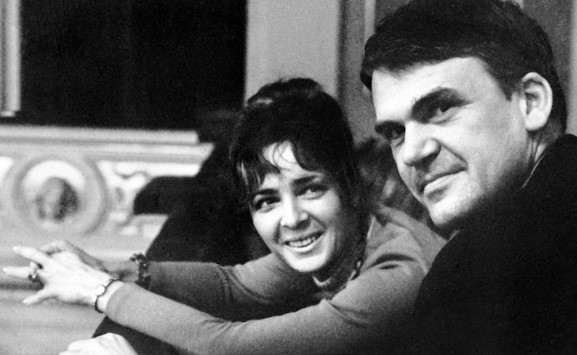
The Unbearable Lightness of Being was released in 1988. It was a remarkable movie that inspired me to read Kundera. From the late 80s and early 90s, he was my favorite author – epitomizing questioning, intelligence, and masculine indulgence with a European flair.
Obituaries from the New York Times and The Economist copied in full:
New York Times
Milan Kundera, Literary Star Who Skewered Communist Rule, Dies at 94
The author of “The Unbearable Lightness of Being,” he was known for sexually charged novels that captured the suffocating absurdity of life in his native Czechoslovakia.
Milan Kundera in 1984, when his novel “The Unbearable Lightness of Being” became an instant success and later the basis of a movie.Credit…Francois Lochon/Gamma-Rapho, via Getty Images
By Daniel Lewis
Milan Kundera, the Communist Party outcast who became a global literary star with mordant, sexually charged novels that captured the suffocating absurdity of life in the workers’ paradise of his native Czechoslovakia, died on Tuesday in Paris. He was 94.
A spokeswoman for Gallimard, Mr. Kundera’s publisher in France, confirmed the death, saying it came “after a prolonged illness.”
Mr. Kundera’s run of popular books began with “The Joke,” which was published to acclaim in 1967, around the time of the Prague Spring, then banned with a vengeance after Soviet-led troops crushed that experiment in “socialism with a human face” a few months later. He completed his final novel, “The Festival of Insignificance” (2015), when he was in his mid-80s and living comfortably in Paris.
“Festival” was his first new fiction since 2000, but its reception, tepid at best, was a far cry from the reaction to his most enduringly popular novel, “The Unbearable Lightness of Being.”
An instant success when it was published in 1984, “Unbearable Lightness” was reprinted over the years in at least two dozen languages. The novel drew even wider attention when it was adapted into a 1988 film starring Daniel Day-Lewis as one of its central characters, Tomas, a Czech surgeon who criticizes the Communist leadership and consequently ends up washing windows for a living.
But washing windows is a pretty good deal for Tomas: A relentless philanderer, he’s always open to meeting new women, including bored housewives. But the sex as well as Tomas himself and the three other main characters — his wife, a seductive painter and the painter’s lover — are there for a larger purpose. In putting the novel on its list of best books of 1984, The New York Times Book Review observed that “this writer’s real business is to find images for the disastrous history of his country in his lifetime.”
“He uses the four pitilessly, setting each pair against the other as opposites in every way, to describe a world in which choice is exhausted and people simply cannot find a way to express their humanity.”
Mr. Kundera could be especially pitiless in his use of female characters — so much so that the British feminist Joan Smith, in her book “Misogynies” (1989), declared that “hostility is the common factor in all Kundera’s writing about women.”
Other critics reckoned that exposing men’s horrible behavior was at least part of his intent. Still, even the stronger women in Mr. Kundera’s books tended to be objectified, and the less fortunate were sometimes victimized in disturbing detail. The narrator of his first novel, “The Joke,” for example, vengefully seduces the wife of an old enemy, slaps her around during sex, then says he doesn’t want her. The woman’s husband doesn’t care; he’s in love with a very cool graduate student. In a final indignity, the distraught woman tries to kill herself with a fistful of pills, which turn out to be laxatives.
Mr. Kundera’s fear that Czech culture could be erased by Stalinism — much as disgraced leaders were airbrushed out of official photos — was at the heart of “The Book of Laughter and Forgetting,” which became available in English in 1979.
It was not exactly what most Western readers would have expected of a “novel”: a sequence of seven stories, told as fiction, autobiography, philosophical speculation and much else. But Mr. Kundera called it a novel nonetheless, and likened it to a set of Beethoven variations.
Writing in The Times Book Review in 1980, John Updike said the book “is brilliant and original, written with a purity and wit that invite us directly in; it is also strange, with a strangeness that locks us out.”
‘The Truth of Uncertainty’
Mr. Kundera had a deep affinity for Central European thinkers and artists — Nietzsche, Kafka, the Viennese novelists Robert Musil and Hermann Broch, the Czech composer Leos Janacek. Like Broch, Mr. Kundera said, he strove to discover “that which the novel alone can discover,” including what he called “the truth of uncertainty.”
Daniel Day-Lewis and Juliette Binoche in a scene from the 1988 movie “The Unbearable Lightness of Being,” an adaptation of the Kundera novel.Credit…Orion, via Getty Images
His books were largely saved from the weight of this heritage by a playfulness that often meant using his own voice to comment on the work in progress. Here is how he begins to invent Tamina, a tragic figure in “The Book of Laughter and Forgetting,” who starts out as a forlorn Czech widow in France and somehow ends up dying at the hands of cruel children in a fairy tale:
I calculate that two or three new fictional characters are baptized here on earth every second. That is why I am always hesitant about joining that vast crowd of John the Baptists. But what can I do? After all, my characters need to have names.
Mr. Kundera told The Paris Review in 1983: “My lifetime ambition has been to unite the utmost seriousness of question with the utmost lightness of form. The combination of a frivolous form and a serious subject immediately unmasks the truth about our dramas (those that occur in our beds as well as those that we play out on the great stage of History) and their awful insignificance. We experience the unbearable lightness of being.”
He acknowledged that the names of his books could easily be swapped around. “Every one of my novels could be entitled ‘The Unbearable Lightness of Being’ or ‘The Joke’ or ‘Laughable Loves,’” he said. “They reflect the small number of themes that obsess me, define me and, unfortunately, restrict me. Beyond these themes, I have nothing else to say or to write.”
Though written in the Czech language, both “The Book of Laughter and Forgetting” and “The Unbearable Lightness of Being” were composed in the clear light of France, where Mr. Kundera resettled in 1975 after giving up hope of political and creative freedom at home.
His decision to emigrate underlined the choices available to the Czech intelligentsia at the time. Thousands left. Among those who stayed and resisted was the playwright Vaclav Havel, who served several prison terms, including one of nearly three years. He survived to help lead the successful Velvet Revolution in 1989, and then served as president, first of Czechoslovakia and then of the Czech Republic after the Slovaks decided to go their own way.
With that great turnabout, Mr. Kundera’s books were legal in his homeland for the first time in 20 years. But there was scant demand for them or sympathy for him there. By one estimate only 10,000 copies of “The Unbearable Lightness of Being” were sold.
Many Czechs saw Mr. Kundera as someone who had abandoned his compatriots and taken the easy way out. And they tended to believe a Czech magazine’s allegation in 2008 that he had been an informer in his student days and had betrayed a Western spy. The agent, Miroslav Dvoracek, served 14 years in prison. Mr. Kundera denied turning him in.
Cast Out of the Party
The rocky history of Mr. Kundera’s first novel, “The Joke,” is a good illustration of the trouble he faced while still trying to promote reform from within.
When the Prague Spring ended, the book was condemned as cynical, erotic and anti-Socialist; and if the reader could somehow adopt the censors’ mind-set, the reader would see their point.
Ludvik, the main narrator of “The Joke,” is a Prague university student in the 1950s who is under suspicion by party members for his perceived individualism. “You smile as though you were thinking to yourself,” he is told. Then he gets a letter from a credulous female friend praising the “healthy atmosphere” at the summer training camp she’s been sent to. Resentful that she should be happy when he is missing her, young Ludvik makes a horrible mistake:
“So I bought a postcard,” he says, “and (to hurt, shock and confuse her) wrote: ‘Optimism is the opium of the people! A healthy atmosphere stinks of stupidity! Long live Trotsky!’”
There is a trial. For his little joke, Ludvik is thrown out of the party and sentenced to work as a coal miner in a military penal unit.
Mr. Kundera in about 1950. As a young man he was twice expelled from the Communist Party, the second time for advocating reform. Credit…Abraham Pisarek/ullstein bild via Getty Images
Mr. Kundera didn’t suffer quite that fate, but he was twice expelled from the party he had supported from age 18, when the Communists seized power in 1948.
His first expulsion, for what he called a trivial remark, was imposed in 1950 and inspired the central plot of “The Joke.” He was nevertheless allowed to continue his studies; he graduated from the Academy of Fine Arts in Prague in 1952 and was then appointed to the faculty there as an instructor in world literature, counting among his students the film director Milos Forman.
Mr. Kundera was reinstated to the Communist Party in 1956 but kicked out again, in 1970, for advocating reform. This time the ejection was forever, effectively erasing him as a person. He was driven from his job and, as he said, “No one had the right to offer me another.”
Over the next several years he picked up money as a jazz musician (he played the piano) and day laborer. Friends sometimes arranged for him to write things under their names or pseudonyms. Which was how he became an astrology columnist.
Mr. Kundera had actually had experience casting horoscopes. So when a magazine editor, whom he identified as R., proposed a weekly astrology feature, he agreed, advising her to “tell the editorial board that the writer would be a brilliant nuclear physicist who did not want his name revealed for fear of being made fun of by his colleagues.”
He even cast a horoscope for R.’s editor in chief, a party hack who would have been disgraced if anyone had known of his superstitious beliefs. R. later reported, he said, that the boss “had begun to guard against the harshness the horoscope warned him about,” that “he was setting great store by the bit of kindness he was capable of” and that “in his often vacant gaze you could recognize the sadness of a man who realizes that the stars merely promise him suffering.”
Mr. Kundera in France in 1979. He settled in Paris in 1975.Credit…Jean-Pierre Couderc/Roger-Viollet
The two of them had a good laugh. Inevitably, though, the authorities would learn the true identity of the brilliant nuclear physicist-astrologer, and Mr. Kundera realized with certainty that there was no way to protect friends who wanted to help him.
In London, the first English translation of “The Joke” had been so botched that it was hard to know what to make of it. Chapters were rearranged or simply omitted. Irony became satire. Isolated in Prague, there was little he could do about it. (Not until 1992 was there an edition that satisfied him. He wrote an author’s note for it that began, “If it didn’t concern me, it would certainly make me laugh: this is the fifth English-language version of ‘The Joke.’”)
In his 1980 Times review, Mr. Updike commented that Mr. Kundera’s struggle “makes the life histories of most American writers look as stolid as the progress of a tomato plant, and it is small wonder that Kundera is able to merge personal and political significances with the ease of a Camus.”
Bred on Music and Books
Milan Kundera was born on April 1, 1929, in Brno, in what is now the Czech Republic, the son of Milada Janosikova and Ludvik Kundera. His father, a noted concert pianist and musicologist, taught him piano, and he considered a career in music before his interests shifted to literature, particularly French.
“From an early age,” he told an interviewer for the literary journal Salmagundi in 1987, “I read Baudelaire, Rimbaud, Apollinaire, Breton, Cocteau, Bataille, Ionesco and admired French surrealism.”
Having grown up in a country occupied by German forces from 1939 to 1945, the young Mr. Kundera was one of many millions who embraced Communism after the war. It was a heady time, with new lists of winners and losers.
“Old injustices were redressed, new injustices were perpetrated,” he wrote in “The Book of Laughter and Forgetting.” “Factories were nationalized, thousands of people went to prison, medical care was free, tobacconists saw their shops confiscated, aged workers vacationed for the first time in expropriated villas, and on our faces we had the smile of happiness.”
Too late, he said, he realized that the evil done in the name of Socialism was not a betrayal of the revolution but rather a poison inherent in it from the beginning.
Mr. Kundera in Paris in 1984. “My lifetime ambition has been to unite the utmost seriousness of question with the utmost lightness of form,” he said. Credit…Francois Lochon/Gamma-Rapho via Getty Images
When Communism ended in 1989, Mr. Kundera, who spoke little about his personal life, had been living in France for 14 years with his wife, Vera Hrabankova, first as a university teacher in Rennes and then in Paris. Czechoslovakia revoked his citizenship in 1979, and he became a French citizen two years later. The Czech Republic restored his citizenship of his homeland in 2019. Information on his survivors was not immediately available.
The last book Mr. Kundera wrote in Czech before switching to French was “Immortality,” in 1990. Beginning there, his later novels were notably less political and more overtly philosophical: “Slowness” (1995), “Identity” (1998) and “Ignorance” (2000).
Of that group, “Immortality,” with bright inventions like the friendship of Hemingway and Goethe when they meet in heaven, was the most favorably received. It enjoyed a few weeks on the Times best-seller list.
With “Slowness,” Mr. Kundera dismayed more than a few readers by supplying no ending and by exceeding the safe limit of first-person discourse: “And I ask myself: Who was dreaming? Who dreamed this story? Who imagined it? She? He? Both of them?” and so on.
Besides the long works of fiction, he had written short stories and a play, “Jacques and His Master.” He was also the author of essays, including several that illuminated his work and that of other writers, collected under the title “The Art of the Novel.”
He was often nominated but not selected for the Nobel Prize in Literature.
Enigmatic and private, and more than a little grumpy about the clatter and clutter of modern Western society, Mr. Kundera was largely out of the public eye from 2000 until the announcement in 2014 that he had created yet another novel, “The Festival of Insignificance,” originally written in French.
Mr. Kundera and his wife, Vera Hrabankova, second from left, in Paris in 2010.Credit…Bertrand Rindoff Petroff/Getty Images
Set in Paris and barely exceeding 100 pages — the critic Michiko Kakutani dismissed it in The Times as “flimsy” — it follows the perambulations of five friends through whom Mr. Kundera considers familiar themes of laughter, practical jokes, despair, sex and death.
“It may be that when Kundera writes about laughter,” she wrote, “he conceives of it not as a subjective expression of appreciation or surprise, the way we usually understand it, but as a material form of aggression, an actual act of self-defense, even a duty.”
As Mr. Kundera himself wrote in “Insignificance”: “We’ve known for a long time that it was no longer possible to overturn this world, nor reshape it, nor head off its dangerous headlong rush. There’s been only one possible resistance: to not take it seriously.”
He had struck a similar note in 1985, on accepting the Jerusalem Prize, one of several honors he received.
“There is a fine Jewish proverb,” he said in his acceptance speech: “Man thinks, God laughs.” And then a fine Kunderian flourish:
“But why does God laugh? Because man thinks, and the truth escapes him. Because the more men think, the more one man’s thought diverges from another’s. And finally, because man is never what he thinks he is.”
The Economist
Milan Kundera believed that truth lay in endless questioning
The Czech novelist, author of “The Unbearable Lightness of Being”, died on July 11th, aged 94
image: getty images
Just before the Prague Spring in 1968, when the Communist regime in Czechoslovakia seemed briefly to relax, Milan Kundera managed to publish a novel about a joke. The joke, sent by a young man to a girlfriend on a postcard, read: “Optimism is the opium of the people! A ‘healthy’ atmosphere stinks of stupidity! Long live Trotsky!” It landed the young man in a lot of trouble.
The novel, his first, sold well. But when later that year Soviet tanks rolled in, forcing his country back into line, “The Joke” disappeared from bookshops. He himself was kicked out of the Communist Party (he had been expelled before, in 1950, for being critical, but had reapplied) and was fired from his lecturer’s job at the Academy of Fine Arts. Since no one was now allowed to employ him, he played dance gigs in the taverns of mining towns. Eventually, though, there was nothing doing in Czechoslovakia, so he and his wife Vera left for France, and stayed.
In retrospect, writing “The Joke” had been a bad decision. But it was good at the time. That was life. You had only one, with no second or third chances to take a different course. His novels were full of characters struggling, like him, to unpick the past, predict the future and, on the basis of that, jump the right way. In the most famous of them, “The Unbearable Lightness of Being”, the protagonist Tomas first appeared standing at a window, ruminating. Should he invite the lovely bartender Tereza to his room, or not? Would he get too involved? If so, how would he get out of it? After spending the night with her, the questions only multiplied.
Tomas, like his creator, made a bad (or good) decision to defy the party. He lost his post as a surgeon and became a window cleaner. He also decided, for good or bad, to stay with Tereza. But all through the novel he had wrestled with his creator’s favourite theme, the weighing of opposites. The Greek philosopher Parmenides had stated, in particular, that lightness was positive and heaviness negative. Lightness was the realm of the soul, space, separateness and freedom; heaviness was to be earth-and-body-bound, rule-bound and constricted. Clear enough.
But not so fast. Lightness also made both history and life insubstantial, airy as a feather, the happenings of a day. It justified betrayal, irresponsibility and breaking ranks (as he from the party), where heaviness stressed duty and obedience. Most important, lightness was about forgetting, and heaviness insisted on remembrance. What was the self, but the sum of memories? In “The Book of Laughter and Forgetting” the heroine, Tamina, clung constantly to the memory of her dead husband even when making love with other men. Was that a good or a bad thing?
The question applied especially to Czechoslovakia, in its highly vulnerable position on the map. How could it survive without remembering its past great men, Hus, Comenius, Janacek, Kafka, or without the language they had spoken? Memory gave it identity, and gave Czechs themselves the only power they had against the states that oppressed them. In 1967 Mr Kundera appealed to fellow-writers to seize the moment with their pens. But he still resisted the thought of enclosing cultures within borders. Borders between ideas were there to be crossed.
In Paris after 1975, living in an attic flat on the rue Récamier, feasting on frogs’ legs and eventually writing a trio of novels in French, it seemed to him that notions of “home” and “roots” might be as illusory as the rest of life. His Czech citizenship had been revoked and, though he still mostly spoke Czech, he was almost indifferent when, in 2019, he got it back. Like Goethe, he saw literature becoming global and himself as a citizen of the world.
He had been one for a long time. His youthful reading was mostly French: Baudelaire and Rimbaud, but especially Rabelais and Diderot. French wit and experiment wonderfully foiled the socialist realism imposed on art and literature by the post-war Soviet regime. He fed it into his writing to defy the kitsch all around him. Sadly, it was kitsch he had fallen for himself when, at 18, he eagerly joined the party: all those heavy, emotional images of wheatsheaves, mothers and babes, hero-workers brandishing spanners, the glowing brotherhood of man. He saw himself as a knife-blade, cutting through the sweetish rose-tinted lies to show the shit—and the mystery—beneath.
Because truth was mysterious. And novels were a wide-open territory of play and hypotheses where he could question the world as a whole: digressively like Sterne in “Tristram Shandy”, or adventurously, like Cervantes’s Don Quixote. No answers, questions only; answers (in advance) were what kitsch provided. He played with philosophical musings, psychological analysis, investigations of misunderstood words, irony, eroticism and dreams. It could make a mish-mash for readers, especially Anglophone ones, and no other novel did as well as “Unbearable Lightness”, though “Laughter and Forgetting” and “Immortality” sold respectably. The Nobel talk came to nothing, and he was glad, because he preferred reclusive delving to any sort of fame.
He liked to call his novels “polyphonic”: a word learned from his father, a concert pianist and musicologist. The many voices, parts and motifs in his work were united by “novelistic counterpoint” into a single music. His chief hero in the enterprise was Janacek, whose photo hung beside his father’s in the Paris flat: a composer who had refused to write by the rules but made directly for the heart of things. He doubted he himself had got anywhere close. Since the world couldn’t be stopped in its headlong rush, it was best just to laugh at it. The devil laughed, because he knew life had no meaning; the angels, as they flew over, laughed too, knowing what the meaning was.
As a child he often sat at the piano playing two chords fortissimo, C minor to F minor, until his father furiously removed him. But as those chords became heavier he felt himself grow lighter until, in a moment of ecstasy, he seemed to float free of time. If that was unbearable lightness, he—and many others—spent an awful lot of their brief, insignificant lives trying to find it again. ■
This article appeared in the Obituary section of the print edition under the headline “When angels laugh”