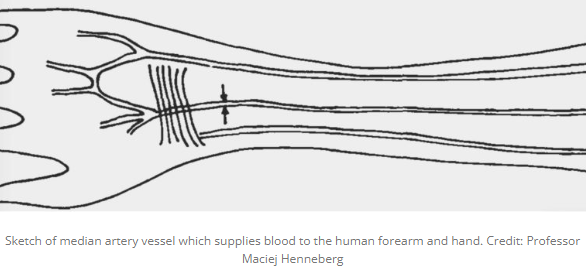
Analysis of the literature showed that the presence of the median artery has been significantly increasing (p = .001) over time, from approximately 10% in people born in the mid-1880s to approximately 30% by the end of the 20th century.
I have covered this is other posts >here< and >here< but give the importance of visualization in weapons training, I thought it useful to revisit the topic.
To my way of thinking, the most effective way to learn the pattern is to ensure the movements have meaning – a contextual purpose.
To understand the purpose of the movements one must first tell the story of each kata in order to visualize how the moves are effective.
Eight Directions – a sword fighting universal
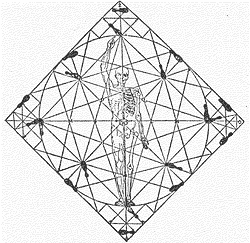
Shihogiri and happogiri are important to learn the foundational footwork and possible avenues of attack. Should you find yourself surrounded with sword wielding opponents, eight is the maximum number that can attack at any given point (and they would need be incredibly synchronized to do so without hitting a friendly).
The image above is to teach European fencing, and note that the eight-directions are a universal. Envision the eight directions as hours on a clock face with you in the center and your nose at 12 o’clock – so someone facing you is at 12 while someone directly behind you is at 6 o’clock. Your right flank is 3 o’clock and your left flank is at 9 o’clock. The basic eight kata ignore the 45-degree angles.
With this orientation language:
Kata
Ashi sabaki
Weapon Action
Opponent Position
#1
step back
cut shomen
first at 12
step in
tsuki
first at 12
withdraw & raise
pivot
cut shomen
second at 6
#2
step forward
cut shomen
first at 12
step in
tsuki
first at 12
withdraw & raise
pivot
cut shomen
second at 6
#3
tenkan
cut up (target wrist)
first at 6
finish turn
cut down
second at 12
step in
tsuki
second at 12
withdraw & raise
pivot
cut shomen
first at 6
#4
draw step
cut up (target wrist)
first at 6
finish turn
cut down
second at 12
step in
tsuki
second at 12
withdraw & raise
pivot
cut shomen
first at 6
#5
move 90-step back
cover & cut
first at 3
step in
tsuki
first at 3
withdraw & raise
pivot
cut shomen
second at 9
#6
step 90 degree forward
cover & cut
first at 3
step in
tsuki
first at 3
withdraw & raise
pivot
cut shomen
second at 9
#7
irimi tenkan (tight)
cover & cut
first at 6
step in
tsuki
first at 6
withdraw & raise
pivot
cut shomen
second at 12
#8
hanmi “booty scoot”
cover & cut
first at 9
step in
tsuki
first at 9
withdraw & raise
pivot
cut shomen
second at 3
Visualizing an opponent (shadow-boxing) when performing the moves should help solidify the movements. You need to be able to see the actions of your invisible opponent that are the stimulus to your response. Practice with the spirit of shinken-shōbu (真剣勝負, lit: win-lose by live sword) because you are training to survive combat to the death. Or, as I phrased it in the earlier post – “Action in dead earnest.” You must put everything you have into your Aikido as if it your life were at stake.
So, the kata should allow you to focus on the principles – good targeting, smooth transitions, and the ability to visualize counters (anticipate the potential responses). The kata, therefore, should coordinate your internal mechanics – integrate mind and body. And the rote repetition to build muscle memory is critical – the movements need be learned deeply because you need to recall the appropriate movement when you need to act in fractions of a second. We cannot think in the moment – it is just too slow. The kata must “think” for us so that we can react appropriately.
The suburi and kata are designed to program your body. First, learn the movements related to the technique or response that you plan to make reflexive. Coordination and familiarity with the movements create the ‘neural map’ that makes it reflexive. As I stated earlier – we must practice and repeat correct motion – mindful practice and quality repetition together with a clear understanding of the right mechanics are imperative. The more you practice and refine the movements involved in the technique, the more easily and quickly you can access them. After many repetitions, your mind will eventually consolidate all the individual motor movements – the points on the path – that comprise the technique into a line of flow. This is when the discrete points become a line of movement.
From there we can begin to add additional stimulus – contact with uke’s sword. The kata contain most of the movements that will become linked together, in synchronic flow. But to take advantage of muscle memory, you must first create an experience that you can remember. If your central nervous system does not have a complete profile on your technique, then you cannot expect the recall to be very smooth or accurate.
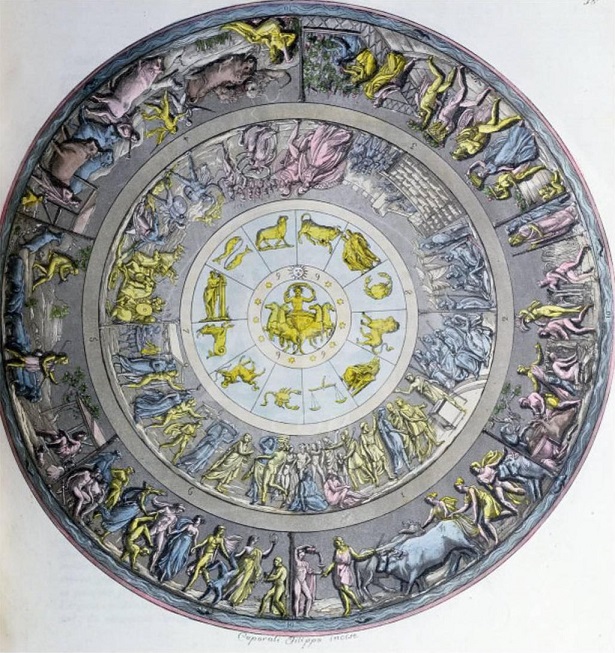
Hector kills Patroclus who is wearing Achilles’ armor. Hector takes the armor as a spoil. Thetis, Achilles’ mother, pleads with Hephaestus to make her son new armor worthy of him to wear when he returns to battle. The smithy god agrees and Homer spends many lines describing the newly forged armor. Each piece is graven with images of the most important aspects of Greek life. On the shield of Achilles, the scene:
Meanwhile the people were gathered in assembly, for there was a quarrel, and two men were wrangling about the blood-money for a man who had been killed, the one saying before the people that he had paid damages in full, and the other that he had not been paid. Each was trying to make his own case good, and the people took sides, each man backing the side that he had taken; but the heralds kept them back, and the elders sate on their seats of stone in a solemn circle, holding the staves which the heralds had put into their hands. Then they rose and each in his turn gave judgement, and there were two talents laid down, to be given to him whose judgement should be deemed the fairest.
The judges weigh the most demanding decision before a court – a capital case where restitution is being adjudicated. But there is a power above the court. The crowd judges the judges. It is a clear answer to the question quis custodiet ipsos custodes? The people themselves are the final tribunal. This resembles jury nullification, the doctrine that the people may decide what is just even when it defies black-letter law. The will of the people, not of the state, is the last arbiter of right.
Against the will of the majority of Americans, the Supreme Court reversed a 50-year precedent (good bye stare decisis) and rejected the conclusions of Roe vs Wade (1973). The conservative court pretended constitutional silence is neutrality, when in truth that silence was written to restrain government power, not to grant it.
The Constitution makes no reference to abortion, and no such right is implicitly protected by any constitutional provision
Justice Samuel Alito writing for the majority
Nonsense.
The Constitution does not enumerate every right because the rights of the people are unlimited.[1] It is not a list of permissions but a fence against power designed to limit governmental powers. The Ninth Amendment preserves that logic: that the absence of an explicit right is not a denial but an affirmation that the people retain all others. When the Court abdicated the question to the states, it violated that principle. No gold talents awarded to this court!
This court has shown its piety [2] more than its principle. The ideal that an individual has the right to be left alone should have been the paramount tenant to uphold.[3] In the Napolitano view, the universality of law must be grounded in natural law, which in the West must always preference individual liberty over collective decree. The Court defended a citizen’s right to self-defense through arms, yet denied the same citizen’s right to self-possession through bodily autonomy. It expanded liberty in one breath and constricted it in the next.
The intersection of the right to bear arms, which ensures the tools for robust self-defense, will have an ugly intersection now that women no longer have the right to control their own bodies.
In 2001 Donohue and Levitt analyzed the data and showed a conclusive correlation between the legalization of abortion and the ensuing drop in crime. In short, because women were allowed to select when and which pregnancies were wanted, the children born were selected and therefore well-raised. Unwanted and neglected children were the future criminals. A very unpopular conclusion drawn from robust data.
They revisited the study in 2019 and found the effect even stronger:
Donohue and Levitt (2001) presented evidence that the legalization of abortion in the early 1970s played an important role in the crime drop of the 1990s. That paper concluded with a strong outof-sample prediction regarding the next two decades: “When a steady state is reached roughly twenty years from now, the impact of abortion will be roughly twice as great as the impact felt so far. Our results suggest that all else equal, legalized abortion will account for persistent declines of 1 percent a year in crime over the next two decades.” Estimating parallel specifications to the original paper, but using the seventeen years of data generated after that paper was written, we find strong support for the prediction. The estimated coefficient on legalized abortion is actually larger in the latter period than it was in the initial dataset in almost all specifications. We estimate that crime fell roughly 20% between 1997 and 2014 due to legalized abortion. The cumulative impact of legalized abortion on crime is roughly 45%, accounting for a very substantial portion of the roughly 50-55% overall decline from the peak of crime in the early 1990s.
With police demoralized and civic trust eroding, violent crime already rises. Now, with state bans on abortion, we have embarked on a new social experiment whose outcome will not be felt for decades and whose unintended consequences may far exceed its moral pretenses.
It appears this Court’s reasoning is an aberration of Justice Scalia’s originalism. I admire Scalia’s intellect, but his positivism, the belief that law must mean only what its text meant at enactment, proves brittle at its moral edges.
Napolitano would answer: And the rights of man mean what they meant before the Constitution was written.
It is unfortunate no one pressed Scalia on the Nuremberg Laws, for by his own reasoning he would have to concede that legality legality can sanctify evil. He warned of judicial overreach, but the present Court has taken his caution as license for retreat. Barrett’s own critique of stare decisis, her willingness to overrule precedent, ruptures Scalia’s originalism. Wiser than both, Napolitano’s reply is absolute: legality without morality is tyranny codified.
Judge Napolitano holds that natural law pre-exists all governments and thus restrains every legislature. The Ninth Amendment is not poetic surplus but the textual witness to that truth.
“Natural law should be a beast on the throat of the legislature.”
The most direct attack against positivism is that a legislature could pass a law that violates natural law (e.g., make murder legal, i.e., the Nuremberg Laws legalizing the state-ordered execution of Jews), there must be an adherence to the fundamental rights of humans. Natural Law theory is the powerful foundation to always posit the rights of the individual over the power of the state. When a statute violates natural rights, it ceases to be law. Dobbs, therefore, is not a constitutional correction but a moral collapse, a Court choosing procedure over principle.
Here we must correct a common confusion. “Rights” are moral boundaries against coercion; “responsibilities” are duties freely undertaken. Health care is not a right to another’s labor. Association is. Speech is not a right to be heard. It is the right to speak without leave. Likewise, bodily autonomy does not grant an entitlement to abortion at public expense, it affirms sovereignty against interference.
The state’s proper role is not to regulate morality but to prevent coercion. Once it regulates “for safety” or “for life,” it assumes the right to define both.
Homer’s trial on Achilles’ shield ends when the crowd affirms the fairest judge. Justice remains answerable to the conscience of free citizens, not to the decrees of their rulers.
The modern Court has inverted that order, placing authority above liberty, text above truth. Napolitano’s lesson is simple:
“The Constitution restrains government, not the people. The ultimate jurisdiction is the human soul.”
When courts forget that, they trade the Republic’s birthright for procedure. The crowd on Achilles’ shield still waits for us to decide which judge speaks for justice, the one who follows the letter, or the one who remembers the spirit. To remember the spirit is not to invent new meanings or breathe modern air into an ancient text. It is to recall that endurance, not elasticity, is the Constitution’s living principle: that liberty is not the product of governance but its limit. The spirit to be remembered is constancy, the recognition that while our tools change, our nature does not.
The framers wrote with the humility of men who knew law cannot create virtue, and with the confidence of men who believed virtue could preserve law. They built a government of constrained power so that the inborn rights of humanity might survive every age. When we mistake the endurance of principle for stagnation, or reinterpret the limits of power as obstacles to progress, we repeat the oldest temptation, to exchange freedom for expertise and conscience for compliance.
The enduring Constitution asks no innovation from its interpreters, only remembrance: that natural rights preexist the state, that government is their servant, and that liberty remains the one foundation that cannot be improved upon.[4]
____________________________
[1] There is an irony to the origin of the Bill of Rights – during the last days of the Constitutional Convention in 1787, George Mason proposed a bill of rights, a list of rights belonging to the people that government could not violate. Roger Sherman posited that the states had their own bills of rights and therefore had no need for a national bill. The convention unanimously rejected Mason’s idea.
When the Constitution was sent to the states for ratification, the (much forgotten) Anti-Federalists were opposed to it and demanded a bill of rights to protect the liberties of the people. The Federalists, argued effectively that a bill was unnecessary: James Wilson argued that a bill of rights was unnecessary because the new national government had limited, enumerated (i.e., specified) powers and had no power to violate liberties in the first place. In Federalist Paper No. 84, Alexander Hamilton warned that a bill of rights could even be dangerous, because defining certain rights vaguely would leave them subject to misinterpretation or violation, where previously no such power had existed. Moreover, some important rights would be left out and therefore endangered. Most importantly, Hamilton argued that “the constitution is itself, in every rational sense, and to every useful purpose, A BILL OF RIGHTS” because of the principle of limited government. (A very deep irony because Hamilton was one of the most powerful advocates for a powerful central government which would indeed expand its power to violate important rights!)
This very public debate resulted in the “conditional amendments” to be included prior to the ratification of the Constitution. The delegates were made to promise to pass a bill of rights after the Constitution had been ratified. Madison opposed even this and thought “the amendments are a blemish” and expressed his concerns to Jefferson (who was in Paris at the time). Jefferson rebutted, “A bill of rights is what the people are entitled to against every government on earth.” Madison waffled on the issue (as he did often when he later came to the presidency). Madison understood that in a republican form of government based on the sovereignty of the people, the majority could act tyrannically by violating the rights of the minority. Madison wrote in Federalist Paper No. 10, that a large republic would have many contending factions that would prevent a majority from violating the rights of minorities. This is precisely where we are now with SCOTUS returning the decision on abortion being pushed to the level of the states.
Despite his prominent role in authoring the Federalist Papers, Madison saw the merits and continuing strength of the Anti-Federalists after the Constitution was ratified. The Anti-Federalists were calling for a second constitutional convention to better limit the powers of the national government and deny it power over taxation and the regulation of commerce (alas, later travesties expanded those very powers!). Madison feared that a second convention would lead to chaos and fought against it. He brokered consensus by reaching out to the opponents and campaigned against James Monroe for a seat in the House of Representatives during which he promised to support a bill of rights, particularly an amendment protecting the liberty of conscience. Finally, Madison wrote President George Washington’s Inaugural Address, which outlined the basis for the principles of liberty and pledges Washington’s personal integrity of character as an additional safeguard as a limitation of executive power (ah, when noblesse oblige meant something!).
A little over a month after Washington’s Address, Madison delivered his speech in favor of a bill of rights: A bill of rights would admit Rhode Island and North Carolina to the Union – both of which had withheld their ratification of the Constitution until a bill of rights was added. Madison asserted the Bill of Rights would “expressly declare the great rights of mankind secured under this constitution.”
Alas, Hamilton proved correct in his concern – in attempting to expressly declare the rights of mankind, important rights are not enumerated and therefore endangered. The proper argument should have been a more strict limitation on the powers of government to restrict individual liberties.
[2] The preference for states rights is the legally defendable reason for the reversal, but the religious underpinning for that decision is clear. The only basis for the denial of a woman’s right to control over her body is the religiously based (albeit science will be invoked) belief in the definition of when sentient life begins. Napolitano outlines his personal belief as a Catholic for the argument against abortion – a clear variance from Rothbard whose belief in the property rights of a mother to eject a trespasser – which is an understandable moral position that differs from his otherwise rabid libertarianism. At least Napolitano is overt in his support for human rights (which clearly starts at the potential of humanity), whereas the current court shows an abysmal lack of clarity even in the religious thought on the rights of the unborn child which must follow from a very restrictive interpretation of the Thomistic tradition. There is a very odd Catholic-heavy tradition informing the anti-abortion crowd that goes against the Protestant ideals of a personal relationship with God and the reading of the Bible.
[3] The Foundation for Economic Education has long-published on the need for individual freedom – the right of free association and privacy is a broad philosophic tradition that has consequential rights drawn from a property right in one’s self which when followed logically would prevent much of the moralizing of both the left and the right that hampers the natural rights of every person.
[4] The phrase “living Constitution” is a twentieth-century invention. It appears nowhere in the debates of 1787 or in the writings of the founders. It first surfaces in Woodrow Wilson’s Constitutional Government in the United States. Its vocabulary reflects the Progressive conviction that society could be managed scientifically, that expertise might replace virtue, and that political forms must evolve with administrative ambition. Wilson’s organic metaphors (the nation as a living organism, the Constitution as its nervous system) served to rationalize a transfer of judgment from citizens to specialists. What had been a charter of limits became an evolving program of improvement. It was a short step from moral persuasion to bureaucratic control.
Both Scalia and Napolitano would have recognized the danger. A Constitution that must be continually “interpreted” to remain relevant is not living but dependent. The vitality of the American order lies in its self-restraint. The framers designed a government that functions precisely because it is difficult to change. It endures because it embodies principles that do not require reinterpretation: natural rights, limited powers, and the sovereignty of the individual.
Napolitano would say that the Constitution gives natural law lawful shape. It translates the pre-political fact of human freedom into procedural form so that government may act without consuming its source. It was never meant to moralize or to perfect the citizen, only to keep power in check so that citizens might perfect themselves. When government assumes the role of moral engineer, liberty becomes an administrative function, dispensed according to expert judgment. The Progressive experiment made that trade: it professionalized virtue and bureaucratized conscience.
Scalia would agree, though his reasoning was textual rather than metaphysical. His fidelity was to the words themselves. He saw in the “living Constitution” the same conceit that animated the Progressive state, the belief that law must adapt to sentiment. Once that premise is accepted, the people no longer govern; they are governed by interpreters. Judicial activism becomes a reflection of bureaucratic paternalism, both claiming necessity, both eroding the fixed meaning that shields liberty from power. To Scalia, stability was not stagnation but respect for the design that makes self-government possible.
The living Constitution is the jurisprudence of the social engineer; the enduring Constitution is the ethic of the free citizen. One treats law as a tool for collective progress, the other as a boundary against collective excess. The first invites regulation in the name of compassion, the second limits power in the name of dignity. The Progressive project blurred the distinction by turning every public good into a public mandate.
Liberty does not require constant reinterpretation, only constant vigilance. A living Constitution changes with its keepers; an enduring one changes its keepers instead. The former trusts the wisdom of administrators, the latter the restraint of citizens. The framers chose the harder path: a framework strong enough to hold, yet open enough for the moral life to flourish within it. Our task is not to modernize that design but to remember why it was built; to preserve freedom from those who would govern too greatly.


 Protective Arts