SIZE MATTERS

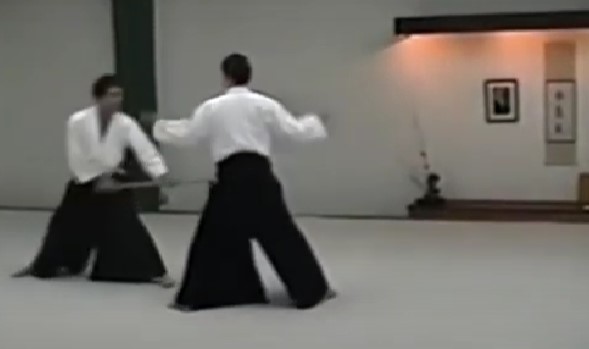
Coaches always look quizzically when they see me approach my boys. The polite ones catch themselves, but inevitably ask, “Where do they get their height?” My boys are both over 6′ and have at least 8″ on me when they stand up straight. At 15, Kyrian is still filling out, but is whip-strong lean from competitive dancing and Adin continues a weight-training regime that increases his 19 years of muscle mass and pushes his bench strength to double my body weight. As the banner photo shows, they tower over me: and I am grateful.

The height-bias is especially pronounced among men, so I am glad my boys are both above average stature.[1] I am a realist and appreciate the reasons why height is universally prized: it remains a good proxy for physical prowess and the ability to provide.

(A fun dead-white-male aside: read John Adam’s letter to Benjamin Rush where he glibly enumerates reasons for George Washington’s prominence, “A tall stature, like the Hebrew sovereign chosen because he was taller by the head than the other Jews.”)

I will sometimes use my boys as training partners when I am working out the specifics of a technique or trying a variation. It is a sobering experience, for despite their knowledge deficit, often my application fails; decades of training dashed against the irrefutable reality of strength and size.

There were early indications. Both Scott Schanaker and Bob Topping were easily able to escape pins and “immobilizations” were effective only if they were unwilling to ignore the pain. I vividly remember both Yoko and I simultaneously trying to pin Scott with ikkyo, only to have him free his arm with relative ease, and Bob Topping grabbing me ushiro ryotedori only to have him simply lift me off the ground.

As much as I wish it were otherwise, traditional martial arts place (market) an exaggerated faith in empty-handed technique. Combat red in tooth and claw is most often determined by size and strength. Weight classes and gender divisions exist to address the reality of the advantage those characteristics provide.[2]

Of course there are outliers – statistical and historical anomalies who defy the odds – but size is determinative in combat.

Except when weapons are involved.

“God made men, but Sam Colt made them equal,” is an easy quip but it speaks hard truth. As I covered in Size Equals Disparity of Force, the reason David prevails against Goliath is because David used a projectile weapon.

_________________________

[1] The bias against short men is so pronounced that some will endure an expensive and painful leg lengthening surgery to compensate.

[2] John McEnroe was unapologetic in his assertion that Serena Williams would have a hard time breaking the top 1,000 best male tennis player despite her dominance among women players. Of course he was lambasted and the pundits all claim that to “qualify her greatness” as merely the “best female” is misogyny. That is Orwellian double-plus good language which places gender politics above facts (facts that Serena acknowledged on David Letterman years earlier in 2003).
CAMMING ACTION

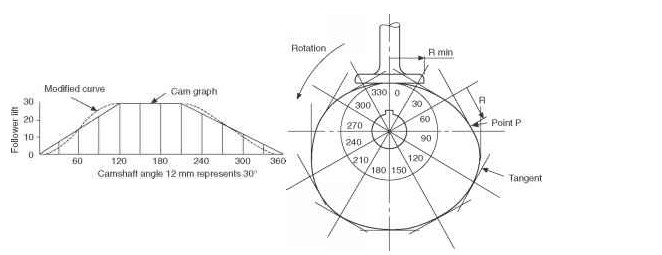
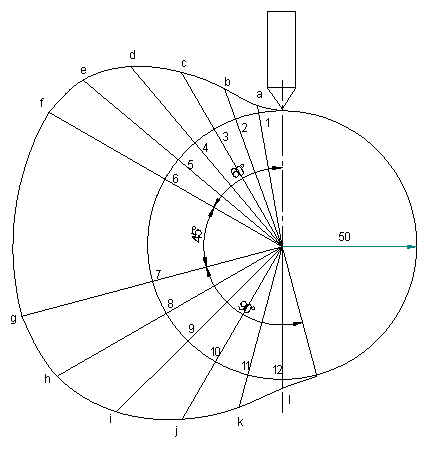
The banner image shows a cam with a flat follower. Cams are used to convert rotary to linear motion. As the cam rotates, the follower rises and falls:

Follower on top with the range of motion mapped based on the rotation of the cam

Abrupt changes in the cam’s velocity results in large accelerations and cause the follower to jerk or chatter. In operating machinery, that is not a good thing, but in a martial art context, that is precisely what we want to achieve: a destabilizing reaction in uke.

The easiest example is found in “blocking” actions. I use quotation marks to emphasize the simplistic use of the concept. Blocking is often understood to mean “stopping an action or absorbing a force.”

Not recommended…

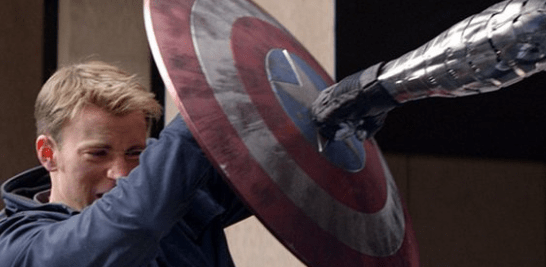
Absorbing a force directly is punishing because the force isn’t dissipated – the physics remains an inelastic collision. Captain America has a Vibranium shield as well as super-human strength and durability – the rest of us have to use technique and demonstrate a better understanding of physics when fending off violent attacks.

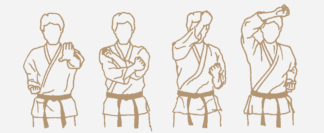
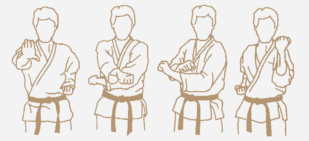
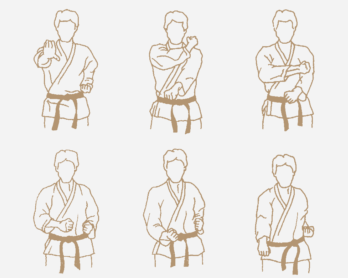
Consider the traditional blocks in karate – high / middle / low line:

Jodan uke
Chudan uke
Gedan uke

As the images show, the forearm is not used as a flat shield. Rather at the moment the attack is intercepted, nage rotates their forearm – camming it – to deflect and redirect the lineal attack. Properly understood, a block is never just a stopping action, but always incorporates a redirect of incoming energy. The redirect of the assailant’s energy is used to gain positional advantage.

Sifu David Harris demonstrated the concept back in 1993 at James Keating‘s dojo.

Follow from drill to concept to application (bunkai)

The drill and application should look familiar – do you see irimi nage? Because irimi nage often is presented from shomen uchi’s descending arc rather than jo dan tsuki’s line the similarity may not be immediately obvious. Once you recall that all lines can be points, and points can be lines, I hope the similarity will manifest. The key take away should be that the camming action off the initial contact creates the redirect, which affords the opportunity to execute the throw (technique).

I alluded to the importance of camming when I stated that ikkyo is makiotoshi. In that post I focused on the similarity in sword-play, but the action is more pronounced when using the (short staff).

With the every receiving contact should be executed with an outward camming action to help dissipate the energy from the collision. The returning action, makiotoshi, reverses that winding action so that the camming is inward (tension -> release). These actions are subtle but critically important (and are often not readily apparent and often not highlighted during presentations).

In a similar manner, the non-grabbed shoulder/arm used in kata or katatae-dori should also have an inward camming action rather than a simple draw-pull in order to create a complex (two vector) response to uke’s linear attack.

Lines are solved by circles.

______________________

Unless you are as proficient as Master Ken and can meet lines with lines.

Study Ameri-Do-Te – Best of All, Worst of None

JO TORI

The  杖 (“wooden staff”) is a walking stick usually about four feet in length. It is unclear precisely how it became incorporated within Aikido. While some of the  movements come from spear-fighting (yarijutsu 槍術), and others from staff-fighting (jō-jutsu 杖術 and bō-jutsu 棒術), many of them are most similar to the use of a bayonet (jūken-jutsu).

tori is taking the from an armed opponent and perfectly reflects the use of a rifle with bayonet: uke’s attack is uniformly tsuki (thrusting with the point).

Mulligan sensei‘s demonstration illustrates the kihon set up and responses. The first part of the video is nage with Asako. The tori with Alex Levens starts at 0:34.

Mulligan Sensei 2010 Kagamibiraki

Table summary of the five basic responses (techniques).

TIMERELATIONRESPONSE
0:34outsidekokyu nage
0:39insidecounter tsuki
0:44outsideikkyo
0:49insideikkyo
0:55outsideshiho nage ura
1:02outsideshiho nage ura (repeat)
1:08insideshiho nage omote
1:15outsideikkyo (repeat)
1:22outsideatemi juji garami (cross over)
time stamps

We have covered all these responses in class. Note that Mulligan sensei does not demonstrate the inside variant of the last technique (juji garami).

Remember that nage is weapon retention and tori is weapon taking, but many of the movements are essentially the same.

In class we explored an expanded response matrix.

RESPONSERELATIONCOMMENTARY
kokyu nage (1st)outsideatemi (shoken) – both hands knuckle up/nails down. Ura-tenkan movement – throw with perpendicular (bar bell)
kokyu nage (2nd)outsideatemi (shoken) – both hands knuckle up/nails down. Ura-tenkan movement – throw with parallel (requires extending forward to impel uke)
koshi nageinsidecognate to kokyu nageatemi (tegakana to face) – both hands knuckle up/nails down. Tenkan movement (not demonstrated in class)
ikkyooutsidefront hand active first – step 90-degree back to avoid thrust – front hand knuckles up, second hand follows – stay outside line
ikkyoinsidefront hand active first – step 90-degree back to avoid thrust – front hand knuckles up, second hand follows – stay inside line
shiho nageoutsidestart like kokyu nage – keep turning
shiho nageinsideomote form
juji nageinsideatemi tegatana – front hand nails up/knuckles down – back hand nails down – uke’s front hand is fulcrum – move to outside (front hand like soto kaiten)
juji nageoutsideatemi – front hand nails up/knuckles down – back hand nails down – uke’s front hand is fulcrum – move to inside
kokyu ho [1]outsidethree-beat: front hand strike, replace with back hand control of uke’s front hand, then nage’s front hand opens cross body while back hand levers opposite vector
irimi nageinsidecognate to kokyu ho – front hand palm strike to chin – back hand rip opposite vector while advancing irimi
ude kimeoutsideatemi (shoken) – front hand grabs nails up/knuckles down, then cams (rotates) over and cross-body irimi to lever uke’s elbow (best done as explosive entry)
Expanded Options

Because the is a lever make sure to use mechanical advantage! Make sure you know whose hand is acting as the fulcrum in every encounter (sometimes it is uke’s and other times it is nage’s hand).

General note on atemi

The inside line dictates a strike to uke’s highline with the tegatana (shyuto) or alternatively a palm strike.

The outside line exposes uke’s ribs and armpit, which requires a “standard” punch to the ribs or a middle knuckle (shoken) punch to the armpit.

[1] Parallels to other arts

Kokyu-ho is an “internal” breath throw in Aikido that teaches (and relies upon) abdominal muscles and hip rotation as its primary driver. In tori, the low-line (leg) should be used and the “life-giving” palm up presentation of the top (throwing) arm opens cross body. This is not the most martial presentation. Okinawan karate provides a more direct application from the Bubishi, with the shyuto: shyuto ashi harai. This use of shyuto no kamae is preserved in kushanku – with a bunkai as an augmented take down.

31a

Use your front hand to parry opponent hand attack and seize it with your rear hand. Simultaneously strike the opponent’s face with your shyuto and sweep his leg with your thigh (Crane opens its wings).