War on Excellence

My oldest boy goes to college this September, he will be a freshman at the University of Oregon. He was not excited. He would rather bypass the next four years, just get a job and start earning. I am empathetic. But I also know college remains a critical rite of passage to show on the resume in order to keep future employment opportunities open.

We drove down for a tour to get him re-familiarized with the campus where he had played in both soccer and basketball tournaments and summer camps previously. On the drive down, I had a call with a contractor who joked, “Well after his freshman year he will come back woke!” That is a concern.

From what I can see most college campuses are filled with self-indulgent, professionally aggrieved professors who cannot make it in the real world and pontificate from their tenured pulpits while insidiously propagating bankrupt normative values. I don’t fear that my son will be infected, but rather that his classical liberalism will run him afoul of professors steeped in post-modern moral certainty.
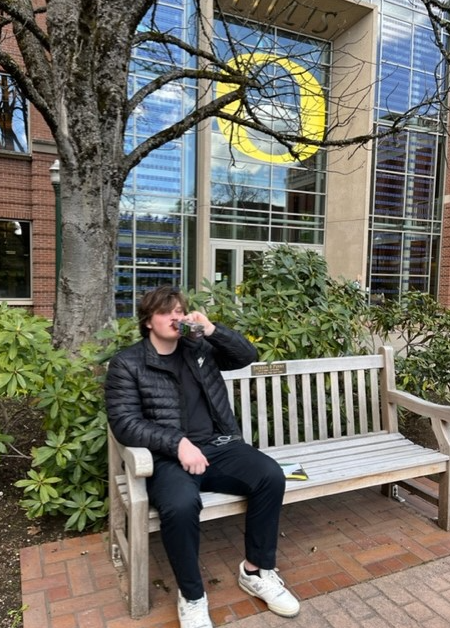
Outside Lundquist

He plans to major in business, so perhaps he will not be as much at risk, and I am projecting my PTSD from having survived Reed. What frightens me is that my decades-old exposure was mild: the British school of anthropology (Firth, Evans-Pritchard, Leach) still set the methodological tone, and Bourdieu still had rigor despite his ideological predilections, and the British school of anthropology was still the basis for most inquiries. Foucault was not taught formally, but he was referenced too often to not read. And I admit, I found him mesmerizing, not for his conclusions on power relationships but because of his prose and footnotes. Of course, we now know that most of Foucault’s research was as valid as Nabokov’s in Pale Fire. I should have just stayed with reading Nabokov…

I subscribe to Inside Higher Ed to stay informed. Regrettably, it shows a persistent Marxist post-modern ideological bent at far too many colleges and universities, and worse, there is a general war on excellence. The shorthand label is a woke agenda.

The opening remarks at the University of Oregon orientation stated with an apologetic acknowledgement of the displacement of the Kalapuya people from their traditional homeland.
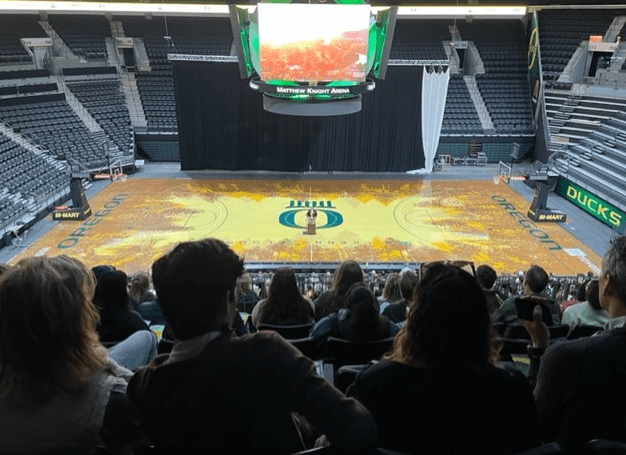
Another 1,300 potential victims of indoctrination

A good reminder of local history. While indigenous peoples should be respected and acknowledged, I grimace at the apologetic tone. It seemed shrill and forced when delivered by the Anointed.[1] I wonder if Europe is as woke on the subject given the Age of Revolution?

Who apologizes to whom? Does Greece apologize for Alexander, or is that Macedonia only, or the Ottomans to them both?

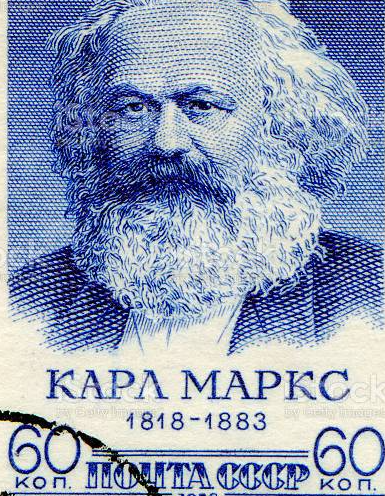
One could hope that current global events could wake us to reality. For instance – Russia invading Ukraine has had an interesting casualty: Karl Marx. The University of Florida announced in March 2022:

Given current events in Ukraine and elsewhere in the world, we have removed the name of Karl Marx that was placed on a group study room at the University of Florida in 2014 …To many people around the world, the Russian invasion of Ukraine invokes strong and painful memories of Soviet domination and oppression, which had an indisputable link to Marxist ideology.

Inside Higher Ed

I am conflicted by this. I fully agree that Marxist ideology is the root cause. I do not however support the cancel-culture mindset which is the basis for re-naming the room. It should never have been named thus in the first place! Marx needs to be taught for the same reason Hitler’s domination of Germany must be: so that we never forget how ideology can be weaponized with catastrophic impact on human lives.
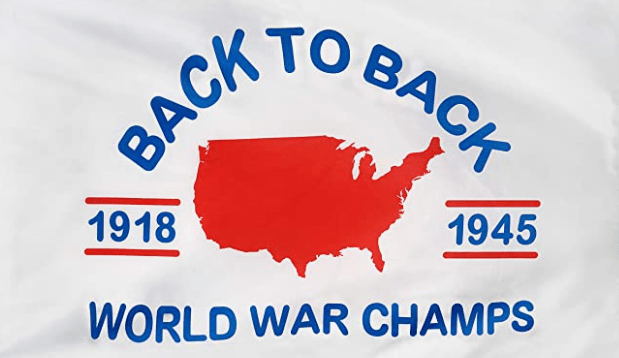
Purchased as dorm room decor

My son’s flag is tongue in cheek pride, but its deeper lesson is a reminder that the West has always had to fight against the tyranny of ideologues. I see little difference between Xerxes, Hitler, Mao, Pol Pot, Xi, or Trump.

The all-too-common milquetoast professor needs to remember that human nature is pernicious and constant. Therefore there will always be conflict and that will result in winners and losers.

I loathe the current focus on DEI. It is group think re-education. The University of Illinois, among others, now requires a DEI statement as part of tenure review. We are all being taught to be nice rather than good. People want equality more than excellence. A preference the Greeks would have recognized as the beginning of decline.

The examples only grow:

Really, focus on student success with a welcoming syllabus, rather than one which is designed to create critical thinkers who are challenged to aspire to excellence?

The continued war on excellence.

The deep irony in mandating diversity and inclusivity is the forced homogenization – by focusing on the “truth” and “importance” of every individual, distinctiveness dies. We are overwhelmed by the specificity of details and thus become blind to them – every tree becomes a forest. We are in the age of average precisely because everything is unique. Everyone is a snowflake. The ancients would have called this inversion hubris, the sin of mistaking sameness for virtue.

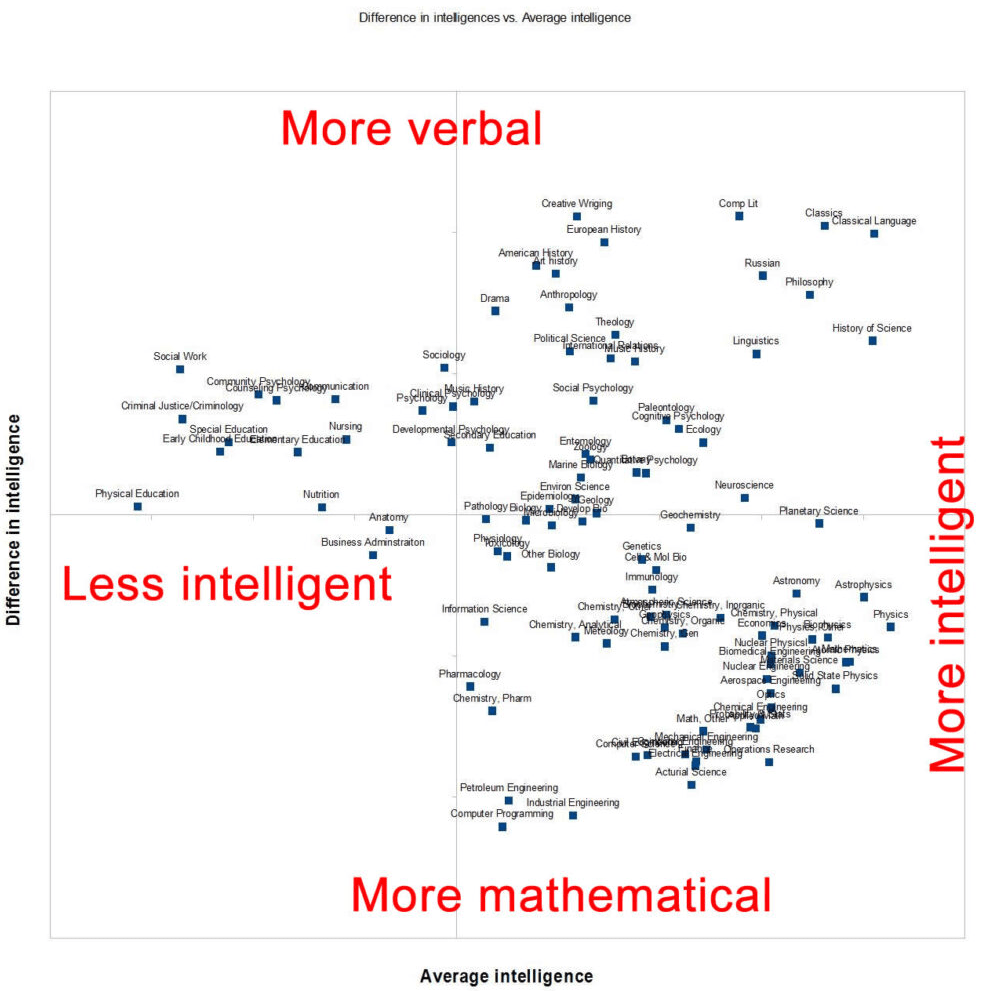
Academia. Those who can’t do, teach and those who can’t teach, teach physical education.
____________________________

[1] Thomas Sowell on the anointed, from 1995, well before the active woke narrative, so you are seeing the intellectual origins of the current dialog. But this ideological war has been with us far longer.
Game Theory

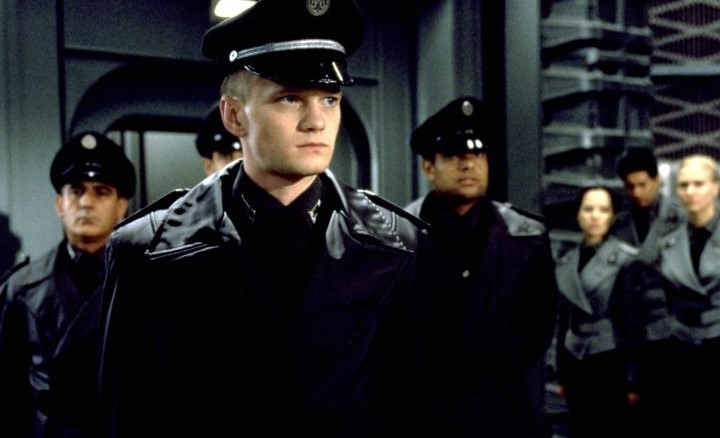
Neil Patrick Harris portrays Carl Jenkins (featured in the banner image) in Starship Troopers (1997). Carl Jenkins demonstrates both a high mathematical intelligence as well as psychic-abilities which, when he signs up for Federal Service, lands him in Games and Theory: military intelligence (replete with SS-styled uniforms).

When I saw the Reading List and Final Exam for Games and Strategy used by Thomas Schelling in 1963. I grabbed it and copied it in full for ease of reference and added the links to the source papers. Coursework for Games and Theory!

Thomas Schelling joined Harvard Economics in 1958 and taught the undergraduate course “Games and Strategy” nine times during the 1960s. Below is the syllabus and final exam from the first term of the 1963–64 academic year.

Related materials from his “Economics and National Security” that he taught in 1960 and from his 1970 course “Conflict, Coalition and Strategy” have been transcribed and posted earlier at Economics in the Rear-view Mirror.

________________________

Course Announcement

Economics 135. Games and Strategy

Half course (fall term). M., W., F., at 10. Professor Schelling

Theories and experimental studies of rational decision in conflict, collusion, coalition, bargaining, collective decision, arbitration, and uncertainty.

SourceOfficial Register of Harvard University. Vol. LX, No. 21 (September 4, 1963): Faculty of Arts and Sciences. Courses of Instruction for Harvard and Radcliffe 1963-1964, p. 103.

________________________

Economics 135
Games and Strategy
Fall, 1963

Reading Assignments

PART I. COPING WITH AN INTELLIGENT ADVERSARY

  1. Rapoport, Anatol: Fights, Games and Debates, Chapters 7, 8, 9; pages 130-165. (35 pages)
  2. Williams, John D.: The Compleat Strategyst, Chapters 1, 2; pages 1-85, and Chapter 3, pages 86-91 then scan rest of chapter. (91 pages)
  3. Hitch, Charles J. and McKean, Roland: The Economics Defense in the Nuclear Age, Chapter 10, “Incommensurables, Uncertainty, and the Enemy,” pages 182-205. (23 pages)
  4. Read, Thornton: “Strategy for Active Defense,” Papers and Proceedings of the AEA, American Economic Review, Vol. 51, No. 2, May 1961, pp. 465-471.
  5. Alchian, Armen A.: “The Meaning of Utility Measurement,” American Economic Review, Vol. 43 (March 1953) pages 26-50. (25 pages)

(OPTIONAL: R. Duncan Luce and Howard Raiffa, Games and Decisions, Chapters 1-4, pp. 1-87.)

PART II. COERCION AND DETERRENCE

  1. Schelling, Strategy of Conflict, Chapters 1, 2, 5, 7, 8; pages 3-52, 117-161, 175-203. (121 pages)
  2. Ellsberg, Daniel: “The Theory and Practice of Blackmail,” (38 pages) mimeograph
  3. Schelling: “The Threat of Violence in International Affairs,” Proceedings, 57th Annual Meeting, American Society International Law. (INT. 16.8)
  4. Stevens, Carl M.: Strategy and Collective Bargaining Negotiation, chapters 3 and 5, pages 27-56 and 77-96. New York: McGraw Hill, 1963.

PART III. MUTUAL RESTRAINT

  1. Kenneth: Conflict and Defense, Chapters 1, 2, 6, pp. 1-40, 105-122. (58 pages)
  2. Schelling: Chapters 3, 4, 9, 10; Appendix A; pages 53-118, 207-254, 257-266. (121 pages)
  3. Cassady, Ralph, Jr.: “Taxicab Rate War,” Journal of Conflict Resolution, Vol. 1, pages 364-8 (December, 1957). (5 pages)
  4. Valvanis, Stephan: “The Resolution of Conflict When Utilities Interact,” Journal of Conflict Resolution, Vol. 2 (June 1958) pages 156-69. (13 pages)
  5. Rapoport, Chapter 10, pp. 166-79 (14 pages)
  6. Boulding, Chapters 12, 13, pp. 227-73.
  7. Schelling: “War Without Pain and Other Models,” World Politics, XV, (April, 1963) pp. 465-487.

PART IV. COLLECTIVE DECISION AND ARBITRATION

  1. Farguharson, Robin: “Sincerity and Strategy in Voting,” mimeograph (February 5, 1955) (7 pages)
  2. Black, Duncan: “On the Rationale of Group Decision Making,” Journal of Political Economy, Vol. 56 (February, 1948), pages 23-34 (12 pages)
  3. Steinhaus, Hugo: “The Problem of Fair Division,” Econometrica, Vol. 16 (January, 1948), pages 101-109. (9 pages)
  4. Dahl, Robert A.: A Preface to Democratic Theory, Chapter 2, pages 34-60, with special attention to notes 9 and 12, pages 42-43 and 43-44. (26 pages)
  5. Rapoport, Chapter 11, pp. 180-194. (15 pages)
  6. Rapoport, Chapter 12, pages 195-212. (17 pages)

PART V. EXPERIMENTAL GAMES

  1. Flood, Merrill M.: “Some Experimental Games,” Management Science, Vol. 5 (October, 1958) pages 5-26. (22 pages)
  2. Kaplan, Burns, and Quandt: “Theoretical Analysis of the Balance of Power,” Behavioral Science, Vol. 5 (July, 1960), pages 240-52. (12 pages)
  3. Schelling: Chapter 6, pages 162-72. (11 pages)
  4. Rapoport: Chapter 13, pages 213-25. (12 pages)

READING PERIOD

  1. Burns, Arthur L.: “A Graphical Approach to some Problems of the Arms Race,” Journal of Conflict Resolution, Vol. 3, pages 326-42. (16 pages)
  2. Thibaut, John W. and Kelley, Harold H.: The Social Psychology of Groups, Chapter 7, pages 100-125. (26 pages)
  3. Goffman, Irving: “On Face-Work,” Psychiatry: Journal for the Study of Interpersonal Processes, Vol. 18 (August 1955), pp. 213-31.
  4. Twain, Mark, “The Man that Corrupted Hadleyburg,” in The Complete Short Stories of Mark Twain.

Source: Harvard University Archives. Syllabi, course outlines and reading lists in Economics, 1895-2003. Box 8, Folder “Economics, 1963-64”.

We won the Cold War – listen to the results

Sleep

The proliferation of wearable technology to grab biometric information should prove beneficial, if it is allowed to do so:

Wearable technology promises to revolutionise health care

Do not let bureaucracy delay matters

The Economist, May 5, 2022

I am optimistic for the future of health care when technology allows for the treatment of individuals and not the theoretical, average human. Because of how drug trials must be conducted on sample groups, most drugs work in just 30-50% of patients. There is a promise that individual regimes are more effective than the one-size-fits-all kind. When doctors can see into a patient’s body in real time all the time, they can provide better care or even respond in remotely (defibrillators).[1]

I prefer to wear mechanical watches (sorry Apple), so I purchased an Oura ring to start tracking my data (Covid-inspired hypochondria?).

The Oura ring fitbits my activity level and delves my sleep cycle. It gives me all the variables; total hours asleep, REM time, deep sleep, body temperature, etc., more data than I know how to use. The data show me two primary conclusions about my sleep habits, (1) alcohol really does impair sleep health and (2) I never get sufficient deep sleep. The ring app reassures me that the amount of deep sleep erodes with age, but I suspect I should really get more – and despite the data the ring provides, I haven’t been able to improve my numbers.

Medical websites extol the importance of sleep and assure me (as does my ring) that good sleep is critical to maintaining good health. But then I remembered the odd Victorian habit of “second sleep.”

The myth of the eight-hour sleep

BBC, February 22, 2012

Prof. Roger Ekirch’s At Day’s Close (2006), is the definitive study on historical sleep habits. His work shows that during the pre-industrial era, people slept in two installments (biphasic sleep). He argues that from time immemorial to the nineteenth century, the dominant pattern of sleep in Western societies was biphasic, when most individuals retired between 9 and 10 pm, slept for three to four hours during their “first sleep,” awakened after midnight for an hour or so, during which individuals conducted normal “daytime” activities before taking a “second sleep,” roughly until dawn. As electric lights came into widespread use and illuminated the night, this pattern changed. People now worked and recreated even after the sun retired because of artificial light and therefore went to sleep much later, resulting in the “new normal” – sleeping in a continued stretch till morning. (Craig Koslofsky’s Evening’s Empire (2011) is also recommended.) Ekrich finds evidence of biphasic sleep in the Odyssey, Aeneid, Thucydides and Livy. (Time to re-read them with a more discerning eye!)

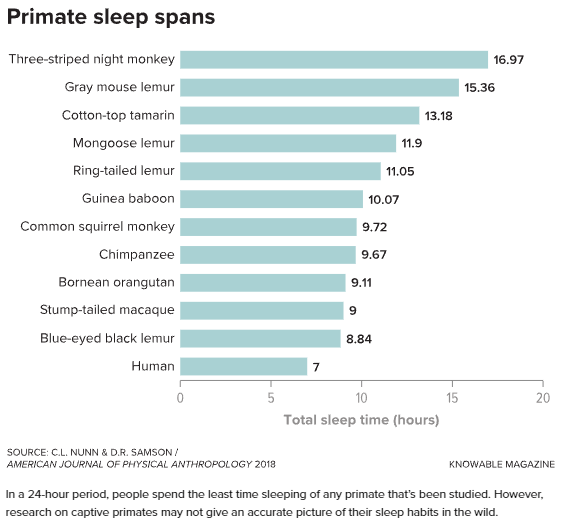
Controlled studies and ethnographic evidence suggest that biphasic sleep is the norm for humans in an environment without artificial light. From a physiological perspective, sleep is vital for regenerative health and optimal physical and cognitive performance. Evolutionarily then, the “natural” human sleep pattern is paradoxical. Humans sleep the least of all primates. And despite the advantages of monolithic sleep, comparative data sets from small-scale societies show that the phasing of the human pattern of sleep–wake activity is highly variable and characterized by significant nighttime activity. To reconcile these phenomena David Samson (2021) postulated the social sleep hypothesis wherein he proposes that extant traits of human sleep emerged because of social and technological niche construction. Specifically, as early humans started sleeping on the ground (terrestrially) rather than in the relative safety of trees, they were subject to more predatory threats. The biological adaptation was to shorten the cycle but increase the quality (more REM sleep). “Short, highquality, and flexibly timed sleep likely originated as a response to predation risks [and] may have been a necessary preadaptation for migration out of Africa and for survival in ecological niches that penetrate latitudes with the greatest seasonal variation in light and temperature on the planet.”

As a species, regardless of how we accomplish it, the total amount of sleep humans get on average isn’t very much.

Samson’s work expands upon that of Isabella Capellini, et alia, their 2008 publication – with the insomnia curing title, Phylogenetic Analysis of the Ecology and Evolution of Mammalian Sleep, wherein they conclude:

In terms of predation risk, both REM and NREM sleep quotas are reduced when animals sleep in more exposed sites, whereas species that sleep socially sleep less. Together with the fact that REM and NREM sleep quotas correlate strongly with each other, these results suggest that variation in sleep primarily reflects ecological constraints acting on total sleep time, rather than the independent responses of each sleep state to specific selection pressures. We propose that, within this ecological framework, interspecific variation in sleep duration might be compensated by variation in the physiological intensity of sleep.

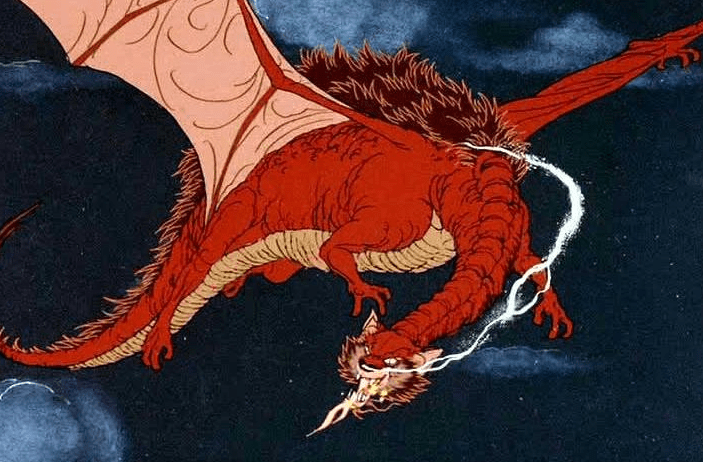
The evolutionary impact on human sleep patterns is intriguing to me. I recall Jordan Peterson commenting on the perdurable image of a dragon. Dragons incorporate the most powerful aspects of those animals that predated on our primordial ancestors: birds of prey, snakes, and feral cats.

In his talk, Peterson forgot the name of scholar who postulated the theory, but the reference is to An Instinct For Dragons (2002) by David Jones. His basic premise is that millions of years ago, our ancestors lived and slept in trees. The relative safety of trees limited predation to birds of prey. As our ancestors transitioned out of the trees to live on the ground, the pool of predators increased to include snakes and lions. Jones’s work also uses the widespread fossil records may also have incited the fear of large reptilian threats (on that see Adrienne Mayor’s work, specifically Flying Snakes and Griffin Claws, and Other Classical Myths, Historical Oddities, and Scientific Curiosities. Princeton University Press, 2022).

Increased threats leading to shorter and communal sleep patterns as a survival strategy is obvious to warriors who divide darkness into watches:

Old English wæccan “keep watch, be awake,” from Proto-Germanic *wakjan, from PIE root *weg- “to be strong, be lively.” Essentially the same word as Old English wacian “be or remain awake” (see wake (v.)); perhaps a Northumbrian form of it. Meaning “be vigilant” is from c. 1200. That of “to guard (someone or some place), stand guard” is late 14c. Sense of “to observe, keep under observance” is mid-15c. Related: Watchedwatching

The Hebrews divided the night into three watches, the Greeks usually into four (sometimes five), the Romans (followed by the Jews in New Testament times) into four.

Oxford English Dictionary

Good sleep defined as surviving the night –

Melisandre speaks the truth

_________________________

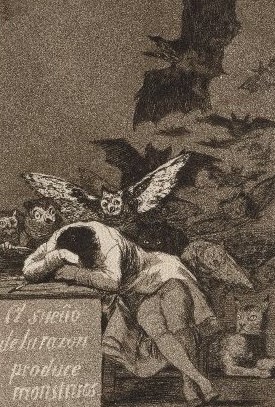
The leading image is from Goya’s “The Sleep of Reason Produces Monsters” (El sueño de la razon produce monstruos) circa 1797. It was one in a series of prints, Los Caprichos (whims, follies), published in 1799 as a condemnation of the foolishness in the Spanish society in which he lived. We need another Francisco Goya to depict the foolishness all too prevalent in America today.

_________________________

[1] The wearable technology will quickly become implanted and powered by glucose powered electricity.