Progressive video repository to track student progress for testing. Thank you Jerry Michalski for the technical guidance!
____________________________
Instructions:
Download your video so you can see the file. Go to studio.youtube.com and click Create (upper right). Pick your video and upload it, then name it and in one of the steps you’ll see a radio button to mark it as Unlisted. Do that.
Then, in the video’s Description field add time stamp markers.
The first line of your “chapters” marks must begin with 0:00 and some text.
Then keep adding time stamps and your comments.
YouTube magically reads them and adds them to the video timeline.
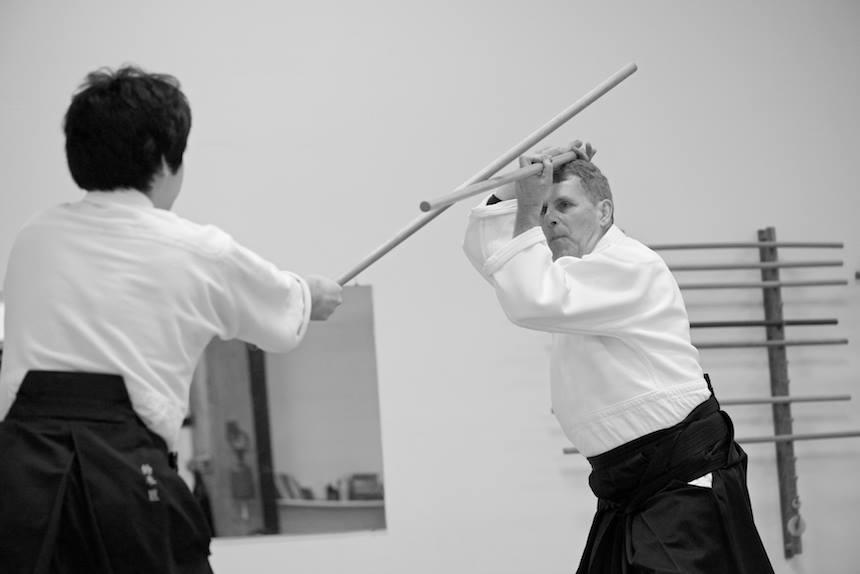
Jō Nage is using the jō to throw an opponent. But it is not an offensive technique. Throwing with a jō is weapon retention. Furthermore, I have shown that the use of the jō in Aikido is more closely related to bayonet than it is to staff work.
Because weapon work demands familiarity with the weapon being used, we covered basic dexterity drills.
To warm up and develop wrist flexibility and strength we performed the basic figure-eight flourish – twirling the jō in a horizontal “infinity” symbol. Starting one-handed, left, right, then transitioning to link the hands by dropping the spinning jō into the waiting open-hand.
I then demonstrated the one-handed vertical figure-eight starting with the thumb-up grasp and the jō placed perpendicular to the ground. The bunkai is to use the bottom of the jō as an overhand strike to uke’s head. To effect the strike the jō is “whipped” up and over – and because there is no contact with a target – momentum caries the jō through the arc and forces nage to perform another back hand strike. This too is a wrist warm-up and strength building exercise. It teaches your body to effect the vertical figure-eight in addition to the horizontal.
This use of the spinning jō is a potential shielding action.[1]
The basic warm-ups complete, we then performed chudan tsuki and junte tsuki.
From there I presented the 8-Count Kumijo to reinforce the foundational coordinated movements with the jō in a paired exercise and to help develop a better understanding of maai (spacing).
The jōnage techniques broader than the class outline, but especially for test-demonstration purposes, focus of the following six which are done sequentially. Mulligan sensei demonstrates the pattern with Asako. (Jō–tori follows with Alex Levens as uke.)
Mulligan Sensei 2010 Kagamibiraki
The matrix:
Time
Order
Nage
Uke
Hanmi
Throw
0:06
1
Chudan tsuki
grab jō
Left
Tsuki – counter tsuki
0:09
2
switch hands
grab jō
Right
Sweep the leg
0:10
3
switch hands
grab jō
Left
Hockey check
0:15
4
switch hands
grab jō
Right
Flowing shihonage
0:18
5
switch hands
grab jō
Left
Shihonage omote
0:22
6
switch hands
grab jō
Right
Nikkyo – wrist lock
0:25
7
lever roll uke
prone
Slip to arm bar pin
Kuden explications and presentations of bunkai applications are best covered live in the dojo – see you there!
___________________
Variations
Gonzalez sensei provides context to empty hands and the Tissier sensei variations
___________________
[1] A related concept to consider is the florette. Watch and listen to Master Keating‘s demonstration to further your understanding on “linking transitions.” It should augment your conceptualization of the jō.

 Protective Arts