The Moth Invades

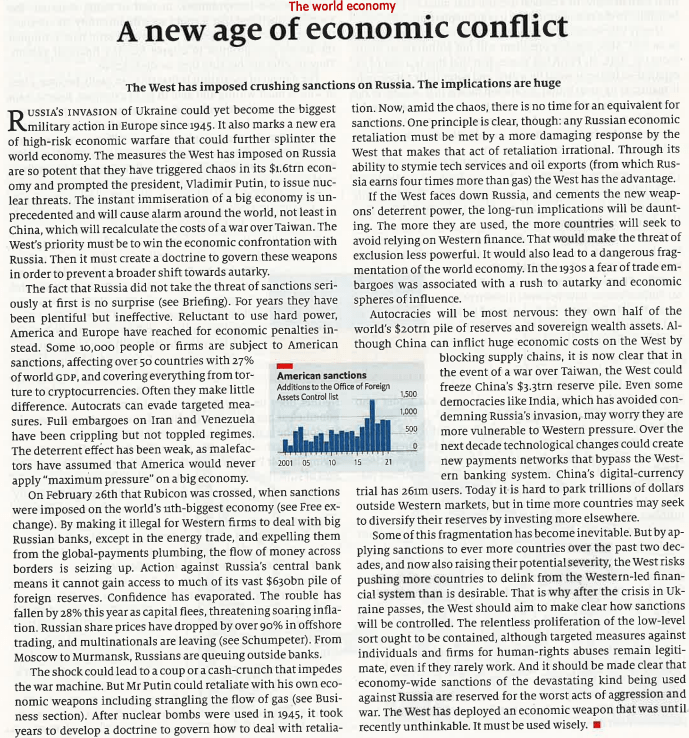
“Is Adin going to be drafted?” asked my 14 year-old son Kyrian on hearing the news of Russia’s invasion of Ukraine. Adin is 18 and has registered, by sexist mandate [1], for selected service and, clearly, my younger son is concerned. He is not an overtly emotional young man, so for him to express any concern shows a profound and deep psychological worry. In addition to Covid, now my sons are contending with another existential crises: a possible World War.

How do I answer? Do I deny the possibility, dismiss his concern as impossible? How do you assuage the fears of a teenager growing increasingly aware of the world he is destined to inherit responsibility for?

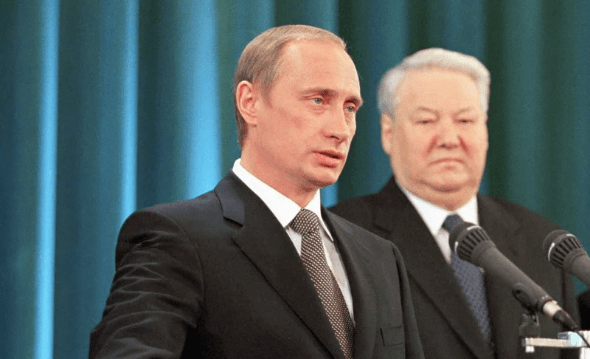
Putin – the moth

I had assumed Putin would use propagandist justification to secure the easterly land route to the Crimea but not risk a protracted war with Ukraine. I had assumed his moves would be tactical, dispassionate and rational. I was wrong. He invaded. Putin is a man of ideas. Worse, could he be religiously inspired? Now I can only hope that the early signs of a robust defense by Ukraine will make this invasion amazingly costly. I can only hope that Putin’s blitzkrieg dreams are dashed by Ukraine’s resolve and Stinger missiles. I can only hope China looks at the demonstrably pathetic capabilities of Russia: It is struggling to invade a former territory with significantly less military capability and is immediately adjacent with flat terrain. I hope the world remembers Desert Storm, wherein the United States demolished the 4th largest army in the world in 100 hours thousands of miles from our shores. And we did that 30 years ago. I can only hope that gives China pause on its expansionist dreams for Taiwan. I can only hope that the world remembers that despite the internal discord and insipid babble current within the United States, our collective belief in the right of self-determination will stiffen our resolve to fight for those principles. I can only hope everyone ignores Trump’s inane rhetoric. I can only hope the incompetence of the presidency since Ronald Reagan hasn’t destroyed that which is best in America: the collective dream in its exceptionalism and its determination to have liberty prevail. I can only hope America still believes in itself.

Of course in our open society the merits of our imperfect past are inveighed and academics flog our performance. But they always fail to contrast it against the non-existent alternatives. If not America, then who? What other hegemonic power would you rather dictate world affairs? There is no alternative worth serious consideration. For all America’s sins (look closely at the etymology of that word!) we are the last best hope. America remains the bulwark against naked aggression. Thus we are constantly castigated as meddlesome and self-interested. Duh. We protect American interests first and ideals second. Sorry for the human foibles of self-interested leaders. When has it been otherwise?

What we are witnessing with Russia’s invasion is a test of wills. Will the United States and its allies take an active roll in the defense of Ukraine? Will we do more than impose economic sanctions? After all, we already let Crimea fall… Putin is testing his limits like a petulant teenager who needs a firm reminder that there are boundaries. I fear we are failing this historical test. Ukraine is not a member of NATO, true, so we do not have legal justification to place troops in harms way. Putin is playing this dangerously because he has less to lose. And that frightens me. Putin is willing to sacrifice Russians for whatever twisted vision he embraces. I can only hope that the Russian public will protest and bristle sufficiently to break the Putin narrative and expose it for the weak-tea it is. (Alas, polling suggests otherwise…)

I can only hope that Russian troops stopped shelling and couldn’t establish air superiority for lack of ammunition and expertise. I want to believe that we are witnessing the actual – and inferior – capabilities of the Russian military. I can only hope that our constant out-pacing the world on military spending keeps us the uncontested dominant force on the globe. I can only hope every other country remembers how easily the United States out-produced the entire world during WW2.

I can only hope that this fracas north of the Bosphorus doesn’t lead to a open and broad conflict of ideology.[2]

_______________

UPDATES

4.15.22 The Moskva sinks. BBC report

4.11.22 Who could overthrow Putin? Foreign Affairs

3.20.23 Open letter to Jeffrey Sachs on his position regarding Russian war on Ukraine, lest we forget that there are apologists – and they need to be corrected
[1] I am so tired of the flaccid gender and race politics that are destroying the unity of vision and the excellence of America. All the forced equity of outcome evaporates when one looks at the historical expendability of males. Until you are forced to sign up for conscription, choke on your gender issues – Israel got that right.

[2] The New Statesman published this excellent interview with Sergey Karaganov, a former advisor to the Kremlin, on what Putin wants and thoughts on the fate of liberalism.

An additional aside – Survival of the Weakest: Why the West Rules (Levine, D. and Salvatore Modica, 2001).

“We study a model of institutions that evolve through conflict. We find that one of three
configurations can emerge: an extractive hegemony, a balance of power between extractive societies or a balance of power between inclusive societies – the latter being most conducive to innovation. As extractive societies are assumed to have an advantage in head to head confrontations we refer to this latter possibility as the survival of the weakest. Our contention is that the reason that the West rules can be traced back to two events both taking place in China: the invention of the cannon, which made possible the survival of the weakest in Europe; and the arrival of Genghis Khan, which led to the survival of the strongest in China.”

The article adds layers of equations to academically justify the historical (empirical) conclusions.
TANTO DORI

PROCEED WITH CAUTION! [1]

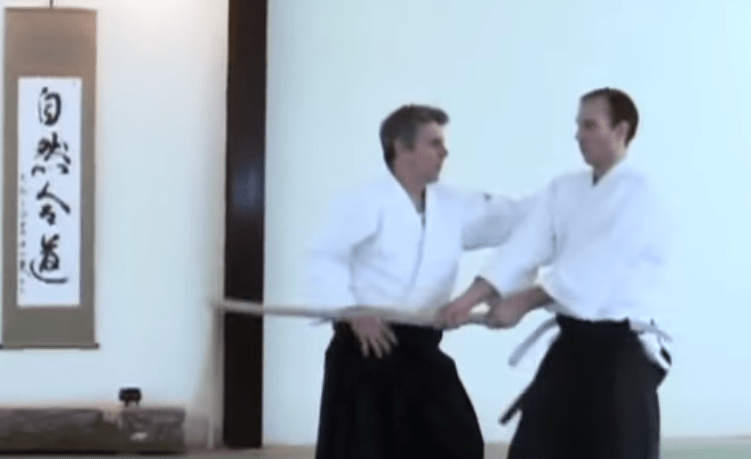
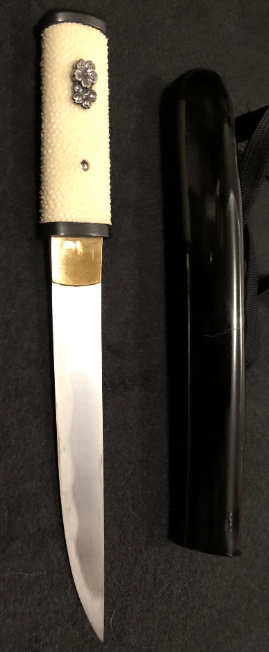
A knife is a deadly weapon. It is easy to obtain, nearly instinctive to use, and is by far the most deadly weapon most of us will encounter. Therefore, please understand that tanto dori is an historical artifact more suitable to the dojo than the street. The attacks we defend against are predicated on the presence of body armor and thus do not represent how assaults will actually occur.

Even in the dojo, knife disarms are more challenging than either jo or bokken because they are smaller and faster. A knife is faster because it is manipulated by more joints in the body and because they are used at close range, thus the reactionary gap is small and the potential vectors of approach are greater.[2]

Aikido has the “advantage” of being culturally constrained in its use of the knife. First, the knife is a tanto. The design changes slightly throughout it history, but in general a tanto should have a single live edge and a blade length of 10″ (~ one shaku), which is longer than the truncated version used in the dojo. (The typical dojo tanto is closer to a kaiken in length.) Second, tanto attacks in Aikido presume limited targeting dictated by the historical use of armor and its use as a weapon of last resort. Presuming a protected target, Aikido’s offensive use of the knife focuses on the direct upward thrust (tsuki), the direct overhand (shomen), and the oblique highline (yokomen). Finally, the presumption is that the first attack is the final strike; there are no sniping attacks, feints or deceptive uses of the blade before the terminal attack is given.

The use of the tanto

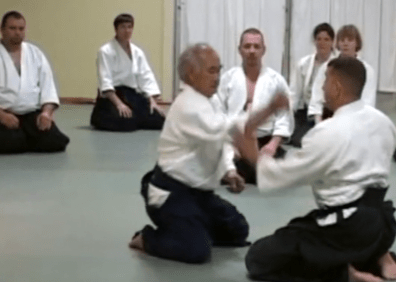
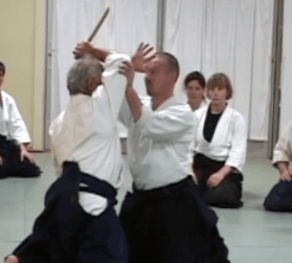
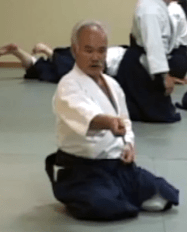
Techniques are usually demonstrated when uke already has a naked blade, they are without the full context of a draw. Chiba sensei was rare in actually training from the draw. Because the tanto was carried blade up (like the katana and wakizashi), the natural draw would place the live edge up for a thrust. However, the draw can place the blade in either the edge up or down position – it depends entirely upon the initial grasp. If uke grabs the handle knuckles facing out the blade will be up, and if the grab is with knuckles up (as in iaido) then the blade will be down.

Draw!
Chiba sensei attacks – from the draw
note the tanto size and the upper arm control

Chudan Tsuki is direct thrust to the abdomen and usually demonstrated with the live edge down. Historically, however, it was probably more often delivered blade up from a close quarters draw. The blade up thrust also has the advantage of keeping the cutting edge in line with the rising arc of a low to high delivery to rip through the abdominal viscera. Regardless of the delivery, the chudan tsuki thrust targets the abdominal region under the cuirass – (胴(仏胴) – centered on the line of the navel.[3]

To puncture the natural armor of the skull, both shomen and yokomen strikes are delivered from an ice-pick grip – the live edge is out and the tip is point down. These are power strikes designed to puncture not slash.

In short, because Aikido is focused on defending against the terminal, killing thrust. The actual mechanics of a knife fight with feints and warding slashes are largely ignored as mere preambles. This reflects the historical use of the tanto as a ‘minor weapon’ rather than a primary tool of offense or defense. Therefore, both the attacks and the defense against those attacks are severely limited and need to be appreciated with the appropriate context.

Historical Techniques

Budo (1938) is a compendium of techniques, photographed by an army film crew, O’Sensei taught to his pre-war students and there are precisely three knife defenses; two shown from chudan tsuki and one from shomen uchi. I encourage all serious students to acquire the book, which is readily available as a download (along with Saito sensei’s commentary) from Aikido Journal.

Budo 1938

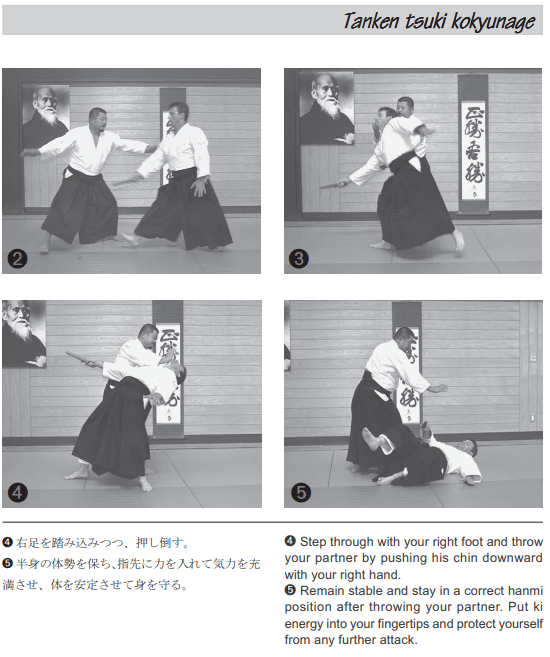
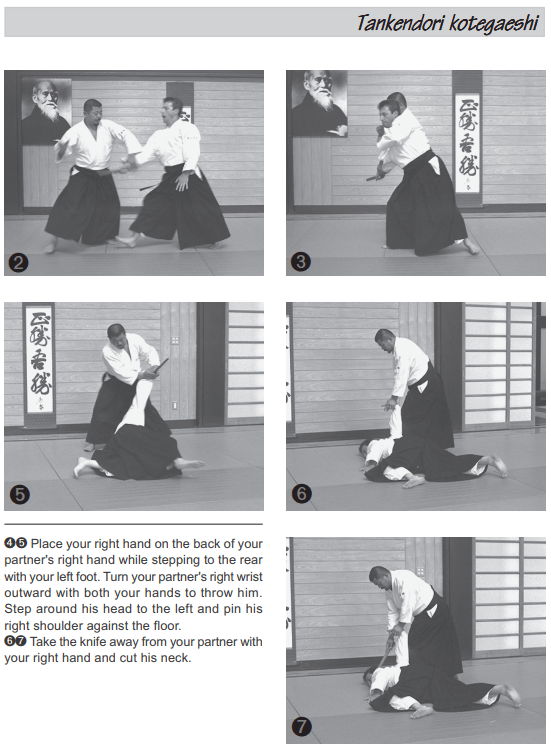
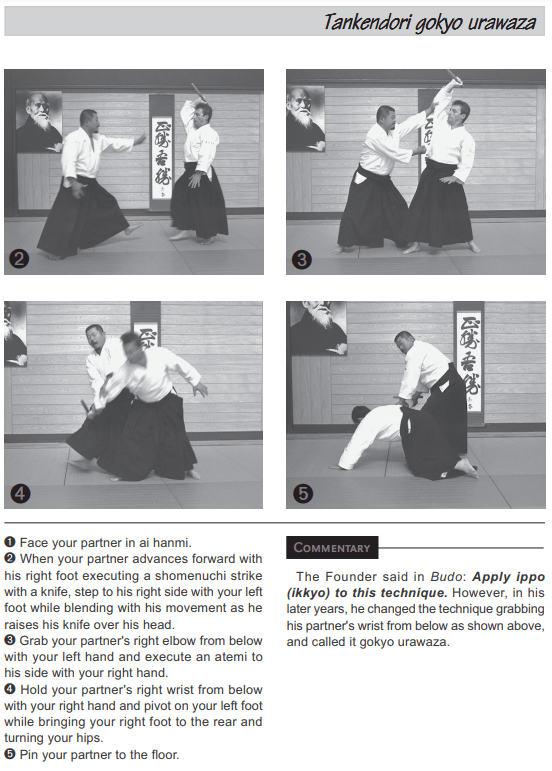
Tsuki -> irimi nage; tsuki -> kotegaeshi; shomen uchi -> gokyo and that is it!

Saito sensei’s explications of Budo are useful, but also show the simplicity of the responses:

Saito sensei calls this kokyu nage, we label it irmi nage
kotegaeshi – note the emphasis on blending
Gokyo has no omote

While the responses to a knife attack are limited, Budo does show a greater number of responses against sword and bayonet (juken) which have been adapted to tanto.

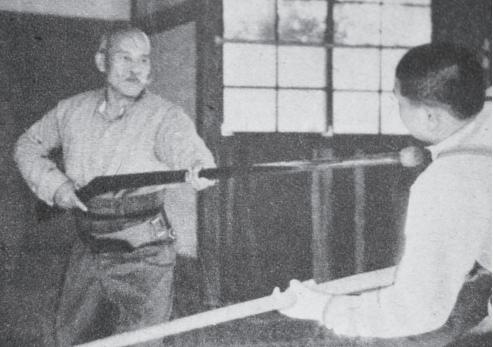
O’Sensei in military garb wielding rifle with bayonet

For example, rokkyo is easily adapted regardless of what weapon is used on for the thrust:

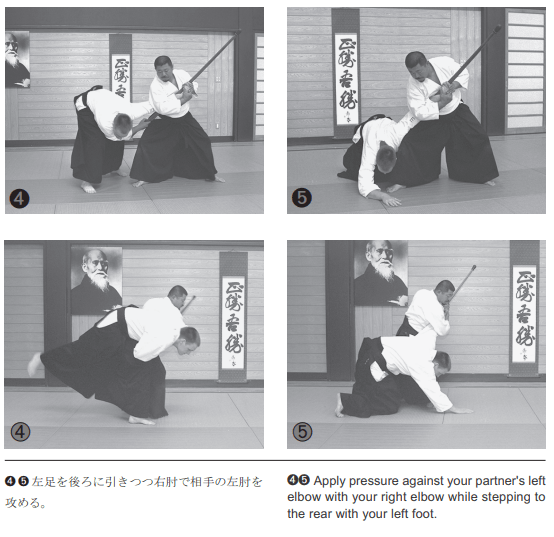
Rokkyo

Never forget the seriousness of these techniques. O’Sensei was teaching soldiers with the explicit understanding that they were learning to kill.

Control the center!

O’Sensei focused on techniques and weapons that were likely to be used in active combat. The Budo of 1938 is more focused and shows far fewer techniques that his Budo Renshu, published in 1933 that consisted of line drawings showing over 200 techniques. Because the 1938 techniques were selected with the battlefield in mind, they preference primary weapons – sword and bayonet – and provide only cursory techniques for the knife; a weapon of last resort for a soldier.

Modern techniques

Tanto dori has been expanded to fit within the matrix of standard Aikido techniques.

tsukishomen yokomen
ikkyoinsidedirect
nikkyoinsidedirect
sankyobothdirect
yonkyo
gokyooutsideura
rokyo (hijikime)outsideoutside
kokyuho / kubishimi / figure 4outsideoutsideblend
iriminagebothbothblend
shihonagebothinsideblend
kotegaeshioutsideinsideblend
udekiminageoutsideoutsideblend
The kihon matrix

This is a useful cognitive structure, a framework to complete, primarily as an exercise to ensure you know how to perform each of the actions in the dojo.

Dangers of the dojo

I cannot stress enough the seriousness of knife disarms because a knife attack is the one form of attack we may encounter outside the safety of the dojo. Therefore, zanshin, active awareness, is critical and I strongly advocate for efficacity over form. To ensure there is some practical foundation in our response to a knife, the initial striking and trapping contact against uke will be emphasized. I teach tanto dori from axiomatic principles.

First principle: don’t get hit. Second principle: don’t allow uke to reset (strike twice). Third principle: keep it simple stupid. Thus, the axioms: move off the line, control the limb wielding the knife, take the knife. Based on these principles, I stress a modified matrix and preference fewer techniques and I preference techniques that result with nage directly controlling the blade.

Chudan Tsuki – Outside Line – Stop Hit

Meet on the outside line with limb destruction.[4] Nage must strike with the lead hand to uke’s radius bone with the intent to crush the radial nerve and stop the thrust before it achieves full extension. From this stop-hit, nage’s lead hand flows to uke’s knife hand to grasp the thumb with the intent to strip it off the handle.

After establishing this master grip, nage can now execute the primary techniques.

Kotegaeshi. Nage’s stop hit allows nage’s striking hand to control uke’s knife hand. Nage then uses his second hand to firmly close uke’s hand on the knife, and with an entering move forces the blade towards uke’s throat, forcing uke’s center back and up. Nage can then apply a standard wrist turn to a standing pin.

Sankyo. From the stop hit, nage covers uke’s knife hand from the top with the free (back) hand and shifts the stop hit hand to the bottom to fully encase uke’s hand on the knife. Nage then drives the blade back to uke’s center and as uke responds turns under uke’s arm to rotate toward uke’s neck with the blade.

Return to sender. From the stop hit, nage controls uke’s knife hand thumb and pulls uke’s center forward. Simultaneously, with the free hand, nage strips and turns the blade to extend toward uke’s center such that uke is impaled on their own knife.

Chudan Tsuki – Inside Line – Shield

The inside shield needs to be done with rapid succession to avoid uke chambering after the first thrust. Meet on the inside line with a shield, fingers pointed down while delivering a counter thrust to uke’s throat. From that spear hand to the trachea, nage traps uke’s knife hand against the shielding arm. From this position nage grasps uke’s knife hand (with focus on the thumb) and can execute gyakuhanmi katate dori techniques: primarily, ikkyo and nikkyo (each distinguished based solely on the pin), sankyo.

Chudan Tsuki – pass

The pass is an advanced play because it doesn’t immediately control the knife hand.

Returning the knife

Never hand the knife back to your opponent! Training to hand the knife back can lead to suicidal operant conditioning. Especially with tanto dori, apply all techniques with maximal bone-locking, constant pressure, effective pins, and make sure to retain control of the knife. To return the knife, make it a ritual to back away while holding the knife in a warding position. Once you establish a safe distance (maai), place the knife on the ground and force uke to retrieve the blade to start the sequence anew.

Reference Videos

Saito – traditional
Maul doing what he does best
Clearly influenced by FMA

Reference Books

Classical Fighting Arts of Japan, by Serge Mol

Tanto: Japanese Knives and Knife Fighting, by Russell Maynard

But there is no substitute for hands-on training and I strongly recommend James Keating for serious knife work and counter knife training.

___________________

[1] The links in this footnote are graphic and a reminder how seriously deadly a knife is – do NOT underestimate its lethality. >This< one from Australia and >this< from NYC (which has the added bonus of learning how f’d-up the DA is in NYC). There are numerous other graphic video reminders online and you should learn from the pain of others so you do not suffer it yourself!

[2] Angles of approach: the basic pattern for the sword has 8 cuts (and 1 thrust) whereas the knife has 12 (9 cuts and three thrusts).

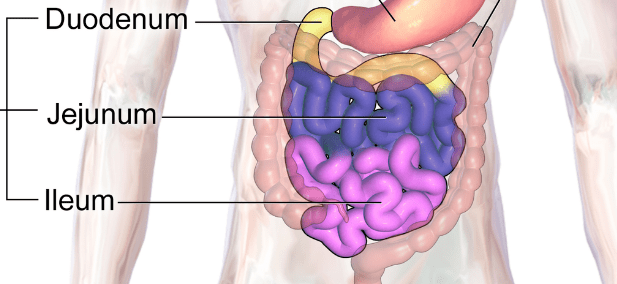
[3] Following the line along the bottom of the cuirass, Sayoc will slash rather than stab, to release the small intestines – “the blue worm.”

Free the blue worm (ileum)

[4] Chiba sensei told the following story that emphasized the importance of the stop-hit and limb destruction:

[On a voyage from Japan at sea]…we had a party on the ship when we crossed the equator, and I was asked to demonstrate. So I agreed, however there was no-one on board with any Aikido experience to act as my partner.

So one of the ship’s crew was asked to assist me, and he attacked me with a knife. At Hombu Dojo, in knife work, we made a positive attack with a Tanto (a dagger). But this guy was crouched low, moving around me, changing the knife from hand to hand. This was difficult, as when he made his attack I would not know which hand had held the weapon. So when he came at me I made Gedan Barai (the low sweeping block) with both arms, and I was able to deflect his attack. The point of his blade actually went through my Obi (belt) and just touched my flesh. From Gedan Barai I moved to a counter technique and broke his arm.

TACHI DORI

The next several Saturday morning classes will be devoted to weapon-disarms, starting with sword, tachidori.

Review this post from 2019 where I presented a slightly different matrix.

The first class focused on three disarms from the outside line – two apricots (rising cut), ude kimi nage (under arm bar), and kotegaeshi (with nikkyo augmentation).

The second class presented three from the inside line – kokyu nage, shiho nage, and decapitation.

A matrix to frame the possible disarms:

ENTRYINSIDEOUTSIDE
SHALLOWshihonagekotegaeshi
ikkyo gyaku hanmi = direct
ikkyo to ude garami ai hanmi = turn
kokyunageude kime nage
2 apricots*2 apricots*
assisted decapitation**kokyuho
irimi nage (chin push) gyaku hanmi = direct or turn
kokyuho ai hanmi = turn
ai hanmi = turn
DEEPkoshinageiriminage
rokyu (arm bar)
This matrix does not encompass all the possible disarms.

Note the “turn” to adjust for hanmi – this is a rotational spin that serves to close maai as well as generate additional force.

Additional classes explored the other disarms in the matrix. The global reminder is that all un-armed techniques are actually disarms and the disarms are the origin of the un-armed techniques.

Video references:

Mulligan sensei – our founder.

Saito sensei classic presentation.

Brady sensei – an early student of Chiba sensei.

Gonzalez sensei – Tissier sensei’s protégé

Koryu origins

___________

* Two apricots – the disarm returns uke’s sword on a rising cut from the low line up uke’s centerline. The reference is to the incomparable Gene Wolfe‘s Shadow of the Torturer:

“The driver I pulled down must have died at once. Because I had wished to impress Dorcas, I had hoped to perform the excruciation we call two apricots; but he had fallen under the feet of the travelers and the heavy wheels of the carts. Even his screams were lost.”

** Assisted decapitation – the un-armed version is morotedori irimi nage direct.