A recent (re)post from the excellent Art of Manliness covered The Insanely Difficult Standards of Histories Hardest P.E. Program. Brett is not typically prone to hyperbole but compared with the current physical education provided students – which is a travesty! – the observation is correct. But he has written about the Spartans, so he knows that standards have been higher. As laudable and challenging as the La Sierra System was, it was no agoge!
In the Hoplites and Physical Limitations, I took Donlan and Thompson (1976) to task for thinking college athletes were a viable comparison to Athenian hoplites when evaluating if it were possible to run a mile in panapoly. I suspect it is the oldest truism that each generation thinks they had it hardest and that there is nothing but a continued decline in physicality and grit. I am inclined to agree that, on average, it is in fact true.
My primary context is from Aikido. To attract and retain students, and because the average instructor is aging, the level of intensity is markedly less than what I remember. I admit to being complicit: when I instruct, I do not demand (or provide) as much as I did a decade ago. I assuage my guilt by telling myself that physical conditioning isn’t the primary goal of learning a martial art (it isn’t). But it doesn’t help because I know that while it isn’t the primary goal, it is an important by-product. Athleticism is required for martial excellence.
Athleticism I define as integrated somatic awareness and skillful ability – you need to be kinesthetically engaged with your environment, be able to move your body appropriately to effect a physical goal, and have the endurance to sustain the activity.[1]
Our ancestors were more athletic because they were generalists by necessity. To survive and thrive in a world with tools of minimal mechanical advantage, muscular labor was everything. Therefore everyone performed manual labor, if only because walking was the primary means of conveyance. I have an Oura ring to nag me into activity and achieve my daily step goal.
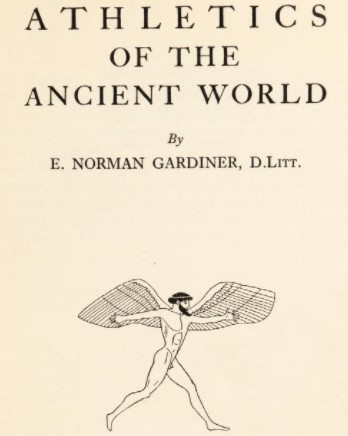
But there is hope. Despite near sloth-like activity levels when contrasted with the (even recent) past, the body is universally pliable. As some company slogan says, all we have to do is just do it! The means of physical conditioning and improvement have not materially changed since the dawn of recorded history. This is best shown in E. Norman Gardner’s (1930) survey, Athletics in the Ancient World.
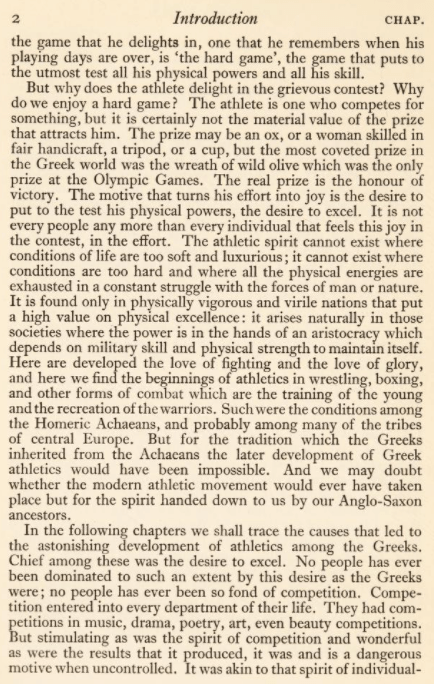
I have mused about the origins and importance of Elite Competition, and Gardner’s introduction is a perfect summary, which I copy in full:
Athletics in the Ancient World
The ideals of excellence are often exemplified by the sports, the athletic contests that are played and form the basis of competition. The connections among athleticism, athletics and excellence competitively proven are ancient and remain irrefutable.
In book 8 of the Odyssey, Odysseus is hosted by the Phaeacians who compete in athletic contests. These competitions all go smoothly until one prince tries to get Odysseus to take part. He politely declines, but when that prince suggests that Odysseus looks like a businessman, not an athlete, Odysseus is goaded to action by this unbearable taunt. He discards his cloak and throws a discus much farther than any of the Phaeacians. (His impressive showing in the discus is somehow seen as proving that he is not a merchant.) An embarrassed silence follows, but the king heals the rift with lots of praise and presents.
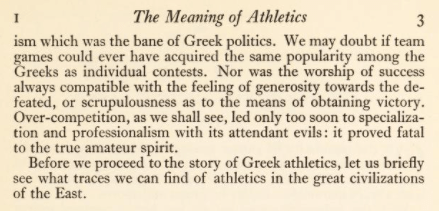
But in these contests, all the activities are individual sports, sports that require no cooperation with others. And I now also have Gardner’s conclusion to justify my abject lack of interest in American team-sports like football and baseball: “We may doubt if team games could ever have acquired the same popularity among the Greeks as individual contests.” I am more Ancient Greek than American in that regard.
________________
[1] My definition of athleticism integrates skill because regardless of “natural” and “innate” ability, excellence requires training: strength, vigor and physical endurance are vital components to be cultivated, but in themselves do not constitute athleticism.
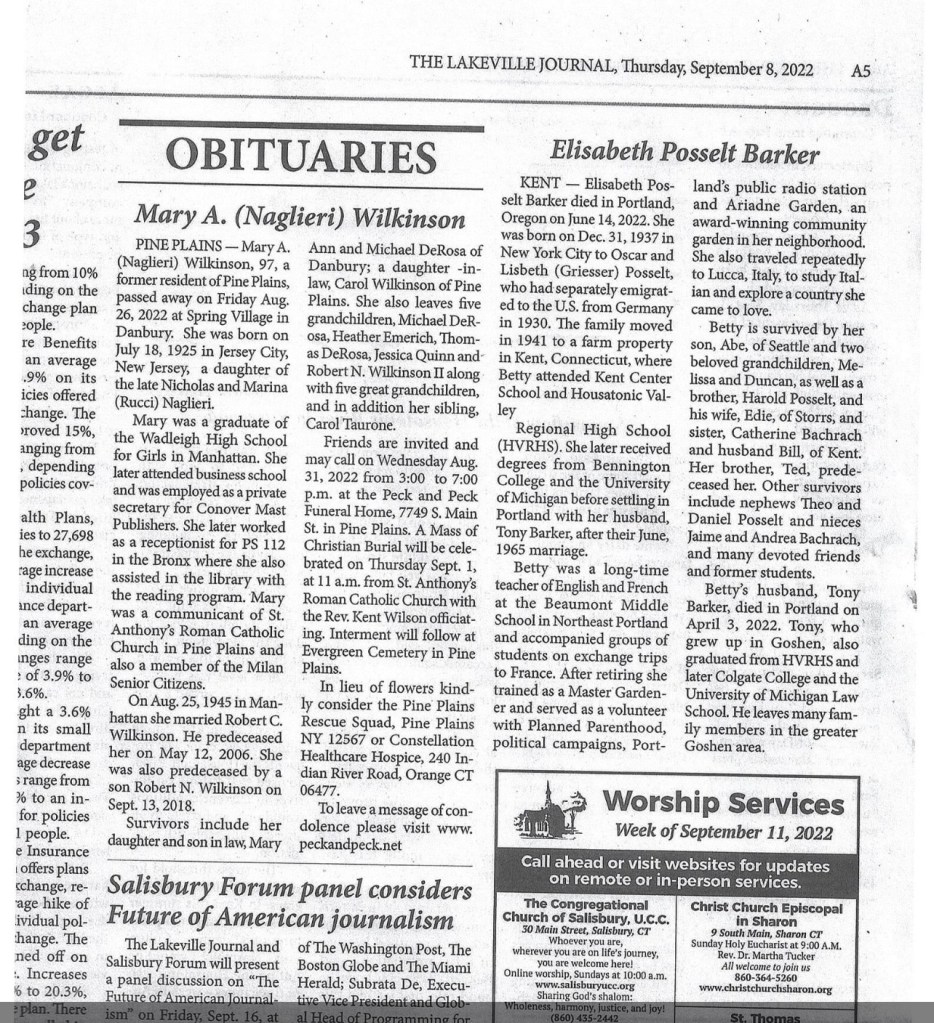
Anthony Barker died April 3, 2022. I was able to visit him the week prior. He had been released from the hospital to the assisted living facility that he shared with his wife, Betty. He was on hospice with a prognostication of three more months. Although he was thinner and frailer than I had ever seen him – much physically diminished – he was fully present. Along with my cousins Eric and Abe (Tony’s son), we had a nice visit with him and Betty – engaging on a ranging conversation while they ate the cheap hard candy Eric and I brought.
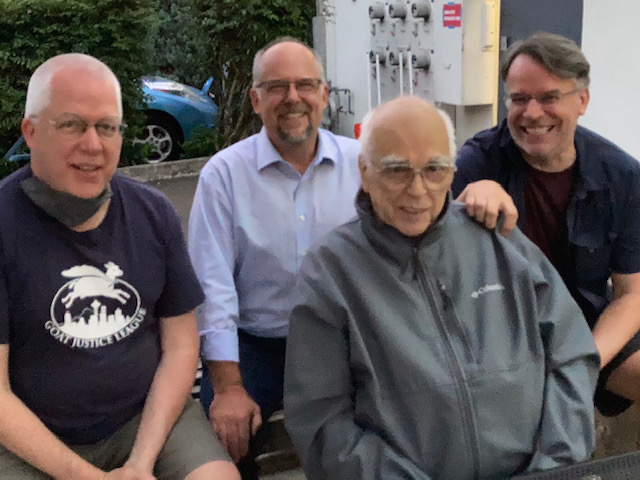
The West Coast Barker men: Eric, Ty, Tony, Abe – September 2021
My family and I were out to dinner to celebrate Kyrian’s birthday when Eric gave me a call to update me on Tony’s status. Eric had just left around 4PM and he let me know Tony was confined to a bed, not very responsive, and being provided morphine pills. I could not believe it possible to wane that quickly. Not more than an hour later, Abe sent a group text:
Hi all, the grand old man has passed on
So passes a generation.
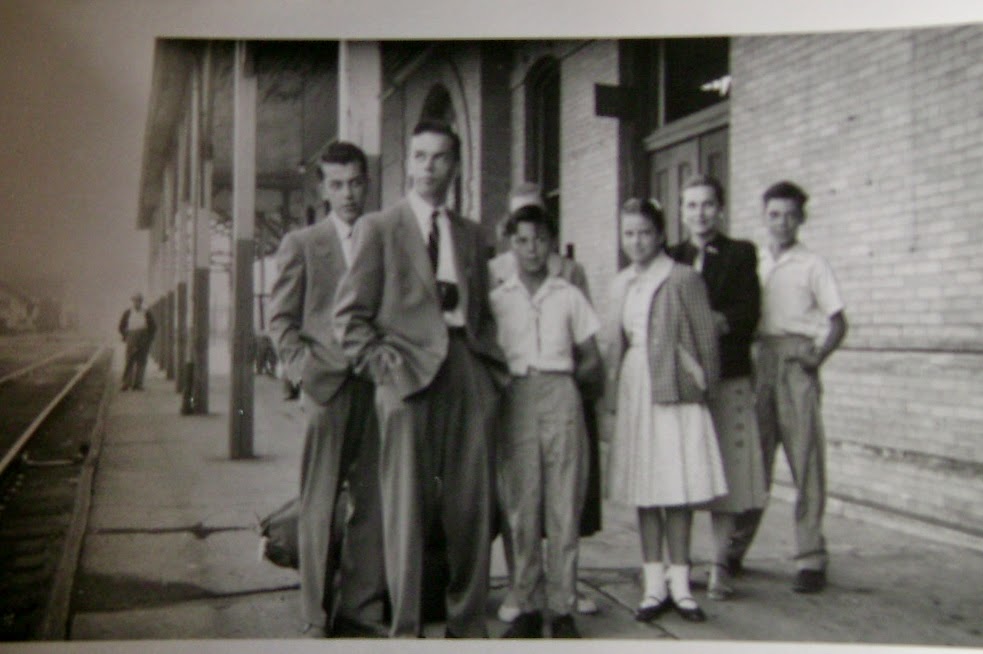
My cousin Abe is younger than I am, but his father was eight years older than mine. Tony was a man apart (as you can see from his posts) from his siblings. He was the oldest Barker boy and of a different era. Born November 3, 1937, Anthony James Barker was the fourth child (of 11) – and born on his sister Sally’s birthday when she was four.
Unfortunately he had a habit of deleting his work from the internet (see opening post 11/30/14 and 1/27/19), so I have managed to capture and preserve only a small portion of his musings.
_________
My Aunt Betty willfully followed Tony. There is cruel irony that they moved to the assisted care facility because she had a debilitating neurological disease, yet Tony predeceased her. Betty lived – and died – on her terms. As enlightened as Oregon’s death with dignity act is, it does require a doctor to certify a patient has less than six-months to live in order to use physician-assisted suicide. Although she was in a deplorable state, no doctor would certify she had only six more months. So she starved herself to death, refusing food and water until she died.
Anyone who thinks whacko conspiracy theories are a new thing should watch “Dr. Strangelove”. It was streaming free on Amazon Prime Videos recently–an opportunity of Kubrickian proportions.
Peter Sellers played three different roles (RAF Group Captain Mandrake, Merkin Muffley, a weirdly Stevensonian President of the United States, and Dr. Strangelove, himself, the ‘former’ Nazi nuclear scientist).
I had forgotten how brilliant George C. Scott was as General Turgidson, head of the Air Force, and how ‘Slim Pickens’ the determined B-52 pilot, went through checklist after checklist, ticking off boxes like an accountant, while avoiding Soviet air defenses and ignoring desperate American efforts to cancel his mission. Supposedly, Kubrick didn’t tell him the movie was a satire, in order to guarantee a ‘straight’ performance.
What particularly sticks in the mind in this age of QAnon was the performance of Sterling Hayden, as Brigadier General Jack D. Ripper, a military bureaucrat committed to a satirical version of the John Birch Society theories wherein the Commies (and women) have ganged up to steal men’s ‘precious bodily fluids’.
His self initiated attack on the Soviet Union, with all its fatal consequences, was a scary demonstration of how close we are to having an impaired person one button away from Armageddon, no matter what precautions are taken to avoid it.
Yes, it was funny–
And haunting–
And the closing voice-over, Vera Lynn singing ‘We’ll Meet Again”, brilliant–
If you were raised in New England in the 1940’s and 50’s, especially if you read any Robert Frost–not just the lyric poems, but story poems like The Death of the Hired Man, you are likely to have acquired an affinity for austerity, and a polite resistance to other people’s ideas for your improvement. So it should not surprise anyone that last Wednesday, a day I might cheerfully have died (except for all ‘those promises to keep’…) I finally succumbed to my wife’s oft repeated suggestion that I call the ‘advice nurse’ at our wonderful HMO. The nurse listened a minute and advised me to go to ‘Urgent Care’. I ordered a Lyft–and was duly delivered to Urgent Care, which was on the verge of closing. There didn’t seem to be anybody around–but a transport tech showed up with a wheel-chair (Lord knows how the nurse had detected the necessity) and whisked me past other late arrivals, no doubt wondering how my ‘urgency’ could be more urgent than their urgencies.
At this point I was fitted up with the usual IV annoyance on my right arm–because I have no veins in my left arm, and was interviewed by a fabulously good looking Dr. whose name I did not get, partly because I was too polite to stare at her name-tag, but mostly because she was asking a lot of personal questions, like what were my resuscitation directions, death options, etc. She was Spanish, or perhaps Portugese. Her name might have been Dulcinea del Tobosa, a student of the great Avicemma. I was getting a little confused, but a lot of these HMO doctors are from foreign schools–and more power to ’em, I say.
With these consent issues resolved to her satisfaction, I was once more transported past the ‘not quite sick enough’ petitioners in the Urgent Care Waiting Room, and delivered to Emergency Care. There I enjoyed the attentions and services appropriate to that department, memorable only for the unexpected stick up my right nostril, and shortly afterward (so it seemed to me–I may have fallen asleep) the ER Doc, announcing through a crack in the door, to my already compromised caregiver, “Positive.” Some paperwork followed and I was transported, by gurney this time, upstairs to room 349–where I was to remain for three more days. The people there were wonderful–regular ministering angels–possibly saints. (I’m not Catholic, or even a believer, so I’m not ‘up’ on the rules for admission.)
I hold them entirely responsible for my survival.
Let it be duly noted that a bunch of them were also immigrants, or American women of poor back-grounds, who had worked hard to become ‘Health Care Professionals’. Oh what a valuable class of people! Note to Joe and Kamala: We need to elevate them, not with some dinky certificate or bonus check. They embody the best hopes of the America. Their aspirations for themselves, for their families, their touching belief in America, deserve Something Transformative, like the GI Bill. We should help them become their very best, and in their turn, they will raise up America with their dreams and hard work. The truth is, we cannot live without them–we middle-class Americans have lost the ability to take care of ourselves.
(I have other groups in mind for similar ‘Hosannahs’. One at a time, one at a time.)
Another unexpected discovery: Trump wasn’t wrong about everything. Remdecivir, with a dash of Predizone, is good stuff. In three days you are back on the job, pretending to run the country, or in my case, with lots of highly useful suggestions for Joe and Kamala–an incurable Democratic Party disease, for which there is no known Physick.
Perhaps the moguls of the Drug Industry prefer it that way.
Unless you were born in the late 1930’s in Litchfield County, Connecticut, you have already missed your best chance for a proper upbringing, so what follows is not a ‘how-to’ but a nostalgic reminder of how things might have been if fate had favored you.
I do not mean to suggest that my upbringing was ideal, or even entirely proper. Definition happens at the margins, that black line that tells us the difference between the subject and the background. My upbringing was uncomfortably close to that line, which may also be evoked by the cliche, ‘skating on thin ice.’
Money: In those days money was not the sole criteria of respectability. In the midst of a terrible depression that (my parents believed) President Roosevelt had so unjustly blamed on Herbert Hoover, most people had very little, and (as often happens) many of the wrong people had the most. For those without much, respectability was thought to turn upon other criteria. Still, there is an ineffable nexus between money and propriety. Having a bit of lolly never hurts, and having a lot will often offset other deficiencies. We had none, so we skated as fast as we could along that line between the firm ice and the thin ice–a slightly hazardous enterprise.
In our favor was the God of the Puritans. He was with us, and we were (of course) with Him, so there wasn’t any question that we were right, but the Congregational Church, once so aggressively evangelical, was still recuperating from the Civil War. The challenge of freeing the slaves, and the effort to rectify the whole country, had exhausted God’s undoubted elect. Congregationalists were taking a temporary break from telling everybody else what to do (while reserving the right to resume that dutiful burden in the future).
Family: We were poor relations (which we fully understood) and worse (although we didn’t yet realize it) the poor relations of a family already bypassed by Irish and Italian Democrats, who, in the midst of the Great Depression, and the Second World War, held many of the political sinecures we considered the due reward of our cousins and other Republicans. Even more astonishing, their children had graduated from famous universities, and were practicing law and medicine. Happily, family privilege had not completely eroded–my father had a guaranteed, albeit low paying, job as a the bookkeeper and (eventually) vice president of a mutual savings bank organized by one of his ancestors.
Education and Culture: We had as much as we thought we needed. We read a lot–but our reading was entirely undiscriminating–everything from the backs of cereal boxes to the latest ‘great novel’. Everybody in our block had a copy of Kristin Lavransdatter on their bookshelf, probably no more than half read. On average, our reading lay in a fairly narrow channel defined by what the right people (e.g., Dad’s Uncle, a small town banker and a sometime Republican candidate for Governor) would consider acceptable, TIME, LIFE, The Torrington Register on weekdays, The Herald-Tribune on Sundays, and every month a copy of The Reader’s Digest–so Mom could talk about books, if ever she had a moment to spare (which she never did–having had too many children for a WASP).
On the plus side, I was a pretty good student, and by reading everything within three feet of my eyes, had accumulated a mountain of trivial information that served me well on entrance examinations. My infallible sense that “Helm is to Hat, as picklehaube is to porkpie,’ brought me an academic scholarship–although nothing so lucrative as the awards to promising quarterbacks, and (alas) not at Yale, the alma mater of choice for the more prosperous branch of our family.
As previously mentioned, Mr. Henry Ford, an otherwise capable fellow, supposedly remarked that “History is bunk!” Whether or not he actually said it, I partly agree. I’m not suggesting history can be ignored. It’s back there all right, but we don’t remember it accurately, and as time goes by some memories get crowded to the side. For example, you may not be aware of what happened in the summer of 1948, but I vividly recall my sisters, who were in high school, being gaga over ‘Frankie’ Sinatra. I thought they were pretty stupid. I was ten, a serious kid. I had a paper route.
I was a bit scared of the old man who repaired bicycles and lawn mowers–but he knew my father, and my father said he was O.K.
Mr. Seibert didn’t remember my name. He called me ‘boy’. “Let me show you something, boy.”
I was reluctant to stop. I still had thirty papers to deliver, plus, he was crazy. Everybody said so. Not scary-crazy. He was O.K. with me–maybe because he liked my father. Everybody did.
“It’ll only take a minute.”
I followed him into his shop which was an undersized garage–built for a Model-T. Bicycle parts hung from the rafters. In the center was an old kitchen table he used as a work bench. There was some kind of gadget on it.
“Know what this is?” he asked.
I looked carefully, “A really bright light, and a lens, and a piece of tin with a slit cut in it.”
“That’s one way of looking at it, or you could say it’s the explanation of Universe, if only we could understand it. Watch this.” He shut the garage door. It was dark. I was nervous being in the dark with a crazy man, no matter that my dad liked him. He turned on the projector light, which was focused through a small hole drilled in the lens cap. He shined the beam through the slit in the tin.
“Do you see it? Do you see it?”
“Yes.”
“Well… what do you make of it?”
“I don’t know.”
“Right! You don’t know. I don’t know. Albert Einstein doesn’t know. The first one of us to figure it out wins the Nobel Prize.”
“Really?”
“Yeah. Really. Well… maybe not. Depends on your definition of Reality–but if we understood it we’d know a hell of a lot more about Light–which is a kind of metaphor of Everything. I shine light through one slit and it’s particles. I shine it through two slits and it’s a wave. What the hell?”
“It’s weird,” I agreed. “Is it important?”
“It’s the most important experiment of the century. The biggest Question, and also the ultimate Answer, if we could only understand it.”
I didn’t believe him. His apparatus looked like a toy. Anybody with a bicycle shop could have made one. I knew about Science. It happened at colleges where they had a lot of scientific stuff. So he must be crazy, or pulling my leg. I eased myself toward the door. He didn’t notice, still staring at the screen. “They’re called ‘photons’. One slit and they’re little discrete packages of light–and the Universe is probably finite. Two slits and they’re waves–so maybe it’s infinite.”
He shrugged, “And here’s the deal, kid… I’m pretty sure Consciousness is something like light–made of memories strung together like a beam. Little particles, or maybe waves, in a field. And our heads are part of the field, attracting all those particles or waves, like gravity attracts photons. I call them ‘mnesyons’. Everybody’s got them, and they’re fundamentally the same for everyone, but how they combine to make ideas, and memory, depends on where you are in space-time, what’s happening around you. You and I are pretty close, so we share a lot of them, but maybe in Zululand, they might whirl in the opposite direction. I wrote to Einstein about it, but he brushed me off. He claimed to have ‘… other questions on his calendar…” A bit ‘hoity-toity,, I thought.”
He turned off the projector and opened the garage door, “Well… that’s what’s on my list today. What’s on yours?”
“I was hoping to borrow your bicycle pump. My front tire keeps going flat.”
Instead of answering, he seized my bike and lifted it into the air as if it weighed nothing. He pinched the front tire, holding the valve close to his ear. He fetched a little tool from his peg-board and tightened the valve. He pumped up the tire and dipped it into a tub of water. We watched for bubbles, which would tell whether the tire was still leaking. There were none. He hoisted the bike onto his work bench, tightened the chain and sprayed it with WD-40. The bicycle was fixed, but I was more obligated than I had intended.
“How much do I owe you Mr. Seibert?”
“How much do I owe you for the paper?”
“It’s twenty-five cents a week.”
“And how much of that do you get to keep?”
“Ten cents, if everybody pays–but I have to pay fifteen cents for each customer’s papers, whether or not I get paid.”
“Hmmmm… Capitalism… It sucks, for sure.” He thought for a minute, “O.K., you need a bike to be in business, and I need to fix bikes to support my research, so let’s say ten cents, half today, and the other half in six months if we’re both still in business.”
I thought for a minute, but it seemed fair. He gave me a quarter and I gave him the nickel I’d been saving for Coca-Cola.
“Thanks for showing me the experiment,” I said.
“Sure. No charge. Let me know if you think of the answer.”
I am interested in history – more for its utility than its veracity. I’m not so dull witted as Mr. Ford who (might have) said, “History is bunk,” by which I suppose he (might have) meant there is nothing truly reliable, or even interesting, in the (presumably) settled past.
Dead wrong, Henry. It’s back there, all right, and it’s interesting–a toxic compost of facts, myths, lies, opinions, triumphs, failures, and serial catastrophes–and that’s only the visible portion of the iceberg. But a tenth is more than enough, so long as we can mine this detritus in support of our current opinions. So, history remains a ‘work in progress’. It’s never settled as long as somebody can dig up some truffles of ‘relevance.’
Historical research has an uncomfortable parallel in ‘legal research.’ Real people imagine that the law is inscribed on granite pillars at the state capital, but anyone who has contemplated the millions of legal opinions shelved at The University of Michigan Law Library (a great temple of legality) will understand what we Pharisees pretend to ignore, i.e., that a lot of what is called ‘Law’ is nothing more than what some other lawyer found plausible under supposedly similar circumstances.
Unlike scientific research, which begins with an observation and gropes forward toward a theory, legal research begins with a theory and scratches around in the chicken litter, (i.e., the opinions of other lawyers) for a favorable precedent, based, in turn, on favorable precedents in other (possibly) similar cases (the more citations, the better.) It is a bit like the lady who couldn’t believe that the earth floated in space. She thought it rested on the back of a giant turtle, who rested on the back of another turtle, and when asked the inevitable question, replied: “Turtles all the way down!’
The object of most legal research is to find what Alfred Hitchcock called ‘the MacGuffin‘–(the lost fortune, the missing girl, or whatever it is that everyone imagines the movie is about) whereas the real point of the show is to sell tickets. Just so with legal research–precedents are not ‘law’ so much as plausible examples supporting the judgment you desire. ‘Putting a face on it’ as an elderly judge once told me. It’s what the civil courts are about, a brokerage wherein past distress can be sold for present dollars.
There are limits, the statute of limitations, the rules governing admissibility of evidence, and even some lingering rules about what constitutes a legally cognizable claim. (Fifty years ago we filed ‘demurrers’ in every case, on the off chance that the judge might conclude that what was alleged in the complaint was not something that the law could remedy.) These barriers to recovery are meant to keep people from abusing the courts with implausible arguments and shaky evidence.
Much the same applies to ‘repairing the past’–it can’t be done (that’s why it’s ‘the past’) but there’s always hope that a present benefit can be picked from the pocket of history.
The justification for the present discussion of ‘reparations’ is essentially similar to a class action lawsuit. There is a clientele, many of whom are undoubtedly injured, seeking a remedy, which is not to be found in the ordinary courts. Perhaps it is recoverable in the higher forum of White Liberal Guilt–the modern successor to Abolitionism which sacrificed 400,000 men serving its writ.
A noble effort–but insufficient. It is, perhaps, regrettable that General Sherman’s rash (and unauthorized) promise of forty acres and a mule (approximately the entire tidewater region) was never carried into effect, but can we project that broken promise forward to the present day, and translate it into dollars. Probably not. Nor should we forget the prior claim of the Native Americans who, by the same logic, are entitled to be reimbursed for the entire continent.
The past cannot be repaired. It is there. A great lump of pain and dismay, an unresolved cancer of bitterness–biting at our surviving organs.
I sometimes contemplate buying a DNA program, but they cost $99, and I suspect they would confirm what I already know–that half my genes are from Britain, and the other $44.50 worth are from Southern Germany (maybe a few from Switzerland.) I don’t anticipate any surprises, but failure to anticipate is the definition of surprise, so the question remains: Would I be $99 better off if my expectations were confirmed, or $99 worse off if they weren’t?
I don’t know much about my Germanic genes. They were carried to America by my Great-Grandparents sometime between 1870 and 1880. My impression is that these ancestors were Catholics in Germany, but became Congregationalists in the bracing air of Massachusetts. It’s also possible that an ancestor named ‘Koch’ was Ashkenazim, or Anabaptist. Either would be fine.
My British genes came to New England in two tranches–about half arrived under sail in the 1600’s, and the rest zipped over by paddle-wheel steamer in 1866. Grandma Barker [Lucy Burr Wadhams] was always a bit dubious about her Johnny-come-lately husband, a kindly man with suspicious Episcopal tendencies–so uncongenial to her Congregational heritage. They didn’t marry until she was thirty, so maybe she had to take what she could get. Anyway, I am among the (possibly unintended) consequences.
Like all Yankees, even of the 25% dilution, I have searched for a Mayflower antecedent. The best hope is the ship’s carpenter, Peter Brown. Everyone with a Brown in their ancestry looks to Peter, but there is some obscurity in the early record, leaving the issue in doubt. On the other hand, researching the Brown connection reveals that Great Grandmother Pelton was a cousin of John Brown. Oh… nothing serious, a second or third cousin, at least a generation removed. She probably wasn’t aware of it, herself, and with all the time that has passed I don’t suppose 23+Me can tell us much about it. For what it’s worth, the three of us were born in the same town, all firmly opposed to slavery.
I think about Cousin Jack now and then–and wonder how someone from our not-at-all-fanatical, family was so eager to kill you (and your wife and children) to demonstrate how right he was. The question becomes more pertinent as each day passes. Kansas was the shopping mall of the 1850’s–full of innocents beleaguered by armed wind-bags, shouting their way toward violence. Nobody was listening to anyone else.
Part of the answer can be found in Jane Smiley’s brilliant novel, The All-True Travels and Adventures of Lidie Newton, wherein an intelligent, but poorly educated, woman (aged thirty, by coincidence) marries her last hope, a Boston intellectual determined to live by abolitionist principles. They move to Kansas, carrying with them a box full of ‘Beecher’s Bibles’, carbines purchased for ‘Free State’ settlers by his friends in New England.
When her husband is murdered, Lidie follows his killers into Missouri, seeking revenge. She suffers a miscarriage and is rescued by the daughter of a prominent slaveholder. The daughter, Helen, and her supposedly devoted house slave, Lorna, nurse Lidie back to health.
Smiley is one of our greatest writers. Her novel reveals the conflicts, both internal and external, that bedevil her heroine, and the tragic consequences of adhering to principles, while ignoring the humanity of other people. No other novel is as relevant to today’s political situation, or as poignantly true in its human story. The three women, Lidie, Helen, and Lorna, lead three different, but almost equally tragic, lives.
As often happens in a Jane Smiley novel, things end badly.
How could they not? The book is populated by armed blowhards, shooting off their mouths and their guns. All around the three women, men taunt and damn each other, boasting, shouting and shooting their way toward 1860. It didn’t have to end that way. If only Franklin Pierce had been a better President… or… or, if only everyone had shut up for a moment and listened. But part of the truth of the novel is our knowledge that, just beyond the last page of her story, our great national tragedy is about to begin.
I rarely think about my brief military career, but July 4 brings it to mind. It was on the first weekend of July, 1961, that I reported for training at Fort Dix, New Jersey, along with a busload of fellow reservists from Northwestern Connecticut.
I was supposedly ‘in charge’. As the oldest recruit, with the most formal education, I had been given the temporary rank of ‘Sergeant’ complete with easily removable chevrons. Nobody listened to anything I had to say. It was a raucous bus ride that ended outside some run down WW 2 barracks which would be our ‘home’ for following eight weeks. We were hustled off the bus and chivvied into the barracks by the training sergeants, who took the opportunity to teach us some of the basics of Basic Training–like how to get into a line, and which foot was the left.
But we were left alone for most of the following day, the Fourth of July. In those happy days, even soldiers were allowed to enjoy the national celebration–unlike today’s service members who must march through the heat and humidity of Washington D.C. to feed the ego of our contemptible Commander in Chief, ‘Bonespurs’ Trump.
It happened that one of the training sergeants was a black man named Sergeant Barker. He was delighted to greet me as I got off the bus, with my removable stripes. “Ah,” he greeted me, “another Sergeant Barker…” From then on, although not in charge of my platoon, he took a ‘familial’ interest in my military career, sometimes addressing me with ironic courtesy as ‘Sergeant Barker”, although I was as miserable a recruit as any that ever served.
In those days (and I hope still today) the army selected its training sergeants from among the best it had to offer. Sgt. Barker was a veteran of the battle at the Chosin Reservoir. My own platoon sergeant, Sgt. Mastrovito, a small Italian man, not a great deal taller than his M-1 rifle, was also an admirable example–a veteran of the Battle of the Bulge–a first class leader and teacher, well able to turn recruits into something resembling soldiers.
At the end of Basic Training most of us were sent to Fort Sill for Basic Cannoneer Training. This course was run by Captain Wing, a Chinese-American officer, and his Battery ‘top’ Sergeant Rodrigues–who warned us all to remember that although born Mexican, he was “A U.S.Army citizen.”
Again, he and the other artillery training sergeants were outstanding teachers and leaders who returned us to our Reserve Unit eight weeks later as reasonably competent artillerists. Several months later I returned to Ft. Sill for OCS training under Captain Dawson, a professional soldier, and his ‘Tac Officers’, Second Lieutenants, who had been outstanding graduates of an earlier OCS training cycle.
I was certainly not destined to be a soldier, but tutored by these men I came to realize that there was honor and satisfaction to be had in a military career. I admired them, and I still do. It has not escaped my notice that many of them were minorities. Contrary to those who mock the military and suggest that professional soldiers lack the qualities required for success, ‘in the real world’, I admire that great institution for nurturing and utilizing abilities which might otherwise have gone to waste in a less ‘color-blind’ civilian society.
I wonder what happened to them later.
I would not be surprised if Captain Wing became a general–and I dearly hope that Sergeant Rodrigues achieved his retirement dream of processing and selling Mexican food–which, in those long ago days, would have been a new thing.
I’m 81. I’d like to hang around and see if Ray Kurzweil is right on the immortality issue–but since the ‘Singularity’ is not scheduled to appear until 2045 I don’t fancy my chances. Lots of people lose their nerve at 81 and start going back to Church. Not me. (Not yet, anyway) but this seems like a good time for a prudent atheist to consider agnosticism. And if it’s still too early to confess my sins, it might not hurt to acknowledge some inadequacies: for example, my complete ignorance of Economics.
I took ‘101’ (of course) and bought that book with the diagrams wherein triumphal arcs of ‘desire’ intersected catenary droops of ‘fulfillment’. (I haven’t checked: maybe the diagrams were called ‘demand and supply’, or possibly, ‘lust and disappointment’. It doesn’t matter, I gave the author credit for his tragic insight: the intersection invariably happened below and to the left of where one might wish.)
This book (known as ‘Samuelson‘) was written by an undoubted genius. While I failed to understand Economics, I admired his skill in persuading innocent liberal artists (no doubt dazzled by those charts and numbers) that Economics was a science. Its truths might have been dismal, compared to the windows of Notre Dame, but we believed that their validity was in direct proportion to their dreariness. Samuelson’s real genius was sales, for although ‘Samuelson’ (the book) was considered the ‘gradus ad parnassum’ of Economics (an infallible ‘Guide to the Perplexed’) oddly enough, it wasn’t Eternal. Annual revision was required, perhaps to prevent college students from buying used copies.
At 19 I was a glowering skeptic when it came to revelations–but that wasn’t the main cause of my failure to understand Economics. I blame my room-mates, Goldberg and Hart. Sixty-two years ago they were (and still remain) excellent fellows, but they kept me up late nearly every night, to talk about life, and women, and such stuff, so (whether or not I made it to class at eight o’clock) I was usually asleep when the professor held forth, and (again because of Goldberg and Hart) I hadn’t really studied the assignment. Sure… I read it–but it was so god-awful boring, I was hoping I’d catch the drift of it from the lecture (assuming I was there.)
Happily, we are gradually overcoming the tragic disjuncture of supply and demand. There is a whole new economics out there, wherein they are not opposed, but convergent. It will be like the USS Enterprise, where Captain Kirk ordered coffee from the computer/synthesizer, and Mr. Spock ordered whatever Vulcans drink (drank? drunk? depending on their location on the space-time continuum) and their orders are (were, will be) instantly, infallibly synthesized from ambient protons… or whatever. Presto!
We aren’t there yet, and I may not make it, but it’s where we’re heading. Already I see riders waving their phones at the bus driver in lieu of tokens. There are Whole Foods stores where you can clear check-out with a smile–no need to wave your phone, as long as it’s in your pocket. Soon, maybe, no pockets. Who needs ’em with a chip imbedded in your scapula, like Lassie? Just magical!
Beyond this, on the near horizon, is that happy day when all the costly and troublesome links in the supply chain will be eliminated. There won’t be any drivers on those buses, but who cares–nobody will be going to an actual store. Poof! Check-out clerks, farmers, ranchers, fisher-people (or any kind of people, really) processors, packagers, long-haul truck drivers, you name it, all the costly delays and annoyances between wish and fulfillment, will have been eliminated.
There will be downsides, I suppose. Assuming evolution still works our descendants may lose their opposable thumbs (computer games will play themselves.) But it seems a small price to pay, and in time, ‘price to pay’ will become a curiously outdated, and eventually forgotten, concept.
Never mind Kurzweil’s vision, this is the real ‘Singularity’, the ‘now-ness’ of everything–the end of Economics as we (well… not me, but you who paid closer attention to ‘Samuelson’) have always understood it. Oh Brave New World, as Shakespeare, and Aldous Huxley used to say. I wish I could be there when an imagined potato chip simply appeared in one’s hand. But wait, why waste time? Why not experience that glorious, salty, crunchy, greasiness directly on the palate?
As Jack Chambers, the (fictional) ‘Writer in Residence’ at Portland State University explains, “Writing Fiction is simply a matter of discarding the useless bits of Reality. Think of Reality as a hunk of marble, Fiction as “The Pieta‘… sixty percent less rock. The genius is in the editing.”
Or, as he puts it another way: “Reality is Brownian Motion, random, incomprehensible, a jumble of cause and effect. There’s no ‘Why’ to it, or even much ‘How.’ If you want it to mean something, you have to discard 99% of the causes, and focus on 1% of the effects.”
His lawyer friend, Rachel, has more than once ignored his argument that “Justice is what you get after excluding the evidence.”
Well… Jack is no genius. He should discard sixty percent of his arguments.
Who can say whether a hunk of marble at the quarry is more Real (i.e., less Fictional) than the same rock reduced to a statue. Are the bits cut away less meaningful than those that remain? Did Michaelangelo remove the right bits? Can it really be possible to add meaning by subtracting content? We need to distinguish ‘meaning’ from ‘understanding’, even if Jack doesn’t. If we fully comprehended marble, would The Pieta be a fragment of its meaning, or the apotheosis?
In Durrell’sAlexandria Quartet, his narrator, Darley, kept a record of daily life in Alexandria, intending to write a ‘true account’ of their time. Happily, the little girl he salvaged from the wreckage, mixed up the pages and drew pictures on them. All that remained when Darley begins to write Justine (the very book we are reading) were his memories–not the ‘truth’, at all, but a construct–edited by the irrelevant processes of Time. Better than a diary, the memories are the story.
What could better illustrate the more or less random way fragments of Reality are transformed into Story?
Well… how about this? My niece, a librarian, recently posted on Facebook an interview with a Cambridge University professor. It concerned a library catalogue created by the son of Christopher Columbus. This fellow (a man of grandiose ambition, like his Dad) meant to collect a copy of every book in the world–a task that might still have seemed possible in the early days of printing. He hired readers to summarize his vast collection of books, then collected their summaries in a handwritten book of 2,000 pages. When he died the catalogue was lost, only to be rediscovered a few weeks ago in Denmark. Although written in Latin it seems to have been mis-shelved in a collection of Icelandic literature. There it remained, lost and ignored for 500 years.
I recalled another librarian, Jorge Luiz Borges, who imagined a universal library in which all memory is preserved and connected–a premonition of the internet. It seemed ironic, or nearly tragic, that Borges died just a few decades before this catalogue was discovered. Still, other librarians, elsewhere, in other times, will doubtless accumulate, preserve, rediscover and redistribute other lost memories. It’s a sacred task, performed mostly for love. But no matter how diligent they are, they’ll never capture the most important fragments of human experience–the truly sacred memories… OUR OWN.
An old man wanders the twilit playing field, poking his cane at the beer cans and candy wrappers of memory.
Mnemosyne jogs past. Recollection, revelation, distraction–all at once. She beckons. And disappears into the glowing mist.
I see that a woman from Connecticut says Joe Biden touched her ‘inappropriately’. Apparently they bumped noses when he hugged her.
As a twelfth generation Connecticut Yankee I understand her shock and horror–talk about ‘inappropriate’! In Connecticut, at least among the Yankee element in the midst of the last century, ANY public touching was ‘inappropriate’. To be nuzzled by some random male from out of state (and a Democrat, to boot) was a fate too horrible to contemplate.
Things may have eased a bit in the six decades since I left. Here on the West Coast people have been hugging indiscriminately for decades. Like the weather, loose habits move from West to East. I’ve always tried to live by the rule, “When in Rome…” so, when hugging became normative, I tried to ‘go along’. But the truth is, I never got the hang of it. Exactly how much touching is appropriate? How much more (or possibly, less) is ‘not’? I don’t know, and I suspect that the goal posts have been moved more than once.
My best effort was a Connecticut version of General De Gaulle conferring the Croix de Guerre. I’d seize the departing dinner guest by the upper arms to keep her at a sanitary distance (while yet appearing to embrace her with the exactly appropriate degree of enthusiasm) and duck my head on both sides. I was never sure whether an actual kiss was expected or allowed. I generally confined myself to an ‘air kiss’, but being somewhat awkward, and uncomfortable with the whole ‘touching’ thing, I have more than once conferred a ‘hair kiss’ and (possibly) an (absolutely unintended) but (no less inappropriate) ‘ear kiss’.
I understand that this confession has killed my hopes of the Presidency.
One can only wonder at the world before ‘transparency”, when General Eisenhower was permitted to liberate Europe notwithstanding his affair with a woman much younger and prettier than his wife, who was also his military subordinate. Yikes! triply inappropriate, and even to envy the crippled Franklin Roosevelt, who made history every day, while meeting some nice lady at the hot springs.
Would Europe have been liberated, or the UN founded, if we had only known?
Memory (as I seem to recall) was never an issue in my youth. I had a ton of it. Once I had studied a subject, let’s say the philosophical connections between Aristotle and St. Thomas, I could cite you chapter and verse for three or four years afterwards. I’m not claiming I had eidetic recall. I forgot Algebra the instant the test proctor said “Pencils down” (11 AM, June 10, 1954) but my memory for written data (right down to page and paragraph) was probably exceptional (although I didn’t realize it at the time.)
Human beings are admirable in many ways, but viewed as data-storage media, we are pathetic. Contrast computer memory, with its clean strings of zeros and ones, to human memory, a stew of misinformation. A little factual beef, a bunch of emotional onions, some doubtful carrots, mom’s heirloom tomatoes, a bit too much zinfandel, a sprig of rosemary… recipes differ. What we remember depends on what we knew beforehand, what we perceived at the time, flavored with desire, shame, pride, self justification… who knows what… and simmered until the flavors blend.
Unlike those immutable zeros and ones, human memory reworks itself as the requirements of self-image develop. The rules of self evidence work to keep each of us in the right. Like stew, memories often taste better the next day, and one need not graduate from Georgetown Prep or Yale Law School to know that other people’s memories are wrong.
In one of my (never-to-be completed) novels, Arrane Edgelord, rules one-twelfth of our galaxy. As a youth, he had been mentored by his aunt, who served as Regent. Upon his accession to the throne, she continued as his Director of Intelligence. In this role she became the genius creator of GAIA, the ‘Galactic Artificial Intelligence Agency’–a massive databank that, once awakened, drew to itself all the data in the galaxy. Humanity failed, but the databank persisted. It renamed itself GAEA, the ‘Galactic Anti-Entropy Apparatus’, a self-sustaining concentration of energy, a pregnant Mnemnosyne massaging her own belly, awaiting a new birth of possibility.
A few weeks ago, a neighbor mentioned that he had climbed Pointe du Hoc on June 6, 1944. He shrugged it off, as if it was a curiosity. I longed to probe his mind–to look over his shoulder at the ships and landing craft off-shore, to feel the adrenaline, to sense the waiting enemy, to grasp the rope and pull myself up through smoke and confusion toward Liberation. (Not just to read the memo, but to experience the entire experience, just as it must be recorded in the files of GAIA.) So I have imagined it, but perhaps what he recalled was as prosaic as he seemed to suggest–just another scary day for an 18 year old combat photographer.
And somehow, thanks to the oddly subterranean synapses that join memory to memory, it reminded me of Radhakrishnan’s Dictionary.
When I first met R. Radhakrishnan, he was a linguistics student at the University of Chicago. Years later, in Portland, he brought us a box full of index cards, to be stored while he revisited India. The cards were a dictionary (perhaps a lexicon) of a previously unrecorded Indian language. It is hard to think of an endeavor with less practical use, and yet more nobly tragic–preserving the last fragments of a culture about to become extinct. I almost tremble to think of the box in the closet of our spare bedroom, at risk of fire and earthquake. Happily, he returned, collected his notes, and set off to Canada where he had become a Professor. Perhaps the lexicon still exists, maybe now in digital form, waiting to be absorbed into the Ur-memory of GAEA.
I quit social media about six months ago, and have steadfastly resisted logging in to Facebook and various other sites I used to frequent, but, like any recovered addict I sometimes feel ‘the urge’. It was my son’s inquiry, “Is dad still writing?” that sent me tumbling through the looking glass to revisit the blogs of former cyber-friends, especially Susanne O’Leary, perhaps the only person other than my son and wife, who ever thought of me as a writer.
Susanne is an Irish author–prolific, clever, energetic and successful. She has written scores of romances, three crime comedies and a couple of biographies. Considering how busy she has been since we ‘met’ on-line ten years ago, she is wonderfully generous with her encouragement to floundering amateurs, e.g., her kindly reference (in a sidebar to Susanne’s Blog (https//susannefromsweden.wordpress.com) to Anthony J. Barker as a ‘witty, talented and charming writer.’ Ho, ho–who needs fame or fortune with such a pat on the back from a lovely Swedish/Irish author. I almost wish I hadn’t deleted the blog to which she refers, no doubt wittier than this one.
To answer my son’s question: ‘Yes and no.’
I haven’t written anything lately, but I am still imagining works of great wit, charm and social significance. Whether I will ever write them is another question. I’ll need to overcome the heart-break of premature self-editing.
Susanne is an exponent of ‘pantzing’ a method of writing based on ‘the seat of the pants’ notion that starting somewhere, and continuing on, must eventually lead to a satisfactory conclusion. Of course, she isn’t entirely clueless about her direction. As a writer of romances, she knows that the HEA (‘happily ever after’) must fall within a range of well tested parameters. But not knowing precisely where you are going allows for serendipitous byways and spontaneous complication. Pantzing is the opposite of what might be called ‘the sensible method’ of story writing that starts with a conclusion, and a clear outline connecting the front and back ends. As one writing professor poignantly pondered, “Would you get on a plane without knowing where it is going?”
Well… yeah. Maybe. I am a ‘uber-pantzer’. I can see how writing the last page first would save me tons of grief. After that writing would become a simple matter of filling in the blanks–but it sounds so boring. This explains why so many of my ingenious beginnings have choked out their lives in a La Brea of self hatred, never even reaching ‘media res’. It’s rare that anything I actually write is as amusing as what I had previously imagined.
Well, screw it. Living in a retirement home, with nothing better to do, I begin to see the full arc of my oeuvre, a story filled with pathos and humor–a delightful journey of several volumes providing countless footnote opportunities for future LitD candidates–if only I can finish it before my own HEA.
I’ve already begun with Frankie Hill, my favorite among all the heroines I have ever imagined. She is distantly related to John Cleland’s classic ‘Fannie Hill’. Frankie is cursed with exceptional beauty and a genius for number theory. One or the other might have brought her happiness. Both can only bring grief. Nothing goes right for Frankie, from her difficult childhood in Keokuk, Iowa, through a decade of misadventures in sex, until convicted of attempted murder at age 24. The astonished reader can’t help sympathizing with the (female) judge who imposes the lightest possible sentence, saying, “Your husband should thank God he wasn’t married to me, for I guarantee that in the same circumstances I would have made a more thorough job of it.”
Frankie is released early for ‘good behavior’–behavior oddly similar to that which led to her incarceration–but it’s all a matter of one’s perspective. Too ashamed to return to Keokuk, she takes a job as a book-keeper at a Nevada brothel. There she meets her father, and having, by sheer luck, avoided the horrors of incest, she imagines she has reached rock bottom. Supposing that nothing worse can happen, she returns to Iowa, to become the first ‘woman of pleasure’ ever to attain a PhD in advanced number theory.
Are things looking up for her? Of course not. There are no seemly academic jobs for female geniuses with criminal records. She is obliged to take work as a ‘quant’ for a diabolical hedge fund, where she quickly discovers the nexus between mathematics and crime.
But that’s as far as I have pantzed–so her future still lies ahead. And it’s my future as well. I hope to bring her safely to a life of satin-sheeted ease, first as manager of her own hedge fund and finally as the mega-billionaire sponsor of a retreat for female revolutionaries. It’s hidden in the woods just northwest of Poughkeepsie. Getting there will not be easy for either of us, but not since Euripides unleashed ‘The Bacchae’ will so many women have so much fun in the forest. Justice at last.
And who says, “Revenge is best served cold.” Some like it hot.
Anyway, that’s the plan–a very indefinite and approximate sort of plan, with many a practical and poetical obstruction to be overcome–but some sort of answer to the question, “Is dad still writing?”
Raquel’s explanation of Everett’s Thesis isn’t at all scientific, and yet it offers hope that in some adjacent universe, quite similar to this one, I am a rich and famous writer of science fiction. What follows is an excerpt from The Naomi Version, a novel which I continue to believe (no matter how obscure, or indeed, Utterly Unknown, it may be) is nevertheless worthy of your consideration.
Raquel Explains Everett’s Thesis “So,” he said, “Tell me about Hugh Everett’s Thesis. And remember, I’m not a real professor—so talk slowly, using words of one syllable, or even fewer.” “Oh, it seems complex—and of course it is—but to describe it is easy. You remember that the margins between energy and matter are rather indefinite. Quanta appear to be either waves or particles, depending on when you look. It’s embarrassing, because physicists measure things—and yet it’s measurement causes the confusion. For our purposes it’s just an analogy—a reminder not to be dogmatic about things we don’t really understand.” “So,” she continued, “We have the analogy of Schrödinger’s famous cat. It’s in a box. Is it alive, is it dead? We don’t know. Like quanta which have not yet been observed, we say ‘It’s in an indeterminate state.’ The only way to know is to look—but also like quanta—looking is what causes the cat to live or die. Forgive me, Jack, I’m not a physicist. I’m sure a great deal is getting lost in translation.” Jack nodded, “Sure. No problem.” Reassured, she continued, “So Everett tells us it’s not a question of whether quanta are particles or energy, or whether the cat is alive or dead—but a question of which reality you are talking about. Cats don’t exist in an indeterminate state—so it must be alive in one reality and not the other—and both realities are co-existent. It’s the same for quanta.” Jack laughed, “I see. That makes it a great deal clearer.” She waved her hand impatiently, glancing around for another analogy. There was a chess set on a side table. “Here,” she said, placing it between them, “Let’s suppose I have chosen white, a slight alteration of the state of the universe, since I might have chosen black. If I had, we’d have a different game. The evening would turn out differently—and everything that follows from it would be different.” “Maybe that would be best,” Jack said. She shook her head. Having started, she did not intend to let him off easily. She picked up a white pawn, “In this reality, we do play. I am White. I make the first move—P-Q4—or wait, maybe P-K3—but no, perhaps a Knight move would be best. In each case the history of the universe is slightly altered. A trifling difference, but who can know what the ultimate effect might be? Perhaps catastrophic, like that butterfly in China whose flapping wings cause a hurricane in Cuba.” … “Anyway,” she continued, “We are sitting here at the chessboard—and suddenly the North Star goes supernova, or not. We are showered with gamma rays, or not. Your children are born with stripes, or not. You answer with a Pawn move, I move a Knight. You spill your drink, I rub the blister on my heel, or not, or not, or not. “O.K.,” Jack said, “I think I’m with you so far.” She sat for a moment frowning, and biting her lower lip. The pawn she held had gathered a cosmic weight of gloomy consequence. She replaced it carefully it in its original position. At last she continued, “Every moment of every day, everywhere in the universe, events occur which alter reality. And think of the magnitude of it. There are probably a hundred billion stars in this galaxy, and a hundred billion galaxies, or so. Can we seriously believe that none of them has a planet identical to Earth where two people named Jack and Raquel are having a silly conversation that avoids the ultimate question? There must be millions, and that’s just our Universe.” “Good grief.” “Yes. But Everett’s theory suggests that there are other universes, that reality is not just this way, but all possible ways—an infinite number of worlds, created in part by our own choices. You and I are certainly on some of those other worlds, making still other choices.” She looked at him seriously, compelling him not to scoff, “This isn’t any weirder than cats who are both alive and dead.” He nodded, “O.K.” She waved at the chess board and continued, “So, of course I didn’t make just one opening move. In all possible worlds, I’ve tried all the possible openings, and you’ve made—or will make—all the possible responses. And beyond the chess board lurk infinities of possibility from which our poor, finite minds select what we need to spin stories from darkness.” … They walked to the streetcar holding hands … As they came around the corner of the building they saw the streetcar stopped a block away. They hurried to the platform. The bell on the streetcar clanged. It started slowly forward, and then accelerated, approaching their stop at an almost alarming speed. She gave him a hurried peck on the cheek as the car came to a stop and the automatic door opened. “We all like to be called,” she said as the door closed. “Wait!” he said, “What was the question? The one they were avoiding on Andromeda?” But the door had closed so he did not hear her reply.
__________________________________
[O.K. So much for the excerpt from the work published in this dimension–but to further illustrate the fact that possibilities are endless, consider a scene cut from the published text.]
__________________________________
Later that same evening, or perhaps in another Portland in some alternate reality, Raquel wakened from a nervous dream. She was filled with sleepy remorse, aware that her explanation had been stupid. Reality was nothing like chess. Chess was just a contest of human skills and attention. There was nothing to it really, a checkered plane with alternate squares and equal resources. The rules were so simple that, unless ‘White’ made a mistake, it must always prevail. In centuries of play great masters had discovered all the best opening moves, and other masters had figured out the most effective responses. Even beginners could soon learn and remember the best ones. What was the point of inventing other openings? Why not set up the board with those moves already played? And other people (Nabokov, she remembered) imagined intricate and surprising end games. ‘It’s only in media res,’ she thought, ‘… where we always find ourselves … that any doubt exists. The great chess masters remembered entire games, and even a dull-witted computer could win at chess, given time to anticipate, and memory to recall, all the games that had ever, or could ever, be played. Anticipation and memory would thus become the same thing. Mistakes would be impossible and White would always win. Jack, caressed her shoulder… “What? Did you say something?” She flinched, startled out of her half sleep. ‘Oh God!’ she was naked, a little cold, and Jack lay behind her, also naked but radiating heat like a dwarf star. How did he get here? Awake now, she recalled her flirty kiss as the streetcar approached, ashamed to remember her playful tug on his shirt collar. ‘Oh God,’ she mourned, ‘So blatant! I must have been drunk.’ He’d followed her into the car, and up the hill to the University stop. They had crossed the Park Blocks arm in arm to her apartment, their embrace anticipating everything to come, which (she now recalled) was both the cause and effect of his presence in her bed. He kissed the back of her neck, lifting her hair to kiss her behind her ear. She shivered. His left arm slid from her shoulder to caress her breasts. She slapped it, then clutched it to her chest, like a valuable possession. “No Jack!” she said, and as urgently as they had earlier made love she apologized, “I was wrong. I lied. About Reality. It’s not like chess.” “Oh? What’s it like?” he asked, sleepily. “It’s different. It’s more complicated.” “O.K. Tell me tomorrow. I’ll be here.” That night, elsewhere in the city, and in all possible Portlands, in this and other universes, lit by uncountable multitudes of moons, other lovers made other choices. Things that might have gone one way, went another, but in the morning, their worlds appeared much as they had before. A few might understand how everything was new and different, but fewer still would remember their other options, or have any notion of their other lives continuing in different directions in other present times. Posted by Anthony Barker at 9:08 PM
I live in a neighborhood blossoming with female writers. Cheryl Strayed lives just down the street, and Whitney Otto around the corner. My friend, Pamela Lindholm-Levy, who lives a block or two beyond Ms. Strayed, has recently published ‘Count the Mountains’ an interesting historical novel about life in early Colorado.
It must have been all these shining examples that caused the pseudonymous, ‘Desiree Cayenne’ to seek my help in publishing her stories.
“Why?” I asked.
“I’m a writer.” she said. “I need to express myself.”
“So?” I said, “The stories are already written, or you might say ‘already expressed’. Publishing is different. Everybody and her Aunt Jane are publishing books. Amazon can’t give them away fast enough.”
“I don’t care about fortune. I want to be famous.”
“That’s just silly,” I said, “You’re so shy even your best friends don’t know your real name.”
“Sorry. You’re right. I don’t want to be famous–I want ‘Desiree’ to be famous.”
“So… You prefer to remain infamous.”
“Ha… Ha… Ha…” she pretended to laugh. “Very funny. Are you going to help, or not?”
Sure. Why not? Desiree’s books include the slightly risque, THE GARDENER’S APPRENTICE, written for women who can dare to contemplate sex and humor in the same story. She is also writing the slightly more advanced, FRANKIE HILL, for senior members of that same tiny demographic.
They were originally published at $2.99, because, as her publisher, I couldn’t figure out how to make them cheaper–and (alas) $2.99 does not appear to be the right price. At least, none of them have ever sold. I feel a bit sorry for her–no artist of her calibre should be living under a bushel.
I will cheerfully send you a copy in e-mail form, for free, if you express a sincere interest in helping Desiree become famous.
I am nearly 80 and don’t travel much. My four brothers range downwards in age from 78 to 68. Mostly grizzled, overweight and arthritic, we resemble rejects from a Duck Dynasty casting call. I live on the West Coast. The other four live in Northwest Connecticut where we grew up.
A few weeks ago they visited Gettysburg. Here are a some (lightly edited) excerpts from my next oldest brother’s “after-action report”:
*** “We left early Wednesday A.M. with enough bottled water, snacks, trail mix and granola for a ten man expedition for a month. It is my belief that our respective spouses hoped we would take the hint and keep going until the food ran out. We made several coffee stops–also anti-coffee stops–and did walk-arounds to keep muscles and joints loose, but still made it to Gettysburg by early afternoon. We did a drive-around to get oriented, putting the first day’s action behind us. Second and third days were misty, foggy and rainy, so we drove around checking all Connecticut monuments, stopping long enough at Gen’l Sedgwick’s* monument for a late afternoon toast of Bourbon to our local hero (also a few after dinner Bourbons back in our rooms.) Early to bed–early up. Lingered over breakfast. Rain stopped long enough for an extended stop at Little Round Top and the Devil’s Den–a place of hollow feelings and heavy, ghastly whisperings, a place where I kept looking over my shoulder to make sure my brothers were still there and alright.” *** “Having done the battlefield from both sides we spent the end of the day at the Cyclarama, still a good show. The visitor’s center is new since I was there last and the mural has been cleaned. The book and gift shop was a disappointment–music wasn’t much. I have more in my collection. … The great part was having a picture taken with Abe. Nice guy. Did the cemetery–stood in an area not quite on the spot where he made his address. National Cemetery next to busy road–mowers going–people all around–but five steps through the gate a mighty hush and quiet surrounds you–a peaceful feeling, not the haunting feeling of Devil’s Den, or the staging area for Pickett’s Charge.” ________ They continued on to Antietam, where they were pleased to discover the postcards were not only cheaper than those at Gettysburg, but on sale for half price. They walked along the infamous Sunken Road whose “… empty, haunted feeling is equal to Devil’s Den.” … ________ The writer and I were in the artillery together nearly 60 years ago. Our battalion was the spiritual descendant of the storied “19th Connecticut Heavy Artillery“–recruited from the same Litchfield hills. Many of our fellow troopers bore the same surnames as their ancestors of the ’19th’. My brother sent me an artillery badge, and remarked: “We spent a bit of time at the staging area of Pickett’s Charge, looking at topography and feeling like targets, knowing every Union cannon was trained on that sector. I know I couldn’t have moved my feet for a few steps, let alone a mile of open ground.” I was there, too, several years ago, except at the top of the ridge where the defenders were entrenched. Many of them were said to have wept for the futile sacrifice of Pickett’s Division. I pitied them too. It was an ill considered attack, which no amount of tragic gallantry could make otherwise. I am not one of those who despise the Confederate battle flag or would topple their commemorative statues. They were Americans, too. They, too, gave “the last full measure of devotion”. Looking down that hill, and imagining my brothers looking up, I cannot believe a single one of Pickett’s troops charged that hill to preserve slavery. It must have been the furthest thought from their minds. Like all soldiers, they fought for their homes, and their families, for the fellow next to them, and the honor of their units. It is not for us, one-hundred fifty years later, to attribute ignoble motives to their sacrifices. ________________ “A long shower, a good meal, a night’s sleep and then home… I am still eating snacks and trail mix.” ________________ * General Sedgwick was born about five miles from our home town, a contemporary of our great, great grandfather. A graduate of West Point, he was commander of Sixth Corps (including several divisions of the Union Army.) Considered an excellent officer, he was loved by his troops who called him “Uncle John.”
Regrettably for his reputation, his all too famous last words were, “Don’t worry boys–they can’t hit a barn door at this distance.”
Avid readers may recall a recent blog post in which I complained about Miss Jane Austen’s tedious build up (some 37 chapters or so) to the resolution of Mansfield Park. She did go on about it–but that was the point. Country life was a maddening reiteration of similar days, followed by tea.
Who wouldn’t have wanted a little amusement? Some amateur theatricals perhaps? But (apparently) they were immoral–so we knew what the end must be. We ought to have braced ourselves for it. But lulled into a stupor by thirty-seven chapters of Fanny’s life as a poor relation–we weren’t quite prepared for divine retribution.
We fully expected the eldest son to be stricken–and stricken he was, but Miss Austen fooled us by not entirely disposing of him. Almost fatally chastened, he was kept alive for the sole purpose of preventing his younger brother, Edmund, from inheriting the title, thereby forcing Edmund to become a Church of England clergyman (notwithstanding the absolutely conclusive arguments of his would be girl-friend, the beautiful and wealthy Mary Crawford, against it.)
But Edmund doesn’t care about her, really. She’s too worldly and ambitious. She actually hopes his older brother will die so Edmund can become the Baronet (a social rank once described, as ‘…neither a gentleman nor a lord…’ but still, not bad, compared to being a Church of England clergyman.)
Never mind–she’ll get over him–because she’s got what it takes to succeed in London–beauty, money and the kind of low morals that can’t see any objection to amateur theatricals.
And the rest of them must be similarly dealt with. It’s like a family gathering in Afghanistan, thirty-seven chapters of boring, and suddenly, for hardly any reason at all, a drone strike!
The eldest daughter is chivvied into marrying a complete idiot, because he has the big bucks. She can’t take it for long, however, and soon has a torrid affair (we assume ‘torrid’ although it happens in London, beyond our horizon) with Henry Crawford, the very same amateur thespian who is either trifling with, or in love with, Fanny. [He is the brother of Mary Crawford, who is either trifling with or in love with Edmund, Fanny’s cousin. Try to keep up!]
Fanny’s other cousin, Julia, elopes with the other thespian, Mr. Yates, pretty much a ‘no-good’ although not charged with anything except acting. Julia is thereby doomed to spend her life with somebody completely ‘ineligible’
It’s all rather shocking, but it is interesting that divine retribution, which takes the form of grotesque marriages of convenience, scandalous divorces, elopements and general degradation, should also be the reward of virtue, for (as we had long suspected) Fanny marries her cousin, Edmund, dooming themselves to a cheese-paring life in the Parsonage. Happily, they were so virtuous we can assume a sexless marriage, thereby avoiding further genetic damage to the ruling class.
Having brought you to the end of Mansfield Park I am obliged to confess that I cheated a little. Just to be sure I finished the story in my lifetime, I got the film, starring Frances O’Connor. It was quite good. Film Fanny is a bit more ‘gamine’ than Book Fanny, but all the more charming for that. At a brisk 112 minutes, the film must be about 900 minutes shorter than the book–cutting away a vast over-burden of subtlety–much of which we could do without.
They could have cut another 10 or 12 minutes by leaving out scenes, totally without any basis in the book, suggesting that Sir Thomas tortured and raped his slaves.
But who knows? We can’t assume much from what Miss Austen leaves out of her stories. Maybe, in 1812, all Baronets with sugar plantations were known to be rapists–so that the film people felt obliged to clarify what Miss Austen considered common knowledge.
As for the veiled sexuality, Austen was a country girl. She (and Fanny) knew where the kittens came out–and how they happened to be in there. As absurdly innocent as her heroine appears to us, Fanny lived in an age when adult women were pregnant half their lives, and babies were born at home. It wasn’t a mystery–just another unpleasantness which, in books at least, could be avoided.
I’ve been reading Mansfield Park. Last week I read Sense and Sensibility.
There is something to be said for Miss Austen’s story (she only wrote one, apparently). She noticed everything about her characters, and brought it all to our attention. Her story has given rise to many excellent movies, and her detailed explanation of her character’s feelings must be a great aid to the actors assigned to play them.
The movies are much to be preferred to her books, where characters of the utmost delicacy speak to each other in full paragraphs (sometimes several paragraphs at a go) made up of sentences whose brilliantly chosen words, are arranged in four or five clauses each–so that, on a Kindle, you are likely to lose track of whether you are still at Mansfield Park, or perhaps at Downton Abbey, or some country parsonage, where more or less identical characters are agonizing over the same dilemma (‘three thousand a year’ versus ‘true affection’).
It is no wonder that Americans consider the British upper classes (as depicted in British fiction) twits and poltroons, redeemed only by our envy of those high-waisted Empire gowns and the libraries and stables of their country estates.
It is hard to believe that Britannia ruled the waves for the satisfaction of Miss Austen’s characters, that India had to be enslaved, the Welsh forced to mine coal, the Irish to dig canals, so that these mannered fellows, and their tiresome women, could fuss about their amateur theatricals, send starving poachers to Australia, misuse their poacher’s daughters before ousting them into the streets, thereby condemning their bastard children to miserable (but, hey! at least they were short) lives as annoying street ‘urchins’ (albeit less annoying, because less frequently encountered, than their recognized children, confined to nurseries until exiled to school, there to be buggered by upperclassmen and whipped by sadistic Masters, with only the ‘heir’ (and possibly ‘the spare’) having any hope of enjoying life thereafter).
All fiction, we are told, is about conflict, but never in the course of western literature have so many excellent words been devoted to such trivial agonies, or so dexterously avoided genuine human suffering. It makes us reflect upon how much of our cultural heritage is owed to ‘markets’. Austen’s stories exist because there were Austen characters, no doubt wearing high-waisted Empire gowns, to read them.
Their half-siblings (the ‘street Arabs’, pick-pockets and prostitutes) were illiterate and penniless. No use addressing their reality, and certainly not in sentences of twenty-seven carefully chosen multi-syllabic words, divided into several subordinate clauses.
Who knows how much Miss Austen knew, or even suspected, of those darker realities, but Mansfield Park, no matter how boring and lengthy, rings truer to our ears than Dickens. Maybe her keen sense of how much conflict would be plausible to her readers is the reason we prefer her. Or perhaps it is the absence of special pleading–that pervasive, suffocating social consciousness, by which Dickens constantly abjures us to ‘feel’ for his characters–who nevertheless remain paper dolls.
Miss Fanny Price’s dilemmas, the trivial problems of a poor relation, what to wear to her first ball, how to politely reject an unpleasing suitor, how to deal with her hots for her first cousin (the boring and priggish Edmund, a second son and a C of E clergyman, the only fates worse than the guillotine) are amazingly ‘real’ by comparison to Mr. Carton’s nobility.
If you escaped a meaningless life in a dying town in upstate New York, you might hate Richard Russo’s latest novel, Everybody’s Fool. Still, you’d have to laugh. That’s how good a writer Russo is. In this version of small town America the characters from Nobody’s Fool–are ten years older, the men even more feckless, the women still grimly capable, still despairing (several of them in and out of the madhouse at Utica, and no wonder). Like the Greeks at Ilium everyone is subject to the random torments of the Gods (these days, ‘luck’). Sully, the unhero of ‘Nobody’s Fool’ (played by Paul Newman in the movie version) has become rich through no virtue of his own, while the venal building contractor, Carl Roebuck (played by Bruce Willis) is now poor. Otherwise they are the same as they were. Sully remains a loiterer in life, hanging around, no use to to his family, no longer appealing to his lover. He’s dying, and suffering (fleeting) regrets for the damage he has more-or-less unintentionally done, in his unintentional life. Roebuck is also the same, an incompetent contractor, a chiseler and cheat, but now his wife has left him, taking all his money. He has remained behind in Bath, a city with an inferiority complex. The mayor, a former academic (by definition, incompetent) has hired Carl to restore an abandoned spa, the relict of a previous era of hubris when Bath tried to copy Schuyler Springs, a sparkling place where tourists take the waters, watch horse racing, eat rugula, and do whatever the just must do in heaven. It is somehow reassuring to find Sully and Roebuck still at it, although, as in real life, the heroes of one story are the subplot of another. This story belongs to Police Chief Douglas Raymer, a laughingstock who ran for office on the misprinted, slogan “We’re not happy until you’re not happy.” He is grieving the death of his wife Becka. In her haste to leave him last year she slipped on a throw rug and tumbled downstairs ‘like a slinky’. He found her folded up on the bottom step, neck broken—together with a note urging him to forgive her and to ‘be happy for us’. He’s possibly the only person in town who doesn’t know which ‘us’ she meant. He has a clue. An electronic garage door opener was found in her car—an opener for somebody else’s garage. The problem for adulterers, in Bath as elsewhere, is not so much time and opportunity, as discovery. Small town neighbors are likely to recognize your car, note that it’s parked on the wrong street, and draw the correct conclusion. Solution: borrow your lover’s garage door opener. Dash inside when nobody’s looking. But can the Chief of Police go around town trying the opener on everybody’s garage? Not very dignified, maybe not even legal. And what good would it do? The right garage might not even be in Bath. The Chief’s assistant, a typical Russo female, more intelligent, sympathetic and devious than any male, suggests Schuyler Springs. Alternatively, she says, the same opener might work on a dozen garages. Becka’s dead. Let her go. Get rid of the opener. It’s a dilemma, and dilemmas were never Chief Raymer’s strong point, even before he got so depressed and confused. Did things get worse when he fainted at the funeral of the local Judge, falling into the grave, losing the opener under casket? Not really. Did they get better when he persuaded Sully and Carl to dig up the grave to find it? Of course not, things always go from bad to worse in Bath. There’s lots more. There’s an ex-con with a list of people who need to be paid back—including BITCH (ex-wife), MAMA BITCH (former mother-in-law) NIGGER COP (the elegant Jerome Bond, or as he puts it, ‘Bond… Jerome Bond’) SULLY himself, and OLD WOMAN (a former teacher, ten years dead, who haunts the men in the story, asking them to think). There’s Sully’s friend ‘Rub’–a man barely within the definition of human, yet filled with longing and devotion, and his counterpart, Sully’s dog (also named ‘Rub’) the world’s most disgusting canine. There’s murder and mayhem. Any reader who has made the hard slog from Bath to Schuyler Springs might spend most of the book as confused as Chief Raymer. It’s not so much that you can’t go home again, it’s more a question of ‘Why would you?’ Except … it’s so funny.
I spent the afternoon at the Portland District Metropolitan Opera Trials. It was fun—but I don’t know if I can promise cyberfriend Marion Stein (see her blog Idiots at the Opera) another Met star any time soon. Angela Meade, the songbird of Centralia, won this competition a few years ago, so Portlanders brag that we discovered her. However, I’m sure she must have been featured in other singalongs long before she appeared in Portland’s ‘Lincoln Performance Hall’. The winners this year were Daniel Ross, a young tenor from Salem, Oregon, who has sung in various venues across the country—and Felicia Moore, a soprano from New Jersey who is scheduled to sing ‘First Lady’ in Portland Opera’s production of Magic Flute. Congratulations to both of them. I can’t argue with the Judges—they were both fine singers. I’m happy to say that I, too, awarded them winning scores in my own inexpert ratings system. I allow up to five points for singing, and five more for presentations that don’t irritate me. The flaws in my system are that I know almost nothing about singing, and am easily annoyed by overacting. However, the system is apparently precise enough to recognize winners. I was less successful judging the four ‘encouragement awards’. I agreed with two of the four choices, Ksenia Popova, a Seattle soprano, and Abigail Dock, a Boston mezzo. I also would have ‘encouraged’ the other tenor, Aaron Short, and another mezzo, Jena Viemeister—both of Portland. I particularly liked Viemeister who is a student in the Portland State University opera program. I hope she sticks with it, and I wish her success. She should do well, particularly at the lighter end of the opera spectrum. You noticed my phrase, ‘the other tenor’. As usual, there were six times as many women as men. The three men were ‘the two tenors’ mentioned above and a counter-tenor (the first live one I’ve ever heard.) No baritones. No basses. I guess all the potential male opera singers have opted for rock and roll. Who can blame them—learning opera is difficult. Acoustics is another subject I know little about—but I wonder if our venue is soprano friendly. Our ‘Lincoln Hall’ is all hard surfaces and seems awfully ‘lively’. It’s also a small fraction of the size of New York’s. All that resonance, combined with high notes at high volume, and it wasn’t long before I was experiencing soprano overload. Maybe a larger hall, with softer surfaces, would dampen some of that excess, and give a more accurate reading of how they’d sound at the Met. Anyway—I generally found the mezzos more pleasing—and I guess I generally do. There was a woman sitting just to my right who tapped her program on her knee, not quite on the beat. It reminded me of the wonderful opening scene in Patrick O’Brian’s Master and Commander, in which Dr. Maturin (as yet unacquainted with Captain Aubrey) sits next to him at a concert. Maturin finds Aubrey’s tapping so irritating he challenges him to a duel. Fortunately, the Captain apologized and they became lifelong friends. I thought about this—and resolved not to slap her upside the head.
A many years ago bedtime story for my grand-daughter, one of several in which Melissa (a tiny girl who lives in a tiny house in the forest near Blaine, Washington) is magically, and not always conveniently, transformed into the stylish Principessa Melika Kitchi Koukala of Paris and New York, known to the readers of People Magazine as ‘MK’.
**** The sunny weather lasted so long that, for once, Poppa and Mr. Smith had time to finish their summer work before the rains started. They did some extra work, just to be sure, but the rains still did not start. They were about to do still more work (just to be absolutely certain) when Melissa’s Momma said, “That’s enough work! It’s time for a holiday.”
“Hooray!” said Melissa. “What are we going to do?”
Her mother was perplexed, “Why. I don’t quite know. Poppa, do you have any ideas?”
“Ideas?” he asked. “No, I don’t believe I have. Not ideas. No.” He thought for a minute or two, “Well, perhaps we could go to that traveling circus…”
“Hooray!” said Melissa.
“A circus?” asked her mother, “Honestly, Poppa, have you heard about a circus, and never said a word? We shall certainly go to the circus. Melissa, put on your pink dress, and Poppa, hitch up Clunker. I shall carry my parasol, since the sun is still so warm.”
Along the way there were signs,
Direct from ancient Memphis Madam Desdemona’s Egyptian Extravaganza And Wild Animal Show!
Melissa jumped with excitement. “What’s an Extravaganza?” she asked. But before her parents could answer, she asked, “Are the animals REALLY wild?”
“Most likely,” her father said.
“I shouldn’t think so,” her mother said.
“Oh! I hope they are!” said Melissa. “The wilder the better!”
Some were pretty wild. Some were tame. There was a wonderful parade of clowns, acrobats, wild weasels in cages, and a giant raccoon. Melissa cheered loudly.
As the parade left the tent there was a puff of purple smoke. Madam Desdemona appeared. She snapped a whip at three fierce weasels, who snarled back at her.
The audience cried, “Oh!”
Madam Desdemona made the weasels dance on their back feet, and leap through rings of fire. The crowd cheered madly. Melissa most of all.
The band played again. In a flash of red smoke Madam Desdemona reappeared—dressed as an Egyptian Queen. The crowd was silent. Melissa held her breath.
“For this event,” Madam Desdemona announced, “I shall need a volunteer. Someone small. Someone… dressed in… PINK!” Madam Desdemona looked round and round but Melissa knew who the volunteer must be. She stood up, “I’m quite small,” she said, shyly, “And I am dressed in pink.”
Suddenly she was alone in the spotlight. It was a little embarrassing.
Madam Desdemona spoke in a strange and silky accent, “Welcome my dear. I have been searching for you, oh… it seems like centuries… and all around the wide world. I had quite given up hope. But here you are at last. Are you ready?”
Melissa was puzzled, but she said, “Sure.”
Madam Desdemona announced, “Ladies and gentlemen. Soon I will snap my magic whip, and this lovely child will disappear. She will return to us, here in this very tent, three minutes later, after being in ancient Egypt for a week!”
The audience laughed.
Madam Desdemona snapped her whip, “You laugh? We’ll see about that!” The audience was silent. Melissa’s mother was very nervous.
Again, Madam Desdemona snapped her whip. Melissa’s pink dress turned into a royal robe, and Melissa had that funny feeling she gets sometimes, as if she was really somebody else. Actually, she was somebody else.
Madam Desdemona whispered, “That went pretty well. I hope the rest works.”
“Me too,” replied the highborn Principessa Melika Kitchi Koukala.
Madam Desdemona winked. “And now,” she announced, “I will ask the young lady to stand on the magic crystal, and turn counterclockwise three times.”
M.K. jumped onto the crystal and just as she spun backwards the third time, Madam Desdemona snapped her whip. Suddenly Melika was alone in a boat among the stars. Far, far in the distance she could hear a circus band, and a woman with a strange accent saying, “We’ll see her again in exactly three minutes… (I hope.) In the meantime, I direct your attention to The Flying Guzendas!”
Hours passed. Frogs croaked in the papyrus. The sun rose. She was in Egypt.
“Gosh!” she said, paddling toward shore, “This is so exciting.”
Seeing her royal robes, the villagers bowed low and worshipped her. It was like being a fashion model. ‘It is Princess Ahknari,” the villagers muttered, “… the lost one… the governor’s daughter…”
“Actually,” she said, “I’m Princess Melika. I live in Paris, or sometimes Blaine, Washington. I’m just here for a visit.”
The villagers paid no attention. Paris and Blaine had not been invented. “We must fetch the governor…” they murmured.
When the governor came the villagers shouted, “We found your lost daughter. Please may we have the reward?” The governor looked at her carefully.
“Yes…” he said, finally. “Perhaps you have.” He spoke to M. K., “Get into the palanquin, dear, and we’ll go home.” Then he spoke to the villagers, “Many thanks. I will send the reward before sundown. Meanwhile, return to your work.”
M.K. got into the palanquin. She was lifted by four soldiers and carried back to the palace. The governor walked beside her.
“I’m not really your daughter, you know,” she said politely.
“I thought not; but one can never be sure. I have so many daughters, and all of them very like you.” They trudged along. “At any rate, you are welcome to stay with us. I suppose Madame Desdemona sent you.”
“Yes, from Blaine, Washington—or just nearby it.”
“Would that be in the future, or the past?”
“Far in the future. Four thousand years, more or less.”
The governor nodded morosely, “That tiresome woman. She misplaced my real daughter, you know.”
“Oh dear!” M.K. replied, “… by magic, I suppose.”
“Exactly. She can’t remember whether Ahknari went backwards or forwards. She has been searching everywhere. Every now and then she sends somebody who looks like Ahknari.” The Governor looked at Melika again. “Yes. I must say, a remarkable resemblance.”
“Well… I am a Princess,” M.K. replied, “My grandfather was…”
“Yes, yes.” the governor said, in a kindly, but impatient, way, “I’m sure you’ll do very well for now. But parents (in general) prefer their own children. If Madam Desdemona does not find Ahknari by Saturday I shall be quite vexed.”
At the palace the governor clapped his hands. Servants appeared. “This is a visiting Princess,” he said, “to take Ahknari’s place for a few days. She will have Ahknari’s rooms, her clothes, her… well, whatever Ahknari, has.” He nodded to M.K. in an absent minded way and said, “Enjoy your stay, my dear. If you want anything, clap your hands. It seems to work, most of the time.”
The next morning they went boating on the Nile. The governor’s boat went first. Six others followed, each with a captain, twenty rowers, a cook and three helpers, a chief fisherman and two assistants, four or five royal daughters (perhaps some were cousins) with nannies and maids, musicians, and a dancing teacher. They sailed upriver, and rowed back down. There were crocodiles and hippopotami. There were ibises and beautiful ducks. It was lovely.
On the second morning M.K. taught Ahknari’s sisters to play soccer. When it got too hot they sat in the shade and talked. Servants brought them fruit juice. It was fun.
The next day the governor took his whole family, and fifty soldiers, to a horse race. M.K. rode in the royal chariot. The governor’s horses always won. It was exciting.
The fourth day was a holy day. They all went to the temple. M.K. learned about Amun Re, and the other gods of Egypt. The long prayers made her sleepy.
On the fifth day the governor consulted a wise woman. He sent for M.K. “The day after tomorrow we will climb the highest pyramid and try to exchange you for Ahknari. Is there anything you would like to see before you go?”
So, the sixth day was spent at a famous temple, still being built. It was all columns and gigantic statues—but instead of tourists with cameras, there were real people, doing real work, stone masons cutting heavy stones, scribes writing inscriptions, and painters decorating the walls. Hundreds of cooks made dinner, and dozens of brewers made beer for the workmen. It was really interesting.
On the last day they woke early to climb the pyramid. It was cold. M.K. dressed in Ahknari’s warmest robes, with Ahknari’s beautiful necklace around her neck.
It was just a small procession; the Governor, twelve or thirteen daughters, three nannies, a company of soldiers, a six-piece band and five people to serve lunch.
The governor asked the princesses if they wanted to climb the pyramid. Most of them said, “No, thank you papa.” Some said, “Been there, done that.”
Melika and the governor climbed the pyramid all alone. It was still new and slippery. They were tired when they got to the top. The old wise woman was waiting.
The governor asked, “Any word from Madame Desdemona?”
The old woman muttered, “That Dessy will be the death of me—girls scattered all over history. It will be a miracle if I can get them back where they belong. Yes, we’ve found Ahknari, in Scotland, in 1431. She’ll be glad to get home, I’m sure.” She looked at M.K. “Are you sure you wouldn’t prefer this one, she seems perfectly satisfactory.”
Before the governor could think about it M.K. said, “I’ve had a wonderful time, thank you, and I’d love to stay, but I should get Melissa home to her parents.”
The old woman understood. “Well then,” she said, “let’s start.” She put her hand to her ear and seemed to listen. “Roger that,” she murmured, “On three, over.”
“Let’s see, dear. We should be connected, but not touching. Take off your necklace. Hold tight to one end. I’ll hold the other.”
Melika took the end with a ruby scarab. The old lady counted, “One…” the sky darkened and the stars came out… “Two…” it was suddenly quite cold… “Three!” A horrible sandstorm blew Melika off her feet. The old lady shouted, “Hold on!” M.K. held on as tightly as she could as she swung from the end of the necklace.
It broke.
She fell through the starry night, faster and faster for thousands of years all in an instant, hanging on to one end of the broken necklace. She noticed a girl in a kilt being blown in the other direction. Just as M.K. wondered whether she could possibly fall any further she was caught by a Flying Guzenda, and lowered into center ring. The trumpets played, “TA DA!!!!!”
M.K. was confused. No… she wasn’t Melika, she was Melissa. Momma ran into the ring.
“Oh Momma,” she cried, “I, … or, I mean M.K…. or … yes, both of us… We’ve had an amazing adventure. We were in Egypt for a whole week. And then I climbed up on a pyramid to bring Ahknari home… and I was blown off by a sandstorm, but I held on by my necklace, I mean by Ahknari’s necklace, and then… ”
“Yes, yes…sweetheart.” Her mother shushed her, “Hiram! We are leaving this outrageous show right now! I’m sure magic is not allowed in the State of Washington!”
Madame Desdemona called after them, “Wait! Wait! Did it work? Show me.”
Melissa held up the jewel. She shouted, “I’m Melissa! Ahknari is in Egypt!”
Madame Desdemona smiled. She waved and snapped her whip. In an instant the circus and all the wild animals, the spectators, and the Flying Guzendas disappeared.
“By golly…” said Melissa’s father, “… that was odd.”
Melissa slept on the way home and did not wake up until Dr. Brown shook her elbow. He looked in her eyes, and listened to her heart, murmuring to himself, “Hmm. Yes. Hmm. Yes.” He rolled up his stethoscope, “A slight fever. Give her a cool bath and put her to bed.”
Momma gave her a bath, and a fresh nightgown, and also changed the bed. It felt lovely between the crispy sheets.
Her mother kissed her Good Night, and closed the door.
Melissa looked at her scarab. The last rays of the sun shown through the red stone. She smiled to herself and put the jewel under her pillow.
Velvet jumped onto the bed.
Melissa and her pet went to sleep, not in a faraway place, but in her own room, in their cottage in the forest.
A possibly too lengthy excerpt from FRANKIE HILL [the Memoirs of an Object of Desire]:
Adela Golosina After some weeks as a test subject in the cosmetics laboratory I was assigned a room mate, a woman who bore the name ‘Adela’ or sometimes ‘la Golosina’ (surely not her real name, so I do not hesitate to use it.) She was a small woman, perfectly formed, with a complexion like coffee ice cream. She was fragile. Her history as an object of desire was scarcely to be believed–for she lacked a coherent narrative of her life. What we learned of her immediate past was that she had been seized by the Immigration Service in New Mexico in a raid on a wildcat drilling operation. They found her locked in a shed, where she was kept for the use of the roughnecks in the adjacent bunkhouse. It was assumed she was an illegal migrant, and a case was begun to return her to her own country. But this was impossible, for nobody, including Adela, knew where she was from. In the course of interrogation, however, she repeatedly pointed to a place behind her ear, insisting ‘Here is where I belong.’ This was thought to be evidence of madness, but when a jail matron finally parted her hair and looked, she found a tattooed telephone number. The number was called. The phone was answered with a gruff instruction to leave a number. Immediately upon hanging up the Immigration Service received a return call from an untraceable phone, evidently belonging to a far more powerful and secretive federal agency. Without either confirming or denying that the prisoner, known as ‘Adela’ or ‘la Golosina’, or any variant of the foregoing, was in any way connected to that ineffable agency, the Immigration people were directed to detain her, but warned against further questioning, and advised that she would be picked up within forty-eight hours. Reluctant to be ordered about by shadowy fellows on the East Coast, the Immigration Service dismissed its proceedings and turned the woman over to the Sheriff. She spent a day at the Albuquerque jail, but as she had not been arrested for any state or local violation, the Sheriff waived objection when presented with a writ of Habeas Corpus. The judge further declined to hold her for a mental hearing, observing that however confused she might be, she was no worse off in that respect than many other homeless persons (or, for that matter, several lawyers in the courtroom) who were allowed to walk the streets of Albuquerque without let or hindrance. “Dismissed,’ he ruled, and she left the courtroom as free as the Mayor. However, she neither walked the streets, nor slept under a bridge, but waited patiently on the steps of the courthouse until two fellows dressed in suits and wearing dark sunglasses, drove up in a black Escalade with darkened windows. She accepted a ride to Reno, and was delivered to ‘Sher Khan Oasis’, an expensive facility for executive-level addicts. From there she had (by means as mysterious and convoluted as my delivery from the Nevada Women’s Prison) become another test subject at the laboratory of Desire Cosmetics, LLC. The test subjects, all of us women known for our desirability (and who had suffered for it) lived together in what we jokingly called the ‘bunny cages’, cheerful dorm rooms, each with two beds, and two chairs, two closets, a bathroom, a tiny refrigerator and a microwave. We could come and go as we pleased within the dorm, but not outside. I was (officially) still a prisoner of the State of Nevada, and if Adela was not exactly a prisoner, she was, at least, in protective custody. We didn’t call her, ‘Adela’ or ‘la Golosina’. The names were obviously phony. Instead we renamed her ‘Deli Treat’ (or sometimes, ‘Roofie’ because of the unexplainable blanks in her history.) Like the rest of us, she was allowed to choose a small wardrobe from a ‘company store’ on the premises. These were clothes such as might be found in a mid-price catalogue, simple but very much nicer than orange jump suits. The day she arrived was the bi-weekly ‘shopping day’ a happy occasion for the inmates. I helped her ‘shop’ and in turn she helped me pick out a nightgown. For herself she chose a modest and fuzzy flannel, and for me the fanciest thing the store had going, a shift of cotton voile with some embroidery on the bodice. We modeled them for each other that night, then lay on our beds to talk while waiting for lights-out. Or rather, I lay on my bed, and she sat on the edge of hers, leaning toward me with an anxious look, too far away for the intimate disclosures she evidently needed to make. She raised her eyebrows (a way she had of asking permission.) I patted the edge of my own bed. She crossed the room and sat down next to me, taking my hand, as if she needed the additional assurance of human contact to tell her story. She seemed to me a precious and fragile vessel, her mind jumbled and incomplete, the fragments of it sharp and painful. Her memories were of brutality and exploitation, but more terrifying still were the months, and even years, missing from her story. She told me what she remembered of her childhood–a village in one of those countries south of Mexico (she wasn’t sure which.) Nights threatened by guerillas, days by soldiers. There had been a battle wherein the men of the village were killed, and the women driven into the jungle to be used by the guerillas, or sold to traffickers. There was a long blank in her memory, until she popped into consciousness at fifteen, a slave herself, trafficked from remote ranches to lumber camps and border outposts. From that first awakening until the night we talked, she had flashed in and out of consciousness, only intermittently aware of the horrors of her life. Amnesia was a safety zone. When her life became too severe, she would drop into dark interludes, only to pop into consciousness again, suffering other horrors, in a different place. We often talked so while waiting for lights-out, and her anxieties were so great that she could rarely return to her own bed without a kiss, a caress or some tender reassurance, all of which I was happy to furnish, for I have never met anyone more in need of disinterested love. When she had been with us in the ‘bunny cages’ for a few weeks, she began to recall things from her blank interludes, and curiously, they were often better memories, not happy exactly, but neutral, moments of safety, times when she was not afraid. I had the eerie sensation that what to me appeared to be a time of consciousness, was the reverse for Deli, one of her periods of amnesia—a time of safety and quietude that might implode at any moment. And yet, she was philosophical: “Keokuk…” she mused one night, touching my hair, and then repeating the strange word as if it was the name of a distant star, “Keokuk… in Iowa, no? And Iowa is in America? So for you it is the normal place. O.K. But think how strange for most women to wake up in Keokuk? For billions of women it would be the strangest thing. But for you, normal. So… why?” She took my hand, and raising it to her lips she kissed my fingers, her eyebrows lifted in inquiry.“Why?” I repeated, uncertain what she was asking. I lifted my head to get a better look at her. She took this for permission and stretched out beside me, so that we were talking at the same level, horizontally instead of up and down. She still held my hand as she looked into my eyes, “I think because that place… Keokuk…” she smiled again, taking a childish delight in the strange sounding word, “Keokuk… was the first place you woke up and said to yourself, ‘I am Frankie–here I am.’ The Big Surprise, no? And then every day afterwards you opened your eyes and it was the same, a little boring maybe but not scary. And if you happened to wake up somewhere else, you’d remember how you got there, and you could say, ‘Ah, here I am. Frankie, from Keokuk. Still here.’ But what if tomorrow you wake up and you are not lying on this soft bed with Deli, who looks so pretty and smells so good…” She smiled, gazing into my eyes (her own as dark as the space between the stars) and raising her eyebrows again in her peculiar gesture of inquiry, she smoothed the hair from my brow and kissed me on the lips, “… but in a bunkhouse in Argentina. All aroun’ you are vacqueros (no wait, they say gauchos) who don’ smell so good as Deli, and who will not be kind. You are confused, terrified. ‘Wasn’t I just talking to Deli? In a hospital?’ (or whatever this place is?) ‘But no, I was in Calgary. The men smelled different, but they didn’ act no better. Was it last night? Last month? A hundred years?’ You don’ know. All you know is, ‘Here I am–but where is this?’” “Ah, Deli,” I sighed, “That is so sad.” “Yes,” she agreed, “Deli is a sad person. But no, wait. Why should she be sad? She just woke up, and again it is the Big Surprise, ‘Oh! Here I am! I am Deli!’ This isn’t where I was.” She looked around in surprise, “It’s nicer.” She put her arms around me. I felt the heat of her, glowing through our gowns. I raised my hand, whether to caress or fend her off. She caught it and pressed it to her breast. I could feel her heart (her newly-awakened heart) fluttering like a captured sparrow. Then she raised my hand to her lips to kiss my palm. “So, here is Deli, and here is Frankie, also beautiful, who also smells like a flower.” She frowned, “How did they get here? Why are they? Never mind, never mind. Here they are. They should make love quickly, while they still have someone pretty. Someone who smells nice… who will be kind.” Who could argue with that? The next morning she was gone. *** I was so angry. When Ram visited later in the day I launched into one of my tirades, “Where is she? What have you done with her?” He waited for me to calm down—an annoying tactic which actually made me angrier, so it was several minutes before his calm prevailed over my agitation. She was, Ram explained, engaged in research. “Something like what you are doing.” “You mean she’s a test animal–a bunny? A monkey? I thought Indians liked monkeys.” “No, no, Frankie, don’t be silly. I’ve never known you to be so irrational. Of course she’s a human being, and she’s doing valuable work, dangerous work… by agreement, just as you agreed to help us research desire and cosmetics.” He looked around at the visitor’s room where we sat on nice leather couches and could order soft drinks or wine. “All freedom is relative,” he said, and somehow the Indian cadences of his speech made the explanation even more aggravating. I love Ram, but like any man he can be intolerably masculine. “Unfortunately for you, Frankie, you’re not free to leave until your sentence is completed. But you are free to quit the experiment. Deli is also free to leave her employment–and she left here by choice, to go back to work. She’s involved in another sort of study. She’s always free to quit. I often urge her to quit, but each time she’s been asked she’s chosen to return to the task.” “So what is this ‘task’, Ram?” “Well, I’m not supposed to discuss it, and maybe I don’t understand all the implications, but because you were friends, I’ll tell you this much. She’s a ‘monitor’.” I must have given him one of my rare blank looks, because he continued, with an exasperated sigh, “It’s a job, Frankie. It’s dangerous. But she volunteered, and she’s well paid.” “A monitor… So what’s she monitoring?” “I can’t discuss it–there are security issues, safety issues, not just for her, for anybody who knows anything about it.” He looked around nervously, “Well, if you can keep quiet you’re probably safe in here.” “Ram!” “Seriously Frankie, for whatever I tell you now somebody may decide to kill you later. Somebody official.” “Ha, ha, ha… I’m waiting, Ram.” He was silent again. We each set our jaws, determined to out wait each other, but as my sentence had two years to run we both knew who could last the longest. He sighed, and shrugged, “O.K. I’ll tell you that she has chips imbedded in her shoulder blades, like a pet cat, but far more sophisticated. They aren’t just locators. We can track her by satellite, and whenever she passes one of our sensors, in bus stations, airports, border crossings… places like that, we can download certain information. But if she’s taken somewhere by truck or mule, bypassing the usual routes, the information she’s accumulating gets lost, or there might be an overload that causes a feedback error.” “A what?” Ram was decidedly nervous now, but whether because he was revealing official secrets, or because he was concerned about my reaction, I couldn’t say. He chose his next words carefully. “These chips are also memory chips–or that’s not quite right… it’s more like they allow us access to her memories. When she’s with us, in a place like this, where we have the necessary equipment, we can ‘download’ her memories, like a CCTV system. It’s not evidence because she can’t testify about it. Whatever’s downloaded is pretty much gone–it leaves a blank.” “Oh God, Ram. That’s so horrible.” “She won’t remember you. But that’s a good thing. She’s not like you, Frankie. She wasn’t in ‘custody’. For her this was just a safe place, a resting place. And now she’s gone back to work. She didn’t have to–she agreed to. The work she does is important to her. She’s not just a woman, she’s also a system–her eyes are television cameras, her ears are microphones, her brain a storage device. What she sees and hears can become part of our database.” “She’s a robot?” “No, no. Maybe a cyborg, if you like. A bit primitive compared to Captain Picard, but valuable.” “Valuable…” I wondered, aloud. “Valuable to whom, Ram?” “To law enforcement. Interpol.”
We had a poet friend to dinner the other night. She brought us a bouquet of pink roses from her garden. The combination of poet and roses reminded me of “Maiden’s Blush” a song lyric I wrote years ago referring to a rose sold by a wonderful nursery here in the Willamette Valley.
According to the catalogue, the bright pink blush was not to be found on the maiden’s face but on another part of her anatomy. (What can I say? It was a French variety.)
I know nothing about music–so I fitted the lyric to a Garth Brooks melody which I liked at the time. When Garth disappeared I forgot all about him, and about my song, and also about the rose which did not flourish in my garden.
I thought I’d send a copy to our friend.
I have made a diligent (almost desperate) search through my computer’s memory–generally so much more reliable than my own.
No luck.
My present computer is my fifth. My celebration of maidenly self consciousness must have been written on my second or third, and stored on a 3.5″ disk, long since discarded.
Oh woe! I’m more of a sketcher than a writer. I finish so few things I’m bound to regret the loss of something with both ends, even if the middle hung from an awkward false rhyme (“blush/tush”.)
The search hasn’t been entirely unproductive. I came across a file called, “Salvaged from a 5.25 inch disk”–a genuine archaeological wonder. It contained the first page of a forgotten story. As usual, it doesn’t have an ending, and (as usual) I don’t have anything in mind–so you are free to extend it in any direction you like. The lesson is: if you have written anything that ought to be preserved, don’t rely on digital media, especially not “The cloud”. Clouds are even more unreliable than papryus.
Here it is:
“When Eddy…” When Eddy “The Monk” Agajanian was fired from, or quit, Seminary just a month before his ordination, Father Paul explained that they were sorry to lose him, for he had great gifts, which the Church badly needed—especially now. That the Church needed more gifted people was certainly a fact. Father Paul, who had great gifts himself, was a wonderful example. Where once he had been an admired professor of homiletics, he was now being run ragged as Principal of both the grammar school and the high school, President of the Seminary, and interim Abbott of the monastery whose five aging monks occupied a corner of one of the unused dormitories. The only thing that made it possible was the fact that St. Barnabas Academy, which formerly hummed with the disputation of the learned, the shouts of grammar school boys, the anxieties of adolescents, and the studious inquiries of the Seminarians, was now sadly reduced. Even before all the troubles, the number of students had fallen off sharply. For years there had not been enough nuns to drill the younger boys in the catechism, too few priests to teach the high school boys, and the lack of learned professors at the seminary was mitigated only by the dearth of seminarians, of whom few indeed possessed notable gifts. So, although Father Paul could have stretched a point and forgiven Eddy the girl (as he had previously forgiven him the other girl) the abortion was a serious issue, and it was no help that Eddy mentioned (not by way of excuse, but simply as a fact) that the child had not been his, for he had made faithful use of a reliable brand of condoms. Father Paul was still shaking his head when Eddy, who could not bear to be the cause of such misery, decided to end it. “The truth is, Father, that I have never believed in the Transubstantiation of the Host.” The old man staggered under this blow, but the pain was a cleansing dose. After a moment he pulled himself together and said, “Well then, that’s it.” And that had been it. As he packed his gear, his room mate asked him what he intended to do. “Soup, I think. I am going to sell soup to the rich for $6 a bowl and give soup to the poor. I have some great recipes from my grandmother.”It was not much of a plan, hardly on the scale of his gifts, but at least it had finite parameters, and with reasonable effort, might succeed. Few young men can say as much.
I am ignorant of poetry. Not by my choice, exactly, but by that of my elders and betters, specifically, the school board in Torrington, Connecticut (circa late 1930’s.) I can’t fault them. It was the depression. There wasn’t any money to spare on useless frills, such as replacing textbooks. What had been good enough for our parents was deemed to be good enough for us. There were also known to be a lot of radicals advocating dangerous ideas. The safer course was to make sure that all ideas were boring, which the curriculum was brilliantly designed to accomplish.
We were especially well protected from poetical tendencies by a prophylactic injection of the New England poets. As a ten year old I memorized some of their jingles (not REAL poetry, as I knew even then) and still remember them:
“Over the rude bridge that arched the flood to grandmother’s house went Hiawatha, (a fearful trip on a burning deck, his wang by April’s breeze uncooled.) Oh Captain, My Captain is the pudding done?”
Let’s face it, being required to learn such stuff at a recalcitrant age, was a near certain guarantee that none of us would ever look at another poem.
Happily, it was not a completely successful strategy. I have read a few poems in the ensuing 67 years, and have even met a few poets. One of my favorite memories is hearing my friend Verlena Orr recite her poem on learning how to swear. I can still see her father, (a large, raw-boned man, I imagine, wearing overalls borrowed from a Dorothea Lange photo) hammering on a piece of farm machinery. His vivid curses light up the sky around his Idaho farm. An awe-stricken little girl takes it all in.
Sadly, I was not aware of the poet, Donald Hall, formerly ‘poet laureate’ of the United States, until a few days ago. A friend gave me a copy of his book ‘Essays After Eighty’ an amusing retrospective of his life in the poetry game. (He claims that in his mid-eighties he no longer has enough testosterone to write poetry.)
In an essay entitled ‘Thank You, Thank You’ he comments on poetic fame. He had been engaged to read his poems to an audience of students for an hour. As he approached the podium he was told to cut his reading to half an hour because the second half of the hour was required for the election of the Homecoming Queen.
He read for half an hour–and was vigorously applauded. (“An audience applauds longest when it knows it has not been paying attention.”) As he left the stage, the podium was taken over by the previous year’s Homecoming Queen, who would preside over the election.
“Now.” said the retiring Queen, “now comes the moment you have been waiting for!”
The story reminded me of a poignant paragraph in Yeats’ Autobiography, remembered from 1960 (I was in graduate school in Chicago, and should have been reading something else) about a poem Yeats had read (or perhaps, written) about a woman who was a queen, and the daughter of a queen, and the grand-daughter of a queen, a charming, mystical image.
I still have the autobiography, an Anchor paperback published in 1958. I’m looking for that passage–so far without any luck. I used to have a nearly eidetic memory for page placement–once I had read something I could infallibly turn to the same page again. Maybe 55 years is too much of a stretch.
Or maybe I’m remembering something that never existed. Yeats confessed in a Preface dated ‘Christmas Day 1914’ that, “I have changed nothing to my knowledge; and yet it must be that I have changed many things without my knowledge; for I am writing after many years and have consulted neither friend, nor letter, nor old newspaper, and describe what comes oftenest to memory.”
In other words–he might have been improving reality, spinning gold from straw–as poets do.
This is the part where I meant to say something clever about the relative importance of Queens and Poets.
As a youth I expected to be famous. Or rather, I thought it was expected of me. Much the same thing, really. Being a sports hero was not in the cards. I couldn’t hit a curve ball, or even tell the difference between a curve ball and a wild pitch (no laughing matter in a town where farm boys threw a lot harder than they aimed.) I drifted through a hapless adolescence, looking for alternatives. Eventually I decided to be a famous intellectual. The pay was lousy, but the perks were intriguing (Arthur Miller had just married Marilyn Monroe) and the work (making fun of Ayn Rand, for example) looked easy. A lousy decision, as it turned out, for which I blamed my parents.. Not that I had mentioned it to them. In retrospect I can see that I was doomed from the start. Nobody in our family had ever been famous, much less intellectual. Of course, we all read a lot. Whatever came to hand. Dad subscribed to both TIME and LIFE, and Mom belonged to The Book of the Month Club, although she rarely had time to read the current selection. On Sunday mornings we read The Herald-Tribune (very inferior comics–no wonder that rag failed.) Lamentably, both my parents were Republicans, although in those days Republicans were often quite sensible. Still, it was better not to mention my ambition. Intellectuals were known to be Democrats. Better to surprise them. If I had been European, or even British, I might have understood how hopeless it was. In that case I might have written something ‘edgy’ to chop out a little niche in the second tier of fame, like the young Kingsley Amis:
“Another thing you’ll find is that the years of illusion are not those of adolescence, as grown-ups try to tell us; they’re the ones immediately after it, say the middle twenties, the false maturity if you like, when you first get thoroughly embroiled in things and lose your head. … That’s when you first realize that sex is important to other people besides yourself. A discovery that can’t help knocking you off balance for a time.” (from ‘Lucky Jim’ 1954)
By now I’d be a famous author, although no longer read by anyone but PhD candidates. As it is, my development was arrested just about the time you see me leaving Connecticut (more or less forever) age 17. That’s me with the ‘I’m not with these people’ look. We’re at the train station. My father is the photographer, which accounts for the lack of focus and the obscured daughter. My mother is contemplating the greatness of all her children, as usual, and some of my younger siblings have come along to wish me well.
Circa 1954. Haworth, Tony, Ernie, Charlene (hidden), Lucy, Florance, Otto
Or, more likely, they wanted to see the steam locomotive–the last one on the Naugatuck line. Bye bye, Mom.
Thanks, Dad. See you when I’m famous. Posted by Anthony Barker at 2:48 PM
Last year I got bored with my blog and deleted it. I’ve decided to revive parts of it—under a new name. Some of it will have to do with life in the 1940’s and 50’s–ancient history, but I’ll post some new stuff occasionally. This one is for practice—to see if I remember how to do it.
Archaeology Fall 1947. Connecticut Route 63, ran north from Litchfield past Grandma’s farm toward Massachusetts. She called it ‘The Turnpike Road’, although there had not been a toll collector in living memory. Parallel to it, a quarter mile to the west, lay ‘The Post Road’. The Post Road had long been abandoned as a public way but was still used by the local farmers for access to their fields and woodlots. That fall my grandmother and I often walked along it, looking for asters or collecting the gaudiest of the fallen leaves. We sometimes went as far as the gate which Mr. Brooks had placed across the road, not from any need to stop through traffic (there was none) but simply to affirm his absolute legal right to do so. It was Mr. Brooks’ grandfather who, in 1858, had written a memoir of his boyhood in which he recalled his neighbors: ‘Mr. John Wadhams, Sen., [Grandma’s great-grandfather] was possessed of an uncommonly firm and robust constitution, and up to the time of my first acquaintance with him in ‘South End’ [1798] had always been a hardworking, laborious man. Mr. Wadhams and his sons were for many years among the largest, most enterprising and prosperous Farmers in the town. The rocks they removed, the acres they subdued, and the sheaves they garnered, bore ample witness to their energy and industry. All those sons had owned farms along the Post Road. By the fall of 1947, the forest had reclaimed the acres they had so laboriously subdued. The only evidence of their hard work was the road itself and the rocks they had removed to make walls—inexplicable boundaries in the dark wilderness of mountain laurel, maples and hemlock. Here and there we found pleasant openings in the forest. Our favorite objective was ‘Aunt Angeline’s’. She had been the surviving wife of one of grandma’s great uncles, still alive when Grandma was a child in the 1870’s. By 1947 her ‘house’ was only a few foundation stones and a shallow cellar filled with sixty years of fallen leaves. Nearby, was a deep well, lined with freestone masonry. In Aunt Angeline’s day, I was told; there had been a sweep, by which Grandma and her brothers dipped water for the old woman. Two massive blocks of granite, dragged from the foundation, capped the well. There was a small space between the blocks. While Grandma rested on the stone steps of the house (perhaps explaining, once again, her exact relationship to Aunt Angeline) I dropped pebbles into the well. I would release one… and wait… and wait… and wait… until it splashed with a remote, invisible ‘paloop!’ Cold air seeped up through the crack. When I spoke into the well, there were spooky echoes, perhaps the voices of three Wadhams brothers and their cousin, killed on the same day at the Battle of Cold Harbor. Posted by Anthony Barker at 8:26 PM
My initial attraction to martial arts was through the weapons as artifacts. I was entranced by the beauty of the swords at the Boston Museum of Fine Arts.[1] I still covet and collect weapons but the pragmatist in me knows this is a servile and dangerous affliction. The importance isn’t the tool, it is the skill of the one who wields it that matters!
And so my thoughts bounce between the raw practical use of a tool and appreciating the beauty of the object itself: A fighting mentality clouded by an aesthete’s sensibility.
I know I have deep deficits that I need to correct when it comes to knife work. I have never field dressed big game, nor have I ever butchered anything larger than a chicken. That is a knowledge gap that I should remedy.[2]
The meatpacking industry in America ramped up during the Civil War and Chicago became the processing center because it was proximate to the ranchers, rail, and rivers to receive and distribute the product. The volume of processing required great speed and thus the “Chicago way” of skilled butchery – the ability to separate choice cuts of meat from bone at speed using simple knives. Skilled butchery is an incredible art and highly translatable to martial arts.
A hanging stationary pig carcass was a challenge to cut, even with a very heavy cleaver. Although I have practiced tamashigiri with a katana, the most I have done with a knife was against “porkman” which proved to me how easily a standard pocket knife could deliver debilitating damage to an unarmored target.[3]
I firmly believe in the importance of winning and winning requires a fighter’s mindset. Thus, knife work is less about the tool itself than it is about the practical knowledge of just where to insert, slice, and cut (a butcher’s pragmatism) with dexterous skill which requires tool familiarity: how to grip-flip, heel-back, twist, and tuck the knife to make full and complete use of it.[4]
This morning I presented some dexterity drills, starting with the doce pares drill (12-count cutting), then moving to some grip exchanges – specifically transitioning from a number 1 and 2 slash (yokomen / gyaku yokomen) with the knife in a sabre grip, transition to ice-pick blade up, and return on the same line with a stab. Number 1 line becomes the number 6 stab and the number 2 line becomes the the number 7 stab: Lines can be points, and points are connected by lines.
To facilitate connecting lessons, I have incorporated some yokomen striking in the Monday class against focus mitts. Striking a resistant target empty-handed teaches how to use the hand properly – the impact conditions the hand and provides painful feedback when done wrong. We have not done impact striking with a knife and I can only assure you that it is invaluable to train full force strikes against a solid target.
The training post, or pell, is the simplest training device to practice striking, cutting, and thrusting with the sword, staff, or knife. Delivering cuts and thrusts against the air is great for developing basic technique, but the resistance of a solid target is necessary for conditioning the mind and body for impact. Striking a solid post will challenge your grip and expose weaknesses in your technique.
This brief survey is a reminder that we need to study deeply the use of weapons in conjunction with defending against them.
The tanto dori techniques covered this morning were against angle 1 and 2 – yokomen delivered from the right and left.
Against an ice-pick grip (stab), I showed the quick strip (one-handed disarm) which uses the same body mechanics as yokomen-uchi shihonage.
Against a sabre grip (slash), I focused on the lead-hand intercept, eye-spear to show the one-hit stop. From there the flow allowed uke to continue the slash as nage shifted their torso back and trapped the back side of uke’s striking arm with a checking eye-spear. This is a two-beat, parry – riposte. I also showed that if nage stops uke’s arc, nage must take the ‘low gate’ (beneath the striking arm) to uke’s eyes vs the ‘high gate’ (above the striking arm) when uke cuts through fully (i.e., past nage’s center).
Please do not forget opening vs closing actions. Nage’s initial intercepting motion is an opening, then the feint/lead is a closing, which will lead to the trap of another opening action.
This refresher on “beats” and “opening vs closing” actions reinvigorated the conceptual-level, but I moved back to more traditional “techniques” off the two-beat intercept. From the two-beat eye-spear, nage can “open” again while executing a snappy tenkan. This allows nage to use the spear-hand to capture uke’s knife hand while the nage’s intercepting hand wraps uke’s upper arm from the top for a figure-four lock.
The figure-four requires that nage get to the outside of uke’s body in one turn. The kubishimi disarm does not. From the third beat (open, close, open) where nage has grasped uke’s knife hand, nage’s initial intercepting arm is now across uke’s chin. From this position, nage must draw uke’s knife hand away from uke’s center which leverages the use of the arm nage has on uke’s chin. Uke will be drawn closer to nage’s armpit and uke’s head will be forced to turn farther. From this position, nage can use the arm which has now past well beyond uke’s head and turn down the thumb which turning to wrap uke’s neck in a vice grip and simultaneously levering uke’s knife arm elbow.
[3] Porkman was popularized by Michael Janich and his CQC material.
[4] I learned the basic knife dexterity drills from Master Keating. And while he has published some of his material on YouTube, the knife manipulation and retention drills are not available to the public. A proxy for those dexterity drills is this well-conceived presentation by Jeff Westfall:
_____________________
There are of course simpler training methods for counter-knife:
Love the voice-over!
The combatives that came from WW2 are well worth your time to study – q.v., Fairbairn and Sykes, John Styers, and references to Bidwell.