ZANSHIN AS THE PRESENTATION OF SELF

Zanshin 残心 is the relaxed state of awareness visibly displayed by the practitioner’s posture at the end of the technique.

Often instructors hide behind foreign lexicon to slather a mystic veneer on the martial arts. I am a pragmatic American and for me the terms need a better explanation and translation.

I crib the title from Erving Goffman’s The Presentation of Self in Everyday Life (1956). Goffman explains our face to face interactions are a bit of theater, a performance.[1] (Clifford Geertz later expanded the concept to entire cultures.)

Zanshin is an active state and we need to cultivate the theatrical components that reflect active awareness.

Active awareness is a two-part state. First and foremost, it means situational awareness. Constantly be aware of your surroundings: head on a swivel son! Earlier posts address Cooper’s Color Codes and situational awareness. Once active awareness is part of your habit, next deepen its internalization so that it becomes hidden. We do not want to be skittish coneys and do not always want to show others that we are aware of their hostile intentions (keep your skills secret and surprise your foe).

The second part of active awareness is being aware of your internal state, both emotionally (how are you reacting to the stimulus?) and physically (are your mechanics correct?). And here we have to incorporate an actor’s awareness. Understand that conveying zanshin is an act of display.

What are the key characteristics of that display?

Calm, sangfroid, aristocratic disdain: I group these as an aspirational attitude.

Explicating that thought. During his Silat Suffian workshops, Brian Pike shares that Maul Mornie is from an aristocratic family and that hierarchical position in society informs the body mechanics of the art. The motions are short and controlled, not exaggerated, to visibly demonstrate the higher skill. The very mechanics emphasize the superiority: I am above you socially, morally, and physically.

The postural set is vertical, spine erect, the footwork precisely controlling the distance of the encounter.

In Aikido, Yamaguchi sensei emphasized the same postural set and aristocratic poise in demonstrating his Aikido. His best exemplar, Tissier sensei also shows the same haughty equilibrium.

How do we cultivate that presentation of self?

The simple answer is train constantly so that your body contains the skills necessary to merit that level of aristocratic distance: a high level of competency. But specifically, the postures will best be inculcated through weapon work. There is a beauty in precision and that precision comes from weapons. The angles of approach are specific because the edge must hit just so and just there. Aim small miss small is a maxim from the firearms community.

Specifically what are the key characteristics?

Calm. Clarity of focus and concentrating on the basics results in what others will perceive as a calm demeanor. The best summation is:

Slow is smooth, smooth is fast

Reacting quickly and snappily to any stimulus might be effective, but indicates you were behind on your reactionary curve (OODA loop). If you are attentive and ahead on the initiative, or playing mental chess well, then your movements will be smooth and your body will display a calm assurance.

I cannot find the original source, but an often reproduced interview with Wyatt Earp highlights the lesson that the calm execution of technique during the frenetic energy of the fight is key to prevailing. “Take your time in a hurry” is a quip that is attributed to both Wyatt and Doc Holliday depending on what source you search. This is the calm, cool and collected attitude in the midst of frenetic fire.

Sangfroid. French for “cold blood” and often with a negative connotation (a ‘cold blooded killer’) but the positive sense is being self-possessed, displaying imperturbability especially under strain.

From the exterior, both sangfroid and calm may appear the same, but the nuance is that we can calm ourselves but sangfroid is a constant state. In Frank Herbert’s Dune, the Bene Gesserit litany against fear is used to create internal calm:

“I must not fear. Fear is the mind-killer. Fear is the little-death that brings total obliteration. I will face my fear. I will permit it to pass over me and through me. And when it has gone past I will turn the inner eye to see its path. Where the fear has gone there will be nothing. Only I will remain.”

Contrast being calm (learning to calm oneself, settle your nerves, etc.) as a reactionary state with a more constant disengagement from external stimulus even while being aware of it. In Le Samourai (1967) the simple act of stealing a car shows a methodical precision that is beyond calm. Okamoto sensei introduced me to this film and I hope the connection is self-evident.

There is a detachment from the material flotsam and noise of the daily mundane – being in the world but not of the world. This does not necessarily indicate enlightenment (although the more zen influenced will point to martial training as a means to this end). Rather, it can also result from the deep internalization of confidence in superior skill: the lion does not concern itself with the bleating of sheep.

Aristocratic disdain. The internalization of confidence and resulting detachment can culminate in that aristocratic disdain. A scornful pride that barely acknowledges the presence of the opponent. Others are beneath your level of concern because they are insignificant.

Formalism and ritual rigorously circumscribe behavior – “Manners maketh man,” as re-popularized in the Kingsman (2015)

Indeed they do

Why this focus on haughty negativity?

I use these examples as descriptive references to provide examples of the external show and the internal attitudes that one may need to adopt to bolster the act. I am not dilating on the prescriptive or normative behavior one should be cultivating when learning the martial arts. I am coaching the presentation.

Is it all an act then?

Emphatically, no! But acting is a component. How you comport yourself should be a question you reflect upon and refine continuously. Acting will always be a consideration: do you hide your skill to actively deceive (ninjutsu) or do you parade it with Spartan pride and thumos – testicular fortitude incarnate?

Either presentations of self may be necessary as dictated by the situation.

But ultimately true skill will be required to back your presentation.

Virtūs et Honos
FLEXIBLE WEAPONS

Brian Pike of Silat Suffian Bela Diri provided an introduction to the scarf as a flexible weapon.

Equipment first

Flexible weapons as a generic category can include a wide variety of everyday objects – most of which were once readily available objects or farming tools, such as the latigo (whip), chains, rope, and daily dress (sarong). The use of flexible weapons is not exclusive to the Filipino arts.[1] The very phrase cloak and dagger alludes to skulduggery which etymologically points to street fighting techniques of 17th and 18th century Europe. What were once traditional tools and common clothing now are specialized martial arts tools. This is antithetical to the very spirit of flexible weapons. They were flexible because found catch as catch can in the environs as well as being non-rigid.

The shemagh was introduced to the US by soldiers returning from Afghanistan where it was a functional article and now has an ironic cachet as a fashion accessory. Brian Chilton found a shemagh, sold by a charity which provides education for Afghan children, and is an excellent (and tacticool) scarf to use everyday. Or consider the tactical bandanna from Comtech. Either can be adapted for your EDC kit.

Orientation

A flexible weapon can be deployed with a snapping whip action on a line to hit targeted points and have the distinct advantage of being able to bend over a block (and therefore still hit) as well as trap limbs and weapons to immobilize and off-balance opponents.

When training the strike, flexible weapons are snapped like a towel. It doesn’t take long to recognize that to deploy a snapping hit, every attack requires full commitment. You cannot feign a strike and the strikes cannot be repeated quickly – each one must go to its full extension, then retract to load for the next strike.

Augment a scarf (load it with shot, line it with hooks, etc.,) and it will hit with more power and do more damage, but for EDC, the scarf is a tool to distract and harry the adversary, to gain you time and positional advantage in the conflict.

Break the adversary’s initiative and get ahead of their OODA loop and you can use the gained time to either escape or close distance as the situation dictates.

Closing the gap then affords you the secondary use of the flexible weapon as a binding tool. Here skillful deployment is critical and the typical focus of workshops and seminars.

Wearing and deploying the scarf

To use a scarf quickly in a self-defense situation, it has to be worn correctly. Place the midpoint of the scarf in front of your neck, then drape each free end around the opposite side behind your head so the tails hang on your chest. To deploy the scarf, grasp the mid point under your chin and pull out and down.

Holding the scarf

The scarf is a binding tool. Once deployed grab the scarf knuckles up, hands shoulder width apart, then roll your hands forward, look at the palms so the scarf makes one wrap and grasp the fabric with your fingers. The scarf can be pulled taut and held firmly while still allowing you to release it quickly in the event that someone counter-grabs your scarf.

Snapping the scarf

Drop one end of the scarf so it hangs loosely. Twirl it as it hangs to tighten it, the tighter the bind, the easier it will be to snap. Snapping the scarf is then like using a whip, or throwing a frisbee and can be done with a side throw or on the vertical. You have to practice distance to know the range of extension. Because it is a whipping action, it is most effective when the tip is at terminal velocity and close to the end of its maximum extension. Because the scarf does not have much mass, you will need to use considerable effort to accelerate it and once snapped, to bring it back to you. Its light weight means no rebound energy and a slow redeployment.

Trapping and blocking

At long range the scarf can be used to ‘block’ by creating a moving barrier. The good ol’ figure eight is your friend here. Just like the flourish with a jo or a weaving sinawali, create a constant motion between you and your opponent. As your opponent enters you have a chance to bind their weapon as it enters the continuous loop. Be careful. Your opponent can also grab or if his weapon is bound perhaps use the scarf against you (binds go both ways…), hence be prepared to release your end.

At closer range, with the scarf held with both hands, the scarf taut, it can substitute for any short baton for blocks.[2] The advantage of a scarf over a rigid baton is that once the strike is blocked, the scarf can wrap over the opponents weapon to trap it and potentially eject it. See the video links below.

Reminder: as a general rule to start the bind, the long part of the scarf orients opposite the opponent’s weapon. If the opponent’s knife if blade up, then start the wrap at the bottom.

_________________________________

YouTube Links

The bandanna as flexible weapon

_________________________________

[1] Nearly every culture developed flexible military-grade weapons (usually derived from agricultural tools). Some examples: European flail, (southern) India’s urumi, Japan’s kusarigama and kusari-fundo, bolas (boleadoras) used by the gauchos of south America, and the slungshot (monkey fist).

[2] The basic expanding baton techniques as taught to police departments all follow the same generic patterns. ASP, Monadnock, all have their variations, but generally follow the same manuals.

Dracula as Historian

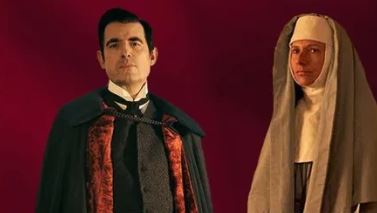
I admit to being a fan of the vampire genre: books and movies. Most recently, the BBC produced Dracula released in 2020 on Netflix.[1] It starts as a smart retelling of Bram Stoker’s novel with visual homages to classic movies along the way, but quickly takes new narrative turns. Unfortunately the series had a very short three-episode run despite quality production.

More episodes please!

My favorite scene in the series: Dracula is awakened in the current era after an entombment of a hundred years. His first encounter with the modern age is with a modest home owner. He has feasted on the husband and confronts the wife Kathleen in their house. Looking around the cluttered home:

Dracula “You are clearly very wealthy”

Kathleen (incredulous) “Wealthy?”

Dracula “Yes. Well, look at all this stuff. All this food. The moving picture box (nods to the television). And that thing outside, Bob calls it um … a car. Is that yours?

Kathleen (nods and breathlessly answers) “Yeah.”

Dracula “And this treasure trove is your house!”

Kathleen “It’s a dump.”

Dracula “Its amazing. Kathleen, I have been a nobleman for 400 years. I have lived in castles and palaces among the richest people of any age. Never … never! Have I stood in greater luxury than surrounds me now. (Scanning the cluttered room.) This is a chamber of marvels. There isn’t a king, or queen or emperor that I have ever known or eaten who would step into this room and ever agree to leave it again. I knew the future would bring wonders. I did not know it would make them ordinary.”

I love that line! A poignant reminder that we do in fact live in an age of abundance and ease. And we take it all for granted and anticipate even greater convenience in the future. The irony is that our modern conveniences make daily labor rare so that we have to pay to exercise. We struggle with obesity not famine.

And watching history unfold from a disinterested perch (mere humans are food after all) grants a vampire the ultimate perspective of the longue durée. The vampire is very aware of the changes through time.

With a nod to Neil Gaiman, I amuse myself thinking about how such perdurable creatures might manifest now. Think about the Moirai (Fates): Clotho spun the thread, Lachesis drew it out and Atropos cut it. I smile to think that they now own DNA testing laboratories thinly prognosticating our moment of death. Protein chains as the thread of life.

How the hell does this pertain to Aikido and the martial arts?

This morning we covered sword basics. In describing the fundamental use of the katana and how the blade must be stopped by wringing the hands inward, my observation was that we moderns do not have the necessary grip strength. We do not daily work with our hands or engage with the sword often enough to wield it with effective ease. What should be normal is now specialized activity.

I recall reading about a history professor skeptical of Herodotus’ assertion that at the Battle of Marathon, “The Athenians advanced at a run towards the enemy, not less than a mile away.” The incredulous professor asked the college football team to don hoplite gear and replicate the run. None accomplished it. The professor concluded that Herodotus yet again got the facts wrong; the Athenians could not possibly have run to engage the Persians and then battled them to prevail.[2]

The arrogance of moderns! That football players could not replicate the martial feat should come as no surprise. A bronze panoply weighs nearly 70 lbs, approximately 50 lbs more than football gear. When not in annual battle, the ancient Greeks were in the fields plowing rocky soil and walking everywhere. No modern conveniences, no mechanical advantages beyond the basic lever and wheel. Everything was toil and, yes, people were tougher then: Because life was harder, people had to be.

So, when thinking about techniques and how they are applied, understand that we are all under-conditioned. When dealing with weapons and control techniques, hand strength is a pre-requisite to efficacy. And mental toughness is mandatory. We now label grit as if it’s a trait to be curated and not a byproduct of life-as-lived. When was the last time you slaughtered an animal to fill your larder? I have had to ‘process’ pigs and chickens in the past but have only ever hunted for ‘fun’ and never out of necessity. I relish the convenience and ease I take for granted. As a result, I am weaker for it.

The point is this: better nutrition, education and training methods are no substitute for the raw experience of daily exertions.

Dracula marveling at our material gains and highlighting the creature comforts we all enjoy also gave me a twinge of guilt; a reminder that easy is not qualitatively better. I have to remind myself: If the goal is improvement, we must do what does not come easy!

_____________

[1] BBC’s “Dracula” was created by the same visionary team that created the earlier BBC series “Sherlock.” See the footnotes in >Mining the Moon<

[2] I found the proper citation while reading Victor Hanson’s The Western Way of War and correct my imperfect memory of the study in that post.

_____________

Update – >here< is a brilliant essay on Dracula, time and economic growth