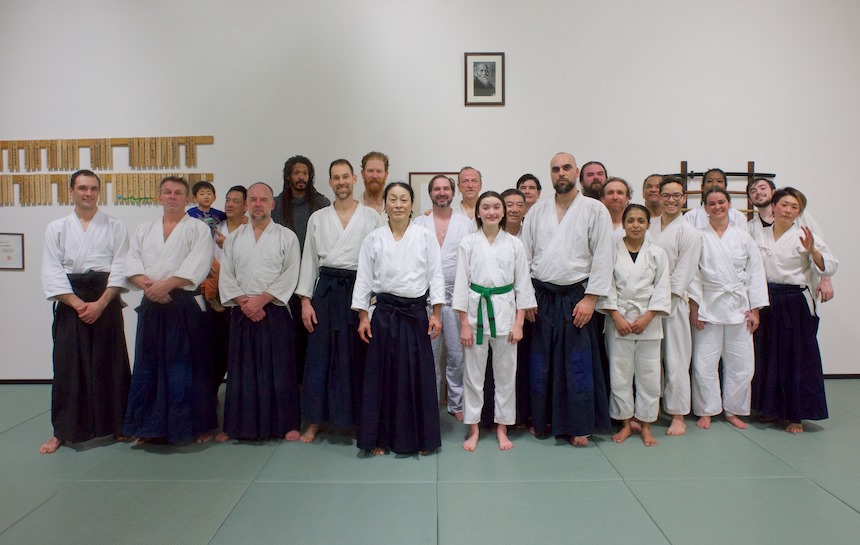
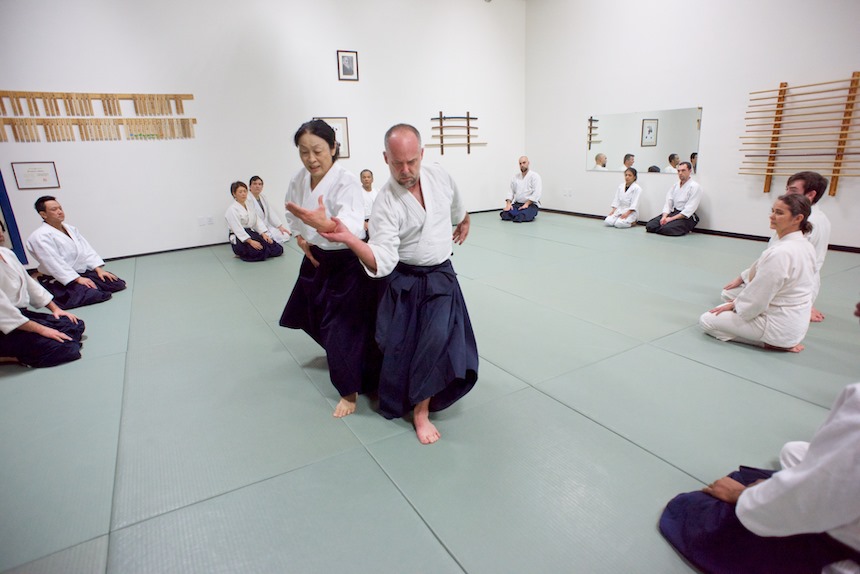
Yoko Okamoto returned to Portland Aikikai for a workshop. This was the first visit to the new location after a four-year gap. It was not a publicized seminar so she was able to concentrate on Portland Aikikai students.
Okamoto sensei is much in demand and we are fortunate to have a familial connection to enjoy her undivided attention.
The highest expression of Aikido’s art is the connection between the players and the movement around the axis of the encounter. Okamoto sensei focused and drew upon exercises to develop that sensitivity and understanding of the art.
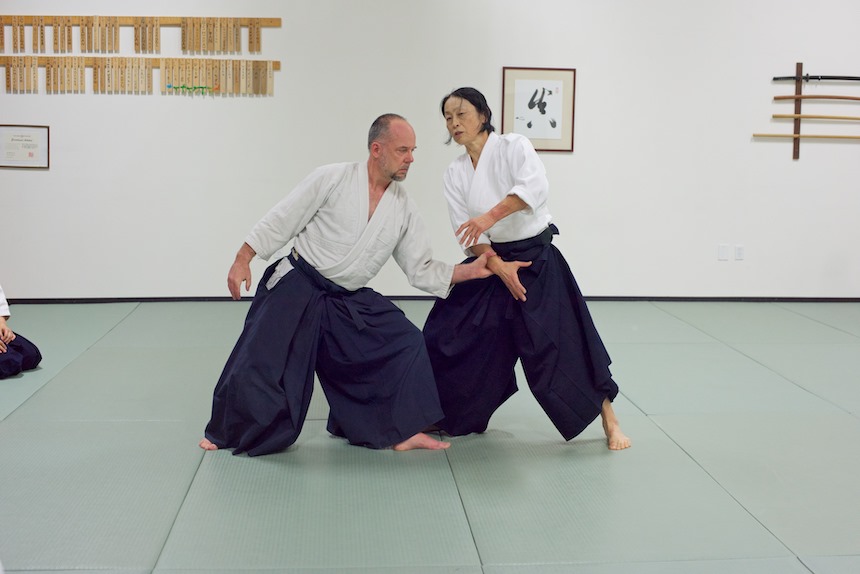
To develop that sensitivity, Okamoto sensei worked from gyaku hanmi katate dori and specifically on moving around the axis of the encounter without disturbing uke’s initial grab.
The point is that without information uke has no reason to change the connection. Uke should grab with sincere intention and nage must move around the point so as not to create a secondary action in uke and thereby create a cascade of reaction-action-reaction.
Hence a quiet connection but one where both players maintain their respective intentions. Therefore, once uke grabs (and properly with the lower three fingers primarily) and if the grasp is opened as a result of movement, then uke re-grabbing is a fiction. Uke needs to move with continuity through the engagement, not stop, grab and snatch again. Smooth engagement. Progressive training is the focus. Start from static and build slowly: slow is smooth, smooth is fast.
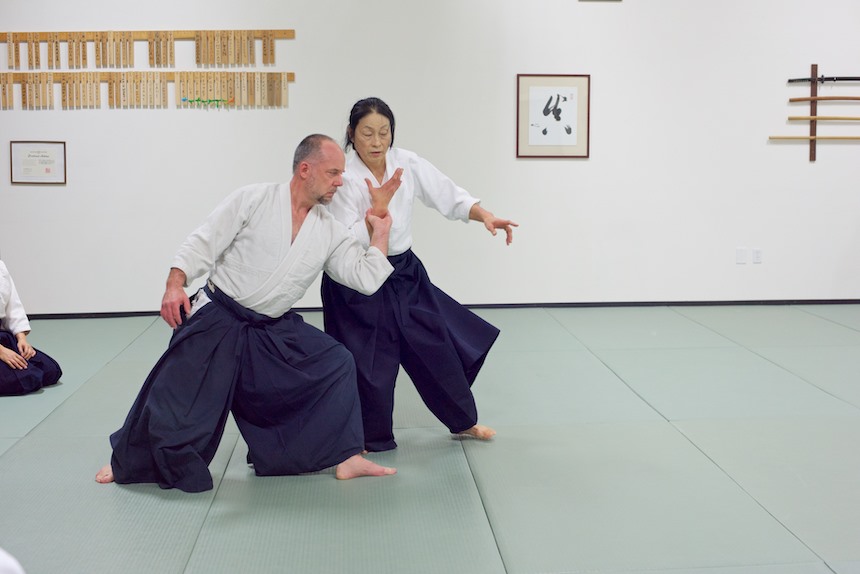
Superior position is nage’s intent and Okamoto sensei demonstrated this at first by controlling uke’s elbow. Starting from compression, Okamoto sensei’s demonstration and explanation is less polemic, but the function is what I call bone locking.
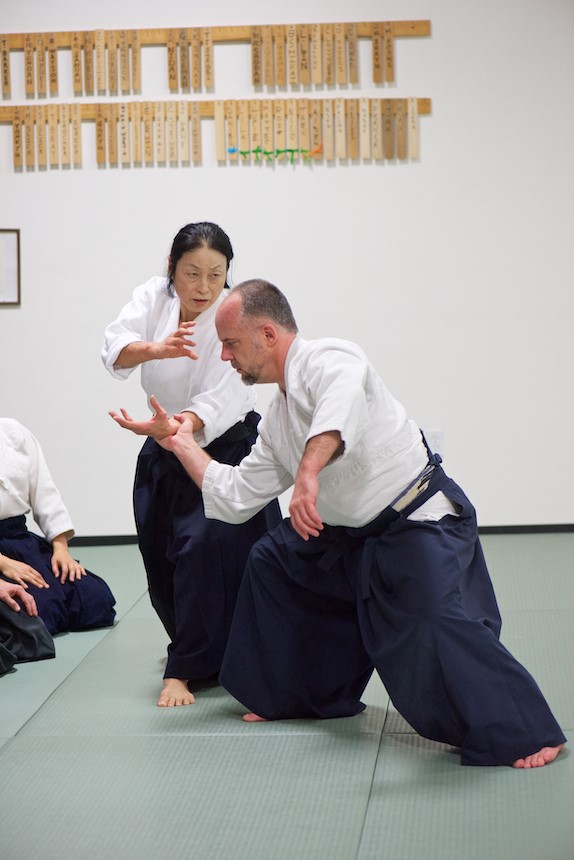
The second presentation was extension – a leading action. By extending uke’s elbow, uke’s balance is taken forward.
The techniques that follow from each of the entries are genuinely far less important than the means of gaining the position that makes a technique possible.
First principles!
Proper position is necessary for any and every technique that follows. That is the key take-away from the workshop.
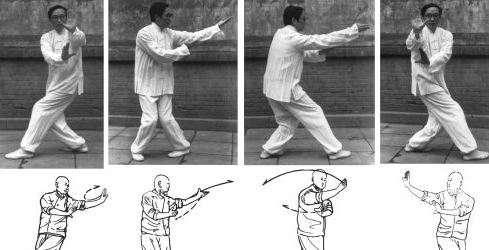
For some time now, I have incorporated a basic hand and body exercise into my “warm up” sequence from Bagua Zhang – “opening hands” (see 3:36 for a reminder).
The Bagua movement in isolation may seem awkward at first. I present it as a global body movement adding trunk and hip rotation and done one side at a time.
Why?
Learning a patterned movement sequence in isolation is good solo training especially when you can see that the flow pattern is irimi nage when using the head as the lever, and kotegaeshi when using the wrist.
Go through the motion solo: it is a circular dissolve. Now envision performing yokomen-uchi kotegaeshi. The Bagua will lead you to intercept the strike, control uke’s line to your center, then the wrist roll to the lock / disarm. Move up the body line and take the arm above the elbow and the pattern leads to irimi nage omote. Move higher still to the head and it becomes a neck break. Same pattern of motion resulting in three techniques.[1]
The nuances of each interaction requires explication in the dojo, but abstracting to and discussing the principles (the potentials) of the movement as a concept is its power. Same pattern, just different ranges as you move up the body from distal to core.
This leads us back to ranges of combat. Aikido is a ‘long range’ art because the weapons used to inform its principal techniques were long: the katana, bayonet, and to a lesser degree the wakazashi and tanto.[2]
Longer weapons extend the range of combat but they have the effect of necessitating using the musculature of the core. As a generalization, the longer the weapon, the larger muscle groups required to deploy it.
Hence, the weapons in Aikido are deployed two-handed. And because the tanto is used to pierce armor, it is used not as a knife, but rather as a spike.
The point is: Aikido’s range has been defined by its weapons and its development of the tanren (core) is a logical byproduct of the type of body engagement needed to effectively deploy and counter the weapons used.
Note that this is a rather specific development to a cultural point in time and therefore just one data set in investigating the range of human motion. Hence using a Bagua exercise to find the principle and potential of the movement rather than focus on the specifics of technique.
Change the weapons and the ranges change dramatically. I default to the Philippines where the confluence of Spanish and Filipino cultures preserved useful distinctions of range.
The family of Filipino Martial Arts (FMA) is essentially, Eskrima which is derived from Spanish esgrima, “fencing,” Arnis – short for arnés de mano, Spanish for “harness of the hand,” and Kali which may derive its name from the karis (kris), or a combination of the Filipino words for body (kamot) + motion (lihok).
The named ranges generally are largo, medio, and corto.
Corto Mano: close range, short movements, minimal extension of arms, legs and weapons, cutting distance
Largo Mano: long range, extended movements, full extension of arms, legs and weapons, creating distance[3]
Medio Mano: medium range, splits the difference (and often involves a long + short weapon: espada y daga)
The technical nature of combat changes as the distance between opponents changes and will have specific techniques to contend with those variables of time, distance and speed.
But in this brief review I want to emphasize one point: that by seeing the conceptual power of a pattern of movement one can deploy the same movement to solve for the problems created at various ranges.
[2] The typical dojo wood tanto is too short. The traditional blade length was between 6 to 12 inches. The typical wood tanto in the dojo is about 11 inches in total length.
The practice or policy of including people who might otherwise be excluded or marginalized, such as those who have physical or mental disabilities and members of minority groups.
A paean to exclusivity.
In this milquetoast world we now parade limitations not as obstacles to overcome, but rather as badges of honor that everyone else must accommodate. It was not always thus. A recent example of cream-puffery, Oxford voted to ban clapping as anxiety inducing and encourage ‘jazz hands’ to indicate celebration and approval.[1]
Do not impose your limitations on me! The entire bloody enterprise is about cultivating and aspiring to excellence. We strive to overcome barriers and obstacles. Especially in the context of the martial arts. All are welcome to walk the path but the destination is self mastery and that requires acknowledging limitations with the explicit goal of surpassing them.
Mandatory, legislated or even encouraged inclusion is sheep think: the easiest way to make my line longer is to shorten everyone else’s. We should acknowledge differences in ability to ensure everyone has a clear path to improve and lengthen their line.[2] Stated simply, equal outcomes cannot be legislated.
Back to jazz hands. Sound is powerful. We humans neurologically react fastest to loud sounds: they cause a startle response that bypasses interpretation by the brain. This is the most direct contact we have to an unmitigated experience of reality. That clapping can induce anxiety clearly is hypersensitivity, but that is why we train, to overcome biological limitations.
Overcome the startle response.
While training pistol marksmanship with a good friend, who is a much better shot than I, the instructor noticed my friend blinked on each shot. Although the reflex was not dramatically adverse to his marksmanship, nevertheless it was a limitation. To train away the reflex, we did a simple drill: point the muzzle in a safe direction, and while engaging in general banter and light conversation, simply keep discharging the weapon. Split the attention and keep repeating the action to train through the reaction. It worked.
In any and every area of human performance there are statistical aberrations, and on both ends of the spectrum. Some humans unfortunately will never be able to overcome their genetic inheritance and others will benefit from an ease most can never imagine. Tough shit buttercup – that’s the genetic lottery. We all have limitations, the point is: what are you going to do about it?
Think you have limitations? Many are self-imposed. Consider the following, which demonstrates a level competency and self-control I aspire to:
No flinching!
How hard are you willing to work and how much effort are you prepared to commit to the task of betterment? That is the key question and once you answer it, then you need prove it with action.
Train to be worthy of an elite organization.
And here is the most salient point: exclusivity should be a means to inspire. Elite organizations exist because they are demonstrably better. Not everyone can become a Navy Seal, a brilliant author, a mellifluous musician, or whatever superlative you want to use. (Elite Competition) The point is that pinnacles of achieved excellence are goal posts to strive for and against which we can measure our own progress.
Furthermore, freedom of association necessitates exclusivity. Everyone does not belong everywhere. And privacy means no one has a right to universal access.
Once we mandate inclusivity or dictate membership based solely on statistical or demographic ratios, the enterprise is up. The goal is to strive and transcend. You cannot legislate equality of effort. Effort can only be proven through sustained action. (And the ugly fact is: Pareto distribution shows that 20% of any given population produces 80% of the benefits.) Many will fail and that is the only way to determine those who transcend and excel.
Critical reflection means facing hard truths. You will fail, your actions will not always measure up and at times you will suck.[3] And this is the key test of character: What will you do now?
Surround yourself with people smarter and better than you are is a long-standing maxim of business success. The same should be true of our general associations. Fight the war on excellence. Find a cohort that inspires you to be your best and who support your path of development. No pandering to weakness.
If someone tells me that I’ve hurt their feelings, I say, “I’m still waiting to hear what your point is” [4]
_____________________
[1] In a Guardian article, Stephanie Cacioppo, the director of the Brain Dynamics Lab at the University of Chicago Pritzker School of Medicine, discussed her research into a pill that could help lonely people lessen the pain associated with the emotional state and lessen their fear of socializing with others (the research paper). Brave New World anyone? The sad fact remains that for most afflictions and limitations, the current Western approach is to solve for it with medicine – a technocratic solution – a pill for everything. Marcus Aurelius – where art thou?
[2] The Hidden Brain “Counting Other People’s Blessings” is a good exploration of envy. Envy can be a positive motivator, but is often a vile emotion of self pity or destructive comparisons (thank you Facebook).
[3] Without testing the Dunning-Kruger Effect will run rabid. Let me dilate on that point:
In Ecco Homo, Friedrich Nietzsche labels his early chapters, “Why I am so wise,” “Why I am so clever,” “Why I write such excellent books” in a manner that approaches hubristic self-aggrandizing.
Nietzsche was an excellent classicist and knew the dangers of hubris. So he was writing purposefully to demarcate a break in thought. And history has shown he was not wrong. Nietzsche did in fact know himself – and his mental collapse perhaps is proof that ultimately he knew himself to be all too human.*
In knowing how human he was and in diving the depths of psychology, Nietzsche exemplified the Delphic admonishment to “Know thyself.”
Gnothi Seauton – Gk. “Know thyself.”
Know what type of being that you are and recognize your true abilities. This should not lead to a self-deprecating or shrinking confidence, but rather the critical evaluation of your skills and where they stand in relation to others. Testing in a competitive environment was key. The Argives were constantly testing themselves – in the Olympiad, during domestic battles and foreign wars, and in critical debates. In an honor-based world, one’s place was constantly evaluated and positionally predicated on performance.
Without competition, we run the risk of the Dunning-Kruger Effect which is a cognitive bias whereby people who are incompetent are unable to recognize their own incompetence and as a result are likely to confidently believe that they actually are competent. Meta-stupidity.**
Honest training is the only feedback mechanism Aikido has and without honest training the Dunning-Kruger Effect is rabid in the art.
Constant competitiveness has the distinct psychological disadvantage of letting you know exactly where you stand. Hard training is much the same; people avoid it because it is hard and because it reveals weakness and inadequacy.
And here is an important, if ironic, twist. The general advice of “fake it ’till you make it” is sound advice. There is good research that shows if you believe you are faster, you will run faster than your peers. If you know you will survive a gun shot, you will.
I believe it was in the Mag 20 class that Massad Ayoob pointed out that criminals often better survive gun shot wounds because when playing cops and robbers, the ‘good guys’ have been psychologically conditioned to play by the rules and therefore die at a higher rate than the bad guys who were conditioned to break them. The key to surviving is knowing you will.
And thus a fine line between a positive confidence to enhance our ability to perform measured against the delusional belief that we are in fact better than everyone else.
_______________
* Milan Kundera poignantly describes Nietzche’s collapse: “Seeing a horse and a coachman beating it with a whip, Nietzche went up to the horse and, before the coachman’s very eyes, put his arms around the horse’s neck and burst into tears. That took place in 1889, when Nietzsche, too, had removed himself from the world of people. In other words, it was at the time when his mental illness had just erupted. But for that very reason I feel his gesture has broad implications: Nietzsche was trying to apologize to the horse for Descartes” (The Unbearable Lightness of Being).
** Bertrand Russell summed up the situation in an essay from 1933 lamenting the rise of Nazi Germany, The Triumph of Stupdity:
The fundamental cause of the trouble is that in the modern world the stupid are cocksure while the intelligent are full of doubt.
[4] Christopher Hitchens will probably be best remembered for God is Not Great and his stage debates with various persons of faith. He had earlier polemics that were just as confrontational – calling Mother Teresa a fraud and Princess Diana a socialite of the worst sort – but his erudite journalism and ability to debate intelligently in the public arena remain seminal.


 Protective Arts