
Herbert Hoover and Moral Engineering

Yesterday (October 3, 2025), Heidi and I visited the Hoover–Minthorn House in Newberg, Oregon. The house, built in 1881 by Jesse Edwards, the Quaker founder of Newberg, stands behind a white picket fence, its clapboard walls repainted in pale yellow. 

The corner of S River St and E 2nd St (front door faces E 2nd St)

Murray Rothbard had already set my prejudice against Hoover, so the visit was a sardonic excuse to do something ironic. The museum is sparse and quaint, so obviously devoid of artifacts that I was amused when the docent asked “Is this your first time visiting?” – why would anyone come a second time? Nevertheless, it was an educational visit. I hadn’t realized Herbert Hoover was an orphan, raised as a Quaker, or knew anything about his uncle, Dr. Henry Minthorn.

I mused that the house, originally built for the founder of Newberg, was small and modest even by New England Protestant standards. The sparse furniture is advertised as having been used by Hoover as a boy: a small bed framed in walnut, a washstand with a ceramic pitcher, a plain dresser with turned knobs and no veneer.
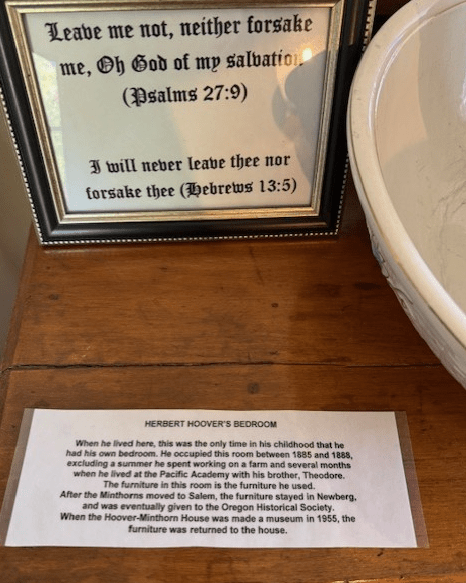

“The furniture in this room is the furniture he used.”
Practical and plain

This is furniture meant to teach sufficiency, not luxury. 

But how did Hoover come to live with his uncle? Hoover arrived in Oregon in 1885, at eleven years old, sent west to live with his maternal uncle Dr. Henry John Minthorn after the deaths of both parents. The Minthorns, Quaker educators recently settled in Newberg, offered him structure. Hoover would later recall, “The doctor was a mostly silent, taciturn man, but still a natural teacher.” The boy became, in effect, a junior apprentice, helping with his uncle’s patients, working in the family garden, and attending Friends Pacific Academy (today’s George Fox University). Years afterward, Hoover referred to Minthorn as “my second father,” and though the remark is affectionate, it carries the tone of duty rather than warmth. Hoover summed his uncle/father:

He had originally been sent to Oregon as a United States Indian agent. He was one of the many Quakers who do not hold to extreme pacifism. One of his expressions was, “Turn your other cheek once, but if he smites it, then punch
him.” With this background of sporadic talks from him, the long tedious drives over rough and often muddy forest roads became part of my education.

Herbert Hoover, Memoirs of Herbert Hoover: Years of Adventure, 1874–1920

Dr. Minthorn was superintendent of the Chemawa Indian Training School, one of the government’s assimilation institutions founded on the belief that Indigenous cultures must be “civilized” through labor and erasure. Under Minthorn’s tenure, children were compelled into unpaid work, punished for speaking native languages, and drilled in what the Bureau of Indian Affairs then called “habits of industry.” The system was unquestionably brutal; an experiment in moral improvement through coercion. The lesson for young Hoover was paradoxical: that compassion could justify discipline, and that order could masquerade as care. The logic of benevolent control, first rehearsed in his uncle’s school, would echo later in his own administrative life, where relief and regulation became indistinguishable gestures of conscience.

In his mid-teens, he left Newberg for California to attend Stanford University, newly opened and dedicated to the fusion of moral purpose and applied science. He studied geology, worked his way through school, graduated in 1895, and entered the world as a practical idealist. 

He began modestly, as a mining engineer, moving quickly from the American West to Australia and then to China, Burma, and London. He developed a reputation as the man who could “make a sick mine well.” By his mid-30s he was internationally known and, by the standards of the day, independently wealthy, worth several million dollars by 1914. Wealth gave him freedom from clients, employers, and ordinary constraints. It also hardened a conviction: that competence was legitimacy. 

Engineering is a noble profession. The great liability of the engineer compared to men of other professions is that his works are out in the open where all can see them. His acts, step by step, are in hard substance. He cannot bury his mistakes in the grave like the doctors. He cannot argue them into thin air or blame the judge, like the lawyers. He cannot, like the architects, cover his failures with trees and vines. He cannot, like the politicians, screen his shortcomings by blaming his opponents and hope the people will forget.

Herbert Hoover, “Engineering as a Profession,” address at Columbia University, February 17, 1908.

Hoover’s success abroad coincided with the twilight of the high-Victorian faith in progress. Where earlier generations spoke of Providence, Hoover spoke of planning. For him, engineering was moral architecture. The moral engineer was not a philosopher but a solver of problems.

The engineer is the pioneer of progress, the builder of our civilization. He must be honest not only in his works but in his purpose, for upon him rests the material foundations of our national life.

Herbert Hoover, Address to the American Society of Civil Engineers, 1910.

It’s no surprise that when the First World War broke out, his instinct was not to choose sides but to organize relief.

In August 1914, with Europe paralyzed by mobilization, more than one hundred thousand Americans found themselves stranded on a continent suddenly at war. Banks had suspended credit, telegraphs were cut, and steamship routes were seized for military use. London was crowded with anxious travelers who could neither pay their hotel bills nor return home. Hoover, then a prosperous mining engineer living in Mayfair, was the obvious man to turn to: solvent, respected, and organizationally fearless. Within twenty-four hours of being approached, he convened a committee of volunteer businessmen, opened offices throughout the city, and personally advanced funds to those in need. “Within twenty-four hours,” he later recalled, “we had organized a committee, established a hundred offices, and had found food and shelter for more than ten thousand Americans.” His committee soon arranged for special trains to carry destitute tourists to ports, and by the end of the crisis had repatriated more than 120,000 people.

That extraordinary efficiency brought him to the attention of diplomats. The American ambassador in London, Walter Hines Page, and U.S. Minister to Belgium Brand Whitlock asked Hoover to coordinate a far more daunting mission: the feeding of an entire nation. Belgium, occupied by German forces and cut off by a British naval blockade, faced starvation. Hoover accepted at once, founding the Commission for Relief in Belgium (CRB) in November 1914. It was a private, neutral organization, an early NGO with quasi-sovereign scope. The CRB negotiated directly with the British and German governments, arranged shipping under a special flag, and distributed food to nine million civilians under strict supervision.

I had never been in public life, yet suddenly I found myself dealing with governments, generals, diplomats, and kings.

Herbert Hoover, Memoirs of Herbert Hoover: Years of Adventure, 1874–1920

Over the next four years, the CRB delivered more than five million tons of food, financed largely by private credit Hoover secured from American and British banks. He operated outside formal government channels but with the confidence of them all. His success transformed him from engineer to humanitarian and, in the eyes of millions, from private man to public servant.

The pattern that would define the rest of his life was set: moral obligation expressed through management, compassion rendered as logistics. Hoover’s genius lay in administration: he persuaded warring governments, organized supply chains, and kept volunteers working under impossible conditions. Hoover harnessed the power of non-coerced but coordinated human activity.

When Congress passed the Lever Act and Wilson created the U.S. Food Administration, he tapped Hoover, who agreed only on condition of a free hand and a direct line to the White House. Hoover then declined any salary, arguing he could better ask Americans to sacrifice if he took none himself. Though the statute armed the agency with licensing and other controls, Hoover ran the program by persuasion: a nationwide, voluntary conservation drive with encouraging slogans, “Food Will Win the War,” meatless and wheatless days, pledge cards, and home-economy pamphlets, designed “to appeal to volunteerism and avoid coercion.” 
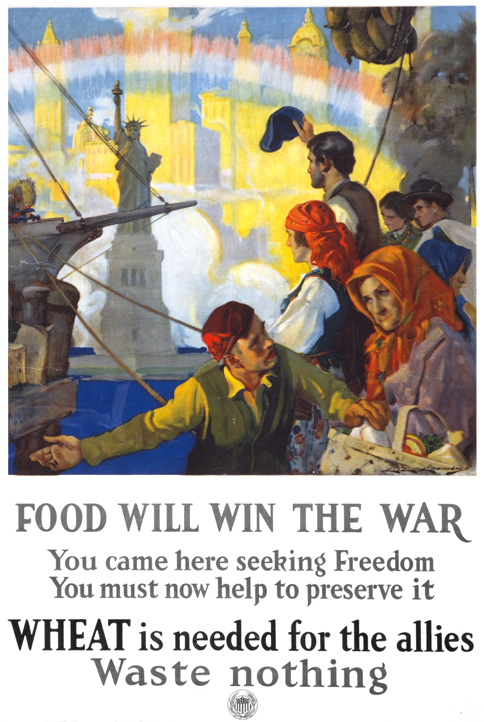
US Food Administration propaganda by Charles Edward Chambers

By 1920, Hoover had become an international figure; admired, rich, and politically unaligned. Both parties courted him. He declined. Politics, he claimed, was a distraction from constructive work. But the distinction would not hold. Moral engineers inevitably drift toward power, because power is simply authority in its most efficient form. 

The ideal of efficiency is a moral one… Waste is immoral because it results in loss of life, of comfort, of happiness.

Paraphrased from Hoover’s essays and public speeches collected in American Individualism (1922).

In 1921, President Harding offered Hoover the post of Secretary of Commerce. It was a minor department; Hoover made it central. He modernized industrial standards, promoted aviation, radio regulation, flood control, and statistical coordination. He believed government should guide, not command, “a partnership of service,” as he called it. But partnerships require hierarchy. Over time, his “cooperation” looked increasingly like supervision. 

When Coolidge declined to run in 1928, Hoover was the obvious successor. He campaigned as a business-progressive reformer and won in a landslide. 

Then came the crash. 

Historians generally portray Hoover as the president who “did nothing” while the economy collapsed, the passive apostle of laissez-faire. But this fails to appreciate what Hoover knew from direct experience worked, voluntary coordinated action. He had proven success with the CBR and the Food Administration. Hoover never conceived of deficit spending as a legitimate policy; he endured it as a failure of circumstance. “The course of unbalanced budgets,” he warned, “is the road to ruin.” His deficits arose not from Keynesian conviction but arithmetic necessity: collapsing revenues, emergency relief, and congressional pressure to “do something.” Like the Smoot–Hawley Tariff, it was an act of political concession rather than conviction. By 1932, he presided over a $2.7 billion deficit (the largest peacetime shortfall in U.S. history) while simultaneously raising taxes to restore balance. The irony, as Rothbard later observed, is that Hoover became “the first Keynesian president by accident,” creating the prototype of New Deal interventionism while still preaching fiscal rectitude.

Between 1929 and 1933, Hoover expanded federal spending from $3.1 billion to $4.6 billion, a 47-percent increase in the midst of economic collapse. The national budget swung from a $700 million surplus to a $2.7 billion deficit, the largest peacetime fiscal shift in U.S. history to that point. Hoover’s administration launched vast public-works programs, loans through the Reconstruction Finance Corporation, and emergency credits to banks and railroads, measures that broke with classical orthodoxy, even if they are considered de rigueur today.

For Rothbard, interventionism exacerbated the problems, so his calling Hoover a natal New Dealer is an indictment. a man whose moral compulsion to coordinate and correct led him to prefigure the very administrative state that would replace him. Rothbard labels Hoover the first interventionist Republican, the prototype of Roosevelt. “The myth of the ‘do-nothing president,’” Rothbard wrote, “is one of the most grotesque distortions of our historical record.” Hoover’s every instinct to stabilize, coordinate, and act delayed recovery. To Rothbard, the Depression was not cured by the state but prolonged by it. 

Rothbard’s critique is brutal but clarifying. To his credit, Hoover’s interventionism did not spring from a lust for power but rather from virtue: the same virtue that once organized Belgian relief. He simply transferred the habits of humanitarian control to the domestic economy. Where a believer in liberty sees crisis as a teacher, the moral engineer sees it as a design flaw. His reflex is correction. 

Rothbard’s larger argument (in America’s Great Depression and essays such as “Herbert Hoover and the Myth of Laissez-Faire”) rests on a psychological as much as an economic diagnosis. The Quaker ethic of moral stewardship, Rothbard suggested, translated into political paternalism.

Hoover was the prototypical ‘progressive’ who sought to substitute the discipline of the market for the moral guidance of the State, administered by a hierarchy of experts.

Murray N. Rothbard, Herbert Hoover and the Myth of Laissez-Faire, The Freeman (1959)

Hoover’s conviction that goodness and expertise were twins made intervention appear righteous. 

After his defeat in 1932, Hoover endured years of vilification, blamed for breadlines he had tried to prevent. (The contemporaneous label ‘Hooverville’ for Depression-era shantytowns was itself a popular indictment of his policy failures.) Yet he outlived his critics. By the 1940s and ’50s, his reputation had softened; President Truman enlisted him to head the Hoover Commission on Government Reorganization, a grand attempt to make bureaucracy more efficient: a final, ironic testament to his lifelong faith in organization. 

He spent his last decades writing, lecturing, and defending the ideals of private initiative and voluntary cooperation. But the record speaks otherwise. The man who preached voluntarism had once cajoled industries into conformity; the champion of efficiency had presided over systemic collapse. His contradictions were American ones; moralism expressed as administration, benevolence fused with bureaucracy. 

Buckminster Fuller, born twenty years after Hoover, inherited the same civilizational optimism but redirected it toward design rather than governance. Hoover wanted to feed the hungry; Fuller wanted to eliminate hunger through material abundance. Hoover trusted the morality of cooperation; Fuller trusted the inevitability of technology. Hoover’s mind was procedural, Fuller’s visionary. Yet both shared a premise: that humanity could be engineered into virtue. 

Had Fuller ever governed, the result might have been beautiful and disastrous: geodesic bureaucracies, aluminum utopias, public housing as sacred geometry. Rothbard would have recognized in Fuller the purest expression of the same hubris: design as destiny. Both men believed that good will plus technical intelligence could outwit disorder. 

Standing in Hoover’s childhood bedroom, you sense how early the pattern began. The furniture’s plainness carries a moral aftertaste. The washstand bears a small plaque quoting Psalms and Hebrews: “I will never leave thee nor forsake thee.” The verse, meant as comfort, reads here almost as a command. The Quaker household permitted no extravagance, no idleness, no self-indulgence. 

His uncle’s life offers the footnote. Dr. Minthorn genuinely cared for his Indian school wards, but he also believed they could be “civilized” by erasing their cultures. He embodied the archetype of benevolent coercion: moral improvement imposed as duty. The continuity to Hoover’s later governance is chillingly direct. The doctor’s clinic becomes the president’s economy, both structured around the assumption that human suffering is an engineering problem. 

I’m not as absolutist as Rothbard, but the moral geometry still troubles me. Markets and human liberty remain untidy, inefficient, and occasionally cruel. But they are also the only feedback system that coordinates without moralizing. Every moral engineer begins with the best of intentions: Hoover feeding Belgium, Fuller designing a world that works for all, Dr. Minthorn educating the “wards of civilization.” Yet, once institutionalized, each ends by constructing a system that sustains itself rather than solves the problem it was meant to address. The institutions become centralized, self-justifying, not problem solving. 

The engineer’s burden is the conviction that human failure can be prevented by better plans. The harder truth is that failure is the one mechanism that keeps us free. Markets correct because they allow error to occur. Liberty endures because it tolerates imperfection. 

Hoover never learned that lesson; Fuller never had to. Both believed virtue could be systematized, and both mistook coordination for consent. Rothbard, the unrepentant skeptic, saw the danger early: that even good men, armed with moral purpose and organizational genius, can produce tyranny by efficiency. 

_____________________

In 2025, tariffs rise again under the banner of national strength, as though protectionism were patriotism reborn. The old Hooverite delusion, “we can design stability,” is revived by men who have never known restraint. The new tariffs, imposed with swagger and incuriosity about consequence, deliver the same ruin: collapsing supply chains, rising prices, vanishing trust. Where Hoover acted from conscience, Trump acts from appetite (and without Congressional authority). It is not stewardship that guides him, but vengeance masquerading as strategy.

Hoover at least believed in order as a moral duty. Trump believes only in domination as a personal right. Where Hoover agonized over deficits and balance, Trump boasts of leverage and threat. Hoover’s tariffs were a blunder born of misplaced faith; Trump’s are a weapon aimed at spectacle. What Hoover did out of misguided virtue, Trump repeats out of performative bullying.

Hovering over this new administration are its engineers. This time not Quakers but profiteers like Elon Musk, self-anointed visionaries of efficiency who see government as a machine to be optimized (data mined?), not a republic to be tended. Hoover sought to redeem waste through planning; Musk and his peers sanctify chaos as innovation. Their “efficiency” has no moral core, no Quaker plainness, no limit. They want to run government as a platform devoid of conscience. It is Hooverism without virtue, Fullerism without beauty, management without mercy.

We have come full circle: the same administrative will to control, now serving ego instead of order; the same rhetoric of efficiency, now severed from any ethic of care. The arrogance of government “providing solutions” has reached its terminal form: a state not of benevolent control but of predatory calculation. Every Hoover needs a Rothbard to remind him that efficiency without liberty is tyranny. In 2025, no such reminder is heeded. The result is not the tragedy of good men mistaking virtue for power, but the spectacle of powerful men mistaking power as a virtue.

_____________________

Herbert Hoover Presidential Library and Museum – published writings

Gholas and the Eternal Golden Braid

On September 30, 2025, researchers at Oregon Health & Science University announced they had developed functional eggs from human skin cells. Immediately, I thought of Frank Herbert’s gholas.[1]

Duncan Idaho is the most-reborn man in Dune. From his first appearance on Arrakis, he is marked as archetype: Swordmaster of Ginaz, sensual, loyal, utterly alive. (Jason Momoa’s portrayal comes closest to Herbert’s sketch: curly “goat hair,” swarthy vitality, women quick to respond to him.) In Dune, Duncan dies protecting Paul Atreides’ retreat, only to return as the first successful ghola. In Dune Messiah, the Bene Tleilax present him as proof-of-concept: a body regrown from cells, memories dormant, a gift meant to tempt Paul with the promise of a resurrected Chani if he yields the throne.

It is Paul’s son, Leto II, the God Emperor, who makes Duncan unique in all human history: the man most often chosen for serial rebirth in the Axlotl tanks. Not resurrected once, but cloned, conditioned, and reawakened across millennia, until his identity grows thin beneath the weight of accumulated memory. Thinness here is not weakness but tautness: bandwidth under tension, more memory forced through the same channel. Each rebirth carries more: Mentat training, Zensunni philosophy, battlefield mastery. Yet Duncan remains bounded; he lacks the Siona marker, remains vulnerable to prescient scrying, and by Chapterhouse: Dune is slower and weaker than his genetically honed contemporaries.

Thinness, then, is the paradox of aging itself: physically diminished, yet far wiser, calmer, more deliberate than the swordsman who died for Paul. Duncan becomes a proxy for all men, his arc stretched across time. As skills and judgment accumulate, raw speed and strength recede. Duncan is pulled taut across the centuries, tensile with memory.

Published in 1965, Frank Herbert’s Dune planted the seed of a cycle that would carry Duncan Idaho across millennia. More than a decade later, Gene Wolfe’s Book of the New Sun appeared, serialized between 1980 and 1983. Wolfe was writing after Dune, and the resonance shows: both authors use memory as the vehicle of identity and continuity, though in strikingly different registers. Herbert presents Duncan as a man reborn serially, stretched thin across centuries. Wolfe reimagines the motif in Severian, the Autarch who carries within him the absorbed memories of all previous rulers. Duncan is the endlessly cloned swordmaster, his identity braided across bodies; Severian is the executioner-king, his identity layered across voices: a Bakhtinian polyphony, embodied.

Wolfe makes memory transfer possible through the alzabo: a beast that consumes human flesh and with it the voices of the dead, its glands distilling a potion that allows humans to take on another’s essence. Herbert’s Bene Gesserit encode a similar principle at the genetic level: their Reverend Mothers descend into the long braid of female memory, accessing lives embedded in DNA. Duncan’s gholas are another version of this recursion: not only flesh reconstituted, but memory carried forward, cumulative, accretive, stretching identity until it thins.

Humanity in all these visions is not merely a genome but a continuity of memory: swallowed, inherited, or regrown in the Axlotl Tank. It is memory, more than body, that constitutes persistence across time. But as in Duncan, persistence is never without strain: the self expands, yet grows taut, pulled across too many lives.

Modern science edges toward this possibility. Memory is no longer seen as confined to neurons. Immune cells “remember” past pathogens, carrying scars of inflammation. Glial cells, once dismissed as mere scaffolding, prove to be active stewards of memory formation, pruning synapses and tuning blood supply. Even skin and gut cells exhibit biochemical priming, altering responses based on prior experience. Memory, at its broadest, is cellular persistence: time inscribed into structure. But as in Duncan, too much inscription risks crowding out plasticity; structure itself grows thin. Into this widened frame arrives the OHSU experiment. By extracting the nucleus of a skin cell and coaxing it through a novel process they call mitomeiosis, researchers managed to mimic the chromosomal halving of meiosis. The result: eggs carrying the donor’s genetic signature, some of which could be fertilized in vitro. A handful developed into blastocyst. Most failed. None were carried further. The conceptual leap, however, is staggering: from somatic tissue to gamete, from a patch of skin to the beginnings of a human being. If cells outside the brain can “remember,” and if skin cells can be retooled into gametes, then the possibility of ghola-like cloning draws closer to plausibility. Not yet the resurrection of memory in a new body, but the reconstitution of the body itself from tissue that was never intended for reproduction. The scaffold is being built.

Here Blade Runner becomes the counterpoint. Tyrell’s Nexus-6 replicants are engineered with short lifespans, four years, to hedge against recombinatorial instability. Their personalities are stabilized by implanted memories, borrowed from others, which lend a sense of grounding but undermine authenticity. This is front-loaded thinness: stability purchased at the cost of expiration. Duncan, by contrast, bears back-loaded thinness: not expiration by decree, but attenuation by accumulation. Each life stretches further, but each new inscription narrows plasticity. Replicants expire because their design won’t bear long duration; gholas grow thin because their history overwhelms flexible adaptation. One collapses under the burden of too little time, the other under the burden of too much. Both are metaphors of recombinant stress. Both ask whether the weave of memory (implanted or accumulated) can sustain a coherent self across discontinuity.

Douglas Hofstadter’s Gödel, Escher, Bach: An Eternal Golden Braid describes recursion and self-reference: patterns that loop and echo at higher orders. Duncan is recursive in this sense: each ghola iteration loops back, carrying forward fragments of memory, layering them again. But unlike Bach’s fugues, which preserve motifs with crystalline fidelity, Duncan’s fugue is lossy, noisy, entropic. Each return repeats the theme of Idaho, but inverted, stretched, blurred. Here the skeptical note matters: recursion in formal systems is exact; recursion in biology is not. To press the metaphor too far is to mistake resonance for equivalence. But Herbert’s point is precisely this: identity is not preserved like a mathematical proof; it is refracted like a fugue, made audible only across multiple imperfect voices. Thinness is the strain we hear when too many voices overlap.[2]

By the end of Chapterhouse: Dune, Duncan flees the Watchers in a no-ship, bearing not only the genetic template of the first Idaho but centuries of layered memory. The Watchers call him thin because he is stretched across time, across selves, across lives. Like Vonnegut’s Tralfamadorians, who perceive all moments simultaneously, Duncan escapes because he has become duration itself. Herbert’s gholas, Wolfe’s eater of memory, Scott’s unstable replicants, Walker’s life-as-time, Hofstadter’s eternal braid, all circle the same question: can life weave continuity across discontinuity? Can memory persist beyond the fragile vehicle of the brain, into cells, into culture, into tissues that become seed once more? For now, 2025 is fragile: OHSU’s eggs are unstable, cellular memory is only partly mapped. Yet each threshold crossed makes the Ship of Theseus problem less an abstraction and more a practical matter. We may one day learn that our cells, too, remember enough to weave us forward. Never resurrected, but always reawakened, stronger in pattern, into the long braid of time.

_____________________________

[1] Months after writing this post, I watched Lex Fridman’s interview with Michael Levin. Amazing!

[2] “What, if some day or night a demon were to steal after you into your loneliest loneliness and say to you: ‘This life as you now live it and have lived it, you will have to live once more and innumerable times more; and there will be nothing new in it, but every pain and every joy and every thought and sigh and everything unutterably small or great in your life must return to you, all in the same succession and sequence…’”

“Would you not throw yourself down and gnash your teeth and curse the demon who spoke thus? Or have you once experienced a tremendous moment when you would have answered him: ‘You are a god and never have I heard anything more divine.’”
The Gay Science, §341, “The Greatest Weight” (trans. Walter Kaufmann)

Nietzsche’s demon asks not whether life will repeat, but whether one could will its repetition eternally. The eternal return is a test of affirmation: could one embrace every joy and every pain, if condemned to relive them infinitely and identically? It presupposes a perfect memory, because only perfect recollection would make recurrence meaningful. Without memory, repetition is irrelevant. Nietzsche’s challenge is therefore ethical, not cosmological: to affirm the totality of life, unchanged, forever.

Herbert’s Duncan Idaho makes that metaphysics biological. Across Dune Messiah, Children of Dune, God Emperor of Dune, Heretics of Dune, and Chapterhouse: Dune, Duncan is not resurrected but iterated. Yet Herbert denies him the perfection Nietzsche requires. Each ghola begins as a blank organism; his memories return only through trauma or shock. In Dune Messiah, Hayt’s recollection “burst like a flood through a broken dam.” In God Emperor of Dune, Leto II calls this process “the pattern of his becoming.” By Chapterhouse, the Bene Gesserit admit, “He is never quite the same man.” Memory in Herbert’s world is partial, unstable: an entropy of recall that fractures identity even as it preserves continuity. Duncan is Nietzsche’s eternal return rendered material, and therefore mortal: recurrence under mutation.

Kundera, writing a century after Nietzsche, reverses the equation. The Unbearable Lightness of Being imagines the horror of perfect recurrence. “What happens but once might as well not have happened at all,” he writes; repetition gives weight, but infinite repetition would crush meaning. When Sabina refuses to spend eternity with Tomas, she affirms mortality as completion; a single life sufficient unto itself. Her “No” is both a betrayal of eternity and an act of self-preservation. Nietzsche’s heavy joy becomes, in Kundera’s world, the unbearable weight of perfection.

Herbert’s Duncan occupies the uneasy middle: he is neither permitted forgetfulness nor granted full remembrance. Each new life begins anew, haunted by echoes that cannot be perfectly placed. Herbert’s universe thus transforms eternal return into iterative decay. Memory functions like genetic transcription; capable of fidelity but always vulnerable to drift, noise, mutation. A perfect return would require a perfect system, immune to entropy. Herbert, Darwinist to the core, insists that life is entropy harnessed for persistence. A ghola with flawless recall would calcify; Duncan survives because he forgets enough to change.

The moral of this imperfect return is evolutionary: it is not recurrence that sanctifies life, but imperfection that permits becoming. Kundera’s Sabina and Herbert’s Duncan converge on this truth: eternity without loss is unlivable. Forgetting, far from failure, is freedom.

Current neuroscience supports Herbert’s intuition. Memory is not a recording but a reconstruction. Each act of recall alters the neural trace; reconsolidation updates memory with new context. Synaptic pruning and transcription noise keep the system plastic. Perfect memory would be pathology. Even at the molecular level, life depends on imperfection. DNA transcription and epigenetic methylation are probabilistic, not absolute; the very drift that causes aging also enables adaptation. Biological systems fight entropy by folding it into learning.

In this light, Nietzsche’s perfect recurrence becomes impossible physics, and Herbert’s lossy recursion a form of realism. The ghola’s fading precision mirrors the brain’s own strategy: remember approximately, or not at all. Biology sides with Kundera and Herbert. The lightness of being is not nihilism, but metabolism. A perfect return would freeze time; an imperfect one allows it to braid.

The Demographic Shadow

In my 2022 post on Soylent Green, I traced how the film’s revelation, “Soylent Green is people,” dramatically literalized overpopulation as self‑consumption, a horror that lingers because it feels both absurd and, from an ecological perspective, plausible. That image was a cultural zygote: mutating into other forms of demographic dread across decades. In 2025, we look back not just at dystopian spectacle but at a longer narrative of how societies imagine, dramatize, and try to engineer population futures.

In 1968, Paul Ehrlich published The Population Bomb, warning of mass famine, societal collapse, and the need for coercive population controls.[1] The book became a media event. Ehrlich debated on television with an air of inevitability, and the Club of Rome’s Limits to Growth (1972) injected computer‑modeled collapse scenarios into mainstream discourse. Fiction tracked alongside: Soylent Green (1973) embodied overcrowding nightmares and Logan’s Run (1967/1976) imagined technocratic culling.[2] 

What gave Ehrlich and the Club of Rome their wide acceptance was the migration of the ecological concept of “carrying capacity” into human affairs. The idea, rooted in Verhulst’s 19th-century logistic growth model (inspired by Malthus), was widely used by biologists like Eugene Odum. Wildlife managers spoke of the carrying capacity of a pasture for deer or cattle. By the 1950s, William Vogt’s Road to Survival (1948) had already applied the metaphor to humans. Ehrlich and the Meadows team amplified a frame already primed: humanity as herd, pressing against an ecological ceiling. Metaphor hardened into policy. NGOs and governments then implemented policy, most dramatically in India’s sterilization campaigns of the 1970s, before China made its own decisive turn. Charismatic leaders mislead; states coerce. The latter is always the more dangerous.[3]

The most dramatic implementation was China’s one‑child policy. The ‘Later, Longer, Fewer’ campaign of the early 1970s already encouraged reduced fertility. Song Jian, a missile scientist, then applied cybernetic models to Chinese demography, projecting catastrophic overshoot absent drastic measures. Here the metaphor of carrying capacity was decisive. Song treated fertility like rocket trajectories: variables to be modeled, thresholds to be enforced. His charts gave scientific legitimacy to leaders already convinced that growth threatened modernization. By 1980, the one-child regime was coercively enforced through fines, propaganda, and, in many cases, forced sterilization or abortion. The legacy is a demographic hangover of aging, skewed sex ratios, and shrinking labor supply.

Ehrlich’s intellectual hubris of the over-population prediction cashiered on September 29, 1990. On that day he mailed Julian Simon a check for $576.07, settling their ten-year wager on the future of resource scarcity. In 1980, Ehrlich had staked his case on five metals—chromium, copper, nickel, tin, and tungsten—convinced their prices would soar as humanity pressed against the planet’s carrying capacity. Simon, betting instead on markets and ingenuity, predicted the opposite. By 1990, every one had fallen in real price, undone by discovery, substitution, and efficiency (Tierney, 1990). The wager stood as a proxy for the population crisis itself. Yet the predicted calamity was not overpopulation, just the great political famines orchestrated by Mao and Stalin.

The irony is that the Communist curtailment of freedom and the Western celebration of it both converge to a similar condition, what Nicholas Eberstadt calls the Age of Depopulation. Fertility collapse now grips East Asia, much of Europe, and reaches into the Americas: the alarm has reversed, from too many mouths to too few births.

The Western economic logic is straightforward. With declining infant mortality and higher income, families concentrate resources on fewer children. Gary Becker formalized this in his economic theory of fertility: children shift from economic necessity to hedonic expansion and sometimes a Veblenian display of wealth (“I can afford them”).[4] Yet behavior is not only economic but recursive. We learn from what others do. Dawkins’ memetics (the spread of ideas, habits, and norms) explains demographic swings as much as policy. In high-fertility eras, the skills of child-rearing and sibling care were learned across generations; in low-fertility eras, small families reproduce themselves culturally as well as biologically.

That suggests family size is not simply a response to incentives but a cultural competence that can be forgotten. If large-family formation has been unlearned, recovery may require more than subsidies. Sweden’s pro-natalist cycles suggest subsidies buy time but not permanence. A true return to replacement fertility would demand re-learning the rhythms, competencies, and social scripts of raising multiple children. In this light, the next demographic turn will come less from technocratic fiat than from memetic diffusion.

Demography may be destiny, but when governments impose demographic policy the results are disaster. Frank Herbert grasped this in fiction: that controlling sexuality and procreation is one of history’s most dangerous temptations. The Catholic Church understood it early; the message to “fructify the Earth” was joined with control of marriage and reproduction, producing a tool of population management and wealth accumulation.[5] Herbert saw the danger in treating human fertility as an equation to be solved, a temptation that carried Malthusian logic into empire and church alike. What Ehrlich and Soylent Green dramatized in the 1970s was ecological alarm; but it manifested, in China, as coercion. Today’s depopulation panic risks repeating the error in reverse: mistaking narrative urgency for policy inevitability. Without forced breeding, decline looks inexorable. The behavioral and economic logic of small families has been adopted broadly as a norm, memetic and recursive across much of the West. We appear to have cultural amnesia: the loss of the skill of family formation.[6]

____________________________

[1] For the 50th anniversary of The Population Bomb, Paul Ehrlich resurfaced on 60 Minutes and in The Guardian, insisting once again that the “collapse of civilisation is a near certainty within decades.” The prediction, repeated for half a century, now sounds less prophetic than compulsive. He still appears on small podcasts, warning of overpopulation, though the supposed Malthusian limit has migrated: not soil and food this time, but the destabilizing heat of agriculture and energy on the climate.

To his credit, Ehrlich is nothing if not consistent. To a biologist, the notion of carrying capacity is elegantly foundational, with powerful predictives. The difficulty is that he insists on applying it to humans, thereby ignoring culture and technology. Buckminster Fuller remains his best foil. Where Ehrlich sees limits as hard stops, Fuller saw them as design challenges. For Fuller, ingenuity is the decisive human trait, and pessimism nothing more than abdication. And so far, history has sided with Fuller’s wager: ingenuity has outpaced entropy. Ehrlich is a blinded cleric of Malthus, repeating the catechism even as the empirical gods refuse his prayer.

[2] Based on Matheson’s I Am Legend (1954), The Omega Man (1971) dramatized depopulation. The same cultural moment feared both excess and absence. Ehrlich warned of crowded streets; Matheson and Heston walked through empty ones. Soylent Green (1973) literalized Ehrlich’s nightmare: too many mouths consuming each other in a terminal economy of scarcity. The Omega Man (1971), put a twist to the panic, a plague leaving Neville the “last man,” with the survivors biologically transformed into a hostile mob. The fear was not of numbers but of the wrong people left, a mass rendered unrecognizable, anti-technological, and destructive of memory.

Then Silent Running (1972) offered the most ascetic parable: nature itself was the endangered species. Bruce Dern’s Freeman Lowell tends the last forests, sealed in domes orbiting Saturn, and when ordered to destroy them, he kills his crew and himself, preserving the trees by launching them alone into space. Where Ehrlich and Soylent Green framed humanity as the devourer of nature, Silent Running went further: humanity was the disposable element, the price worth paying to let photosynthesis continue.

Seen together, the trilogy dramatized the cultural logic of the early 1970s, the Limits to Growth (1972) moment and the origins of ecological awareness. Population, plague, and ecology became interchangeable metaphors for collapse. In one script, we choke on our own numbers (Soylent Green); in another, we are undone by transformation and plague (The Omega Man); in a third, we sacrifice ourselves to preserve the planet (Silent Running). All three share the same haunting backdrop: Malthus in new guises, asking whether the limit lies in land, in people, or in nature itself.

I imbibed the mythic origins, so the Greta Thunberg strikes me as a shrill tonal rupture. The ecological jeremiads of the 1970s presented ecological awareness as myth and consequence: nature as sacred, limits as parable, catastrophe as a solemn warning. Thunberg inverts that register. Her speeches frame climate change not as mythic inevitability but as political betrayal. “How dare you?” is not prophecy but prosecution. In doing so, she politicizes what was once contemplative, converting ecological awe into moral outrage. That shift is not a deepening of the myth but its perversion: a demand that awe be weaponized into grievance. Politicization is always an act of violence.

[3] Herbert’s caution was always double-edged. In interviews he said Dune was, at its core, a warning against charismatic leaders. A hero could seduce a people into surrendering judgment, and from there into tyranny. But the subtler danger, and the one more directly relevant to Ehrlich and the Club of Rome, is the state that arms itself with “scientific” inevitability. Once the metaphor of carrying capacity was transposed from deer herds to human beings, it offered bureaucrats and planners a language of necessity: limits, thresholds, overshoot. The danger was not merely being misled by a prophet but being coerced by a state that claimed biology as its warrant. In India’s sterilization campaigns of the 1970s, or China’s one-child regime of the 1980s, ecological metaphor hardened into fiat. Herbert’s prescience was in recognizing that once life itself is treated as an equation to be solved, the temptation to enforce the “solution” becomes irresistible. His warning about the hero thus extends to the apparatus behind him: charisma dazzles, but it is the state that compels.

On the ecological front, Herbert’s timing was uncanny. Dune predated the Club of Rome, The Population Bomb, and the cinematic panic of the 1970s. His ecological education was practical, tested in the Oregon dunes where he reported on federal experiments to stabilize sand with imported grasses. Walking those shifting landscapes with Wilbur Ternyik, he saw how human intervention could redirect wind and water across centuries. Howard Hansen, a Quileute elder, pressed him to take ecology seriously and gave him Paul Sears’ Where There Is Life, a book Herbert later said shaped his thinking as much as anything else. Sears’ maxim, that the highest function of science is to give us “an understanding of consequences,” echoes through Liet-Kynes. Other texts, like Leslie Reid’s The Sociology of Nature, with its portraits of tightly coupled resource cycles, provided academic insights Herbert could scale into planetary myth. By the time Dune appeared in 1965, his self-education had become a synthesis: Indigenous land wisdom, soil conservation practice, and mid-century popular ecology. While Ehrlich was still sketching famine graphs, Herbert had already written a myth in which ecology was destiny and fertility a lever of empire. He gave ecology the permanence of scripture, turning Sears’ warnings and the dunes’ lessons into parable. And parables endure longer than panic.

But Herbert was most prescient in his treatment of sexual energy. He saw eros not as subplot but as a civilizational engine. The Bene Gesserit reduced it to data, an index managed across centuries. The Fremen disciplined it into fertility for survival. The Imperium bent it toward loyalty and control. Again and again, Herbert dramatized the same temptation: to treat sexuality as just another ecological variable. Yet whenever the design seemed airtight, vitality burst free: through Paul’s love for Chani, through Leto II’s deviations, through Duncan Idaho’s refusal to remain a pawn. Herbert’s lesson is stark: sexuality is never mere indulgence; it is the most volatile energy of the species. Harness it, and you may steer history for a time. Try to master it completely, and collapse follows.

[4] Becker and Emmanuel Todd can be read as adversaries, but I view them as complements. Becker’s Treatise on the Family (1981) provides the economic “genotype”: households weigh costs and benefits, shifting from many children of necessity to fewer children of higher investment as incomes rise and mortality falls. Fertility collapse thus begins as a rational recalibration. Todd, by contrast, illuminates the cultural “phenotype.” In The Explanation of Ideology (1985), he maps family systems onto political structures: egalitarian nuclear families yielding liberalism, authoritarian stem families sustaining hierarchy, communitarian clans underpinning collectivism. In this frame, the same Beckerian household calculus expresses differently depending on the kinship culture that mediates it. A nuclear family system may interpret low fertility as a lifestyle choice; a communitarian system may absorb it into kinship solidarity; an authoritarian system may see it as threat to hierarchy. Becker explains the evolutionary logic of fertility decline; Todd reveals how that logic blossoms into divergent political orders. Read together, they suggest that the economic rationality of family life has cultural origins and that demographic decline is never just arithmetic, it is also ideology embodied.

[5] Genesis 1:28 commands humanity to “be fruitful, and multiply, and replenish the earth, and subdue it” (KJV). The Catholic Church not only transmitted this injunction but institutionalized it. By the early medieval period, it had asserted jurisdiction over marriage, sexuality, and inheritance through canon law. Jack Goody (1983) argues that this “marriage and inheritance revolution” was not mere theology but a structural strategy: by prohibiting levirate marriage, consanguinity, adoption, and easy remarriage, the Church effectively redirected wealth away from extended kinship networks and into ecclesiastical hands. Widows and childless couples, deprived of kin channels, often donated property to monasteries, bishoprics, and ecclesiastical foundations. This gave the Church immense demographic leverage: control of fertility through sacramental marriage and control of patrimony through legal restriction. The economic consequences were staggering. By the sixteenth century, ecclesiastical holdings constituted a massive share of European land and wealth, which Henry VIII famously confiscated during the Dissolution of the Monasteries (1536–1541), seizing centuries of accumulated treasure.

[6] The economist Tyler Cowen has argued that America’s long-run prosperity depends less on preserving a perfect fertility rate and more on maintaining a dynamic inflow of people. In Average Is Over (2013) and later essays (2020), he stresses that immigration policy is the critical margin for sustaining innovation, labor supply, and cultural vitality in the face of domestic fertility collapse. For Cowen, the alarm is not famine but sclerosis: a society that forgets how to reproduce itself demographically and culturally must offset that amnesia by recruiting talent and energy from elsewhere. The United States, unlike East Asia or Europe, possesses the geographic and institutional openness to do so, but only if policy is intentional. The paradox is stark: family formation is a skill that must be re-learned, yet until it is, immigration becomes the substitute skill: imported vitality standing in for forgotten rhythms of reproduction.

Here Emmanuel Todd offers a counterpoint. His work shows that demographic systems are not just arithmetic but cultural blueprints, reproducing political orders across centuries. Assimilation succeeds only when newcomers adapt to the host kinship model: in America, the egalitarian nuclear family and the democratic individualism it underwrites. Cowen’s optimism thus depends on the very cultural confidence Todd insists is fragile. Immigration can buy time, but it cannot substitute indefinitely for a culture that forgets how to reproduce itself or if it allows in a people unwilling to adopt the host culture.

____________________________

Selected Bibliography

Becker, Gary S. A Treatise on the Family. Cambridge, MA: Harvard University Press, 1981.

Club of Rome. Meadows, Donella H., Dennis L. Meadows, Jørgen Randers, and William W. Behrens III. The Limits to Growth. New York: Universe Books, 1972.

Cowen, Tyler. Average Is Over: Powering America Beyond the Age of the Great Stagnation. New York: Dutton, 2013.

Cowen, Tyler. “Why Immigration Is America’s Greatest Strength.” The Atlantic, January 2020.

Eberstadt, Nicholas. Men Without Work: America’s Invisible Crisis. Rev. ed. West Conshohocken, PA: Templeton Press, 2017. (See also Eberstadt’s essays on the “Age of Depopulation.”)

Ehrlich, Paul R. The Population Bomb. New York: Ballantine Books, 1968.

Goody, Jack. The Development of the Family and Marriage in Europe. Cambridge: Cambridge University Press, 1983.

Graziosi, Andrea. “Stalin’s and Mao’s Famines: Similarities and Differences.” East/West: Journal of Ukrainian Studies 3, no. 2 (2016): 9–34

Greenhalgh, Susan. 2005. “Missile Science, Population Science: The Origins of China’s One-Child Policy.” The China Quarterly, no. 182 (June): 253–76.

Herbert, Frank. Dune. Philadelphia: Chilton Books, 1965.

Logan’s Run. Directed by Michael Anderson. Beverly Hills, CA: Metro-Goldwyn-Mayer, 1976.

Longman, Phillip. The Empty Cradle: How Falling Birthrates Threaten World Prosperity and What to Do About It. New York: Basic Books, 2004.

Odum, Eugene P. Fundamentals of Ecology. Philadelphia: W. B. Saunders, 1953.

Reid, Leslie. The Sociology of Nature. London: Penguin Books, 1958.

Sears, Paul B. Where there is Life. New York: Dell Publishing, 1970.

Simon, Julian. The Ultimate Resource. Princeton: Princeton University Press, 1981.

Soylent Green. Directed by Richard Fleischer. Beverly Hills, CA: Metro-Goldwyn-Mayer, 1973.

The Omega Man. Directed by Boris Sagal. Burbank, CA: Warner Bros., 1971.

Tierney, John. “Betting the Planet.” The New York Times Magazine, December 2, 1990.

Vogt, William. Road to Survival. New York: William Sloane Associates, 1948.