Janus again as a featured image to symbolize the start of a new year and for 2018 I will embark on a new experiment. For the past two years, I have been focusing of teaching concepts rather than techniques (re-visit the beginning) in order to train the trainers. For this New Year I will systematically go through the basic kihon of the Aikido curriculum. I hope to still elucidate concepts – or at least help make connections – through teaching the techniques but the direction of the pedagogical thread will be inverted.
Why? I want to ensure a systematic presentation of the curriculum and focus on teaching to the test (rather than training the trainers). The USAF Aikido standard testing requirements will define the curriculum. I will cover all the techniques required for shodan (1st degree black belt). Please make a study of the USAF test Matrix (which also includes Hombu dojo’s) as well as the requirement sheet.
There are a total of 29 discrete techniques required for 1st kyu which jumps to a minimum presentation of 35 for shodan in the USAF Requirements. For comparison, at Hombu 31 are required for 1st kyu but at shodan the requirements cover “all forms.” However, look at the time requirement for days of practice: In Japan the time commitment necessary to achieve shodan is less than half that in the United States.
Remember – the reason for the difference is primarily cultural. Meaning, shodan in Japan is clearly understood as demarking the start of training, the beginning of real learning and refinement; whereas in the United States shodan often denotes the beginning of teaching. My goal is to clearly impart the curriculum in a clear and concise manner so as to build a solid foundation for efficient training, genuine understanding, and future refinement.
Let us be clear. Teaching to the test is nothing more than a quick way to show how to replicate the basic responses. I do not believe that this is the best way to impart understanding. I do however think it is necessary to ensure that the framework for future learning is solid. And testing is an important aspect of training in Aikido.
The total number of techniques is small when you recognize that there really isn’t a significant difference in the execution of the movement (the response) when done from different positions (modes) – i.e., from standing, both sitting, and only nage seated (and omote and ura forms). In a list form, the number of techniques looks more intimidating than it should be:
Katatetori Shihonage (omote & ura)
Katatetori Nikyo (omote & ura)
Hanmi handachi: Katatetori Shihonage (omote & ura)
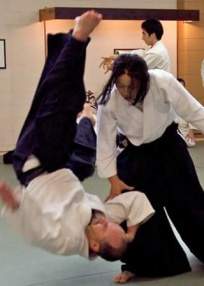
Katatetori Kaitennage (uchi & soto mawari)
Morotetori Kokyunage (omote & ura)
Morotetori Nikyo (omote & ura)
Morotetori Iriminage (2 variations)
Morotetori – 5 Techniques
Tsuki Iriminage (irimi, tenkan & tenshin variations)
Tsuki Kotegaeshi (tenkan)
Tsuki Kaitennage (omote & ura
Ryotetori Tenchinage (omote & ura)
Ryotetori – 5 Techniques
Koshinage – 5 Techniques
Katatori Nikyo (omote & ura)
Katatori Sankyo (omote & ura)
Katatori Menuchi – 5 Techniques
Ushiro Tekubitori Kotegaeshi (omote & ura)
Ushiro Tekubitori Shihonage (omote & ura)
Ushiro Kubishime Koshinage (2 variations)
Ushiro Tekubitori Jujinage (omote & ura)
Ushiro Tekubitori Sankyo (omote & ura)
Ushiro Ryokatatori Kotegaeshi (omote & ura)
Ushiro Ryokatatori Sankyo (omote & ura)
Hanmi handachi: Ushiro waza – 5 Techniques
Shomenuchi Ikkyo (omote & ura)
Shomenuchi Iriminage
Shomenuchi Nikyo (omote & ura)
Shomenuchi Ikkyo (omote & ura
Shomenuchi Sankyo (omote & ura)
Suwari waza: Shomenuchi Iriminage Shomenuchi Nikyo (omote & ura)
Shomenuchi Shihonage (omote & ura)
Shomenuchi Kaitennage (omote & ura)
Hanmi handachi: Shomenuchi Iriminage
Shomenuchi – 5 Techniques
Yokomenuchi Shihonage (omote & ura)
Yokomenuchi Iriminage (3 variations)
Yokomenuchi Kotegaeshi (omote & ura)
Yokomenuchi Gokyo (omote & ura)
Yokomenuchi Kotegaeshi (omote & ura)
Yokomenuchi – 5 Techniques
If you take the time to break each attack and response into a collective matrix, the number of possible combinations are impressive and I would point you to Stefan Stenudd’s well-thought compilations. Another good mental frame work would be the list here.
Ultimately, these frameworks that create discrete boxes and if-then style thinking need to transform into an organic logic-chain – in other words, techniques need to be reduced back to concepts. Nevertheless, because focusing on the connections without a clear understanding of the discrete elements is challenging – back to the basic pedagogy for a while.
____________
[For those who want a quick video-reference reminder – one could do no better than to review Tissier’s lessons.]
 Protective Arts
2 thoughts on “BACK TO BASICS”