The opening move of san no tachi begins with both players connecting their ken near the kissaki. Keeping the connection flat to flat, the initial move is to snappily turn uke’s blade off-line and cut the thumb while simultaneously sliding to the flank. Nage’s right hand started vertical (seigan no kamai) and now has turned nails down to cut ‘do.’ Done properly this is all that is necessary to win: either uke has lost a thumb or was eviscerated, or both. So it is with sword fighting – maximum results with minimal movement.
RvR (ai hanmi) is the primary set up but RvL (gyaku hanmi) is a potential. The technique is the same just done on the opposite side of the sword. The movement pattern is simple, but it does require proper timing, pressure, distance, and speed: all the messy variables that we are learning to control and control for.
And because things that can go wrong will, we need a back-up plan. In this situation, continuity of motion is the plan. Nage follows the do cut by stepping through (across and in front of uke) while raising the sword jodan to pivot quickly 180-degrees and deliver a shomen strike to finish off uke. Of course, if uke was incapacitated by the first strike, the secondary flow cut could be delivered to any of nage’s four primary quadrants (front, left, right, back) hence shi-ho-nage (4 direction throw).
We have covered shihonage as a technique and this elaboration is to tie back to the foundation in weapon play.
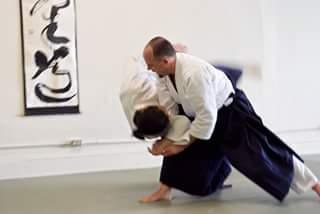
The sword play correlates directly with aihanmi and gyakuhanmi shihonage. In a RvR/LvL situation nage must counter grasp with the thumb acting as primary control. With uke’s arm controlled by nage’s firm grasp, uke’s arm becomes nage’s sword, uke’s elbow is the kissaki which nage draws across uke’s belly. Gyakuhanmi as a RvL/LvR simply changes nage’s initial control from his thumb to the shyuto (hand blade). The gross body motions remain the same – control uke’s arm by treating it as if it were a sword while flanking.
The details of effecting the throw depend upon which part of uke’s body nage controls better. The kihon version focuses on a wrist control. Nage must forcefully fold uke’s wrist down and drop precipitously – this is a tight cut which would, if done with a sword, result is the tip snapping down and the hilt rising, a battle field cut. Kihon is a wrist lock to ensure that uke’s elbow remains close to vertical, preventing a counter.
The throw typically taught as advanced is an applied lever. In this version rather than nage forcing uke’s wrist into a bent lock, nage allows uke to maintain a straight wrist. Nage can execute this version of the throw one-handed. The elbow is the fulcrum and the force of the cut is delivered when nage extends his hand out and down while raising his elbow – this is an extending or arcing cut. It works on a larger surface area than the kihon version which is an isolation lock: entire arm vs distal wrist.
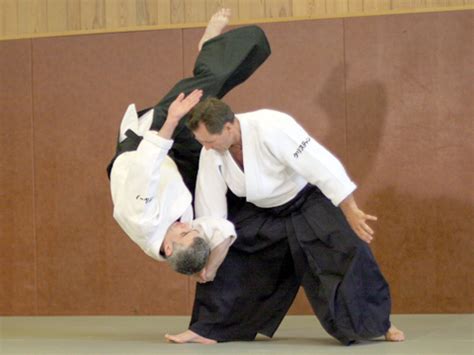
These details, just like the examination of any variables are best explored in the dojo.
So the contact exercise of katatedori mimics the initial blade to blade contact. Stepping back in time to the point before contact is made becomes tsuki. We must now work to establish contact. Chudan tsuki is the first variable to defeat. The two primary means are a traditional ge-dan-uke karate block (back hand cut-over / aihanmi) or a front-hand brush block (gyaku hanmi). Which method is used is contextual based on the initial starting position and rate of approach. This cannot be a ‘block’ that deflects uke’s strike too far off line but rather is a means of establishing contact to gain connection that leads to control.
From tsuki the initial response is not immediately to shihonage, but rather udekiminage. With contact established nage must execute two beats in linked succession to trap uke’s elbow hyper-extension in order to break it. That is the combative goal (defang the snake). The challenge of executing a three-beat counter to a single beat attack is that uke will have time to react. Done brilliantly, nage will disable uke’s elbow before uke can react, but uke will attempt to preserve his elbow by contracting it. As soon as uke contracts the elbow, nage will be able to execute shihonage as a back-up. Always have a back-up plan.
__________________________
Developmental exercises from Chiba sensei – gyaku hanmi shihonage
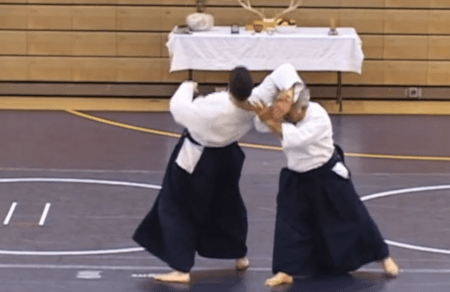
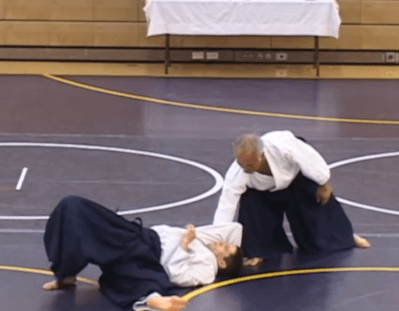
Chiba sensei told the story on how a judo expert attempted to sweep O’Sensei’s lead leg while he threw shihonage, so O’Sensei changed how he entered for the throw:
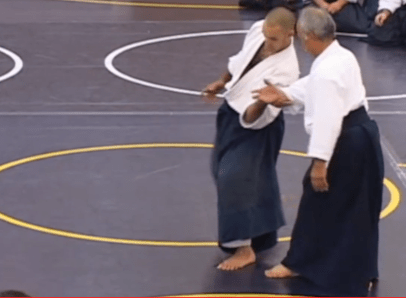
An absorbing footwork rather than a direct entry. (Chiba sensei, nevertheless did not often present the entry in that manner…)


2 thoughts on “SHIHONAGE”