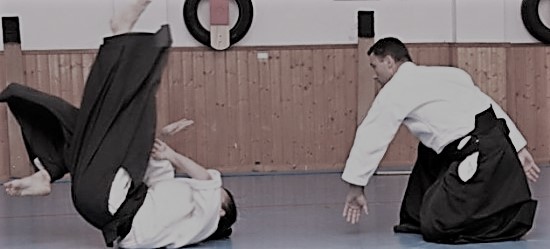
Kata dori menuchi must start with a proper grab >review< to set the logic of the encounter. Uke initiates the action by grabbing the nage’s lead shoulder (because it is closest) and performs an overhead strike (shomen uchi) with the back hand.
Although nage’s shoulder is grasped, the arm remains free to move. Watch Yamada sensei >here< as a good reminder on immediate responses (starts at 0:55), but for pedagogical simplicity, we explored only the direct intercept where nage receives uke’s strike by raising the grabbed arm so that the encounter is a RvR encounter.
The timing and sequence of actions is important. As a training exercise simply being able to remain stable and balanced as uke grabs the shoulder and draws nage forward and down is an invaluable lesson. Nage must be well-connected to the ground and have a tight hara to resist the grab attack. Next as the overhead strike is delivered, nage must intercept the arm by shooting in. There are three basic times for nage’s response. In superior time, nage strikes uke as soon as uke grasps the shoulder – this forces uke to block nage’s strike. In proper time (the kihon presentation), nage will anticipate the strike and be able to execute ikkyo omote. With inferior time, nage is responding to uke’s descending strike and must turn ura to escape the hit.
Starting with tanren geiko to develop proper grounding, uke starts with the grab and both players match the strikes to ensure good dynamic tension. Uke should be applying two vectors of force – a downward descending draw on the shoulder and then a constant vertical force toward nage’s head. To resist those forces, nage’s raised arm needs replicate a sword (the unbendable arm concept). This locks the players into dynamic tension. From that state of tension both players are engaging good kokyu.
By starting from a point of tension, both players can start to feel how and where the axis of the encounter is created. Nage will have to adjust his arm to keep tension without allowing uke to dominate and collapse the structure. Both players will have to use shinkokyu movements, shifting their centers slightly forward and back and rotationally through their hips to keep good dynamic tension. Each equally is responsible to better develop each other’s center (hara).
After establishing a good base contact, the first exercise. Nage will need to shift forward to destabilize uke (take their center) creating a rebounding energy when uke then comes forward again. At that moment, nage turns his hips in place and drops to one knee
while keeping the arc of his arm to throw uke forward.
Kokyunage is foundational because it forces a constant dynamic tension throughout the entire encounter. Should uke release tension, nage should immediately strike either throat or groin (bunkai). Should nage release tension, uke will strike men (the head) because that was always uke’s intent.

The in-place hip rotation forces nage to learn to avoid the strike with a tight arc of movement. This use of the hips will allow for more subtle responses in ikkyo.
Katadori menuchi ikkyo is the progression. With kokyunage, nage learns to receive the pressure of uke’s attack. With ikkyo, nage must control the encounter. The subtle rotation of the hips can lead uke forward (receiving), or shinkokyu entry can shift uke back (dominate), or nage can soften his knees (breaking plane), or all simultaneously to disrupt uke’s attack. These refinements of response can only be learned through time on the mat. For ikkyo, nage should receive uke’s strike with the flat of the blade (the back of the forearm) and only after nage disrupts uke’s balance should nage return uke’s cut with the shyuto (edge out). The combination of a horizontal dissipation/return with the hips plus the camming action on the arm creates the power of ikkyo.
The ‘ura‘ variants are nothing more than a continuity of motion created by uke’s superior pressure or speed. Nage must absorb the energy by moving with the strike to avoid being hit.
From katadori menuchi ikkyo ura, we flowed to iriminage. In terms of levels of training, the kihon presentation should show large arcs of motion. In and up to receive the initial strike, rotate and down precipitously to draw the response, up again as uke recovers, then nage rolls over the arm to reverse the direction. As nage develops sensitivity and control, the arcs become smaller and less perceptible – with only enough changes in pressure to elicit a response from uke which dictates the responses to lead to the conclusion of the throw.
But all these distinctions are necessary fictions of pedagogy. Each lexical marker (ikkyo, ura, irmi, etc.) is trying to provide a framework to better understand a logic chain. The ultimate goal is to respond ‘appropriately’ which means dictating the encounter from the start.
 Protective Arts