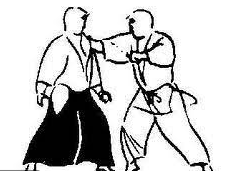
Kata dori is a shoulder grab with the distinct intent of a follow up strike: usually it is not a primary offensive technique. But it should not be demonstrated or perceived as a passive grab.
The banner line drawing from Aikido and the Dynamic Sphere nicely illustrates one possible follow up after the initial shoulder grab.
Because the shoulder grab is a precursor to a more violent attack, uke needs to learn to make the first grab intentional and effective. To do so, use the lower three fingers to grab and wrap the weave of nage’s gi into the palm of your hand. This is a binding action, not a snatch or pinching action driven by the thumb and index finger. The use of the hand grab exploits the hand strength developed in sword training.
As the hand wraps, uke drops their elbow with an inward spiral, tip of the elbow toward their own hip. With a tight and structured grab, uke can drop to break nage’s balance – effectively pitching nage forward and down. A shoulder grab should be done with the intent of pulling nage face forward to the ground.
Thus the tanren exercise. Uke grabs with violent intent and nage must learn to resist the throw by tightening the hara (belly muscles) so as to not be pulled head down / bend at the waist, while driving the heel with the quadriceps to remain resolute and firmly grounded. As a static exercise, this represents body development and would be just a fleeting moment during a dynamic encounter. Nevertheless it is an important developmental stage. As uke, learn to grab effectively and to throw with one hand. As nage, focus on internal stability and watch the timing of uke’s approach: learn to anticipate the moment of uke’s contact such that you know how to intercept it when the technique advances to ki no nagare flow.
From the static encounter, nage must learn to break uke’s structure / balance. The most effective method is a swift punch to the face. From the atemi, nage leaves the striking arm in place just below uke’s deltoid. This arm will be used as an active brace which will cam (rotate while striking) toward uke’s center while nage simultaneously draws the grabbed shoulder out and diametrically away from the bracing arm. To assist drawing the shoulder back, nage should throw his arm back to add momentum. By establishing an active brace, nage’s arms are moving in opposite vectors and uke is fixed at two points (their grabbing hand on nage’s moving shoulder) and just below the deltoid by nage’s camming arm. Nage further adds muscular energy by drawing bodily along the same vector as his grabbed shoulder. The result should be that uke is drawn off balance. The key lesson is to leave the atemi hand on uke’s deltoid and biceps and not to slide down to uke’s elbow, or worse, to pull uke toward you with the atemi hand. Inevitably, moving to the elbow or attempting a circular draw (e.g., while performing ushiro tenkan) will expose nage’s flank to a counter hit. This exercise is designed to develop horizontal mobility, i.e., moving off the line at approximately 90-degrees to the initial line of attack.
Once uke’s balance is taken (kuzushi), nage’s camming arm slides along uke’s grabbing arm to pin uke’s hand to nage’s shoulder. This is the kihon entry pattern initiated from the ‘triggering’ grab: stike (closing action), cam and draw (opening action), trap (closing action). From this action pattern, the basic kata-dori techniques emerge.
Once the structure is understood and ingrained in the body, then ‘blending’ can be added – which means, we introduce timing and dynamic movement as variables.
The Hombu presentations are the foundational techniques. However, as one explores the possibilities of ‘advanced’ timing and tempo the beauty of the encounter expands.
Notice that the ki no nagare exploration is possible only because it is contextualized within the framework of sword and only when nage is ahead of uke’s intention. Nage must lead uke’s spirit – or more prosaically – nage is ahead of the OODA loop.
 Protective Arts