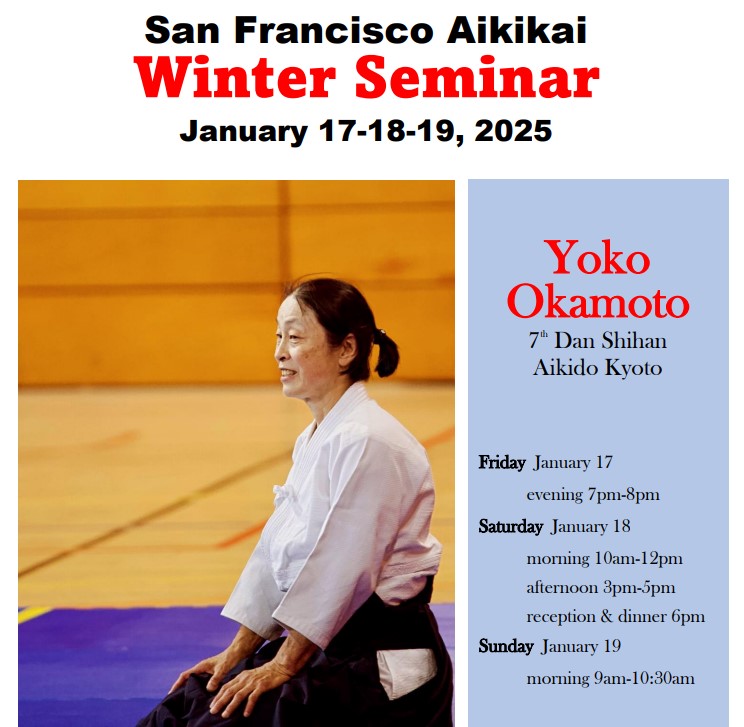
Okamoto sensei was in San Francisco for the January seminar which, historically, was the time Yamada sensei made his annual visit. It was a well-attended seminar with instructors from Mexico City and Montreal in attendance.
Mike Napoli, Russ Gorman, Oscar Johnson and I represented Portland Aikikai.
Okamoto sensei focused on connection and presented very few techniques – showing just gyaku and morote dori kokyu-ho, ai-hanmi katate-dori and shomen-uchi irimi-nage, ikkyo and shihonage.
Connection is challenging to establish, so she presented most of the exercises from a static grab in order to draw out a balanced commitment to the encounters. Starting from static eliminates the complication of timing and enhances the ability to work on appropriate responses from uke.
She was critical of hyper-responsive ukeme – ukeme where uke exaggerated the movement which nage was impelling. She did not explain in thus, but the difference she was driving to is the difference between a reflex, a choreographed (trained) response, and a correct response. (I have called exaggerated ukeme an artifact of training.) The levels of understanding are reflective of the shu/ha/ri levels of training. A reflexive response is precisely what most martial art techniques rely upon – essentially a technique is a trick that exploits a reflexive response. In the dojo we quickly replace reflexive techniques with a trained response by teaching what is essentially choreography. Unfortunately, humans like drama, and dramatic ukeme is visually compelling. Most people enjoy the exaggerated responses precisely because the movements are large, easily seen and exciting.
Okamoto sensei tried to tone-down the responses in order to draw out a correct response. Equal energetic response based on input from nage and the corresponding output from uke. She used the example of two people hands together leaning into one another to demonstrate the principle. Nage does not pull uke and uke cannot lean upon nage. Neither party should be reliant upon the other for the structure of the encounter.
Which leads to the concept of “axis.” While nage must remain centered about his own axis – the line from the center of the head, through the core, and between the distributed weight of the legs – and has the goal of disrupting uke’s axis (balance and, specifically, spinal alignment), the primary way Okamoto uses the term is to describe the axis of the encounter, which is the moment of the initial encounter between nage and uke. This is the most interesting point in time because it is pregnant with possibilities.
Starting from gyaku hanmi, Okamoto sensei demonstrated two potential response, a full blend (tenkan) and a driving re-direct (irimi). Both and either should be available from the first moment of contact and nage needs to learn how to determine which is necessary from the moment of first touch. Sensitivity to uke’s grab and energetic input drives the possibilities, not nage’s expectations of a result. However, for Aikdo training to be productive, uke must present a genuine intention – provide an input that is combatively viable.
Therefore, Okamoto sensei reminded us that a grab must have a vector that is toward nage’s center with a goal to control the grabbed arm. Too much pressure in any other vector and nage should simply escape and riposte. She physically demonstrated this by slapping, or hitting ukes who were out of position or over-zealous with an imbalanced attack. I have shown this by using rebouding strikes and half-beats, and arts like Kenpo explicitly use them to advantage.
Critically, the balanced approach to the initial encounter among nage and uke is what defines the axis of the encounter. This axis is what nage must move around with minimal disruptive movement so as not to disturb uke’s initial intention. With a more combat-efficacious description, nage must not telegraph their intent so the initial grab is the point suspended in space as “bait” while nage moves to a tactically superior position.
Shihonage provides a difficult, but clear example of this principle.
Starting from gyaku hanmi, nage moves obliquely approximately 33-degrees off the line of original approach while dropping the grabbed hand down along the vertical axis of the encounter. The reason is to absorb and redirect uke’s original intention – simultaneously dropping uke’s center down. Uke’s trained response will be to keep the grabbing arm extended, maintain a firm contact with the hand, and soften the knees to lower their center. Nage then shifts slightly back while keeping the grabbed arm extended which allows uke to start to come vertical again, which provides the invitation for nage to continue to raise the extended arm vertically up the axis to nage’s natural full extent (shikko) while moving under the axis of the encounter to perform a turn, then cut for the throw. This requires a high level of trained sensitivity from both players because it requires continuous monitoring of intention/connection from each throughout the entire movement. It is far easier to perform a simple “bone-lock” throw.
Okamoto’s Aikido moves beyond simple efficacity as a goal. But it is based on highly pragmatic principles. Hence her use of the shyuto.
I suspect few people appreciated her use of the tanto to illustrate what the shyuto is. She used the tanto as an attempt to show the seriousness of ai-hanmi irimi-nage as a martial encounter. She used a tanto to illustrate how nage’s grabbed hand needs to be perceived by uke and used by nage. Most uke’s grab the hand blithely and most nage’s use the grabbed hand merely as a vehicle for the arm to pull or off-balance uke using gross body movements – explosively getting behind uke and essentially making it a pure momentum throw. This is not the higher-level training she was illustrating.
The shyuto is the knife-hand. The base of the hand to the tip of the little finger is the cutting edge. Therefore the angle which nage presents demands the seriousness of a knife, and the hand must be used as a knife, not merely as the terminal point of the arm.
As uke grabs, Okamoto sensei explicitly used the inward camming of the shyuto to force uke’s elbow to pronate to uke’s interior. I call this bone-locking when done as a gross body movement, but in her presentation, it is a survival response. If uke fails to keep the shyuto away from their center, the knife edge explicitly targets their neck.
Okamoto sensei does not use graphically explicit language, but don’t fail to see the seriousness of her intentions, lest you fail to learn the lesson!
Her use of the hand is training uke to have a correct response which then allows the encounter to flourish. As nage uses the shyuoto to threaten uke, uke keeps their hand extended (to keep the knife away) and therefore must use their body to absorb the threat. This means uke shifts backward along their original line of approach while nage enters irimi to take a position behind uke – moving around the axis of the encounter, which is the grasped hand. From that superior position (shikakku), nage can further disrupt uke’s balance by continuing to move their shyuto toward uke’s center while rotationally disrupting uke’s spinal alignment with the neck hand. Nage must be clear – this is not intended to be a pulsing energy, ideally, nage uses equal energy in both hands but with opposite vectors – like drawing a bow. As the neck hand (nage’s elbow pointing down!) creates a slight inward (toward nage’s sternum) draw, nage’s shyuto extends toward uke’s center such that there is a single line of force connecting the two points. Emphatically, this is not a “double pull” to off balance uke. While potentially efficacious, that gross muscularity of the balance destruction misses the subtlety of a weapon-based encounter.
This is a higher level of training.
As a cautionary reminder, Okamoto sensei told me, “Don’t do what I do.” Why? Because her presentations in a seminar setting are to be inspirational, they provide a picture of where the art is going, and does not reflect a means of getting there. The actual path to achieve the level of understanding is not simple replication of what we saw over the course of a long-weekend seminar. The means of achieving understanding requires time on the mat: Pounding the body and spirit to drive out impurities.
 Protective Arts
One thought on “OKAMOTO SHIHAN SEMINAR 2025”