My Uncle Tony recalled that his grandmother, Lucy Burr Wadhams, thought of her husband, Dr. Abram Barker, as a “Johnny-come-lately,” a man without the deep historical connection to America (and Goshen specifically) of her lineage.
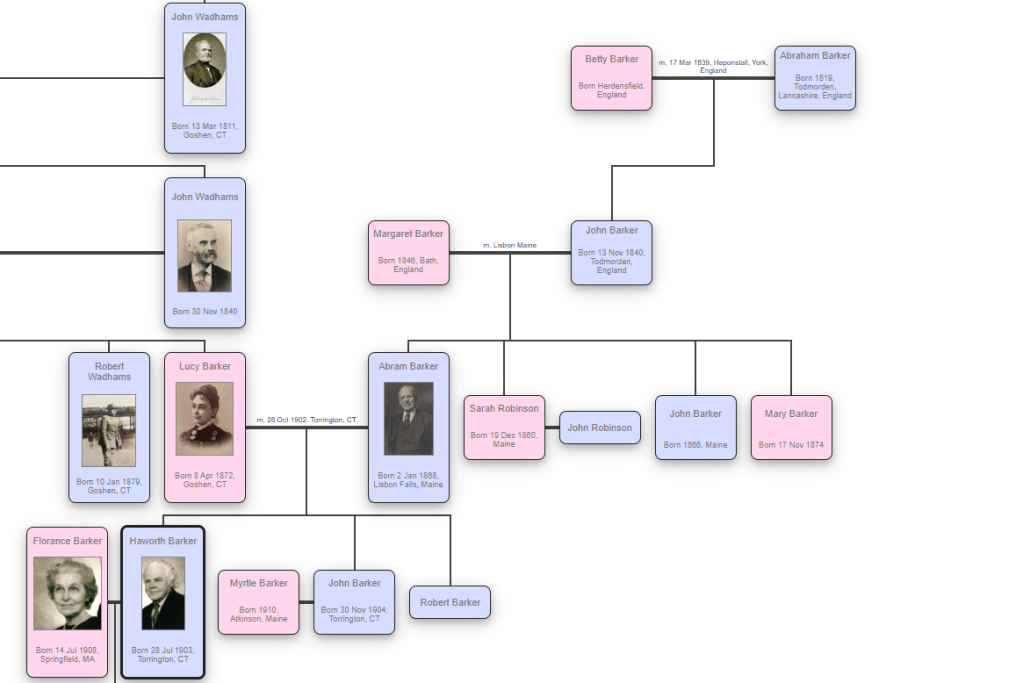
She was not wrong. The Wadhams had been in Connecticut for generations. Abram Barker had been born in Maine as the son of English immigrants. Measured agaisnt a family whose memory reached comfortably into colonial New England, the Barkers were newcomers.
The documentation carries the Barker family back through the industrial communities of the Upper Calder Valley in Yorkshire, and in doing so turns what was once little more than a surname into a recognizable family history: textile workers, Nonconformist chapels, migration, industrial America, and within a generation an American physician.
From Bark to Barker
My Uncle Tony mused that the family name was associated with a carnival barker, yet it seems more likely that the surname derived from OE “beorc” meaning to tan hides using tree bark, pointing to the occupational surname for tanners and bark-strippers.
That origin tells us nothing by itself about our Barkers. Occupational surnames arose independently in many places, which is precisely why the family has proved so difficult to trace. A Barker in Lincolnshire, Kent or Yorkshire need have no genealogical connection to another family of the same name.
For years I could establish the family only as far back as the early nineteenth century. Better records now allow the line to be reconstructed one generation farther.
William Barker and Mary Sutcliffe
The earliest couple I can presently document with confidence is William Barker and Mary Sutcliffe, who married at Halifax St. John the Baptist on 15 September 1818.

Their son Abraham Barker was born on 30 July 1819 and baptized on 15 September 1819 at Myrtle Grove Independent Chapel, Eastwood by Todmorden.

That combination of records immediately places the family within a characteristic feature of northern English life. William and Mary married through the established parish system, while their child was baptized in an Independent chapel.
The religious implications deserve their own treatment. For present purposes, the important point is geographic. By 1819 the family was firmly rooted in the communities around Todmorden and Stansfield, on the Lancashire–Yorkshire border in the Upper Calder Valley.
Todmorden is therefore no longer merely a candidate for the Barker homeland. It is the earliest securely documented center of this branch of the family.

Abraham Barker and Betty Howarth
On 1 April 1839, Abraham Barker married Betty Howarth.
The original marriage register is unusually useful because it records occupations and fathers. Abraham, twenty, was a weaver, son of Jacob Barker, weaver. Betty, also twenty, was a weaver, daughter of James Howarth, weaver.
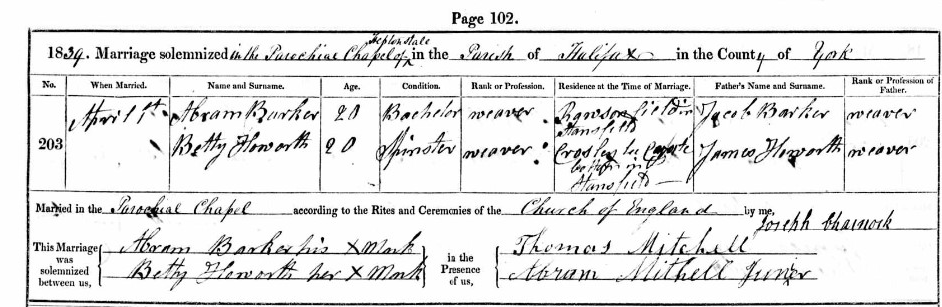
There is very little ambiguity about the family’s economic world. They were textile workers in one of the landscapes being transformed most profoundly by the Industrial Revolution.
The 1841 census finds Abraham and Betty at Rake, Stansfield, with an infant son, Jacob Barker.

Ten years later the 1851 census places the family at Gate Bottom. Abraham, now thirty-two, is recorded as a twister. Betty is thirty-one. Their children include Jacob, age ten; Susan, age five; and John, age two.
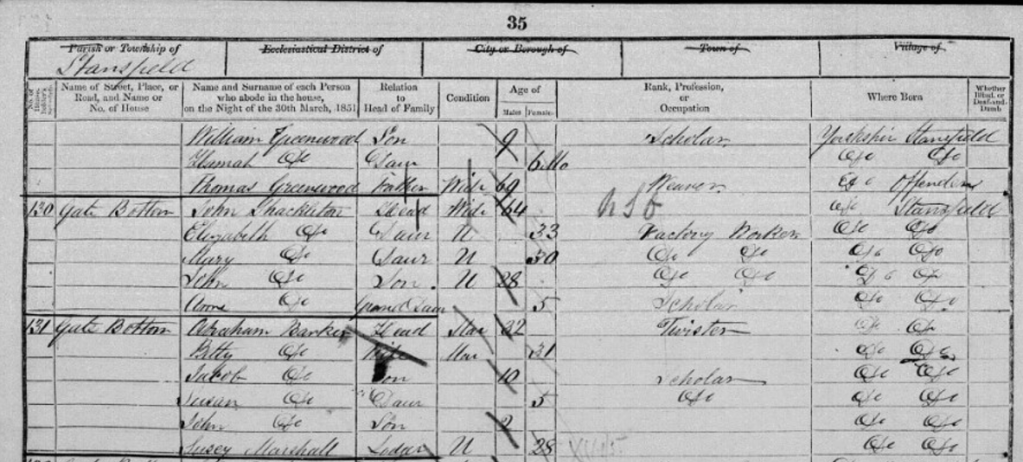
That last detail matters because later American records complicate Jacob’s name. The English census makes clear that Jacob and John were separate sons.
Jacob Barker and the Atlantic Problem
In 1861, a twenty-year-old Jacob Barker appears at Black Rock, Stansfield, now married and working as a power-loom cotton weaver. His wife, recorded as Mary, was seventeen and employed in the same trade.
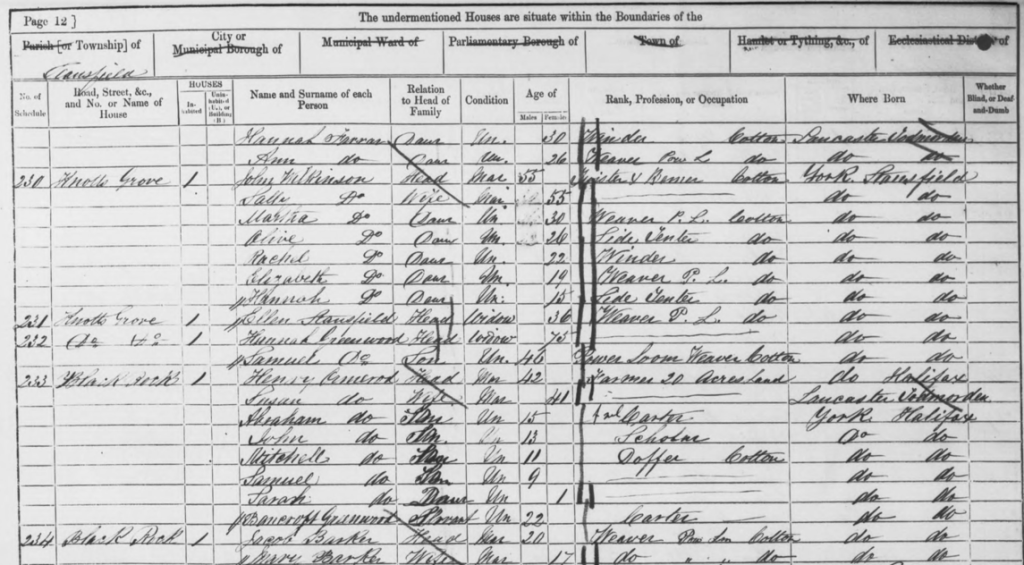
The progression is compelling: 1841 Jacob, infant; 1851 Jacob, age ten; 1861 Jacob, age twenty. The geography barely changes. Neither does the family’s relationship to textiles. And then the English trail stops and the family reappears across the Atlantic.
The 1870 United States census in Connecticut records an English-born Jacob Barker, about twenty-nine, with an English-born wife Margaret and Maine-born children, including two-year-old Abram Barker.

This is the household from which my great-grandfather, Dr. Abram James Barker, emerges.
There is an unresolved genealogical challenge. The Jacob documented in England in 1861 has a wife called Mary. The Jacob documented in America in 1870 has a wife called Margaret.
They may be the same woman using different given names. Jacob may have remarried. The balance of evidence currently favors continuity: the age, English birth, chronology, family tradition, geography and textile occupation all fit remarkably well. But the transatlantic identification has not yet produced the one document I would like to have. I have yet to locate a passenger record, marriage, naturalization document or other record explicitly tying the English Jacob to the American family.
Margaret E. Ridley, or Riddle
The identity of Jacob’s American wife is considerably firmer.
Family records name her Margaret E. Ridley, and the documentary evidence now independently confirms a woman of approximately the correct age and origin.
Margaret E. Barker died in Philadelphia on 25 October 1911. Her death record gives her birth as 5 November 1840 in England, identifies her father as A. Riddle, and her mother as M. Howarth.

The Ridley/Riddle variation is unsurprising in handwritten nineteenth-century records. Far more persuasive is what happens when this record is compared with the Wadhams family diary.
On Wednesday, October 25, Mary Pelton Wadhams wrote that “Mother Barker had died at 1 o’clock that morning.” On the following day she recorded that Dr. Barker went to Philadelphia on the early train. The Philadelphia record gives Margaret Barker’s death on precisely that date and records that her remains were sent to Torrington, Connecticut.
This is one of those satisfying moments in family research when an impersonal public record and an intimate family record suddenly describe the same event from opposite sides.
From Cotton to Silk
By 1880, the family was living in Paterson, New Jersey. The census identifies the household head as John J. Barker, thirty-nine, born in England, and employed as a silk picker. His household includes Abram Barker, age twelve, born in Maine.
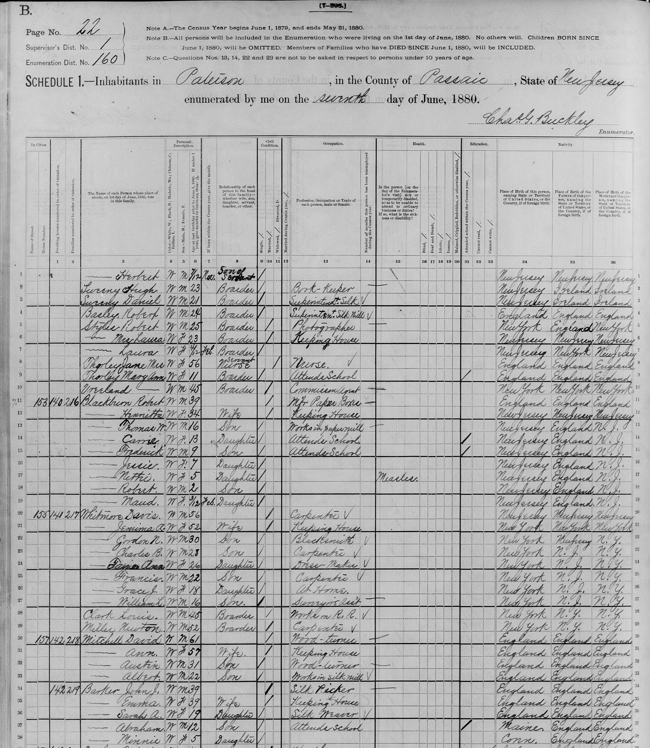
The age progression from the 1870 household is excellent: Jacob Barker, 29 → John J. Barker, 39 and Abram Barker, 2 → Abram Barker, 12. This makes it highly probable that Jacob and John J. were the same man and helps explain the later family use of John Jacob Barker.
More interesting to me is the occupation continuity, the line runs:
Abraham Barker — weaver and twister
Jacob Barker — power-loom cotton weaver while in England, and when he comes to America as:
John J. Barker — silk worker in Paterson in America
If Jacob and John J. are indeed the same man, immigration was an economic transplantation. The Barker family moved from one of Britain’s great textile regions into the developing textile economy of the northeastern United States.
Abram James Barker
The break occurs with the next generation.
Abram James Barker was born at Lisbon Falls, Maine, on 2 January 1868. By family account he received relatively little formal schooling before finding employment tending a physician’s horse, an accident of circumstance that eventually led to medical training. That part of the story still deserves additional documentary work, but what followed is much better established.
Abram became a physician.
He met Lucy Burr Wadhams, and on 28 October 1902 Connecticut records show their marriage in Torrington. By the 1910 census, Abram was forty-two, living in Torrington with Lucy and their sons and practicing as a physician.
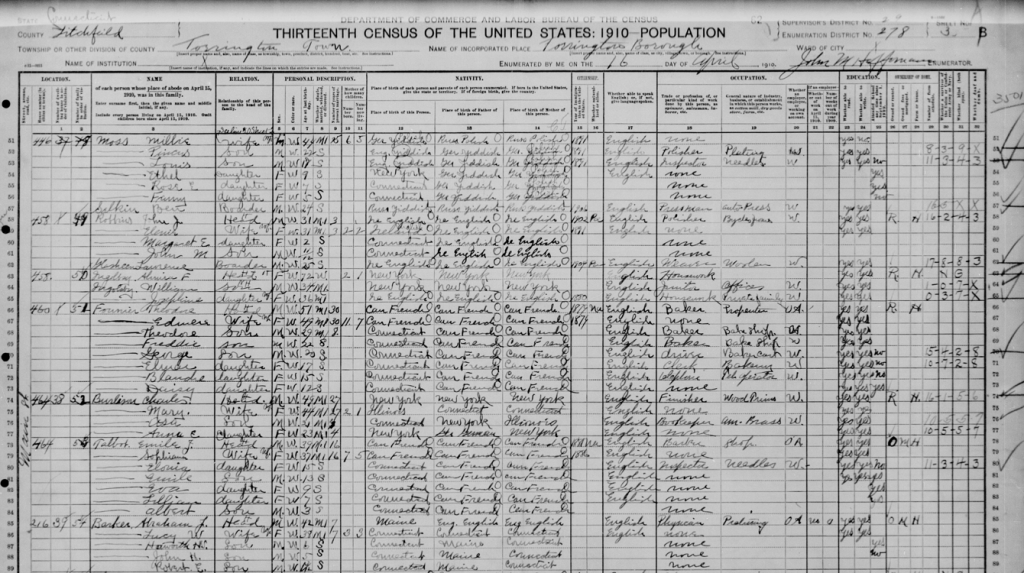
The transformation over three generations is Yorkshire weaver → immigrant textile worker → Maine-born physician.
The Griffins in the Room
Ironically, none of this is why I started researching the Barkers.
My original objective was much less ambitious. I wanted to determine which, if any, Barker coat of arms could legitimately be used on signet rings I planned to give my sons.
That led directly into the swamp of heraldic genealogy.
Todmorden, England appears to be the family omphalos. Geographically situated northeast of Manchester and southwest of Leeds.
While I can establish that the male line is rooted in the Todmorden/Calder Valley by early 1800s I have yet to trace it backward in parish and nonconformist registers to locate a prior county of origin. However, the Barker of Holbeach and Barker of Todmorden lines are separated by distance but not by implausible migration patterns.
There is no documented genealogical connection between the Todmorden Barkers and the Barker families of Holbeach or Great Steeping. They are simply geographic candidates.
Arthur Roland Maddison (1843-1912) collected and edited the Lincolnshire Pedigrees and recorded the Barker line of Great Steeping:
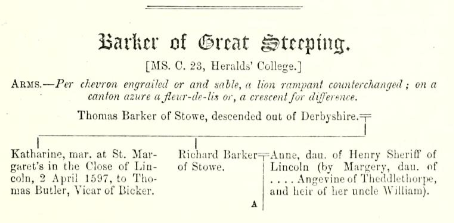
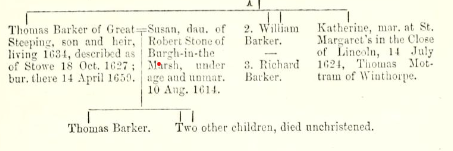
The Great Steeping pedigree’s statement of Derbyshire origin provides a credible bridge county. A two-generation relocation westward, fueled by trade, dissent, and industry, could plausibly produce the Todmorden line. Pending corroboration via parish and legal records, the linkage remains unproven but historically possible. However, there is no record of such a migration, and occupational Barkers are extremely common across the Midlands and North.
The Ogilby and Moll maps (1675–1724) show a continuous roadway linking Lincolnshire market towns to the Pennine valleys through Derbyshire. This east–west road system became the artery for craft and trade migration.
Great Steeping, 25 miles northeast of Holbeach, confirms that multiple Barker lines occupied the Lincolnshire fenland by the 17th century, one claiming descent from Derbyshire. This descent gives geographic plausibility to a Barker migration from the midlands into Todmorden’s textile region two centuries later. The Holbeach → Todmorden vector thus serves as the evidentiary spine for reconstructing a potential lineage, situating my ancestors within a realistic historical migration path.
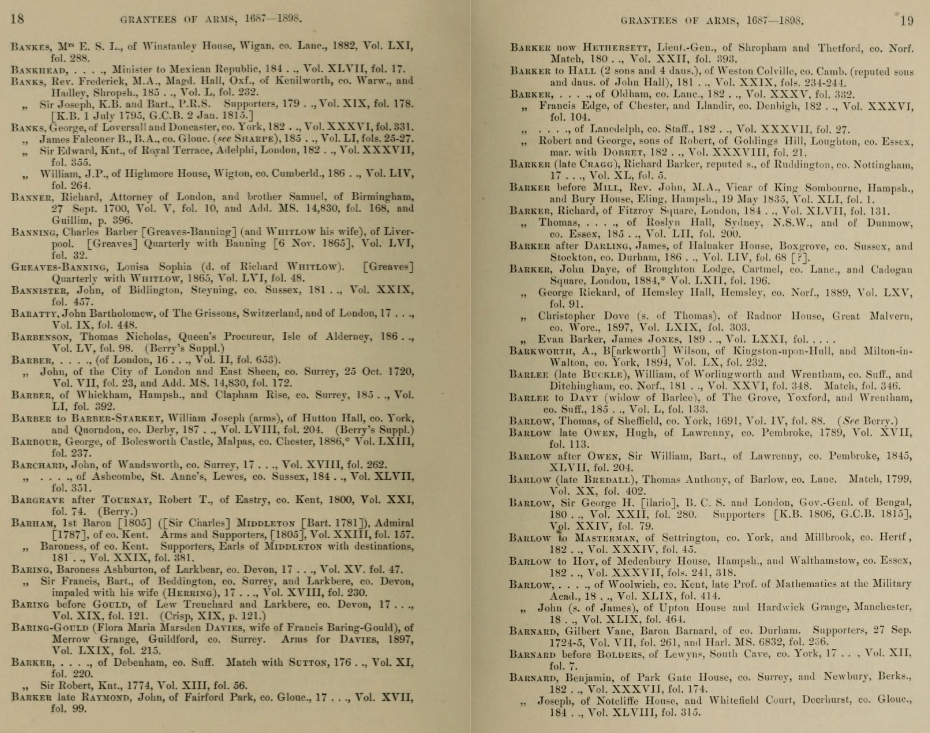
The Grantees of Arms lists several Barker lines
And Burke’s General Armory provides the blazon/motto citation:
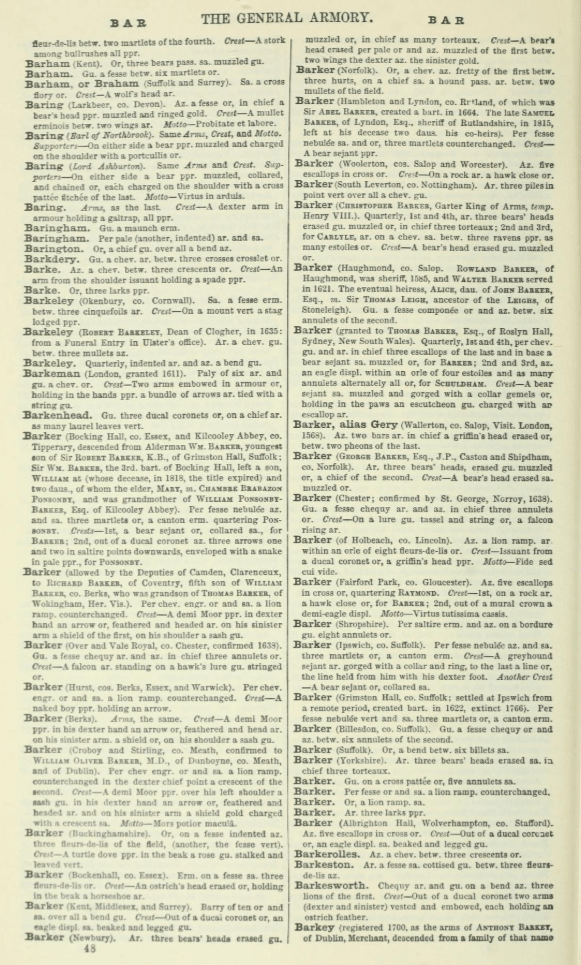
My goal in researching the Barker lineage was to establish which crest should be used on signet rings which I planned as a family Christmas gift for each of us.
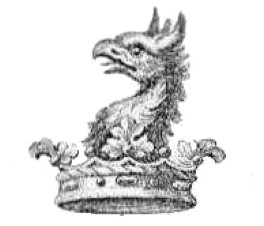
I cannot prove to be of an armigerous family with a coat-of-arms but as a convenience the Barkers of Holbeach appear to be the most geographically proximate lineage. And this was fortuitous. The crest is a griffin out of a ducal coronet and, more poignantly, the family motto is Fide Sed Cui Vide (Trust, but in whom take care) – a wonderful coincidence given my oft-used quip, “trust but verify!”
I take that coincidence as evidence of genetic disposition – thus providing provenance.
This particular image does not belong to any verifiable Barker lineage in the College of Arms, Lyon Court, or Ulster’s Office:
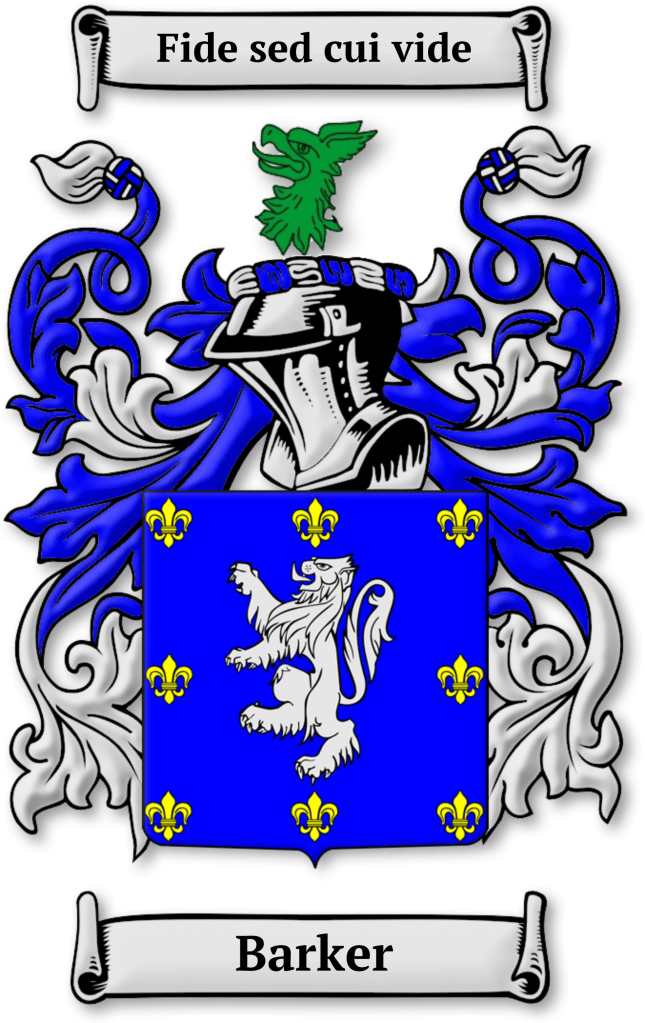
It is a composite, commercial design made from: a Suffolk lion; a Kent/Lancashire fleur-de-lis motif; a modified Holbeach griffin, and the Holbeach motto. No single historical Barker family used this combination.
All this to justify the use of the griffin on a signet ring. A signet ring to evidence the bond we share as immediate family members.
And a longer connection to those ancestors (barely remembered) who preceded us. I hope my boys eventually find the ancestral connections meaningful.


2 thoughts on “The Barker Surname”