In Genetics and New England Pathology, I sketched a possible line to medieval England to illustrate a simpler truth from population genetics: the number of ancestral positions doubles geometrically, while the number of people who actually left you DNA shrinks via pedigree collapse.
From this follows an unsettling comfort: living humans are orders of magnitude more connected than a tidy doubling implies. Both mitochondrially and historically, shared ancestry collapses faster than linear intuition suggests.
So, my original article wasn’t a genealogy article, and this is an exploration of the glibly posited connection to Wadham College, Oxford.[1] This post is not a definitive genealogy. It is an exploration of the often-floated connection between the American Wadhams and Wadham families of England.
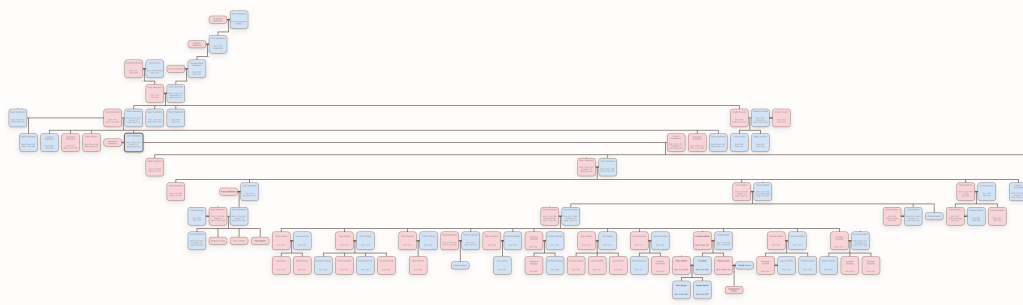
Pushing the record earlier is hard, but the American trunk is solid. The uploaded chart aligns with town, probate, and compiled references and agrees with notices in Hibbard’s History of the Town of Goshen (1897). Hibbard is derivative (drawing on Deacon Norton’s manuscripts and local records) yet reliable for Connecticut facts.
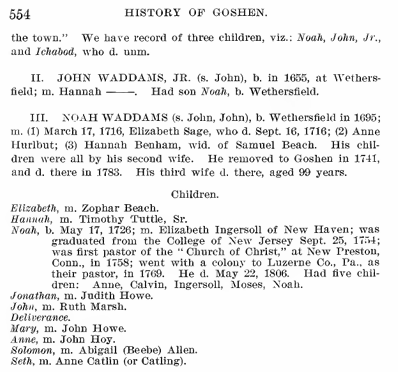
Hibbard places John Waddam/Wadham in Wethersfield by the 1650s and repeats the tradition of a Somersetshire origin; the book does not cite an English parish for him.

John¹ Wadhams (or Waddams, Wadhams, Wadham) appears in Wethersfield records by mid-century, part of the second generation of settlers expanding outward from Hartford and Windsor. He likely came from England during the late phase of the Great Migration (1630–1650), when Puritan settlement along the Connecticut River began to stabilize politically and economically. By the time of John¹’s arrival, the Pequot War (1636–1637) had ended just over a decade earlier, opening the Connecticut interior, but it was not entirely secure. Wethersfield had matured into one of the Connecticut River Valley’s richest grain towns, exporting wheat and pork to the West Indies. Its militia, church covenants, and town governance were firmly in the hands of Puritan congregants.
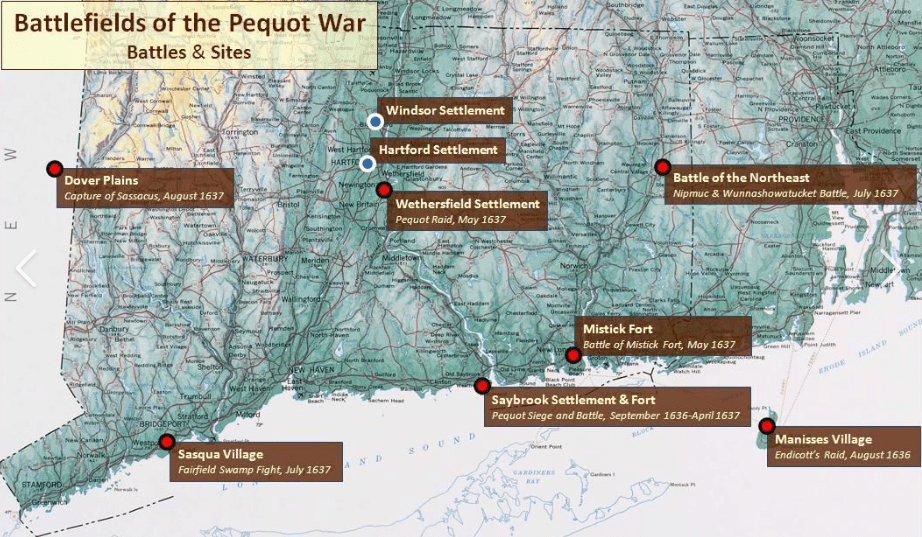
By the 1650s, the Connecticut River towns (Hartford, Windsor, Wethersfield) operated under the 1639 Fundamental Orders, though Saybrook and New Haven retained semi-independent authority until consolidated under the 1662 Charter. The General Court of Connecticut (1639) had begun enforcing property registration, land apportionment, and militia obligation; so John¹’s name in town records indicates not merely residence but likely land ownership and civic participation.
As a settler arriving ca. 1650, John¹ lived through two defining regional episodes: The absorption of the Saybrook Patent (1644–1647), which unified lower Connecticut under Hartford’s authority; and the outbreak of King Philip’s War (1675–1676). Though there is no direct evidence of his participation, his death at that time coincides with a period of militia mobilization throughout the colony. He was appointed Constable for Wethersfield in 1674. Connecticut troops were dispatched to fight under Major John Talcott against the Narragansett and Wampanoag allies in Rhode Island and Massachusetts (Leach, Flintlock and Tomahawk, 1958).
Thus, John¹’s life spanned the transformation of Connecticut from a fortified outpost to a relatively secure Puritan agrarian colony. His generation lived as bridge settlers, developing farms where their predecessors had built garrisons.
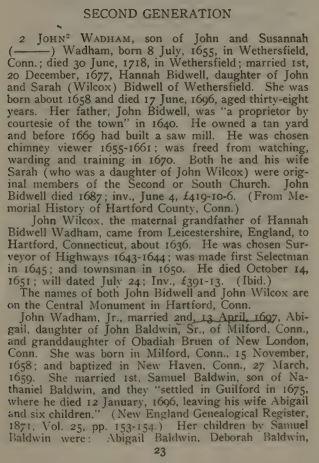
His son, John² Wadhams, born in Wethersfield in 1655, represents the first American-born generation of the family, one that inherited land, church membership, and militia obligation as civic norms rather than frontier duties. His early adulthood coincided with Connecticut’s legal consolidation under the 1662 Charter from King Charles II, which formally merged the New Haven and Hartford colonies and granted broad autonomy.
By the 1670s–1690s, Wethersfield had become one of the wealthier agrarian towns of the colony, supplying grain and livestock downriver to Middletown and Saybrook for export to the West Indies (see Main, Society and Economy in Colonial Connecticut, 1985). The younger John² would have grown up in this prosperous yet still defensive society. As a freeman of military age during King Philip’s War (1675–76), he would almost certainly have been enrolled in the local militia, as all able-bodied men were required to muster monthly.
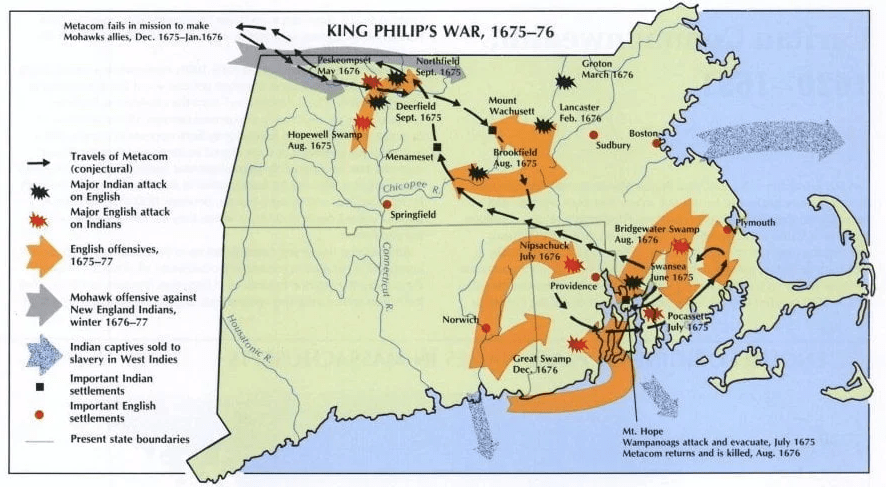
While Wethersfield escaped major attack, massacres at Springfield and Deerfield and the Great Swamp Fight left deep psychological and religious marks. The colonial church interpreted the conflict as divine chastisement for backsliding, inaugurating the wave of revivalism that culminated a generation later in the Great Awakening (1730s–40s), the spiritual atmosphere into which John²’s grandson, Noah³, would be born.
John²’s lifespan also overlapped with a quiet but consequential demographic shift: as Indian resistance waned, younger men began migrating westward into new interior towns, Middletown, Durham, and later Litchfield (chartered 1719), establishing the path that his son Noah³ (b. 1695) would follow.
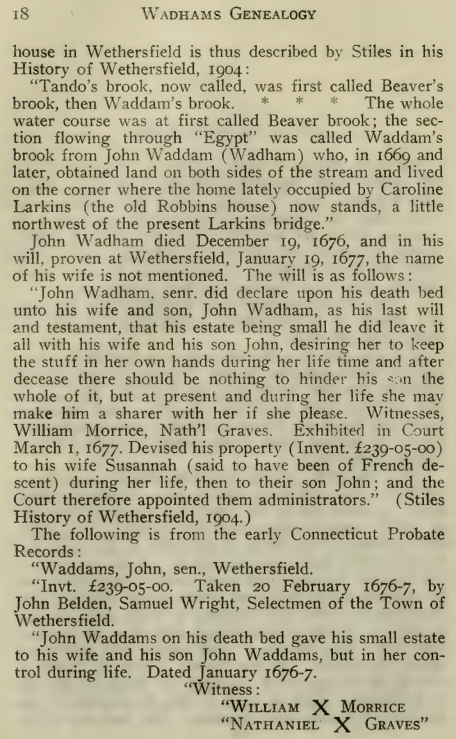
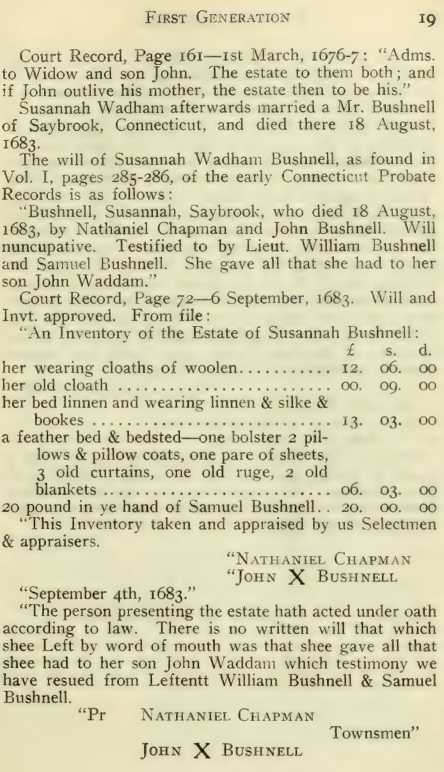
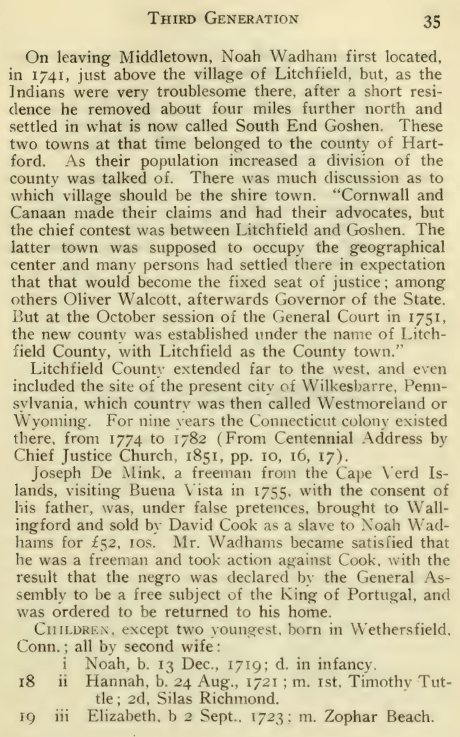
The first generation in Connecticut is further corroborated by Harriet Weeks Wadhams Stevens, The Wadhams Genealogy (1913) with additional historical information and probate details:
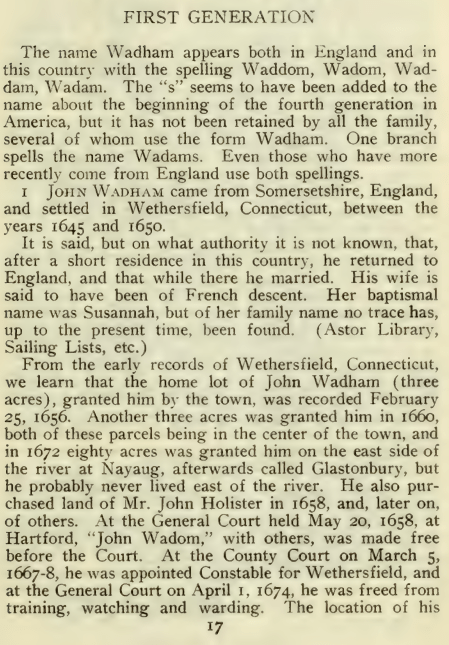
Stevens notes the spelling shift Wadham → Wadhams represents a normal colonial plural/possessive drift. Early New England records commonly append an “-s” (e.g., Williams, Stevens); Hibbard and later Goshen records standardize on Wadhams. No direct English baptism or will yet ties “John Wadham(s)” to a Somerset parish, but surname clustering in that region makes it the best candidate locus.
While unverified, a marriage to Susannah if she were a French Huguenot (very likely if the tale is true), fits Puritan Connecticut; French Protestants were welcomed as co-religionists (most arrivals were 1680s+, but individuals appear earlier in New England and London’s French churches from 1599 onward). The alternative reading of Catholic sympathies appears inconsistent with immigration to Connecticut at this time, but there are heretical leanings if John is associated with the Oxford founders who were suspected recusants (Dorothy Petre Wadham was pardoned under the anti-recusancy act; both she and Nicholas appear in recusancy notices). That establishes Catholic leanings in the gentry family. However, a collateral Protestant line is entirely consistent with English practice after 1559.

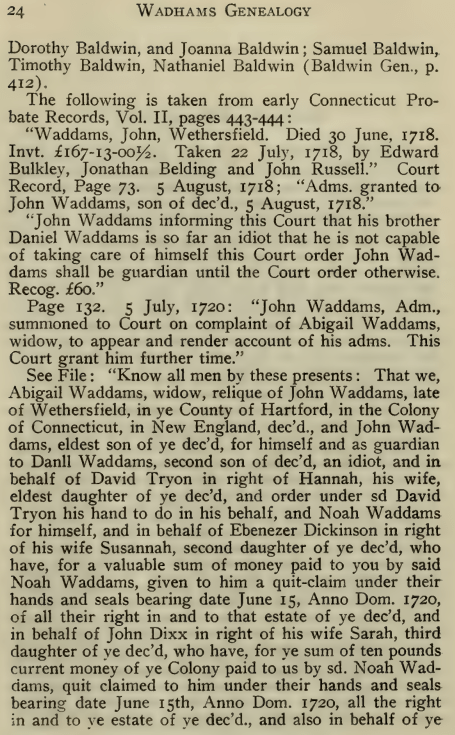
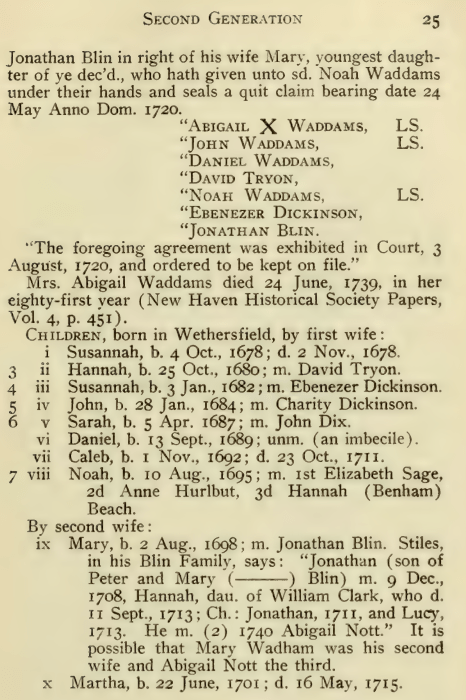

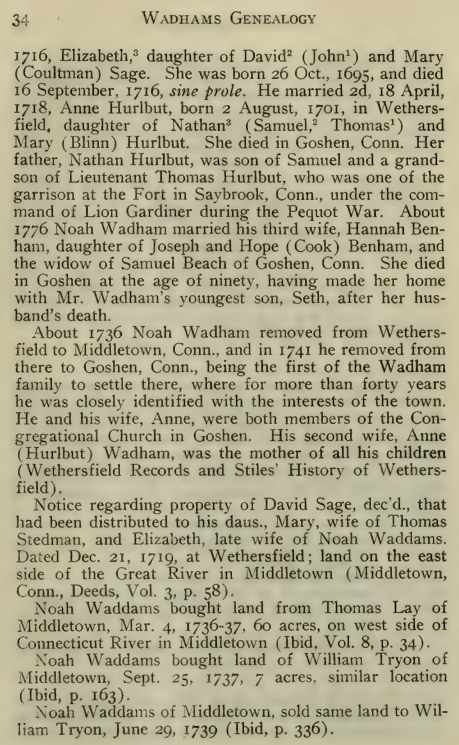
Through his marriage to Anne Hurlbut in 1718, Noah Wadhams (1695–1783) became linked to one of Connecticut’s earliest military families. Anne’s grandfather, Lieutenant Thomas Hurlbut, had served under Lion Gardiner at the Fort in Saybrook during the Pequot War (1636–1638), a campaign that annihilated the Pequot tribe and secured English dominance along the lower Connecticut River. This connection situates Noah within a lineage that helped open the colony’s early frontiers through violence and fortification. Born nearly sixty years later in Wethersfield, a settlement repeatedly threatened during King Philip’s War (1675–1676), Noah grew up in a region still haunted by that conflict’s aftermath. When he later migrated west to Middletown (1736) and then Goshen (1741), his move mirrored the post-war push into lands vacated or ceded by Native tribes after a century of intermittent fighting.
By the 1740s, however, the western highlands of Connecticut (now Litchfield County) remained contested terrain. The primary Native groups still active there were the Mahican (Stockbridge) to the north and Paugussett and Weantinock to the south and west, with remnants of the Tunxis and Mattabesec along the Farmington and Housatonic Rivers. Colonial settlers in Goshen and Litchfield continued to report “Indian troubles” through the 1740s, often involving land disputes or reprisals linked to trade and hunting rights rather than open warfare. The History of the Town of Litchfield, Connecticut 1720-1920. Thus, Noah’s westward settlement represents the final phase of Connecticut’s colonial frontier: an inheritance of both his Hurlbut forebears’ Pequot War militancy and the lingering instability left by King Philip’s War. “…the Indians were very troublesome there…”
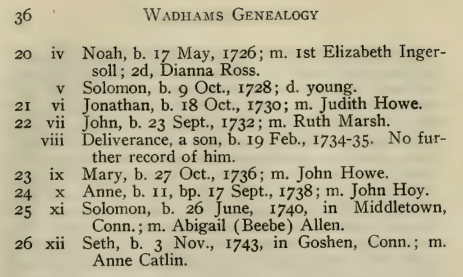
The established descent in America is: John¹ (immigrant, d. 1676/7) → John² (b. 1655) → Noah³ (b. 1695) → John⁴ (b. 1732).
These are (inverse order) the father, grandfather, and great grandfather of John Hodges Wadhams.
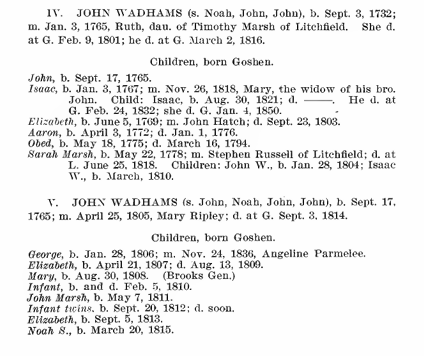
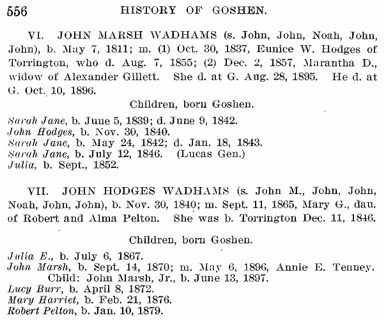
The Wadhams family has been a Goshen line since Noah’s arrival in 1741, with an unbroken patrilineal descent continuing to John Marsh Wadhams IV (d. 2002).
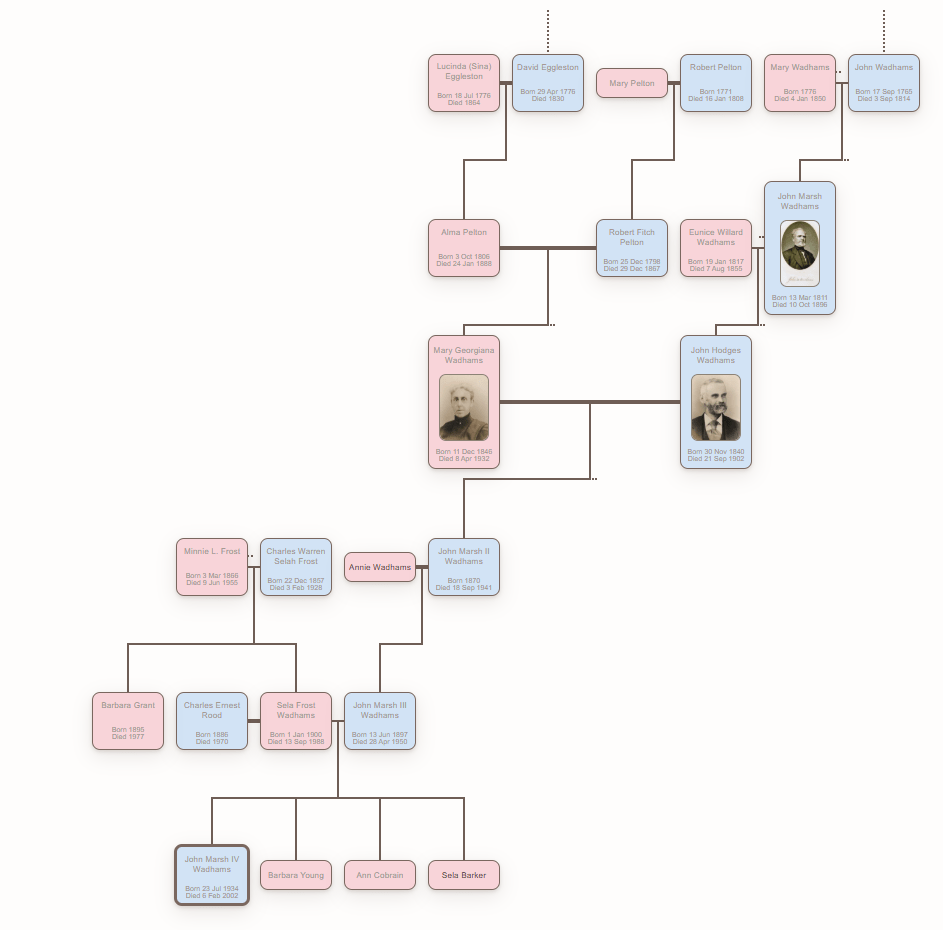
Noah³ Wadhams (1695–1783) → John⁴ (b. 1732) → John Marsh¹ Wadhams (1811–1881) → John Hodges Wadhams (1842–1922) → John Marsh² Wadhams (1879–1941) → John Marsh³ Wadhams (1897–1956) → John Marsh⁴ Wadhams (1934-2002).
John Marsh Wadhams IV, my father’s second cousin (and about ten years his senior), held the same core farmland first settled by our forebears, though the tract changed size through successive partitions and accretions. Cousin Johnny married late and had no children of his own, so the male-line ended in 2002. By then the estate was over 330 acres after 260 years.
Starting from that first American, John the immigrant (my 10× grandfather) most plausibly originated in the West Country (Somerset/Devon), the historic homeland of Wadham families. Primogeniture customs (as social practice, not statute) and the economic, religious, and political disruptions of the 1630s–1650s created obvious push factors for younger sons. Probable but unproven: the Wethersfield Wadhams descend from a Somerset/Devon collateral line.
______________________
[1] Stevens’s front plate (“Pedigree of Wadham”) provides a useful framework for the medieval–Tudor family (Merryfield/Edge/Catherston branches) but not a documented bridge to America.
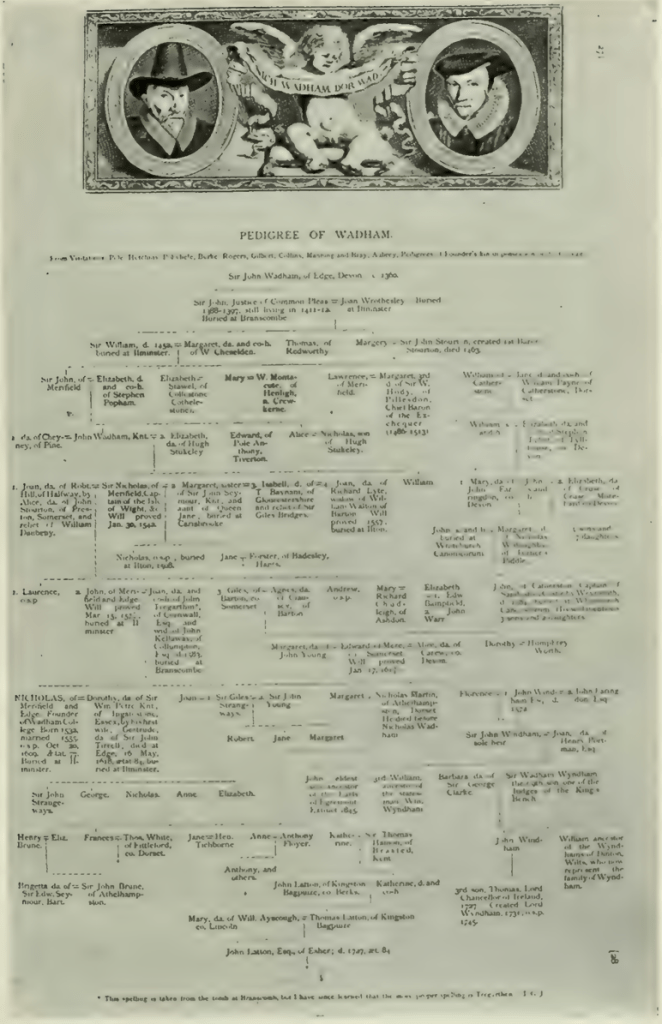
There is no documentary evidence that the American Wadhams were armigerous or entitled to bear the Wadham College arms.
The most defensible hypothesis is that the immigrant John¹ came from the West Country surname cluster (Somerset/Devon), possibly from a cadet or yeoman branch, but no link to the Oxford founders or medieval judges can be demonstrated.
 Protective Arts
4 thoughts on “The Wadhams Surname”