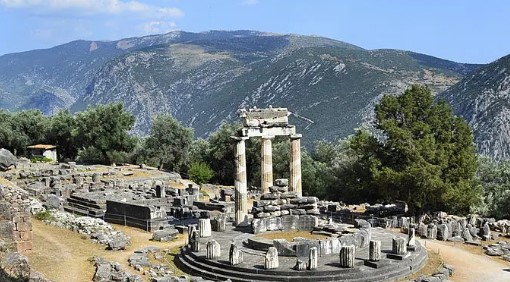
Delphi emerges as a Panhellenic sanctuary around 650 BCE but it started earlier, much earlier. Inscribed on the pronaos of the Temple of Apollo was the threshold admonition: γνῶθι σεαυτόν, know thyself.
It was never therapeutic advice. It does not mean discover your preferences or honor your feelings. It means: know what kind of creature you are.
That is a structural reminder, not a rejoinder for self-actualization. Knowing yourself is not what you believe, feel, or declare. It is revealed by how you behave under power, how you rationalize advantage, and how you respond to limits. A prophylactic against hubris carved above the limen. You are human; mortal, neither animal nor god.
Delphi’s rise coincides with the same sixth-century world that produced the Seven Sages and early natural philosophy (Paus. 10.24.1). Restraint and explanation emerge together. Philosophy would later radicalize inquiry, but that excess was born after the Athenians forgot what kind of creature they were, forgot that the polis was just a consortium of humans who forgot the second Delphic maxim: “Nothing in excess” (Μηδὲν ἄγαν).
The Greeks did not believe man could escape his type. Delphi warned them to recognize what they already were. And what they were demands restraint. Self-knowledge is inseparable from restraint. To misjudge your type is not a moral failure; it is an error of scale.
Humans almost never accept their type voluntarily. They learn it through consequence. This is why moral education fails at scale. This is why tragedy exists. The tragedian authors show that gods do not demand virtue; they enforce proportion. Hubris is not wickedness, it is miscalculation.
The Greek gods intervene, but they do not redeem. They may take oaths, but never make covenants. They spawn heroes and demi-gods but never redemptive saviors. Thus they never offer humans any lasting confidence or eternal promises, only fleeting favors. The tragedies highlight this. Nowhere do they express the confident authorization of being right.
I skip millennia, pass over Rome, Stoic interiorization, Augustine’s fusion of providence and history (if only for a moment), and traverse continents.
By the time we reach New England, uncertainty has been replaced with mandate. The Puritans do not merely seek to live well under God; they believe they have been chosen to model righteousness to the world. The “city upon a hill” is covenant made visible. History is no longer cyclical and corrective; it is linear and purposeful. God does not merely judge actions. He directs outcomes. And His Grace is achieved through faith alone.
This divergence can be summarized with two contrasting statements:
Ancient Greece fears overreach.
Puritan theology fears damnation.
One produces tragedy. The other produces reform movements.
Over time, the Puritan inward anxiety of election turns outward. What begins as a search for signs of grace in the soul becomes a conviction that grace should be made manifest in the ordering of society itself. The covenant expands from a gathered church to the possibility of a redeemed community.
Two centuries later, this moral grammar reappears in more radical form.
My ancestors believed in creating a Utopia. They followed Adin Ballou to Hopedale. Adin Ballou was an idealist and pacificist who organized a like-minded congregation. That is precisely why he is dangerous in the Greek sense.
In founding the Hopedale Community, Ballou attempted something characteristically American: the purification of social life through moral clarity. Violence was rejected not because it was imprudent, but because it was absolutely wrong. The assumption was that human nature could be improved and perfected once the false structures were removed.
This is the critical divergence from Delphi.
Ballou does not ask his followers to know what kind of creatures they are. He asks them to become what they ought to be. Moral instruction replaces tragic recognition. Failure is reinterpreted not as limitation, but as insufficient commitment.
Hopedale did not collapse because its ideals were ignoble. It collapsed because it demanded a form of sustained moral heroism from ordinary people. That demand is structurally unstable. It exhausts the participants and selects for the most sanctimonious rather than the most prudent.
From a Greek perspective, the failure was predictable.
Tragedy is not meant to make us better. It is meant to make us wiser. It teaches not by exhortation but by demonstration. You watch Creon destroy his house not because he is cruel, but because he is certain. You watch Agamemnon fall not because he is unjust, but because he overestimates what victory entitles him to.
This is what American moral absolutism struggles to assimilate.
If you believe moral clarity is sufficient, tragedy looks like pessimism. If you believe human nature is malleable, limits look like excuses. If you believe history bends toward justice, catastrophe must be the result of bad actors rather than bad assumptions.
But the Greeks insist otherwise: catastrophe is often the result of good intentions operating beyond their scale. I think of Herbert Hoover.
Where the Greeks fear overreach, the Puritans fear compromise. Where the Greeks ask whether an act exceeds human scale, the Puritans ask whether it conforms to divine instruction. One tries to restrain power; the other sanctifies it.
Once providence is assumed, restraint looks like cowardice. Once covenant is believed, hesitation looks like faithlessness. Winthrop’s “city upon a hill” sermon does not merely exhort piety. It declares destiny to be visible. The community is not simply trying to live well; it is charged with demonstrating moral truth to the world. This is the arc that carries forward into America.
Revolution is justified not as necessity but as destiny. Expansion is framed not as conquest but as fulfillment. Abolition, reform, intervention, each inherits the same moral grammar: we are right, therefore we may act.
The Greeks would have found the permissive may terrifying because the moral claim precedes the reckoning with consequence. Certainty is dangerous. Aeschylus and Sophocles populate their world with men who are correct in principle and catastrophic in execution. The lesson is not moral relativism; it is moral humility. Even the gods are bound by the Moirai. No one, divine or human, escapes consequence.
Puritan confidence dissolves that constraint.
To act without knowing your type is to gamble with forces you cannot control. To engage morally without tragic awareness is to mistake sincerity for wisdom. The Greeks understood asymmetry: between intention and outcome, power and foresight, righteousness and restraint.
America begins with what ought to be.
Greek wisdom begins with what is.
 Protective Arts
One thought on “Delphi: Know Thyself”