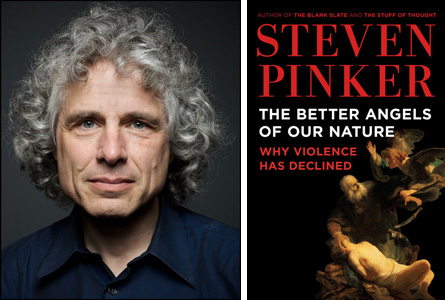
Uncle Jim pointed to a recent article in Science discussing Steven Pinker’s The Better Angels of Our Nature: Why Violence Has Declined (2011). I gave the book a quick read and found it a simple gloss on the benefits of global integration; hopeful homilies of an academician sheltered from the possibilities of violence. Pinker’s general thesis is that the overall rate of violence has decreased significantly over time indicating we are better, more civilized – hence the better Angels reference in the title. And while I admire his sentiment, Pinker’s reliance on big data disguises the most relevant aspects of violence (Nassim Taleb pointed out Pinker’s statistical errors). More importantly, like most academicians of the 1920s and 30s he falls to the arrogant guile of centralized power [1] which is best evidenced by his title, taken from Lincoln’s first inaugural address which betrays Pinker’s naïveté.[2]
Simply stated, Pinker observes that with the end of “the anarchy of hunting, gathering, and horticultural societies” and the rise of agriculture there was a reduction in violence. Centralized authority leading to a reduction in violence? Better academics than I have already pointed out the terrible fallacy here.[3] And I find it ironic (given Pinker’s earlier work on language) that he so baldly shows his prejudice in describing hunting and gathering societies as living in “anarchy.” Without a doubt agriculture lead to an increase in population which allowed (some claim necessitated) centralized authority which then leads to a monopoly on violence. So we have traded raiding for war and vengeance for state sanctioned murder. The scale has changed, but the principle behind the violence has not. We have not become our better Angels, we have just become subjugated. I am not hypocritical enough to ignore the fact that I personally enjoy the benefits of centralized power, but I am too aware of history to naively believe it isn’t simultaneously the greatest threat to our freedom (and the increase in the disparities in wealth).[4]
The fact that we are all statistically far more likely to die in an automobile accident than we are in an act of raw violence is mistaking correlation for causation.[5] Most of us are insulated against direct violence and protected from it by experts in its use. The massively integrated global economy has definite benefits that are increasingly raising the living standards for most of the globe. Combine the overall increase in the standards of living with the amazing decline in the percentage of the population directly involved in food production and the result is passive complacency. Passive because most of us are not directly responsible for our daily survival – we have all traded our varied skills for money which mediates our need to produce for ourselves. Food is no longer a mere necessity for survival but rather a celebratory social engagement. And I am thankful for it! But I am not blind to the fragility of the arrangement.
Having grown up around small-scale farms I remember what it is all too convenient to forget: that most of our protein is provided only after the jugular is slit. Pinker agonizing over torturing a rat as a psychology student is admirably pathetic. Admirable in its sentiment, pathetic in demonstrating how disconnected we are from providing for ourselves. Humans are killers because it is necessary to kill to eat. (Even you vegetarians are destroying life to survive.) That is a basic fact for our species. Modernization can disguise and bury it with specialization and insulate us from it and Pinker misses this ugly truth.
Sitting in a comfortable Harvard office reviewing statistics compiled by others, it is easy to see the macro-trends in the overall decline in death resulting from war as a percentage of the population. His observation is an inane one because he ignores the means of violence. At its core, to kill another human is an intimate interaction. Freud had that right.
We are not, as a species, evolved to be the better angels that big data suggests. Our nature is defined by our responses in crisis. It is precisely the deviations from the mean that we need to address. The fact that most of us will not experience a direct threat to our survival, that most of us will not be subjected to violence, and we no longer need hunt for our larder doesn’t mean that human nature has changed. The need for violence will always be present because violence is the only means to remove a mortal threat. The fact that modern social structures have made wage-slaves of most of us just shows that we willing subjugate ourselves for a modicum of security.
But in the statistical margins we see the persistence of human nature: Buddhist perpetrating genocide on Rohingya, Muslim jihadist extremism, CIA black sites… Violence remains pervasive and is not limited to any religion, culture or time. It remains a persistent human trait. And that fact gnaws on us. The Walking Dead is a brilliant reminder that we are our own worst enemies. Zombies aren’t the threat because zombies have no volition.
So while I am enthusiastic for Pinker’s optimism and revel in the comfort and safety that the modern world provides me, I hold no illusions that our better angels will prevail. History and current events prove otherwise.
It may be relegated to the margins, to the aberrations in the data set, but violence remains real and – impolite as it is to write this: necessary. Necessary because the only counter for violence is superior violence.
Much like table manners had a profound civilizing effect, the cultivation of martial skill civilizes violence. And it is precisely martial skill that we need to understand. Not just the technical “how to” or even the cultural differences “like this” but the more critical understanding of “why?”
The greatest and earliest examples of deep psychology are teaching texts: Gilgamesh and Illiad. Gilgamesh’s transformation after meeting and helping civilize Enkidu and later, his mourning Enkidu’s death and his subsequent quest for immortality shows the higher path. But his quest is fraught with violence. Achilles’ great anger is succored only when he and Priam share the experience of loss. These men did not become great because of their ability to commit violent acts, but because they came to understand violence and its proper use. Violence staves off death and provides the foundation for the edifices of civilization. The life preserving sword. We moderns too easily forget that fact.
Our aspirations to transcend our nature are admirable. The idea of violence as a means of effecting power is trite and a deep study in the martial arts should teach us to become truly better as individuals and that is a personal responsibility.
_________________________
[1] To my thinking, Lewis Mumford’s The Myth of the Machine is a far more subtle and insightful read. Mumford is aware of the benefits and dangers of Leviathan.
[2] Examine the origin of Pinker’s title. Lincoln’s first inaugural address given on the eve of the greatest sacrifice of American blood by the State. The entire speech is a justification for violence perpetrated by a central authority but with clever rhetoric shifting the blame to the polis (Pericles would have been proud to have authored this!) – read the concluding paragraphs (the emphasis is Lincoln’s):
In your hands, my dissatisfied fellow-countrymen, and not in mine, is the momentous issue of civil war. The Government will not assail you. You can have no conflict without being yourselves the aggressors. You have no oath registered in heaven to destroy the Government, while I shall have the most solemn one to “preserve, protect, and defend it.”
I am loath to close. We are not enemies, but friends. We must not be enemies. Though passion may have strained it must not break our bonds of affection. The mystic chords of memory, stretching from every battlefield and patriot grave to every living heart and hearthstone all over this broad land, will yet swell the chorus of the Union, when again touched, as surely they will be, by the better angels of our nature.
Thus wars are begun, with the swelling pride of patriots fighting for a Union. Look at the rhetorical flourishes hiding embedded lies (The government will not assail you! Balderdash: mandatory conscription forced many on the battlefield). Our motives may have become more abstracted – fighting for the preservation of the Union and only later the abolition of slavery – but I am not convinced that dying for an abstraction is nobler than fighting over hunting territory. And in the final analysis, the violence remains.
[3] The most frightful omission is the possible impact of a nuclear exchange. Briefly a distant potential, but now one that could dramatically change the statistics of death. A black swan event indeed! Review the links at the bottom of this post.
Perhaps a simple means of reviewing what Pinker is fascinated by. The Economist graphs both the general decline but highlights the important aberrations:
Economist November 10th, 2018
Note the observation, “The countries most prone to wars appear to be neither autocracies nor full democracies, but rather countries in between.” Tease apart that observation and look deeper in time. I am reminded of the Peloponnesian War and those grave conflicts where the largest spikes in death from protracted conflict have been democratic causes. The demos swayed by demagogues resulting in wars like no other (Hanson, 2005).
And this recent post by Tyler Cowen reviewing Only the Dead: The Persistence of War in the Modern Age, by Bear F. Braumoeller, which is largely a critique of Pinker on trends toward peacefulness (Pinker gives only the more optimistic data on Europe). And from the text:
…there is variation in the rate of conflict and war initiation over time, and it’s pretty substantial. Leaving aside the two jumps during the World Wars, the median rate of conflict initiation quadruples in the period between 1815 and the end of the Cold War, after which it abruptly drops by more than half.
The “falling rate of conflict” is thus not entirely reassuring.
How about the deadliness of occurring conflicts?
Analyzing the two most commonly used measures of the deadliness of war, I find no significant change in war’s lethality. If anything, the data indicate a very modest increase in lethality, but that increase could very easily be due to chance…Worse still, the data are consistent with a process by which only random chance prevents small wars from escalating into very, very big ones.
Overall, the arguments in this book are strong, and the discussion of data issues is subtle throughout.
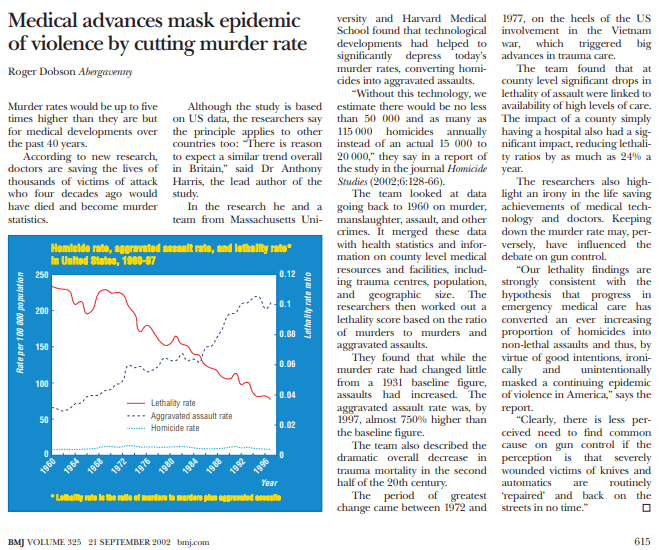
And one massively important variable that has reduced the lethality of combat is medical technology.
The article examined long-term trends in violent injury and homicide and the conclusion is sobering in its simplicity: a significant portion of the modern decline in homicide rates is not the result of reduced violent behavior, but of dramatically improved survival rates following violent acts. Advances in emergency response, antibiotics, blood transfusion, vascular repair, and neurological care have radically altered the probability that an assault results in death. What would once have been fatal now often resolves as an injury.
This matters because homicide statistics are commonly treated as a proxy for moral progress. They are not. They are downstream of medical capacity.
Administrative categories record mechanisms and outcomes, not counterfactuals. A stabbing that would have been fatal in 1850 but is survivable in 2025 is no longer counted as a homicide. The violent intent remains; the victim simply survives it. If modern trauma systems were removed the statistics would change overnight without any corresponding alteration in human psychology or social norms.
This is not a pedantic distinction. It goes to the heart of Pinker’s causal claim. A reduction in lethality is not the same thing as a reduction in violence, and neither is proof of moral transformation. It is proof of technological interposition: modern societies have become safer largely because violence has been buffered, managed, and medically mediated, not because it has been transcended.
This helps explain the confidence of modern elites. We live doubly insulated lives. Protected first by institutions that monopolize violence on our behalf, and second by medical systems that erase its consequences before we ever see them. From such a vantage point it is easy to mistake safety for goodness, and survival for virtue.
I admire Pinker’s optimism. I enjoy the world his data describes. I benefit from it daily. But optimism becomes dangerous when it forgets the conditions that make it possible. Institutions that suppress violence are among humanity’s greatest achievements. Right up until they fail. History suggests they always do.
Human nature is not revealed in averages or trend lines. It is revealed under stress, scarcity, and collapse. In those moments, the same patterns reassert themselves with depressing regularity.
Violence remains impolite to discuss. It remains uncomfortable to acknowledge. And it remains, in extremis, necessary. The only durable counter to violence has ever been superior violence, disciplined by restraint, tradition, and understanding.
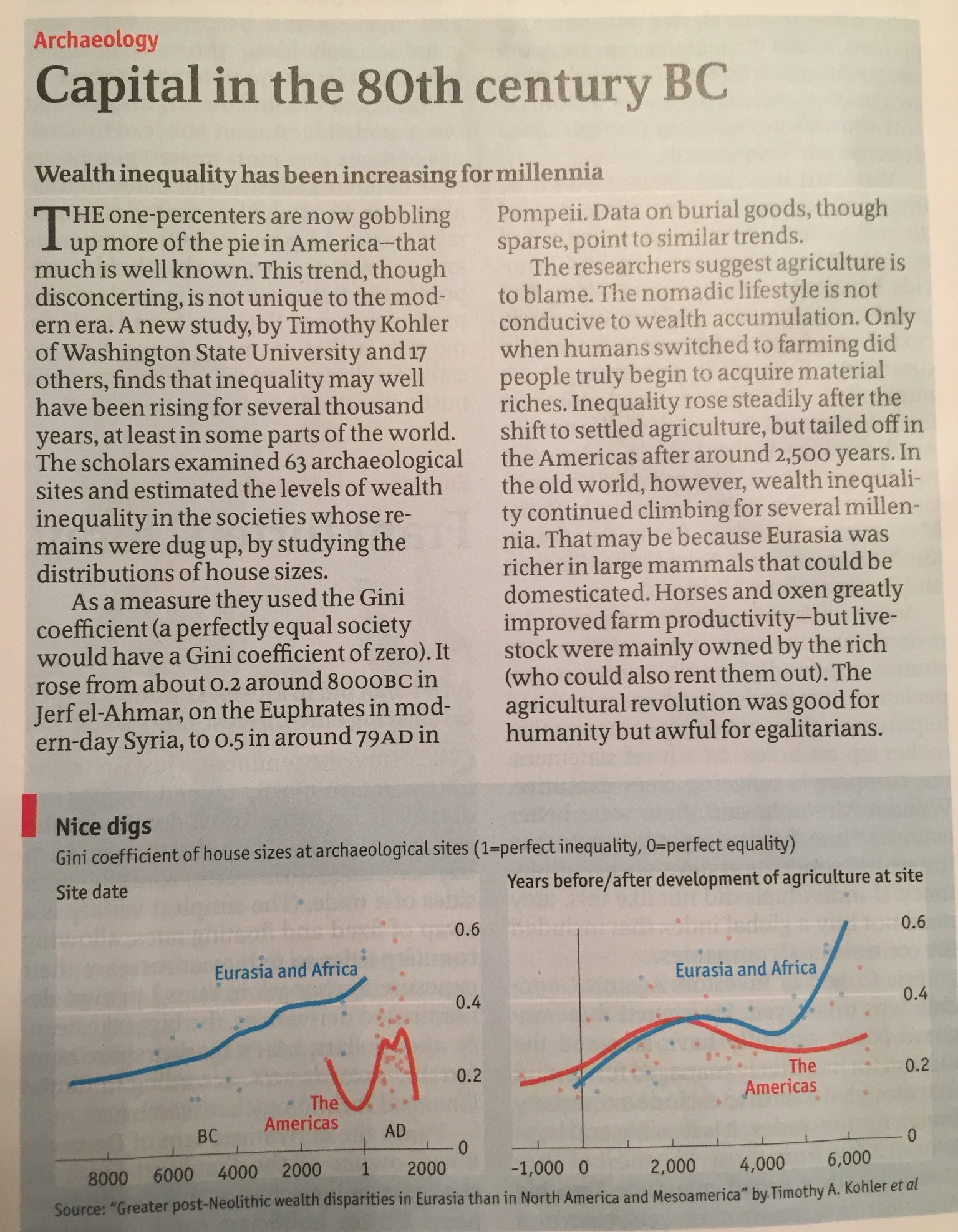
[4] Wealth inequality through time from The Economist – note that while agriculture improved the overall standards of living that there is a trade-off in disparity.
[5] A controversial but statistically convincing explanation for the recent decrease in violence in the United States is the legalization of abortion (Donohue and Levitt 2001). Summaries: Stephen Levitt and Steve Dubner on Freakonomics, and criticisms, and the counterpoint. The underlying logic – those children who would have been unwanted or burdensome to parents unwilling or unable to raise a well-adjusted human are never born and therefore never get to cause predatory violence.
Above all, overconfidence about the decline of war may lead states to underestimate how dangerously and quickly any clashes can escalate, with potentially disastrous consequences. It would not be the first time: the European powers that started World War I all set out to wage limited preventive wars, only to be locked into a regional conflagration. In fact, as the historian A. J. P. Taylor observed, “every war between Great Powers . . . started as a preventive war, not a war of conquest.”
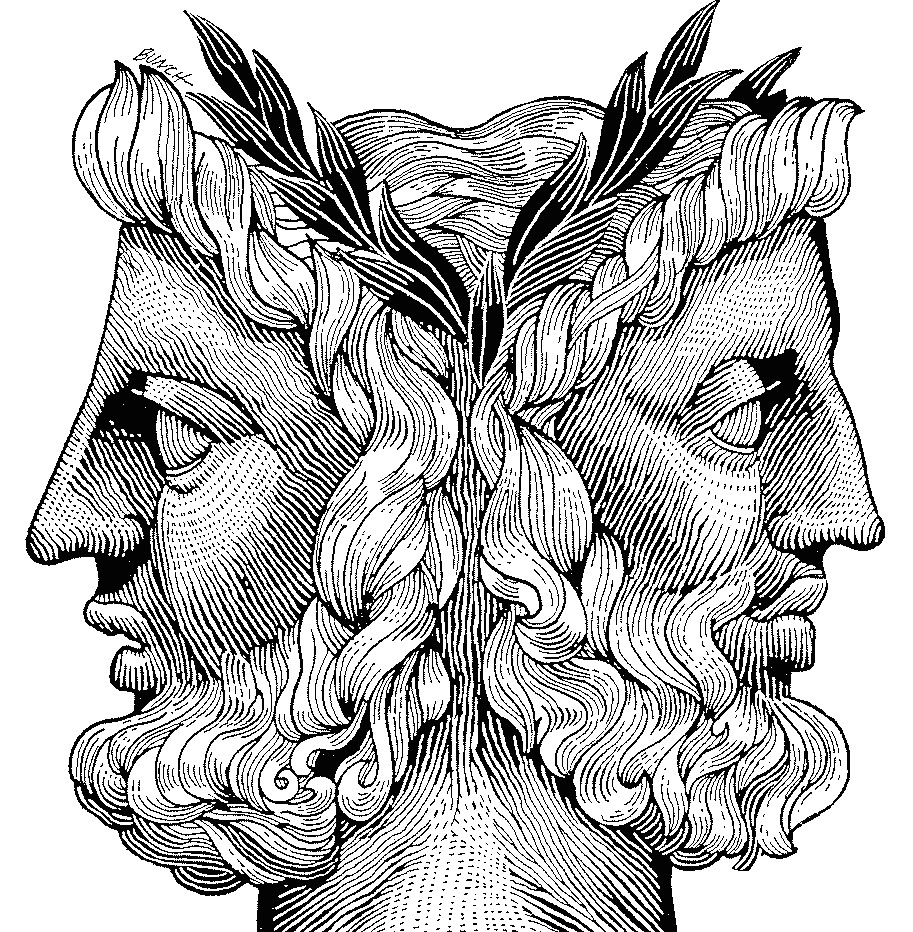
Janus again as a featured image to symbolize the start of a new year and for 2018 I will embark on a new experiment. For the past two years, I have been focusing of teaching concepts rather than techniques (re-visit the beginning) in order to train the trainers. For this New Year I will systematically go through the basic kihon of the Aikido curriculum. I hope to still elucidate concepts – or at least help make connections – through teaching the techniques but the direction of the pedagogical thread will be inverted.
Why? I want to ensure a systematic presentation of the curriculum and focus on teaching to the test (rather than training the trainers). The USAF Aikido standard testing requirements will define the curriculum. I will cover all the techniques required for shodan (1st degree black belt). Please make a study of the USAF test Matrix (which also includes Hombu dojo’s) as well as the requirement sheet.
There are a total of 29 discrete techniques required for 1st kyu which jumps to a minimum presentation of 35 for shodan in the USAF Requirements. For comparison, at Hombu 31 are required for 1st kyu but at shodan the requirements cover “all forms.” However, look at the time requirement for days of practice: In Japan the time commitment necessary to achieve shodan is less than half that in the United States.
Remember – the reason for the difference is primarily cultural. Meaning, shodan in Japan is clearly understood as demarking the start of training, the beginning of real learning and refinement; whereas in the United States shodan often denotes the beginning of teaching. My goal is to clearly impart the curriculum in a clear and concise manner so as to build a solid foundation for efficient training, genuine understanding, and future refinement.
Let us be clear. Teaching to the test is nothing more than a quick way to show how to replicate the basic responses. I do not believe that this is the best way to impart understanding. I do however think it is necessary to ensure that the framework for future learning is solid. And testing is an important aspect of training in Aikido.
The total number of techniques is small when you recognize that there really isn’t a significant difference in the execution of the movement (the response) when done from different positions (modes) – i.e., from standing, both sitting, and only nage seated (and omote and ura forms). In a list form, the number of techniques looks more intimidating than it should be:
If you take the time to break each attack and response into a collective matrix, the number of possible combinations are impressive and I would point you to Stefan Stenudd’s well-thought compilations. Another good mental frame work would be the list here.
Ultimately, these frameworks that create discrete boxes and if-then style thinking need to transform into an organic logic-chain – in other words, techniques need to be reduced back to concepts. Nevertheless, because focusing on the connections without a clear understanding of the discrete elements is challenging – back to the basic pedagogy for a while.
____________
[For those who want a quick video-reference reminder – one could do no better than to review Tissier’s lessons.]
Mulligan sensei when we last communicated, you mentioned:
I just had a discussion with Malory Graham sensei (of Seattle Aikikai) and we were discussing some of the reasons that Aikido membership in the States is declining. She believes, and I agree, that it is mainly bad teaching. To be a good teacher, you first have to have mastery of the art and that usually doesn’t happen until around 4th dan. In many cases, you have people teaching at shodan with limited expertise or older people who haven’t gained the proficiency and are physically out of shape. What kind of impression does this create? How can you attack students this way? Moreover, what kind of pedagogical training is provided? How about classroom management skills? People receive their fukushidoin and shidoin certificates but it doesn’t mean they can teach.
This is similar to the ideas Tissier sensei has eloquently described. The key concept is effective teaching. Can the decline be reverted with effective teaching? And how does one produce/become a good teacher?
Yes, I agree with Christian, Aikido is in the midst of an identity crisis–it needs to redefine what it actually is. And he also points out that there are many more choices today to compete with. However, there are places, even in the US, where growth or numbers have been sustained.
What do you feel creates that difference in success?
The common ingredient to their success seems to be: a competence in the art; clear pedagogical, sometimes dogmatic, approach; accessibility to quality weapons training; an integration of the spiritual elements (Zen, misogi*) and a solid sense of community. These dojos have created the whole package.
There is a great deal to unpack: in your list what is the single most important ingredient to foster a successful dojo?
For me, the most important ingredient is teaching. You have to know your art and be able to transmit the principles in a clear and comprehensive fashion.
Tissier sensei suggested that the art needs to provide younger practitioners the opportunity to be the primary instruction staff. But providing the opportunity doesn’t necessarily make for quality instruction. So the crux of the problem: what constitutes good instruction and how does one create an effective teacher?
As Christian [Tissier] emphasized, if all you teachers are old, and can’t move well, then the students will be the same. It is important to also provide younger more vigorous models for the students to emulate.
So the physical presentation of the art is key.
Yes but students need to also be stimulated on three levels: the physical/technical; mental and spiritual. A lot of teachers do well in some areas but lack in others. Most importantly, does your approach reap results; are you producing quality students?
It’s a bit of a circular logic challenge – you need a good teacher to produce quality students to create the next pool of good teachers. First be able to do, but importantly know how to teach. How do you view the traditional uchi-deshi method to create a teaching pool?
I’m not sure that an uchi-deshi program, especially in the past, explicitly taught how to teach or how to manage a classroom. It was all learned through experience, which can be hit or miss.
It also seems that an uchi-deshi program requires a great time commitment from both students and teacher. That requires a personal connection – adapting to the needs of the student in the moment. A tailor-made experience that may create a good practitioner but if the student learns via this method then is that the only method they know how to transmit the art.
If you look at the classic Japanese approach to teaching martial arts, especially Aikido, it demonstrates and then says “Let’s go,” and then the teacher goes around and throws people, basically using an inductive approach to learning. It is up to the student to steal as much from the teacher as they can. If you look back at your time at Hombu, it was pretty much the same.
I recall that you emphasized the need for both an inductive and deductive (reductive) method – the Western audience isn’t attuned to a purely inductive approach.
Teachers such as Chiba Sensei, trying this approach in England when he first arrived, was very frustrated by its poor results; thus, his exploration of a more Western deductive approach to teaching. He came to develop a sound pedagogical approach.
So what constitutes good teaching?
As I stated before, the two main ways we learn Aikido is from the visual input from the teacher. If the input is flawed or bastardized, then the students will be affected in that way. The other way is interaction, or being thrown by the teacher. This way we notice how the technic should be done, compare it to our prior understanding, and make adjustments to our waza. Based on the feedback we get from our partner, we make, further, adjustment, gradually moving closer and closer to a mastery competence. In language learning, this is what Chomsky refers to as hypothesis testing. This can be either a conscious or an unconscious process.
Back to Chomsky: Deep structure to the rescue! So outline the key components in your experience please.
First have a structure to the class. Curriculum development: do you have a plan. What is it you want your students to know? How do you want them to achieve these goals, what exercises, techniques, principles are necessary to achieve your objectives? How this is executed depends on the teacher. Yoko [Okamoto] is much visceral, organic in her approach; she may not even have an idea of the specifics of what she is going to do until she gets on the mat. I, on the other, had, have a clear roadmap, but may alter or tinker with it during the class based on overall understanding–or noticing flaws or misunderstandings that may cause me to backtrack.
Second, just like in language acquisition you need to develop and distinguish between fluency vs. accuracy. Deconstruction (accuracy): breaking a waza down into its logical parts and then reconstructing it. Remember the Asian inductive approach is extremely holistic. This approach allows students to see the discrete part and how they connect to make a whole (the trees vs. the forest approach). Taking a difficult technic and grading movement from simple to more complex is a manageable way to lead students from discrete forms to a whole movement. You seem to be extremely adept at doing this. But over-reliance on this creates students who are not smooth and fluid–it is just one end of the spectrum.
The need for fluency. Getting students to move in a smooth and fluid way, able to improvise and generate various possibilities. Where you are on the spectrum, often depends on the level of the students. In my basic class, I lean more toward the accuracy end, and in my more advanced class, more towards the fluency end.
Third, cluster elements into a logical provocative flow: Are you just taking 5 techniques from one attack, or are you using the input to teach a certain principle–where is the point of disengagement from a grab, or using the triangle as a tool for destabilization. This is a much richer approach.
Fourth, consciousness-raising activities: Creating junctures or points of comparisons on how two techniques from two attacks can be very different or showing the similarity of certain patterns that seem different. Students have to be also stimulated on an intellectual level.
That is a concise framework – but it deserves elaboration to make clear what you mean. Can you give us an example of a class plan?
Previously, I had notice students having a difficult time discerning omote and ura in kokyu nage forms. These are not only important distinction in the execution of a technique, but also students are expected to know this while being tested.
First, I begin with omote form. The first application is Ryotetori kokynage direct. The grab helps accentuate the articulation of the hand and foot work on a deeper level. It enhances the 鍛錬 tanren process of forging or tempering the body to move in a certain way.
Next, I move to aihami extended hand (connection) prelude to shomenuchi kokynage direct. This allows students to gradually move to a more difficult place in a graded fashion.
Then full shomenuchi kokyunage. Emphasizing the hand change and the specific extension and corners that need to be manipulated.
Next, we go to jodan tsuki kokynage direct. This gives students a more realistic application of the technic and also helps reinforce the whole entry process. Remember boredom destroys everything in its path. Varying the attack stimulates students also on an intellectual level by creating a process of noticing and comparing, even if very subtle.
Finally, in the direct form, I introduce it from Yokomenuchi. Here the dynamics of the technique change a bit, because the handwork is different, giving students an opportunity to see how the technique functions in a slightly different environment. (process of noticing and comparing)
Now we move to the ura version. Once again we begin with ryotetori kokyunage ura. The grab helps facilitate the forging of the correct hand and footwork. This should be the first step before introducing a striking attack. This is something many people outside the art often do not understand (why can’t you just let go). It is a necessary forging precursor to a higher-level attack.
Next, extended hand connection—emphasizing the hand change and the need go for the back arm to eliminate the possibility of a punch.
Next full shomen uchi attack—followed by, attack from jodan tsuki. Certain points are emphasized—the extension of the front hand and the need to take the persons center or space from them.
Finally, once again, using yokomenuchi attack for the ura form.
To finish students are ask to use either omote or ura from Jodan tsuki, giving them an opportunity to execute either one, hopefully, in a spontaneous fashion.
Because our mat is crowded —7 minutes before the class ends. Line work from shomenuchi using either omote or ura forms. This helps ingrain the movement without thinking, and creating a certain amount of muscle memory.
What principles have been employed in this example?
1) Addressing a perceived weakness or misunderstanding. This should be the goal of a teacher. Are students getting what you are trying to teach?
2) Process of Grading—leading students from simple to gradually more complex forms. This enhances comprehension and allows you to teach to a wider range in levels.
3) Consciousness raising and comparing. Helping students not only to notice the difference between omote and ura, but also to help them executed it in an effective manner. Also, by using the same movement from different attracts, students (maybe unconsciously) are further forced into a state of noticing—then comparing—moving them to a higher level of understanding.
The learning process should look something like this:
Input—noticing—comparing—feedback—adjusting—moving to a higher level
Once again the input can be visual (teacher demonstration of the waza) or interactive (being thrown by a teacher)
The physical theater of teaching You leave a memorable image. Tissier too. It seems few know how to be dynamically large. And play with the tempo / timing of a presentation. If it’s all the same speed and emphasis it’s either a blur or boring.
With the traditional class structure there is usually a large variety of student skill levels – how do you keep everyone engaged?
You mean, how do you accommodate a mixed level class? Task-based Learning offers an alternative for language teachers. In a task-based lesson, the teacher doesn’t pre-determine what language will be studied, the lesson is based on the completion of a central task and the language studied is determined by what happens as the students complete it. The lesson follows certain stages. The same approach can be applied to Aikido teaching. I want to teach a difficult sword form, but I have less experienced students in the class who have not gone through the same linear process of learning. Do I separate them, or provide the specific scaffolding necessary for them to complete the task successfully. So a linear time-consuming learning process is not necessary–the ingredients needed to complete this task successfully are isolated and presented in a comprehensible manner.
Classroom management – in the academic world there is a good amount of time with in the field coaching – a practicum before a fledgling teacher is released. How could that be better accomplished in the martial arts?
In most teacher training programs this crucial issue is not even addressed. How do you run a class? How many techniques per class; how long do you spend on each? If the class is too crowded (as it always is in Kyoto), how do you maximize space: line-work, techniques that don’t take up much space, or have half the class train while the other half watches? Do you keep the same partner, or change? How often? How do you pair people? How do you deal with problematic students? How do you teach a split-level class? How do you maximize learning in a lower level class? Beginners, working together with older or more experienced students, can achieve an understanding of something that may normally be out of their ranges of development. This is what [Lev] Vygotsky termed “The Zone of Proximal Development.” Peer learning is a way that you can accommodate a range of levels in one class by pairing less experience students with their seniors. In its pure form, this should be the goal of the sempai/kohai relationship, and not as a form of control and power. The less experience students are able to accomplish something they normally could not have achieved on their own, and the more experienced peer gains a deeper understanding of the skill by transmitting it. We learn the most when we teach something! Therefore, having black belts attend beginner classes accelerates the learning process.
We have talked about the need for a stage presence in the past – how does that play into teaching?
Presence and command: for input or information to stick it needs a charge. The presence of the teacher is crucial here. Quin once said that once I changed into my dogi and got on the mat, I seemed bigger. Assuming the role of the teacher or getting into character. And using your force of character to makes what you do believable—it gives it credibility. Without commanding respect no one will follow or believe in you. Yoko has that je ne sais quoi! She could stand on her head and drink a milkshake and it would be incredible. I, on the other hand, have to rely on other ploys.
Earlier you mentioned the need for a spiritual component. With the Founder’s deep connection to Omoto, I found Doshu’s recent articlerevealing that even the Ueshiba family hasn’t actively maintained that aspect of the art.** How do you integrate the spiritual – while in Portland it was never an explicit component?
Yes, you are correct; we don’t teach spirituality in an explicit way. However, here in Kyoto Zazen is an integral part of everyday training. We do emphasize philosophical aspects. I am always talking about “the path of least resistance” what is the most efficacious way of throwing your opponent. I may from time to time talk about things like your power is where your awareness is. Yoko often uses the tension/release principles and the proper use of breath in her teaching, but yes it is more subtle.
I wonder at the famed American pragmatism eschews the spiritual in favor of the direct practical effectiveness of an art. Perhaps Aikido lost a key constituent market share of the young and active to the overtly practical arts? Does a spiritual message really help – is it necessary?
I agree that the MMA approach reflects American values of pragmatism/utilitarianism–if it doesn’t work, why use it. But the value of a martial art can’t always be measured by how effectively you defeat someone in a cage. What about knives, guns, garbage cans, pencil in the eye? It is still a controlled arena. It is also devoid of any spirituality I predict that people will tire of this expediency and return to the classical forms/arts just for the sake of their purity, inherent beauty and philosophy.
That would be an interesting revival!
I know these conversations are a poor substitution for in-class learning but I appreciate your time and insights.
________________
* Misogi: ritual purification – a Shinto purification ritual, usually by washing, hence training in water. Without the Shinto gloss, misogi is often presented as a highly repetitive and focused training (doing ikkyo only for hours…) and it can be a great way to legitimize training: the shared obstacle to overcome to provide the feeling of success. Similar to a rite of passage. In the past it was surviving Chiba or Shibata sensei seminars.
______________________
**Originally Published Fall/Winter 1999
Stanley Pranin: When did you first begin to pursue aikido with an eye to your future as inheritor of the tradition?
Doshu: It was only once I’d become a university student that I began to pursue it with real consistency. I had to go to school, though, so I could only practice a couple hours a day, in the morning or evening, depending on my class schedule. I suppose I got in about two hours per day on average. During spring vacations and the like I did an extra hour, for example practicing an hour in the morning and two hours in the evening, or vice versa. Even after graduating the pace stayed about the same until I was almost thirty. Around 1979 my father fell ill for a while, and from that point on the teaching duties began shifting my way gradually.
Would you say that your father Kisshomaru had the greatest influence on you?
He used to teach every morning and on Friday evenings, so I was always at those classes. I went to classes by the other teachers, too, but I had lived all my life under the same roof as my father, so the training I received under him undoubtedly influenced me the most.
Was there ever anything in particular that your father emphasized in talking to you about aikido history?
A young Ueshiba Moriteru in old Aikikai Hombu Dojo c. 1961
He didn’t really talk much about that sort of thing to me. Most of what I ever heard him say about it I picked up after I began training more regularly under him and when I accompanied him to seminars, lectures, and demonstrations. He never sat me down while we were at home and said, “Moriteru, it’s like this…” or “Moriteru, these are the things I want you to know…”In any case, from the time I was born I lived together with my grandfather, the founder of aikido, and my father, the previous Doshu, so I’m sure I’ve been influenced by them both in many ways, even if they never spoke to me specifically about such things. I was born and raised in an aikido environment, in all its aspects, technical and otherwise.
What kind of training did your father give you specifically?
I trained along with everyone else, so there was never any time when he called me aside to give me alone any special training. He always did make a point to give me certain pieces of advice while I was out on the mat, for example, to always perform my techniques cleanly and carefully, to keep my hips down, and to make my movements large. But in terms of how to do nikyo or sankyo or what have you, I’d been seeing and experiencing those techniques since I was small and already understood them, so I never received any particularly detailed instruction about them. Mostly what I was taught had to do with the larger main points like those I just mentioned.
Also, I have to say although my father was also my teacher, when we went home at night I think our relationship was just about like that between any other father and son. (laughs)
Did that include the kind of “rebellious” stage that most teenagers go through at one point or another?
Well, no, in fact I never went against my father like that, but apparently I was something of a terror in elementary school. (laughs) I used to get into all kinds of mischief, and my mother was forever being called in to the school to account for something I’d done. So I suppose any rebellious urges I may have had got channeled outside instead of going against my father.
How do you view your father’s role in the history of aikido?
Aikido exists because somebody created it, but the fact that it exists in its present form is in great part due to the cumulative results of the ongoing efforts my father made all his life based on his understanding of the founder’s intentions. I think it is largely due to those efforts that aikido has taken the form it has now, and that it has become so popular and well-regarded throughout the world today.
Looking even further back, in the process of formulating aikido the founder travelled extensively and pursued many different types of training, and he was able to do that largely thanks to the backing and support of my great grandfather Yoroku, who let him walk on his own path and helped him do it. My grandmother also supported him, in her own fashion, as his wife. So for the aikido we have today, we owe a great deal to the cumulative efforts of many different people.
Doshu at Budokan, c. 1995
At the same time, there have also many fortuitous conditions, for example, the fact that the Hombu Dojo escaped destruction during the war. I would also mention the efforts of those who worked to have the Aikido Hombu Dojo legally recognized as a non-profit foundation (zaidan hojin) even before the war. It was first recognized as such in 1940, as the Zaidan Hojin Kobukai, and based on that was later recognized by the Ministry of Education as the Zaidan Hojin Aikikai (Aikikai Foundation) in 1947.
So aikido exists today through a combination of all of these factors: its creation by the founder, my father’s efforts as doshu, the survival of the dojo during the war, the establishment of aikido as a non-profit foundation, as well as the support the founder received from his parents, wife, and many others.
I’ve heard stories of the desperate efforts your father Kisshomaru made to save the dojo from the fires that engulfed much of Tokyo during the war.
I think only about five other buildings in this area managed to survive. Even the building right next door was burning, so they formed a bucket brigade in a frantic effort to keep the flames from consuming the dojo as well.
Everything would have had to have been started from square one again if the dojo had been destroyed then, so it is quite significant for the development of aikido that it was spared.
Yes, I think so. I remember when I was small, there was not yet much activity at the Hombu Dojo. For a time my father was actually in Iwama instead. He married there, and starting around 1949, he worked for about seven years at a company called Osaka Shoji. He had no other choice. Even if you have a dojo, you can’t make a living if nobody is coming to train, which was largely the case after the war. So, he took a job as an ordinary company employee during the day and taught only in the mornings and evenings. As things gradually began to stabilize, he was eventually influenced by various people to leave the company and take up aikido full time. I think it was deemed most proper for the son of the founder to assume a position of leadership, especially since it would help stimulate membership growth.
Kisshomaru Ueshiba and Moriteru Ueshiba at 1998 All-Japan Demonstration
We’ve just had our 37th Annual Aikido Demonstration [at the Nippon Budokan], but demonstrations back then were held in places like the rooftop of Takashimaya department store. I remember going there with my grandmother to watch one of them.
Also, I believe my father enthusiastically encouraged many of the university students training at the Hombu Dojo to form aikido clubs back at their schools, so gradually aikido dojos began to appear in many parts of the country as those students graduated and returned to their hometowns.
Encouraging the formation of university aikido clubs seems to have been an important element in spreading aikido. Did you yourself ever train at a university club?
No, I was busy training at the Hombu Dojo, so I didn’t have any particular interest in training at a university club. Of course it also had to do with the fact that I was too busy enjoying myself doing other things. (laughs)
I’ve heard you were a member of your university’s calligraphy club instead.
(Laughs) Ah, that I was… I wanted to improve my handwriting, but I must confess I didn’t pursue it that seriously. I was in the calligraphy club, but actually I spent most of my time doing things with my friends and so on, just like any university student. (laughs)
When did you first start travelling abroad to teach aikido?
The very first time was in 1975, when I went with Mamoru Suganuma Shihan to accompany Doshu around Europe. The atmosphere of the training in each place we went was different depending on the teacher hosting us. In any case, it was my first time abroad, so everything was quite new to me. I remember being particularly impressed, for example, that our hotel in Rome had been built in such a way that it actually incorporated some ancient ruins. I also remember thinking how beautiful the sea in Cannes was. To tell the truth, most of my memories and impressions from that trip had more to do with it being my first time abroad than with the aikido training. We were only there for twenty-five days, but it was still a pretty packed schedule.
I’ve heard your English is quite good…
I would hardly say that! I used to speak a little, but actually I have the feeling it’s gotten worse! (laughs)
There are those who say that empty-handed technique (taijutsu) is the basis of aikido, while others assert that aikido is a so-called “comprehensive budo” (sogo budo) that includes the use of weapons. What is your view?
It is certainly true that founder often trained with weapons like the ken (sword) and jo (short staff) and explained that these were aikido; but most of my training has been under my father, the previous Doshu, so I am more inclined to go with the interpretation he espoused throughout his life, which is that empty-handed technique is the foundation of aikido.
This is not to say there is anything wrong with training with the ken and jo, and people interested in pursuing them should by all means do so. There’s no reason to prohibit such things. It’s perfectly fine if people want to use these as part of their own training, but I think it is a mistake to insist that they are [the basis of] aikido.
Did you ever have an opportunity to train under the founder?
Many people have asked me that question. I know it would sound good and fit the image for me to be able to say “Yes, I had a lot of special training under the founder,” but that’s just not the case. (laughs) I was around him from the time I was small, so I watched him quite a bit. I lived under the same roof with him and often watched him train, and I also attended his morning classes, but I don’t think there was anything special about my training under him. Sometimes the founder would teach the whole class, but there were just as many times when my father would be teaching and the founder would only come in for a while to add his own general explanation about whatever the class was doing. That was about the extent of my training under him. Sometimes during the morning classes he used to call me over to have a friendly chat, as grandfather and grandson, but he never told me to get out on the mat and practice.
Did you ever find him a little frightening?
Not particularly. I can imagine that his students may have found him that way given their teacher-student relationship, but I was just his grandson and he never really lost his temper with me the way he might have with others. In fact, I don’t think he ever got angry with me about anything, even when I was small and used to sit there and hit him on the head for fun. I don’t remember it, but they say I used to do that! (laughs)
The Ueshiba family’s relationship to the Omoto religion goes back nearly eighty years. What significance does Omoto have for the family now?
Obviously my grandfather was highly influenced by the Omoto sect in the process of creating aikido, and particularly by Onisaburo Deguchi Sensei. My father was brought up in that environment, but I don’t think he was ever influenced by it to the extent that his father was. He was always conscientious to maintain and observe the various associated rites and functions, but he didn’t visit Omoto all the time the way my grandfather did, and I don’t either. The founder himself had an Omoto shrine built, and when he passed away a lock of his hair was enshrined there in the traditional manner. Whenever we hold the Taisai (lit. “great festival,” an annual ceremony commemorating the passing of the founder), we have the Omoto priests associated with that shrine come to perform the rites, but this tradition is based on the founder’s relationship with Omoto, not the Ueshiba family’s. In fact, the Ueshiba family temple is still Kozanji in the city of Tanabe in Wakayama Prefecture, and that is where the founder’s ashes are interred. Morihei Ueshiba himself happened to have been influenced a great deal by Omoto in the process of formulating aikido, so that relationship remains to an extent; but I think the relationship with Kozanji as the ancestral family temple is the deeper of the two.
Moriteru Ueshiba at 1998 All-Japan Demonstration
During the 1970s there were a number of people who left the Aikikai organization for various reasons, but who have later wanted to come back and have been allowed to do so. It seems to me that that kind of broad-minded acceptance was something the former Doshu Kisshomaru felt to be extremely important. As someone very close to him, I wonder if you can tell us anything about the background of that attitude on his part?
During the 1970s there were a number of people who left the Aikikai organization for various reasons, but who have later wanted to come back and have been allowed to do so. It seems to me that that kind of broad-minded acceptance was something the former Doshu Kisshomaru felt to be extremely important. As someone very close to him, I wonder if you can tell us anything about the background of that attitude on his part?
The founder always said that “there is no expulsion (hamon) from aikido.” There are those who have left the Aikikai, but it was never because anyone told them to leave. My father had the same attitude. If people who have left the organization eventually want to come back, there is no reason to prevent them from doing so. The only caveat might be that those who have left the organization for a time and then returned will inevitably have some influence on those who have stayed on the entire time. But aikido is not about eliminating or removing the other, it’s about building harmony, about bringing people together. These are the very basis of aikido, and this was undoubtedly the kind of thinking that formed my father’s response as Doshu to such situations.
By now aikido has been practiced outside of Japan for over forty years, and among those practitioners abroad there are quite a few who began their study under an Aikikai teacher in Japan, but who have since formed their own independent groups. But there are also those who have come to Japan wanting to develop closer ties with the Aikikai. How do you think such situations should be handled?
Under the traditional Japanese way of thinking, the most correct approach would be to go through the Japanese teacher who taught them originally, but for some groups past circumstances have made this impossible.
The Aikikai now includes an International Affairs Department. People wishing to develop or re-develop such a relationship with the Aikikai should submit their request, along with all the relevant information, to that department, after which we will be able to see what can be done. Each case is different, of course, but as long as the proper process is observed, I think most such groups will be able to return to the Aikikai.
What is the significance for the Aikikai of the International Aikido Federation that was created in 1975?
The people who organized the International Aikido Federation are still around, so you should probably ask them instead of me, but in general I think the most obvious purpose was to assist the smooth development of aikido abroad. That was twenty-four years ago, and the aikido world is considerably wider now than it was then. In the interim, the ease with which we can now exchange information, for example using the Internet, as well as the development of much more accessible transportation networks, have made the social background of today completely different from the social background that existed back then.
The International Aikido Federation is organized on a Western model based on democracy and so emphasizes the importance of lateral relationships. In contrast, the Aikikai is a non-profit foundation that is based on a more traditional family -or lineage- based iemoto system with a strongly vertical structure. How do you think these two different organizations one structured horizontally, the other vertically can be reconciled in such a way that they can work together successfully?
The differences you mention do indeed present some difficulties, but even if there are some occasional ripples in the relationship, I think things generally go fairly well between the two and there are not so many truly serious disputes.
There are many non-Japanese who have the idea that a “democratic” organization is one in which everyone gets to cast their vote in the process of making decisions about important issues. But wouldn’t it be more correct to understand the International Aikido Federation as being under the umbrella of the Aikikai, and that just as dan rankings are overseen not by the Federation but by the Aikikai, it is actually the iemoto that serves as the foundation and has overall control of everything?
The Aikikai is, of course, the foundation, but that is not to say that it makes all of the decisions all of the time regardless of what the other side wants. Essentially the Aikikai is a collective of people who originally came together based on their shared interpretation of aikido as it was created by Morihei Ueshiba, people who were members of the organization that developed under him. That group of people was subsequently recognized by the Japanese government as a legal entity called the Aikikai.
The activities of the Aikikai happen to include activities abroad, and the International Federation represents an establishment within that of a horizontal structure with its own rules, regulations, and officials. Naturally, decisions within such a horizontal organization are handled by majority rule, and in fact their by-laws specify that they must be. That means there are inevitably instances in which things are not handled as the Aikikai feels they should be. If you create an organization and give it its own by-laws, that is naturally going to happen.
Nevertheless, as I first explained, the Aikikai is still essentially an organization comprised of people who agree on the aikido created by the founder and have come together as a way of respecting and preserving it.
Aikido is one of the few modern budo that still maintains the iemoto system. It is also one of the few among those in which the official successor to the system actually continues to practice the art. What do you think is the significance for aikido that this iemoto system is still used?
Aikido is not the kind of martial art in which there is competition to determine superiority, but rather one that strives to realize an essential ideal of forging respect among people. The question is, how do we go about organizing and expanding it to achieve that ideal in a coordinated manner? The answer and this is not something that I personally have decided is that the most natural approach is to base that organization on the iemoto system that has such a long tradition in Japan. I doubt there are very many Japanese who would question this or find it strange; it just seems very natural to us. Even when I’m asked by a non-Japanese why this should be so, all I can say is that it just seems to be part of our heritage, something that is simply part of us, like DNA. I guess there are things like this that can’t be explained very well. (laughs)
Yes, as you say, it does seem very natural, and most Japanese seem to accept it as so. What about your eldest son? Does he have an interest in eventually succeeding you as doshu?
He has been born and raised so far in the same environment I was, and in fact he even appeared in the 37th Annual All-Japan Aikido Demonstration, which this year also included a mourning for my father’s passing. At the moment he’s still in his third year of high school, but I think he has become much more interested in aikido than I was at that age, and he seems to be doing a good job of pursuing his training. (laughs)
Doshu at All-Japan Demonstration in 2000
Looking at the history of aikido, in addition to being strongly influenced by the Omoto-kyo, it seems to have enjoyed considerable support from quite a few individuals of high social status. While the founder was resident in Ayabe he had contact with people like Seikyo Asano and Admiral Isamu Takeshita, and later, through that network, with people like Gombei Yamamoto and other political leaders of the day. Many of these pre-war connections continued to a certain degree in the postwar period, with people like Kenji Tomita and Kin’ya Fujita becoming directors of the Aikikai shortly after the war. Former Prime Minister Toshiki Kaifu would be another one. Please tell us your view on the kinds of roles people like these have played in the development of aikido.
The prewar and postwar periods were different eras for aikido. Particularly before the war, aikido was hardly known in the world and it was only through the kind of support you describe that the founder was able to come to Tokyo. I think the fact that people like that supported Morihei Ueshiba so strongly attests to their opinion that he truly did have something wonderful to offer. As you say, those kinds of relationships also continued after the war. Mr. Kaifu was introduced to aikido through a connection between my father and Mr. Yoshimasa Miyazaki.
Did Mr. Kaifu ever actually practice aikido himself?
Yes, back during the days when we still had the old wooden dojo. Obviously these days he is quite busy with his involvement in government, so I imagine it would be difficult for him to train now. Both before and after the war, Mitsujiro Ishii [a former higher-up in the Asahi News organization who was active in promoting aiki budo and Daito-ryu aikijujutsu before World War II] was handling the directorship of the Aikikai, and Sunao Sonoda, a former cabinet minister, came to practice every day from about 1955 through the late 1960s. I believe he also served as the first chairman of the All-Japan Aikido Federation. If you look at the old programs from demonstrations and events back then, you will find the names of people like Ishii Sensei and Sonoda Sensei. Ishii’s grandson also trained here for a long time.
The fact that aikido has had that kind of backing was of course largely due to the wonderful personality of Morihei Ueshiba and the aikido that he created. Those relationships led to many positive things and eventually, I think, to positive influences on society. I would also mention that it was my father’s subsequent efforts to understand and disseminate the intent of aikido that helped it continue from there, eventually to be embraced by so many people as it is today.
Shigenobu Okumura Shihan once stated in an interview in a previous issue of Aikido Journal that Kisshomaru’s three great contributions to aikido had been its organization, transmission, and theorization.
I would agree. Aikido exists today not only because of the person who created it, but also because of the steady efforts over many years of others who have helped develop it. That is why my father was even honored with an award by the Japanese government for his service as doshu in that regard.
What kinds of aspirations do you have as the third Doshu of the aikido tradition? What dreams for the future of aikido do you hope to realize?
Ah, I get asked that a lot! (laughs) Aikido was created by one man, then developed and spread by another; what, then, am I to be for aikido? My answer is that what I can do for aikido will not be on such a grand scale. I think my role has more to do with creating and maintaining a path that the many people who have helped bring aikido to this pointas well as those who are just discovering itcan continue walking together, a path that allows them to continue practicing together with a spirit of friendship and solidarity.
Doshu with Aikido Journal Editor Stanley Pranin following interview
When I was small, aikido was still hardly known to most people, but that has changed and there are now considerably more people who have at least heard of it. Since it has come that far, the task now is to continue to pursue and hand it down in a clear and ordered form that accurately reflects the essence of what it is. So rather than stating that I want to do such-and-such with aikido, or that aikido has to be such-and-such a way, I think it is more important that I simply help to maintain an environment in which we can continue doing what we are already doing so well.
Has your lifestyle changed at all as a result of assuming the role of doshu?
Not that much. Before my father’s health declined we used to divide up the teaching commitments in Japan and abroad, but for the last two years of his life he was mostly unable to travel abroad, so I started going in his place. In that sense not much has changed for me, since I’d already started taking over some of those duties. Still, although what I do hasn’t changed, the sense of responsibility that goes with being doshu is certainly much heavier, so it feels completely different in that respect.
I can imagine. But given your personality, I doubt you’ll be the kind of leader who sits up on a cloud, but rather the kind who is friendly and easy to talk to and get to know.
(Laughs) Yes, I hope so! My father’s face at forty-eight was a lot more stern than mine is now at that same age. Of course, he was actually more easygoing than his expression tended to suggest, mostly I think because he was simply brought up in a different, harder era.
The environment of the war years must have had a lot to do with that. There seems to be a difference between people who experienced that era and those who didn’t.
To be sure, people of his generation tend to have a certain austerity about them.
Well, I don’t suppose I’ve been able to give you the kind of answers you might have been hoping for. There are probably people hoping I would say things like, “Yes, as the founder’s grandson I trained diligently from the time I was very small!”, but unfortunately I could never get away with statements like that. (laughs)
On the contrary, I appreciate your frankness, as I’m sure most of our readers and others in the aikido community will as well. Thank you very much for sharing your time and thoughts with us!