James Keating Hellbows
JAK Panatukan Boxing
Comtech Djurus
Remy Presas Visidario and basic
Remy Presas Two Cane Disarms
Maul Mornie Silat
Paul Vunak Killer Instinct
______________________________
Kali formulas – Hubud = 2/4/5/1
Snake 1 : macro = kokunage, medial = figure 4, weapon = top quadrant
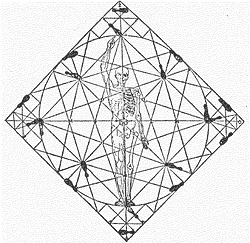
Kali inverted triangle
5 methods of knife retention
Roll over / inside and out circles
Point up into forearm
Simple assisted strip with other hand
Pass to other hand
Stork neck then return to armpit
Every cross block creates a zone of entry
Angle 1/2 slash instant disarm
Angle 1 check feed to right hand grab thumb like Sankyo then strip with hand forearm and elbow
Selberg YouTube fencing
Selberg Italian fencing method
Selberg history of saber and its us
Know your voids
Tanto Jutsu as voiding just like the backcut
Tanto – Don Angier
Bock – parry- evade is the progression
High to low is close range
Low to high is long range
High fake in Kali thrusting uke takes bait and then nage darts low to cut under
Fencing is inverse to in quattro
Military lead arm shield comes from old shield concept. Not sound strategy.
Weapon should be forward. tomahawk has 2 planes of motion. Horizontal and vertical simultaneously. Sword only vertical or horizontal at one time
Longer knife is an articulated lever and therefore faster. A small knife is not faster than the fist holding it. Longer knife can bridge at least 16″ overall length.
Get the fuck away arts vs trapping adhering arts
James Keating 10.14.17
Arm manipulation results in belly up (shihonage, udegarami, kotegaeshi) or belly down (ikkyo, nikkyo)
Quick strips
Stick – sword. Angle 1 from the cross = snake A whereas angle 2 (backhand) is snake B – both must have the free hand shoot through the gate to entangle
That as a reference, the strips with blade is saber are from cross block flow. Point of impact should be a void – meaning no hard block but a connection to the flow energy to get to the pass
Blade in reverse grip is the quick roll over and can be done same side or cross body but both must get high into the v of the knife and assailants wrist
Ai-Hanmi release exercise to promote the snake grasp – from the grip – on the horizontal plane move against the thumb to release then back in to promote your grasp by the thumb then out again to perfect the grasp
Knife to counter knife flow. Off the standard strip (kotegaeshi with elbow) the knife is back at assailant, then roll the knife up and over and slam the pommel
Note in sword fighting the goal was more to entangle and bind than it was to disarm
Kotegaeshi – the putting the wrist around a corner vs the straight metacarpal throw : this merits investigation – the Aikido presumes the grasp at the very apex of the thrust – so nage has absorbed and will move around the terminus point the disarm necessitates a thumb strip and much closer positioning. Look at the Aikijujutsu for cognate?
There appears to be no variant that is akin to Yokomenuchi ikkyo – timing is too challenged? It could be done with an explosive hit then pommel hit to eject the blade
2 finger flick must hit the forte not the foible
_________________________________________
Notes from JAK, 3/16 – 3/17
Notes from JAK (1)
Filipino culture was heavily influenced by Spanish – and therefore a Catholic influence: a triadic culture (the Father, Son, and Holy Ghost) and the 3 parts of the Butterfly knife represent each part of the Holy Trinity.
There are variants on 5 and 7*
Triangle — 3 points: impart knowledge in 3’s – the attack (use of weapon), the defense (weapon v weapon) and the disarm (unarmed v weapon). Do not impart each piece discretely.
Counter knife (weapon) is a broad category and includes use of other weapons (guns, chairs, etc.) and empty hand techniques. Remember that all locks are disarms and disarms are locks.
While counter-knife was the focus of the seminar, one need learn each of the triadic structure to see how they interact.
The driving principle is that motion is universal: Body Motions – from art to art or culture to culture, the motion is the same but with different names. In Japan, Kotegaeshi but in Kali = #1 Lock flow.
Mental State is imperative: Skills matter but attitude is the deciding factor:
“Retreat but retreat forward”
– Flank people, set an ambush for those who think they are ambushing you.
-You do need some stamina, some physical fitness and a hint of a killer instinct. This is a drag race. If things go down, you have to let it all out for a short time.
Tactics are part of the Art: Trickery, sleight of hand because a gun or a knife negate athleticism, toughness. The gun and knife do not care how tough you are.
Enganyo – (Engaño) – trickery in Spanish – this is the bread and butter of the knife player. There is no point in head-on confrontation – there is no primary attack in a knife fight. Deceit and trickery are necessary tactics.
Edged weapons are now demonized but historically the Blade = Art of Nobility. With an edged weapon fast is timing, power is flow. Engagement with a weapon – go after them with timing and flow.
Class Structure
1 Pekiti tirsia flow
2 Knife v knife (Mexican)
3 Hitting exercise (counter strikes) Hubud Lubud
4 Empty hand v knife – teach grip then to hijikimi osae and knife return / Snakes & Vines
First Drill: Pekiti tirsia Passing – Cross reference always – palm-up- forearm toward threat. A damage control technique (protect the flexor tendons by presenting the bony side of the forearm).
Don’t push thru – sense the threat and let it pass through: allow the feeder to move
Horse stance and rotate the ankles – your elbow is the pivot point
Show students that in cross reference (RvR, LvL) you cannot be cut but in RvL/LvR you can
Drill – Timing Development – done from contact and eyes closed to feel when the feeder moves, then react to their stimulus, do not force the technique.
Second Drill – as feeder attacks, stop hit by retreating then adhere and flow to Pekiti tirsia
Threat slices back and forth on the horizontals. You pass, pass, get in and neutralize. Choose a side and go. Do not hesitate. Can now take knife and counter attack.
Third Drill – now have knife in right hand, hammer grip, comeback across the throat with a #3, c-cut down to #4 to intestines, left hand checking hand to their right arm, follow checking arm to triceps (#6 cut?) and cut. Finish quickly, drag race concept.
BONUS – Step over Technique and break the lower leg.
– Take them down
– Your forward foot slides under their ankle/foot (creates elevation, fulcrum)
– Step across and edge of foot (heel?) into the cavern of inside shin.
ITCB – I take care of business
Cut vs Thrust?
-Where are you? Warm weather or cold. Clothing layers and type can affect cuts/thrusts. Be adaptable. What’s appropriate for the moment? Most knife attacks will happen in confined spaces with numerous obstacles. Observation: island/beach arts tend to have sweeping feet movements whereas jungle arts lift the feet.
Training vs. Real life – a drill vs combat: in combat there should never be more than 3 exchanges (beats) to end the fight. Following is fighting, strips are training.
Now to Pekiti tirsia passing, add a jing – a snapping shot (like shaking water off) to the nerve at the top of the radius just below the elbow or at elbow. The hit to the top of the forearm should buckle the knees.
Recall that the knife v knife version of Pekiti tirsia: the cross reference check is a throat cut, the pass is a C cut to the kidney, then reverse the hand to cut the triceps.
[Hubud – poison hand drill use the back knuckle to hit the hand then quick roll to double hit with fore knuckle]
The cross-referencing hand is the one that delivers the shot. Your palm extends toward the threatening arm and then you turn your wrist to the outside (thumb goes to the outside) exposing your knuckles and forearm. The passing mechanics of the checking hand – the entire plain of the arm must rotate (hollow the elbow).
Attitude – on a mission, a goal to accomplish, no emotion, just going to work, command and control. Keep gaze just over the head, good posture, look high, spirit high. Telling of the tale is the closure of the mission. The stories must be told.
The passing action needs to result in a shihonage grip. This exposes the threat’s thumb. Grab and control the hand through the thumb always. Working to get to the outside and on the humerus for control. Salute with other hand to prepare hellbow and possible other attack from threat’s free hand. Then Lock Flow can take over from here if necessary.
This is where creativity can enter the equation because there are a million combinations from here.
For example, Pass, free hand comes over the top and execute universal #4 to #5 (cross hands to spread open hands).
Knife to belly = hollow out
Knife to throat = pass it. (tumble knife drill also)
If you are attacking, move the weapon first. If you are defending, move what is being targeted.
Gun drill (guns only utilize angle 5) – no finger in trigger guard, high probability of break. Get off the line and execute any knife takeaway.
-grab the cylinder to stop a revolver, push the slide back to stop an auto.
Another cool combination: Pass, loop threats arm up and around on neck, blade is on their throat, pin foot (always), take down, now can put knee on lungs and compress.
Teaching Sets
1) Return: Returns (to sender)
2) Remove: Keep (I keep/take and determine what’s next)
3) Eject/Project: Fly (eject, project – send the knife flying)
Teaching must: Entertain, Educate, Enlighten
Entering – enter with pain (Paul Vunak – R.A.T. [Rapid Assault Tactics] has three phases: (a) Entry/Inflict Pain (b) Pressure/Blast to keep the pressure on (c) Terminate/Headbutt, knee and elbow strikes)
Rifle Takeaways
1) Rifle Shihonage – Enter ai hanmi. Reach under rifle to grab threat’s thumb with your forward hand, palm up. With your same forward arm, roll your elbow over the top of barrel. The rifle can be under both of your armpits
2) Rifle Snake – Enter gyaku hanmi. Your front arm’s elbow goes down the top of the barrel, passing it safely and then Snake A with same arm to threat’s head. Strip if you wish
3) Sankyu take away (more for pistol) – Enter gyaku hanmi. Your forward arm grabs pistol. Your other hand grabs the wrist of engaged hand and executes a Sankyu and canter.
[Sankyo supported removal reminder – tricks. (a) from a finger grasp, push uke’s fingers down, when uke responds, twist up to sanyko. (b) supported (parallel cant] grab your own wrist to create the leverage]
New Sword takeaway – really allows defender to move to zero pressure (irimi tankan) – Yokomen cut with sword. As defender enters, back hand inserts into the triangle formed by the threat’s arms, now execute tankan and keep turning 360 degrees until extraction occurs.
Knock-out-their-teeth technique for club or longer knife– need to review this one a bit – Assume right handed attack to exposed left side. Irimi Tenkan but do not pass, come over the top, turn back out 180 degrees, left hand on top of the blade, right hand becomes a fulcrum. Their handle pops out and hits them in the mouth.
Yonkyo – (Qu Sao, Ku Sao?) – heavy hands on wrist.
Jing – 3 hits, then 5 hits
Tapping Exercise as Entry Drill – the tapping exercise is an entry drill – stop hit and close!
Double taps reverses the leads
Robert Langford techniques
– cross hand pass to kotegaieshi – punch from other hand comes, roll with it (really turn the body away and have elbow capture incoming punch), his arm with knife on outside, press his arm compressing both (need to review).
– Second technique is cross pass to shihonage grip and return knife to their throat, then rotate grip down, switch grip keeping threat’s thumb controlled and blow thru knife with outside of forearm from your free hand.
Ken Smith – worked on body movement without hands….tenkan. Also, used crescent style inside out and outside in knee deflections to guide, not strike, knife.
Used body to strip. Belly button on knife and turn away from threat’s unarmed hand.
Ai hanmi – strike comes in, jing with cross reference hand, come over the top and palm down, slide down the top of arm to pin the blade against the body and turn away from threat’s unarmed hand.
Bill Sanders – T-Step drill – turning hips and forming “t” with feet.
-hands behind the back
Angle 6 and 7s – 6 to shoulder, 7 to shoulder
-6 to hip, 7 to hip
Pin their knife on them, your knee, your hip, explore this.
Never seek a lock or a strip
Preview of next day – Snake A & B, Vine A & B
Body postures – TaiChi and Kung Fu are based on a balanced scale – the hands on each side. Front hand is the asking hand. The asking hand is sharp – palm up, fingers stiff.
History of JKD – Inasanto introduced Kali/Silat into JKD which previously was not heavy on weapons
Day 2
Single Stick training – each disarm has variations so knowing 4 (inside out, outside in, left and right) is really 16. Creativity is encouraged.
Basic premises of disarms with sticks.
B is off angle 2 – A is off angle 1
Snake A – Threat in Red has stick in right hand, you in Green have stick in right hand. Threat attacks angle 1. You move right off the line and block. Your left hand goes through the “gate” here and wraps around to the outside.
Snake B (back hand) – Threat in Red has stick in right hand, you in Green have stick in right hand. Threat attacks angle 2, back hand attack. You move left off the line and block back hand. Your left hand goes through the “gate” here, Pekiti tirsia passes, and wraps around to the outside.
With Vines, you use your stick or body to pry away.
Vine A – Threat in Red has stick in right hand, you in Green have stick in right hand. Threat attacks angle 1. You move right off the line and target his hand. You pull back your stick and insert palm up under his struck hand against the back of his hand. Create opposing forces using your left hand on his stick while your stick is going opposite direction on the back of threat’s hand.
Vine B (back hand) – Threat in Red has stick in right hand, you in Green have stick in right hand. Threat attacks angle 2, back hand attack.
Figure a. You block with you angle 2 to his stick and your free hand to back of his stick hand. You are in Universal #5 body position (open). Drive the tip of your stick down as if you are going to stab the threat in his side nearest to you and come up under the inside of his stick arm.
Figure b. Your stick is up. His is down. Your stick hand rotates to the outside while your left hand raises palm up and takes out his stick
Snake and Vine Drills
Note: Check hand is important and pay attention and study its position. It matters more than armed hand.
Find and explore Snakes and Vines:
1) Empty hand vs. Empty hand
2) Empty hand vs. stick
3) Empty hand vs. short blade
4) Empty hand vs. machete
5) Stick vs. Stick
6) Stick vs. short blade
7) Stick vs. machete
8) Short blade vs. short blade
9) Short blade vs. machete
10) Machete vs. machete
Entries and Sensitivity Drills
- Pekiti tirsia Passing
- Hubud Lubud
- Kali Triangle
Work these drills left and right, armed and unarmed. Drills can also combine the three into one. Can practice attacks, disarms, locks, etc.
Don’t forget to move the body and feet.
Hubud note – execute ikkyo on humerus and above.
4 circle drill for footwork to get your legs/body out of the way of and attack
Blocking vs Chasing. Chasing is more advanced. Chasing = threat uses #1 to attack, I respond with #2.
____________________________
JAK’s first Kali teacher – Richard Bustillo
____________________________
John Farnam – fighting with a gun
____________________________
Bowing the head – bending at the neck breaks the energy of the spine – making one a slave. Keep the head high (military posture) look above their heads and retain your power. [People looking at their phones are making slaves of themselves!] Old style reverent prayer was looking up to heaven, not bowing your head in shame. So to command is to make them bow – kowtow, bowing your head and touching the ground to ensure subservient.
In Kali the head moves the body – and moves first like a panther and snake. In Japanese arts the hips move the body. Note the difference!
____________________________
Dunning-Kruger effect: so stupid you don’t know you are stupid
Stupid is forever, ignorance can be fixed
____________________________
Dr Schroeter’s Ultimate Self Defense – a chiropractor who developed a universal method of self-defense without any formal training other than looking at the body all based on one move.
____________________________
*Athena’s divine number is 7 – the Virgin number because no number less than seven enters into it: specifically 4,6,8 and 10 can be divided by two; three divides 6 and 9; 4 divides 8 and 5 divides 10 – 7 stands alone. Seven is connected to the four different quarters of the moon (first, new, third and full), each measuring seven days. The Gregorian calendar is based on the four moon quarters plus the monthly two or three moonless nights, totaling the approximate thirty-day month. In the book of Genesis all life was created in six days; the seventh day became a day of rest to complete the cycle of creation. Long before Christianity, the cycles of the moon were related to fertility and goddess worship. Symbolically, seven refers to the perfect order of a set of parts that facilitate the completion of a stage. Because seven is indivisible by any other number with a whole remainder (other than by “wholeness,” or one), it is known as the “virgin” number. Nothing can separate it. The heptagon (or septagon) can be approximated with a geometer’s tools, but not constructed with complete accuracy like the other nine shapes. The Pythagoreans regarded the number seven as perfect because it is made up of three plus four, representing the triangle and the square. A classic combination used in Greek architecture, the triangle placed upon the square is metaphoric for transcending the mundane nature of literal reality with an inspirational pointer to the lofty heavens. It is associated with superstition and the luck of the draw (“lucky seven”), and has a feminine orientation: invisible, mysterious and linked to the unknowable.
__________________________________
Attack Arts – from a Rambling of the Roach post
How about the diff between the attack arts and the defense arts? Few people address this split in the core principles of what a fighting art is really all about! Why? Too uncomfortable of a topic for today’s PC world? And now many of the older “attack” arts have turned into “defensive” arts whether it is admitted or not. Social pressure and public image shapes what is done in some arts. Others cling to their heritage, not giving in to the prim & proper. Fighting is ugly, the rules of fighting are non-existent. Anything goes is the true way. Win, win at all costs, win by any means possible. The end justifies the means. Only one chance, winning is the ONLY way of ways! The majority of martial arts pride themselves in being the “good guys”. They only respond in defense. They teach defense as the way to engage a killer. The stuff they tell you sounds good, “defend yourself”. And the old standby “Once they attack, they expose themselves”. Tired rhetoric of the defensive crowd to support their beliefs. They need such material ready at hand because they too secretly understand the power of attack, yet are uncomfortable to admit it. Defending immediately puts you one beat behind – right off the start! You’ll need to shoot out a brisk double-tap to take the lead back! Other arts and individuals openly admit they practice “attack arts”. They take the lead beat upon entry and keep it! These are highly successful methods of hand to hand survival. Most arts that attack will use weapons (it’s a grown up world right?)
In uncertain, deadly times the discerning practitioner opts for attack arts. Attack arts breed a different, more hyper awareness level of personal being. One more suited to today’s needs. You are NOT a bad guy for learning attack arts. The use of these arts must be governed by sound judgement of course. But never doubt it, attack arts are better when the chips are down. They will win in 80% of the situations you shall encounter. We are talking about life & death encounters here. Develop your attack sequences & win your life!
There are many people who can tell you all about defending yourself. Too many really. But how many can accurately tell you how to attack? How does one simply walk up and launch a solid attack sequence? Yeah, no clue. I don’t refer to bully boy bullshit, but rather to a trained fighter’s entry skill in all-out attack mode. Such skill is an awesome thing. It’s “always there for you”. Nice –
Time to get beyond sports, martial arts must come full circle back to their deadly roots. Let them take the guns. Let’em ban everything they want. There will always be men such as you and I. Bans on certain items cannot stop us from our tactical duties.
The hoda korosu, or “naked kill” idea – being able to employ anything as a tool or weapon in your personal quest to bring peace to a violent world is viable. These are still secret things, yes even today. Ya gotta learn this stuff first hand from someone who knows. Behind every cool weapon, be it a gun, a knife or a sword is someone just like yourself. It’s the man that makes the magic – the weapon weaves the way. But the all critical man guides its path! Develop yourself for the coming times. Teach others. Do not depend on guns and technology. They absolutely will NOT save you. When the overlords are ready, they shall take such toys away from everyone and then many helpless, lost children will cry in the dark. Yes, I too shall “cry”, but a war-cry, not a wail of despair. Stop, look & listen – learn now and prepare. Much can be learned from very simple things.
Simple is good enough / You are good enough / Attack arts anyone?