KATA DORI Continued

In The Knowledge Illusion, Steven Sloman and Philip Fernbach argue that the mind has evolved to do the bare minimum that improves the fitness of the host – one could insert cynical observations on the obviousness of this given the general lack of critical thinking skills …

The authors draw on evolutionary theory to demonstrate that because humans are a social species who collaborate highly, abilities have been ‘outsourced,’ resulting in a diffused intelligence where people individually store very little information in their heads.  Good economists and social scientists will not be surprised by the general conclusion because robust networks are always distributed broadly and among specialists with competitive redundancy.  As demonstrated years earlier, not one person knows how a pencil is made.

There are numerous conclusions to draw, but as it pertains to the principles of motion, the analogy is: no one teacher and no one art contains all the information necessary to achieve mastery.  Or perhaps phrased differently, to unlock the principles contained within each art we may need keys from other arts.

While training in Okinawa Kenpo, I was bemoaning the number of kata and the number of steps in each so I asked my teacher, “why does the art have so many (and seemingly unrelated) kata?”  The wisest answer I ever received: “Only ten-percent of karate works, but you will never know which ten-percent works for you until you learn it all.”

I also remember Necomedes Flores telling me, “Aikido is like a laser” – he was drawing a distinction that Aikido honed in on and isolated just a narrow range of motion, whereas Okinawa Kenpo was closer to a ‘shot gun’ approach – encompassing a wider array.  The differences in approach gives truth to “there are many paths but one destination.”

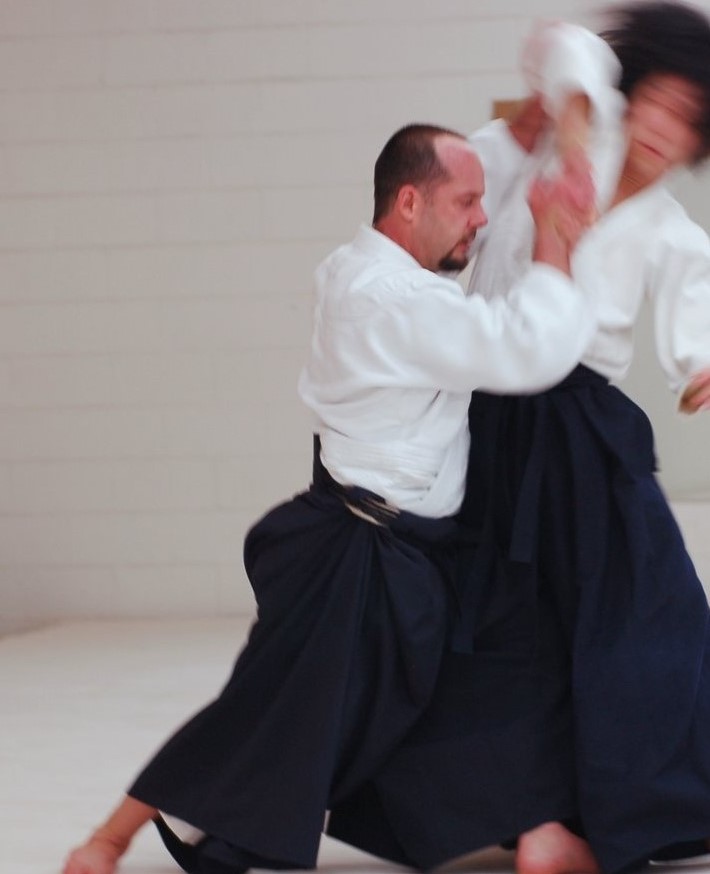
This leads back to ‘unpacking’ kata dori.  We have been focusing on the importance of understanding ranges of attack using a very specific form – the shoulder grab.  Last class we started with the static contact and basic (kihon) technique – a short step with atemi followed by a flanking step and arm control: what I have labeled a ‘box step’ for the simple analogy that expressed in its full range, the feet will traverse a square.  But that is a mere teaching convention.  We focused on the physical sequence of action to ensure that it is correct because done out of proper sequence, the tension drops which exposes nage to a counter.  So proper sequencing.

The exercise to learn proper sequencing.  Both players must be willing participants in the game.  Uke grabs firmly and with a natural heaviness (but not resisting, otherwise nage should apply an impactful atemi).  Nage responds by keeping the tension in play and drawing uke in by using the back leg as the muscular column to initiate the movement (the front leg is free and could be used as a front snap kick, but that isn’t the point).  Once the back leg is ‘loaded’ tori should be drawn toward nage (this is the kuzushi, or destabilizing action).  Continuing to experience uke’s weight, nage then steps directly back then sinks into an extended iai-goshi-esque position with the back leg now out in full extension.  Uke has been drawn forward and down to be thrown by nage’s balanced acceleration.  I cannot emphasize enough that this is an exercise that allows uke to experience the draw and for nage to feel which parts of the body must be engaged muscularly (stable core) and which are relaxed (resist using your shoulders).

From the lineal exercise we can introduce the second vectors and the hip rotation.  The shoulder draw exercise isolated the tanren portion of the technique, the atemi– hand begins to add the element of timing.  At its most basic, the atemi is done as a direct half-step (a full step would necessitate a knee to the groin and full palm strike) hence the half beat (jab) where nage’s free hand executes a jab, brachial to elbow sequence.  Remember that this hand is establishing one fixed point of tension that is vectoring toward tori’s center line while the shoulder hand is drawn back.  Again – the kihon footwork is a half step forward, followed by a full lateral flank followed by a full step forward.   The more advanced timing is to invite uke in – meaning the shoulder is grabbed, but rather than allow uke to establish weight, nage uses a straight (not angular) atemi while executing an ushiro tenkan step and using the atemi and shoulder vectors to continuously de-stabilize uke.  Because nage’s shoulders and lines of force are moving in opposite directions while the front foot is stepping back, uke will look as if he is being pulled with a rotational energy.  This is not the case.  Both combatants initially play a straight line – At its most effective, the kata-dori to atemi sequence is expressed similar to an in-quartata motion.  It is only because uke avoids the initial eye-spear and by moving the head away, off line – starting what will now look like a circular movement.  Adamantly, nage should not start to “blend” for if you do, you will expose the opposite flank to a quick counter.

In the next stage of timing, nage now closes maai as uke grabs.  Nage’s atemi and footwork must now be in perfect time.  As uke grabs, nage advances irimi, executes an eye-spear, brachial to elbow hit and then back to the carotid line.  This three-beat attack with the free hand forces uke’s head back and the elbow up, allowing for the grabbed shoulder hand to flow low to high and control uke’s elbow.  I also demonstrated the low line (invisible) kick as nage moves irimi to add yet one more point of contact.

From the advanced lines of play, we explored different beats – as the timing becomes ‘more perfect’ nage should be able to do a two-beat (free-hand to elbow then grabbed shoulder hand to elbow) and then a one-beat (grabbed shoulder hand to elbow only).  And then we isolated the grabbed shoulder to show the use of that hand alone.  This changes the overall line of motion to ashi-sabaki.  The grabbed shoulder hand executes a back-knuckle strike to the musculocutaneous nerve followed by a punch to the mandible.   The ‘rolling’ use of the striking arm is similar to a proper ashi-sabaki arm pattern.  From the strike pattern we then moved to a pure ‘snake’ which is executed in time without the need for an atemi sequence.

Unpacking the very ‘basic’ kata-dori attack with different responses in time and range, we begin to see the expansion of possible ‘techniques.’  The analogies (similar to, as if) and tricks imbedded in this exploration are drawn from multiple arts – keep exploring.

RANGES OF COMBAT

For all its elegance, Aikido is not a Ryū -流, – a complete art. Its formal curriculum lacks a full set of techniques at every range – maai “interval.” This is a simple observation, a discussion of fact, not a normative evaluation of its merits.

Like most traditional martial arts we are discussing contact range – close quarters combat. Meaning, the combatants are within the orbit of the human body. A true Ryuha would need to have all battle field ranges, and therefore include training in the use of rifle, bow and arrow, javelin and other skirmisher weapons; training for different terrains; siege weapons; in short the art of warfare. Modern martial arts specialize in monomachy (L. monomachia < Gk. monomakhia, from monos ‘alone’ + –makhia ‘fighting’).

As a generalization, Aikido at its most dynamic specializes in the kicking range. Ironically, Aikido has a paucity of organic tools at kicking range because of history. The metaphor in Aikido is that the techniques are ‘like’ or ‘based upon’ sword and spear, therefore the presumptive range of engagement is greater than that of a ‘naturally’ unarmed art. The beauty and flow of the Aikido derives from its origin from older arts that assume armored and weaponized engagements. Battlefield engagements assumed a spear, katana, or tanto. As such, the specific angles of attack, targets, and ranges are circumscribed by the history of the art. This is not an indictment, but rather an explanation of the techniques in the curriculum.

However, sticking to a sclerotic understanding of the art – an assumption that the art is the compendium of its techniques only results in a self-imposed (and limited) understanding of the principles of motion. For our purposes, at close-quarters-combat there are the general four ranges to consider with the tools at each range:

RangeTools – body / [augmented]
Kicking RangeFoot / [sword]
Boxing RangeHands, fingers / [dagger]
Trapping RangeHead, teeth, shoulder, elbows, forearm, hand, knees, shins, feet / [folder]
Grappling RangeTeeth, arms, legs / [folder]
Tabulated generalizations

Please remember these are concepts and therefore generalizations. As a general rule – the longer the range, the fewer organic tools available. As the range closes, more elements of the body can be deployed, until we get to grappling range, when the possibilities again begin to diminish.

One can quibble over the specifics, but in broad strokes there are arts that specialize at each range (e.g., Tae Kwon Do at ‘kicking’, Western boxing at ‘boxing,’ etc.). This is not to circumscribe an art but rather acknowledge a tendency to specificity. Hence the need to look to those arts that more readily express a systemization across all ranges – or more simply to look for universal lines of motion that work at any and all ranges and across multiple types of mechanical tools (aka weapons).

This morning we continued to explore kata dori. Starting with the kihon presentation of kata-dori ikkyo‘s entry to practice the ‘box step’ pattern of in (atemi), flank (draw), enter.  This is the beginner’s range – teaching precise movements and eliminating variables.  Please note, however, that this presumes a static encounter – starting a grappling range where the expression of movement is at its greatest number of possibilities, but we select a very specific (delimited) response for ease of training.

We then moved to kicking range – the ‘advanced’ presentation where the grab is intercepted before contact is made. The elegance of Aikido is expressed here because the range allows us to focus on ki-musubi – the harmonizing of action between uke and nage.  As uke enters for the shoulder/lapel grab, nage can perform a leading ushiro-tenkan movement while deploying a palm strike that flows naturally down to the grabbing hand’s elbow as a control point. Last class we worked the nuances of the shuyto and the camming action – and all those lessons still apply. From this basic line, we then started to explore a five-count response.

As tori approaches for the kata-dori (or jo-dan tsuki) attack, nage executes an ushiro-tenkan movement while (1) executing a palm strike to elbow control (2) then a back knuckle with the same hand, which will cause tori to react – as the head moves away, tori’s grabbing arm will naturally raise, allowing (3) nage’s free hand to move from low-line to control tori’s elbow and then a quick 2-beat where nage then (4) replaces his hand control on the elbow and (5) the newly freed hand then performs a femoral strike.  (A great visual reminder of the principle as shown by Tissier sensei on a three-beat at about 2:35)

We then moved back to a trapping range presentation. This time, as tori approaches for the grab, nage enters irimi – a step with the back foot into the approaching arm. The challenge is to continue to face tori with your torso while the lower body (waist down) enters at an angle – this is a brisk move – a stop-hit. I also showed this irimi action as a kick with the advancing leg to tori’s lead leg. Done properly it is invisible to tori and highly effective: done forcefully, it will destroy tori’s knee while you simultaneously execute a cut to tori’s arm or neck (whichever is closest). This pattern is really no different from the five-count at kicking range. Merely an advance to close and ensure effective trapping vs the ushiro tenkan to absorb at kicking range.

Icon_CombatType

Master Keating made the following observations about knife fighting specifically but it applies to ranges in general:

Most styles of knife fighting have some sort of footwork as part of their overall instructional format. For the most part knife men are ambitious, active and always on the move. It’s the nature of the game. To some observers a knife man’s footwork when seen in action can appear to be “nervous” or “flinchy”. Well, duh… it IS a knife fight after all! So indeed one gets a little jumpy and reactionary in such a situation. The price for being too complacent could be serious injury or death! We hear such ancient axioms as “a moving target is harder to hit” and “attacks made while in motion are harder to detect by the opponent”. Yes, all true. Most men fight this way because it comes naturally, it is all they know, instinct and fear are their mentors! It keeps them alive and that’s what counts. The trained knife man uses advanced principles along with his natural instincts!  This makes a truly impressive package of defense. 

The footwork and body mechanics of the long range methods are different from the footwork and body mechanics of the close range fighter. Long range is mostly a side-fighting method like fencing (little physical pressure). Close range is head on, squared up to the opponent like a football player (American football) (heavy physical pressure). Learn to shift in and out of ranges. Adjust body mechanics and footwork accordingly. Be able to click in and out of the “killer instinct” mode that Vu used to speak about. He wrote a book too. Be able to adjust to that path of behavior as part of the range changes.

______________________________

Vu = Paul Vunak

Understand the ranges!

KATA DORI

A new month so moving to a new focus: a front shoulder grab – kata dori. First the context. A shoulder grab while wearing a dogi (or Edo-period clothing) can be an effective control. Starting with the little finger one quickly wraps his grip in the fabric of the shoulder or upper sleeve to effectively pin the opponent’s arm or at least provide a solid purchase for taking the balance. This grasp is a brisk attack, a control then a destabilization which could be followed by a strike with the free hand (kata dori menuchi). However, done with vim and vigor the shoulder grab could become and effective attack – imagine pulling the opponent straight down into an object. Whatever the scenario, kata dori requires a prompt response.

Given a proper attack tori has already taken out the slack which thereby creates the necessary tension. Momentarily allow uke that point. Without moving the shoulder or telegraphing, take a stabilizing step back which simultaneously counter’s tori’s pull and keeps the tension so that from this new deeper base (farther from the point of contact) you can now draw your shoulder back with a hip rotation. Simple tanren development and a good way for both players to develop a sense of rooted, grounded connection that forces balanced development. Once the stability and hip strength is understood, then we add the arm.

First the kihon-waza. Assume nage presents left shoulder which uke obligingly grabs with his forward (right) hand. Leaving the shoulder in place, nage steps forward with his right leg and delivers an atemi, then with uke distracted/stunned, nage moves to the flank with his left foot whilst the right hand moves from the atemi down the brachial to the uke’s biceps with constant contact and forward (i.e., toward uke’s hara) pressure to deliver a ‘camming‘ rotation with the ulna. All this while drawing the grasped shoulder back. Lots of vectors to follow, but the ashi-sabaki (footwork) is a simple ‘box step’ and the arm pattern is just drawing the sword (iaido). The lessons from tanren training are the stability and sequencing of the feet (establish position, then deliver torque) and iaido should remind you that the saya moves as much as the sword does (i.e., the grasped shoulder is critically important to keep moving in the opposite vector as the ‘striking’ hand).

The typical point of failure is that most people pull uke toward them, push uke’s arm down or otherwise forget to perform a rotational camming action and fail to move their shoulder away from the action.

The bunkai should be obvious insofar as uke’s initial aggression is immediately stopped with a strike to the face then a rapid disengagement of the grab and a follow up strike. Should uke maintain the grab, then the flow of action will bring them down and directly in front of nage. But all this presumes an ill-trained opponent.

An opponent who is better trained will ‘follow’ the action and thereby close the distance (or if nage struck, will intercept the strike, thereby forcing kata menuchi). This moves us to the slightly more advanced line of play whereby nage rotates to the inside line (ushiro tenkan) rather than the basic ‘drawing’ move. This action will often drop uke’s head down and in front – a kaiten-nage-esque move. If you imagine a Spanish Circle or any basic 8-direction figure – such as:

Cutting rose
Geometry in action

The footwork is increasing in complexity because the path of travel is greater and timing (ki-musubi) is now of critical importance. The basic footwork (with nage in left hanmi) is, right foot from E to A, then left foot from C to G. However, the more advanced would require left foot ‘sweeping’ from G to C while right foot advances pressure from D to H and perhaps culminating its move from H to G. In the kihon-waza, uke remains at A, but in the more advanced, tori has started on the A-E vector only to move to C-G because of the dynamic tension of the technique. But again, all this presumes a specific encounter wherein both players assume the shoulder grab is of paramount importance.

o sensei diagram
The geometry keeps recurring

Most of Aikido’s beauty is the flow of the encounter – the visual ‘dynamic sphere’ that is created when both practitioners are adhering to the logic of the scenario. This ‘suspension of disbelief’ allows the ‘advanced’ flow where in tori attacks with the intention of kata dori, nage matches the rate of uke’s advance by drawing tori forward and intercepting the grasping hand many techniques become possible. However, rather than work off a presumed grasp, tonight we played the attack with the possibility that the kata dori could be a jodan tsuki and later, a double dagger. Change the assumptions of the scenario and the movements become more abrupt.

Because a tsuki or a dagger thrust rapidly closes the distance, nage must move first off the line and close just as rapidly to counter the attack – strike that which moves first. The play here is to trap the dagger against the opponent who would (should) be retracting to re-load for another strike. The angles will be unfamiliar at first because the distance is much closer than a “normal” Aikido attack. If you play the ‘normal’ Aikido line (with a drawing retreat or ushio tenkan), you will find a cunning adversary will attack your newly vulnerable side with his free hand. This bit of devious reality from a knife-fighter’s game wherein the opening move is mere deadly bait to elicit a response that assures tori of the kill stroke. So the counter to pin the assailing arm with the ‘basic’ camming action but this time at an angle to return the first knife to the attacker’s center, then to use the powerful hip turn to force their secondary weapon off line – because you have controlled and rotated the opponent’s spine. This is controlling uke’s center.

Once turned, the assailant’s original offending hand is now across nage’s chest, so a quick upward strike to the hyper-extended elbow, followed by a rapid strike to the groin, then the head allows for a much discombobulated uke to be thrown ude-kimi nage, shihonage, kote-gaeshi: take your pick. It wasn’t the throw but rather the concept of the set-up that we were working on tonight.

We will be exploring kata-dori because it automatically puts us in ‘trapping range.’ This is close in-fighting range. All our natural weapons are available to us and we must be able to contend with them all. Tonight we started close, then moved out, only to move in close again. Shorter range, faster timing, fewer visual signals. Work here for a while and then the longer ranges will seem slow – time expands again and your options increase. The brusk movements are necessary developmental tools that should allow you to better understand the flow and connections of the longer ranges. We must learn to play them all.