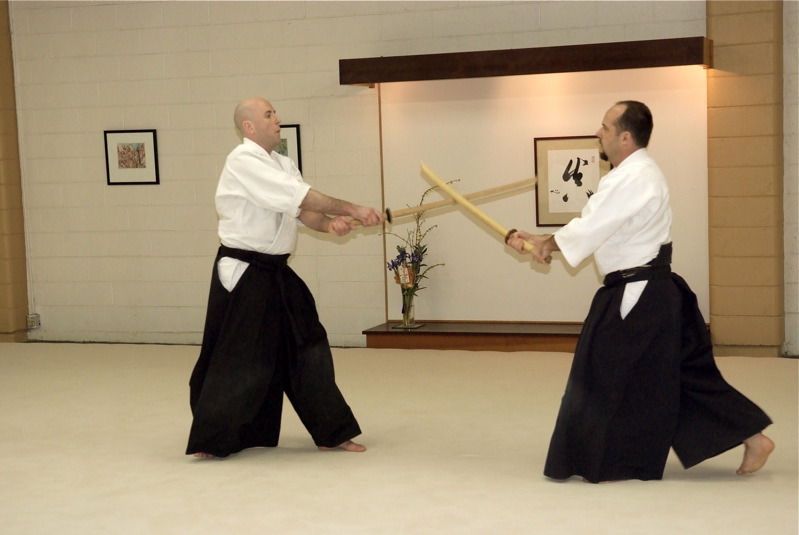
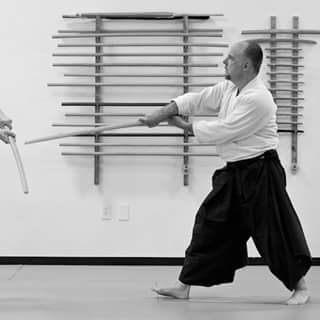
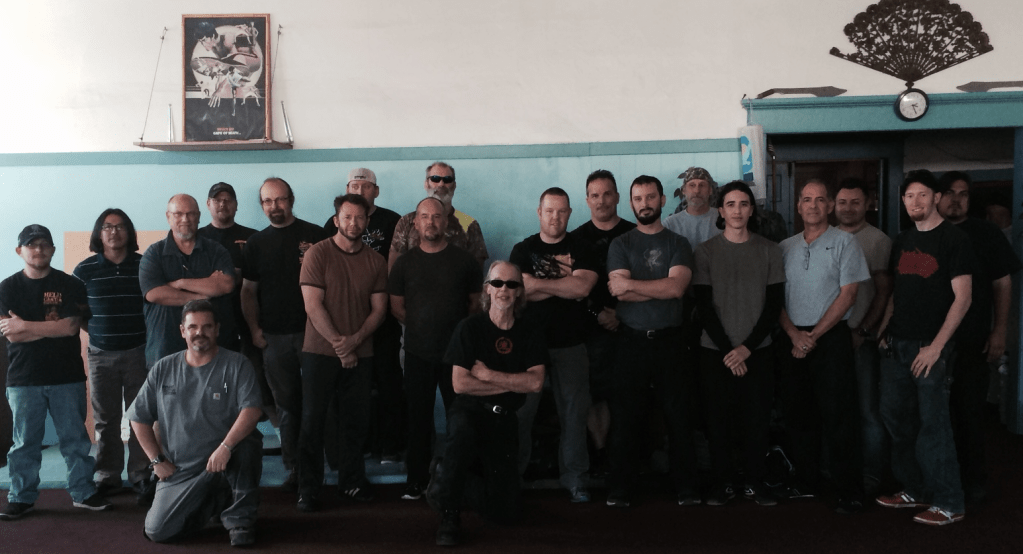
The third paired sword exercise – we broke it down into its constituent movements of uchi komiand kiri kaeshi then rebuilt it as a flow sequence. But each component has its purpose – its bunkai. Any given point in the flow could be a terminal movement.
Uchidachi’s opening gambit of kiri kaeshi could remove shidachi’s thumb. As shidachi escapes the cut to the thumb, uchidachi has a brief moment to cut shidachi’s wrist before shidachi returns the stroke to cut uchidachi’s wrist (kote), only to stop the devastation with a quick retreat and capture. And from that capture to try to cut shidachi again on the opposite side and as shidachi counters – uchidachi then cuts the final domination on the centerline kiri otoshi.
The finer points – experiment on the final cut by trapping shidachi’s ken using the weight of the press – not a simple stroke – uchidachi must close any opportunity for shidachi to escape.
There is the take away variation – uchidachi opens kirikaeshi, shidachi escapes to counter cut, but in time (with kimusubi) uchidachi continues to follow the uchidachi to jodan (threatening shidachi’s wrist from the underside) to use that pause to capture the tsuka (handle) only to then accelerate shidachi’s counter stroke with a downward drop.
There is a counter by shidachi at the ‘terminal’ cut whereby uchidachi’s cut is captured on the horizontal (like the exercise) and returned with a wrist snap cut.
The components of the kumi tachi are nothing more that a logic chain based on an opening gambit that forces a specific series of actions from each player. Like chess you will eventually begin to see several moves ‘deep’ and therefore know the conclusion at the first contact.
Playing the encounter with iaito adds a depth. This is not a recommended training practice. However, the play of steel on steel increases the mental focus and demands a new level of respect: mental acuity needs increase. Now the feeling of the planes of the blade, the angles of impact and the necessary transitional flows manifest.
Kiri kaeshi with a bokken can feel like a simple circular motion but with an iaito the conical entry and the manipulation of shidachi’s blade takes on new dimensions – there are angular forces as well created by the flat of the blade.
Uchi komi must now be felt with the flat of the blade – bashing shidachi’s blade aside is now clearly tantamount to suicide by samurai. The importance of the glissade and the small degrees or arc we must use are apparent.
Weapons training is supposed to elicit the seriousness of play.[1]
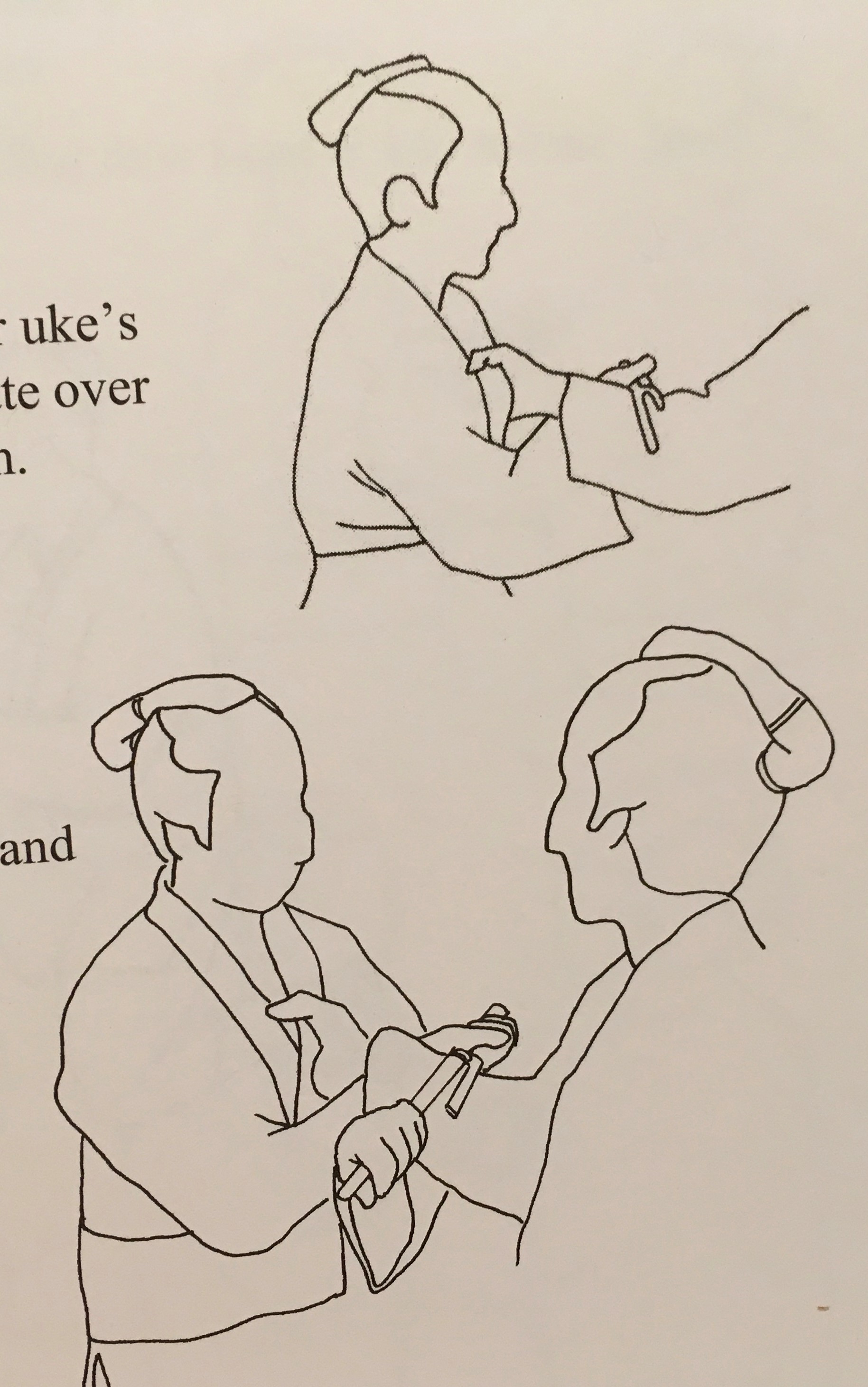
Ancillary exploration using the iaito – nikkyo off the cross hand grab; ikkyo off the cross hand trap (and the explication that the cut to the head drives the ukeme) – escape through rotational step; sankyo the lock from attempted grab with the direct relationship to the empty hand derivatives. It is important to remember that the weapons are primary – all the empty handed are nothing more than shadows.
_________________________________________
[1] The seriousness of play – I first came across the concept in Clifford Geertz’s analysis of a Balinese cock fight but it originates from Johan Huizinga’s (1938) Homo Ludens which is well worth revisiting and still proves influential. (And for the importance of play, listen to the Ted Radio Hour Press Play and follow the trail.)
For the martial artist the concept of play in war is a valuable one – mutual combat as a contest and war as an extension of the will of the prince allows for an honorable defeat where the rules take precedence over effective destruction. The rise of democracy (it has been argued) leads to the commitment of the polis to destruction of the enemy (q.v. Thucydides, the Roman total commitment to warfare during the Republic, Sherman’s March, the Allied bombing of Dresden, etc.). [See also Better Angels.] A contest of individuals (and kings and tyrants are the state embodied as individuals) allows for a dueling mentality where first blood rather than total exsanguination can satisfy.
Aikido is a modern art founded in the 1920s but its techniques are derivative from older material. With a penchant for hierarchy, Japan classifies its arts as Gendai (new) and Koryu (old) with the Meiji Restoration (1868) as the demarcation line.
I am a firm believer that reading history is invaluable to understand the present. Why? Human nature is a constant – despite cultural differences – and in our particular study, the range of motion and possibilities are limited by the human body. Therefore, a broad reading and appreciation for other arts can lead to a deeper understanding of any particular art.
I would encourage Aikidoists take a close look at the Daito Ryu curriculum as Aikido’s antecedent. All arts have their time and place – meaning many techniques are specific to the weapons, armor, and geography and therefore will have inherent limitations. Put the techniques in their proper context before dismissing them, there may be tips, tricks, and insights that help better develop your own art.
European martial arts (HEMA) are currently in ascendance and some talented people are exploring and revitalizing the western fighting arts. With the proliferation of HEMA, manuals that were once difficult to find are readily available on line.
The Codex Wallerstein is a 15th century Fechtbuch (c. 1470) that contains both armed and unarmed techniques.
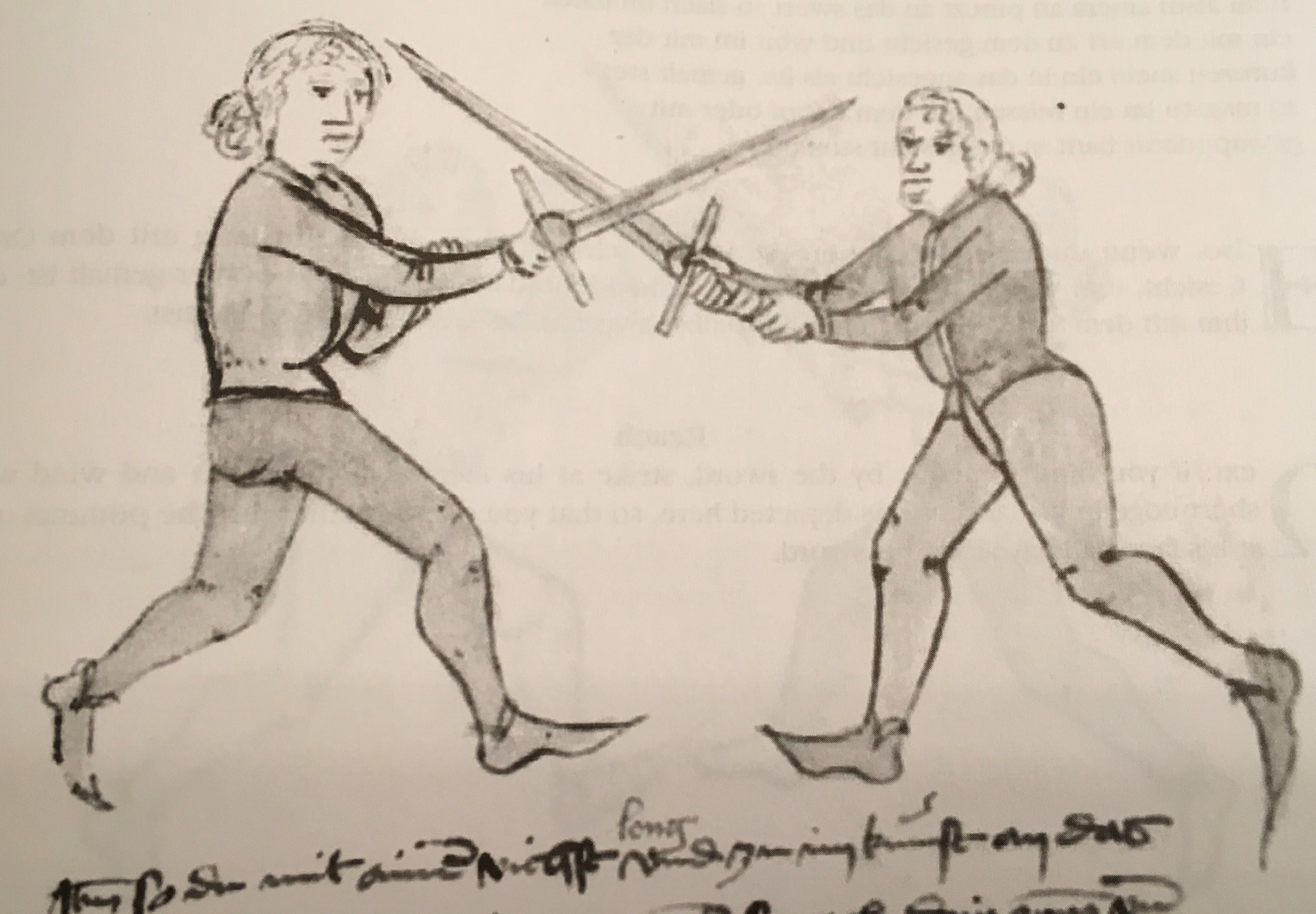
The opening technique in the codex is a sword technique at distance and is titled “Length”
So you fight against someone, and you come at him at the length of the sword, so both of you are going head to head. Then you should stretch your arms and your sword far from you and put yourself into a low body position so that you have good reach and expulsion with your sword and so that you may attack and defend yourself against all that is necessary. The reach is your standing behind your sword and bending yourself, the distance is in your staying low, as shown here, and making yourself small in your body so that you are great in your sword.
PLATE 5
This is not a simple guard, but sound combat advice. You should recognize kiri otoshi (with a longsword) and given the current focus on the foundational kumi tachi – the bunkai should be very familiar…
Same measure
Review the codex and you will find additional cognates to the kumi tachi we are exploring, but the differences are numerous and should encourage you to ask “why” and “how” are the techniques different. Many techniques result from the design of the weapon and the weapon was designed for a combative purpose – the longsword tried to balance the use of both the edge and the point.[1] So while not all the plates will show you something that readily translates to katana, seeing the differences should be as informative as the similarities.
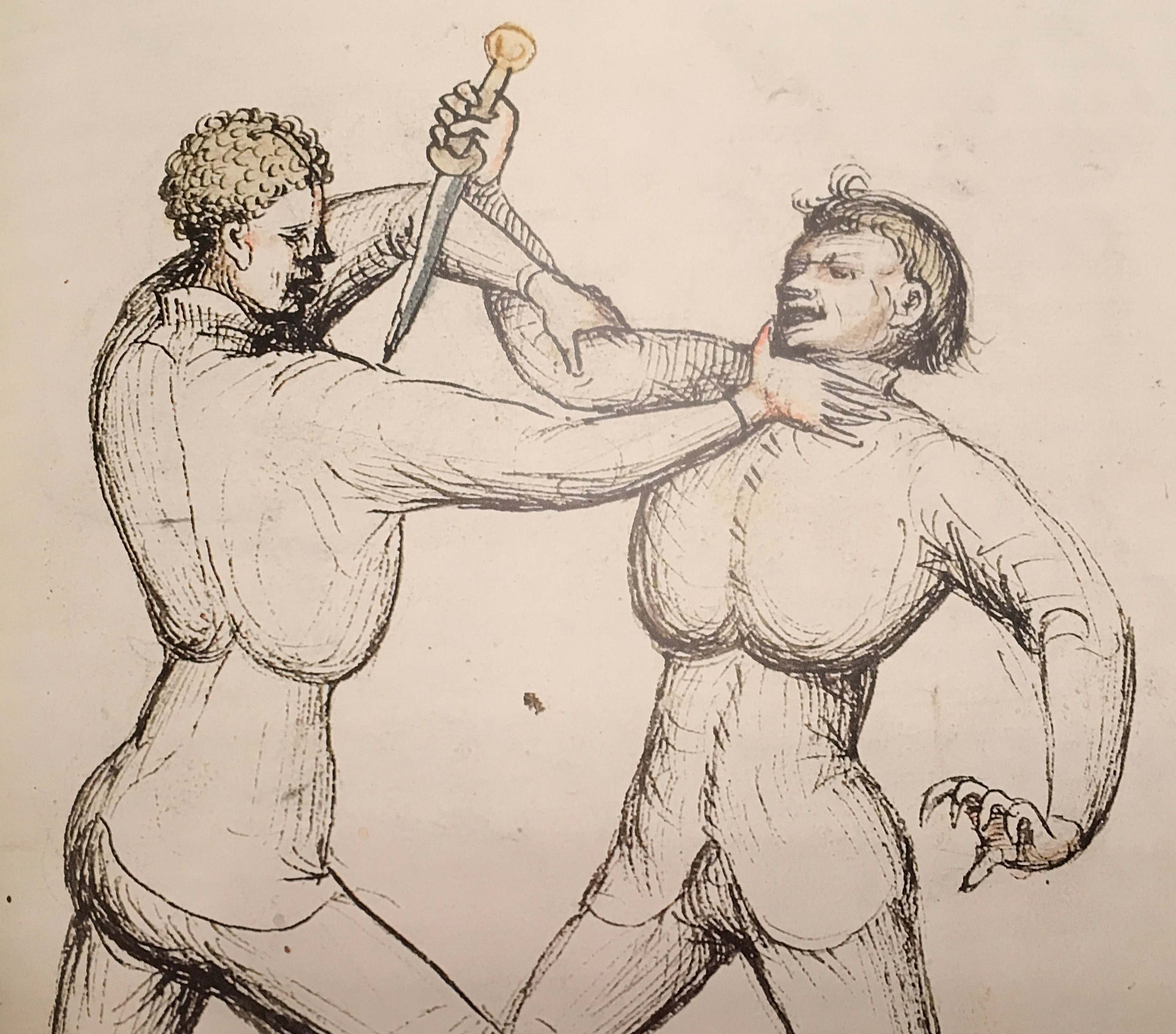
Looking at armed close-quarter techniques the Codex Wallerstein illustrates rondel techniques including the following disarm and leg trap:
Note the disarm
The rondel is basically a spike with limited edge making these trap/disarms relatively low-risk, but as I have demonstrated in class, this same disarm is possible against an edged dagger – it just requires more practice. In Der Konigsegger Codex, Talhoffer expands on the use of the rondel.
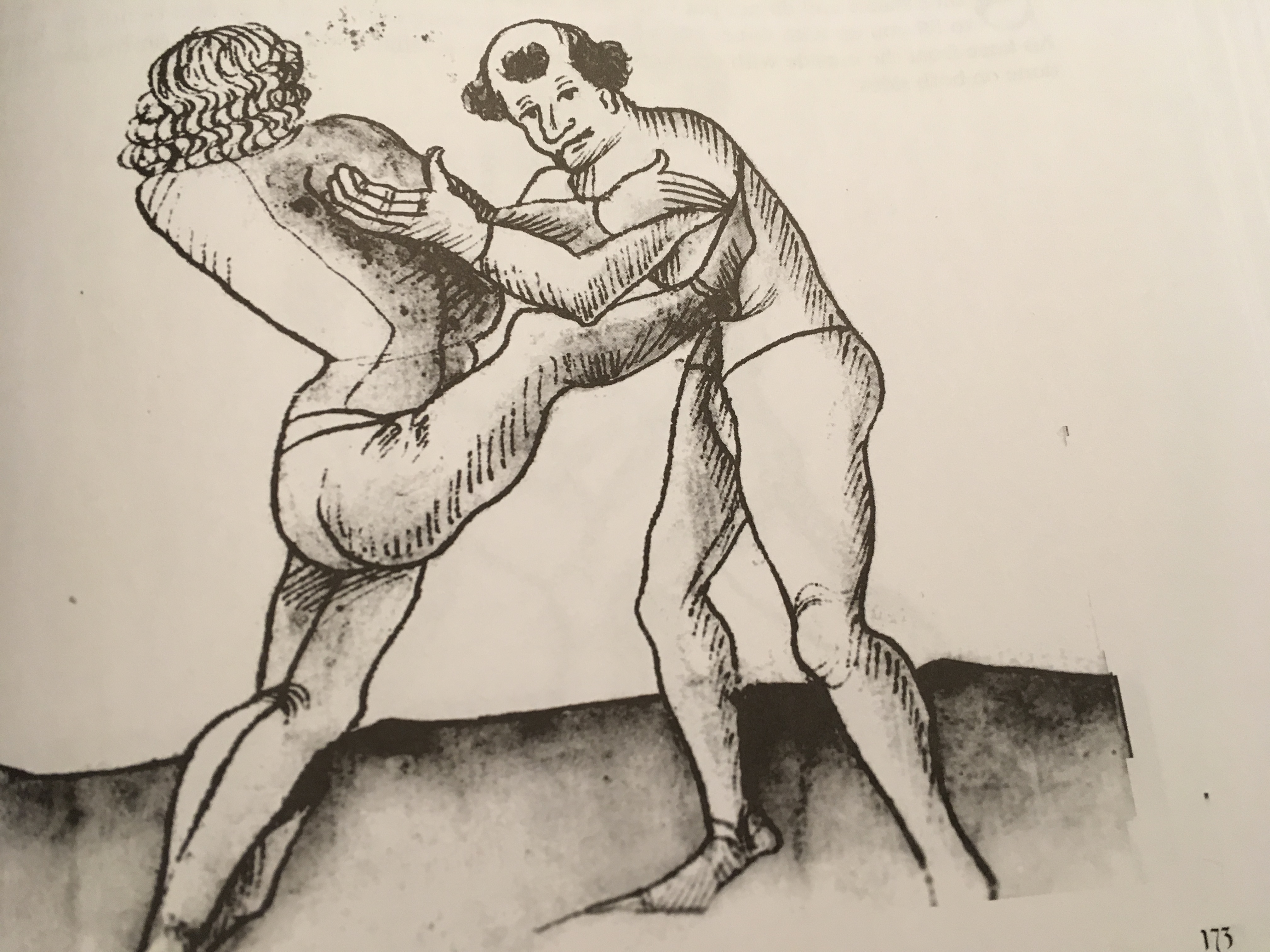
Do you see the basic figure-four? Or is it tenchi nage?
Notice that the techniques are logical uses of the weapon, but are not limited to the specific weapon – rather the general type. There are cognate techniques because the proper use of a weapon of similar types will result in similar uses. A katana and a long sword are similar in length and edge – hence kiriotoshi is logical in each. A rondel is similar to a hanbo, jutte, tessen, cane etc. To see the expression of technique based on a logical use of type of tool, look at the following from Der Konigsegger
Double bind
And then compare with a taiho-jutsu technique using a jutte:
This is merely a cursory example. A more comprehensive exploration would easily reveal more cognates across time and cultures – but remember that this simple review shows similar expressions from 15th century Germany to 18th century Japan.
And if you look closely enough the unarmed expression of these armed techniques become evident – ude garami without the mechanical advantage of a stick becomes nikkyo.
Many of the unarmed techniques appear quite ‘simple’ or ‘obvious’ in the Codex, but the descriptions outline a frank use of the body:
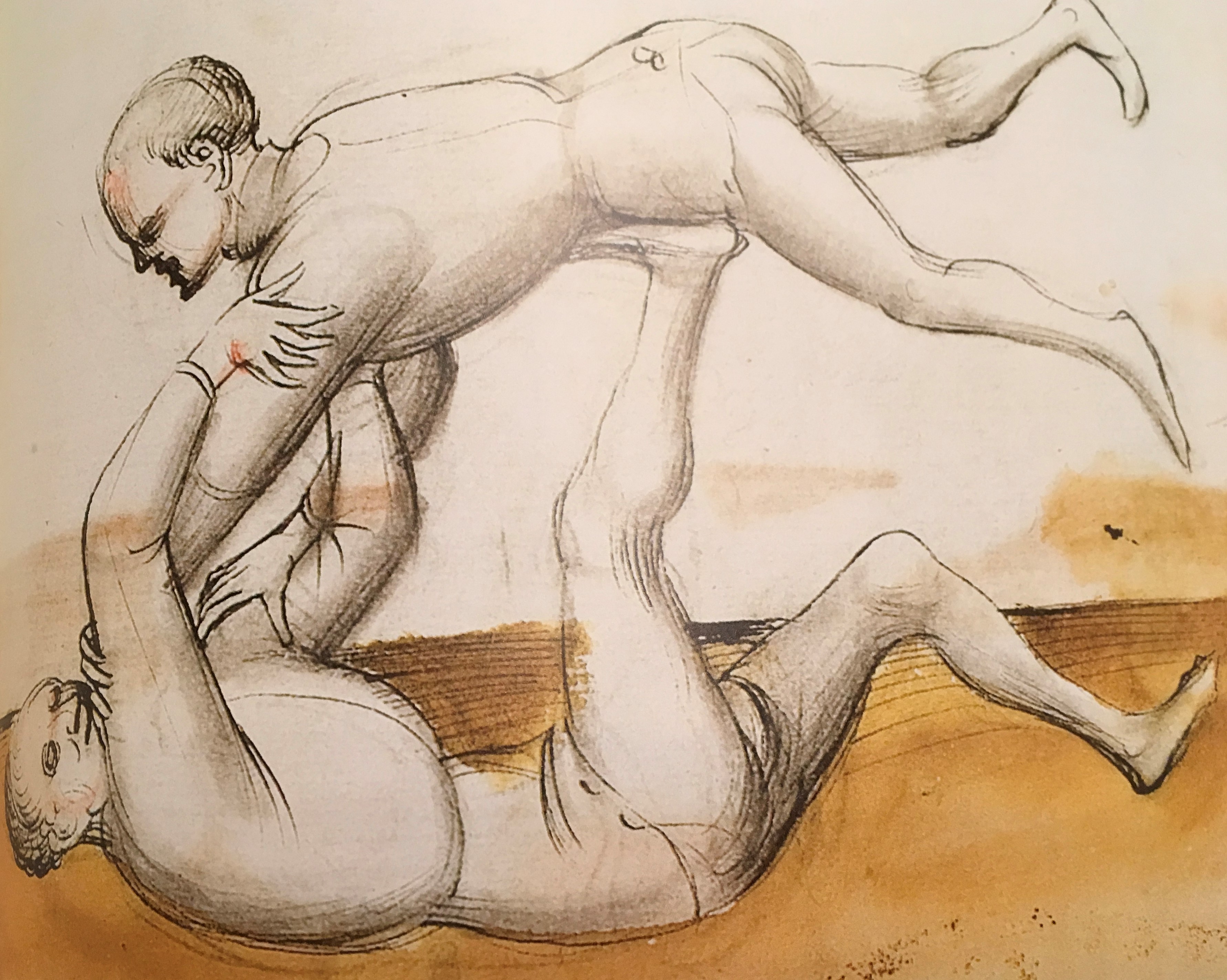
So one more trick: if you want to fight someone by running at him and he is quite strong: boldly grasp him any way you want with a lot of force. When he pulls you with force, put your foot into his stomach and fall down quickly onto your seat: hold your knees close together, as depicted here; and throw him over you, holding his hands tightly so that he has to fall onto his face. You can act with both feet and you should be quick.
PLATE 81
I immediately called Plate 81 the “James T Kirk technique” (re-watch the original Star Trek series). The follow-up image is found in Der Konigsegger Codex
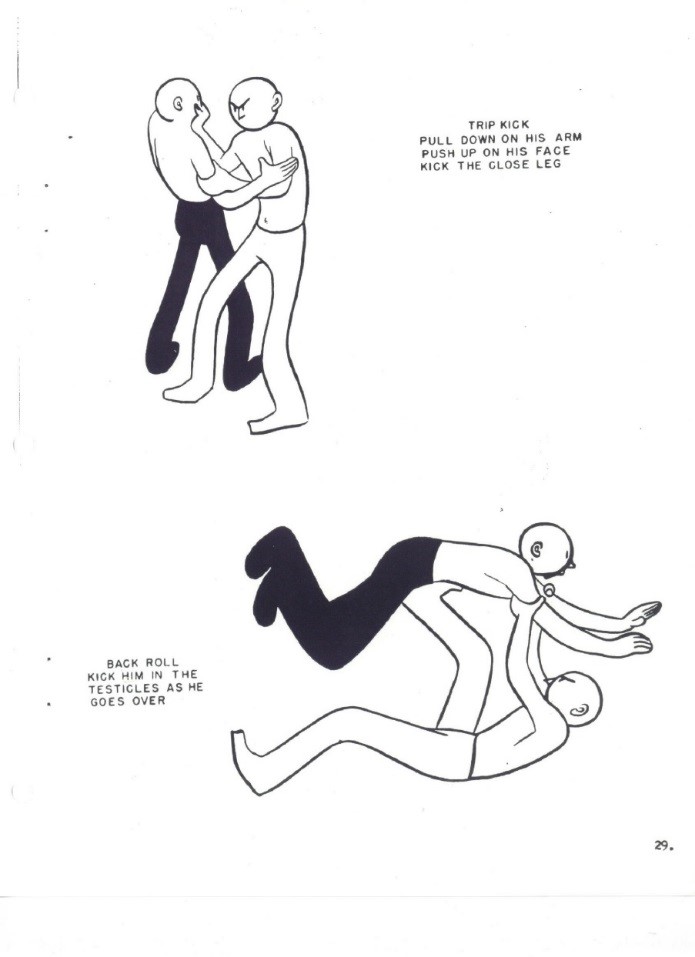
I purposefully selected those techniques that were somewhat amusing – but if you compare these with general combative manuals you will find the same techniques. These are from “Dirty Fighting” by Lt. David Morrah Jr. (1945). [2]
Unarmed combat training
More research will easily reveal more cognates and often the very same technique. Does the same technique imply a direct exchange? While in some cases it may, but I am inclined to believe that the simpler explanation is independent discovery. If your goal is combat effectiveness, then the means and methods will not be difficult to discover.
Some advice is best left in its relevant historical period. The Wallerstein is a very practical manual, and provided a technique to rob a peasant:
PLATE 148
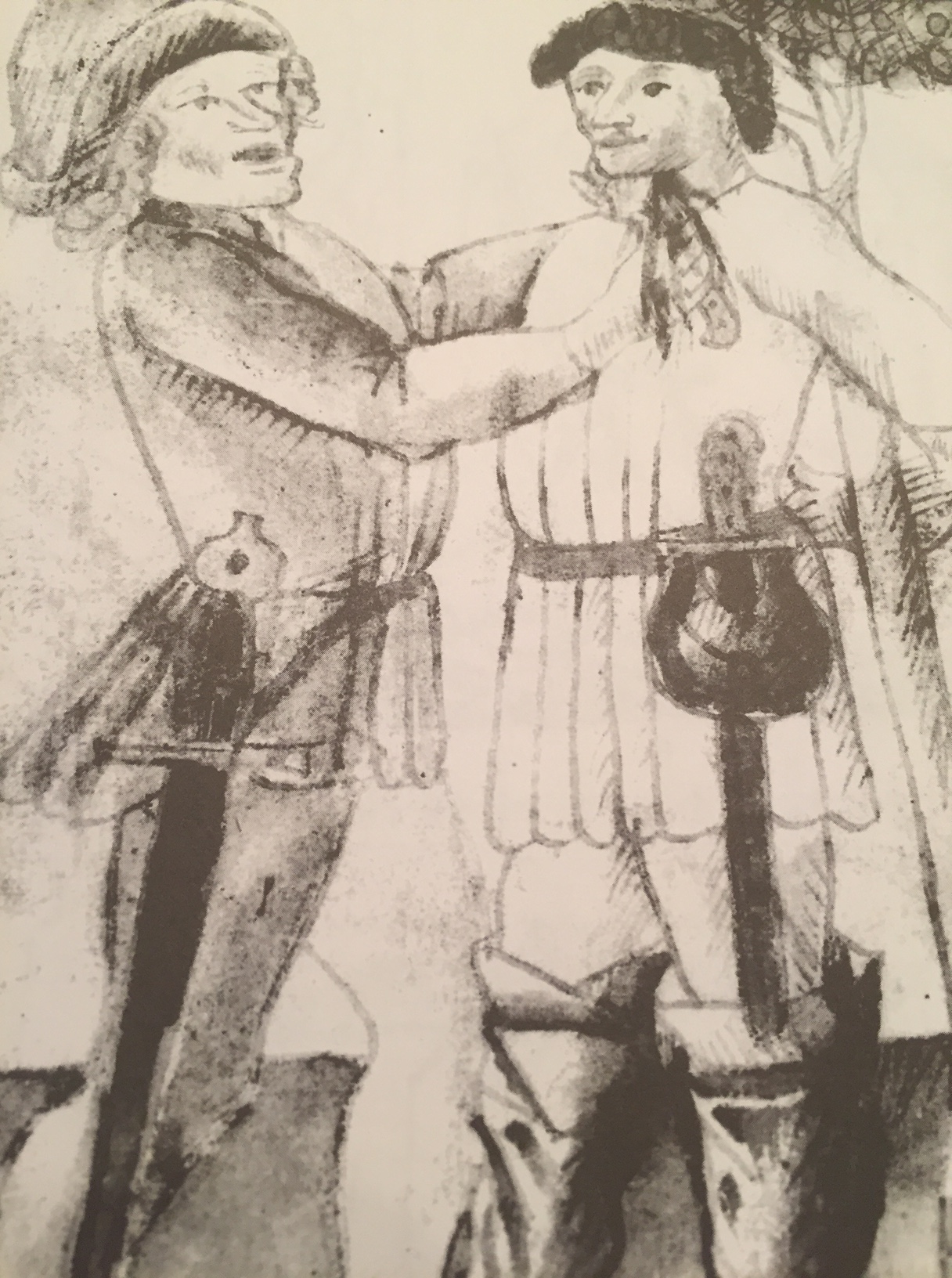
At first glance, the illustration appears to depict a simple murder, but the explanation is dryly pragmatic,
So if you want to rob a peasant, pinch the skin on his throat and thrust through it, as shown, so that he thinks that you have cut his throat, and this does no harm.
I love the standards of doing no harm! To the author, this is simple scare tactics: pinch the skin at the throat and make a superficial cut – it may bleed profusely, but will not kill the victim.
Only one plate out of the hundreds shown in the codex describes an overtly nefarious use of martial skill – but one must remember that only the educated elite could afford to own a codex and read the contents. These were techniques for the ruling class. As a compendium of important ‘how to’ techniques (appropriately called ‘tricks’) a majority of the plates describe techniques used exclusively in judicial duels – techniques for trial by combat (including the use of judicial shields). The important skills of robbing peasants, self defense and acquitting oneself in a trial.
Each of these manuals and techniques are tied to a specific point in time. Given the constantly changing political landscape in Europe technological innovation was more dynamic than in Japan where the Tokugawa Shogunate was able to impose country-wide edicts, most notably limiting exposure to the west and the proliferation of firearms.
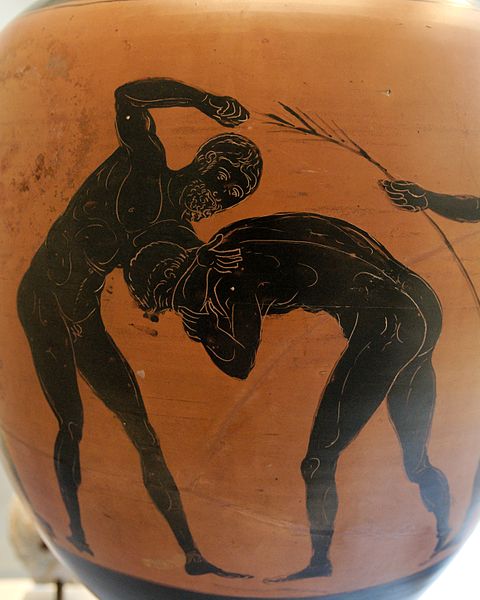
The unarmed arts are more durable – the techniques are much more consistent across time and cultures. Compare pankration with wrestling techniques from the 17th century Petter-Wrestling 1674 with jujutsu. The principles are the same because human physiology is the same and good technique is based on a solid understanding of anatomy and the physics of human motion.
All fights end on the ground?
___________________________________
[1] Sword Typology. Ewart Oakeshott’s works are invaluable and set the standard for classifying the types of European swords. Experts may quibble over the details, but review the 1,000 year consistency in the design of the Japanese sword.
Perdurable design
Europe was political chaos by comparison over the same time period and the changes in sword design are pronounced. [Brief summary >here<]
[2] Back to the basic eight cuts – here is Morrah’s (Dirty Fighting) presentation of the concept – stripped of any pretext at general concept, as a combat manual he showed only application.
The eight cuts are now reduced to five movements and the point is favored over the edge. Target areas are specified and to reach the targets the point is more effective than the edge with the solitary exception of the trachea.
Learning is progressive. First one follows instructions, memorizes patterns, absorbs variations; once the basics are mastered, one starts to learn the linkages, the theory connecting the techniques; then one starts to learn from his own practice, creates new approaches and adapts. Then there those rare few who transcend mastery to distill the essentials, sees the universals. Master of Arms James A Keating (MAAJAK) is one of those wizards.
“We advance together into the unknown future with the strength of our abilities sustaining us through thick and thin. Skill banishes fear. Skill is the secret, otherwise it’s just plain ordinary violence. In the process of acquiring skill one also learns of the discretionary judgement required to use such power in a wise manner“
James A. Keating
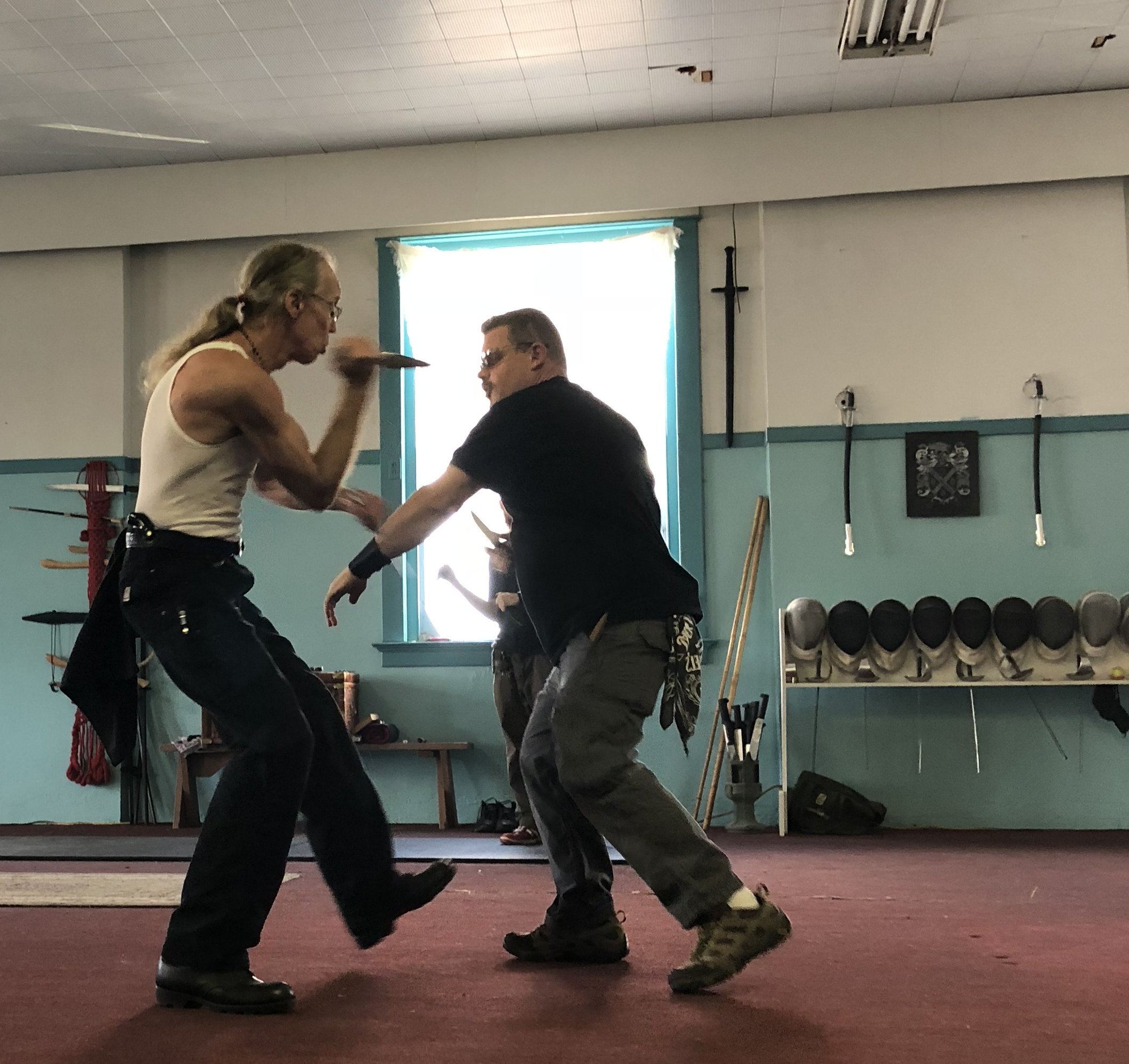
His studio in Milton Freewater, Oregon is on the second floor of a brick building from the 1900s. The door at the top of the stairs to the training hall is hard-sprung, a waiting trap for the unaware: reminding us of the dangers of transitions (limen). Immediately past the door is a counter with a bucket of Stingers and his original karate dojo sign sits half-hidden in the corner. Passing into the studio proper, the floor has threadbare red carpet (to hide the blood) and training tools line the walls: Blunted machetes next to foil daggers and fencing masks, Escrima sticks in the corner, crossed sabers on the wall. A dragon-hilted daisho set sits on an elevated shelf above an abandoned brick plinth for a long-removed wood stove. A shrine to Bruce Lee is on the dominant wall. This is a place of serious training.
The “New” studio on the second floor
Master Keating has practiced and taught martial arts for over forty years. He started with Karate and Judo and began Wing Chun in the early eighties. His lineage is Red Boat Wing Chun under the late Dave Harris (under Fook Yeung)* and later studied with Cliff Lenderman (under Guro Inosanto). This was formalized as part of the JKD program where Wing Chun augmented the Kali-JKD foundation. In his presentations, concept takes precedent over form and technique. But the drills and exercises provide fertile ground to explore practical application.
Master Keating’s seminars are componentized and complimentary excerpts designed to augment any art. As he describes it, his modules are like customized bolt-on car parts designed to enhance performance.
There is no substitute for hands-on training with a master.
This post consolidates and preserves some of the online articles, interviews and videos published over Master Keating’s career.
__________________________
See the Keating Files that collect many of Master Keating’s essays with embedded videos.
*Fook Yueng was like an Uncle to Bruce Lee. When Bruce disembarked from the ship in Oakland, Fook was met him and took him to Seattle, where as a favor to Bruce’s father he helped him get his start. The first thing Bruce Lee did after getting off the ship was to extend his hand to Fook and say, “Chi Sao” an invitation to play/stick hands. When he could not get through, he asked Fook to teach him. Bruce Lee trained with Fook from 1959 to about 1967. Fook showed him the systems and Bruce was an adept student, and worked them to a very effective level. One of Bruce’s favorite forms was the Preying Mantis form. Fook grieved the passing of Bruce Lee and Bruce’s son Brandon Lee, saying, “too soon, they died too soon.” Mr. Yeung used to perform martial arts roles with a Chinese opera company. As such, he had to study a number of arts in some depth. In addition to Wing Chun, he studied Baguazhang and Taijiquan, and possibly other arts. David Harris was like an adopted son to him.
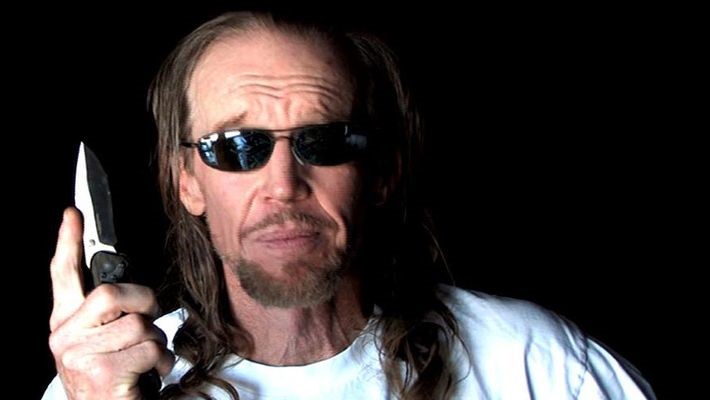
Interview with Master At Arms James A. Keating by Dan
Today I am talking with the one and only James A. Keating. Internationally recognized as an authority on edged combat, James is a legend among enthusiasts of self defense, knives and everything in between.
Although this interview has been the product of a couple months of conversation, I knew from our very first exchange of emails that I had genuinely funny and interesting person on the other end of the line. Jim’s zaniness and warmth is perhaps unexpected from someone who could disarm you with the twitch of an eyebrow, but I immediately noticed that he is not only driven by a great passion for martial arts but also by a very human desire to share and connect… definitely a guy I want to have a beer with one day (which is perhaps my highest form of compliment).
Now let me be the first to say that I am not a martial artist – not at all. So me talking with Jim about knife fighting technique would be like a child talking to Einstein about the theory of relativity. That’s why I’m not going to sit here and pretend like I was born with a sword in my hand. Instead, I decided to get another side of his story, and ask about his background, his history and philosophy… where he is from and where he is going.
I hope fans of James will find this interesting, and perhaps even a little refreshing. Either way, it is with the utmost honor and respect that I welcome James A. Keating to BladeReviews.com.
Welcome to BladeReviews, James! Lets start at the beginning. What got you into martial arts?
Well Dan, it was my mother who first introduced me to the martial arts, yoga and calligraphy. She encouraged me to pursue martial arts over the traditional sports of the time. This was around 1965, so martial arts had not gone mainstream yet. Once I began with the martial arts, it clicked with me and I intuitively knew that “this was for me”. It began with Judo, moved to Karate, matured into Kenpo, slid slowly into fencing, grew into Aiki-Jitsu, evolved into JKD and Kali, blossomed into TaiChi and Gung Fu. It truly became a life-long pursuit for me and its still on-going to this very day!
So at what point did you begin training with knives?
My father being a knifemaker always had cutlery about. Either his own designs or repairing the cutlery of friends seemed to always keep blades coming in and out of the small shop he worked out of. As a fighting man he was coming from the WWII generation mindset where knives were a part of the combat equation. Kabar knives, bolo knives, throwing knives were not uncommon items for me to play about with as a child. My father taught us kids to throw knives well. He also instructed us in the basics of knife combat. It was the real thing, simple and effective. Even to this day, I still have the first throwing knife he ever gave me. For my 19th birthday my Dad made me a Bowie Knife. I still possess it today in my collection. I am still proud of the gift though he’s been gone since ’94.
I took up formal training in blade with Fencing. Fencing is the ultimate in my book. Kali came into being for me around 1982 and I fell in love with it, I have practiced Kali (FMA) with great passion ever since that time. Silat has also provided fertile ground to learn skills from, I am grateful for the knowledge I have gleaned from Silat as well!
When did you start instructing others in self defense?
I began teaching as an assistant instructor in 1966 or ’67. I taught all kinds of classes for various teachers. They could see my seriousness and employed it to their benefit. It also helped me understand how it all came together and provided me ample growth for the time when I’d open my own studio. Nothing beats “experience” and I was grateful for the chance to help and learn more.
It was in 1972 when I opened my own (first) studio with my partner Randy Wanamaker. I have had an ongoing studio of some type ever since that time. My studio is my laboratory, my studio is a “gentleman’s club” more so than it is a dojo. It is a rich environment for the pursuance of combative abilities, a museum of mysteries waiting for those interested enough to come within and learn. Together we can discover the inner rewards that come from walking this ancient path of steel and stride forth boldly into the future secure in our capabilities as men and warriors.
Sounds like my kind of place! Running a dojo like that has to be both a fun and rewarding experience. At what point did you found Comtech?
Comtech (Combat Technologies Inc) came into being in 1989. It blossomed in 92 into the way I had envisioned it originally. Like any business it took time to get the public aware of what I offered and who I was.
Comtech IS a business that offers tactical training and solutions to real world problems. Many folks believe Comtech to be a martial arts style. I am here to tell you that it’s not. Comtech is a corporation that offers tactical training, tactical solutions and customized gear for those who need such materials. If a person is seeking a rank belt or other such childish notions from their boyhood they needn’t visit me at all. I left that tripe behind me long ago and have moved on to wiser, better things to be concerned about. Rank is great for novices or children, beyond that it’s only fit fare for those sad scavengers who still seek out such worthless “attaboys” from the local Bing Bang Ryu studio somewhere downtown. It’s black & white simple really! In the real world all that counts is skill – you either do it, or you don’t… Comtech can be interpreted in many ways aka “My JKD is not your JKD” influence.
It is a martial method custom made for adults and those serious about their personal defense choices.
As a “no frills” kind of guy, this style of training is extremely attractive. Can you describe Comtech’s growth? Were there any big hardships you had to overcome?
Growth for Comtech was phenomenal in the mid to late nineties. It seemed that people were hungry for the knowledge of the knife. It was if people had been waiting for something like the knife arts to come along. As the cutlery business was growing from it’s cottage level beginnings into the larger version of itself I hopped on for the ride too. It was an ideal situation. I love working in the cutlery industry and wish I could do more in the future. The blending of the knife related martial arts and the cutlery industry itself was a key factor that put me out ahead of others initially.
Hardships were not too many. I was openly accepted by nearly everyone who had interest. Resistance came from the traditionalists, the naysayers and those who associated knife related martial arts with criminal behavior. (IE: You must be a criminal if you practice the knife… what else??) It did not take long to discard such a weak and pointless mindset and win over the resistant ones. The knife is no different from the gun. Owners of knives and guns are responsible people by and large. It only takes one or two bad apples though to ruin it for everyone. This why the arts must have the element of professionalism to them, legalities must be taught along with the techniques of application. We need to establish a win-win mindset and stay practical.
I totally agree. The uninformed can be especially quick to make snap judgments and latch onto the negative when it comes to “scary things” like knives, so really anyone who practices this kind of self defense needs to act as an ambassador for the art.
What accomplishments are you the most proud of?
Hmm, the reputation I have worked so hard for, to be a good man and a good teacher.. and to have that recognized worldwide. I am very pleased with that aspect of my success formula. The knives, gadgets and products I have designed or created have helped out many people around the world in finding their own martial paths or to establish some peace of mind in their worlds. I am pleased that I have helped so many people in such a wide array of areas.
What advice would you give to someone looking to learn a martial art or defense system?
I would advise them to learn to see the way clearly. To do their homework and discover that art which truly sparks their inner flame. Avoid factionalism and cult-like behavior, it is not the way. Avoid polarization, extremes of belief or training lead to cultism. Keep mental, physical and spiritual balance, seek the middle path Seek self knowledge and freedom through the martial arts. Do not be taken in by belt ranks, contracts and commercial based hoodwinking practices.
What, in your opinion, is the future of self defense?
The future of self defense lies with “RAYGUNS” Dan! Once we all have a Raygun it’s ZAP – problems all gone! Heh Heh, that’s me being “funny” – not to worry! (Its ok, I totally invited this 😉 -Ed.) Ok, seriously though, the future of self defense doesn’t lie with MMA or traditional arts. The future of personal defense begins and grows from the minds and endeavors of those individuals who are open enough and sharp enough to grasp that it is the individual – not the art which governs the future.
Bruce Lee was one of the first to publicly claim that the man should always be deemed more important than the art he practices – a revolutionary thought in it’s time. The art has always came before the practitioner and many still cling to this backward, self limiting thinking as if it were something to be proud of. It’s Not! Move on pilgrim, just move on! My Goju teacher Master Peter Urban used to say: “that which is not self evident, is not evident”. Reality realized! – Yes, there is the future for those who can handle it! Personal revelations – breakthroughs into confidence and skill, going beyond your teacher or style and finding yourself!
The Comtech Stinger may be one of your most widely known inventions, and has received critical acclaim from around the world. What went into designing this self defense tool?
I originally envisioned a blunt pushdagger. Basically a less than lethal knife type of design. By taking away the blade of the common pushdagger and replacing it with a rounded, blunt tip I achieved my goal(s). From there we experimented some with the design and refined it. I invested money in the project more so as a lark. I never expected it to create such a strong effect in the greater picture of things. But, as we know, it did! There are two versions now available, the original (sterile) (Gen I) version and the newer, slightly larger version (Gen II). I wanted an intuitive, ergo-dynamic, no-bullshit personal defense device that did not depend upon batteries, sprays or 20 years of training. It needed to something anyone could use with little or no advance training. The STINGER hit the bullseye in every respect!
What I find interesting about the Stinger is how well known it has become outside the martial arts community. I have a number of friends who couldn’t do a karate chop to save their lives, but know all about the Stinger. It’s really humbling to chat with the guy who created it.
On the subject of various products (and being a knife site) I wanted to talk about one of the knives you designed, (a personal favorite) the Spyderco Chinook. Any plans for future collaborations with knife manufacturers?
Indeed, the Chinook was a super project. It is now part of history, it was discontinued last year. I am very grateful to all concerned for the success of the Chinook project! I am currently working with Spyderco and Knife Master Mike Janich on a new design. I hope this new folder of the future will find it’s place in the minds, hands and hearts of those needing such a tool in the days to come (as did the mighty Chinook).
Awesome! I will certainly be keeping an eye out for it and hope to write all about this new knife in the not so distant future. While I’m on the lookout, do you have any other plans for future projects?
Indeed Dan, I do have a few new projects forthcoming. Besides the folder project with Spyderco that I’ve already mentioned I have a book coming out soon as well. Its on a topic that many do not associate with myself. The public image is that of Jim Keating being the “Knife Guy” and this newest book has no knife at all in it’s format. It is about Snake Fist style Kung Fu, a secret passion of mine for many years along with Tai Chi Chuan and Wing Chun. Both arts Tai Chi and Wing Chun have the snake and crane in their roots – so it is a logical extension of study to seek out snake boxing too.
My book will raise some eyebrows I am sure but given the chance the methods taught will bring about knowledge and skill swiftly. Skill banishes fear, ability cannot be denied. This book is a rare look into a side of my life that I do not often share publicly. I intend to do a seminar on these very things in the coming months. At this point in my life, my Kung Fu has never been better – now it’s time to give back to martial arts community for all they’ve given me over these many years. I hope that by sharing my knowledge I will inspire others to follow their hearts as I have. The old saying is thus: “He + Art = Heart” and so it is! It is a hard path to follow at times, but very rewarding just the same.
I’ll have some new DVDs coming out soon also. Seminars are few this year, I concentrate mainly on private instruction (one on one) these days. I enjoy the private training more too. Teaching tribal arts such as Kali has largely taken over my teaching format. Martial arts are stricter, more demanding than tribal arts. The easy going flow of the tribal art methods appeals to me in my old age more so than the harsh, punishment based methods I previously practiced as “martial” arts.
Sounds like you are staying incredibly busy – I look forward to hearing more about that book.
Ok, final question, and one I’m sure a lot of people are curious to hear the answer to: what knives do you carry with you every day?
I carry two folders usually. I don’t vary too much from either Spyderco or Cold Steel products. The rare times that I do carry a fixed bladed knife it’s usually a four inch blade model. Nothing too big. Of course being Jim Keating – the popular public image of me is one where I carry ONLY Bowie knives. That is a fun image to be saddled with but its hardly practical or intelligent. Yes, I do have Bowies, but to carry one is the rare opportunity for me and only in the right setting. As I write this, I have two Cold Steel Voyagers on each side of my body. They are the older style with non-metallic clips. I carry my own knife too. The Spyderco / Keating Chinook is a great all around folder. I love it. It’s why I designed that way, so men would value it and most of all use it!
Thanks so much for doing the interview James, is there anything else you would like to add?
Thanks for allowing me to communicate these things to those who are interested in such material Dan. Your efforts are greatly appreciated in the cutlery community and I look forward to inter-acting with yourself and your readership again in the future. Good training and much success to everyone!
James, thanks again. It has really been an honor to have you here and you are welcome back any time.
How do you introduce someone like James A. Keating? Anyone interested in self-defense who doesn’t already know who he is has to have been living in a cave. That said, there may be a few of you who have slipped through the cracks so I’ll do my best to fill you in.
As far as I’m concerned, Keating is in a class of his own when it comes to the study, application, and teaching of realistic self-defense. For well over 30 years now he has made it his life, and literally thousands of students have been the beneficiaries of this pursuit. Whether they came to him in order to study firearms, sticks, knives, unarmed combat-or more importantly the integration of all forms of defense-they went away with both new skills and a new outlook on protecting themselves and their loved ones.
You see, Keating is far more than just a gifted teacher and practitioner of the martial arts-he is a visionary. A creative man with the innate ability to transfer theory to practicality, and apply ancient concepts to modern society, he connects with his students in ways few other instructors can. You go away from a session with Jim saying to yourself, “Yeah, now I finally understand how it all works.”
Ladies and gentlemen, read what Jim writes carefully. Then run a copy of it and keep it for future reference. Like all great teaching, you will understand it in new ways as your own study of close quarters combat matures. When you study with James A. Keating, you get the real thing without having to separate the wheat from the chaff. The name of his company, Combat Technologies, says it all: A pragmatic system of fighting taught with a Western mindset. Another good name for his style could be No-Bullshito-Ryu.
*****
Realfighting Last time we spoke a little bit about the origin of knife fighting, and you said something to the effect that it can be traced to the time of the Spanish Empire.
Keating There’s a lot of research being done out there, people picking up odd passages here and there, I think we can see that one of the things that Asia overlooked was the point. Asia did not have what in western fencing is called “a sense of point,” they could stab, sure, whether it was with a sword of knife, they could do these things, but it wasn’t part of what they taught or how they would fight. They were mainly hackers, slicers and choppers; but as the world changed the thrust became more noted.
One of the things we noticed going way back to ancient Greece and Rome, was the use of point over the use of edge. The edge seems to be synonymous with Asia; the point is synonymous with the nations that eventually conquered the world.
RF Alexander’s success with the Phalanx, and the Rome’s success with the Gladius.
Keating Exactly…Greece and Rome conquered the then known world with the point, the thrust, the shield and basic formations. It wasn’t any one specific maneuver; it was the use of point. So while we cannot go back and get an actual manual that someone has written, we know that it existed.
Many people refer back to a book that was written, I believe in the 1840s, it was written in Spain and it was one of the better-systemized methods of knife fighting; it’s called the Baratero. Within that little book, there’s footwork, and all types of tricks of the trade.
RF I’ve read a lot of stories about the knife in the middle ages but I’ve never pinpointed any sources, have you looked down that road?
Keating I have, in fact one of the interesting things they have found, Pete Kautz and his research has found, a dagger manual from Germany from around 1200 A.D., something very unusual. I don’t know if you’re familiar with HACA, the Historical Armed Combat Association, [now known as ARMA] they have some wonderful things on their website. They also have some old texts from various European countries and have some very interesting documents.
My slant on things comes from the periods in history where no armor was used, since it relates more to our present day situation. A period in Europe where they had clothing swords called “espada ropera.” That was a period where people carried short swords, no armor, and this is the period where I’m more interested in.
RF Since that time still applies to us today.
Keating Exactly, it’s very similar to today, so I purposely avoid a lot of specialized things that were done on horseback, or that were done with armor or with tools that I can no longer access; you know, some exotic weapon that is totally impractical.
RF That you can’t walk down the street with.
Keating Right…to stop someone who is trying to kill you, you must access one or two vital organs, and damage them, there’s no way you can stop…or kill someone fast who is trying to kill you by slashing somebody.
RF Well, there goes my Zatoichi movies. What length should a knife be in order to shut someone down FAST?
Keating Generally speaking, this is something that has been bantered about. To shut down a human being who is desperately trying to do you harm, you need a 4-1/2″ or 5″ knife. If you want a universal kill, for large predators, a 5″ knife will not reach the organs the way it should. The minimum you’ll need for large men and animals is a 7″ knife, and I recommend the #1 Randall as a good starting point, with a double guard. Even if you don’t want to go with the Randal because of the price, Cold Steel makes what’s called the R1, and it’s like only $100, and it’s a wonderful knife and it’s basically a replica of the Randall knife.
RF I have your Chinook, is that good at the minimal level?
Keating Yes, that’s a good self-defense knife against people, but here where I live you have bears, you have cougars, you never know what you’re going to bump into. Just last week a man in British Colombia was attacked by a mountain lion and he used a 3″ folding knife to kill it. We have bears from our house, less than three miles on the river, and so it is a serious thing. For an animal the Chinook would probably not be adequate.
RF What do you want to carry in bear country?
Keating When I’m in bear country, a lot of people like the Randall 9″ number one, well to me, you get something stuck in there that’s too long, and when you get an animal that’s heavy or has power, it will take the tip of that and snap it right out of your hands, cause now you’ve given the animal too much leverage against you, by that length of blade. Your wrist and hand can no longer control it, so I’m a little hesitant to say go with the 9″ knife, cause usually, when you’re hiking and moving you don’t want some great big heavy Gladius on your hip.
If I ‘m going to carry something heavy on my hip, I’ll carry a pistol. So I’ll usually carry a .44 Magnum pistol and a 7″ Randall, and the reason I like that is because it does it all. If you go smaller, it’s questionable, if you go larger it’s awkward. But if you go with a 7″ inch knife you can wear it all day, it will serve its purpose very well if you do ever have to tangle, and once you get up into a 9″ or 10″ blade it really becomes difficult to do minor tasks, whether to prepare lunch, or dig a stick out of your finger, it’s just too big, but at that 7″ level you still have a very handy utility knife, that can also fight and defend, and the purpose of the length is to access organs.
RF I have the model 12 “Bear Bowie” — 8″ blade, 1 5/8″ wide of 1/4″ stock, I’ve had it for nearly 20 years, and have used it in the Amazon, and other various places in Asia and the Middle east, and it still is in great shape.
Keating You know you can’t beat Randall for quality, they’re just classic, I have the Randall #1 one and a #2, the #2 being a dagger, I like the Bowie/dagger combination and with that you can do just about anything. When you get close quarter (as I mentioned in our past conversation) you need to use that knife like a bullet. You know the size of a .45 caliber bullet, well imagine that compared to the size of a knife blade. Well in a Randall #1, or even my Chinook, you’re using well over a .90 caliber bullet (in size). People talk about when a .45 hits someone, or a 9mm or something like that, that’s all well and good, but a knife plunging into that same organ is going to do three times the damage. So in that way, we’re looking at the knife as a means to stop someone (who’s trying to kill you) FAST. The only way you can do that is with a thrust. A thrust will seal itself, it’s not horribly messy, whereas a slash; there’s no controlling the flow of blood, and It doesn’t always stop them, it makes a big stinky mess, it’s just a bad scene.
I’m not an advocate of going in there and cutting something up. One guy said, “Oh well that’s bullshit, you’ve never been cut, but I’ve been cut.” But my point is this, these guys who go out and hunt these 300 lb. pigs with knives, none of them chop or slash the pig, it doesn’t do anything. Every one of these guys thrust the pig when he comes close and nails the pig to stop him. And then uses that knife in the pig as a handle to keep away from the thing and to steer the thing. It’s like installing a handle in the animal, that’s the only way to stop a wild pig quickly.
RF Now, you’ve seen the samurai movies where they slash each other, and the guys are falling like flies, is that just nonsense?
Keating Well it’s similar to the gun fighting movies, the westerns, the cop shows, when they show someone being shot and flying backwards, why the hell would a bullet make you fly backwards? That’s just the special effects bullshit. Once again, we discussed this, the assassination attempt (in the Philippines) on the dais during a speech during the then president Corazon Aquino. A madman came up onto the dais, unannounced, he was standing there, there were a dozen people there, and he whipped out a knife the size of my arm, it was like a machete, and proceeded to use straight up and straight down motions, just like hammering, Boom, boom, boom, boom, boom. He was hitting people all around him; there were some severe cuts but no one was seriously hurt. He was quickly subdued; he didn’t kill a single person. Well that’s another example of using the wrong tactic. If he would have just gone bang, bang, bang, bang, and stabbed five people, they would have probably been dead. So the dramatic effect of keeping your calm, of using your thrust, knowing where to hit to do the maximum damage. This is so important because we see this over and over again. In Europe, the old schools would teach you to be calm, use the point, use the science of fighting. But in the Philippines they are really using something called run amok. The word amok is a Filipino word that entered our culture and it means to go bug shit crazy, just like you’re on fire, only kill people. Well that may be impressive to see someone to go crazy, but guess what, it doesn’t make you a better fighter. Their version of fighting is to get agitated, angry, completely freaked out of your mind, go attack the enemy and chop them to pieces.
RF Another parallel would the samurai, they would just go nuts, scream and try to chop up everyone in sight.
Keating That’s right, where the western mindset is very different, stay clam, stay focused, do your job and you see completely different emotions involved in combat, and personally I would rather stay calm, I don’t see putting on a big display of anger [especially in our society] it just works against you. You learn to keep your mind calm and focused. There are some major differences between the cultures, how they advocate the use of a knife, and how they don’t.Like reverse grip, to me this is a self-defense method, it is not a knife fighting method, if we’re going to talk classic knife fighting, one man with a knife versus another, that is an entirely different subject, cause we each are armed, you each may have trained, but when you’re looking at self-defense with a knife in everyday circumstances, I think reverse grip is far superior.
RF It’s the ice-pick grip, yes?
Keating It’s like an ice pick grip, either the edge would be towards my forearm or the edge would be out away from my forearm.
RF Where do you prefer the edge to be?
Keating Back, I prefer the edge back towards me, all my knives ride in a holster open and the edge is to the rear so when I pull the knife, the sharpened edge is in towards my forearm. Many people disagree with this but this comes out of Pekiti-tersia, and without trying to sound bloody, all these knife experts…I guarantee, none of them have cut someone up.
RF Can you expound on that?
Keating During a fight, people’s arms rise up, you want to be able to come straight down and pull them in like a tiger, not knock them away, where they can mount another attack on you. Again, I think too many guys want to go out and do a knife kata and look cool, but they have no clue what it is like to be in a knife fight. A lot of these guys are full of untested opinions and teach their stuff and are going to get their students hurt.
RF I took Pekiti-tiersa years ago, I liked it; it’s a very fast style, but it’s got a lot of crap in it too.
Keating Laughter…this is what I’ve done; I’ve taken Pekiti-tiersa and modified it, I agree with you, so you don’t have to do a lot of the crap. I basically want the high-speed effectiveness and that’s what we’ve got. So again in my opinion, as far as self-defense, close quarter, against any situation, the reverse grip is one of the best. But if we’re talking about two men with knives squaring off amongst each other, oh hell no, get your knife out of reverse grip, get into regular grip, it is not a knife fighting method.
RF When squaring off with someone, if you’re right handed, do you keep your blade back or forward?
Keating Almost…the fight must start somewhere, the [knife] fight will always start at long range, there are very few people who wish to rush forward into cold steel, or a burning branch, they don’t want to get on fire, so there’s very few people who’ll charge into the heart of death. So you will circle each other, you will test the other one, in which case I will keep that point directly in their eyes, Just like in the Spanish Circle, I will keep that point in their eyes and walk the circle. But that’s one of the big ones for us, we’re the only school that I’m aware of, out of all the different masters including; Kelly Worden, Hock Hochheim, and all these other men that teach sleight of hand as part of our knife fighting curriculum, and I’ve written big volumes online about that.
RF Is that with distractions, using scarves…
Keating It is, but think of stage magic, like in Las Vegas, but instead of using the principles of distraction, angle, deception that involve good stage magic, we’re not doing it to entertain or to make a parrot in a cage disappear, we’re doing it to stop someone, and we take the concepts of magic and apply them to the blade.
Once you see what we’re doing, many people say, oh, wow why didn’t I think of that. It’s fairly simple but it’s profound in its effects though. That means you can do invisible hitting, people are struck and don’t know how they were hit. They never had a clue when it was coming; they never saw it when it did come. That’s even been said about kung fu, if you can strike without them knowing, that’s one of the highest skills.
RF Well that’s a perfect segue to talk about kung fu. I went to China five times, for business, from the early ’90s to about 1996. In between I sought out famous masters and their schools, not to be a wise guy but to learn…I was thoroughly disappointed each time. Obviously the stuff must have worked at some time in history [probably not since the boxer rebellion] but I don’t know what it is, they just don’t make effective fighters, everyone knows this but its not spoken of, and even in San Shou, look at them fight, they use western wrestling and boxing techniques (a apt example is Cung Le), where’s the kung fu?
Keating Right, I agree, and this goes back to something Sir Richard Burton said.
RF The explorer? The guy who searched for the source of the Nile?
Keating Yes, that Sir Richard Burton. He said this stuff about methods, systems and styles is nonsense, because any human being with two legs and two arms all move on the same matrix. There are a set of universal motions that govern man under times of stress and violence, and you may think you will move a certain way but very rapidly you learn you don’t. The rest may be developmental, it may be healthy, it may be beneficial and entertaining, but when it comes to life and death combat; all human beings whether they are seven foot tall Africans or a tiny guy from Canada, it doesn’t matter, everybody moves the same.
RF And responds the same with adrenal rush…
Keating Exactly and this is what Burton was trying to say, that you must access those core movements and core mechanics and motions, because that is what is going to guide you.
RF Those are human actions and reactions, not those of a tiger, crane, snake and monkey.
Keating Right, exactly
RF Let’s talk about the Bowie knife; was it developed by James Bowie or his brother?
Keating Well let’s just say the Bowie family, I’m involved in a research project at a university and they wanted to paint James Bowie in a bad light by saying he was just a drunken, brawling, gambling, slave-owning, shithead. And I said I’m not going to participate in this if this is what you’re going to do, because the guy owned slaves for a very short period of time…that’s like condemning you and me for owning automobiles and being directly responsible for causing air pollution.
RF Well that was part of the life in those days, most wealthy people had slaves. But many people forget that slavery was worldwide institution, only later in history were Africans singled out.
Keating Right, so I said I would not participate because it’s an unfair image. This guy was the first American to have trade relations with Mexico. He had cotton mills and gins set up in both countries, he set up the first factory in Mexico, this guy was one of the first American industrialists, a powerful interesting individual, and hardly a drunken, brawling slave-owner.
He was out with the Indians, he explored the silver mines the Spanish left centuries before, he was an adventurer, a creator, a businessman, you cannot do all these things and still have the reputation of an athlete and fighter and a gentleman, without being a very motivated individual. So at this point these institutions wish to modify and change history away from the truth and put the politically correct spin on it, and I won’t do it.
RF Revisionist history is forced on us nowadays to try to make everyone feel good. People should just accept the facts the way they are.
Keating Yes, that’s what I say, don’t change the facts. Right now, I produced my knife, the Chinook; it was named after the native fish of the Pacific Northwest, it was called the buffalo of the Northwest, meaning just like the plains Indians survived by buffalo, these Indians survived by salmon. So I’m working with many of the tribes to save the salmon, and the Chinook tribe being one of them, and in that sense we’re looking at the past, the sacred sites, almost every week I’m involved with some archaeological expedition, here in the pacific northwest, so I’m very fortunate to be able to go out employ my skills, go to these wilderness areas, explore, it’s really a great lifestyle, and the opinions I hold, which are very similar to yours, I’ll never quit, I’ll expound on them, I’ll write about them every chance I get because it’s important for people to understand the actual viewpoint not the political one.
RF Getting back to the Chinook, it’s a great knife, but it’s a little large for some occasions, especially if you work in a large city. If a client would see the large clip, they would immediately know it’s a large folder, and in New York City, the capital of liberalism, it would scare a great many people.
Keating Well this is why I designed the Hornet, with M.O.D. (Masters Of Defense), because you cannot carry a great big knife without looking odd at the office or health club. The Hornet is a tactical gentleman’s folder. It’s a small discreet knife that looks like it won’t do anything, yet when I need it to kick ass, it can do that (this knife is reviewed in our products section). Even now when I go places where I have to move around a lot (most recently in Ohio), people ask me, “what do you carry Mr. Keating, for real? I carry my own knife, my Hornet, I don’t carry the Chinook, I don’t carry many other things, but I carry that Hornet religiously, and the reason I’m so excited about it, because it works so well. It’s one of the most well designed systems on the market today for what we need it to do.
RF Kelly McCann told me you are a wickedly knowledgeable guy about knives
Keating Well, my dad was a knife maker in the 1950s when nobody gave a shit, and my dad taught us about knife fighting (coming out of WWII, he was still kind of pumped) and how to throw knives, he made knives, and it was always something that was in our family and not something we spoke about or did in public. I had always been studying these things, arnis, kali and had always been collecting knives, it’s always been a piece of me, but I never went public with it until around 1989, early ’90s.
I just felt, here I am, I just spent my entire life, at that point some 25 some years of training in martial arts, yet I was just like any other guy, you could walk into my school, I was in a uniform, just like the studio down the street. And that’s bullshit, and that’s why I was broke and wasn’t going anywhere, and I thought to myself, Jim Keating, what do you know more than anyone else? I knew the knife but God, the knife is the assassins tool, it’s thought about by criminals, and I went ahead and did it anyway, it turned out to be a good thing, and it has been the guiding light in my life and of course as it has been accepted more into society, other people started doing it, Gee whiz, even though I’m not that old, people look at me as this generations grandfather of the knife, as people looked at colonel Applegate in the last generation. I’m very fortunate for that, yet I’ve taken the time to learn knife fighting systems and styles, very rare one.
Back to what Sir Richard Burton said, let’s face it, there’s only so many ways to move, there’s only so many things you can do, and if you’re an intelligent reasoning man, whether you’re from the Philippines, Mexico or Europe or America, you’re going to discover these things eventually if you’re determined. And that’s what I did, I studied Mexican, Arabic, Filipino, Spanish, just all types of different blade systems methods and tricks, and I suppose in that sense I am more of a wicked knife fighter than a wicked gun fighter.
Although the pistol was one of my original tools, the knife has just become what I’ve been famous for, I like the knife because it’s quiet, you can do something with a knife and it may be messy but it’s quiet, where a gun is both messy and noisy and everybody on the whole street knows you did it. Unless you have a silencer, which is again a big problem, so the knife is a very slick tool. Out of all the tools, that have come down to us, don’t you think in your heart that the knife a cutting instrument, must have been one of those major things like fire? To discover, employ and use?
RF Yes, even before fire, for every purpose
Keating Exactly, because even the spear is just a knife on a stick, and the sword is just a great big old knife. The knife has been with us from the dawn of time, OK, how many times have come down to us from the dawn of time are still with us, everyday, right now, you name them?
RF The wheel, fire…
Keating You see what I mean; you can count them on the fingers of one hand. Out of all the millions of weapons man has created for war, destruction and defense, are any of them being carried today by special forces? No they are not, but the knife is. The knife is the only ancient weapon that has come to us from the dawn of time, throughout history that still has a functional role in our everyday life whether it’s in the kitchen, carrying a folder in our pocket or a soldier carrying a knife in a field in Afghanistan.
RF And if you don’t have your knife, you can pull out your Stinger
Keating Yeah, put your keys on them, which gives them the counter weight, and I’m telling you, right there, you can hit someone lightly and it will break his rib. Sometimes you just can’t pull out a knife. And this thing, when you’re walking to your car to your home is always in your hand and all you have to do is reach out and strike. And you don’t have to be a karate master and toughen your hands for 20 years, because this is a very subtle thing.
RF Well that whole thing karate stylists do with breaking inanimate objects is just silly, and I can talk about it because I spent a great part of my life doing all styles of karate, from Korean, to Okinawan, to Japanese. And the funny thing is, it doesn’t help your fighting ability one percent. I think Robert Smith said that Mas Oyama was a wreck from all that breaking.
Keating Oh yeah, Oyama was a classic case of woe and sorrow because he was a man that went around breaking boards, stones, ice and killing animals…
RF You mean sickly animals…
Keating Yeah, and at the end of his life, he was a total cripple, he could hardly walk, his hands and feet looked more like the stones he had been breaking, you cannot destroy your body. Man is tool-using being, and if for some reason I have to use my teeth or bash something with my hand, like a walnut or a coconut to open it, then I’m just a stupid son of a bitch I’m not a tough guy, cause all I have to do is pick up a tool and go boom, and my hand is fine. I never understood the Japanese, Korean and Chinese fighting systems; these systems have a penchant for leaning towards self-destruction. If we were looking at this in Mexico, it would be called “Machismo,” meaning in order to show you I am a man, and have a lot of balls, I’m going to beat myself up, and cut myself up, and won’t that impress you. Well in Asia it does, but in the western world we say, “why is he doing that, doesn’t that hurt, and won’t that fuck him up forever?” Oh yeah, but it’s their way of doing things, this is one of the things behind, oh, I’ll commit hara-kiri, or I’ll die for the emperor…why waste the warrior?This is a ridiculous thing; you know I haven’t trained 30 years of my life to throw it away in combat. This futility in some Asian arts based on ancestor worship, that somehow it’s honorable to go out and throw my life away. Well, I’m totally against that, because I train so I that won’t throw my life away. This is what I personally disagree with that whole morbid aspect and devotion to the daimyo. This caused me a lot of grief in my Asian martial art days, I’m much happier fitting into the western styles.
RF I agree with you, I also noticed that the Filipino arts (except for the Moros, who are Muslims) don’t have that “I want to kill myself mentality.”
Keating That’s partly due to the influence from Spain. Once again you have a western art that’s been transposed to the Philippines, and a lot of people argue that point and say, no it’s not true! Well why did much of the population speak Spanish until the Americans showed up?
RF Spain occupied the Philippines for 333 years, and America and its influence has been there since they won the Spanish American war.
Keating And when you recognize the terms, all these things…even Jeet Kune Do is fencing without a sword. In that sense, the western arts have always governed combat; there is no known (classical) Asian art that has ever ruled the world, with the exception of the Mongols, who technically also used the point, their main weapon was the point (bow & arrow), not the sword.
RF Well many people who take arnis refuse to understand that much of it is intertwined with western fencing.
Keating They want to make it like; this is the holy art that came out of the Philippines
RF Well then they need to adopt Catholicism too.
Keating Well that pisses me off, cause I’m 6′-2″, I have reddish hair, I’m damn good with a stick and a knife, better than a lot of Filipino masters but people ignore me. If I was 5′-1″ born in the Philippines I would be world famous by now.
RF I’ve been to the Philippines many times throughout my life and it’s not so formalized there, here it’s not only formalized but overly political as well.
Keating There’s a lot of good men that are black, that are white, that are yellow, but they’re not getting the recognition because of one cultural perception and bias. And especially if you’re Filipino, you can play and kind of con-job, and play like you’re a master and people will follow you. You can teach ridiculous shit and people will believe it, but like me, I have to prove everything I say; for example if I say arnis and kali are not really part of Filipino culture the response is oh God damn, they’ll threaten to kill you, you son of a bitch, you biased this, no, no, no, it all came from Spain, The Philippines was basically a Malay culture that migrated to the islands over a long period of time and used the stick and machete like and did the best they could. They did not have a sophisticated art until the Spanish arrived.
RF They had bladed systems based on slashing, and clubs for thrashing, just like the Indonesians, also Malays.
Keating Exactly, hacking and madman slashing, there was no sophistication until they met up with the Spanish, the Portuguese and the Dutch. These Europeans taught them about the western superiority of the point the hard way.
We can’t change history, the facts are the facts, and when some group says, oh no, we had this before, well why isn’t it pronounced in Tagalog, is there any reference in Tagalog, no there isn’t, they used the proper Spanish term.
There’s a guy in Southwest Arizona, he has taken plain old arnis, and he teaches it as La Azteca! La Azteca, the stick fighting art of the Aztecs. This guy is Spanish, and he says this is the art of my people and he discovered it.
RF Well the Aztecs actually didn’t use sticks; their main battle weapon was a large club with pieces of obsidian notched into it. The principle of using that club has no relation in any way to any style of stick fighting.
Keating Exactly, to me, when I see this it’s ridiculous, he’s still teaching flow drills right out of arnis, it would be like me taking kali or arnis and saying, this is Irish stick fighting, because my hair is red, it’s stupid. And yet these other guys are trying to transpose this over.
The best way is to teach a solid program by using the truth. I cut the cultural shit out, I cut any racial bias out, and just said, here we are, men with two arms and two legs and an edged weapon.
And that’s the bottom line, and you can solve so many problems this way. It gets down to, this time this moment, not what they did 100 years ago, but right now, and by God, if we’re not in tune with right now today, then we’ve blown it, we may know everything there is about the way the samurai did it but it doesn’t mean a thing.
RF Well the samurai’s prowess is so over exaggerated. There was a noted story about a cabin boy on a Portuguese ship in the 16th Century that landed in Japan to sell guns, with only one year of haphazard training in European fencing, killed a skilled Japanese pirate (and former samurai). Take a look at Japanese armor in any major museum, the majority of these guys were very short, some of this armor was made for someone who was not that much taller than 5′-0″. Take a look at the European armor; the northern Europeans were tall, even by today’s standards, If the samurai would have seen them en masse on the battlefield, they would have pissed in their hakama’s. Size matters in all things.
Keating Well this is a commonly repeated story of the Portuguese, of the Spanish, of the Dutch, because all these people knew how to go to point, they were not going to clang blades, crash into each other, and hack each other to a thousand pieces.
RF Because the technology in fencing (in Europe) moved forward.
Keating They would just go bump, hit, and you had a big hole in you, you didn’t know where it came from, and suddenly you’re falling. I tell people from twelve feet away (these God damn people who mock fencing) I say put on your fencing helmet, we pick up weapons, and say from twelve feet away, I can hit you without seeing me or stopping me. And in the course of that match, sometime, I will hit them squarely between the eyes. With the force of a battering ram from twelve feet away, and it is a well know trick, I can bridge or double my distance.
I’m 6′-2″, I can move that 6′ and another 6′ in the blink of an eye, that is a hell of a move and yet, it’s called the fleche (the running arrow). People have no understanding or comprehension of how deadly this is, that’s why I always have weapons and helmets on hand, because we can give you a living example. There’s a great big blind spot right between your eyes, you cannot see things coming straight in.
RF That’s why a straight punch from a boxer is so hard to defend against.
Keating Absolutely, it comes right in and hits you before you can blink. Well it’s the same with the thrust, well most people say if you stick your hand straight out you’ll get it cut off, but if you do it with timing it’s the most devastating moves there is, psychologically as well as physically.
RF When I was in Japan I studied kendo for a time, but I knew even then there were weaknesses in the basic system, and I also didn’t like it because you had to scream all the time, and I’m not a screamer, some people are screamers, but not me.
Keating Well it goes back to get agitated, get pissed off and start stomping around vs. staying calm, we don’t scream.
RF And it makes sense; you are actually distracting yourself from doing what you need to do. That’s probably why Monica Seles doesn’t win as much as she probably could; she spends too much time screaming. Many people who do some type of Asian weapons work do not comprehend how superior western fencers really are and don’t realize that if they were to face off with a fencer using a real weapon, they would be run through helplessly.
Keating I think if a person were to learn one thing, it should be fencing, not these other arts, and not that I’m against them but I’m just saying to get it all complete in one package, that is well explained, well understood and scientific…and again this goes to difference between a fighting art and a fighting science. I prefer a fighting science. Western arts have rarely pushed too much religion or superstition, but what they have done is applied geometry, mathematics and science to these combative equations to produce a high degree of replication, and success in combat.
RF In contrast Taoism has permeated many of the Chinese arts ruining them with mysticism and unnecessary dogma, just as Feng Shui started out as a useful set of examples designed for better living, then became totally mired in mysticism.
Keating Yes, exactly, the Asian stuff that is always art, art, art, or the other word being spirituality, does not have a high degree of success in combat, it’s hard to replicate by others, if one man can do it, it doesn’t mean the other one can, or another culture can. This is the way of art, art is unique, there’s only one Van Gogh, art is hard to replicate, it’s one man’s expression that you must capture, but impossible to replicate, science can be captured every time, and is based on a precise set of rules, the laws of the universe, physic, mathematics, and this is what comes out of all European fighting methods, they were all based around this mindset, there was very little ancestor worship, and all these factors combined, and this is why I prefer a fighting science, and I can tell you why your body works this way, what its strongest actions are, these are all easily proved over and over again.
RF In Asian arts they don’t allow you to improvise
Keating Hell no, I remember in my karate days, if you changed a form, you were just right up there with the devil.
RF Well I got really tired of the limitations of karate early on but that was basically the only game in town. In Europe you could get excellent amateur boxing instruction, but in America, for the most part, going into a boxing gym meant you wanted to go pro and you automatically became the moving practice pad for the tough guys. It’s only in the last few years that boxing gyms have started to offer amateur instruction in a facility that doesn’t resemble a pigsty.
Keating Well that was even typical of some of the karate schools, the whole thing there was some test of courage, macho bullshit vs. true learning.
RF In a past issue, I interviewed Skipper Mullins
Keating Oh yeah, he’s a classic
RF And he told me, well, yeah we would train hard everyday and people would go to the hospital. And I give him all my respect, but what kind of training is that?
Keating Well is that something to be proud of? In the old days you used to hear, well, John broke his finger and Steve broke his foot, wow, that was a great class. Why? If you’re learning this shit, you’re not supposed to get hurt, #2, why is getting hurt a badge of honor, it’s the wrong way of looking at it.
RF Well just introduce weapons and see what happens. I was in an iaido class, and this guy was doing one of the forms. Now, iaido forms are usually slow and deliberate, but this guy was going fast to impress someone, well, as he was sheathing the sword, he didn’t use his left hand in the usual guide-in maneuver, but thought he could just stick the point into the sheath, well, the sword went right through his forearm to about one third down the blade (at top speed) and they rushed him to the emergency room.
Keating I think a lot of that is due to the juvenile mentality that has infected our whole culture in a way, it’s a sad thing. Look at the whole skateboard thing, Oh yeah I broke my arm doing this, and then he gets recognition from his peer group. It’s a whole twisted way of looking at things.
RF What aspects of the Filipino arts do you find rewarding?
Keating On the Filipino arts I like their ideas about movement, they’re very good about teaching the transition from handwork to footwork, from stability to mobility. Probably the best thing I like is to view the stick fighting as knife fighting. I mean, there’s no point in becoming a stick fighter, I have no interest in it. I usually carry a gun or a knife, so why learn it, since it’s kind of a primitive weapon? Because it’s lever training, anytime the human body trains with levers, it creates one more joint, an articulated lever. There are three classifications of levers, and when one understands lever training, how the use of an extension weapon, such as a foil, a saber, a stick, works, then you understand why this is such a fantastic developmental tool.
So beyond saying that the Moro styles are better than Visayan styles, which is silly, what I’m saying is by learning to use an extension weapon and viewing it as lever training, you will find one of the greatest developmental tools to make your gun fighting, your knife fighting and empty hands fighting better. And I asked this of Dan Inosanto. If we’re playing knife, why must we learn these other things? He said the stick turbo-charges the blade.
If you were good with the knife before doing stick, you will become even better and faster. You are now learning to respond on other levels besides visual acuity. Depending on who you speak to, there are around eight or nine levels of speed. Scientifically when you break it all down there’s speed in footwork, hand speed, combinations speed. By using only empty hands the average practitioner, only develops and accesses four to five of these speed levels. The lever will take you to those untouched zones. And you just can’t do that by practicing kung fu, karate and empty hands. Again the most important aspect of Filipino stick fighting is to use the stick as a developmental tool.
RF How do you run your classes?
Keating Well it depends; seminars are very different than regular classes. People who come to regular training learn a variety of things in sets, a sort of circular training regimen. This way at the right time and place, they will be introduced into the sparring phase, the long and short range knife, one knife, two knife, counter knife, and each one is a phase a range and a goal that is addressed.
As Remy Presas explained this to me, everything coming out of Japan is linear, meaning you start at the bottom of the totem pole and you work your way up to black belt, and when you’re ready they will teach you certain things. And if you’re not ready you’re denied those things. In arnis and the Filipino arts, Remy told me, it’s not a line but a circle, and all of these different skills are on this circle. So you might pick certain aspects, single knife, double-stick, knife and shield, etc. Well at that point the beginner will start at any one of these places, because it will eventually complete the whole circuit and be back at the same place. Where martial arts coming from Japan and China will always force you to learn in a linear method, from the bottom up gradually to the top.
If you were to come to my school this month, we’ve been on the firing range all month, guns, very little knife, very little stick, because it’s summer, we must shoot while we can.
RF What are your favorite guns?
Keating Well if you’re talking about combat I like Sigs and Glocks, but on a daily basis, I carry a .44 Charter Arms Bulldog. I’m rarely in a deadly environment, or in combat. Right now as we’re talking I have on me a Smith & Wesson air weight, five-shot Bodyguard revolver on my hip. It’s a very light gun. 90% of the time, I have a light five-shot revolver on me cause that’s all I need. If I’m in the field and I feel I may be in danger, I’ll probably carry a Glock. To reach down and shoot off a few quick rounds, revolvers are much faster than semi-automatics.
RF What’s a good gun that can handle, not only self-defense, but the occasional bear or cougar?
Keating Well the .38 wouldn’t do much. The .44 would do just fine. The .44 would take care of any animal in my country, but it wouldn’t do anything to a lion in Africa.
RF But a mountain lion?
Keating Oh yeah, no problem. It’s a big slow round, it kills by inertia, it’s just like being slapped by a giant. It’s an old cowboy round. But by God is it good.
RF What about small rifles for home protection, what do you like?
Keating The .45 caliber Marlin carbine, it runs the exact ammunition as your pistol. It’s great for home defense, but it’s not really good for out in the woods, it doesn’t shoot too far. If you’re looking for absolute stopping power the number one gun is a shotgun with slugs. Probably a Mossberg 500 will do the trick. A man who knows what he’s doing with a shotgun is probably one of your most dangerous adversaries in the world.
RF Massad Ayoob talks about shotguns and M-15’s
Keating Oh, he’s in the Masters Of Defense Program with me
RF I know, I saw his knife on the website, what do you think of his knife?
Keating Mas knows what he’s doing. He is one of those fellows that doesn’t go for the cosmetics or appeal for the eye, he goes for what kills things. I guarantee you Ayoob has put forth a deadly design. Ayoob’s stuff is very practical.
RF Jerry Van Cook did a review of the Syderco Ayoob model (not the Masters Of Defense knife) and he mentioned, at first he didn’t like it, but later when he was using it, especially in the reverse grip he came to appreciate it.
Keating Well out of the Masters Of Defense line, Mas is the only one who made his knife a fixed blade, all the rest of us made folders. Mas out of the five people involved is the only one who took his knife to a slaughter house, and killed things, I didn’t, but Ayoob did. He plunged the blade into the side of a pig, cause he didn’t want the blade to bend when it hit a rib. He wanted it to go through the rib. Once you see the knife work you get a real appreciation for it, but if you look at it, it looks like a little steak knife.
RF Do you like serrated or non-serrated?
Keating Well serrated cuts the hell out of things, but personally I don’t like them, I have all straight edges.
RF Why?
Keating Because I use my knives for more functions than just hurting people. It leaves ragged, jagged, horrible cuts. You want a clean cut. If you have to cut into a jacket, you don’t want to be caught up in the jacket. If you’re in the field for two or three weeks and your serrated edge goes dull, you’re screwed; you’ll need a serrated edge sharpener. With a straight edge, I can pick up a flat river stone and get a sharp edge in a few minutes. On a multi-level plane, the straight edge is better, but just tearing things up; you can’t beat a serrated edge.
RF You told me some people want to go at it with you with a stick?
Keating I’m a knife fighter, not a stick fighter; I do not wish to have my wrist joints and finger joints crushed
RF You don’t want to go to the Dog Brothers either…
Keating Their big contribution to the martial arts is “man oh man, when you get hit by a stick, it really hurts.” I knew that when I was six years old. At 30 or 40 years of age, I’m going to get my head, elbow and knee cracked up for no pay, just for fun? Oh yeah, what a good idea. Forget it.
RF Recently there have been a rash of wildings in New York; do you prepare your students for defense against these things?
Keating Well one of the things we do in our Bowie Knife Seminar, it’s a three-day event and one of the things people want to know is when a guy is bullying you, and what if he picks up a baseball bat, and you have a knife, well what do you do then, what if there are three of them, two of them have knives and the other guys has a bat, well, we’ll put you through these, with the rubber knives and plastic bats, and the helmets on, try it out and see, and we show you how to engage these different weapons, because this is becoming more and more prevalent all over, these surprise assaults on people, the motive? They have no motive.
A gang is on the street, let’s have some fun, then suddenly someone pulls a knife, it escalates and suddenly someone’s dead. Well it’s just like a pack of dogs that stray until they see a cat, a dog, a small child or anything else that’s moving and that becomes the target, then they attack. I remember a very famous case of a NY woman who was raped, had her head bludgeoned, and she lived but she’ll never be the same.
Many times people come up to me and say, hey Keating when you teach your Bowie class and your fencing style methods, who do you think you’re going to fight? Are you going to fight the three musketeers out there? No they’re the idiots, not me, cause if you can deal with me one-on-one, which will be a matter of hours, not years, if you can face me, I guarantee you can kill three normal men. If they’re armed with knives.
RF Did this phenomenon of wildings just erupt suddenly or has it been going on for a while?
Keating You know where this started, a long time ago, in Vancouver, around the time of the worlds fair. And knives are a big deal cause guns are really regulated up there. We were on a street corner one day and I said, what are all these little kids coming around us? My friend said, they’re not kids, they’re in their twenties and early thirties. Well what do they want? Well they had something in mind. I started studying the situation, if they want your new Trans Am or you have a misses around you, that’s the end of it. That Trans Am is theirs and maybe you’re dead, I don’t know. That’s when people started approaching us and asked how do you fight thirty people? It aint like a Bruce Lee movie where I do a spinning kick and hit 12 people and they all fall down. How do you fight all these people at once, and the only thing I was teaching in those years was #1 taking a hostage, #2 that becomes a human shield #3 it becomes a sacrificial victim, you take another. If you are not prepared to do this, then prepare to die.
RF What’s the procedure?
Keating The procedure is you grab the closest son of a bitch and put your knife right up under his chin, under his tongue and just gig him like a salmon on a fish hook, and you say, I’m going to walk out of here me and your friend, if you fuck with me, he’s a dead man, and who ever is close enough is a dead man, and they may eventually get you, but I’m telling you, I’ve done this, and you don’t grab somebody and say PLEASE, WORK WITH ME (Laughter).
The first thing you do is put your knife blade right through the center of this hand, now will you walk with me, they’re on they’re fuckin tip toes, they’re crying they’re pissing, but the rest of them see it, and once you put him into a shielding position, I’m telling you, you’re as secure as you can be.
RF Do they sometimes rush you anyway?
Keating Well in an instance I was told about, it wasn’t me, where even though they took one of their own they said fine, kill him.
RF Is this still happening?
Keating This type of thing, yeah, in that instance it was in Miami, the undercover officer took a hostage to defend himself, and they said, fuck you, go ahead and kill him, we don’t care
RF Did he have a gun?
Keating NO, he was an undercover officer making a drug deal in a hotel room with five guys, luckily his backup stormed though the door and he lived to talk about it. If ten guys with guns want to kill you, I assume you’re dead. No matter what you do or what you think you know. Unless a miracle happens.
If you’re in police or security you use the force ladder. You go from words to empty hand restraints to sprays, batons, impact weapons right up to edged weapons, firearms etc. You just can’t go from words to shooting someone. Sometime those other rungs are bypassed.
It goes back to the ability to terminate your hostage and snatch another individual, in the business you never say kill you never say murder, you say terminate the enemy, it’s cleaner. When you take a human hostage, in the back of your mind you must always thing that you will sacrifice this individual. And take another as quickly as possible, otherwise if they call your bluff you’re done, it’s very important to carry out your threat of mayhem.
RF Well let’s say you were in a foreign country, and an anti-American crowd gathers around you, with the intention of arranging a tour of the afterlife for you; If you need to take a hostage and need to dispatch him quickly, what’s the fastest way of dispatching him, a cut across the neck?
Keating Yes, as far as the immediate bang, bang, drop one, pick up another one. You don’t want someone who is squirming too much like a belly thrust, they still have plenty of time to pull a gun and shoot you. One of the things you want to do, there two quick ways of terminating someone who is intent on killing you. One is air, that is cutting the off the airflow either by cutting or choking, and it works on so many levels, it’s instinctual and doesn’t take 10 years to learn, hell, anyone can learn it, and you can graduate the level of intensity on the victim from just choking him out quickly to if need be, cutting. So in my opinion, the quickest way of shutting someone down and taking their mind off of you is take a way their air.
RF If you need to go beyond the choke, would you go just above the breastbone?
Keating Right above the breastbone? Under the Adams Apple, that’s where you need to hook your knife and that’s where the choke comes in, if you go over it, it’s much easier for their neck muscles to resist your choke.
RF So, in that hypothetical situation, when you’re about to be torn apart by a crowd, take one, cut, drop him, take another.
Keating Yes, and that goes back to having a sharp blade. With a sharp blade you should be able to carry out your task with a mere flick, the results being a giant hole. On the other hand, a dull knife…you can hit him like you have an arnis stick in your hand, it will cut, but it won’t do shit. Now they’re bleeding and pissed, and coming at you. People must understand if you’re going to play with a knife, carry a knife, use a knife that it has to be kept razor sharp.
RF Does anyone produce a good video or kit on how to sharpen your knife?
Keating There are a couple of systems, one of the easiest systems I’ve found is something called the lanskey system, it’s a very simple and inexpensive system that’s sold in hardware stores for around $22. Even though it’s sort of an old-time system it works even though you don’t have any experience in sharpening knives.
RF Back to being prepared for a sudden assault by one or more opponents.
Keating Well criminals always have the intent to do harm so they go out of their way to carry tools that can be potentially lethal to their victims, they have that advantage. On the other hand, we don’t think about hurting others so we don’t walk around with a baseball bat under our coat. They will always be one-up on you. If I can’t take my knives, one of the things I recommend for discreet downtown carry is a scribe. It’s something that welders, sheet metal people carry; you can buy them at the hardware store, It looks exactly like a metal pen but it has an extendable tungsten shell carbide tip. So what you have is an easy to carry, durable and inexpensive ice pick. You won’t have the slashing capacity of a knife, but, in my training, I focus on the thrust. There are more things you can pick up off your desk of immediate surroundings that you can thrust with. If you roll up a magazine and thrust them in the gut, it really hurts, worse than a fist.
RF On thrusting, if you need to stop a crazed psycho fast, are the organs like the liver and kidney good places to visit? Which others do you recommend.
Keating Oh yes, I would visit the esophagus, larynx, that’s one, the liver of course; another one that instills immediate discomfort is the kidneys (this also applies in boxing). Even coming up to an aggressor and slapping him hard in the kidney will alleviate him from several body functions. The best way to think of your knife is as a giant bullet, your hand and arm is the gun barrel. It will make a big opening and what you have to do is seek those organs. Now if you need to stop a crazed killer fast, you should seriously consider pinpointing several organs during your engagement. Trauma to one organ can in many cases be corrected, Trauma to two gets iffy, and trauma to three or more can cause lasting results. If you use a quick darting thrust into a vital area, followed by a slash under the Adams Apple, then you’ve got an effective combination. These may be horrible things to say and do, but it’s more horrible to have them done to yourself.
RF All you have to do is read the newspaper and acknowledge that these type of wilding attacks occur with very little recriminations against the gangs, but in the end, an innocent citizen dies or is crippled for life.
Keating And yet, there are so many people that are against owning a gun despite the fact that it can and will save your life.
Well, some people are very naïve, but If you are reluctant to own and use a gun you can also buy a pellet gun, which looks identical in many cases to the real thing. You can pull the trigger and hit someone, it might sting, but it won’t cause serious damage, and you have time to get in close and stop the attacker’s actions of have time to get away. This is close quarter now (eight to ten feet); we’re not talking about targeting someone 300 ft away.
RF Do you use any special custom made equipment for your knife training classes, or just off-the-shelf gear.
Keating Well martial artists are always trying to discover and make up new stuff, but bullshit, this stuff has been around for hundreds of years and has been improved on since. Put on a damn fencing mask, forget about your goggles and mouthpiece and anything else and put on a decent glove and then get the Santelli parrying daggers (or flexi-daggers), and damn, that’s everything that a knife-fighter would ever want to train with.
RF Some people criticize your three-day class what’s your response?
Keating A lot of people have said to me that I cannot make a fighter (using the Bowie) in three days, but I tell them, oh hell yes I can, because it starts off right away with the basics, and for the next two days are nothing but working and sparring. Real time, real rhythm, real energy. And you learn right then when it comes to the real test, you want pain, oh these dull metal daggers, they will make pain and draw blood, but it won’t cut your arm off, and they are the very best things we have found. Plus the benefits are that these daggers have effective guards, very much like a real knife, like a Randall #1, etc. It also teaches you how to use the guard, which is so valuable. When you have a knife with a guard, whether it’s big or small, these Santelli parrying daggers really teach you how to use it. There are not too many training tools that can bridge that gap between reality and play as well as these daggers can. And as I said combine them with the safe mask, a glove, etc. and you can learn a lot.
RF What are some of your favorite knives?
Keating One of my favorite knives when I used to travel all over is a 5″ Randall #1. What a sweet knife, I’ll face a samurai sword or a baseball bat with that knife. If you don’t want to spend that much, Cold Steel has a great knife called the Master Hunter, which is a great deal at about $100 or less. Of course I like my knives, the Chinook and Hornet.
Keating Have you seen my video, “The Deadly Back Cut?”
RF Yes, we are currently reviewing it.
Keating Oh, beyond all the videos I made, this tape has been acclaimed as one of the best. The most devastating maneuver in my arsenal, and Bill Bagwell, he also is a firm believer in this, and in his book, he talks quite a bit about the back cut. The back cut is something that comes out of saber fencing, and it was largely unknown until I brought it into the knife community. And it is the quickest motion the human body can make, it is absolutely so devastating, that even if you know the person is going to do it, it’s almost unstoppable. You can either get away, or shoot him, but if you engage this person in a knife fight and they know this technique, I guarantee you, it will win, it just comes out of nowhere.
RF Many people in combatives and reality based defense say there is no such thing as a knife disarm, they say what you want to do is come in within the arc of the weapon, and hurt the guy so he thinks about being elsewhere, what’s your opinion?
Keating Right, this is what I say before I teach disarms, “disarms are an illusion, if you think you will take a knife from an expert, you have a snowballs chance in hell. So I want you to understand right away, it depends a lot on your courage, your desperation, the moment and time. If you’re lucky, you may get a disarm, if not, you’re probably going to end up in a real bad way.”
So disarming is a last ditch attempt, it is when all else fails, you can’t run, you can’t hide, you can’t pick up a stick, and call for help, whatever. If you do a disarm, again, with someone who knows what he’s doing, you may not succeed. This is a very deadly zone, you don’t have much of a chance, and that goes back to your training. If you’ve been training for a while, it’s a different story, I’ve trained for 30 years, you see what I mean, what I can do is not what the average guy can do, unless he also practices all his life.
Well, yeah, knife disarms are very risky, largely bullshit, and that has to be acknowledged. But in an expert’s opinion, there are ways to engage these. The Filipino’s have long ago figured out ways to take the knife away, but this is at the expert level. And of course we see it coming through the Philippines, but that originally came from Spain.
That’s why I’m an advocate of using knives since that gives you that little extra edge.
RF Do you carry several knives just in case?
Keating Oh yeah, I’m a firm believer in two knives, for multiple adversaries. I’m not saying for everyone, but for my level of skill, oh yes.
RF Would you use them both in normal grip, or one in reverse and one in normal?
Keating Once I go to two knives they’re both in straight grip.
RF You mentioned knife and shield also?
Keating Yes, the shield can be your briefcase, your trench coat wrapped around your arm, your grocery bag, if you’re a musician, your instrument case, it could be many things. Your shield is just something you’re going to hang in front of you for the time being.
When you’re knife fighting, knife to knife, if we’re both right handed, and if you’re going to have a chance in hell, you’d better not put your left hand out, with your knife back by your belly, cause you’ll die that way. Your knife should be out in front…
RF Like a fencer?
Right, but when we go to shield and dagger, it switches, now the knife goes to the rear and the buckler goes forward. Because it is now the primary tool of engagement, it will engage first, not the weapon is free to snipe and pick away while you are suffocating his attacks. And we do this, cause you know normal people do not do this, they don’t think of it, so when I take students through the progressions of single knife, single knife, single to double, long to short, and all these variations, once they go over to shield they go…oh my God, I win every time, exactly, that’s how dramatic it is.
RF Can you use Kevlar to deflect a blade?
Keating Kevlar works with turning edges; it’s only minimal effective in turning points. So you need multiple layers, because a point will begin to penetrate.
RF In New York City, it’s gotten to a point where if you’re caught with a knife you will be lucky if you’re not arrested. I knew a small guy who always got picked on by gang types, so he carried a knife. Once, while going into the WTC (before the disaster) he went through the metal detector and set the alarms off. The cops found three small knives on him and promptly placed him in the city psychiatric ward for about a week or so, where he was brutally attacked by a patient.
Last week a local legislator was heard saying that he wants to outlaw the flashlight (in public) because it can be used as a bludgeon instrument.
Keating They’re trying to take everything away, as much as possible; this is why I told my community at a local conference, that someday, all weapons will be taken away from us, and of course, it’s not something they wanted to hear, it was like farting in church. Look at New York, in the five boroughs; it’s already pretty much like that, if they catch you with weapons, it’s automatic jail. It’s already happened in many parts of Europe.
RF And that leaves the average person defenseless fodder, ready for the taking by the criminal element.
Keating Right, exactly.
RF The only chance you have nowadays IS to carry a weapon. I’m at the point where I carry two; due to recent wildings and in many cases don’t get reported.
Keating It’s also good to have some kind of knife that you can throw at your attacker to distract them. You either back up, and I’ll run at you and stick you, or I’ll throw this knife at you and you won’t know which. And I make sure that it’s heavy enough, that even if I don’t hit you with the blade, it’s still going to knock the hell out of you, and at that point, as soon as you release it, take two steps back, boom, draw your second weapon or third weapon and move back in. Throw, step back, rush, that is the goal, your opponent will flinch, giving you the opportunity to attack.
And this is what I call “the respect getter,” having one more major knife gets people to move away from you, oh, oh, this crazy guy’s got a knife, he’s gonna throw it, keep back.
RF Do you use a throwing knife?
Keating No, I’ll just use a normal knife, I usually carry three folders. We have a little rule thing that we play, for those who have graduated from the riddle of steel, about the three knives, but there’s a reason for carrying the three. I’ll usually carry two of my fighting folders and something small, like the Hornet as my third. And I carry it where I can get at it easy.