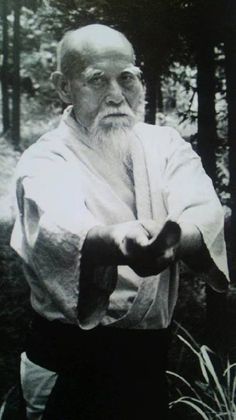
JODAN

Funes the Memorious by Borges, for me, is a poignant reminder of the dangers of specificity – missing the forest for the trees. Funes focuses only on the details to the point that everything is unique – he has no ability to form connections to extrapolate a general pattern. There is a deep lesson here. Concentrate too heavily on each and every datum and analysis paralysis results.

As a student of Aikido we learn the names of techniques – labeled in Japanese. In some ways this may be useful, to have an arbitrary (because in a foreign language) linguistic cue to frame a physical movement. This may help build a mental-physical lexicon wherein we can collect an ever expanding number of discrete techniques. I do not think that I was unique in collecting ‘cool’ techniques: this variant from this teacher, that one from another. Like a reference library, the more I collected, the more I knew. Or so it may seem to the lexiographically inclined. But each new ‘technique’ remained discrete, even if it were a variation on a prior form, which leads to an ever deepening specialization. And then I recalled a quote from Robert Heinlein (Time Enough For Love):

“A human being should be able to change a diaper, plan an invasion, butcher a hog, conn a ship, design a building, write a sonnet, balance accounts, build a wall, set a bone, comfort the dying, take orders, give orders, cooperate, act alone, solve equations, analyze a new problem, pitch manure, program a computer, cook a tasty meal, fight efficiently, die gallantly. Specialization is for insects.” [1]

We cannot become too enamored with the specialized techniques – a matching of if this, then that logic, where a presentation of the wrist up is one technique whereas wrist down is a different one. This would lead to a loss of adaptability and increase processing speed – the idea one must first recognize the attack, then categorize it, then select the correct response, then execute that technique.[2] For me this ties back to OODA loops, cognitive linguistics, and Funes.[3]

This is the fragility[4] of specialization. I contend, we are meant to be bricoleurs – generalists – pattern finders – connection makers. Build your lexicon, gather the variants, collect broadly, but then reflect and refine. Like a good alchemist, distill the universals.

How does this relate to this morning’s class? In the post title, I dropped the Tsuki purposefully because jodan tsuki is too specific. This morning I attempted to present a more general reference frame – some might label it a heuristic – to simplify and better explore the physiological potential (Michael Janich) of our responses to any highline attack.

First a reminder of the lexical specificity you know already: shomen, yokomen, gyaku yokomen, kata dori, kata menuchi, kubi-shime, jodan tsuki, etc. but these are all highline attacks.

So let’s simplify and define: The centerline bisects your body, left and right. The midline separates the body on the high and low-lines. In general anything above your elbow line is the high-line and anything below your elbows is low-line. The anatomical quadrants[5] illustrate some of the target organs available in each quadrant.

Combat anatomy

The classical sword posture of seigan-no-kaimae further illustrates the four quadrants:

Kamae
Protect your center

Upper left, upper right, lower left, lower right. Revisit the basic 8 cuts and the doce pares diagrams. Now look at it again.

Master Keating diagram

Rather than defining the strike (i.e., angle 1) look at it as a defensive zone (zone 1). To your assailant, a “1 strike” is a specific attack. For you it is a zone to protect (i.e., left side of your head).

We have been working from a very specific attack to explore the concept. Jodan Tsuki is angle 5 (a straight thrust) but please recall that any thrust (point) can also define a line – shomen-uchi. This was done purposefully because the #5 is a common way to along the #11/12 line (the centerline). It also sets up the reference matrix discussed in the previous post.

Form your own matrix

The specific training was R/R and L/L outside line – therefore nage delivered a back-knuckle rather than a palm deflection. We therefore played this as irimi-nage, but that is just one possible dynamic. It could just as easily have been kokyuho.

From there we moved  to the inside line – R/L and L/R thereby dictating a palm deflection, which was presented as a deflection to carotid strike to kokyu-nage.  Expanding this line of play, this transforms to shiho-nage. But rather than encountering this at Aikido’s typical maai where tori’s attack is picked up at its terminal position (i.e., at full extension) this morning we moved to trapping range to make sure that the deflection, re-direction and capture were all nage-induced movements. Meaning nage was the primary causal agent in the encounter. Foot work was minimal, torsional power was arm and hip driven. Why play at close range? To ensure that you can do it. No intelligent assailant would commit as fully at largo mano range – it is a training fiction.  So, to use the metaphor of the morning: take off the training wheels.

To make the connection back to a weaponized presentation, I showed that the R/L-L/R dynamic off the #5 is the same pattern as the “generic” opening for a 2 dagger or Espada y Daga opening. R slash, L thrust, R thrust & clear, L thrust. Follow the logic chain and you will see that this was the same pattern as the jodan tsuki kokyu nage throw we did.  Or, if you want a different “kata” think of the Kali sequence, this is #2 to #3. Same pattern – different methods of presentation.

Perhaps a plethora of examples only adds to confusion. The intent is the opposite – by showing the similarities among the ‘systems’ I hope to build linkages. Momentarily ignore the myriad of details and look only to the broader global body motions and the similarities emerge. Suddenly, one need not remember the multitude, and the universal becomes manifest. We pare to the minimal movements with maximal efficacity.  At least that is the goal as I see it.

jodan
Jodan – the power of 12

_______________________________________________

[1] Polymaths aren’t generalists

[2] In Heretics of Dune (1984) Frank Herbert introduced the Honored Matres whose Prana-bindu and Hormu fighting culminated with the logical (if fantastical) conclusion that to minimize response time one must bypass the brain.  Their kicking speed is reflexive and processed locally rather than through the central nervous system.

[3] Cognitive Linguistics:  I am not trying to make an academic argument, merely point out that there are interesting connections to make.  Boyd’s OODA loop was discussed in an earlier post as have the different types of speed (Bruce Lee).  The idea of mental constructs hindering or amplifying reactionary speed may be a testable hypothesis, but I am not aware of anyone conducting one.  Despite it being out of favor, the Sapir-Whorf hypothesis remains a valuable insight – our linguistic constructs (lexicon, grammar, etc.) produce perceptual blinders.  [I think of the Dragon of the North scene in Eric the Viking, where the Christian priest cannot see the dragon the Vikings fight – it simply doesn’t exist as a mental construct, therefore has no instantiated reality.]  But such broad generalities are out of favor – small-minded specialists lauding the primacy of individual experience always provide the exception to the rule.  It seems the academic-insects have won – hypertrophied specialist decrying the applicability of a general rule.  Back to heuristics again?  Perhaps I betray my intellectual age, but having read with David French and Gail Kelly, I find broad connections valuable and seminal.

Gail M. Kelly was something of a legend at Reed and once earned the dubious honor of being named “scariest college professor” by a local weekly paper. Often intimidating, she nevertheless earned undying respect and admiration because her standards of excellence forced students to strive for depth and cogency. She spoke her mind with wit and without regard to “political correctness.” In a 1973 public lecture, “The Economics of Dropping Out,” she noted that “hippieism is what hedonism would be like, if it had been invented by Puritans. What could be more ascetic, bleak, and sensually uninformed than living on inadequate food, drugs chosen for their cheapness, and hand-me-down clothing?” Something Reed students still aspired to while I was confined there.

After I graduated, when I would happen upon her at a bus stop (she never drove herself) and offer her a ride, she usually accepted with a chiding, Oxford-stutter “Mr. Barker, are you in the habit of rescuing damsels?”

[4] Antifragile. I like the phrase as a concept better than the book, although I respect Nassim Taleb’s intellect and his conclusion(s).

[5] Anatomy. The reminder of anatomical targets in each quadrant should not be lost on advance practitioners. The natural “body armor” of the sternum and ribs protects the vital targets (lungs and heart) but the secondary organs are available and more exposed.

__________________________

SIZE EQUALS DISPARITY OF FORCE

Defensive Tactics With Flashlights” by John Peters (1982) pp. 156-158.

p 156, 157

The chart is from Juste David Myers – the work cited was an unpublished manuscript (“Close Quarter Combat” 1982), which doesn’t appear to have ever gone to print. Nevertheless, the matrix shows a presumptive survival ratio based on physical size.

Peter’s book primarily is an instructional manual on the tactical use of a large Maglite style flashlight. However, in his MAG 20 class, Massad Ayoob referenced this book for the Size = Disparity of Force matrix, which is linked above for your reference and self-defense library to augment your understanding of the use of force – AOJ.

Legal Link >here<

There is no substitute for expert instruction – seek it out.

________________________________________

David and Goliath: The classic size – disparity of force confrontation. Goliath clearly demonstrated ample ability, opportunity and threatened jeopardy. David armed himself with an effective range weapon and stopped the threat.

Osmar_Schindler_David_und_Goliath
Philistines fail to adopt the latest technology

______________________

JODAN TSUKI (Highline Thrust)

With a nod back to the thrusting triangle, it is important to remember that tsuki – the thrust – can be delivered on any line. The doce pares count is a mnemonic for you to learn that every line (slash) can be a point (thrust). 

Master Keating’s reference

We continue to play the highline. Why? Because it is arguably the most persuasive attack – a thrust or slash to the head is a fierce move and inevitably elicits a flinch response from an untrained opponent.[1]

First the delivery of the strike. Because Aikido presumes a weapon, the atemi is a thrust from low to high – with the fingernails perpendicular to the ground, as below:

gokyo with atemi
Atemi – it’s not just for gokyu

This type of thrusting punch replicates a dagger thrust and the shape the hand takes is important and varied depending on the target area. It is important to know both how and where (and in some arts, at what time of day) to strike. Furthermore, please recall that the spirit of the attack is a committed delivery, not a feint or jab, tori should be delivering a killing blow. Start with the hand and the body power follows – weapon, body, feet in sequence. If you go out of sequence you will be open and subject to a stop-hit – pay attention to the true times!

From the atemi practice, we moved to a confidence exercise. Standing in simple measure (i.e., you can simply extend your arm to punch, no need for footwork), tori delivers a thrust to the face. Nage’s job is to deflect the thrust with minimal body and head movement. Nage intercepts the attack with the hand and doesn’t try to slip the punch. This is a confidence game to teach the requisite sangfroid and visual acuity to recognize tori’s timing and understand composure is the perfect defense. We practiced only the outside line this morning, using both the front and the back hand. As a reminder: assume tori gives a right thrust and nage has assumed a migi-hanmi stance.  Nage’s front hand (R) parry will be a back fist (elbow shield 2) whereas the back hand (L) parry will be delivered with the palm. Repeat this exercise and it will soon become obvious that the hanmi each player adopts is really inconsequential, the point it to recognize the R-L vs R-R and L-R vs L-L pattern as played on the outside line.

A standard technique from the L-R / R–L outside line is jodan-tsuki, sode-dori, kokyu-nage. In short, tori strikes with the right hand, nage palm parries the strike, and while moving irimi-tenkan grasps tori’s sleeve to amplify tori’s continuity of motion and throw vigorously. Many subtle details to work out in practice (non-interruption of tori’s commitment, well-timed blend on the irimi line, etc.) but in essence, a quick projecting throw. The variations should present themselves to the attentive practitioner. If nage misses the sleeve, simply snake over to the top of tori’s wrist on the inside gate. Snap down and execute a throw (this projects tori more on the vertical rather than horizontal plane). Totally miss tori’s arm? A well timed irimi-tenkan has put you in the shikaku and your free hand has control of tori’s low line (e.g., belly, groin, and knee). Note that this technique is a one-beat response. For comparison the 2-beat cognate is R-R / L-L which is to say, tori strikes right, nage parries right (back-hand) then captures the striking hand while performing irimi-tenkan and simultaneously striking tori in the ribs with the left and culminating in ude-kimi-nage. But notice that the primacy now should be on relationships, not techniques.

Based on the relationship you could build a Matrix of responses – and then you can develop mental maps, or “plays” that move beyond the if-this, then-that realm of technique. You can complete the your matrices in an ever-expanding or always refining manner – and you will thereby discover new connections and patterns, and universals. You may find plays that are simple (passata-sotto) yet have a broad application.

For the outside line we also played the direct kote-gaeshiTori thrusts, depending on nage’s confidence and timing, nage picks up the thrust either with the palm or back-hand to grab the thrusting hand with the opposite hand (i.e. gyaku-hanmi) and applies the technique with the rolling elbow (shield 1) in order to have ‘gross motor’ response. The high-dexterity (i.e. normal) application should still be a ‘direct’ return (that is almost on the same line as the thrust was delivered). Empty-hand it appears that one could do a cross-body throw, but weaponized the thrust and the direct return makes more sense. We explored the ‘gross motor’ return whereby the elbow drives the blade back to tori (and tori’s inertia causes a self-impaling), or the master-play (high dexterity) wherein nage captures tori’s thumb and grasps the dagger to return it directly to stab tori’s throat.

Breaking pedagogy but keeping with the knife play, I moved to the inside line to show the point encircling move which simultaneously traps tori’s blade and does a hip strip [review at about 1:30] and impaling move in one beat.

If you review the flow of the themes in these posted class notes, you may begin to find that they link. Review the Matrix again – how you would construct it?

__________________________________

[1] Flinch response. Attacks to the head against an untrained opponent almost always result with them trying to avoid the strike by turning their head, which then leads their body to turn: they give flank. Count on this!