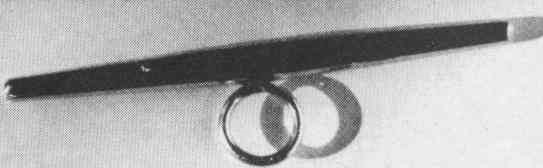
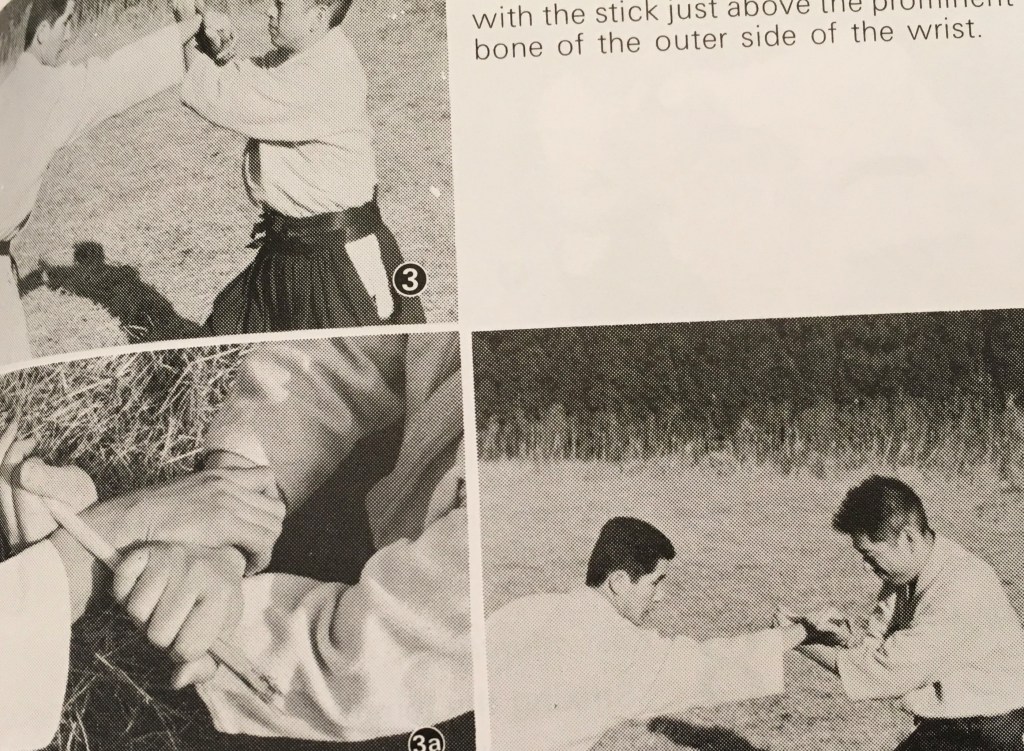
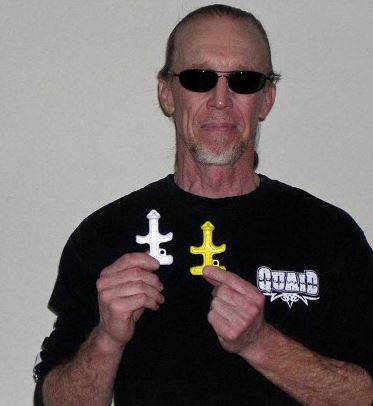
What is a kubotan? A small hand-held impact weapon that is used as a “force multiplier” in order to facilitate locks and nerve plexus strikes. There are numerous historical and cultural precedents – yawara, kongou (vajra), tessen, shobo, pasak, etc.
The techniques illustrated are by no means unique but do serve as additional examples of basic controls and strikes that are widely taught and employed.
What is the practical application? Palm held multipliers are easily concealed and therefore ideal for self defense. However their prevalence and recognition makes it more difficult to carry them legally so please be sure to check local laws.
Use a kubotan – Silat Suffian Bela Diri
Additional related resources:
Stick Fighting by Masaaki Hatsumi is another good reference manual.
Well considered applications and thoughts from Don Rearic.
Purchase a “stinger” by James Keating from the source >here< or from >Amazon<
Pete Kautz’s very important overview on How to Use the Comtech Stinger is found >here< and excerpts from it are copied below for ease of reference.
_________________________
The Comtech Stinger Self Defense Tool By Pete Kautz
Stinger Self Defense Tool History
The Comtech Stinger Self Defense Tool was designed by Master at Arms James A. Keatin based on a 19th century push-dagger that he had seen while researching the martial history of old New Orleans. Jim immediately saw the utility of such an item and devised a modern version made of lightweight high-strength injection-molded plastic. Designing his tool along the same lines, the Stinger Self Defense Tool protrudes between the top two fingers to focus the entire force of a punch into a tiny area about the size of a pencil’s eraser. Unlike the push-dagger of old, the Stinger Self Defense Tool is only meant to cause shock of impact and is thus a less-than-lethal striking option.
Stinger Self Defense Tool Colors
One interesting aspect of the Stinger Self Defense Tool is that they have been produced in numerous colors over the years such as red, yellow, green, blue, clear plastic, clear blue, and even clear purple (Laci Szabo’s Miami Beach model) in addition to good old black and tactical gray. While black is always a tempting choice for most guys, the diversity of color adds to the Stinger Self Defense Tool’s invisibility and utility for today.
What do I mean? Simply that a black one looks like a weapon, while a clear plastic (ice) or clear blue (blue ice) look more like a normal item upon quick examination.
S.T.I.N.G.E.R. 7-Point Safety Checklist
For the untrained person, simply holding the Stinger on a keychain at “key” transitional times (house to car to office, etc.) can act as an anchor to remind them to PAY ATTENTION to what is happening around them. I advise newcomers to self defense to do this whenever they touch or even think of the Stinger for the first few weeks they carry it, and it makes it a safety habit so in their minds Stinger Self Defense Tool = Pay Attention To What Is Happening!
What should you pay attention to? To make it simple, we’ve used the word “Stinger” to create a basic 7-point check list. There are more of course, but this is a start to get the untrained person thinking about these issues. (Readers here doubtfully need a reminder of the basic color codes of awareness or other such principles but can probably appreciate it when dealing with family members, friends, and so on.)
S – Surroundings – What’s going on around you? A bar, a subway, the street? T – Time of Day – Early morning, afternoon, 2 am, when? I – Intuition – If something “feels wrong” then pay attention! Trust yourself on this and act! N – Neighborhood – Where are you? Someplace you know or not? How sketchy? G – Groups – Whether formal (gangs, sports teams) or informal (bar patrons), groups act differently than individuals. A big group of rowdy drunk women usually just means bad tips for the bartenders where a big group of rowdy drunk guys could mean watch out. E – Exits – What are the exits from any room or area you enter? Is there only one or are there more? Who is between it and you? R – Reactions – Unusual reactions from people to normal situations can indicate trouble. If someone is wearing only shorts in December, gets unusually friendly or skittish, or flips out about something trivial then watch out.
So, if you run through the S.T.I.N.G.E.R. list and say “Hmmm…I’m at a party at 2am in a neighborhood I don’t know and have a funny feeling about this group of guys who got all quiet then were suddenly irritated after I walked into the room – you know what – IT’S TIME TO GO via through the side door over there!” Given that 7-point checklist failure, only a fool would stay, right? Obviously, this is an exaggerated example but I’m sure you get the idea.
Basic Grip
The Stinger Self Defense Tool is properly held between the top two fingers of the hand. This allows the thumb to lock down on the side of the fingers and secure the grip. It also promotes the same body mechanics as if you were firing a traditional punch with the top two knuckles of the fist or the ram’s head as it is known in some styles. Whether striking with the fist in a vertical Chinese manner, with a partial twist, or with a Japanese full twist this is a strong grip and will help protect your hand.
Some people, especially those with large hands, may instinctively grip the Stinger Self Defense Tool between the middle two fingers. However, while this can also work, it is not the preferred method as it does not promote correct striking mechanics or allow for a secured grip on the Stinger Self Defense Tool. Try both in the drills and see
Originally this post was titled “Shooting to Live” to make sure that the classic text would be available. It has been expanded (and may continue to be updated) to better serve as a reference for the men who were pioneers and innovators – but more importantly – men who actually used the techniques they taught.
William E Fairbairn
Fairbairn is one of the luminaries of modern martial arts. He joined the Royal Marine Light Infantry in 1901 and six years later joined the Shanghai Police were he had to engage in numerous street fights during his twenty-year career. While serving in Shanghai he studied a variety of traditional eastern and western martial arts, but he pared down the variations to his own ‘hybrid’ which (with a wry British humor) he called Defendu.
Flip through the book and it may seem simplistic. Yes: simple works. And unlike most modern practitioners Fairbairn’s skills were honed by conflicts to the death – no time for theory, just pragmatic, no-nonsense execution.
His talents were recognized and during WW2 he served in the army for the British Secret Service to train allied commandos (special forces) in close-combat, pistol, and knife, where he reminded his pupils to “Get tough, get down in the gutter, win at all costs…” And his most important lesson: “There’s no rules except one: kill or be killed.” The inspiration for Appelgate’s title (below).
Fairbairn’s self defense and combat manuals are still in print and continue to influence modern experts.[1]
Eric A Sykes
Sykes met Fairbairn in Shanghai in 1919 and joined the department as a volunteer reserve officer in 1926. An expert rifleman, Sykes trained snipers and during WW2 he joined the British Secret Intelligence Service where he worked as a trainer and reportedly ended each lesson with a concluding, “…and then kick him in the testicles.”
The Sykes-Fairbairn collaboration culminated with the publication of Shooting_to_Live – a classic work on high-stress, one-hand shooting. It is worth adding to your library.
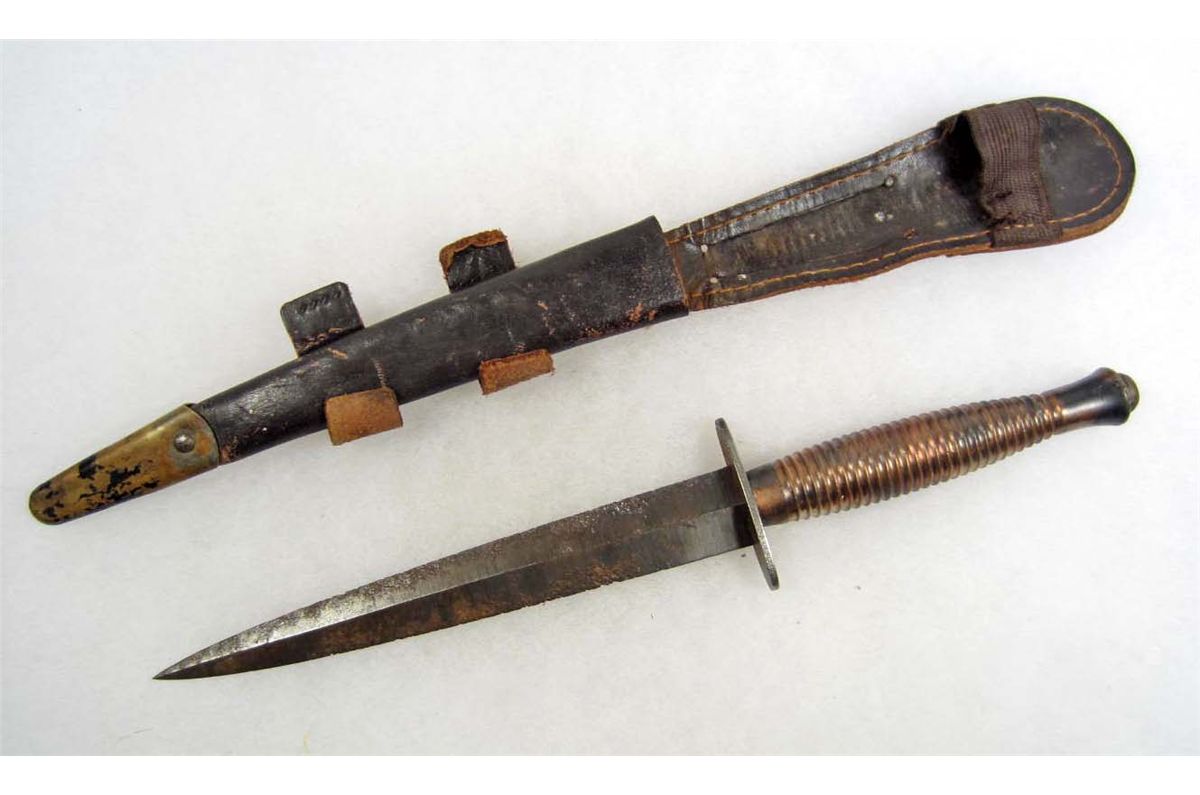
Their unarmed and knife methods are exemplified by their knife design that is elegantly deadly. For a good oral history by someone who was there and did it, see Stan Scott’s interviews. If you want to purchase a reproduction of the classic design start >here<
Rex Applegate
Rex Applegate, a native Oregonian, was sent to the OSS to learn all that he could from Fairbairn and Sykes in 1942. The “point shooting” system they taught uses much of the skeletal alignment that good fencers and pugilists need maintain. Principles are universal. Applegate continued to promulgate the methods and publishedKill or Get Killedin 1943.
The focus on efficient motion and brutal simplicity is exceedingly valuable in a high-stress environment. Simplicity is mandatory when tasked with teaching cohorts that need to be trained to maximal efficiency with minimal time. So while these men developed a highly efficient curriculum – the simplicity pares away master-plays and complex exchanges that will occur among higher-level practitioners.
But ignore the lessons within their works at your peril. Their methods helped win WW2. And these methods remain contemporary. Both Michael Janich and James Keating trained with Applegate – continuing the lineage by teaching point shooting methods.
____________________________________
The use of and fighting with a dagger is distinct from combat knives derivative of sabers. [2] Medieval fightbooks remain instructive, more >here<
______________________________________
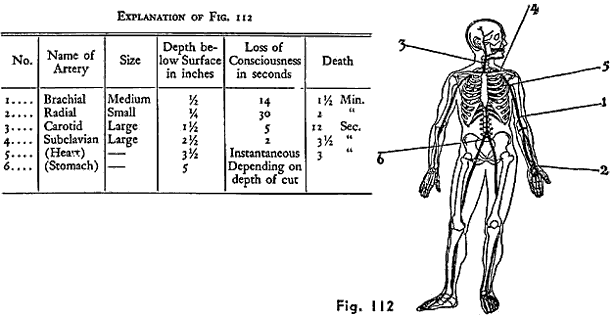
[1] TIME TABLE OF DEATH
Fairbairn’s original table showed the target arteries, relative depths and the resulting damage when cut.
A good start
Although historically interesting, and innovative at the time, Fairbairn’s timetable is simplistic and not entirely accurate. Michael Janich updated the table in a more scientific manner and published the results in his “Contemporary Knife Targeting.”
In all instances, however, the Timetable of Death reminds us why, it is said that the winner of a knife fight is the one who dies last.
______________________________
Daggers and Combat Knives – point v. edge
[2] The following is a great comparison on knife fighting – the KA-BAR is exemplified by Styers and the dagger by Fairbairn-Sykes. The text is copied below but be sure to follow the link to the original for photographs and imbedded video links.
The knife is a silent and deadly weapon that is easily concealed and against which, in the hands of an expert, there is no sure defence, except firearms or running like hell.
-From the declassified Special Operations Executive Syllabus
When it comes to modern combat knives, the two most iconic knives of the Western world are undoubtedly the American “KA-BAR” and the British Fairbairn-Sykes Fighting Knife. These two knives represent completely different philosophies with the KA-BAR being a very strong and sturdy fighting knife of utilitarian design, and the Fairbairn-Sykes representing a more elegant design for more delicate use in clandestine operations.
To really understand these knives, however, we have to look back at the contexts for which they were designed and what needs they were intended to satisfy.
Fairbairn & Sykes
So, stepping back in history…
Lt. Col. W.E. Fairbairn
Famous British Lt. Col. W.E. Fairbairn joined the British Marines at the age of 15, using faked documents stating that he was of legal age, i.e. 18. He was deployed to serve in Japanese-occupied Korea already in 1903, then at the real age of 18. Here he spent much of his time practicing various forms of martial arts with Japanese and Korean fighters, practiced drilling with the Royal Marines and fighting Japanese Army troops with bayonet.
Fairbairn left the military in 1907 and instead joined the Shanghai Municipal Police, serving in one of the red light districts, then considered to be one of the most dangerous places in the world. Shanghai was a one of the most important centres for the opium trade, the precursor of today’s heroin and cocaine trade and just about as sinister, with related crime and well-armed gang activity. This increased dramatically after opium trade once again became illegal in 1906, after having been forced upon and “legalized” in China by the British Empire. (For more on this see the 1st Opium War & the 2nd Opium War). Of course as with any city, and in particular port cities, gambling and prostitution was also common and it was by some called the vice capital of the world. Around this time more than 10% of the Chinese were smoking opium. About 15% of China’s crop acreage was dedicated to opium while 20 years later twice as much, a change which would greatly diminish the need for British export of opium to China.
As a result of the initiative taken a year earlier, the Shanghai Municipal Council stopped issuing licenses to opium dens in 1907, the very year of Fairbairn’s arrival. The same year he was stabbed a dozen times by members of a Chinese separatist gang and left to die in the back streets of Shangha, but luckily he managed to survive this brutal experience.
Ten years later, in 1917, the last legal opium shop was closed. Opium trade didn’t disappear though. Quite the contrary. This was a golden age for the Green Gang triad, collaborating with the senior Chinese officer in the French gendarmerie Huang Jinrong in taking over the whole opium trade which now made more money than ever.
The Green Gang Triad, led by ‘Big Ears’ Du Yuesheng (far right). Photo from tony-henderson.com
As if this wasn’t enough, Shanghai was also haunted by increased Chinese nationalist activity, an increasing amount of armed robberies. Terrorist kidnappings & bombings and rioting and large-scale conflict was also very common. The Green Gang was often hired by Chinese Chiang Kai-shek’s Kuomintang for political violence and they, along with other criminal gangs took part in the White Terror massacre where some 5,000 pro-communist strikers in Shanghai were slaughtered in April 1927.
It was a huge boiling pot of vicious violence and Fairbarn was right in the middle of it at quite young age, something which would shape the rest of his life, laying the foundation of a very pragmatic and ruthless perspective on violence and martial arts.
Sikh, Chinese and British members of the SMP
Eric A. Sykes
Later, after the war, Fairbairn would create and train a special anti-riot squad for the SMP and many of the tactics and techniques developed here are still in use today.
It is here, in 1919 in Shanghai, that he met Eric A. Sykes, while Sykes was still working with weapons import/export at a British Secret Service-run company. Sykes was an expert marksman and came to form and oversee a team of civilian & police snipers for the SMP and naturally he also became the head of this unit in 1937. In 1939 Sykes would properly join the British Secret Intelligence Service (SIS-MI6).
Based on their experiences and training the two designed their own martial arts system for specific use for the Shanghai Municipal Police called Defendu. For hand-to-hand combat Fairbairn mixed Savate, Jujitsu, early Judo, Chinese martial arts (he had studied Kung-Fu with the Empress’ former bodyguard), wrestling and boxing, all of it reflected against his own experience of raw and brutal street fighting as a police.
The below video is from a dvd released by Gutter Fighting Films in Australia and while dubbed in Greek it has been subtitled using the original and publicly available scripts. If you have an interest in the topic, then it is strongly suggested you support their work by ordering the dvd.
The system emphasized pragmatical rather than gentlemanly and honourable fighting, teaching rapid disabling of the opponent with potentially lethal force. Fairbairn declared:
Get tough, get down in the gutter, win at all costs… I teach what is called ‘Gutter Fighting.’ There’s no fair play, no rules except one: kill or be killed.
The techniques of the system were brutal and quick, which can be exemplified by the following quote from the SOE syllabus:
The Queensberry rules enumerate, under the heading of ‘fouls’, some good targets which the boxer is not trained to defend. This, however, is WAR, not sport. Your aim is to kill your opponent as quickly as possible. … So forget the Queensberry rules; forget the term ‘foul methods’. That may sound cruel, but it is still more cruel to take longer than necessary to kill your opponent. ‘Foul methods’, so-called, help you to kill more quickly… Don’t just stop because an opponent is crippled. If you have broken his arm, for instance, that is only of value because it is then easier to kill.
During his 30 years of service in Shanghai Fairbairn reportedly engaged in at least 600 actual fights. Large parts of his body, with arms, legs, torso and even the palms of his hands are said to have been covered with scars from knife wounds sustained during those years.
The Defendu system was designed to be easy to learn and to provide effective results. It included unarmed fighting as well as gun combat & point shooting, use of knives, clubs and improvised weapons such as chairs or table legs. As such it fulfilled the needs of the military quite well too. Consequently, Fairbairn’s and Sykes’ teachings were adopted by the Allies in 1941 and first taught at the British Commando School in Scotland, although in a militarized form called British Close Quarters Combat. Much of Fairnbairn’s and Sykes’ pioneering work in close combat, riot control, clandestine operations and trained instinctive fighting with guns and knives is still in use by military and police around the world today.
The Fairbairn-Sykes Fighting Knife
Already in Shanghai Fairbairn was working on designing a combat knife for their martial arts system, together with Sykes and a young US Marines officer; 2nd Lt. Samuel Sylvester Yeaton.
A rare believed genuine Shanghai Knife, designed to be carried hanging upside-down and used by the SMP. Photo courtesy of Gota Vapen
The work continued back in England in November 1940, then with the less commonly known, Col. Leslie Wood R.E and Jack Wilkinson Latham of manufacturer Wilkinson Sword Ltd. And this is the actual birth of the now quite iconic knife, the British commando knife, commonly called the Fairbairn-Sykes.
F–S fighting knife blueprint from FMFRP 12-80, Kill or Get Killed, by Rex Applegate. Image from Wikipedia
Possibly some inspiration was taken from the simple 17th and 18th cent. “plug” bayonets such as the one depicted below, but the design is also similar to many other classical dagger and stiletto designs of the preceding centuries. Regardless, the final result was a very carefully designed and engineered fighting knife.
Fairbairn’s philosophy for the design was naturally based on his experience of close quarters combat during the preceding decades, although in military version made longer to reach vital organs through thick military garments.
In close-quarters fighting there is no more deadly weapon than the knife. In choosing a knife there are two important factors to bear in mind: balance and keenness. The hilt should fit easily in your hand, and the blade should not be so heavy that it tends to drag the hilt from your fingers in a loose grip. It is essential that the blade have a sharp stabbing point and good cutting edges, because an artery torn through (as against a clean cut) tends to contract and stop the bleeding. If a main artery is cleanly severed, the wounded man will quickly lose consciousness and die.
This knife was designed primarily for quick, ruthless and silent disposal of enemies, preferably from behind, and was soon issued to British Commandos, the Airborne Forces, the SASand many other troops. The knife came in many different versions; fully black, half-black, plain steel and also with a nickel-plated hilt. The latter followed Fairbairn’s philosophy of;
I believe that a knife should be bright and highly polished for the reason that 20% of the fight is lost by not striking awe in the mind of the victim that a flashing knife gives.
Almost two million of these British fighting knives are estimated to have been produced.
In June 1942 The two partners split ways on less than friendly terms with Sykes claiming that Fairbairn had treated him as an inferior. Fairbairn was borrowed to the US military and the OSS, to teach close combat techniques at Camp X in Canada and later at US Camp B (now Camp David). Maj. Eric A. Sykes stayed in Great Britain, training Special Operations Executive agents at their various training centres.
The OSS stiletto
Col. Rex Applegate, friend of John Wayne, one time bodyguard of Franklin D. Roosevelt, and believed to have been the role model for several characters of the James Bond books.
One of Fairbairn’s American students, Col. Rex Applegate continued working on spreading and developing the teachings of Fairbairn and Sykes in his own teaching of OSS operatives at Camp X. Quite naturally this also led to the OSS’s own version of the Fairbairn-Sykes combat knife, the OSS Stiletto, a knife also used in Applegate’s 1943 manual “Kill or get killed.“
The knife was manufactured by several companies including Pasadena Firearms and Landers, Frary & Clark. The latter had manufactured pancake flappers before the war which is quite apparent from the design of the scabbard. Consequently that was also the name that was given to it, the pancake flapper. Reportedly it was Fairbairn’s personal favorite scabbard type.
The US V-42 Stiletto
Meanwhile, US Lt. Colonel Robert T. Frederick, who had seen the Fairbairn-Sykes dagger while on duty in England, had come to wish for an American version of this knife and initiated the making of an improved version of it that would come to be designated the V-42 Stiletto.
This was designed for use by the American-Canadian elite commando; the 1st Special Service Force (FSSF), the so called Devil’s Brigade, and had a pointy pommel designed for cracking skulls, a blade with a double hollow-ground bevel and a ricasso designed specifically to promote thumbing the blade in a side-grip.
The V-42 Stiletto was first issued in 1942 to the FSSF as their standard fighting knife. The knife is said to have had great piercing capacities, even capable of piercing a steel helmet with liner, but also prone to breaking if used for prying. It also commonly got stuck in bone, making it difficult to withdraw and some soldiers are said to have ground down the tip because of this.
The US Marine Raider Stiletto
Following this the US military decided to design a more official copy of the Fairbairn-Sykes knife, albeit with some changes to the design due to financial concerns. The knife was manufactured by Camillus Cutlery Co and was in standard delivery decorated on the blade with the letters “USMC” framed by leaves. Some 15,000 were manufactured, although only ca 6,000 marines served as Raiders.
However, the changes to this version of the fighting knife had turned out to be serious flaws. The hilt was a zinc-aluminum one-piece die-cast directly onto the tang and with time, the zinc ions leaked out, leaving the hilt very brittle and weak. Furthermore, for economical reasons the blade had been made thinner and as the tempering was also inferior the whole knife was rather fragile, if still deadly when used correctly.
Consequently, non-commando troops commonly found it lacking for fighting and their need for every day utility use wasn’t nearly satisfied, with its inherent weakness and completely round grip. They would much rather have a more versatile tool that would not just let them fight, but also let them hammer, pry open boxes and tins & cans, cut wire, split wood etc. Consequently, for some troops, the stiletto was thus for a brief period replaced by short machetes or even personal hunting knives, commonly of Bowie-like designs like the Randall Model 1 and the Marble’s Ideal hunting knife, where the latter likely served as inspiration for what was to come.
The Mark 1 Trench Knife & Mark 3 Fighting Knife
Still in WWII the old WWI Mark 1 Trench Knife (M1918) was reissued by the Army as a large stock remained from WWI. Most of these were issued to Army Rangers and Airborne troops, but some were reissued to Marines, in particular Raiders.
A replica of the M1918 Mk 1 Trench Knife with brass hilt. The American made variant used bronze.
Support for the knife was mixed but the expensive bronze knuckle hilt limited the gripping options and the somewhat weak blade had a tendency to break when prying things. As such it was not a success and in 1943 it was replaced by the M3 Fighting Knife. Some troops however, initially received the Raider Stiletto described above.
The M3 Fighting Knife in in turn would be highly influential on military knives around the world and served as the role model for many, many military knives which more or less copied the design.
The KA-BAR
While Camillus Cutlery Co. was the biggest manufacturer of contracted combat knives Union Cutlery Co. produced nearly as many knives and was the only company to stamp their knives with the mark “KA-BAR”. However, already in 1944 marines were refering to the knife type as “KA-BARs” and the name has stuck with it regardless of brand since then.
The name itself is said to come from a badly written letter from a fur trapper who wrote to Union Cutlery trying to describe an encounter he had had with a bear, where he had used the knife to kill it. The maker only just managed to make out a few of the letters of the phrase “K(ill) a b(e)ar“. Already in 1923 Union Cutlery was using the name to market their knives, but after the success of the Mark 2combat knife Union Cutlery Co. renamed itself in 1952 to KA-BAR Cutlery Inc.
At first the KA-BAR received criticism for its dual-purpose, since it was believed that it would be lacking as a fighting knife. However, returning veterans and field reports quickly dispelled any such doubts. A fellow HEMA-fencer and ex-soldier recently commented on the practical difference between the Fairbairn-Sykes and the KA-BAR, based on his 30 years of Special Forces instructing in three different armies:
What special forces like most is a nice wide non-slip grip, and these had that! We didnt care too much about the blade as long as it was over 4 inches long an inch wide at least, and thick enough up the tang not to snap off when cranked about inside a human body. You could soak this grip in water or blood and still keep a good working grip on it.
We hated the Sykes-Fairbairn as the blade tips snapped off in bone and the grip was designed by a surgeon who thought he was doing brain surgery. We had to tape the grips but would mostly use “throwaways” (blades cut from plate steel with the grips taped) as they could be left behind without issue loss, and you could carry several on your webbing.
-Robert Loki Thornton
Former SAS regiment NCO and Special Force consultant
After WWII
Moving onwards, after WWII other knives also became popular, among them the famous Randall Model 14 Attack Knife designed by Bo Randall in the 1950s, and the Gerber Mark 2, a knife first issued in 1967 and clearly derived from the Fairbairn-Sykes knife.
Gerber Mark II fighting knife. Photo from Wikipedia
Although not officially a US Military fighting knife for the Korea and Vietnam Wars, many troops still carried the KA-BARs and some old WWII KA-BARs were even given by war veterans to their sons serving in these wars.
The KA-BAR Cutlery brand still exists though, although it has been sold several times e.g. in 1960, -61, -66 and -82, ending up sold to Alcas Co, now renamed to Cutco Co, in 1996. The company still manufactures very good knives for a wide array of uses, including bushcraft, military and tactical. Camillus Cutlery Co, the first military contractor for this knife, filed for bankruptcy in 2007 and Acme United Co purchased the brand and relaunched it as Camillus Cutlery in 2009. More and more old designs are added to the product range but currently no Mark 2 Combat Knife type or other military/tactical knives. Ontario Knife Company bought Robeson Cutlery Co, one of the original manufacturers of the WWII KA-BARs in 1971. They have had contract with the US military for making KA-BARs ever since 1980 and is currently the only contract holder.
Here is a link to my research Bibliography and it is weighted to Aikido as my alma mater but there are other resources found there.
It is by no means exhaustive but it may prove useful to help you along your path.
There are additional evolving imbedded links and suggestions here.
I recommend paper copies – good quality paper is a proven medium for retaining and transmitting ideas through time – I am enough of a skeptic to worry that the internet may not prove durable as elaborated in another post.