KI-MUSUBI

Linguistically, Japanese sounds exotic, which (like most things in life) is both a blessing and a curse. It is a blessing because a Japanese phrase like ki-musubi forces non-Japanese speakers to pause mentally and to question seriously whether or not we understand the concept. Translated, ki-musubi is ‘to tie ki.’ Now the curse of a foreign language is obvious: what does ‘ki’ mean and how does one ‘tie’ it?

In English ‘to tie’ derives from Old English têah, têg ‘that with which anything is fastened’ (and ultimately from Old Norse taug ‘rope’) and is related to rope-related action verbs like ‘to bind’ (*tegan, tgan), ‘to draw, drag’ (togian) and ‘to pull’ (ton). Good Anglo-Saxon words that Sir Walter Scott would approve of using, but the implicit idea (the hidden etymological assumption) in these concepts is coercive and forced.

In Latin the verb vincio has a broader semantic range: to bind, bind about, fetter, tie, fasten, surround, and encircle. It survives in English (through the present infinitive, vincîre) as vinculum, which means a bond or a tie and specifically in anatomy, a ligament.

Ovid was very fond of vincio. As a poet, his uses are metaphorically beautiful:

Miscuimus lacrimas maestus uterque suas;

Non sic adpositis vincitur vitibus ulmus,

Ut tua sunt collo bracchia nexa meo.

“Our mingled tears spoke our mutual sadness.

You clasped your arms round my neck,

more closely than the curling vines embrace the towering elm.”

(Letter from Oinone to Paris)

For Ovid being tied is the embrace of a lover, held tight and bound fast. Later authors like Cicero and Tacitus used vincio slightly more often (statistically) than Ovid did, but they focused on the obligations of being ‘tied’ to another as a member of a group. Later usage often expressed the concept by using the noun vinculum:

“…tum accedit mea quidem sententia maximum vinculum, quod ita rem geris atque gessisti…”

… your complimenting me has been exactly the same as, in common with your ancestors and entire family… (M. Tullius Cicero, Epistulae ad Familiares, bk 15, ltr 11, sec 2).

To tie the knot is also a Latin idea: vinculum matrimonii (‘the bond of marriage’). But a bond of unity can quickly become a fetter or impediment. In the Latin Vulgate, the Book of Mark (7:35), we find, “et statim apertae sunt aures eius et solutum est vinculum linguae eius et loquebatur recte,” or “immediately his ears were opened and the impediment of his tongue was loosed, and he spoke clearly.” (The man was ‘tongue-tied.’) But even later Latin acknowledged the positive aspects of bonds. In Colossians (3:14), “super omnia autem haec caritatem quod est vinculum perdectionis,” ‘Above all these things, walk in love, which is the bond of perfection.’

The complex etymological history should indicate how the act of tying oneself to another has deep physical and emotional implications. Being bound in marriage (which we moderns need to be reminded, means that a unity is created from a dyad), being exactly of the same mind, and engulfed in a lover’s embrace are all the positive aspects of musubi. This concept is inseparable from productive training in Aikido.

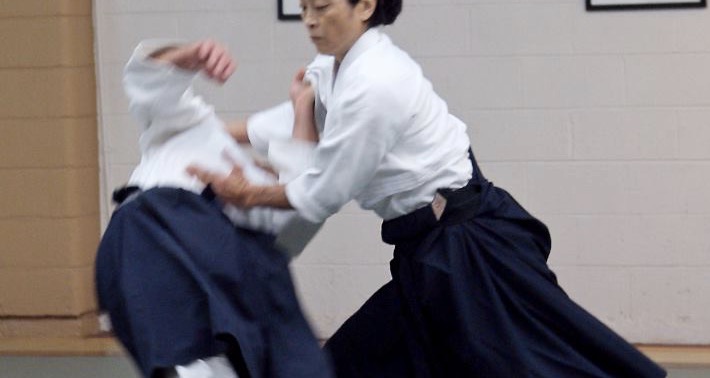
In weapons training, the prosaically named sixth paired exercise, roku no tachi, is also called ki-musubi. Each practitioner must watch the other closely. The focus of the exercise is to develop a mutual awareness, a sense of timing, wherein the motions of both people are matched exactly: both people are of the same mind (sententia maximum vinculum). There are of course physical cues (breathing patterns, eye movement, etc.) that indicate that each party ultimately is watching the other in order to know when to respond. However, in the past, Okamoto sensei has made us practice this exercise from a distance in the dark in order to limit the visual cues and learn to sense when the other is moving. This is nothing mystical, it simply means paying very close attention to all possible sense data.

In practice it is very easy to get wrapped up in the personal experience of the art. This is unavoidable, especially when first learning the movement patterns. However, to progress in Aikido, one must move beyond his or her own physical experience (how does it feel, where does my hand go, etc.) and learn to ‘read’ the other person. In my understanding, this is ki-musubi.

All to often our focus on the personal experience of the art (even the Western teaching method of telling someone what to ‘do’) can form unrealistic ideals of self-sufficiency that puts one out of touch with interdependence and consequently out of touch with the very purpose of Aikido.

AT CLOSE RANGE: Shomen and Yokomen

First warm up with a new pattern – shomen practice with a step-cut, slide-cut, step-cut to get out of fixed patterns; disrupt habits and the facile assumptions.  Then yokomen with the same step-cut, slide-cut, step-cut.  The tempo is quick beat cut, cut – you are advancing through space – your first cut misses and your second is a follow up attack.  (If you want to add further complexity later, then add a double cut – so step-forehand/backhand, slide-forehand/backhand – aka yokomen, gyaku yokomen.)

A reminder shomen exercise – a cut, counter cut is a typical sequence.  In weapon work it is kiri-otoshi.  Empty handed we can replicate the exercise but this evening we did a cut, counter tsuki (palm strike to the chin, which is a safer form to practice than the logical eye-spear).

IMG_0327
Palm strike or eye gouge?

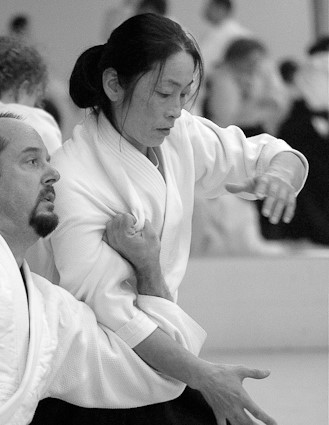
The next development pattern added a more traditional ikkyo style arrest, but with the top hand free to cut uke and the bottom hand doing the ‘work.’  But much time was spent training how to ensure the lower hand was used effectively – and the primary method was to use the lower hand only to first arrest uke’s striking arm, then drive it up and over – staying close to vertical – while playing uke’s center via the deltoid and latissimus.  As a test, if uke can counter cut with the original striking hand, then tori provided too much horizontal energy (i.e. pushed uke away) or not enough lift (i.e. didn’t come from low to high).  Done properly, you should be able to exert enough control to provide for the next step – which would be to add the top hand.  Tori uses the palm of the free hand against uke’s little finger in a sankyo-like cork-screw.  Small circle jujutsu done with palm pressure and the counter lock on the elbow.  From here much productive learning can be found in playing that line to feel uke’s center: can you control someone with those two points alone?  Experiment, you can.  However, that control is elusive, so we need to know the next step, which is to ensure uke’s arm is as vertical as possible and then to ‘snap’ uke’s hand over your elbow.  The result should be similar to rokyo in its position (or a basic snake) and this allows tori to use his entire body weight to control uke’s shoulder.  Tori can ‘fall into’ uke with devastating physiological effects.

Getting used to training at close range attacks and a quick riposte, we add a complicating two beat counter.  Shomen countered with a cross-hand intercept then the eye-rake and leg trap (aka koyku-ho on the inside line).  From there we move to yokomen.  But how do we know when yokomen is delivered?  An exercise – tori strikes shomen, uke responds with yokomen to avoid the initial strike and win the contest.  It is the absence of contact that lets tori know that yokomen is coming.  So the response: tori is already in a downward strike, thus turning the blade isn’t the solution, it is turning the hips 90 degrees to meet the yokomen directly.  Note that this is a right- to-right or left-to-left counter cut.  As a pattern the basic exercise is simple.  You have seen and practiced this as a set piece in more “advanced” classes.  Uke delivers a yokomen and nage responds counter yokomen to the offending arm (strike whatever moves first).  It is a good form to practice, but as I said – it is a set piece and delivered on a basic one-step kill principle.  We are playing a more subtle encounter – attack, counter-attack, and riposte.  We are trying to build beyond the visual stimulus because done quickly and correctly, the uke’s counter yokomen should be largely unseen – thus, we are responding to the absence of information and perform the only logical move in the sequence of action.  A logic-chain dictated by the initial action.  I am playing with ranges – within the shikko of each participant – rather than the longer range actions typically presented.  And I am ‘messing’ with tempos and beats, but you have seen this all before.  The encounter I merely adapted from a ‘standard’ yokomen, ushiro-tenkan to low-line shikaku (Okamoto sensei does this often and you can see it in her Offenbach seminar 2014 – if you follow the principles).

Once uke’s arm is intercepted and the balance taken, tori’s free hand can now take the neck and because we are at close range, tori also uses a leg trap (which could be at the level of the thigh, knee, or a foot trap and done with either leg).  Playing at closer ranges increases the threats and opportunities.  Remember as a generalization, the longer the range the fewer the ‘natural’ weapons that can be deployed.  I am decreasing distance, thereby increasing threats and opportunities, and forcing faster reactions in time because the space is limited.  This is not a beginner’s range.

12004148_939671572738000_3234619769590534894_n

_________________

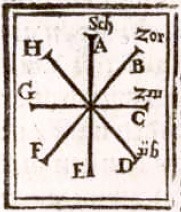
Look for cognates – Fendente and yokomen

RESPONSES IN TIME

With the two basic ranges understood, let us focus again on shomen.  The step-cut is ‘long range’ and the slide-cut is ‘short range’ but the ranges are also examples of time.  Meaning the longer the range the more time tori has to respond.  In order to train the correct response, we focus first on the longer range.  With a proper and decisive shomen, the correct response is not to use a cross-block arm and focus on the distal part of the arm, but rather to use the opposite (usually the back) hand to stop uke’s striking arm at the triceps.  Simply stated, gokyo’s entry.  However the refinements are as follows.

For simplicity – focus on a right handed shomen.  Arrest the strike in proper time with your left hand from below on the triceps.  Tori’s right hand is focused on the counter strike to uke’s head (which is always a viable target).  Respecting the threat, uke’s attack is firmly stopped which allows tori the time (beat) to replace the left-hand control of uke’s strike to transfer to the right hand.  This can look similar to ikkyo.  However, rather than focus on uke’s arm, once the right-to-right contact is established, tori’s left hand then drops to strike uke’s femoral.  In short, tori executes a reverse “c” cut hitting first uke’s offending (striking) hand then to the groin.  Tori’s right hand game is a simple counter cut.  Either of tori’s actions could succeed – and really it is immaterial which does.  The idea of technique is a fine heuristic for teaching, but we are trying to move beyond techniques to derive principles.

To emphasize the principle, I will point out a long-taught fallacy regarding ikkyo omote.  The focus on the control of the weapon (the invisible katana) and the wielding arm leads many students off the true path for years.  Students struggle to control uke’s arm, which is free to move at the shoulder and contains the least amount of mass.  Remember – the real weapon is your opponent, what they wield is a tool.  Given that reminder, ikkyo omote is a secondary response when tori fails to simply strike uke first.  Ikkyo is a back-up play, not a primary response.  As a secondary response that doesn’t mean it is of lesser importance.  Just like the old adage that “two is one, and one is none” when it comes to preparation, we all need to have programed back-up scripts to play when our primary ones fail to achieve the necessary results.  So if the primary goal is to counter-cut, and the secondary is ikkyo, the tertiary play is the reverse c-cut I described above.  These are all permutations on a timed response to an overhead strike (or even a properly delivered yokomen – remember we are at close range here).

Another principle to derive from the reverse-c is to remember that tori’s control over uke is on the vertical axis, not on the horizontal line.  At close range, uke largely dictates the horizontal line of play: uke attacks which closes the horizontal distance.  Tori however has full freedom on the vertical line of play (hence passata-sotto among other ‘techniques’).  Wherefrom these concepts?  Armed combat, which was the origin of the gamut of Aikido techniques, but as I have stressed so often: no one art, culture or time has the monopoly on the universals.  Technique is derived from principles.  Principles are delimited by the human body and its responses to physics and physiological limits.

After exploring the ikkyo inside line, I then introduced kokyu-ho but from the inside line.  How does this work?  Again for simplicity, let us review uke delivering a right hand shomen strike.  Tori responds at first with a right hand cross but the left hand will quickly become ‘primary’ as a finger spear to the eyes (combatively) or a palm cover (in training) that effectively blinds uke to the lower body’s play.  The lower body stays on the inside line, which means tori’s groin is exposed to uke’s lead leg.  But is it?  Remember tori is closing the gap by advancing also which puts tori’s left leg on the outside of uke’s right.  As tori’s left hand ‘rakes’ uke’s head, tori’s left leg can either reap or brace for a leveraged throw.  The threat of a kick is largely nullified by uke’s strong intention to strike (you cannot execute a genuine cut and kick simultaneously) or if the strike is a ploy, tori can always ‘cover’ his crotch with a quick closing-cross of his legs.  Most males do this instinctively anyways.  The effect of a cross will be to buckle uke’s lead leg in most instances.  Add the bunkai of a foot trap to the encounter and uke’s ankle will break.

Please note that this ‘technique’ is a genuine form of kokyu-ho.  Just one played from the inside line and not the outside.  So the primary difference will be that tori’s hand will be palm down and elbow up, whereas kokyu-ho on the traditional outside line is performed palm up and elbow down.  So, please keep training the ‘basics.’  The traditional form of gyaku-hanmi, tenkan, kokyu-ho with its correct emphasis on lower body control, soft shoulders, dual-vectoring of forces to instill proper tension, and diaphragm controlled breathing and foundational skills to develop.  These are the necessary forms of individual and internal development necessary to execute techniques and deploy the derivatives that form the compass of principled movement.

kisshomaru-morihei-ueshiba.jpg
It’s all timing son