In the past several articles, I have argued that Aikido’s strength and aesthetic lies not merely in technique, but in deportment: the cultivation of calm, structural integrity, and presence under pressure (shizentai). I have also raised concerns about how knives are addressed within Aikido training, our treatment of tanto-dori is under-developed given the realities of violence.
This matters because the knife is not an exotic weapon. It is cheap, concealable, and socially ubiquitous. In truly horrible circumstances, it is precisely the weapon an Aikidoka is most likely to face. For that reason alone, training with knives (and especially training to defend against them) demands seriousness, restraint, and humility.
In class I have acknowledged the lessons I have learned from Master at Arms James Keating and I have presented several of his exercises and lesson plans explicitly. I deliberately counterpoint traditional Aikido knife disarms with the concepts Keating teaches. Not to replace Aikido, but to stress-test it. I incorporate these ideas, sometimes subtly and sometimes overtly, because even when they are not commonly associated with Aikido, they are fully compatible with its principles. In combatives, this domain is often labeled knife trapping.
The term is a bit of a misnomer. It suggests something static, like catching a blade and freezing time. In truth, the method is more like redirection and interruption; a living grammar of contact, structure, and transition.
Knife trapping is not a standalone technique, it is a skill set within a tactical method. Master Keating’s approach is drawn from diverse lineages including Filipino Kali, Chinese Wing Chun, and classical fencing. It recognizes trapping not as a solution but as an option, one that emerges under specific structural and timing conditions. Within that, however, there are openings that we recognize from Aikido: a limb extended too far, a check neglected, a moment of hubris. Trapping is what happens when you arrive before that moment closes.
This is where the continuity with Aikido becomes explicit.
In my own teaching, I try to keep Aikido grounded in its classical, combative intent. It once had battlefield relevance, and we should not behave as if that history is irrelevant. In fact, I would argue that we are training to trap constantly; we simply do not always name it. Consider sankyo or yonkyo. These are not wrist locks in the sporting sense; they are traps applied to a limb to interrupt structure and extract leverage along the opponent’s axis.
Master Keating’s method of trapping emphasized something every Aikidoka should appreciate: pressure sensitivity, economy of motion, and the marriage of timing and structure. One of the most elegant drills he taught is the Thrusting Triangle from Kali. This drill is not merely technical. It develops the deep reflexes needed to read angle, pressure, and return line in real time. You begin with the live hand (palm up to receive low-line attacks, palm down for high-line entries) guiding or deflecting thrusts along three planes of motion: high, middle, and low; the triangle marking your zones of interception.
What impressed me then, and continues to resonate now, is that this drill has a tactical clarity that mirrors Aikido’s paired kumi-tachi, you do not stop at one sequence; you move forward in layers. The triangle becomes a framework for compound entries: disarms, wrist ties, arm drags, or atemi. The purpose is not to “win” by trapping, it is to unmake the opponent’s structure and deny them further initiative.
I don’t teach these ideas as combative dogma. They are not final forms. The trap exists only for a moment. It is a transition, a punctuation between intent and effect. What matters more is the sensitivity to find it, the calm mind to read it, and the body mechanics to enter without hesitation. If you understand the biomechanics, if you train to respond structurally, not emotionally, then trapping becomes no different than any other entry. And that is the key: it is an entry, not a finish.
In my own practice, especially with knife in hand, I’ve come to view trapping not as a technique, but as a test. It tests timing, structure, and your ability to act without overacting. It is where the mind must be faster than the hands. As Master Keating once said, you may start second, but if your structure is correct, you will arrive first.
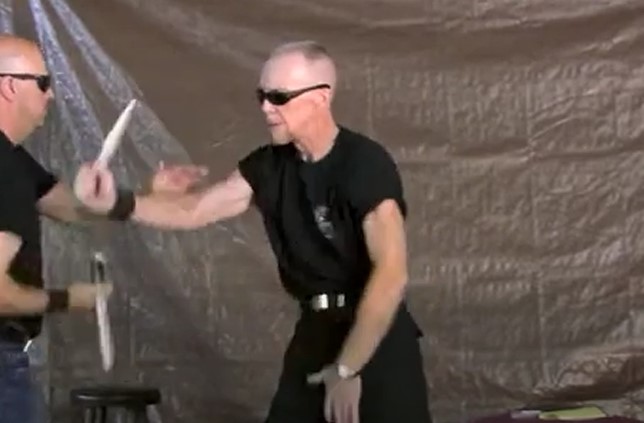
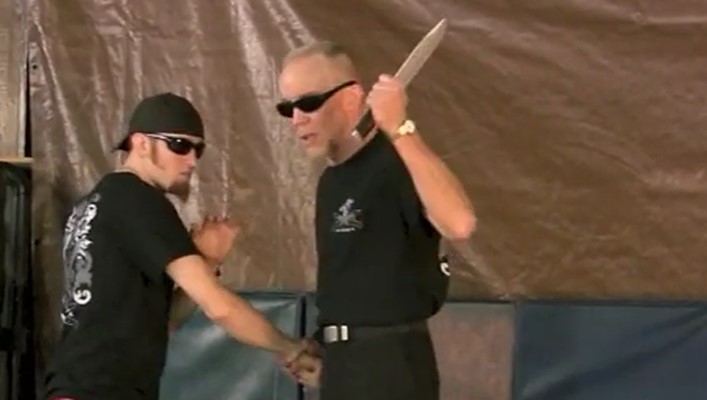
Knife trapping also reveals the importance of the free hand or live hand. In many dojo, this hand is taught passively, left floating or wagging while the dominant hand leads. But that is folly. In weapons work, especially close-in, the live hand is often the hand that saves you. It checks, traps, interrupts, and clears lines for the blade or the body to enter. The sinawalli patterns of Kali or the flow drills of Silat offer excellent training here. When the checking hand and the blade hand work together, each reading pressure and offering structure, you’ve begun to move from technique to principle.
Of course, none of this is useful without grounding in the body. As we teach in Aikido, the wrist cannot succeed without the hips. Likewise, in trapping, you must train the torso, the knees, the eyes. The body must know how to sway, drop weight, hollow out the centerline, and flow. And, as Master Keating stressed, peripheral vision is the best way to track motion.
There are also lessons of humility here. Trapping can fail. The knife can still cut. And it will. But the practice of trapping builds survival geometry: the ability to intercept, redirect, and preempt a moment before it becomes lethal. If Aikido offers the principle of not being there, trapping offers the principle of still being there, but already in control.
What Master Keating gave me, and what I try to pass on, is not (just) a set of tricks, but a way of thinking and seeing. Trapping is a kind of interview: you touch the limb and ask, “What do it do from here?” And if you’ve trained the line well you will already be ahead of the answer.
So yes, trapping is fun. But more than that, it is revealing. It reveals your balance, your fear, your bias toward force or retreat. It makes you honest. And it sharpens your structure so that when the knife is drawn you do not meet it with panic, but with presence.
Train slowly. Build structure. Honor the path. And, when necessary, be the stillness at the center of motion. Shizentai at the axis of the encounter.
__________________________
“Knife Trapping” By J. Keating
I’d like to share some thoughts with you. They revolve around the concept of what is commonly called “knife trapping”. Meaning, to trap or immobilize an adversary’s limb(s). This concept is not popular with everyone in the combat-oriented knife community, martial arts, military, etc. On the other hand there are several “experts” who give knife trapping a thumbs up. So the panel is divided so to speak. Those people who prefer trapping usually include it in their overall curriculum. Not as a panacea for every violent encounter one comes across. But, as a means to realize a wider spectrum of combative play. To employ trapping as a developmental vehicle as well as a combative vehicle is part and parcel to our goals. But, the developmental side of trapping is what we truly seek. For trapping skill turbo-charges your knife! A knife is a “force multiplier” it absolutely outstrips the empty hand on every turn. A knife makes any motion you choose to employ into a damaging, maiming action. Motions that would carry no authority what so ever in the empty hand world of fighting suddenly become highly effective with a knife. Thus is the nature of the blade. Some men learn of its mysteries early in life, others resist them out of fear. They learn of the blade too late to assist them in life. It’s my belief to eschew none. Each method and each master has a certain something to offer you. So, I give you knife trapping. For fun, for fight, for fears in the night
General Principles Revealed
In this section I decided to list some of the general principles of trapping with a knife. Also I’d like to address some questions which are often asked about knife trapping.
Lastly let us attempt to dispel any of the ridiculous myths/lies often heard about this skill. We’ve got our work cut out for us, let’s get to it! The Combative Goals: As easy as 1, 2, 3! To possess the ability to rapidly assault an aggressor and to momentarily control their actions. Applying the science of levers and limb manipulations (the mathematics of combat) allows one to dominate the limbs and weapons of the opponent. So our combat priority is to deal with the bad guy’s limbs, those are the thing’s which can harm you.
What we may call the normal target areas (IE: Neck, face, solar plexus, etc) become secondary in priority. Trapping is used to capture, control, interview or to simply save the life of your opponent. Indeed the aggressor will be wounded, but not in a life threatening manner (hopefully). Total de-animation of the subject is possible as a later option if so given. Trapping can lead to capture, death or wounding. It can lead to you escaping from a possibly terminal encounter. The realm of close quarter knife fighting is the most severe range to operate in. It is the absolute, sole domain of the experts and the crazy. Yes, it is that lethal. At close range one separates the knife men from da knife boyz quickly.
Developmental Goals: Beyond the fire for what you desire! Ok, this is the part where we trade in our war helmets for our thinking caps. Developmental training with knife trapping is a blast. It enables you to have fun as you accomplish your loftier goals. By learning the secrets of trapping you also learn “how to get around” the human body.
Being such that an opponent has two limbs there are only so many ways they may attack you. These doors or gateways area known aspect of human behavior. If you have a working knowledge of these doorways gained from developmental knife trapping you have a huge edged over others! It is simply logic, math and a calm mind amidst a whirlwind of hacking horror. You may start after the opponent, but you will always arrive first. Body mechanics become highly refined during developmental knife trapping exercises. Trapping polishes not only the lighting fast actions of your hands, but the even faster actions of your own mind as well.
3. Hidden Benefits: Unexpected gifts and reality shifts
Knife trapping is a skill that leads to its transference to others areas of endeavor. For example, if you are a boxer, knife trapping will certainly add depth to your overall abilities. If you are a smaller person I can assure you that developmental training in knife trapping will double your abilities to cope with larger adversaries. In fact your mental state will be clearer too! It must be in order to grasp the essentials of knife trapping and to employ them adequately for your goal at hand. I see math being the root of trapping.
Others see it through there own filters. It is hard to describe the hidden perks one experience’s through the honest study of Knife trapping. They are unexpected little gifts and acknowledgements that let you know that you are following the correct path. Watch for them. Ok, I think you have the idea now!
Commonly Asked Questions on Knife Trapping
Q: Does knife trapping really work in combat? I mean like could I do it?
A: Yes, it does work in a fight. But it is used selectively. Not as a combat cure-all
Q: Isn’t knife trapping too dangerous for actual use?
A: Only if you have not learned your lessons well. Don’t blame the tool for your shortcomings.
Q: If trapping is so good, then why haven’t I heard of it before now?
A: Knife trapping is not a common skill. If it were easy then everyone would do it.
Q: Knife trapping is too fancy. Isn’t it really just pretty motion for martial arts nuts to play?
A: On the contrary! Those who lack an attention span, those people who are overly aggressive all find learning knife trapping to be quite challenging. So, they mock it and deride its benefits out of their own inability to cope with the art or to learn its secrets. Bluntly speaking it intimidates the hell outta them, thusly they rage about it being “too durn fancy”. An old fable indeed propagated by the weak to keep the strong from getting stronger.
Q: Knife trapping looks so “structured”. How could it ever work in a fight?
A: The structure is merely there during the learning phase. It should be cast aside once you have grasped the essence of the game. Then it becomes a “catch as catch can” affair. This is where a person must be able to release the studio teaching structure and directly access the heart of that particular moment and encounter. The zen of the “now” is what we are seeking and allowing its energy to guide us. A mere touch to a knife trapper can tell him a vast amount of things about whom he is facing. Knife trapping is a wild, untamed thing in natural form.
Tidbits of Trapping
There exist many misinformed people who pass along misinformation as if it were truth. This is done for commercial gain, personal vendetta and desperation for recognition. The lies told about trapping often become transparent in the harsh light of reality. Even more so when the lies and the liars are simply confronted by someone who truly knows the craft of knife trapping. The depth of ignorance shone by the scoffers shines forth on every side. No physical encounter is required. One considers the source and moves on. The world is comprised by those that “have” and those that “have not”. Here is a myth: Knife trapping takes years to learn and master! Ah-ha another common whine! Guess what? So does Tae Kwon Do, carpentry, auto mechanics and calligraphy! What’s new? To say knife trapping takes too long to learn is simply the nega-speak of a terminally weak personality. Such whiners are many, ignore their bleating and advance scholar, and advance to the next level!
Devices such as adequate wrist bracers (armor) can add a great deal of dimension to your confidence and skill. If you are wearing light armor you have an even greater chance of success if you attempt any knife trapping manipulations. If you can trap and cope with
Unable to load the shape the hi-speed world of knives, then it’s a cinch you’ll be ok in the lesser world of the empty hand. Why even against multiple opponents knife trapping can be a most helpful skill. To relegate it to a one on one type fighting method is to certainly short change it. Knife trapping is swift, agile and ideal for dealing with several opponents at once. Armor is passive defense. Explore it. Many people do no know where or how to touch the adversary properly in order to create the proper atmosphere for knife trapping to occur.
Have ya ever noticed that the arms on a mookjong (a Wing Chun wooden dummy) are short? They are meant to replicate not the whole arm, but only the upper part. This upper forearm area is called the humorous. It is this same area that a knife trapper must strive to touch and control. By controlling this area one may move, control and dominate the opponent like someone twice the size and strength could. Add the special spice which comes from a dash of well placed steel and by god my friends, you’ll be pleasantly surprised at what a great exponent of knife trapping you have become! Touching the right spot can make or break your chances of victory in a fight. Without knowing, refining and possessing a certain degree of ability in trapping, a knifeman can greatly reduce his overall tactical profile. The trapping provides the knifeman much needed sensitivity. It is sensitivity that saves your butt in knife fighting, not callousness. Pressures are what we “read” or sense with our hands and forearms during close quarter fighting. When you take trapping skills and blend them smoothly with Kalis (or Amis) sinawalli patterns then the intricate blade work becomes much, much more manageable. It is at such a moment when all things magically synchronize that you’ll know that knife trapping is fun, beneficial and effective for you! In this phase, you will dig even deeper, catching nuance here and there…. until the immobilization skill is yours completely. Be sensitive to all things, walk lightly, save lives when possible… after all, you are now the dreaded “fang in the dark”.
Are you not? Aye. Go ahead, wash yer hands, it will never come off advance scholar, advance, but do so slowly, with caution.
ADVANCED KNIFE:
An “In-Close Dose” to Ponder Howdy all! Many are the ways of the path of steel. Regarded as myth and rumor less than twenty years ago, now the schools of the blade flourish once again as in days of olde. Such is my dream realized and the path I carved out true. I profess that the longer range methods based upon some form of fencing are by far easier and faster to learn. The truth there is that only one hand is required to wield the weapon. It is lithe-grace and evasion mixed with fire-hot attacks and setups at this range. As far as the close quarter methods of blade work go I profess that they are harder to learn and take more time to absorb. In close-quarters it is checking hand, upper forearm control, sensitivity and flow. Neither is what we’d call “superior”. Both ways-methods are needed in ANY encounter where steel is going to be present. To be solely a long range guy or ONLY a close range fanatic is so backward! You can have it all friends! Prescribe to nothing (styles, schools, etc) save the realities of the range yer in and the specifics of the spate itselfl “Favorite” anything’s that people get attached to often get them killed. It makes you too limited, too specialized to that “favorite thing” you are comfortable with. It creates a narrow base. Be skilled in many ways, have knowledge that’s broad-based.
Know how to make anything that falls into your hands into something your enemies will dread and then fall dead. Keep an elevated mental perspective riding shotgun over the entire mix of mayhem that is now called “YOU” lest the charm and the heady-appeal of being a real knife-man ends up getting your romantic badass self killed. (Think Zorro and his sword – But see Al Bundy armed with a spork). The motto for the modem man of steel today is simple: BECOOL! Meaning stay calm, leave that knife be, smile and shift your weight, but at all costs be cool. Yeah I hadda explain that one otherwise there are some knife people who’d be combing their greasy hair, wearing blue suede shoes and dark sunglasses attempting to be “cool” cause Uncle Jim tolt’em to! Oops! No, no, fool, NOT that one, the OTHER cool! Ha Ha Ha! OK, let’s move on and cease the vitriolic frolic! We’re hunting for metallic meat and this lad’s hungry for more. C’mon, jump in and follow along with me, there’s plenty to go around. Sumbrada Range – In-Close / The Dynamics For everything there is a reason, for everything there is a season. So true! Taking this knowledge and running with it we come up with nothing less than the list of critical components needed for successful close quarter knife training and fighting. In other words what season are you in? What’s needed to win this conflict? At the top of my critical component list is the ever-faithful checking hand! The mano of surprise that’s known as the “live hand” is my recommendation to invest in learning about. And to those upon the path of steel there is nothing more valuable than this strong, deceptive ally to have fighting upon one’s side. TIMING, oh my how I could write about timing! For hours and hours I could expound upon timing, for therein lie many secrets and truths. The LIVE HAND needs timing to be victorious. To enter a swirling sea of sharpened steel objects and come back out of it unscathed is to possess true timing. To do so and then inflict pain upon, take control of and eventually vanquish the foe is also part of the live hand checking hand duties. Oh yeah, a multi-function doozy of a tool that really works. Hey, in the Comtech method it’s why we add a dose of Wing Chun and Silathand skills into the mix. It continues to sophisticate the live hand well past the standard stuff taught in most Kali and Amis schools. Remember, broad based knowledge and abilities that blend and cross-train well together are the keys to personal training dynamite. Let’s get on with more insider tips about getting your two mitts up to speed for knife play !The hand itself is where we begin your education, hand-palm, back of the hand, fingers, grip. Get used to employing those parts of the hand in the early stages of Sumbrada, Hubud, Punyo Sumbrada and pallasoot. These exercises teach us the crucial timings, the placements and the pressures required to steal victory from steel. Yeah sure, you must also know the knife related parts of those drills too! Ha Ha! Of course, done at the right timings.
Remember, that’s what this is about eh? I’ve met several people who can do the drills quite well. But, only as done with the actions of the knife, the checking hand work is weak! Sometimes non-existent even! So it appears that some people focus too much upon the knife rather than the creation of a balanced blend of equal abilities from either side.
Balance, timing, rhythm and coordination. These things to seek are good and proper. They work for you through-out your life in many ways. Their cultivation is what the wise player of the knife seeks. And remember gang; deal with low-line attacks with a palm up check and the high-line attacks with a palm down check. This is important, the positionings of the hand as per the line of in-coming attacks are taught, ingrained and mastered via the drills and exercises I mention in this article as well as being covered in many of my current DVD’s! Checking hand skills revolve around this palm up or down key principle. For more on these aspects of the checking hand come see me and let’s train
Unable to load the shape or find a qualified teacher that can help you sort this shit out. Either way, it’s learn or burn baby! The better you are the better the chances you’ll survive. Be trained or be chained. As we move up and into another yet closer range of play we come in to the realm of the lower forearm. Mainly the back side of it, the meaty top side, yeah that part! From the wrist up to about mid-forearm is our new area of contact. No longer the hand(s). This manner of checking requires some cool body mechanics and some real sensitivity. but man, when you get this under control, it works and gives you a real advantage over others in the lethal killing range of close quarter knife. You may get cut pilgrim, but by God they’ll get worse! Adding some Pikiti Tirsia counter knife passing into the mix really sophisticates things even more. It focuses upon this area of contact more-so than other drills. Play about with it some, have fun – relax and by all means don’t play fast or furious when training. FLOW… a steady eddy rhythm of motion that is neither too fast nor too slow. Smmooooth, think smooth! Play on playah! The Kali “Thrusting Triangle” exercise from Kali is another checking hand drill that increases skill rapidly. Plus it has value on the street immediately. Double benefits. This drill can be compounded nicely by adding other components to the existing shell. Grip aspects can be dealt with, half beat strikes can be entered in time, disarms can be sought. etc, all via the Thrusting Triangle drill matrix. Yes, have this in your arsenal of skill building tricks that help you grow and to know the flow. The Body and its Actions The knife or the live hand cannot succeed without one another in the close interval realm. This we know. These two aspects together cannot survive without the addition of certain motions of the torso, legs and hips. These actions (body mechanics) are accomplished by first bending the knees. Then practice swaying the torso (spine) side to side, leaning back and hollowing out the lower body area. Similar to what boxers do, but done more dramatically one might say. This material should go with the live hand and knife skills because it is the stuff masters are made of. Impossible saves, daring strikes and real control come from having your body (torso) in league with your knife and checking hand pressures. This of course connects to footwork and the different methods therein etc… Soon we will be past the topic all together and into something related, yet totally new. So these areas will wait for another time for discussion. Lastly for this segment I must tell you that in such hi-speed close quarter ranges I want you to always use your peripheral vision. Look slightly away from the action, use the outer rings of your eyes to see the nearly invisible motions that hi-speed combat promotes. This trick is one that many hunters know about. They use it at night or in low-light conditions. You see movement better; particularly you see high-speed movement better when using your eyes in this way. And for us that’s a plus! Practice “Magic Eye” (the children’s books) to get your vision abilities sharper for the close quarter knife encounter that I hope you never have! These books get you into a way of alternative vision like nothing else out there. Valuable they are to the knif man of today. We learn from many sources, we never stop learning, if you do stop in this business of the blade, you die. Pressures, Surging, Effortless Power OK, from our work we now have many sensations, sensitivity and intuitive tactics that aid our technical abilities. Contact is part of the CQB Knife territory. This is all about sensing pressures aka “intent”. Then “reading” that intent and being one step ahead of the other guy comes next. Oh yes, it’s a real skill. It can be yours. If you already have it, then it can be rediscovered in a new way. One of those “new ways” I speak of is the employment of surging power. You see the internal arts use this type power in situations where a conventional blow wouldn’t be effective or appropriate. Usually this is done in close proximity with the opponent. Ah yes, therein lies the “connection”. When checking hand or the forearm contact points are employed a surge of power can be expelled via those contact points. By surge I refer to a type of shudder or shiver. This is done explosively – anyone who ever knew of the great Chen Man Cheng (TaiChi) and his ability to literally “blast” people off their feet knows what I mean. Many Tai Chi teachers can do this, so it isn’t some arcane secret technique. All it takes is some practice and getting a knack for how it’s done. Then adding it into the already existing mix. By an act of your will, you simply begin doing it in training, when appropriate, in time, in flow.
Soon that shocking blasting power will be yours. Indeed, now the live hand truly gets more sophisticated as per our plan! What a surprise it is to see such skills blossom so quickly. It’s the nature of their mechanics. Hey Man, Get a Grip! The checking hand (live hand) must be fast, well timed, in flow and sensitive to change. But it also needs strength. Yes, good old fashioned grip strength. Hand power that is used to catch and control an opponent must be deft, sure and dog bite strong! A product called the “SZABALL” from Laci Szabo is an ideal way to get such grip power. http://www.szaboinc.com The talon like hand ability is really cool when used to sort of “sweep down” upon the opponents wrist and BAM! They are caught in a vise-like grip from hell, from there; well … end the fight mate! What else? Never attempt to catch a swiftly moving limb with outside edge of the hand… fast things defy being caught when you try to snag’em in that way. Instead, use the inside part of your arm, this produces a thumb-side catch. And lucky you, in this way one can indeed catch and control a swiftly moving limb! Whether the boxers jab or the knife man’s slash you will catch their limb. This inside line, thumb catching method is from Kung Fu. I demonstrate this very thing in a skill developing drill in one of the upcoming DVD’s (The Desquerdes) that Pete Kautz and I recently shot while on location. It’s a cool little drill that really helps you get the hang of it. Now your old level of “fast” just got “faster” because of this wee bit O’ knowledge about using the thumb to snag a punch. Never forget that, you know the old gunman’s saying, it goes like this: “bullets don’t save lives, tactics do” A true saying it is! OK, one last item I might mention that even further sophisticates the knifeman’s live hand abilities is the employment of an advanced gripping method. This one takes a bit of practice, but oh man is it worth it! The surprise on people’s faces when they encounter this amazing grip is always funny to see. In some forms of Kung Fu it is known as “que sao” (Cue-sow), it is also seen in Kenpo as part of their signature hand. Aikido recognizes this technique as one of the Master’s favorites known as “Yonkyu” and they add a twist to it making it even more painful. (Hell, I even used the Que Sao hand as part of my logo for my ACE programs (Accelerated Combat Efficiency)! Why not try making this hand position now? Make a normal palm heel strike, curl all fingers into a fore-knuckle fist (leopards paw), now extend the index finger and slightly hook the thumb. That’s it! Ya know I don’t expect you glom onto this stuff immediately. It takes some getting used and practicing.
Get some hands on training via a reputable teacher, it helps! This unique hand skill uses the palm side of the index finger knuckle as the pressure point to focus the power that makes adversary’s wince in pain. Those who’ve encountered my own skills with this unique grip during knife training sessions have felt this odd power and know of its veracity as a viable venue of vengeance via the live hand skill base. Again, this is an odd thing, but it’s not really that rare of technique at all as you can see. Many styles share the same secret and they express it in many ways. Some similar and some differently.
Express your own way too and ya gotta remember that “it’s sharp out there baby!” So play it smart. and always be cool! Conclusion: Some Extra Tactical Insights In conclusion, in order to help you gain a bit more tactical insight I shall list a few aspects you can ponder over. Small stuff really, but each one layers in well with what’s already been covered. In training apply the checking hand lightly. Always be able to goose it up and hit harder. But, not in training! Know the positions, is your hand turned inwardly exposing the little finger side only. Good if it is, that is a great way to check safely. If it’s more like a conventional “grab”, where the thumb and index finger are leading then use caution. Yes, you must do this to catch their wrist – if that is your goal. But if it is not then you run the risk of having your thumb broke under a heavy, powerful attack. KNOW the difference and purposes behind the hand positions, adjust to each as you see fit. Once in a while try to break rhythm, change up. Move to out range and then back, restarting whatever the drill you were doing. It will add a “fight-like” dimension that was not there before. Does this as you get better, but not initially. From the outset, designate which person will be doing this next exercise (Uke or Tori). Basically set forth who wins and who loses. Now, begin an interactive drill where both knife and checking hands are in play. Now, the “winner” gets to smoothly break flow and execute a finishing move. Foot traps, levers, knife or strikes are all allowed in this short burst of movement. Now, the rolls reverse, the other side gets their tum to execute a flow of motion. This begins the integration of “rehearsed flow” with “real flow”… free form. The eventual goal being to “free-form” more and more, like real life – an impromptu explosion – dealing with the unknown successfully.
J. A.
 Protective Arts