Aikido is like Latin: a dead language. To revive it, first learn its grammar.
And like Latin, it still exerts power—through law, theology, science.
Aikido is an art of commitment. Hesitation corrodes.
Until one is committed, there is hesitancy, the chance to draw back.
Laughter relaxes the body. Relaxation signals safety. Can one laugh and strike at the same time?
Excellence is cultivated only in the body. Pressure testing drives the art into the hara. Like mochi, the body must be pounded into form.
Aikido is the cultivation of excellence. The art is embodied physically- the stuff of soma. It has to be pressure tested and forced deep. Tanren-geiko is the only way I have seen it manifest.
Tanren-geiko is the forge. Without it, the art dissolves into gesture.
Because this is a physical art it is embodied physically- the stuff of soma. It has to be pressure tested to become forced deep in the hara – the center of movement. I was told the body had to be molded like mochi pounded into shape. Tanren-geiko is the only way I have seen it manifest.
The spirit is purified through hard work – misogi – that is the way.
The importance of seriousness in training cannot be understated. It cannot be spoken or transmitted by words alone.
Tradition is preserved not only intechniques but in stories. Memory is the hidden technique.
You are following a tradition and to stay connected to that lineage you have to know the stories. Those collective memories provide your cultural heritage.
Without a center, an acephalous dojo drifts into haze.
Inspiration: to breathe into. Aikido now breathes with difficulty.
I did not train with O-Sensei, but I trained with his son and grandson. Transmission is a chain of bodies, not of books.
It was not O-Sensei who codified technique. That task fell to Kisshomaru, Saitō, and the post-war uchi-deshi. The war swallowed the rest.
The wonderful work that Josh Gould is doing with preserving the biographies of the pre- and post-war instructors showcases the depth of instructors who really developed the art.
To transmit Aikido is also to transmit pedagogy. Yamaguchi, Chiba, Yamada — their vigor is gone.
I am hyper sensitive to the impending sense of loss in the world of Aikido. I have watched the luminaries of the art dwindle and die.
My generation failed to inspire. The art offered neither martial competence nor spiritual enlightenment. A poor product, or a poor market?
Despite her family’s multigenerational ownership of a temple in Japan – Yoko never taught or spoke about the spiritual history of Aikido – she told me years ago she would sit zen only when she was old. Spiritual development was in the art – moving zen.
To disguise incompetence as spirituality is fraud. Weakness is not a virtue.
I have a visceral reaction to highlighting spirituality to compensate for the lack of the instructor’s ability – spiritual growth is not a panacea for physical incompetence.
When the student is ready, the teacher appears. When the student is truly ready, the teacher disappears.
Tao Te Ching was part of the inspiration for my pursuit of Aikido and as much as I like the sentiment of the quote – and time has taught me it is true – it always seemed to be an excuse. Over the years I have tried multiple pedagogical approaches to transmitting the art. The most honest approach for me is a “coach” because I cannot be a guru – my New England reticence and sardonic mocking of cultism wouldn’t allow it.
Time teaches that sentiment is not structure.
Aphorisms are not conclusions. They are stepping stones. Each must be tested in practice, hammered into the body, or abandoned.
And of course, I could not resist my own commentary for each.
In a prior article, I explained ikkyo and irimi-nage arise from the moment of contested weapon access—the effort to draw and the counter-effort to suppress. The last Saturday weapons class continued that line of thought, focusing more precisely on ikkyo and nikkyo as a means to draw the katana in a contested encounter.
Protecting the katana from an opponent directly informs empty hand techniques. In short, technique is tactical.
I repeat, with some additional observations, my previous explanation:
Ai-hanmi katate dori ikkyo ushiro tenkan
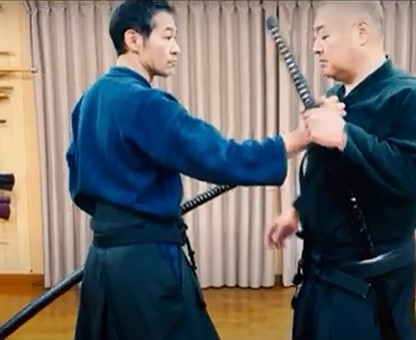
The encounter starts because uke attempts to grasp nage’s weapon that is held by the obi (belt) on the left hip. (Because warriors are right handed, this is a RvR encounter, but train both sides for bi-lateral development.)
In response, nage withdraws the weapon handle, thereby removing it from uke’s grab by turning the left hip while using the left hand to pull the saya vertical and tight to the ribs, and making a small step ushiro tenkan. Uke then orients to take nage’s right hand – the only viable target once the handle is out of reach.
Nage cams their grabbed arm – elbow down, shyuto rotating inward – which defines the axis of the encounter where uke’s need to keep contact (lest nage immediately deploy the weapon). Nage’s shoulders must be soft and allow uke the illusion of a possible pin of the sword-drawing arm to nage’s chest. Nage must keep the armpits closed; do not try to keep uke away: invite the attack. At the apex of the turn nage’s grabbed arm will touch their opposite shoulder. From this point nage extends their fingers along the vertical line – absorbing uke’s pressure without contesting it. This will ensure uke’s elbow is moving vertically upward while their balance is being drawn forward. Keeping the grabbed hand as a static point, nage can use their left hand to control uke’s elbow and execute a controlling cut through uke’s center (direct attack to the head – shomen).
This narrative could be expanded to describe nage using their left hand to feed the saya up so as to place the handle into their right hand, which would allow (with a drop of nage’s hip) drawing the weapon and use it as an inducement for uke to move (as the blade rests against the back of uke’s neck).
But the further refinement is to understand what Okamoto sensei calls the “invitation” – nage must not move faster than uke. Uke must remain “interested” in the original intent: grabbing the sword (or the secondary target, nage’s hand). The difference I am explicating is one of timing. This is the ai-ki, the blending of timing and intent.
While the gross rusticity of the movement is to first prevent an opponent from taking your weapon, and secondarily drawing it even when the opponent has some physical control over a portion of your body, ikkyo ultimately is a lead and a capture. Once the movement is mastered and the practical use of the technique is understood, the next level is to find the connection in action.
Ai-hanmi katate dori nikkyo – direct
In the continuation of this exploration, nikkyo is no longer a simple wrist lock, but a derivative of a contested draw.
Where ikkyo starts with nage tactically removing the handle from uke’s grasp, nikkyo starts with nage drawing. Uke protectively arrests nage’s drawing hand (stop hit), uke forcefully intercepts the right hand at the moment nage has grasped the handle to draw.
At this moment, the technique is simply to use the handle as the short end (load) of a lever, where the grabbed wrist is the fulcrum and the back of the saya is used to deliver the effort – a first order lever. The mistake most students make is to forget that the sword is the tool, meaning students try to push the handle forcefully through uke’s wrist, forgetting the mechanical advantage of the handle (not their hand) as the load moving end of the lever. We get trapped by thinking the grabbed hand does the work. Once we understand that the encounter created an opportunity to use a lever, the crushing effect of nikkyo manifests.
Of course the subtle integration of the entire body must follow the gross mechanical advantage. Nage will employ a small withdraw, circle of the handle to gain positional superiority (above) uke’s wrist, and then turn his hip back so the handle points directly at uke’s center. Once properly aligned, nage must lift the saya up (dropping the handle down) and simultaneously shift his weight down and through the right thigh.
Once we understand precisely how the sword while in the saya creates mechanical advantage, we can extrapolate back to the empty-hand encounter. The shyuto of the grabbed hand is the handle and nage’s forearm is the saya. Consider the empty hand encounter where uke grabs nage’s wrist – in response, nage pronates his elbow inward toward the centerline, which then orients the shyuto vertical and above uke’s wrist. To do so, nage must move around the fixed point in space defined at the moment uke grabbed him because that point is the fulcrum.
Nage’s shyuto – is strengthened by spreading the fingers (expanding the space among the metacarpals) and then is levered over uke’s wrist when nage aligns his body around the fulcrum. With the right hand fixed as a pivot, nage’s left hand reaches across to reinforce, trapping uke’s hand to prevent uke from escaping the fulcrum. From here, nage drops diagonally backward and down, drawing uke slightly forward in a motion they cannot resist without losing their center. The purpose is not pain. The purpose is to freeze uke’s control over the draw and replace it with your own structure.
The structure of the wrist joint is the target, but it is a time interval that nikkyo truly captures. Uke’s attempt to control becomes their undoing.
Nikkyo is weapon retention by interruption. Where ikkyo removes the weapon from danger and leads uke’s energy forward and up to culminate with a draw and cut, nikkyo stops the attempt midstream and shatters the path of control with a trap. From the trap the draw can be completed with uke still on the arm.
It is important to understand then that nikkyo does not exist in isolation: like all Aikido techniques, it is contextual. Nikkyo can only occur when uke has latched on and is attempting to control the drawing hand. And it only works if uke remains interested in that control.
This is where Okamoto Sensei’s concept of “invitation” returns with new clarity. Nage must not move faster than uke. If uke loses interest in the draw, or shifts intent, nikkyo will not arise. The blend—the ai-ki—is in keeping uke’s attention on the hand that no longer holds the weapon, while their own spine becomes vulnerable to destabilization.
This requires not superior timing, but rather equal timing—interlocked timing (ki-musubi)—and from this interlock, structural advantage is extracted.
Once this functional origin is understood, nikkyo can be seen as a tactical necessity. In close quarters, it is the method by which the opponent is frozen long enough to reclaim your weapon—or to complete the draw with safety and control.
The ultimate training refinement is not in the pressure applied to uke’s wrist, but in the clarity of timing and the exactness of axis control—not suppressing uke’s action, but letting it complete itself on your terms.
Once the movement is mastered and the tactical value of the technique is understood, the next level is to find the connection in action.
____________________________
Additional technical considerations for nikkyo:
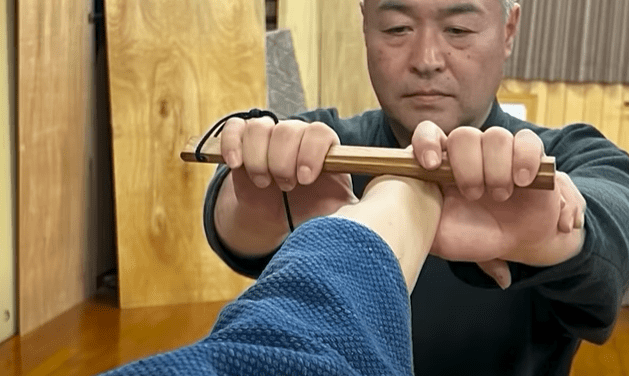
Review how the handle can be grasped as a lever-lock like any tessen or kobutan.
An excellent visual and historical aid to study for deeper understanding:
“Similia similibus curentur.” Let like be cured by like.
— Hippocrates (attrib.), echoed by Paracelsus and Galen
This principle, later adopted by homeopaths and ridiculed by modern medicine, remains as stubbornly persistent—and surprisingly insightful—as any ancient folk wisdom. You’ll find it not only in medical aphorism but also in the logic of sympathetic magic, as described by James Frazer in The Golden Bough: the belief that a small token of the harmful thing itself, properly administered, holds the key to healing (or beating the electric chair).
Pliny the Elder advised rubbing the ashes of a scorpion’s head into a scorpion sting. Ancient warriors smeared bits of rust from a cursed blade into their wounds to “pull out the evil.” The practice remains in common parlance after a hard night of drinking – the origin of “hair of the dog” is a contraction of:“Take a little hair of the dog that bit you.”
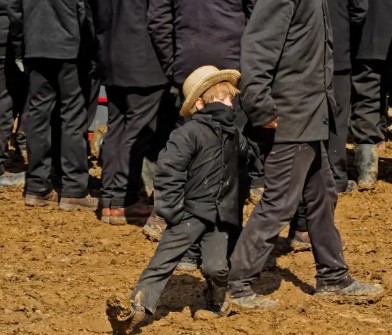
Perhaps we should not readily dismiss the idea, which as new scientific grounding, thanks to a series of elegant studies by Carole Ober and colleagues. In a 2016 New England Journal of Medicine article, further developed in a 2017 review in Current Opinion in Immunology (PMID: 28843541), Ober showed that children raised in traditional Amish farming environments exhibit dramatically lower rates of asthma and allergies, not because of their genetics, but because of their proximity to barns, animals, and microbial richness. Amish houses are full of what the modern world tries to eliminate: dust, dander, endotoxins. Early exposure to these allergens stimulates innate immunity because the exposures are mild, daily, and nonlethal. The immune system is not overwhelmed, it is trained.
This maps directly to what I described in my article Pain as a Teacher: the principle that adversity, in measured form, builds capacity, calibrates response, and teaches discernment. A student who has never been hit flinches at every feint. A child never scratched by the world develops allergies to life itself. Biological snowflakes.
We learn through discomfort and become more capable through experiencing it. A protected immune system, like an overparented child or a poorly trained fighter, becomes reactive, oversensitive, and prone to catastrophic overreach.
Frazer divided sympathetic magic into two laws: contagion (things that have been in contact remain connected), and similarity (like affects like). Both are at play in Ober’s study. Contagion: Amish children are constantly exposed to barn dust; particulate microbial DNA, animal hair, feed particles. Their bodies internalize the environment. Similarity: Their immune systems are challenged by irritants that resemble pathogens but do not overwhelm. Like trains like.
What is immune training if not the biochemical form of sympathetic magic? I use a similar logic in my classes when I provide demonstrations of bunkai and a staccato rhythm that punctuate demonstrations of ki-no-nagare. Expose the child to dust, and the body learns not to overreact to pollen. Strike the student gently, and he learns to defend against a real blow.
We laugh at the ancients for believing in healing relics and ritual bloodletting, yet it informed our modern immunology. We inject children with diluted toxins in a controlled modern ritual. We haven’t abandoned the logic. We’ve only changed the priesthood. This is not just a medical insight. It is a moral one. In every domain, education, parenting, politics, personal growth, we face the temptation to sanitize and protect. But the lesson from Ober’s research and from martial training is the same: overprotection breeds fragility. Controlled adversity breeds resilience.
Just as dust can inoculate, so too can pain, difficulty, and fear become allies in our moral and physical development. We do not conquer them by avoidance. We master them by exposure.
Ex malo bonum“From evil, good”[1]
_________________________________________
[1] Of course there is a footnote and a play on an old disagreement.
Seneca the Younger’s gave us the original dictum (from Epistulae Morales ad Lucilium 87.22) Bonum ex malo non fit, “Good does not come from evil.” His formulation is classic Stoicism; holding that virtue is self-contained and cannot arise from vice or wrongdoing. An evil man cannot do good acts. For the Stoics (which deeply informs my New England Pathology) the moral universe is a realm of intrinsic rational order, and any claim that good could arise from evil would imply that vice is somehow productive, which undermines virtue’s purity.
That reformed libertine, St. Augustine argued the opposite (in part no doubt to justify his own behavior). In his Sermon LXI (61) he offers a pointed and deliberate contradiction of Seneca’s conceptualization:
“Et hoc bonum est, ut ex malo surgat bonum. Non hoc dixit Seneca. Philosophus erat, et dixit: Bonum ex malo non fit. Et ecce fit: non ab homine, sed ab omnipotente artifice.” (And it is a good that good arises from evil. Seneca did not say this. He was a philosopher, and he said: ‘No good comes from evil.’ But behold, it does: not by man, but by the omnipotent craftsman.)
St. Augustine’s argument is theological not philosophical. He needs to demonstrate the power of redemption. The cross as the ultimate evil turned to good. The crucifixion as salvation.
I must admit, my younger self rejected Augustine’s arguments as too apologetic, too philosophically weak – “God judged it better to bring good out of evil than to suffer no evil to exist” – really? The whole enterprise of The City of Godwas silly. Why allow the Fall only to provide for the greater glory of redemption? A righteous clockmaker would simply make it correctly the first time.
Yet watching humans be human, I can only conclude we gotta learn the hard way. So perhaps St. Augustine was on to something.
____________________
Update 10/20/25
A 2015 study published in the Annals of Allergy, Asthma & Immunology concluded that there was “emerging evidence … regarding potential benefits of supporting early, rather than delayed, peanut introduction during the period of complementary food introduction in infants.” In short, early exposure to allergens was recommended.
These recommendations must have been broadly adopted because following the publication, and well reported by media outlets, were the results (this from the American Academy of Pediatrics): “We detected decreased rates of peanut or any IgE-FA in the period following the publication of early introduction guidelines and addendum guidelines. Our results are supportive of the intended effect of these landmark public health recommendations.”