PERCEPTUAL SPEED

As I grow older, I worry that my vision will continue to degrade. During my last eye exam, my optometrist asked me my age, 50, I answered. “Ah, your eyes will continue to go to shit until about 65 and then it will level out.” Candid, but not reassuring.

Eyesight is very important to me and mine isn’t great. It also impedes my combat-efficacity.

I took my boys to Threat Dynamics to do some interactive simulated shooting and live-fire range time. Threat Dynamics has a 300-degree interactive environment that forces you to engage random targets which can appear all around you. There are auditory signals that clue you in on where they will appear, but you have to orient, observe and react before they disappear. Despite me having far more training and familiarity with handguns, both my boys scored better than I did. My reaction time was as good and my accuracy better than theirs, but my perceptual speed was worse. The targets I found and saw, I hit, but I didn’t see as many as they did.

JKD segments and classifies types of speed. Perceptual speed is crucial to your reactionary time. In order to react to a threat, you first need to observe the threat, then orient on it in order to decide what to do and act accordingly (OODA). What range time reminds me is that I have a challenge with both perceptual acuity as well as orientation (the time it takes to recognize a threat). I also noticed this when hunting sage rats – I wasn’t nearly as quick to spot the varmints as the other hunters – and I don’t think it was simply my lack of experience.

Perceptual speed is probably the single most important type of speed for survival. And arguably it is a deep part of our genetic inheritance. In The Fruit, the Tree, and the Serpent: Why We See So Well (2009), Lynne Isbell cogently argues that our visual acuity results from the need to quickly identify predatory threats, specifically snakes. The hypothesis she develops is that predatory pressure from snakes selected for threat detection, thus snakes were responsible for the development of primate vision which is now our most developed sensory interface and results in the disproportionately large size of the pulvinar region of the brain.[1]

Fortunately for me, perceptual speed in monomachy is not focused on visual identification as much as it is on the detection of motion and intuiting threatening range – seeing furtive movements and understanding combat distance.

In weapons training, I have focused on teaching the points along the continuum of motion to recognize as cues that merit a response. Recognizing those moments requires rote repetition to be sure – practice and more practice to ingrain the pattern and see the openings. But rote repetition needs refinement to learn to see the tsuki (openings). We have focused on finding these moments along the descending arc of the opponent’s sword because those brief time intervals are when possibility expands to counter-cuts, stop hits and disarms.

Learning to see those moments is the focus of training as soon as the pattern (kumitachi) is ingrained. Move beyond the rote and learn to identify opportunities created by the logic-chain.

Once you have learned to see openings, the next step is learning to anticipate them by reading the intention of your opponent.

How does one do that? Don’t fire until you see the white of their eyes!

Human eyes differ from great apes by having sclera – the white surrounding the pupil. This allows us to read each other’s focus – and we watch each other intently, recursive attention: We watch the other’s eyes to see what holds their attention. What do they want? If I know what they want I can predict their behavior. This is a critical social skill to master and we do it reflexively.

And as students of the martial arts, we need to exploit reflexive behavior in others while training/controlling our own. By watching the focal point of your opponent, you can anticipate their target. Hence the corollary strategy of hiding your eyes.

Master at Arms James Keating frequently wears dark glasses. Why?
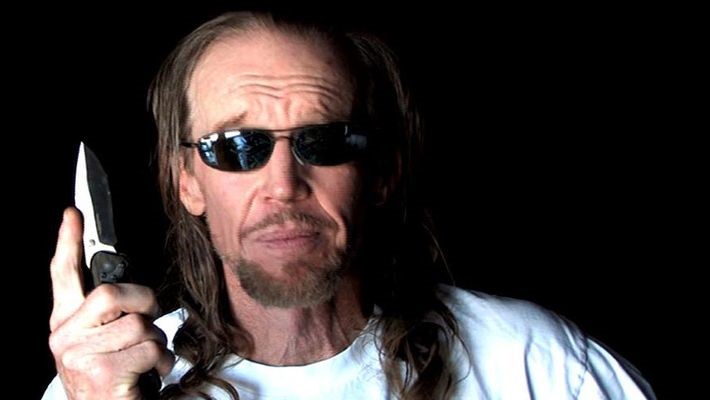
Look into my eyes

Eye-protection during training, yes, but the habit is deeper – much harder to read his intention. Disguise your intentions.

Misdirection is another key skill to develop – learn to look both no where (mushin no shin) and intensively at false targets. By shifting your gaze you can lead an opponent. And you lead by moving your pupil and that movement is transmitted by the contrast of the sclera showing providing the background, the field of movement.

The level of concentration is paramount in weapons training. The physical exertion isn’t as important as the mental focus. Each cut should be a kill-stroke, therefore each cut needs intense visual focus. You see what you aim at.[2] This concentration can be disguised and then used for misdirection.

Play with misdirection. You can do this in everyday conversations to practice. In the course of normal conversation, quickly shift your focus on something behind your interlocutor and watch their reaction. Do they break their focus to follow yours? It’s a game to develop the skill.

The things you do everyday are not mundane – they are of paramount importance! Statistically you repeat these actions the most. So integrate your training into these actions.

______________________________

[1] Inquiry continues to both validate and disprove her hypothesis but I look to two salient facts: Ophidiophobia (phobia of snakes) is one of the most common and intense phobias among the general population and intriguingly, ayahuasca celebrants report snakes as the most common vision. One also could expand the thesis to account for dragons, which are an amalgam of predators of primates: snake, cat, and raptor.

[2] The negative side of this is tunnel vision – focus on the single problem in front of you to the dangerous exclusion of all other input. Once you master the ability to focus on your target, you need to move to the next level of breaking tunnel vision – see the entirety (the Gestalt) of the situation.

___________________________

Scientifically study human perception and Kant’s inquiry of the ding an sich dissolves in the acid test of biology and pragmatics. The very possibility of a thing in itself, not mediated through perception by the senses or conceptualization, can be dismissed entirely. Human perception and reality is comprised of ‘affordances.’ In his Ecological Approach to Visual Perception (1979), Gibson develops the argument that our perception is mediated at a deep level by biological demands. Thus, we do not see a “cliff” but rather a ‘place to fall from’ and we do not see “rock” but a ‘thing that can be thrown.’ This has profound implications. Gone is the Kantian imperative that people are not means to an end, since every object is perceived as nothing more than a tool (a thing that helps us to get to achieve our goal) or an obstacle (a negative impediment to our progress). Consider being at a party with friends and acquaintances. A fire erupts and one time ‘acquaintances’ and ‘friends’ become concrete obstacles that limit your access to the exit. We are built to see the world at a level of resolution to bifurcate our perceptual classification into tools and obstacles (threats). Layer Darwinian selection on this concept of affordances and one must acknowledge that this classification system is a selected survival mechanism. Inspiration >here<
Elite Competition

Sing, Goddess, Achilles’ rage,
Black and murderous, that cost the Greeks
Incalculable pain, pitched countless souls
Of heroes into Hades’ dark,
And left their bodies to rot as feasts
For dogs and birds, as Zeus’ will was done.
    Begin with the clash between Agamemnon–
The Greek warlord–and godlike Achilles.

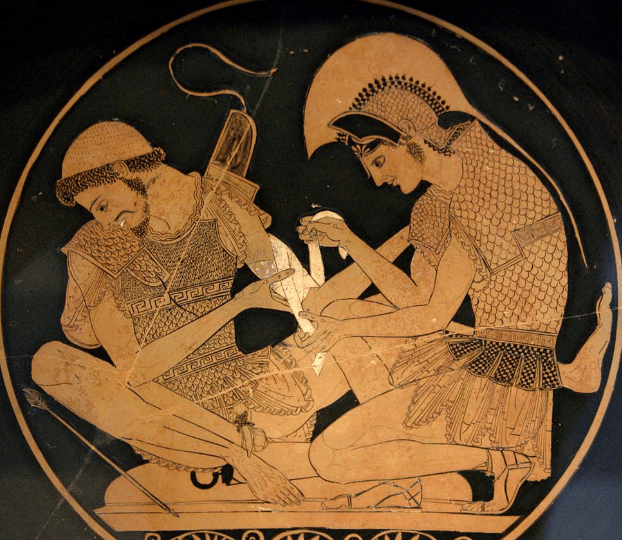
So opens the Illiad. Homer focuses our attention on the combatants: this is an epic struggle between two Greeks, Achilles against Agamemnon, even if the bulk of the verses are about the gristly combat of Greek against Trojan.

Achilles retreats to his tent and refuses to enter into combat because Agamemnon took honor from him (Briseis). We moderns need to understand that this isn’t just a personal insult leading to a sulking response (even if Achilles was in fact a petulant teen-ager).[1]

Achilles tending to Patroklos – Achilles is a beardless youth

Achilles’ rage results from the loss of honor, not personal pride, but his standing. His standing amongst his fellow kings is diminished by Agamemnon. In a positional culture where your worth is determined by the honors others bestow upon you, this public taking by Agamemnon is a direct insult and an overt power play.

Achilles withdraws from combat (elite competition par excellence) to show everyone precisely how necessary he is to Greek success. He is the greatest warrior and he will prove it with the pain of his absence and triumphantly with his dominating return.

The ancient Greeks were competitors bar none. They fought with everyone and defined the world competitively to demonstrate arête excellence. Ancient Greek education (paideia) sought to teach the ideals of moral (and practical) excellence and the Greeks split the world in a binary manner – you either shared the ideals of paideia or you didn’t. Arête was an ideal to achieve and the binding concept which demands contest. The Greeks awarded prizes for excellence and competed in everything. They were the first “best of…” list makers. In Book 23 of the Iliad, right after Achilles kills Hector, the Greeks return to camp, blood splattered but victorious, to honor Patroklos with a funeral pyre and games of competition. They nominate judges and name prizes to be awarded the winners of each contest; the best charioteer, the best boxer, the best wrestler, spear fighter, etc., all of whom struggle (at grave personal risk) to prove their excellence.

The Greeks perfected this elite contest and all the quarrelsome city-states sent their very best to compete before the gods at the Sanctuary of Zeus in Elis. That site, Achaia Olympia, gives us the name for the Olympics.

The Olympics celebrate the pinnacle of human achievement, show us the limits of what the human body and spirit can achieve, and provide exemplars of what we should all strive for – that binding and galvanizing sense of paideia.

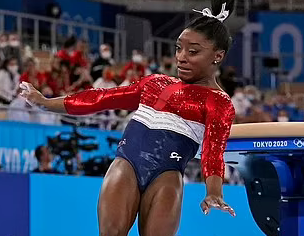
How far we have fallen. What a travesty these once-great games have become! I am aghast to see the talking heads laud Simone Biles for walking away in the middle of competition. The media is calling her brave? That is linguistic corruption—doublespeak at its best. That is the very opposite of the definition of bravery. This coddle-culture that celebrates weakness has infected the very ideals of elite athletic performance.

Why do we fall down?

The ancients would not have understood this inversion. For them, failure was instruction, pain was proof of striving, and competition itself was sacred.

Indeed! A lesson learned in childhood

Imagine other elites using the same failure-logic. “Sorry general, but Seal Team 6 is having a mental health day…” Ludicrous! It’s absurd, and it reveals how far the contagion of fragility has spread. We are discussing the best in the world who have trained mercilessly for years, dedicated their entire lives to show us the tested limits of human physical achievement. For the media to focus on and celebrate Simone’s failure of will is a travesty and diminishes the accomplishments of the other athletes.

Achilles walked away from the battle to provide a context that would force everyone to know with visceral pain that he was the greatest of all time. Simone – you ain’t no GOAT – you gave up. You just taught the next generation of elite athletes that it is okay to quit – in the middle of the Olympics! Quit before you get there so that people who can handle the pressure get to show what they are capable of.

I imagine that Piers Morgan will be castigated for having the courage to say what needed to be said: Sorry Simone Biles, but there’s nothing heroic or brave about quitting because you’re not having ‘fun’ – you let down your team-mates, your fans and your country. As a culture, we need to get our shit together and stop celebrating failure.

I know if this post were widely read I would be chastised by all those who believe mental health issues should be given more prominence because they are real health problems. Yes, I know mental health issues are real. But that isn’t the point. The point is that while mental health issues deserve compassion and treatment, they should not be confused with heroism. They need to be addressed privately, not celebrated publicly as examples of courage.

And most importantly, it has no place in conversations about elite performance. By definition, the elite are those who perform under conditions that would break ordinary people.

The Greeks understood this truth instinctively: excellence demands cost, honor requires endurance, and civilization is built by those who refuse to quit.

_____________________

[1] Ruth Benedict popularized the shame vs guilt cultural description in her The Chrysanthemum and the Sword. The terminology is broad-stroke and sociological refinements like Emmanuel Todd‘s shift the focus, but remain essentially an analysis of how individual psychology is culturally constrained. A more recent global survey was just published (Sept. 2021) by the National Bureau of Economic Research: Herding, Warfare, and a Culture of Honor. It is a global survey of Shame societies:

According to the widely known ‘culture of honor’ hypothesis from social psychology, traditional herding practices are believed to have generated a value system that is conducive to revenge-taking and violence. We test this idea at a global scale using a combination of ethnographic records, historical folklore information, global data on contemporary conflict events, and large-scale surveys. The data show systematic links between traditional herding practices and a culture of honor. First, the culture of pre-industrial societies that relied on animal herding emphasizes violence, punishment, and revenge-taking. Second, contemporary ethnolinguistic groups that historically subsisted more strongly on herding have more frequent and severe conflict today. Third, the contemporary descendants of herders report being more willing to take revenge and punish unfair behavior in the globally representative Global Preferences Survey. In all, the evidence supports the idea that this form of economic subsistence generated a functional psychology that has persisted until today and plays a role in shaping conflict across the globe.

JOINT CONTROL

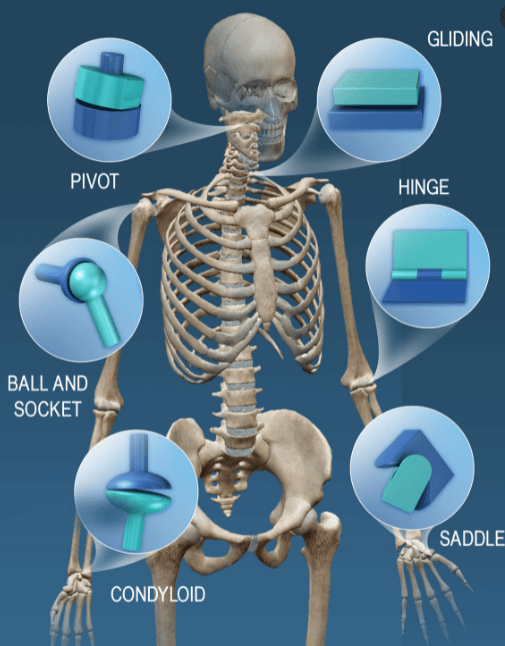
Any martial artist must study the use and limitations of the body; its structure and mechanics – and specifically its joints. (The banner image shows the major synovial joints of the skeletal system.)

In Aikido, we are principally concerned with the control of the opponent’s “center” but the techniques achieve this by working from the outer joints toward the inner joints:

[Fingers] -> Wrist -> Elbow -> Shoulder -> [Hips] -> Neck / [Head/Spine]

I [bracket] those parts of the body that are used but not always given the primacy of focus that they merit. The joints of the lower body, foot, knee, to hip are subject to the same manipulation as the upper body, but they are not the primary focus of Aikido.

Fingers/Wrist

The fingers are not explicitly discussed as often as they should be. Aikidoists usually discuss the tekubi (wrist) as if nikkyo/sankyo/kotegaeshi were just “wrist” manipulations. The progression starts small bones to larger bones.

Phalanges to metacarpals

Nikkyo as a wrist lock only works when the thumbs are aligned so as to compress the metacarples and the power of sankyo is amplified when the phalanges (fingers) are captures and torqued. Kotegaeshi as a proper knife strip must control the thumb first before the turn of the wrist. And knowing that the wrist is a condyloid joint (a limited hinge) allows us to manipulate the elbow through the wrist by applying pressure along uke’s shyuto during the throw.

It is important to know that the hand is holding the weapon and therefore a critical target to manipulate and disable.

Even in a nuke fight

During our warm-ups, we self-manipulate our wrist joints. Too often this becomes a rote activity, done so often it becomes perfunctory and devoid of real value. Slow down and really manipulate your body to learn to better manipulate others.

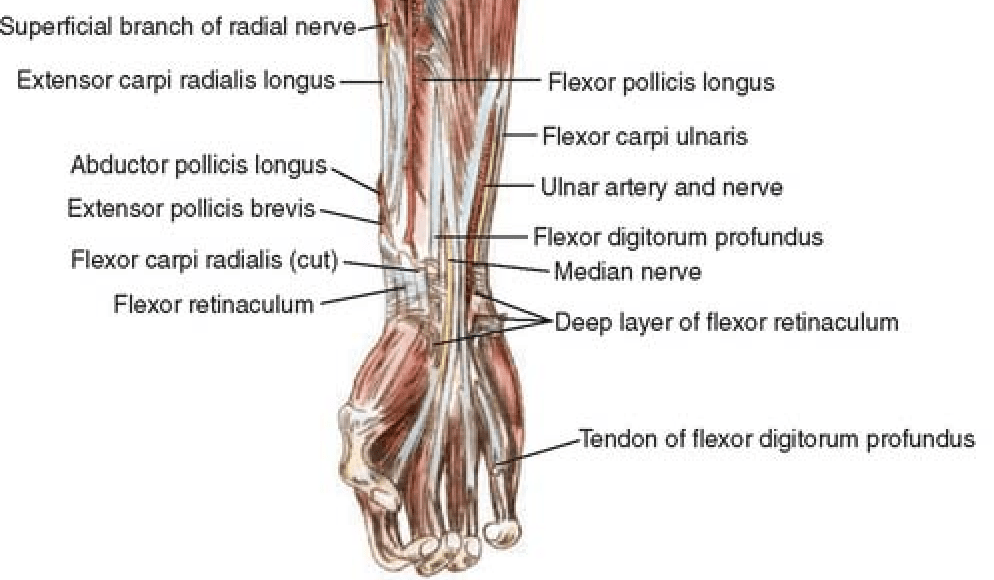
Ikkyo – compress your wrist joint tightly, fold your fingers to your inner forearm, yes, but then isolate the fingers while the wrist is bent to compress them individually. Can you get your thumb to touch your inner forearm? Feel how your index finger is more painful to compress – that is the extensor indicis proprius (EIP) tendon.

Nikkyo – fully grasp your own hand to compress the metacarpals and position them 90-degrees from your own wrist and only then crank them, little finger leading, toward your nose. You should feel a strain in the muscles in your forearm and your elbow should lock. Lock small joints to control larger ones closer to the core.

Sankyo – this is the clearest example of small bones locking to control larger ones. While we usually grasp palm to palm so our controlling hand had thumb around tekubi and fingers around the opposing thumb, try grasping your fingers instead and then applying the outward torque. You should feel your fingers lock wrist then wrist lock elbow to then drive the forces into your shoulder.

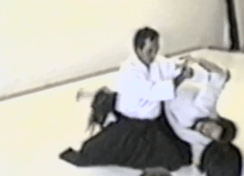
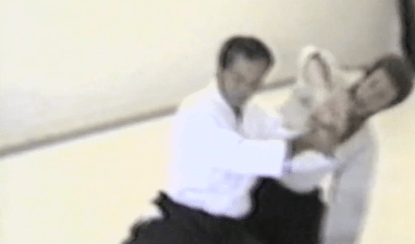
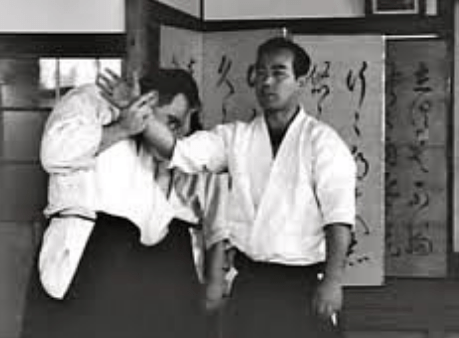
Chiba sensei 1991 – look at the finger lock lead
ubi (fingers) first
finger lock transition

Yonkyo – is a nerve and tendon manipulation foremost, but it requires a torquing action on the wrist to expose the median nerve and make it easier to manipulate.

Nerves and tendons

Any yonkyo’s failsafe is to crank the wrist in a two-handed grab to lock the elbow, brace uke’s shoulder on your lead knee and then drive into uke’s shoulder for the control.

Gokyo – requires the same hand control and manipulation that nikkyo does, but it is taught as a gross-motor, stop-hit first. Neglect the hand control at your peril.

The fingers are the key to wrist control, and the wrist is the key to locking the elbow.

Elbow

The elbow, or hiji is a primary target for Aikido. Both hiji-kime-osae and ude-kime-nage name the elbow explicitly, but the anatomical target of shiho-nage, ikkyo’s pin, figure-4 locks are all the elbow. Lock and break the elbow with a direct force against the hinge and the arm is rendered combat-ineffective.

any arm bar

With longer two-hand weapons like the sword and spear, the elbow is relatively inert when compared with one-handed blade use. In pugilistic arts, the elbows are direct extensions of the body structure and act to transmit power from the spine to the hands via shoulder/hip rotation. Likewise, manipulating the opponent’s elbow creates a direct path back to the the head/neck/spine via the shoulders.

I have covered ikkyo in several posts to cover aspects of this ‘basic’ technique but here it is important to see ikkyo as an elbow manipulation because it is an accessible contact point, proximate to the body and below the threat of uke’s weaponized hand. The intercepting contact with the forearm is really a stop-hit at the triceps to better access the elbow in order to take uke’s balance and control them.

Understanding how the elbow is manipulated, we should learn how to defend against – or limit the exposure – we have in the offense. The shape of the ‘unbendable arm,’ exercises like hiriki no yosei and the jodan blocks in karate all emphasize the connection between the elbow and the core.

Koichi Tohei made physiology mystical

The physiology is simple: keep your elbows ‘soft’ (don’t lock them, keep a slight bend at all times) and keep your armpits closed. As soon as your elbow breaks the horizontal plane, it will be used against you to control your balance.

The offensive use of knees and legs are not part of the overt curriculum in Aikido, but note that your elbows and knees are essentially the same joint type. And where the elbows connect to the upper body to spine (center), the knees of course connect to the lower body in the same manner. Therefore, they can be used to disrupt the hip line and the opponent’s spinal integrity from the bottom up.

It is also vitally important to understand how knee alignment is to effectively transfer power from the hips; and not just for muscular transfer from kicks, but also for delivering upper body strikes, throws and fa jin projections as well. The knees and feet should point in the same direction and be aligned the the top of the sacrum to allow for maximum rotation and energy transfer from the feet into the spine via the hips. We keep this connection by use of the sliding step (suriashi) and by flexing bodyweight onto the balls of the feet by bending the knees and pointing them into the target.

Shoulders/Hips 

The shoulders and hips are identical ball joint structures on the high and low lines and are responsible for transferring power from the spine to the extremities (arms and legs). As such, learn to use your peripheral vision tuned to the shoulders/hips to read your opponent’s intent and respond accordingly. Stay ahead of your opponent’s OODA loop! Aikido teaches that the hips are the body’s primary driver of momentum and power generation.

The shoulders are a key area of focus, both offensively (in using a sword) and defensively. A simple example is counter-yokomen, where nage strikes to the front of the shoulder to check the opponent’s arm while entering. The vast majority of Aikido’s locks and controls are applied to the shoulder in order to dislocate it or to secure the lower arm and weapon.

Entering to control the shoulders and hips is done to ‘control the center’ and more honestly, to get easier access to the head/neck/spine.

Head/Neck/Spine

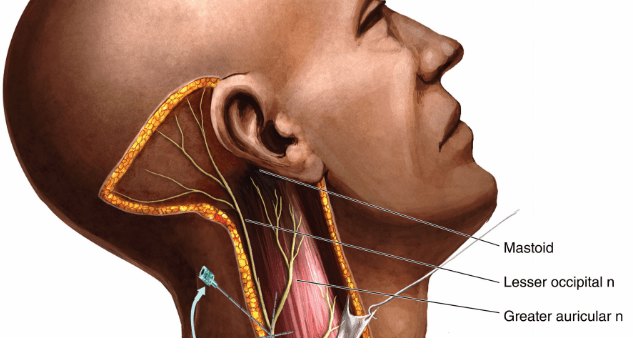
The head appears to be an easy target, but it is encased in bone (skull) designed to protect the brain. While weapon strikes to the head (especially heavy blunt force) can be very effective, closed-fist strikes will usually do more damage to the assailant unless they know precisely where to strike. There are soft tissue targets on the head, such as eye sockets/temples and ears, but these are small targets and we all move our head reflexively to protect them. If, however, you have properly moved up the chain, locking hand to elbow to shoulder to gain access to the head, neck and spine, you now have several handholds (ears/hair/eye sockets/mouth) that are easy to grab and manipulate. Polite Aikido ignores most of these natural handholds, but the bunkai of irmi nage will still employ nerve control on the mastoid.

dig those fingertips in!

The neck is the most vulnerable part of this chain since it is without a protective bone structure such as the ribcage and skull, so the soft tissue and nerves are exposed and vulnerable to direct manipulation or attack.

For the spine, it is usually well protected by muscles of the back and can be hard to attack. The tailbone is a notable exception and can cause disruption through the whole spinal chain when damaged. This can be done using strong, direct knee strikes or also by causing the opponent to land heavily when sitting down backward from a sweep or drop.

_____________________

This article should be reviewed in conjunction with Human Frailty as well as Will To Win, both of which review physiology, and Thrusting Triangle which shows proper targeting, all of which takes place within the box containing our larger vital organs bracketed by the four points of both shoulders and both hips.