Troy

Troy is not the beginning of the heroic age.

It is the point where the heroic age destroys itself.

The Greeks understood this. Their myths do not describe a long golden era stretching indefinitely backward into legend. The heroic age is startlingly brief. From the first monster-slayers to the sack of Troy spans only a handful of generations. It is the length of a family’s living memory. Your great-great-great-grandfather could have fought the Gorgon. Your father died at Troy.

This compression is not accidental. It is structural. The Greeks are not describing a remote mythical time in the way the Norse sagas describe the age of gods and giants. They are describing something almost recent. The obligations still bind. The oaths still hold. What Perseus did three or four generations earlier is still working itself out in what Achilles does on the plain of Ilium.

The genealogy is not decorative. The genealogy is the argument.

Consequence does not dilute across generations. It concentrates. Troy is where four generations of accumulated obligation, violated oath, and inherited excellence arrive simultaneously at a single shoreline.

The sequence begins with the figures who make the world habitable. Perseus kills the Gorgon and takes her head as a weapon (Apollodorus, Bibliotheca 2.4.2). Cadmus slays the dragon of Ares, sows its teeth into the earth, and produces the first warriors of Thebes (Bibliotheca 3.4.1). Bellerophon kills the Chimera on the plains of Lycia (Iliad 6.179–183). These are not kings administering cities but founders confronting monsters. The violence clears the ground on which cities can exist at all.

The next generation consolidates what the founders created. Heracles moves through the Greek world like a storm, clearing the remaining terrors: the Nemean lion, the Lernaean hydra, the Augean stables, the Stymphalian birds (Bibliotheca 2.5.1–12). Theseus kills the Minotaur and gathers the scattered villages of Attica into a single political body, synoikismos (Thucydides, History 2.15). Wilderness is pushed back. Roads connect the cities. The heroic energy that made the landscape habitable begins to move inside the civic order.

And once it enters the city, it becomes harder to control.

Heracles is the warning. The same force that destroys monsters kills his own family. Theseus, who unifies Athens, leaves a trail of broken alliances and abandoned women behind him: Ariadne on Naxos, Antiope the Amazon queen, Helen herself abducted as a child. The violence that was necessary outside the walls becomes crime within them. The consolidators are already transitional figures. Too powerful for the world they are helping to create.

The heroes are clearing a world that will eventually have no place for them.

The third generation forms the network that will eventually produce Troy.

At Calydon the pattern announces itself in miniature. A hunting contest over a boar’s hide destroys a royal house (Bibliotheca 1.8.2). The same mechanisms – honor contested, family fractured, violence turning inward – will operate at full scale a generation later and destroy a civilization.

Soon afterward another gathering takes place on the shore of Thessaly. Jason calls the heroes to crew the Argo in search of the Golden Fleece, and they come from every corner of the Greek world: Orpheus, Castor and Polydeuces, Peleus, Telamon, the young Heracles, and many others (Apollonius of Rhodes, Argonautica 1.20–227; Apollodorus, Bibliotheca 1.9.16).

After the Argo, the heroes will not assemble again until Troy.

The voyage creates a dense web of familiarity, rivalry, and obligation. These heroes fight together, survive together, and form alliances that will bind their children. When they return, they disperse to found families and kingdoms.

Peleus, who sailed with Jason, wins the sea-goddess Thetis in a wrestling match and becomes king of the Myrmidons (Bibliotheca 3.13.5). At their wedding the apple is thrown, the judgment is set in motion, and Achilles is conceived.

The war begins at a wedding.

The greatest warrior of the Trojan War and the cause of the war originate in the same moment. Telamon, Peleus’s companion on the Argo, establishes his house on Salamis and will father Ajax. Tydeus, son of Oeneus of Calydon, begins the violent career that ends with him devouring the brains of a fallen enemy (Bibliotheca 3.6.8), but not before fathering Diomedes. Laertes rules quietly in Ithaca and raises a son whose cunning will prove more durable than any warrior’s excellence. Atreus consolidates the Pelopid line at Mycenae. His house carries a curse that predates the heroic age itself, running back through Pelops and Tantalus to violations the Olympians have not forgotten.

These men are heroes themselves. Most of them sailed on the Argo, hunted at Calydon, fought their own wars. But their defining function is as fathers. What each house built, and what each house violated, arrives at Troy in the bodies of their sons.

Achilles inherits the speed of Peleus and the dangerous divinity of Thetis and the foreknowledge that he will die young at Troy (Iliad 1.352–356). Ajax inherits the massive strength of Telamon, the straightforward force that needs no cunning to justify itself. Diomedes receives the ferocity of Tydeus, but disciplined and sharpened by the lesson his father’s excess taught. Odysseus inherits the cunning that small kingdoms must cultivate if they are to survive among larger powers. Agamemnon inherits the Pelopid wealth, the Mycenaean armies, the command of the largest Greek expedition ever assembled – and the curse that has been working through his house since before he was born.

When the war finally begins, the compression becomes visible.

Every major house of the Greek world appears simultaneously on the same stretch of shoreline. The oath sworn at Sparta activates the entire network at once. Sons of men who hunted together at Calydon or sailed together on the Argo are now bound by legal obligation to a war none of them chose. The judgment of Paris ignites it. The structure sustains it.

But the war itself cannot begin until the heroic world pays its first terrible price.

Agamemnon’s fleet assembles at Aulis and the winds do not come. The seer Calchas delivers the verdict: Artemis requires the sacrifice of Iphigenia, Agamemnon’s daughter, in repayment for an offense against the goddess (Bibliotheca Epitome 3.21). The offense is Agamemnon’s. The price falls on his child.

Agamemnon pays it.

This is the first of Troy’s preconditions and the most terrible. The war has not yet begun and its commander has already committed the act that will destroy his house when he returns. Clytemnestra watches her daughter led to the altar by the lie that she would marry Achilles. The war’s final accounting begins at Aulis, before the first ship reaches Troy. Aeschylus understood this precisely. The Oresteia begins not with Agamemnon’s return but with the necessity that made his return impossible to survive (Agamemnon 160–183).

The war begins with a sacrifice that guarantees its aftermath.

Troy itself is protected by conditions that reach back across the entire heroic arc.

The Palladium, the sacred image of Athena, carved in grief for the childhood companion she accidentally killed, stands in the city’s sanctuary (Bibliotheca 3.12.3). As long as it remains there, the city cannot be taken. So Odysseus and Diomedes infiltrate the city at night and steal it to remove Athena’s protection from a city the goddess has already, for reasons traced back to the Judgment of Paris, decided to abandon (Bibliotheca Epitome 5.13).

The war cannot end without the bow of Heracles.

Heracles, dying on Mount Oeta, gave his bow and arrows to Philoctetes as the price of lighting the pyre (Bibliotheca 2.7.7). Philoctetes sailed with the Greek fleet toward Troy. On the island of Lemnos a serpent bit him. The wound festered and would not heal. On Odysseus’s advice the Greeks abandoned him there and sailed without him – a strategic convenience that left a man with a decade of justified grievance and a weapon the war could not conclude without.

The seer Helenus, captured by the Greeks, reveals the conditions for Troy’s fall: the city requires the bow of Heracles and the presence of a son of Achilles (Sophocles, Philoctetes 610–613). Odysseus sails to Lemnos carrying an argument Philoctetes has every reason to refuse. The man who abandoned him now needs him. Philoctetes refuses. It is Neoptolemus, the young son of Achilles, not yet old enough to have learned Odysseus’s brand of cunning, who finally persuades him, not through strategy but through honest acknowledgment of the wrong done.

The bow of Heracles arrives at Troy in the hands of a son of Achilles. Its first arrow kills Paris.

The bow has been here before. Heracles sacked Troy in an earlier generation, when Laomedon refused him the horses Poseidon had promised (Bibliotheca 2.6.4). The founding hero’s weapon returns to finish what the founding hero began. The heroic inheritance travels through injury and betrayal before it arrives at its final purpose. The bow could not have come to Troy any other way, because Philoctetes could only be persuaded by someone who had not yet learned to treat men as instruments. The son of Achilles succeeds where the cunning of Odysseus fails. Neoptolemus arrives with a capacity for restraint he does not keep. What is striking is not that he becomes violent, but how quickly that capacity of restraint disappears.

The Palladium is stolen. The bow has spoken. Achilles is dead. His son Neoptolemus has arrived. Every structural condition has been met.

Troy does not fall because Odysseus invents a clever trick.

Troy falls because the entire structure sustaining it has been dismantled.

The horse is not a stratagem. It is a ceremony. The Greeks construct a wooden horse large enough to hold a company of warriors and leave it on the beach with Sinon, a planted interpreter who tells the Trojans it is a sacred offering to Athena (Bibliotheca Epitome 5.15–19). The Trojans, whose city has just lost its divine protection, whose greatest defender is dead, whose prince lies killed by the weapon of Heracles, bring the horse inside the walls themselves.

They open their own gates.

The Greeks have not overcome Troy’s defenses. They have waited for the structure to exhaust itself. The horse marks the moment when the exhaustion is complete.

The sons who inherit the victory inherit a diminished world.

Neoptolemus throws Hector’s baby son Astyanax from the walls of Troy and kills the old king Priam at the altar of Zeus: violations that would have shocked his grandfather’s generation but barely register in the moral accounting of the war’s final hours (Bibliotheca Epitome 5.23). He has satisfied the conditions required of him and immediately violated the sanctity that made those conditions meaningful. The heroic inheritance is received and spent in the same campaign.

Achilles, briefly, recognizes what his son will not inherit: that an enemy father kneeling in the dust is still a father. It is the one moment in the heroic age when excellence stops and something older than excellence speaks. Homer ends the poem not with Greek triumph but with a Trojan funeral. The last dignity belongs to the enemy.

Orestes returns home to find his father murdered and is required to kill his own mother to restore order. The act is simultaneously just and polluted. The Greeks are forced to invent the Areopagus, a trial, to determine whether justice and pollution can coexist in the same action. They can, Athena decides, but only barely, and only by replacing the personal logic of vendetta with the civic logic of judgment (Aeschylus, Eumenides 681–710).

Telemachus grows to adulthood in a house full of suitors devouring his inheritance while his father struggles to return (Odyssey 1.245–251). His education in the Odyssey is the first lesson in how to live after the heroic network has dissolved, without the institutions that will eventually replace it.

The war that began over Helen ends with the collapse of the civilization that fought it.

The heroic age was not long. It was four generations of accumulated consequence arriving simultaneously at a single place. Perseus cleared the ground. Heracles and Theseus consolidated it. The Argo bound the houses together. The fathers condensed into their sons. The sons arrived at Troy carrying the cumulative inheritance: everything their houses had built, violated, and transmitted. The founding violence had only one place left to go.

Troy is where the compression reaches its limit.

Not the birth of the heroic age.

Its detonation.

_____________________

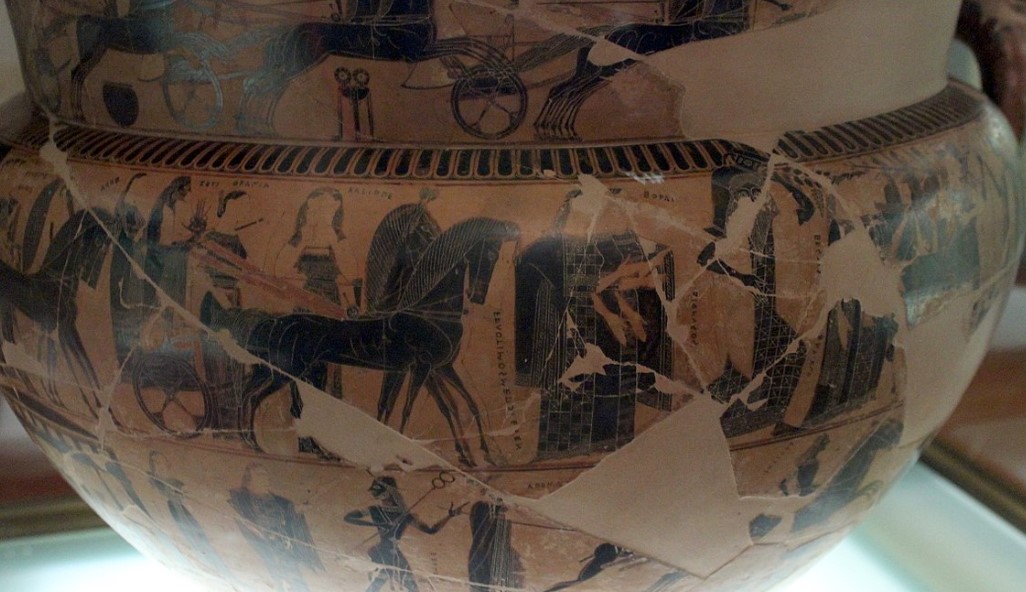
Banner image – the François Vase, the wedding of Peleus and Thetis, the moment before the apple lands.


Narcissus

The daffodils have begun to flower. Narcissus emerges from the ground.

The Greeks named the flower for a boy who could not look away. The myth remembers something about spring that the botanical name preserves without explaining: that the eye, given something sufficiently beautiful, stops. The will follows the gaze. The season announces itself through sight.

But before the pool there was a refusal. Narcissus rejected Echo, who could only return his own words back to him. He rejected the nymph Ameinias, who loved him. He rejected, in the Greek understanding, the domain of Aphrodite entirely: desire as an outward force, the eye drawn toward another rather than toward itself. Nemesis responded not with punishment but with proportion: the eye that refused to be caught by another was turned inward until it could see nothing else. The capacity for full attention, which should bind a man to the world outside him, became the instrument of his disappearance from it.

The myth is not about vanity. It is about the eye losing its proper object.

In the Pacific Northwest the signal comes weeks earlier than the calendar habits I grew up with in New England. There, spring arrived with more hesitation. The woods stayed gray and bare until late April.

But the serviceberry was always among the first to appear. The name itself carries a small piece of forgotten history.

serviceberry

There is a popular explanation that the flowering of the serviceberry marked the time when ministers could finally travel again after the winter snows, allowing delayed funeral services to be held for those who had died during the frozen months. Historians are skeptical of this etymology. But the story persists because it feels true to the conditions of an earlier world.

I have a reason not to dismiss it entirely.

My grandmother’s house had been in the family since the early 1800s. In the basement stood an unused headstone. Whose name and dates I can no longer recover – only the fact of it, waiting there in the dark. The explanation was simple and practical: winter ground in New England freezes hard. Digging graves is difficult. Burials were sometimes delayed until the thaw.

The dead waited for spring to be planted.

Whether or not this is the true origin of the word, the story captures something real about the seasonal structure of life in colder climates. Winter interrupts the normal rhythm of things. Spring restores it. The bloom of a particular tree marks the moment when both the living and the dead resume their proper order.

The Greeks understood this not as metaphor but as fact. When Persephone descends, the earth grows barren with Demeter‘s grief. When she returns, the fields grow again. Each year initiates gathered outside Athens for the Eleusinian Mysteries, rituals tied directly to the agricultural cycle. They reenacted the loss and return of Persephone, symbolizing the burial and rebirth of seed in the soil. The sacred calendar and the farming calendar were the same calendar.

If we follow the lineage of seasonal knowledge backward far enough, it leads to archaic Greece. To Hesiod.

Around 700 BCE Hesiod composed Works and Days: part moral lecture, part agricultural manual. He does not instruct the farmer by calendar dates. He instructs him to watch.

The poem encodes seasonal intelligence in observation. Always the primacy of sight. A farmer who cannot read the sky, the birds, the particular quality of light in a given week is a farmer who will plant late and harvest poorly. The knowledge is not abstract.

The serviceberry had been flowering for days before I noticed it. Not because it was hidden. Because I was not looking. Hesiod would have known the date by the tree. I had to check my phone to find out what week it was.

The practical need to watch the land carefully has largely disappeared. Food arrives from distant continents regardless of what grows locally. The rhythms continue. We moderns have simply stopped being the kind of creatures who are bound by them. Most of the time.

Hesiod addressed farmers facing precarious harvests in an age still recovering from the Bronze Age collapse; a world in which missing the planting window was not an inconvenience but a sentence.[1] The instruction carried that weight. It still does, though we have arranged our lives so that we rarely feel it.

The forsythia spring-bursts yellow. The daffodils open. The serviceberry stands white at the forest edge.

The season has been visible all along. The question is whether we still know how to look.

_________________________________

[1] Archaeological and paleoclimate evidence suggests that Hesiod lived in a world still recovering from several centuries of environmental stress following the Late Bronze Age collapse (ca. 1200 BCE). Climate reconstructions from pollen cores, lake sediments, and dendrochronology indicate prolonged drought conditions in parts of the eastern Mediterranean that contributed to agricultural instability and societal disruption. Scholars have suggested that Hesiod’s intense concern with seasonal timing and agricultural discipline reflects the precarious farming conditions of this period. (See: Brandon L. Drake, “The Influence of Climatic Change on the Late Bronze Age Collapse,” Journal of Archaeological Science 39, no. 6 (2012): 1862–1870; and Martin Finné et al., “Climate in the Eastern Mediterranean During the Past 6000 Years,” Journal of Archaeological Science 38 (2011): 3153–3173.) The environmental stresses faced by early Iron Age Greek farmers differ from the cooling conditions associated with the early modern Little Ice Age that affected Europe and North America when English settlers arrived in New England in the seventeenth century.

Why Return to the Greek Myths

This project begins from a simple premise: human nature has not changed.

The technologies surrounding us have transformed almost beyond recognition, but the underlying motives that drive human action remain stubbornly familiar. Ambition, envy, loyalty, desire, the longing for recognition, the dread of mortality: these appear in every age, already fully visible in the earliest surviving literature. Read the Epic of Gilgamesh and the emotional terrain is immediately recognizable: a king struggling with mortality, the discovery of friendship, the fear that one’s life will vanish without leaving a trace. Four thousand years collapse in a single reading.

My return to the Greek myths owes much to Roberto Calasso. When I first read The Marriage of Cadmus and Harmony in 1993, I experienced the particular shock that comes when one discovers that the book he had long imagined writing has already been written. And written more beautifully than I could have managed.

These essays arise from a different position.

Calasso restores the mythic world from aesthetic distance, allowing its patterns to emerge without argument. That is a genuine achievement. But I write from within the civilization that inherited these stories, as a citizen, a father, a man who still practices how to stand his ground. For me, a myth that has survived three thousand years is not primarily elegant. It is durable. It has proved itself against the realities of human behavior. Beauty must be tested against action, or it remains decoration.

My approach therefore treats myth less as poetry and more as a set of behavioral maps.

These maps are not moral commandments. They are closer to field notes from a long civilizational experiment in observing human behavior. The Greeks assumed that human motives were stable, that consequences were often larger than intentions, and that wisdom therefore consisted less in discovering perfect rules than in learning to recognize recurring patterns. When read carefully, these stories reveal structural insights about human action that remain recognizable across centuries.

Scholars have been here before me, and I have read them. But scholars tend to illuminate the myths from outside, the way a museum light illuminates a weapon. I am more interested in the edge. The anthropological tradition reads myth as a system of relationships encoding the culture’s deepest tensions about violence, kinship, and the sacred. The philological tradition, running from Nietzsche through the classical scholars, treats these stories as expressions of psychological forces the culture could not otherwise articulate. The comparative tradition searches for recurring structures across civilizations. Each approach illuminates something real. None of them alone explains why these particular stories, in this particular civilization, produced the habit of mind that eventually became philosophy, law, and the examined life.

That question is the one that interests me most.

The Greeks themselves provide the most important methodological clue. Greek intellectual culture developed an unusual habit of mind: curiosity tempered by skepticism. Herodotus famously remarked that he was obliged to report what he was told, but not obliged to believe it.

The myths reflect this environment of inquiry. They rarely function as simple moral instruction. Instead they explore the consequences that emerge when powerful forces collide inside structured systems: family, oath, hospitality, ambition, rivalry, desire.

In this sense the myths resemble case studies not sermons.

They do not say: do not do this. They show what happens when this is done. And they show it with a completeness that includes the actor’s reasons, the structure’s indifference to those reasons, and the consequences that follow regardless. The Greeks were not interested in making you feel guilty. They were interested in making you see clearly.

Again and again the stories show how catastrophe develops through the accumulation of conditions: rivalry becomes oath, oath becomes obligation, obligation becomes war. The actors often believe themselves to be making free decisions, yet the larger pattern only becomes visible in retrospect.

The point is not simply to retell archaic myths but to examine the patterns of behavior they preserve. Individuals act freely, but they do so inside structures that long predate them. We all do. The Greeks simply showed it with unusual clarity.

The vantage point from which I read these stories is not purely academic. My family history runs deep into the early colonies, which means the Puritan moral grammar this series diagnoses as a structural distortion of the Greek inheritance is not an abstract historical object for me. It is what I grew up inside. I practice a martial art whose pedagogy still assumes a psychology closer to Homer than to modern theories of the mind; which means the Homeric account of distributed cognition, of thought following action rather than commanding it, is not a scholarly hypothesis but a daily experience. And I have children growing up inside institutions that increasingly struggle to articulate why the civilization that produced them is worth understanding; which means the polemic in these essays is not academic irritation. It is a father’s concern about what gets transmitted and what gets lost.

All of this shapes how I encounter the myths. It is also, I think, precisely the position from which they should be encountered. The Greeks did not write for disinterested scholars. They wrote for citizens with something at stake.

The essays in this series, therefore, move across several registers: classical sources, anthropology, martial practice, American history, and occasional personal reflection. This mixture is deliberate. The Greeks themselves did not isolate myth into a literary category. Their stories existed simultaneously as religion, history, education, and political memory.

Seen in this light, myth becomes something more than ancient storytelling. They are a record of how one civilization learned to recognize the forces that shape human action. And from those stories emerged something unprecedented: the habit of critical inquiry. That habit would help organize empires, shape philosophy, and eventually turn inward into the moral and religious introspection that later civilizations treated as a providential path toward perfection.

I return to the myths for a simpler reason.

They remind us that human beings rarely understand the systems they are already inside and that the consequences of that ignorance are structural, not moral. They follow whether or not you have been warned.

That is not pessimism. It is the beginning of clarity.

The Greeks called it gnōthi seauton. Know what kind of creature you are. Not what you aspire to become. What you already are, operating inside forces that were in motion long before you arrived.

This is not the same as resignation. The Greeks understood excellence, aretê, as the fullest expression of what a thing actually is, not the imposition of what it ought to be. The aspiration toward self-mastery, toward becoming more fully oneself through discipline and practice, is something the Greek and Christian inheritances genuinely share. Augustine’s restless heart seeking rest, the Puritan’s daily examination of conscience, the martial artist returning to the same technique ten thousand times, these are recognizable to Homer, however strange the theological clothing.

Where the traditions diverge is not in the aspiration but in the ground. The Greek starts from what is and asks how excellence can be drawn out of it. The Christian moral tradition, at its most distorted in the Puritan inheritance, starts from what ought to be and measures the present against an ideal that floats free of structural constraint. One tradition produces tragedy when the aspiration exceeds the creature’s nature. The other produces reform movements. And when those fail, as they must, it produces guilt without consequence and confession without cost.

The reminder the Greeks offer is not that excellence is impossible. It is that excellence begins in accurate self-knowledge: in knowing the kind of creature you are, the kind of forces you are operating inside, and the limits that are not obstacles to be overcome but parameters to be understood.

That reminder has not aged. We have simply stopped teaching it.