PNWBMWM

Bad role-model parent day.

Adin found a post from a BMW (M) club doing a drive to the Maryhill Stonehenge. He was excited to participate and see the other cars, so I agreed to drive so he could take photos of the rally. I drove my de-badged 2014, 428i xdrive that Adin had helped me upgrade with a Dinan exhaust and rear spoiler. Mine was the blandest car in the group.

Most of them had modified exhausts, so the cars were all loud. Mine rumbles assertively, but with reserve. Their exhaust systems announced the arrival of true track-ready cars.

Not healthy

Risking the very unhealthy air quality caused by the forest-fires, about 15 drivers gathered at the South East DMV parking lot for a 9:30am departure. This was not to be a leisurely drive.

There and back again

The drive along highway 84 was fast. Once past Troutdale, the speed limit jumps to 70 mph, but to stay with the pack, I had to average speeds closer to 95+ for much of the run. At any given section of road, two of the cars would slow only to do a burst micro-race where the drivers got well over the 120+ mark and one reportedly hit 163 mph.

M6

We were not witness – no way for us to even get close to those speeds – but given the after-market tunes these M-series cars had, I am inclined to believe them.


M3

Stonehenge is just over 100 miles east from Portland – a drive through the scenic Columbia River Gorge along highway 84 on the Oregon side and a river crossing over to Washington at Biggs. Set on the top of a cliff, the views from Maryhill are normally spectacular.

The view with clear weather

With the smoke from the unprecedented forest fires, the view was apocalyptic
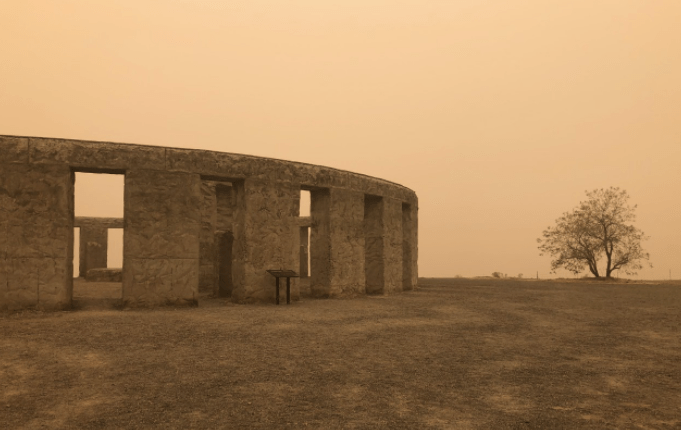
sepia tone by smoke – no camera filter added

We lined the cars upon arrival for the requisite instagram photo:

Bad role-modeling to be sure, but Adin was ecstatic, “This is the most fun I have had in a long time!” With the pandemic, social unrest, online school, wildfires, I justify to myself that the risk was well-worth the improvements for his long-term mental health.

We made an early exit, I didn’t want to risk another high-speed run, and drove the speed of traffic back to Portland. Adin slept most of the way back.

I smiled contentedly.

___________

Sam Hill built the Stonehenge replica as a memorial and tribute to the soldiers who died in WW1. As a Quaker, Sam Hill viewed his Stonehenge as an alter – the blood of young men sacrificed to the gods of war. A tribute to the men and an indictment of human nature.


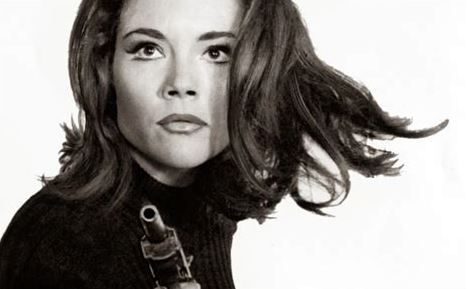
Dame Diana Rigg

Olenna Tyrell was one of my favorite characters in Game Of Thrones. She was brilliant, a masterful strategist with a keen understanding of human nature. I only know the character from the HBO series (I have not read the books) and it was Diana Rigg who transformed Olenna into a force of nature: regal, lethal, and utterly self-possessed.

Every time I watched her perform as Olenna, I flashed to Katherine Hepburn’s Eleanor of Aquitaine in The Lion in Winter: the same steel-trap wit wrapped in centuries of breeding and regret.

Diana Rigg died September 10, 2020.

Diana Rigg was made a Dame Commander of the Order of the British Empire (DBE) in 1994, for her services to drama. Formally: Dame Enid Diana Elizabeth Rigg, DBE.

_______

BBC obituary and tribute – A Dame of the Order of the British Empire.

The Guardian presents a wonderful overview of her performances.

_______

Her rise to fame began in the 1960s with her role as Emma Peel in The Avengers.

As Emma Peel, Rigg was James-Bond-cool, a martial artist and intellectual, radiating sang-froid in leather catsuits. She also portrayed the only woman James Bond ever married in On Her Majesty’s Secret Service (1969).

There she played Countess Teresa “Tracy” di Vicenzo opposite George Lazenby, the lone actor to play Bond just once. Tracy was a fiercely independent woman whose strength and intelligence matched Bond’s own. Their love story ends in tragedy: moments after their wedding, Blofeld’s assassins open fire on their car, and Tracy is killed instantly. Bond cradles her body, whispering, “It’s all right… she’s having a rest. We have all the time in the world.”

That line, and Rigg’s quiet, lifeless grace, still stands as the emotional high-water mark of the entire series.

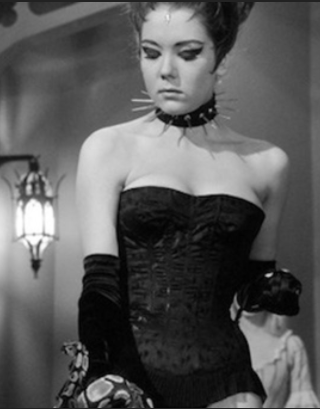
Memorably, she infiltrated the Hellfire Club as the Queen of Sin. Reportedly, the outfit she wore came from her personal wardrobe:

Queen of Sin

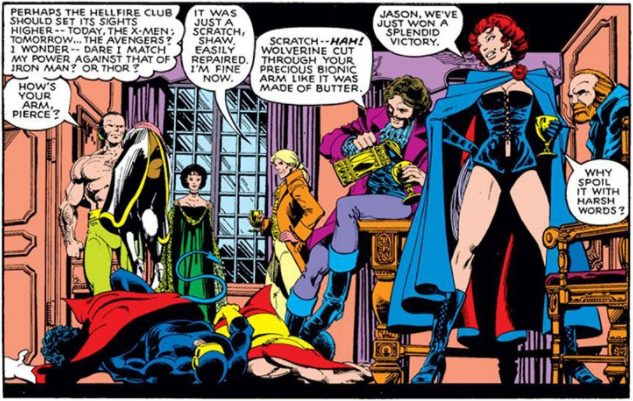
And that role and outfit clearly influenced Chris Claremont and John Byrne’s creation of Jean Grey’s transformation into the Dark Queen in The Dark Phoenix Saga.

Chris Claremont and John Byrne must have been fans

Diana – you will be missed!

YOKOMEN – CROSS TRAINING

Cross-training is learning techniques from a different art or style to augment your understanding of the primary art you study.

Done poorly, cross-training leads to confusion – a hybrid system that misses the fundamentals of all – and that is all too easy to do.

Done properly, cross-training is a catalyst for clarity – breaking paradigmatic blocks and anal glaucoma.

For years I have struggled to impart yokomen uchi‘s proper form, a simple strike to the side of the opponent’s head (temple/carotid) delivered from the top of your head (jodan) at a sharply acute (less than 30-degree) downward angle.

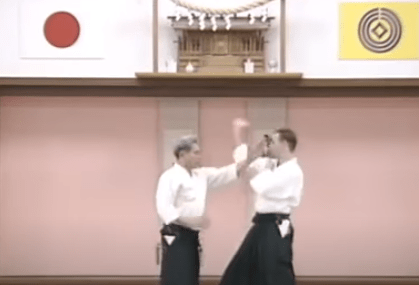
Should be simple enough, yet it is all-too-common to see it done wrong. Here, an example from Nishio sensei:

Bad uke!

Uke has flaired his elbow and opened his center line – of course Nishio’s intercepting fist hits first. Uke invited the strike to the face with his piss-poor attack.

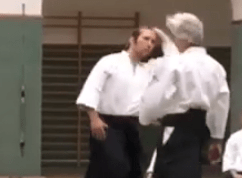
This bad example (more egregious because uke lists to the side) from a seminar with Bruno Gonzalez:

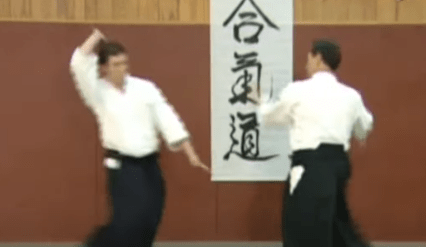
Alas, even Tissier sensei’s videos reinforce an image of a poor yokomen delivery.

Tissier sensei

And these examples are from instructors whom I admire greatly!

Because Aikido is nage-centric, it emphasizes the response to an attack and minimizes the importance of first delivering the attack effectively – which is the very premise of the art! One cannot “blend” or “harmonize” with an ineffective strike because there is nothing, no committed energy, to use against the attacker.

As an artifact of training, Aikido has the unfortunate habit of teaching yokomen as a ki-no-nagare (continuous flow) which often results in a circular path for both nage and uke. Uke thus develops a conditioned habit of striking wide and oblique in order to better carry the momentum along the circumference of the circle. Training reinforcing a bad habit born out of convention.

As I have mentioned in a prior post, Shibata sensei delivered the moment of clarity to me when I had the frightening pleasure of training with him at a seminar. He was on the mat training while Yamada sensei was leading the class. I had jumped at him and thus had him as my partner. Shibata sensei’s yokomen came sharp and fast – nothing like what I was used to – the speed wasn’t just his vigor, but also the angle of approach. Little telegraphing action, no wind-up, just attack! The “aha” realization that yokomen was a very effective attack and the sobering realization that mine was not. I had been delivering the strike incorrectly as a convenience to nage. Shibata sensei was not about to convenience me – or any one else.

If the form of attack is patently simple, the key question becomes, how do we teach the attack correctly?

Mulligan sensei imparted a lesson he took from iaido, which is: while holding towels under your armpits,you must raise the sword jodan and it must reach the apex without the towels falling: the armpits must not be opened, nor are the elbows allowed to flair. A good image and exercise, but this two-handed lesson that does not translate well to the one-handed variant.

The next cross-training tip is from Coach Tony Blauer – his “magic wall” drill – an amazingly simple, yet highly effective conditioning method. Simply line your shoulder perpendicular to a wall, touch the base of it with your foot. From that “impinged” starting point strike yokomen. The beauty of the drill is that you will have immediate feedback – both negative and positive – to reinforce your body mechanics. It will be impossible to deliver the strike incorrectly from that position. Done properly, your strike will start by raising your hand up your center-line to jodan, then briskly angled to the opponent who is directly in front of you. Done improperly, you will bash your elbow against the wall. Brilliantly simple!

I recommend Coach Blauer’s Spear System for other very useful training tips and lessons on neuro-programming to enhance your training and overall efficacity.

Virtūs et Honos