Memory Palace

In the BBC Sherlock, series, both Holmes and his adversary Charles Augustus Magnussen demonstrate a disciplined version of the method of loci, the so-called “Memory Palace.” Sherlock stores libraries of information in imagined corridors and retrieves them at will, solving cases and saving himself from peril by walking the halls of his own mind.

I first saw someone use a memory palace in real life during my freshman year at Reed. The class was billed as “science for poets,” a supposed reprieve from the rigors of biology and chemistry, held in Vollum Hall. The instructor introduced himself as Stavros Theodorakis. He was teaching in America to avoid military service in Greece. He was intense, brilliant, and serious about imparting observational frame reference equations. He promised that by semester’s end we would “know as much particle physics as any graduate student.”

He then asked every student’s name, once, in a hall of over a hundred. At the end of the hour, he dismissed us individually. By name. A name which had heard precisely once from a hall of students he had never previously met.
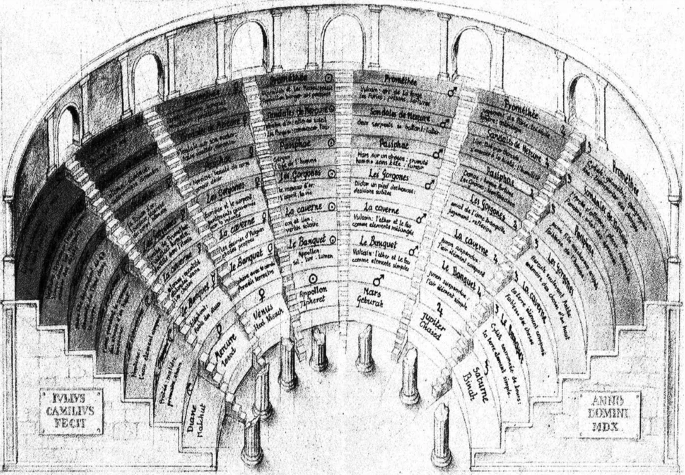
Lecture hall palace?

He also offered a challenge: anyone who could replicate his feat would receive an “A” and be excused from class for the rest of the term. No one even tried.

Years later stumbled upon Frances Yates’s, The Art of Memory (1966), a luminous history of the classical techniques of recall. I read a few chapters and, predictably, attempted to build a palace of my own. I was inconsistent, impatient, and unsuccessful. The first room never formed.

The method, as first described in Rhetorica ad Herennium, a text long attributed to Cicero, divides memory into the natural and the artificial. Natural memory is the gift we are born with; artificial memory is its cultivated twin, strengthened through discipline and architecture.

“The artificial memory includes locations and images. By locations I mean such scenes as are naturally or artificially set off on a small scale…for example, a house, an intercolumnar space, a recess, an arch. An image is a figure, mark, or portrait of the object we wish to remember….”
Ad Herennium, III.28–30

Greek and Roman orators depended on such architecture to deliver their speeches without notes. In an oral culture, persuasion was built not on manuscripts but on memory.

Wired Magazine offered a primer with an embedded link on how to build a memory palace; there are now entire websites devoted to selling the discipline as a life-hack.

How to Build a Memory Palace

MemoryPalace.com

Yet there is something more profound at stake. The art of memory is not about efficiency; it is about presence. To remember is to inhabit one’s own interior landscape.

Umberto Eco, quoting Plato’s Phaedrus, retells the story of Theut presenting the invention of writing to Pharaoh Thamus. Writing, Theut claimed, would help people remember what they might otherwise forget. Thamus replied that it would do the opposite: it would make people rely on external devices instead of exercising their internal memory.

Plato was of course writing down his argument against writing, a delicious irony, but his warning survives every technological age. Books did not narcotize memory, as Eco reminds us; they refined it. But each new invention rekindles the same fear: that what we offload to our tools, we lose in ourselves.

The Pharaoh’s caution feels newly relevant. Our memories now live in clouds and feeds, indexed by algorithms rather than imagination. The palace of the mind is dissolving into data.

We have not lost the gift of memory; we have merely outsourced the labor.

________________

Slate remembering Frances Yates

Google Books digital version of The Art of Memory

________________

Connected with memory is learning – often the two can be conflated, such that to remember a fact or skill is to have learned it – yet >this< article argues that we still learn inefficiently.
Saurians

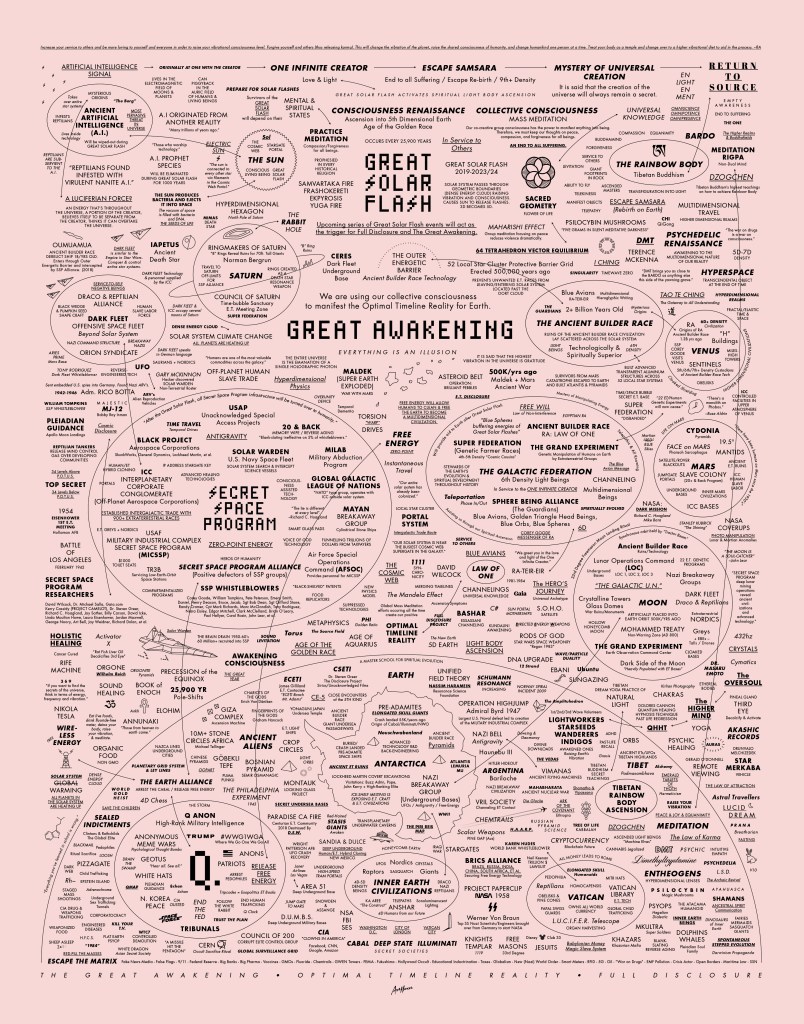
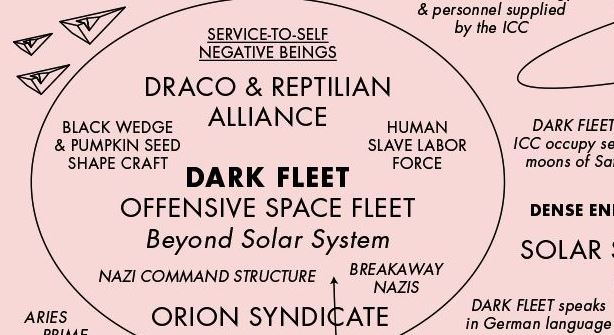
The Great Awakening Map is a must download for surviving the crisis! Political unrest, global warming, the Covid-pandemic, and the cashless society are all explained. And I know who ultimately is behind it.

The insidious perpetrators, who have already deeply infiltrated the highest reaches of political power are Saurians. They are purposefully changing the very climate of the planet to better suit their physiology and ensure their dominance.

The coronavirus is a dramatic attempt to winnow the population, thin the herd. The pending vaccine will be a way to implant microchips and further cement their control. And a cashless society means there is no escaping financial tracking and their ultimate control of the global economy. We are their unwitting slaves and a potential source of nourishment.

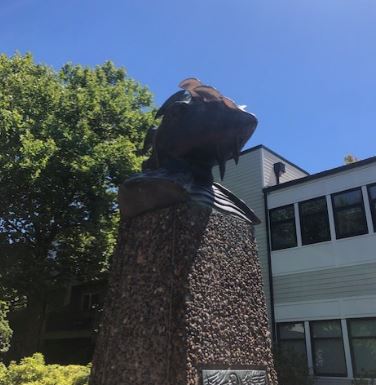
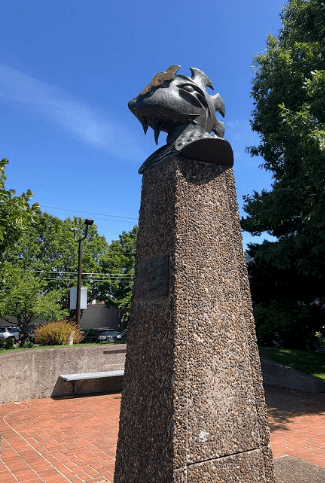
And I have found incontrovertible evidence of Saurian worship in Portland, Oregon! I stumbled upon a hidden monument to the Saurians in a small park in NW Portland.

A weathered stone base: older than you think!

Notice the pinnacle of the obelisk and the deeply weathered base; clearly erected far earlier than any archaeologist will admit. Locals call it “Fish Park” thinking that the glorious bust is a mere fish, ignorantly they gloss over the shoulders to make the strange innocuously familiar.

Ancient Aliens!

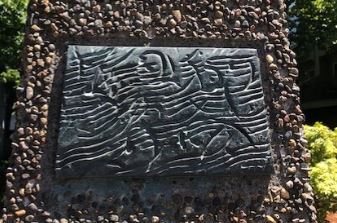
And the commemorating plaque is written in no Earthly language!

Need a Xenolinguistics expert!

These shape-shifting Saurians infiltrated the system to create a Deep State, they have also converted select humans who install these tributes to the hidden Overlords.

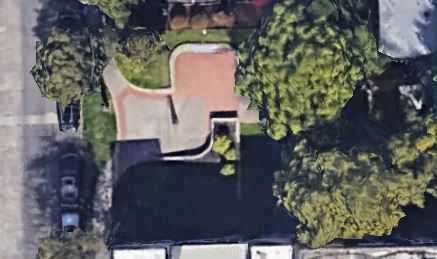
Google Earth – you can see the shadow of the obelisk

The brazen tribute is in plain view. And it is private property disguised as a public park! The layers of deceit are profound: ownership hidden in Limited Liability Companies run by General Partnerships with a web of inter-related parties to confound even a diligent investigator.

But, but, but: Qanon knows how to read the signs.

And yet they still have not uncovered the identity of Q.

Trump? Ted Kennedy Jr?

No!

I must admit I am surprised that no one has discovered (am I the only one?) that Q is none other than the celebrated Italian semiologist, Umberto Eco. He gave us the first glimpse of the Truth in Foucault’s Pendulum (1988) – and then disguised his later writings in more opaque (albeit prosaic) novels and essays, because the Truth cannot be made too evident. On February 16, 2016, knowing that candidate Trump was a Saurian in disguise, Umberto faked his death to hide from the Saurians and dedicate himself to training the resistance. He worked quietly from 2016 until, under one of his least known monikers “Q,” Umberto made a bold master-move: a post on 4chan as a false flag to draw out and identify those humans who were devoted to the reptilians.

It remains a dangerous game to incite those faithful to the Saurians, climate and vaccine deniers all, in order to spread disinformation while trying to inoculate the True humans. Strategic deceptions, layered upon layers, like only a semiologist can! And the proof of it?

Look at how hard Covid-19 hit Italy. Clearly the Saurians were using viral carpet-bombing tactics in a desperate attempt to eliminate Umberto’s guiding genius. But it did not work! Umberto remains alive and well. Look deeper into the message boards; pry beyond first to third order meanings to divine the True message to the resistance. Resistance is never futile!

Dear reader, keep the faith! We need to discover the truth – the Truth is Out There. We will learn to build a credible defense – resist!

_____________________

The Great Map

The Key to Understanding the Truth – it’s all mapped out!

True believers – follow the links and tremble!

TOMAHAWK

James Fenimore Cooper’s Leatherstocking Tales (1823-1841) is a five-part series comprised of The Deerslayer, The Last of the Mohicans, The Pathfinder, The Pioneers, and The Praire. (Mark Twain has a nicely acerbic essay on Cooper’s literary offenses.)

In the Last of the Mohicans (1992) movie, Col. Munro’s younger daughter Alice, grows weary on the escorted ride to Ft. William Henry, and as she lists in her saddle, notices a mountain lion in the bushes. She is the only one in the party who does.

I have been doing some trail hiking to replace the aerobic conditioning I would normally get from training. Because I was on a health-motivated hike, it was a forced march. So naturally, my thoughts drifted to Roman legionnaires and then flitted to Alice in that scene from the movie, reminding me that I need to see the beauty I am surrounded by and not just exercise in it.

After briefly musing on nature’s wonders, my mind wandered back to the movie and the fight scene in the woods. Mugua (played by the brilliant Wes Studi) initiates the surprise attack on the British column by the Huron raiding party. The disciplined British try a battlefield musket volley rendered entirely ineffectual by the dense forest, and the Huron close the gap with tomahawks to make short shrift of the British.

So many valuable lessons to consider! Make sure your techniques are adapted to the environment. The British were conditioned to open field combat – a continuation of the Western Way of War – seeking the decisive encounter. The Huron, by contrast, knew how to use cover, concealment and ambush. (These techniques are adopted by the Colonials and best exemplified by Roger’s Rangers during the Revolutionary War.) The Huron also use a tomahawk – an indigenous weapon that was co-opted by Colonists who copied the stone original to make metal variants. A tomahawk is a pragmatic frontier tool, able to chop small trees, hammer nails, as well as a highly effective close quarter weapon.

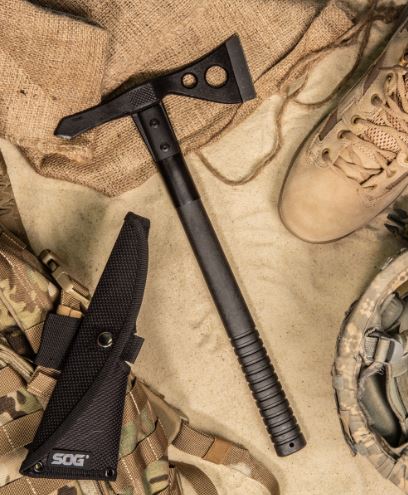
The featured image is from SOG, which replaces a hammer with a spike; a combat variant modeled after those carried by soldiers in Vietnam. There are many excellent versions available in the market to consider.

A tomahawk has multiple active surfaces and its longer handle and heavy head provide opportunities but also require technical adjustments. Mark Hatmaker shows the basic punch – notice the witik strike – and pay attention to the point of aim:

Tomahawk Punching

(Mark Hatmaker also has >these< additional observations on early American adaptations.)

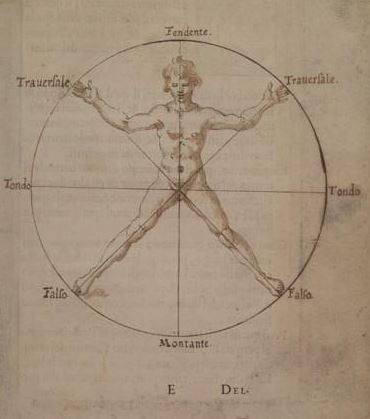
Basic strikes start with the standard angles:

Eight cuts starts the progression

Peter Weckauf (SAMI Combat Systems) demonstrates the basics.

Peter Weckauf

Doug Marcadia presents the tomahawk with a distinct FMA influence: because the head of the tomahawk has multiple planes of engagement, notice the improved hooks and traps that are possible. The handle (punyo) is also a passing, striking, and trapping device.

Integrating a tomahawk as a primary or secondary weapon in an FMA weave, a sinawali pattern expands the possible disarms.

The tomahawk is a great American weapon and a great way to augment the other classic American weapon, the Bowie.

Virtūs et Honos