March 1, 2021, the first Monday class after almost a full year off the Aikido mat. Restrictions are still in place – masked, no-contact training – which makes for a challenging teaching and learning environment. Aikido is an energetic art: we need to touch each other to understand how to ‘blend’ with the intentional force of another.
And it is with full optimism that vaccinations and a declining infection rate will allow us to soon return to a traditional training environment, so I will be posting class notes that (I hope) will systematize a means to remind us all of the fundamental tools that will provide a solid base for further development and expedited learning.
Etiquette – rei (礼)
The importance of etiquette cannot be understated. As a traditional Japanese art, rei is a skill to master. A good overview from the perspective of karate is >here< and it is equally applicable to Aikidoka. For us, the seated bow has additional practical reasons. From the seated position (seiza), proper form derives from the need to maintain awareness (zanshin) and martial efficacity – you need to be able to deploy your sword instantaneously. Therefore, the proper sequence is: first left then right hand down with hands placed so the out stretched thumbs and index fingers almost touch which forms a triangle. As you bow keep your eyes up to stay in peripheral contact with the entire room – don’t ostrich your awareness!
Aikido is an armed art; all its rationale and form derives from the use of the sword (katana) and spear (yari) and short staff (jyo). These tools are the teachers. The tools dictate the forms and informs the basis for all our movements. And it starts with your sword in you belt (obi) as you show proper respect (rei) when bowing to the kamiza and to each other.
Conditioning Exercises
From the bow, we start in seiza (kneeling seated position). Practice moving gracefully from seiza where the toes are flat to the earth to kiza where the toes are up and ready to spring you up or forward. Accomplish this by pushing your weight up using only your legs, keep your upper body relaxed but still and spine held straight. Push your head up, do not rock forward. Repeat this action until it is effortless to go from one position to the next.
Return to seiza to find your hara (center), which anatomically is forward of and near the top of your sacrum. To develop internal awareness, in seiza, rock forward and back with the movement starting at the hips. Do not bend your spine and hold your head still so as not to bend your neck. The purpose is to find the limits of your range of motion and improve upon it. Keep rocking forward and back, keep your awareness low. Then shift side to side. Again the motion should stretch toward the ilium, the top of your hip bones, keeping your spine straight.
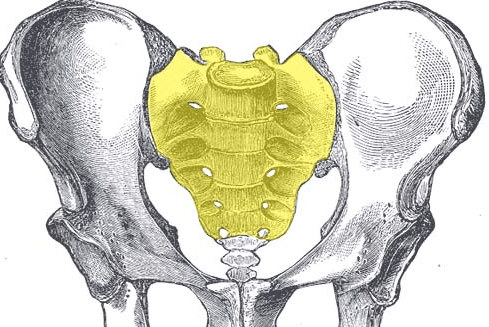
While shifting front to back and side to side, your hands should rest lightly on your thighs. Allow them to move with your motion. Having found the range of motion in two planes, you should have a sense of where your hara is. Now that point becomes the center of an internal circle. With spine still straight, begin a circular rotation around your hara. Circle first one direction, then reverse it. Imagine your head is a pestal and the base of your sacrum is the bottom of a mortar.
I admit to a lax aerobic training regime over the winter. So to get back some conditioning and familiarize ourselves to the proper use of the body in Aikido, we use an “Aikido burpee.” Starting from standing hanmi (half-stance), the movement pattern is: front foot back, fold it underneath your buttocks as if for a back roll, use your front leg to piston down to a controlled drop, without outstretched arms slap the mat to dissipate energy, tuck you chin to your chest as the momentum rolls you back along your spine, then when your feet are in the air, switch them, and as your return momentum carries you forward again, tuck your leg under you buttock to push yourself back to standing in the opposite hanmi. Focus on using your lower body for muscular energy – your legs push you up vertically. Resist the need to use your hands, or to project your head forward to increase momentum. This exercise develops the leg muscles and core abdominals while conditioning your spine and back to receive energy and dissipate it.
Next the “rowing exercise” (funakogi) – but without the kiai to avoid explosive exhalation and potential of Covid spread. The earlier linked posts cover the details, but for the first class, the emphasis was on relaxed shoulders and movement from the top of the hip bones while keeping rooted engagement with the feet to mat. The developmental rationale is again based on the use of weapons. We are grounded to provide a stable platform for their use, which is in contrast with unarmed arts that tend to be elevated for ranged attacks (high kicks and extended punches).
Next, shikko (knee walking). Shikko is a traditional means of locomotion in Japan. Low seated positions and the lack of high-back furniture produce better posture and shikko is more efficient than constantly getting up and down to traverse a given space. Aikido retains this artifact as a lower body conditioning exercise, but it also has combative applications – more on that in other posts. Starting from seiza (seated kneel), the first leg is raised, knee leading so that the patella shows the line of travel. Your nose and raised knee are in the same line. Your back leg remains perpendicular to your front, toes are up and heels directly under the buttocks. Your feet should always remain as if tied together so they move in unison. The sequence is, front leg up, then down, push your back leg up and forward your hips open at least to 90 degrees each time. Your legs carry your upper carriage which should remain stable and undisturbed as you glide along the mat, arms freely able to deploy and use your sword.
Add a turn: Every turn must start with the head – the eyes must re-acquire the target as quickly as possible! Like “spotting” in ballet, the head initiates the turn, as you rotate your head, your lower body must follow, exaggerate the hip opening to facilitate the turn – avoid ‘spinning’ on your knees – and focus on snappily returning to the line of travel to maintain balance and precision.
This manner of movement is applicable to a standing walk. Pay careful attention to maintaining contact with the mat using the whole flat of the foot. There should always be an audible glissade as the feet move. The rationale for this sliding step is to feel objects and to avoid tripping over them while carrying deployed weapons. While eventually, standing movements should start from shizentai (natural relaxed posture), for now, start from an ‘athletic stance’ with both knees softly bent, weight evenly distributed over both legs, feet shoulder width apart. Movement starts from the iliac crest (your hip bones) – remember how you found your hara – that is a foundational exercise and the origin of our movements.
Once forward motion is comfortable, then move in reverse. The feet still slide, glissade, so resist the habit of ‘stepping’ and lifting the feet. Turning should be done just like from shikko – a snappy turn initiated by ‘spotting.’ A combative application is a spinning back fist – the arcing energy of your body has to hit a precise target, which is exactly 180 degrees from your starting point – no more, no less! Maintain your balance and poise through the turn – remember the arcing movement is a byproduct of your need to get back on the line of travel.
From standing movement develop the facility to move easily to shikko then back to standing movement without breaking stride or pace.
In this class we covered this in a cursory manner, later we will add ukeme (rolls) into the pattern and change direction (forward/back) to develop spatial awareness and dexterity.
The final movement exercise was the ‘grape vine’ walk where the legs cross forward and back to carry you along a line with the blades of your feet pulling you left and right rather than forward and back. The exercise should enhance awareness of foot placement as well as encourage iliotibial band (IT band) flexibility.
Contextual Applications
The weapon as teacher. I demonstrated the basic iaido draw to emphasize the forward and outward arc while keeping in balance. Practitioners must move along two distinct planes of motion: the lower body moves forward and vertical while the arm is horizontal and outward arcing. One must maintain poise and balance despite the arcing momentum. Stop the kissaki (tip of the sword) at the target’s tracheae. Keep the arm and sword parallel to the ground and visualize your target. The elbow is soft and tip out to keep the kissaki aligned. Now add a paired exercise: Ki-musubi (to tie ki together). Both players draw and maintain their swords targeting the opponent’s tracheae at a fixed distance each participant finds Covid-comfortable while maintaining sincerity of intent. From that initial position, advance and retreat in time without changing the distance. This requires astute attention to one another to keep in time and at a fixed relationship while traversing the mat.
Challenge yourself to maintain soft elbow and shoulder while carrying a moving weight (sword) level and in a fixed location. Both players keep their spirit projecting toward the other regardless of the direction of travel – even while moving backward keep forward intention.
Although in class, only the right hand draw was used (all samurai were right handed!) future classes will add the left side for bilateral development.
Closing Kata(s)
Ai-hanmi katatedori ikkyo/nikkyo replicated as a solo kata (form) with a sword in sheath is a weapon retention technique. Uke approaches to grasp nage’s sword by the hilt with the intention to draw the weapon and use it against its owner. Nage starts in shizentai but takes an arcing step back with left foot to protect his sword as uke advances to grab it. While in movement, nage grabs the handle with right hand to prepare for the draw. Once nage hits 90-degrees from the starting position, draw the sword with an outbound arc, kissaki leading, and stop the cut just beyond parallel to the ground. Sequentially, nage then supports the blade by placing the flat of his left palm on the mune (back or false edge of the sword). The left hand on blade replicates the elbow control in an empty hand presentation of ikkyo. The left (back) foot advances in time with the left hand replicating a pin (this ends ikkyo). From that terminal position the right leg now steps in an arcing 90 degree advance into uke’s space while the right hand raises the handle to nage’s high-line, keeping the blade toward uke’s neck while the left hand stays low-line to brace the bottom of the blade and the left foot steps back. Nage is now 180-degrees from the initial encounter (i.e. you made a complete turn). This hand position inversion while arcing is the corkscrew energy of the (nikkyo) pin.
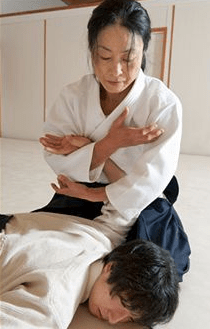
The sword represents uke’s arm held vertically and the advancing turn is the torquing pin. This solo kata should be done with both sides for bilateral development.
The challenge of kata is the need to visualize the encounter and the proper sequencing of action (step a, to b, to c) while effecting precise foot and hand movements. Teaching kata requires assiduously monitoring the student’s precision in motion and sensing the clarity of intent given each student’s zanshin at each stopping point, because there is no other feedback mechanism to give the student information.