Gail Kelly had us read Emmanuel Todd’s, The Explanation of Ideology: Family Structures and Social Systems, shortly after it was first released in 1985. She loved the breadth of the work and I recall her musing, “Mr. Barker, wouldn’t it be wonderful to be French? To be so certain you were right?” That Gallic confidence – nay, the raw arrogance – and audacity of scale impressed her.
Todd has surfaced again and his work is being tested
Many years ago, Emmanuel Todd came up with a classification of family types and argued that the historically prevalent family types in a society have important consequences for its economic, political, and social development. Here, we evaluate Todd’s most important predictions empirically. Relying on a parsimonious model with exogenous covariates, we find mixed results. On the one hand, authoritarian family types are, in stark contrast to Todd’s predictions, associated with increased levels of the rule of law and innovation. On the other hand, and in line with Todd’s expectations, communitarian family types are linked to racism, low levels of the rule of law, and late industrialization. Countries in which endogamy is frequently practiced also display an expectedly high level of state fragility and weak civil society organizations
Data-testing grand visions is always death by Lingchi; ethnographic exceptions to the rule start to pull the focus downward, cloud the clarity of the broad view.
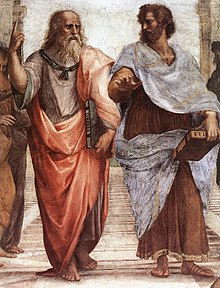
Raphael captures Plato admonishing Aristotle to get out of the guts of the cuttlefish
But the scale of the work is precisely why it is important – to remind us to look for the universal connections, the Claude Levi-Strauss common mind of mankind.
The nattering noise of individual “truths” will no doubt only further focus attention on the parsimonious understanding of sociology.
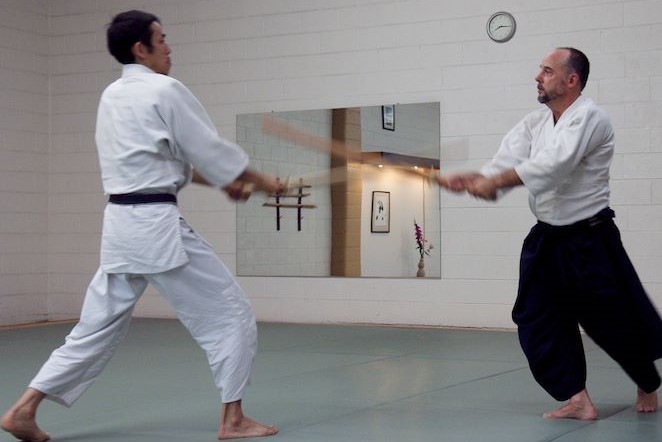
Over the last two classes, we covered the foundational suburi (sword forms) for bokken which are derived from Chiba sensei’s curriculum. We will continue to refine and expand the conceptual movements over the next several classes.
To provide video references between dojo sessions, here are the eight basic suburi as demonstrated by Hori sensei:
And this presentation from Brady sensei who was an early student of Chiba sensei’s when he was in England:
These forms are simple patterns.
Numbers 1 and 2 are essentially the same, with the only difference being the maai of the opponent, forcing nage to either retreat (#1) or enter (#8) to close the distance. Numbers 3 and 4 are linked, with #3 as a tenkan and #4 a draw cut, but again the same pattern with either a retreat (#3) or closing movement (#4). Numbers 5 and 6 address a flanking opponent and the close or more distant maai. Number 7 contemplates an opponent immediately to the rear (check your 6 o’clock!) and number 8 is similar to 5 and 6 in addressing the flank but this time the inside line rather than the outside.
When we get back to empty-hand contact training, the shihonage forms in #3 and #4 will be easily recognized and felt.
Because the suburi can be practiced solo, they are immensely beneficial to augment your Aikido training during the time of Covid. Focus on developmental precision – remembering only perfect practice makes for perfect form.
Hints. Use a fixed starting marker for your right big toe. As you move through each of the eight suburi, at the conclusion of each, your toe should hit the same starting mark. To ingrain precision, make sure all cuts remain on the same line, you are hitting only the four cardinal directions: For suburi 1, 2, 3, 4, and 7 you only cut north and south (zero and 180-degrees) and suburi 5, 6, 8 cut east and west (90 and 270-degrees). Once you develop familiarity with the footwork necessary to perform these eight suburi and can move smoothly through the patterns, the next level of development is conceptual. Meaning, these cuts and the associated footwork appear to cover only four angles, simply rotate these four 45-degrees and now all eight are addressed.
Slow is smooth, smooth is fast. While demonstrating, I will often break the continuous movement of the sword at check points. I do this to provide visual markers so you can verify that the sword position is correctly oriented. But once you can hit each mark with precision, then it is time to work on continuity of motion. Remember, the sword cuts with velocity, with continuous motion, not with muscular force, so keep the shoulder joints freely moving!
Transitions are critical. Moving your body around and under the sword so that you do not slow its motion is key. This is easier to demonstrate in class than it is to describe in writing, but the general reminder is that each time you turn your body, it should be under the sword to avoid ‘cavitating’ the blade. The sword should be moving in continuous arcs on the vertical axis only throughout these eight suburi.
As we get back to training in the dojo, movement and breathing are the keys to development. To facilitate upper and lower body integration, conditioning practice focused on Suri ashi and Okuri ashi footwork: contact with the ground with a variety of movement patterns. The patterns derive from Japanese swordsmanship and kendo preserves the granular distinctions for further study. Using Japanese labels reinforces the importance of the pattern differences and should help in remembering them. [1]
Because contact based training may still be months away, independent conditioning exercises are all we can do. Fortunately, there are solo kata that will inform our movements.
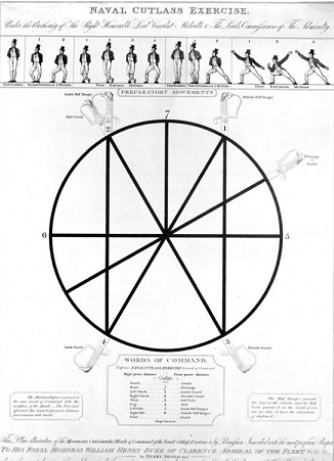
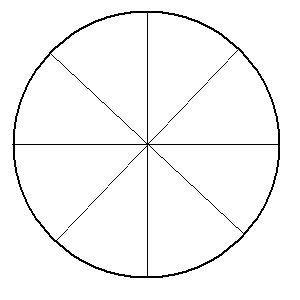
Happo Giri is a foundational exercise. It teaches universal lines in two planes. On the vertical axis, it is a targeting map. On the horizontal plane, it shows paths of travel.
Happo Giri – 8 Direction Cut
On the ground each of the eight cardinal points on the circle represent the location of an opponent. Eight weapon-wielding assailants is the maximum number which can approach without severely interfering with each other. Therefore, each line represents an avenue of engagement.
When visualizing the same eight lines in front of you, they represent the lines of your sword cuts. The eight cuts are found in all sword systems – and later derivations are just expansions on the basic pattern.
“Oak” and “fruit forward” are for wine amateurs. “Cedar” and “barnyard” are for real connoisseurs, and only a professional would have the confidence to deploy “gravel” or “tennis balls”. One tasting note says a wine has hints of “mélisse, lemon-balm”. If you are wondering what “mélisse” is, don’t bother: it is actually just French for “lemon-balm”.
The language of wine is easy to mock. It can be recondite, even downright obscure. Oenophiles make a convenient subject for ridicule: if their cellars require such a wide-ranging lexicon, they are probably rich enough to cope with it. But wine vocabulary has its uses. Among the vast array of tastes, perhaps even flowery labels help experts pinpoint odours and flavours that they are interested in and want to remember. If you have a name for something, it may be easier to keep it in your head.
Perhaps. You might have heard the stereotyping joke about women having hundreds of words for colour in their vocabularies because they love to shop, but men having just the eight that come in a child’s crayon box. This is a caricatured and simplified version of Ludwig Wittgenstein’s view that “the limits of my language mean the limits of my world.” The underlying argument is that having a name for something lets you understand it. But researchers have found that the links between perception, cognition and language turn out to be more complicated than that.
The debate over the relationship between thought and language is one of the most heated in psychology and linguistics. In one corner is the “Sapir-Whorf hypothesis”, named after two early-20th-century American linguists, who posited that the world is made up of continuous realities (colour is a classic example) that are chopped into discrete categories by language. People perceive what their vocabulary prompts them to. An extreme version of this theory holds that it would be difficult, even impossible to distinguish colours—or wine odours or flavours—without names for them.
On the other side of the debate are those who say that although language is indeed linked with cognition, it derives from thought, rather than preceding it. You can certainly think about things that you have no labels for, they point out, or you would be unable to learn new words. Supposedly “untranslatable” words from other tongues—which seem to suggest that without the right language, comprehension is impossible—are not really inscrutable; they can usually be explained in longer expressions. One-word labels are not the sole way to grasp things.
Into this dispute comes a new study of wine experts and their mental labels. Ilja Croijmans, Asifa Majid and their colleagues gave a host of wine experts and amateurs a number of wines and wine-related flavours (such as vanilla) to sniff. Some from each group were told to name the odours they encountered; others were not. Then they were given a distraction to clear their minds, followed by a chance to recollect what they had smelled. As expected, the experts performed better than the amateurs—but those who articulated their thoughts did no better than those who had not.
Some who did not label the odours out loud may have done so in their heads. So the researchers conducted a second experiment. Some subjects were distracted while sniffing by a requirement to memorise a series of numbers, making it harder for them to verbalise what they smelled, even mentally. They did no better or worse than a second group who were given a visual distraction (memorising a spatial pattern), or a control group with no distractions.
The team conclude that olfactory memory in wine experts, at least, is not directly mediated by language. This is not to say such language is useless. Vinologists describe wines more consistently than amateurs do, meaning that—contrary to sceptical gibes about their pretentiousness—they are not just making up what they taste.
Ms Majid says that rather than ask whether language affects cognition—since it clearly seems to, at least some of the time—the real question is what functions it affects. Perception, discrimination and memory are not the same thing, and some might be swayed by language more than others. Mr Croijmans compares words to a spotlight, which may not give you the ability to perceive things you could not otherwise, but rather help separate them from the background. That is a rather more positive version of Wittgenstein’s aphorism: language not as a limit, but as a light.