Arrakis teaches the attitude of the knife—chopping off what’s incomplete and saying: ‘Now, it’s complete because it’s ended here.’
Dune, Collected Sayings of Maud’Dib by the Princess Irulan
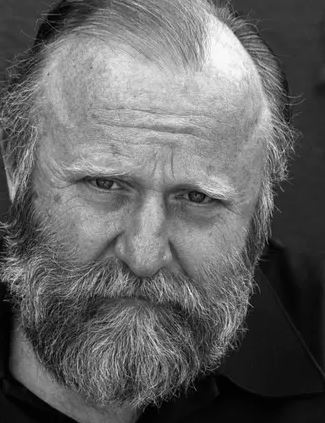
I first read most of the Dune saga in high school and arrived at college in Oregon eager, naïvely, to meet its author. A classmate from the Pacific Northwest laughed and told me Herbert had died earlier that year (February 11, 1986). The desert already had reclaimed its prophet.
___________________
The seed of Dune sprouted in Florence, Oregon, where the U.S. Forest Service was experimenting with sand stabilization to keep dunes from swallowing the highway. Herbert became fascinated by the physics of moving sand (fluid dynamics) and wondered: what if an entire planet behaved that way? From this question flowed another realization: most religions arise in the desert. Out of that terrain Herbert layered ecology, anthropology, and theology to produce an epic: man shaping his world and the world reshaping him. “Ecology,” he said, “is the science of understanding consequences.”
Ecology as the premise
The political architecture of Dune is explicitly feudal; a recognition that human societies, left to themselves, crystallize into hierarchy. Herbert used that archaic clarity to expose the mechanics of power. He distrusted centralized authority and viewed bureaucracy as entropy in political form.
I wrote the Dune Saga because I had this idea that charismatic leaders ought to come with the warning label ‘May Be Dangerous To Your Health’
JFK was on his mind; Paul Atreides became the example. The hero’s arc was itself the warning label.
The religious and psychedelic threads (prescient vision, ancestral memory, the trance logic of prophecy) were likely deepened by Herbert’s experiments with peyote and his 1960 friendship with Alan Watts. These encounters widened Dune’s exploration of time and identity, of consciousness folded into matter. The Zen-Sunni syncretism and the Orange Catholic Bible anchor Paul’s metamorphosis from noble to messiah. In gaining mythic vision he forfeits individuality, dissolving into the Jungian collective he embodies.
The Fremen form Dune’s moral axis; a persecuted people who remain resolutely stoic, adaptive, ecological. Paul joins them and is remade as Muad’Dib. The parallels are deliberate: T. E. Lawrence, leading his men to Aqaba on one horizon, the Islamic Mahdi on another. Their prophecy promises a leader who will “guide us into paradise.” Paul fulfills it, reclaims his title, ascends the throne, and begins to green the desert. Yet in Herbert’s geometry, every paradise conceals its own fall; the seed of jihad germinates in the first oasis.
Herbert had originally conceived Dune and Dune Messiah as a single novel showing Paul’s ascent and fall entwined. Only at his editor’s insistence was it divided for length. Thus Dune ends at the false summit of triumph, where the myth still shines. “The difference between a hero and an anti-hero,” Herbert observed, “is where you stop the story.” Messiah resumes the line and bends it downward. Paul abandons, in fear, his prophetic visions. The Jihad has shattered feudal limits: humanity expands explosively, but at an immense cost of life.
Herbert deliberately ended Dune at the point of Paul’s apotheosis. As Herbert said, “The difference between a hero and an anti-hero is where you stop the story.” That distinction becomes explicit in Dune Messiah, where Paul abandons, in fear, his prophetic visions. The Jihad has shattered feudal limits: humanity expands explosively, but at an immense cost of life.
Paul’s son Leto II inherits the burden and conceives the Golden Path: a forced evolution to prevent extinction. He sees that humanity, if left within its feudal terrarium, will suffocate. Merging with sandtrout, he becomes the God Emperor: half human, half worm, wholly necessary because it was the only means to extend his life, to become the God Emperor, and force humanity down the path.
Ever the ecologist, Herbert warns us against humanity becoming a monoculture. As large as it was, the known universe could be controlled by a single interest (the spice) and single will (the God Emperor). Such a structure is vulnerable. Leto’s rule is purposefully oppressive to “teach humanity a lesson that they will remember in their bones.”
What is that lesson?
That safety breeds extinction. Sheltered safety inextricably culminates in species stagnation and death. To inoculate the species, Leto restricts spice, limits travel, and engineers pressure to force rebellion, dispersal, and the evolution of minds opaque to prescience.
Herbert understood that humanity needs conflict and volatility to flourish. He knew that peace, pursued too perfectly, becomes a trap. Leto’s tyranny drives humanity outward, guaranteeing survival through diversity.
Herbert treated evolution not as backdrop but as engine. The Fremen and Sardaukar are early proofs: harsh worlds forge superior stock. Under Leto’s empire, breeding replaces battle as selection pressure. By Chapterhouse, even the average human runs marathons; the exceptional dodge las-fire. The Bene Gesserit’s ancestral recall and the Honored Matres’ synaptic ferocity are refinements of the same law; environment sculpting potential.
Heretics of Dune shows that the Golden Path succeeded. Prescience no longer governs destiny; human will is free again. The newly arrived Honored Matres return from the Scattering with lethal skills but flee an unnamed, greater threat.
By Chapterhouse: Dune, survival seems assured, though danger remains diffuse. The species endures precisely because control is gone and human potential is unlimited.[1]
________________
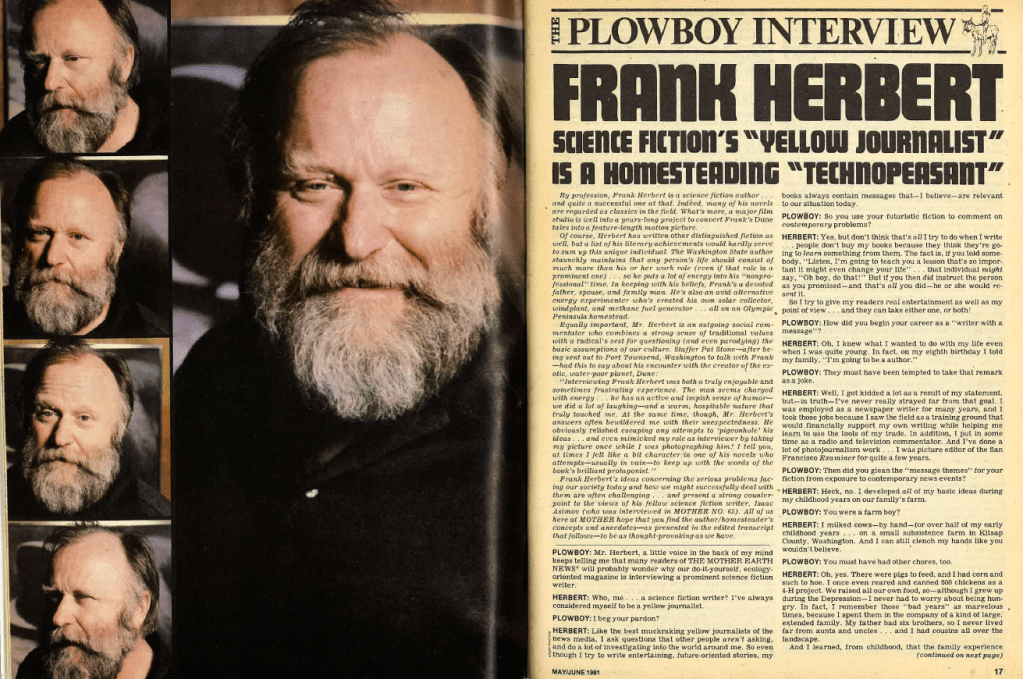
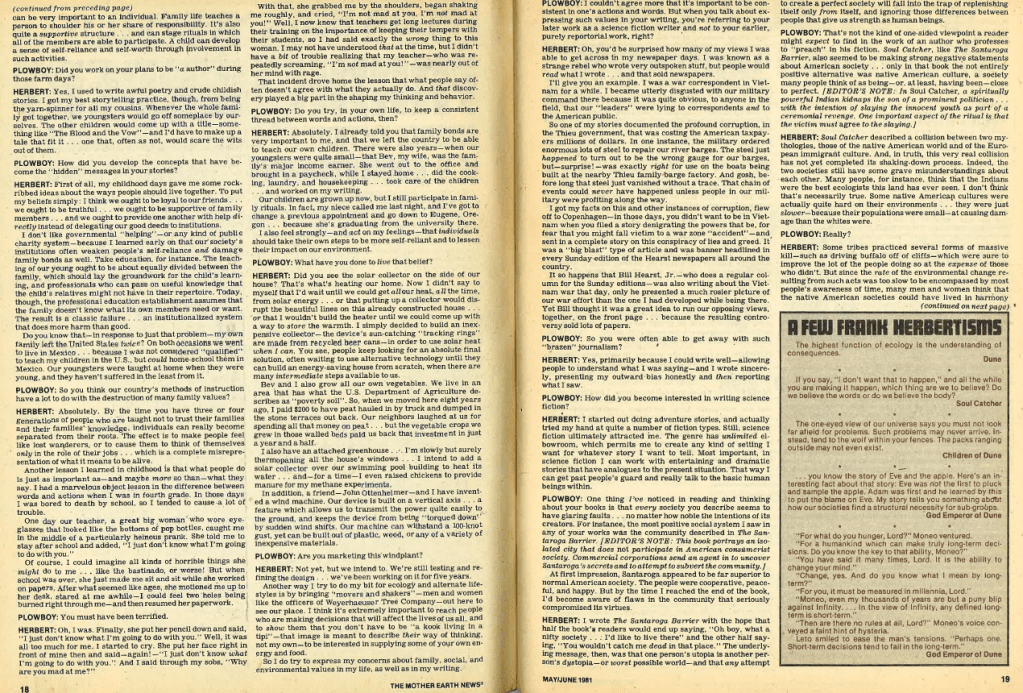
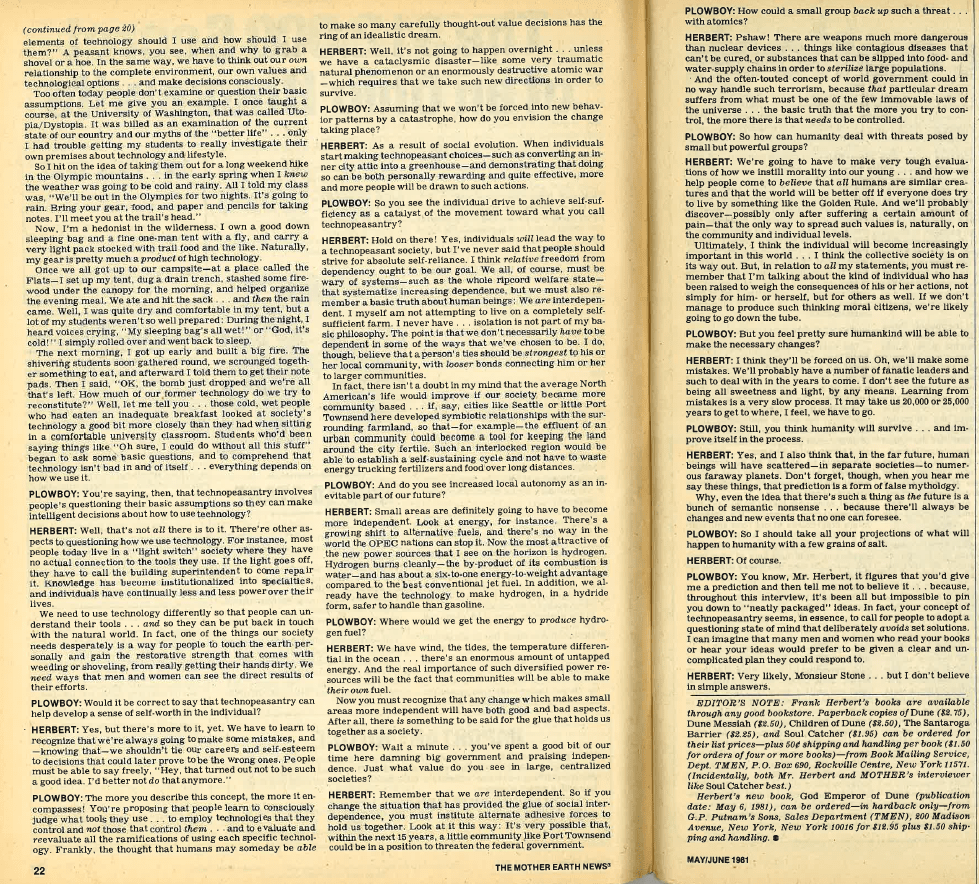
Below are images from Mother Earth News, #69, May/June 1981 – an interview with Frank Herbert.
>This< recent paper on cellular learning is an intriguing potential – some basis for the idea of gholas and genetic memories? Can single cells learn?
________________
[1] I do not consider anything written by Frank Herbert’s son as canonical. I have read only the first few chapters on one of the all-too-numerous additions. Unfortunately his son is not the writer his father was.
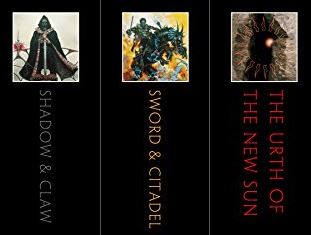
Wolfe’s The Book of the New Sun (1980-1983, 1987) comprises The Shadow of the Torturer, The Claw of the Conciliator, The Sword of the Lictor, The Citadel of the Autarch, and The Urth of the New Sun. Set in the far future when the Sun itself is dying, it is on the surface a bewildering chronicle of an exiled torturer. He has been rightly called “the Modern Melville” for his narrative density, theological depth, and intertextual brilliance.
As may be evident from some of the footnotes in these posts, I like to find connections among disparate sources. Recently I read an article in Nature that reminded me of Wolfe. That article reported on a paper published in 2011, entitled “Observation of the Dynamical Casimir Effect in a Superconducting Circuit.” Its abstract distilled a revelation:
One of the most surprising predictions of modern quantum theory is that the vacuum of space is not empty. In fact, quantum theory predicts that it teems with virtual particles flitting in and out of existence. While initially a curiosity, it was quickly realized that these vacuum fluctuations had measurable consequences, for instance producing the Lamb shift of atomic spectra and modifying the magnetic moment for the electron. This type of renormalization due to vacuum fluctuations is now central to our understanding of nature. However, these effects provide indirect evidence for the existence of vacuum fluctuations. From early on, it was discussed if it might instead be possible to more directly observe the virtual particles that compose the quantum vacuum. 40 years ago, Moore suggested that a mirror undergoing relativistic motion could convert virtual photons into directly observable real photons. This effect was later named the dynamical Casimir effect (DCE). Using a superconducting circuit, we have observed the DCE for the first time.
The existence of these particles is so fleeting that they are often described as virtual, yet they can have tangible effects. For example, if two mirrors are placed extremely close together, the kinds of virtual photons that can exist between them can be limited. The limit means that more virtual photons exist outside the mirrors than between them, creating a force that pushes the plates together. This ‘Casimir force’ is strong enough at short distances for scientists to physically measure it.
The ancients called mirror-divination catoptromancy (Gk. κάτοπτρον, katoptron, “mirror,” and μαντεία, manteia, “divination”). [The Forgotten History of Mirrors] Wolfe re-enchants that forgotten science with physics.
In Chapter 20 of The Shadow of the Torturer, “Father Inire’s Mirrors,” Severian recalls Thecla’s story of her friend Domnina visiting the court magician after witnessing something impossible in glass.
She realized when she see saw them that the wall of the octagonal enclosure through which she passed faced another mirror. In fact, all the others were mirrors. The light of the blue-white lamp was caught by them all and reflected from one to another as boys might pass silver balls, interlacing and intertwining in an interminable dance. In the center, the fish flickered to and fro, a thing formed, it seemed, by the convergence of the light.
The interposed mirrors conjure being from absence. Whether or not Wolfe knew of the 1947 Casimir proposal, Father Inire’s experiment parallels the DCE precisely; light summoned from the void parallels Inire’s summoning a ‘fish’ with his mirrors. The passage continues:
‘Here you see him,’ Father Inire said. “The ancients, who knew this process at least as well as we and perhaps better, considered the Fish the least important and the most common of the inhabitants of specula. With their false belief that the creatures they summoned were ever present in the depths of the glass, we need not concern ourselves. In time, they turned to a more serious question: By what means may travel be effected when the point of departure is at an astronomical distance from the place of arrival?”
Father Inire dismisses summoning a denizen of the mirror as less interesting than the more serious question of achieving faster than light travel. Respecting that nothing can achieve speeds greater than light, Father Inire explains to Domnia that, with concentrated light and optically exact mirrors, “the orientation of the wave fronts is the same because the image is the same. Since nothing can exceed the speed of light in our universe, the accelerated light leaves it and enters another. When it slows down, it reenters ours, naturally at another place.” So, the mirrors effect time dilation or perhaps fold space (like Guild Navigators in the Dune saga).
Because the characters in Wolfe’s epic do not have equal familiarity with technology, the words they use to describe space travel are archaic metaphors – emphasizing the rareness of exposure and the knowledge deficit.
One space sailor that Severian meets, Hethor, describes his ship being:
Sometimes driven aground by the photon storms, by the swirling of the galaxies, clockwise and counterclockwise, ticking with light down the dark sea-corridors lined with our silver sails, our demon-haunted mirror sails…
For Wolfe, technology is a fallen form of miracle, a material echo of divine power misunderstood by men. The mirror-sails that catch light are both engines and icons: they suggest a world where even propulsion depends upon reflection. This is the theology of incarnation: grace moving through matter.
More prosaically, the “mirror sails” recall Clarke’s Sunjammer (1972) and NASA’s 2011 solar-sail tests, but their demon-haunted quality implies risk of summoning. Hethor’s imagery of ticking, spiraling light hints at time dilation and the constant c: corridors of light itself. We learn that these ships (or is there only one?) travel faster than relativistic corridors.
Wolfe doubles the mirror’s function: transport and drive, invocation and motion. Even as Autarch, Severian never masters their nature. Proof that miracle is merely misunderstood engineering.
Beneath the machinery of time travel and the fading Sun [2] lies Wolfe’s Catholic architecture. Severian’s arc parallels the Passion: he is both torturer and victim, executioner and Christ. His memory, fallible yet absolute, functions as conscience made flesh. Expelled from the guild, he descends through suffering, claims the relic of the Claw (a symbol of grace), and finally dies and returns as the New Sun, the Conciliator who renews the world.
In Catholic eschatology, the Second Coming is both judgment and restoration; Wolfe renders it astrophysical. The dying star is creation under original sin; Severian’s resurrection as the New Sun is the redemption of the cosmos itself.
That duality, cruelty redeemed through compassion, reflects Wolfe’s conviction that salvation operates through the fallen. Grace is mediated by imperfection. The torturer becomes the savior because no one else understands pain so well.
___________________
Other textual connections to explore: When first introduced, Tzadkiel is an animal-like apports, evolves to a caveman, then a normal sailor, to a god-like Adonis figure, a giant angel (first male, then female) and as a tiny tinker-bell sized fairy, but Tzadkiel’s true form is likely a star. This alludes to Frank Herbert’s Whipping Star (1970).
Fuliginous derives from “fuligo,” the Latin word for “soot.” English speakers have been using the sooty connotation since the early 1620s to describe dense fogs, malevolent clouds, and overworked chimney sweeps. “Fuliginous” can also be used to refer to something dark or dusky. In an early sense (now obsolete), “fuliginous” was used to describe noxious bodily vapors thought to be produced by organic processes.
___________________
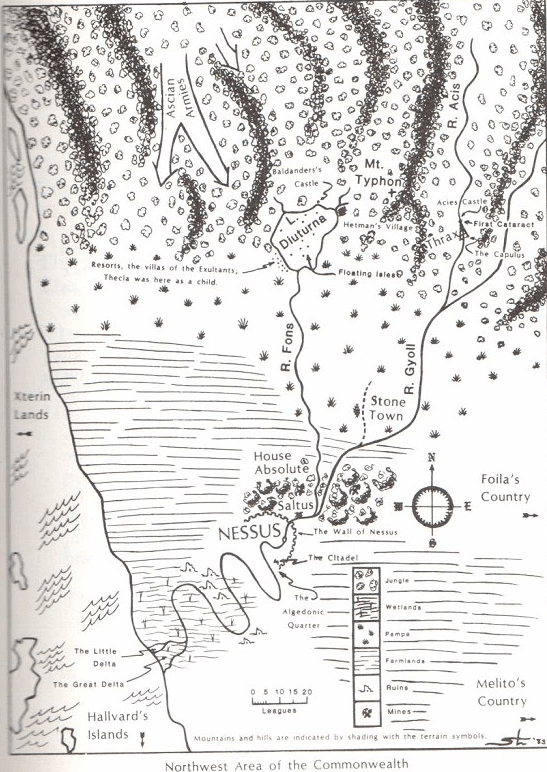
Wolfe shows the long history of human inhabitation of Urth in numerous and subtle ways – the city of Nessus has migrated along the Gyoll and people scour the abandoned sections for artifacts, mines are cities buried where metal is reclaimed and repurposed, Serverian’s tower is an abandoned rocket. Given the span of time this is only logical. Even now anthropogenic mass exceeds that of all life on Earth.
The immense volume of human-made materials is inescapable in Severian’s Urth because it has been continuously inhabited. A related paper (The Silurian Hypothesis) examines whether it would be possible to detect an industrial civilization in the geological record if that civilization had not persisted:
If an industrial civilization had existed on Earth many millions of years prior to our own era, what traces would it have left and would they be detectable today? We summarize the likely geological fingerprint of the Anthropocene, and demonstrate that while clear, it will not differ greatly in many respects from other known events in the geological record. We then propose tests that could plausibly distinguish an industrial cause from an otherwise naturally occurring climate event.
Gene Wolfe provides clues to how far in the future Urth is from us, but never to a level of precision.
Modern stellar physics paints a very different future from Wolfe’s dim red sky. The Sun, a main-sequence G-type star about 4.6 billion years old, is still in its stable hydrogen-burning phase. As it converts hydrogen to helium, the core contracts slightly, raising pressure and temperature, which in turn increases luminosity, about 10 percent every billion years.
In one billion years, that extra heat will trigger a runaway greenhouse effect: oceans will boil, the atmosphere will collapse, and the biosphere will end in blinding light, not twilight. Roughly five billion years from now the Sun will expand into a red giant, swelling hundreds of times its current size and engulfing Mercury and Venus, possibly Earth itself. After that convulsion, it will shed its outer layers to form a planetary nebula and contract into a white dwarf, hot but dim, cooling for trillions of years.
The cosmology is clear: Earth dies by fire long before the Sun fades. Entropy in the stellar sense ends in glare, not darkness. Any world orbiting the Sun in its final age would be scorched, not frozen.
Wolfe knew this. By the early 1980s stellar evolution was textbook knowledge. His choice to imagine a cooling, crimson Sun was deliberate: a symbolic inversion, not scientific ignorance.
He draws instead from H. G. Wells’s “The Time Machine” (1895), whose final pages show the traveler on a frozen shore beneath a blood-red, dying star. Wells wrote before nuclear fusion was understood; he conceived the universe as running down into heat-death and cold. Wolfe retains that outdated image because it harmonizes with his deeper theme of Augustinian decline. In The City of God, Augustine describes the fallen world as light dimming into shadow, awaiting renewal. Wolfe re-casts that theology in cosmological form: the Sun itself is fallen, and its rebirth as the New Sun becomes a literal apocalypse.
If one insists on physical coherence, the text still allows a speculative loophole. A civilization capable of planetary terraforming and interstellar mirrors could, in principle, alter its star’s evolution: siphoning hydrogen for fusion fuel, surrounding it with vast collectors, or dimming its output through Dyson-scale engineering. Such manipulation could extend a star’s lifespan at the cost of luminosity, leaving a system bathed in weak red light; stars visible by day, atmosphere thinned and iron-dust tinted. Urth’s red spectrum and day-visible stars would then mark a technologically-induced senescence, not natural decay.
Wolfe begins where astrophysics ends. He accepts the scientific death of worlds, then reverses it to dramatize the moral death of man. The New Sun promises not a correction of physics but the restoration of grace. The universe, in Wolfe’s telling, obeys thermodynamics only until it remembers God.
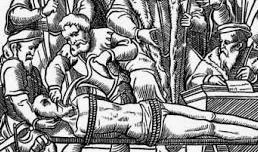
Empirical evidence on contemporary torture is sparse. The archives of the Spanish Inquisition provide a detailed historical source of quantitative and qualitative information about interrogational torture. The inquisition tortured brutally and systematically, willing to torment all who it deemed as withholding evidence. This torture yielded information that was often reliable: witnesses in the torture chamber and witnesses that were not tortured provided corresponding information about collaborators, locations, events, and practices. Nonetheless, inquisitors treated the results of interrogations in the torture chamber with skepticism. This bureaucratized torture stands in stark contrast to the “ticking bomb” philosophy that has motivated US torture policy in the aftermath of 9/11. Evidence from the archives of the Spanish Inquisition suggests torture affords no middle ground: one cannot improvise quick, amateurish, and half-hearted torture sessions, motivated by anger and fear, and hope to extract reliable intelligence.
Re-read that conclusion: “torture affords no middle ground: one cannot improvise quick, amateurish, and half-hearted torture sessions, motivated by anger and fear, and hope to extract reliable intelligence.”
I am not willing to pay for full access to the article, but does this mean that professional torture extracts reliable and actionable intelligence? Was the CIA training curriculum simply not sufficiently advanced?
The phrasing of Ron E. Hassner’s abstract invites the question: if Inquisition torture produced reliable information, does that imply that professionalized torture can yield actionable intelligence? The answer, drawn from Hassner’s data and wider research, is more nuanced.
Hassner’s quantitative review of over 1,000 Inquisition trials (1575–1610) shows that roughly 12 percent involved torture; confessions under torture occurred in about 29 percent of those cases, while non-tortured confessions reached 42 percent. The apparent reliability noted in the archives reflects correlation, not causation. Tortured and non-tortured witnesses sometimes corroborated each other, but inquisitors had already accumulated extensive independent evidence before resorting to coercion. Torture, in practice, confirmed what was already suspected; it seldom uncovered new leads. In other words, its epistemic value was supplementary, not revelatory.
This bureaucratized and highly regulated system differs radically from modern “ticking-bomb” fantasies. The Inquisition’s procedures were conducted by trained officials, under procedural guidelines refined over centuries, within a quasi-judicial framework. Even then, inquisitors treated the results with formal skepticism, cross-checking and often discounting testimony given under duress. Hassner’s conclusion “torture affords no middle ground” underscores that the only circumstances under which torture yielded even partial reliability required institutional control, documentation, and time-intensive verification. These are precisely the conditions absent from emergency intelligence operations.
Contemporary research amplifies the same conclusion. Neuroscientific studies (e.g., Shane O’Mara, Why Torture Doesn’t Work, 2015) demonstrate that acute stress impairs hippocampal memory consolidation, distorts temporal sequencing, and increases confabulation, the creation of false but sincerely believed memories. Psychological analyses of coercive interrogation likewise find that fear, pain, and exhaustion accelerate compliance but degrade accuracy. The 2014 U.S. Senate Select Committee report on CIA interrogations concluded that coercive methods produced little unique, verifiable intelligence and often delayed cooperation or encouraged deception.
Thus, if “professional torture” ever achieved partial reliability, it did so within a framework of obsessive bureaucracy, a system so slow, resource-intensive, and morally corrupting as to be incompatible with modern intelligence needs. The historical record and scientific consensus converge: torture can confirm but rarely discover truth. The epistemic cost is too high, and the moral corrosion total.
For further perspective, NPR’s Fresh Air (Terry Gross, 2012) interviewed former interrogators and psychologists, all emphasizing that rapport-based, evidence-driven methods consistently yield more reliable intelligence than coercion.