SPEAR HAND IN AIKIDO

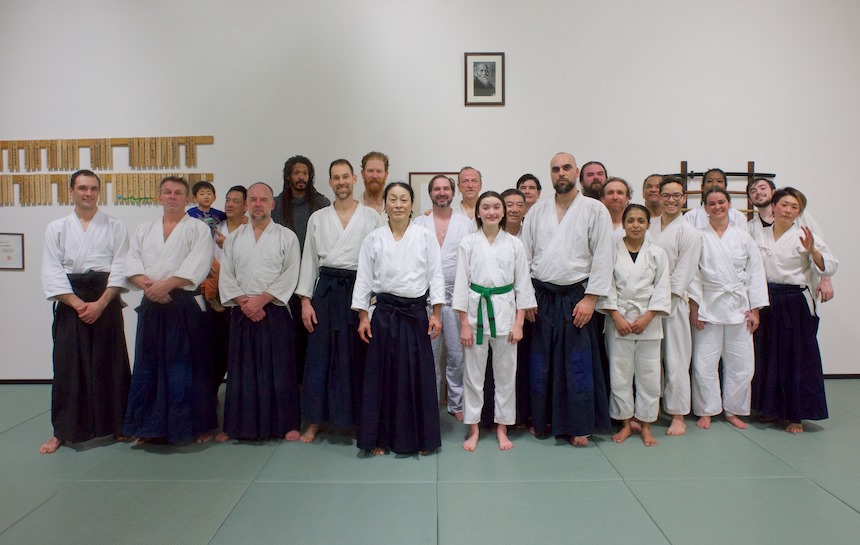
Saturday morning practice at 0830 – it’s not for snowflakes.

Shomen-uchi was the attack which of course could be a punch to the face. Don’t get stuck in linguistic ruts that occlude your ability to see the similarities.

The warm up was suwariwaza with the basic dexterity familiarization: ikkyo, nikkyo, sankyo, yonkyo in a linked (kanren) flow sequence. From there we added a few variations and refinements (henka): nikkyo with a Mulligan-sensei “snake” application, nikkyo using the head as the driver; sankyo done on the vertical axis rather than the horizontal plane; and yonkyo done with both the ligament press and the nerve press.

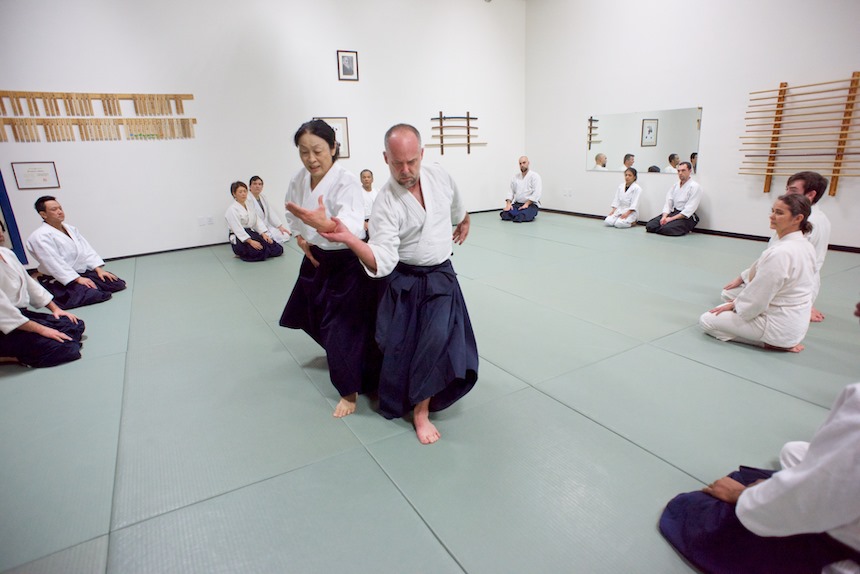
Moving to standing work through discrete responses: ikkyo, flow under kokyu nage, leading to the sequence of ikkyo – (chin strike) kokyu nage – (hip snap supported strike) udekime nage – (uke protects elbow so) shihonage. This is a set based upon chain-logic and proper targeting. Hit each break or strike with emphasis to find the stopping points that are the nodes in a ki-no-nagare presentation. Ki-no-nagare hides the budo, emphasizing the theatrical elegance to the detriment of a deeper understanding.

Deeper understanding: Shomen – irimi nage direct

The kihon presentation is ai-hanmi front hand intercept (R/R, L/L), allowing the back hand control of the neck.

Aikido uses this two hand pattern as a blending – the lead hand finds the oncoming strike, sticks to it so as to allow the nage’s body to enter, the back hand to control uke’s neck, then for nage to pivot snappily to blend parallel to uke (or Yamada-sensei style simply keep driving forward). Both presentations only represent a portion of the possibilities of the encounter.

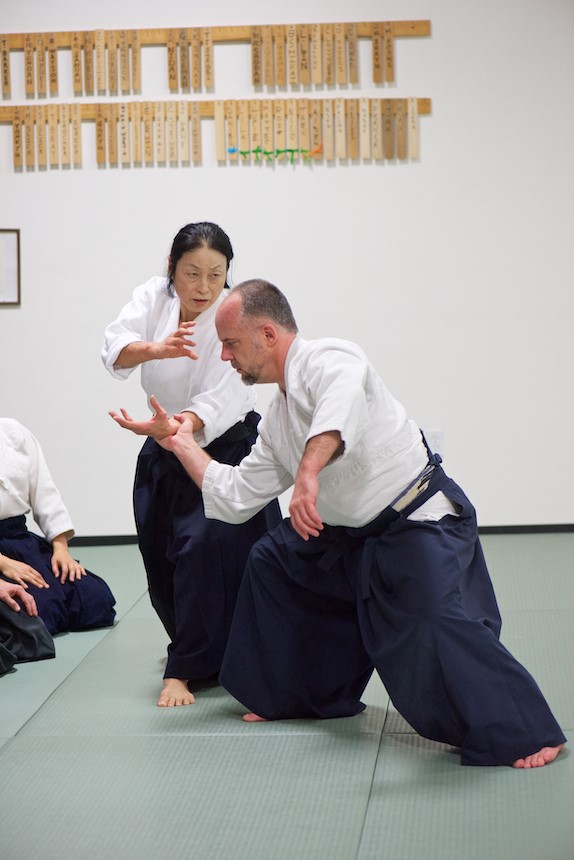
Weaponize the lead hand, or simply use a bill-sao approach and irimi-nage direct is a one-hand response. The intercepting hand receives, redirects and thrusts (throws) all in one beat. This is a dagger response to the outside line.

Kokyu-ho is the inverse of irimi-nage done on a shallow approach. Irimi-nage is a closing (nage’s hands come from the outside to the center) whereas kokyu-ho is an opening (nage’s hands come from the center to extension). The shallow approach means nage’s body position is in front of uke’s lead hip whereas in irimi-nage, nage is behind uke’s lead leg. Stop thinking of these as discrete techniques.

Uke strikes sincerely and nage manages to slip past, then irmi-nage is a viable response. However, if the stike is less committed, or if nage is late and cannot slip past, then controlling uke’s weapon is imperative. Therefore, kokyu-ho.

Kokyu-ho with sword is a cut-counter-cut. Kokyu-ho with a jo is an arm-bar neck-throw (break). Empty-handed its all about how nage presents his shyuto. Both are possible when you are on uke’s outside line.

The inside line response is tenchi-nage.

From shomen-uchi, the kihon presentation is RvR/LvL lead hand cross-block, hand transition to clear the line (i.e., back hand then clears uke’s strike hand) and strike. The strike is done with the shyuto to represent an umbrella shield to counter-yokomen.

find the notch

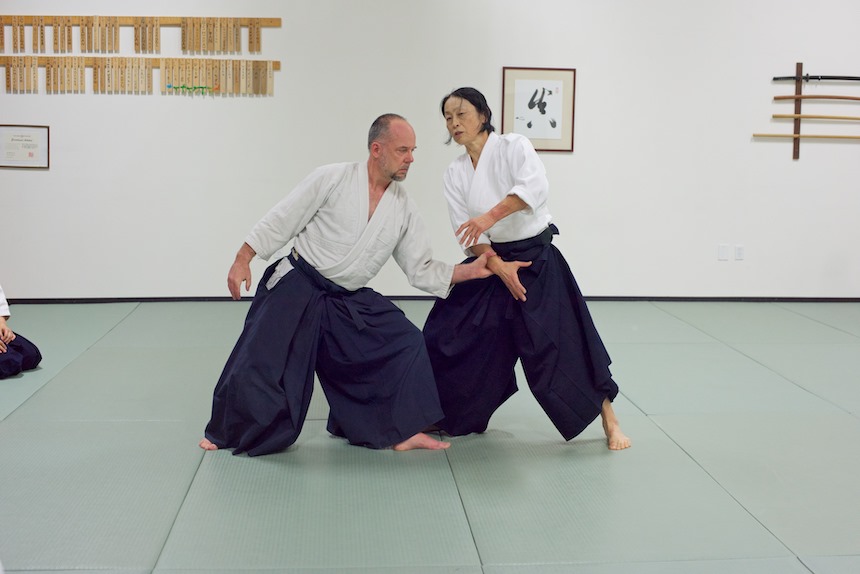
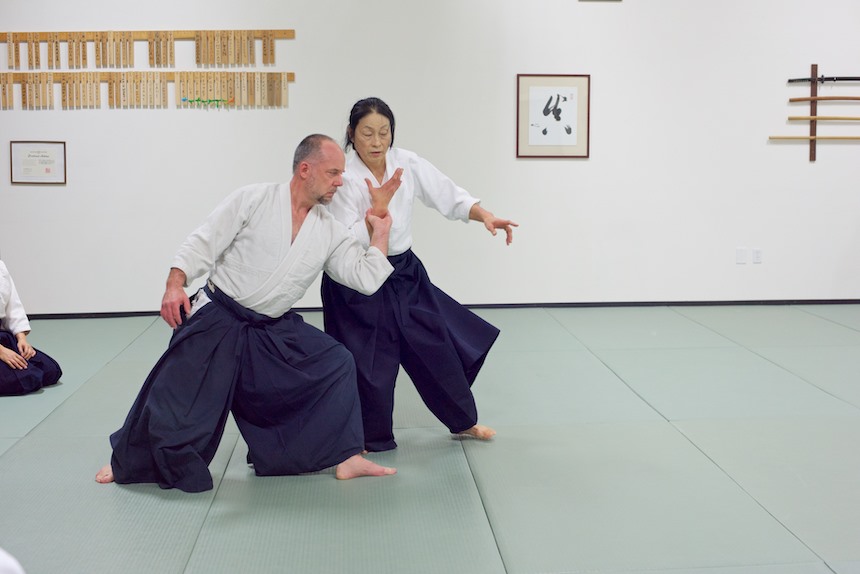
However, the more direct approach is closer to a prayer entry where nage receives the strike with the forward hand (LvR/RvL) and the back hand thrusts to the suprasternal notch. With a dagger this is a straight thrust. Empty handed, your back hand is a spear-hand strike followed by a press straight down fingers behind the sternum. Attack the weak points and exploit human frailty.

Related to the suprasternal notch press is attacking the brachial nerve plexus behind the clavicle

where to find the plexus

Enter irimi-nage and slip fully behind to move from a rear naked choke to come under both arms as if for a full Nelson. You must still control uke’s head (so place yours against it to isolate range of motion), but your hands now move from the back of uke’s neck to grasp both clavicles and dig your fingers into the brachial plexus on each side simultaneously.

Full Nelson (Mandela)

Call them what you will – variations, applications, tricks – they are the pragmatic foundations that back-up your skills – this is how it works when you don’t have a complicit uke with dojo conditioning.

These applications are easy to understand when you have weapons in your hand. The form does not change when you do not have a weapon – you must make your hands into weapons. No that isn’t a metaphor.

_______________________

Nicomedes Floresmy Kenpo instructor’s father

IKKYO – HENKA WAZA

In Levels of Training, I used the three levels of Shoden Chuden Okuden as the framework. In Japanese, there are other terms of distinction that describe a progression of waza through a hierarchical framework would be: kihon, ki no nagare, oyo, henka, kanren, and kaeshi-waza. I prefer to collapse these distinctions and call them complex encounters. But first let us explicate the traditional terms.

Kihon – these constitute the “basic” techniques of the curriculum. In class the presentation of kihon is often done from static to eliminate variables that can limit learning.

Ki No Nagare – the “flowing” deployment of techniques executed from motion. The flow requires blending with an opponent’s ki (energy) which means the variables increase: time, distance and speed now come into play.

Oyo – is the “applied” technique which isn’t emphasized often because we train with a variety of body-types. Oyo is learning how to adapt the kihon to make it “work” with that particular opponent (who may be taller/smaller, stronger/weaker than you). Oyo can quickly lead to Henka.

Henka – are the “variations” because the technique changes during its execution. Henka are the expression of the principles of the technique.

Kanren – means “linking” because the first deployment of a technique to its near completion doesn’t achieve its goal – uke gets back up and nage must then execute another (perhaps different) technique to control uke.[1] Because this linking implies uke is trying to be nage, we have “role reversal” which makes kanren very similar to:

Kaeshi – “turning” or “countering” techniques that are executed because uke has begun a reversal, necessitating nage‘s change to a different technique to counter uke.

The more I train the more these terms are distinctions without differences. They are useful to help build a categorical framework, but my goal is to find the universals, so I simplify these distinctions to “complex” encounters when sensitivity is paramount. Energetic arts. Many martial artists talk about (around) energy which is a convenient short hand for a multitude of physical attributes: intention, pressure, tension, acceleration, which when taken as a whole is the energy that the players bring to the encounter.

Henka-waza – variations are always a response to a change the other player makes – as such they are not ‘techniques’ because you are responding in time to a new stimulus – a variable changed so you must adapt and overcome. Nevertheless, we must present henka as set pieces, otherwise the only instruction is “do the best thing you can in the moment to prevail.” Sound advice, poor instruction. So, a progressive class outline:

Starting from ai-hanmi-katate dori we execute ikkyo omote.

Ikkyo is stopped – so flow under, elbow strike the opponent’s chin and throw kokyu nage. Note your hands never change from the initial ikkyo omote response.

Ikkyo is beginning to be countered ikkyo – so push uke‘s elbow down and past for kokyu-ho. Again, your initial hand position and contact doesn’t change – you are “rolling” over your opponent’s arm until the final throw.

Ikkyo to kokyu-ho is resisted – so do a bone-lock shihonage (remember the wrist twist form, not the forearm as unit [2] form is more efficacious for this variation).

If the opponent contracts the elbow ahead of the throw, then move briskly to ude-kimi nage.

Ikkyo is stopped at the top – this time release the elbow to punch under the open gate, this forces the opponent to turn away which rotates the controlled hand, facilitating a rip-strip and feed to sankyo. This is a direct transition that plays all on the high plane (above the waist).

The outline is simple. Practicing effectively requires sincerity from all players. Sincerity: only intention differentiates between an actual attack/technique and training. If we attack with the intention of doing serious harm, we have committed assault. In the dojo, we need to train with the spirit of sincerity which closely approximates a killing strike, but without the intent to kill. That spirit is critical but understandably difficult to maintain for the duration of a practice session. Make it a goal!

_________________________

[1] For an outline of a class illustrating kanren – see Flow.

[2] An exemplar to study, emulate and aspire to – but the shihonage >here< isn’t what I am describing (this time). Watch the entire video: an excellent seminar.

SELLING AIKIDO

Aikido is a consumer good. If we want the art to continue, not only must we make it relevant, but also we need to capture market share. That requires sales. As soon as I hear sales, I hear John Cusack in Say Anything.

But the reality is, Aikido has to be sold. Which means you have to create a Sales Funnel. Ashley Stahl describes how to create your first one.

Although I see the necessity of selling the art, I also know that I am terrible at it. I have the luxury of being my own patron. But for those of you who aspire to making your art a profession, your primary means of sustenance, create your Sales Funnel.

Create Awareness – the clients have to know where you are and what it is you do;

Discovery – get them on the mat;

Evaluation – you have to make it work for them;

Purchase – they gotta come back;

Loyalty – they gotta come back to you!

Part of the sales job is consistency of message. Contradictory information induces confusion, leading to indecision (should I do Aikido or Yoga?). Somehow Aikido needs to become meaningful enough to each individual practitioner that each becomes a loyal customer. Which essentially means, we are selling a lifestyle.

Selling a lifestyle?

Indeed. Like any art, the time commitment necessary from the students is enormous, it is a genuine investment. We only invest in things that matter.

What matters will of course vary from person to person. But ultimately it’s about what matters to the people on the mat. So I leave it as an open question – the key problem to solve: how do you make it relevant, worthy of the consumer’s time and money?

Compounding the challenge is that teaching a martial art is inherently inefficient. Economists point out the cost disease and specifically that the increasing costs of education are largely because of labor-inputs. William Baumol and William Bowen in 1966 (Performing Arts, the Economic Dilemma) illustrate the problem – the total amount of time to perform a work of Beethoven is the same now as it was when written, there have been no improvements in productivity in the performing arts. The same is true of learning and teaching art. Teaching methods are no more productive now than they were in the 1800s and worse still in a martial art the best transmission is often through direct physical contact at a one-to-one teacher to student ratio.

Driving to the dojo each Saturday morning, I see numerous yoga-mats carried by younger urbanites, look through windows and see the spin-classes full of zealous stationary-bikers, and even the cross-fit and boxing boot camps are packed. Clear choices are being made, economic choices, and martial arts suffer from both a “util” deficit as well as from the Baumol effect.

Spending and membership

Channel Signal data suggests the scale – $27B spent on Yoga products with over 20 million Yoga practitioners compared to martial arts product sales of $452M with 3.4 million practitioners. Yoga is just one competitive alternative. And yes, there are any number of individuals who may elect to do both yoga and a martial art, but the very scale of the difference in participation and spending is daunting.

A standard gym membership is even more telling. The entire business model of the national chain gyms is that fully half the members never step into the gym! The ultimate aspirational membership – a low cost of membership combines with the thought that you might show up, so you feel better but do little. The standard martial art model is the opposite – unlimited attendance for a higher entry cost. And your sense of progress and success is not tied just to your individual achievements, but also to the opinions of your training partners. Our training partners become our validation tool. Wait a minute, my journey of self-actualization is subject to validation by some one else? Should we really wonder then:

Where have all the martial artists gone?

Based on the numbers, in the United States approximately 1% of the population practices a martial art – and any given martial art only has access to a fraction of the available pool of practitioners.

The traditional martial arts have a further challenges – hierarchical structures and the time required to ascend the levels.

Practicing a martial art requires a serious time commitment. A time commitment with a delayed gratification of around five years to achieve a black belt in Aikido. A greater time commitment than a undergraduate education.

I am surprised Aikido doesn’t have more cache in liberal Portland. The mealy-mouthed values of “inclusion” and “acceptance” is the original meme Aikido played with its post-war, Way of Peace campaign. But there is a schizophrenic message in selling a peaceful martial art (perhaps best exemplified by Morgan in The Walking Dead). Remember the comment about inducing confusion?

Perhaps acceptance of all isn’t the best marketing campaign?

Alternative strategies to consider.

Selling the exotic, the rituals of Japan and the promise of Zen enlightenment could be a pitch, but active-Zen also creates cognitive dissonance in many people. Again, we lose market share.

Aikdio as an effective martial art is an albatross – let me know when MMA adopts Aikido techniques. I mourn the passing of Mr. Seagal who gave the art some credibility. Sell the hidden budo of Aikido.

Create training cohorts. The general consumer is a herd animal. People are motivated to show up if they know the people they train with and come to rely upon with the expectation of showing up. A cohort can lead to exclusivity and tribalism.

Tribalism I believe could have currency. Create exclusivity and loyalty to make the art more valuable by being more difficult to access. Create obstacles to acceptance to the inclusion, force commitment, create greater ceremonies to demarcate initiation. Like a drug dealer, give away the taste but then guard well the secrets to force students to keep them coming back.

Good luck!

____________________

*Why Are the Prices so D*mn High

Selling Aikido 2