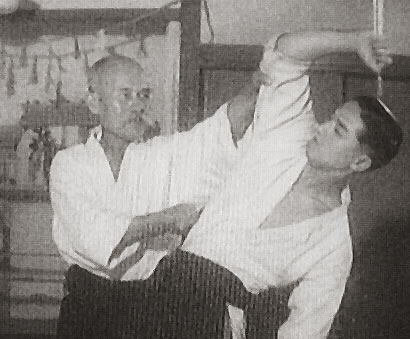
RYOTEDORI KOKYU NAGE

Suwariwaza ryotedori kokyuho as a means to establish correct tension, indexing and lines of force.

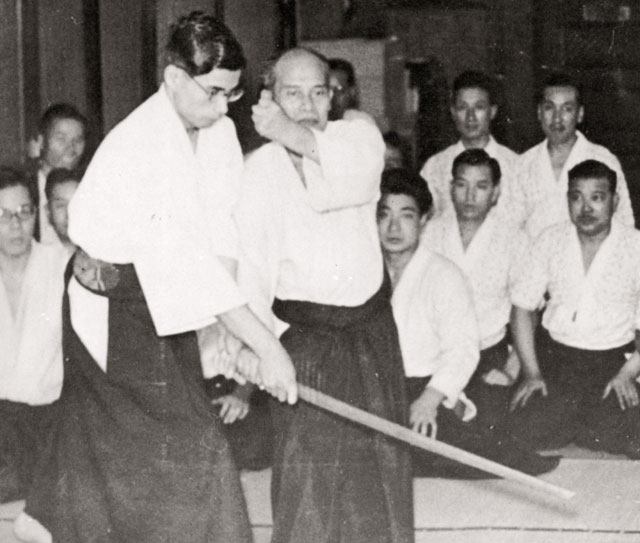
Correct tensionUke must approach nage with the intention of controlling nage’s arms with force from high to low and nage will receive with equal counter force from low to high. The resulting tension is the starting point, the axis of the encounter. At this point there are two primary means of releasing the tension. First – what I labelled Mulligan sensei‘s approach. The forward hand meets at the elbow and nage shifts bodily to the opposite side with the back hand ready to strike: a flanking action. Once nage establishes this superior position, nage shifts from the hip and toes to drive through uke’s center of mass. The second – Okamoto sensei – will approach more directly with the back hand softening at the elbow to allow greater contact with uke (driving into the sternum as necessary). The first approach dissolves the tension, the second will develop the hara by meeting it more directly.

Indexing. The ryotedori relationship is a L/R and R/L on the inside line. Indexing is a quick reference – i.e., “you have been here before.” Knowing where your hands are in relationship to your opponent’s body is critical to understanding what responses are available.

Lines of force. We flank uke’s center in order to traverse and cut though the initial approach. This means we drive through 90-degrees off the original line of attack.

kokyu-nage-osensei

Move to standing – the technique does not change. The primary reminder is to ensure that you step through with your back leg. (In combat, your front foot has trapped uke’s lead foot and now your back leg will be coming through as a strike.) Stepping through should be as simple as walking. Shizentai, the natural body posture. Once you have shifted off line and disrupted uke’s force with a redirect with both hands, then walk through the space uke occupies.

Then add dynamic movement. Uke could still grasp both hands while in motion, but uke might slip up to (or nage may redirect to) both shoulders. Ryokatatedori moves to ryokatadori. But the technique does not change. Nage’s response is still, slip, flank and drive through.

Change this to yokomen and nothing changes. Your response as nage should be the same. Front hand intercepts, back hand strikes.

Change the attack to shomen and now and a beat: stop-hit cross-hand (RvL, LvR) and then move back to the same response.

Then look deeper still. The front hand that was receiving and setting up the back hand as the strike now is primary. There is no block, the front hand moves directly in and strikes.

“The same response?” In Aikido’s lexicon, we have covered a number of techniques, but only one concept.

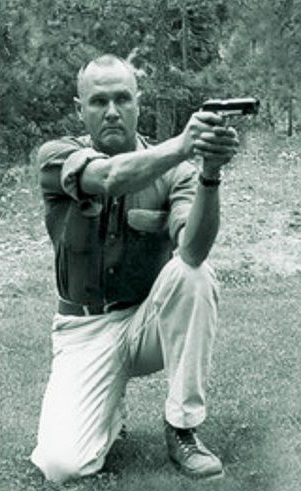
In The Five Keys to Kali Master at Arms James A. Keating teaches a simple set of body movements. All of this morning’s class is motion number five. The beauty of the Kali set (kata) is that it provides a very concise formula. That formula shows the principle motions of the upper torso, you are given the “key” or understanding to then “know” any and all movement the human upper torso is capable of making (conceptually). Disguised in this class of kihon Aikido techniques was the exploration of one range of motion of the upper body from the basic Kali set.

kali-self-defense-fighting.jpg
Same principle – it’s all applied concept

_____________________

Secret bonus – watch Cliff Lenderman on basic knife concepts to discern (a) how ryotedori is a weapon technique (b) how kokyu-nage can be employed.

IKKYO IS MAKIOTOSHI

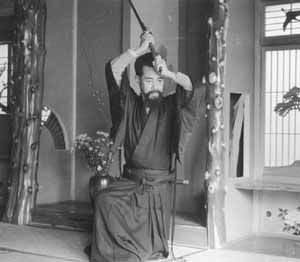
This morning we started with bokken. Standard shomen cut suburi to free the shoulders, then slide-cut to incorporate footwork (ashi-sabaki). From solo suburi to shomen uchi as a paired exercise.

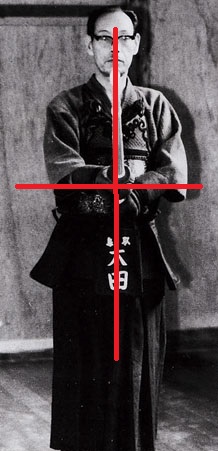
Shidachi gives gedan no kamai to invite uchidachi to strike.[1] Uchidachi strikes at the available opening: shomenShidachi receives with a cross block with a slight forward advance whilst simultaneously lowering to dissipate the force of the strike – absorbing the force with the legs not the arms. Similar to this classic kendo exercise:

ed1bfb22621b82b695b81538f27ab8d6--japanese-culture-japanese-art.jpg
Classic pose – careful using your head as a brace point

Unlike the photo above, shidachi having started from gedan raises the sword one-handed and supports the forward portion of the blade with the flat of the front palm.

Shidachi then executes a makiotoshi by snapping the right hand precipitously down and the left hand helps roll the blade from its flat to edge to traverse uchidachi’s sword (or forearm) and control the center. This is ikkyo.

Ikkyo as a concept is makiotoshi.

But a digression is in order to ensure that the terms are defined. If we understand that Aikido is a metaphor for weapon play (usually weapons are the metaphor), then it should be obvious that ikkyo is really a response in time; a cut, counter-cut. That is, at its most primal, ikkyo is responding to shomen uchi with shomen uchi in time. Done perfectly, uchidachi strikes first, thereby creating an opening that shidachi fills with a counter-shomen which efficiently dispatches the attacker. Brilliant timing, but not much of a ‘technique’ to explore.

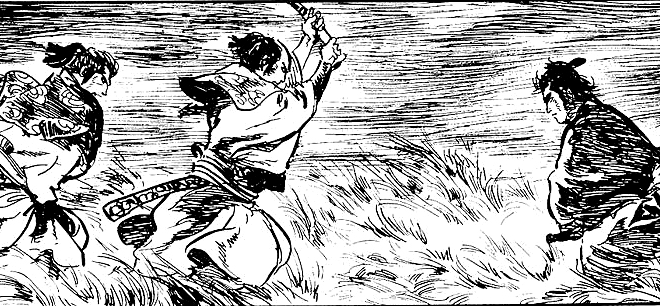
Now understand that if shidachi does not time the counter strike perfectly, the resulting encounter will be the cross-block. Shomen meets shomen. Examine our samurai from the banner photo:

Block with Forte.jpg

If the samurai on the right had better timing, he would have simply avoided the attacker’s shomen and moved off-line (flanking) to counter cut. But he was late and had to receive the strike instead. He is now behind his assailant’s OODA loop! And because our defender has received the assailant’s sword too close to the foible, the attacker might be quick-witted enough to keep sword pressure, ride down and slip his point under the cross block before our defender can dominate. Remember you cannot win by defending! And defending with imperfect technique seals your doom.

To prevail, our defending samurai can makiotoshi immediately or continue to receive as described above and perform makiotoshi with two hands. Ikkyo as a concept instantiated at different elevations (planes) and in two different times.

To emphasize the point, a block with a sword must be done closer to the cross-guard/tsuba – i.e., with the forte/strong portion of the sword. As a visual reminder – the forte is that portion of the blade closest to the cross-guard (tsuba) whereas the foible is (roughly) the last 2/3 of the blade extending to the point.

Sword-anatomy.jpg

We need to receive a block forte to forte to ensure proper leverage (think 5th kumitachi) and a good bind on the opponent’s blade. One cannot block with the foible, just re-direct, beat or slip. As I have indicated in other posts, none of this is unique to Japanese arts. Some beautiful applications are found in the manuals of the west. I will continue to blend eastern and western terms when one provides greater specificity.

Translating this analysis to an unarmed presentation, it should now be clear that ikkyo is not a manipulation of the forearm and wrist but rather above the elbow on the humerus. Contact may be made at the foible, but the control is done at the forte. The unarmed presentation is more challenging than the weapons because the arm is articulated: it bends at the wrist, elbow and shoulder. When we train, however, the entirety of the arm is used as if it were a sword, so uke must learn to hold the arm in a constant shape when performing shomen uchi. If uke allows the striking arm to bend at the wrist or elbow when received by nage, the entire structure will collapse and to uke’s detriment because nage should be counter striking (not blocking).

15940601_1270088746362946_3252956943957023399_n

Only when both players appreciate the need for proper striking form will ikkyo be revealed as a universal application of makiotoshi. Years of training is one way to see this relationship, or study deeply the need to treat all encounters as a weaponized encounters. There are no unarmed techniques in Aikido. Just weapon work without the tools of the trade. Unarmed techniques is a failure in logic: it presumes that you know your assailant is unarmed.

gokyo with atemi
Ikkyo is gokyo

Arikawa sensei disabused me of that assumption when I saw him at end of a class when he was teaching ikkyo, suddenly step into the shomen, perform a gokyo stop-hit, magically pull a hidden tanto from his keikogi and stab ukeIkkyo as gokyo: There is always a weapon.

Gokyo is ikkyo done on an advancing beat. Ikkyo in true time is makiotoshiIkkyo in superior time is kiri-otoshi.

I am illustrating examples and concepts so you can draw connections.

Weapons training is the foundation but it is taught as a supplement. I have never had the courage of my convictions to correct that pedagogical flaw and begin a training cohort starting with weapons. Even this, however, would be nothing more than an experiment in pedagogy. In the end, there should be equal emphasis on both armed and unarmed training, and further, to treat every scenario with the possibility that it involves multiple assailants.

This post tries to make explicit the logic of this morning’s class starting with bokken, moving to unarmed and then connecting the two. Weapon vs weapon, then unarmed vs unarmed. With more time I would have shown the weapon vs unarmed to complete the presentation.

For good measure, although I emphasized the kimusubi (connected flow) of Aikido’s rhythm, I interjected staccato beats and nerve disruptions, limb and bone destructions. Kuden to be kept alive.

_____________________

[1] Training nomenclature. In Japanese arts, the uchidachi is typically the one who initiates the violent action and invariably is the one who dies in the encounter. There is a certain irony in that Aikido will usually present kumi-ken (and kumi-) with nage taking the role of shidachi (the role that ‘wins’) to demonstrate technique. This is ironic because in more traditional arts, uchidachi is the senior student who controls the pace of the encounter in order to help shidachi learn to react in the concise and structured environment of the form. In FMA, the role of uchidachi is the ‘feeder.’ Uchidachi should verify shidachi’s form, body mechanics and zanshin before moving to the next sequential step.

With this in mind, uchidachi must perform their portion of the kata with precision and clear intent in order to make the training sequence useful. Hence the senior taking the default role of uchidachi: because the role of the feeder requires greater skill (controlling shidachi’s pacing) and should be embraced without a sense of competition. A true uchidachi is ready to assist the shidachi without any other intent. This is expressed through the uchidachi performing their strikes cleanly and purposefully, allowing shidachi a proper training environment.

EDGED ETTIQUETTE

“An armed society is a polite society. Manners are good when one may have to back up his acts with his life.”

― Robert A. Heinlein, Beyond This Horizon

In the Aikido dojo the sword is the soul of the samurai and that spirit remains salient.  Even a bokken (wooden sword) should be handled as the symbolic representation of a shinken (live blade).

When sitting in a line, place the sword on your right with the blade facing you. This demonstrates a lack of hostile intent because drawing the sword from that position is awkward. When seated alone, position the sword with the blade on the left and edge facing away from your body for rapid deployment.

A samurai was always prepared for violence and never appeared unarmed even in times of peace. The katana and wakizashi were part of daily dress. I encourage an alert reader to consider the modern corollary to this practice. Violent encounters are always possible and you do not chose when, where, how or by how many. It is your moral duty to be prepared for and defend against the possibility of violence.

It is frequently said that the sign of a samurai was his two swords, but this tradition was formalized only during the latter half of the sixteenth century. The term daisho refers specifically to wearing a katana and wakizashi and this practice is nothing more than common sense given a linguistic label. All warriors carry multiple weapons because you need redundancy when your life is on the line. A primary (long) weapon and a secondary (medium) is the minimum and a tertiary (short) weapon is advisable. Katana, wakazashi, tanto for the samurai – musket, rapier, main gauche for the musketeer. All warriors across cultures and through time live by the maximum that “two is one and one is none.” You can not rely on your primary weapon being sufficient. Murphy’s Law dictates that failure is imminent, so have a contingency plan.

The katana and wakizashi were worn thrust through the obi (belt), edge up on the left side (no warrior is left-handed so no one would carry their swords on the right side).[1] An indication of someone’s rank was based on how he wore his sword. One with rank and authority wore the katana almost horizontally (thus establishing his “personal space”). A more humble or lower ranking man wore his closer to his body, with the sheath nearly parallel to his leg. To clash the scabbard of another was often deemed an insult and could have been seen as a challenge to an immediate duel.[2]

Indications of violent intent – what modern combatives would call a “furtive move” – include: grasping the scabbard just behind the guard and pushing the guard forward with the thumb (breaking the “seal” on the scabbard); deliberately reaching across the body and grasping the hilt with one’s right hand but not actually drawing the blade; removing the cloth “sleeve” that travelers sometimes put over the hilt and guard to keep dust away; and pulling the scabbard forward but not quite out of the sash, so that the hilt is more accessible for a draw. Therefore handling weapons in the presence of another must be ritualized so as to make clear non-violent intent.

When handing over a sword, the person with superior status will use one hand, the inferior both. The blade is always properly oriented (i.e.; for a tachi, edge down; for a katana, edge up). A superior person grasps the sword palm down on the scabbard, near the middle, and hands it over horizontally; the recipient receives it in both open palms, one at the hilt and one near the foot. If an inferior hands one over, it is palms up, under the hilt and foot; the recipient grasps it, palm down, at the center-point. This is similar for all weapons, as well, be they firearms, spears, or blades.

When handing over an unsheathed sword (e.g., for inspection), one should grasp the sword in one hand at the very base of the hilt, holding the sword upright with the edge toward the one offering the sword. The recipient grasps the hilt directly below the guard; this puts him in a position to cut right down and take your arm off. That is the idea. It should be returned the same way. One thing implied in this is respect for the person receiving the sword; one is putting him in the dominant position, saying, “I trust you.”

Master Keating wrote a good article on general weapon etiquette that I have copied here:

____________

Many times in the past I remember my instructor in the sword arts cautioning me to handle swords and knives with proper etiquette. I was advised to only pull them partially from the scabbards and to admire them from there If I did feel the inclination to fully reveal he blade I was told to ask permission. I have always held this knowledge dear to my heart.

Manners and etiquette are part of any weapon bearing culture. A man can be judged by how he handles (or mishandles) a weapon. Each culture has its own beliefs and reasons for how they handle a knife. Some make sense and others are down right baffling. I have listed some blade etiquette practices from around the world for you to be aware of. By refining your sensitivity to the cutlery customs of the world you will find that you gain insight into yourself.

Never touch the knife of another without first getting permission. Many people feel that to touch a man’s knife without consent is an insult or the act of a fool. If you are allowed to touch the knife you must never touch the blade, this is a rule you must not violate!  Keep you fingers away from and off the blade! Never twirl or make movie style slashing motions with the knife. Handle it gently, admire the edge with your eyes, appreciate its fit and finish with kind words to the owner. Knives can be dangerous, act like a gentleman at all times and you can avoid the hassles that plague others.

Some knives are tailor-made to specific measurements and can only be judged by their makers and owners. Never be too quick with a derogatory comment about another man’s knife. For you his knife may miss the mark by a long shot, but for him the knife is perfect. Watch what you say or run the risk of appearing the amateur in the eyes of other men. Most makers and knife people do not mind if you ask questions about their knife. It’s the backward comments from those individuals who lack knife etiquette that cause the hackles to stand up on a man’s neck.

Even at the dinner table we find the aspects of American cutlery customs. When set properly, the silverware is laid out in a specific manner. The knife should have the edge turned in toward the plate. This shows the guest who is savvy in edged etiquette that you welcome their presence at your table. It also keeps the edge of a truly sharp knife away from the hand of your guest for safety reasons. If the knife is laid with the edge outward it can mean that while the guest is allowed to sit at the table they are really not welcome. In such an instance, the guest should eat, thank his hosts, and leave promptly.

The act of drawing certain blades can lead to consequences that you may be unprepared to meet. In some cultures it is thought that if you pull a knife it must draw blood before it can be resheathed. Some people adhere to this custom as odd as it may seem to you.  If they are adamant about it, then you must be ready to nick your finger or such. It’s no big deal, but it can surprise people not accustomed to living around sharpened steel.

When handing a knife to someone else always make sure to hand the knife butt (handle) first If the knife is not in its sheath do not allow the knife to cut you as it is being passed from hand to hand. Whenever a knife is being passed around the group of people watch your feet.  If the knife is dropped you can get a nasty wound. Keep the kids, dogs, and non blade-people away.

There you have it. I hope this short piece can make a positive difference in your life. By learning and practicing some of these customs used by professional knifemen and edged weapons handlers you can move with ease at the next knife show or rendezvous. You will find acceptance from other men and experience the positive common bond we all share in our fascination of all things steel.

Until next time…stay sharp!

James A. Keating

____________

Although I was taught proper Japanese etiquette, I admit to being a bit of an iconoclast, often eschewing or flouting the prescribed norms. Primarily because I don’t like the artificial barriers that rigid adherence creates. I prefer a less formal, more familiar, environment to foster trust. But I do want everyone to clearly know the rules so as to always be respectful as a guest in someone else’s house (dojo). Never be a buffoon.  Know the rules and know when (or if) it is safe to bend them.

 ________________________________

[1] The left handed warrior has a tactical advantage.  Just look to modern fencing bouts.  Statistically left-handedness is far less common and therefore a right-handed warrior facing a left-handed would be facing an unfamiliar opponent.  Whereas a left-handed warrior has trained against right-handed all his life.  The left hand – in Latin, left = sinister, which now is “malicious, underhanded.”  Underhanded, the left hand holds the dagger, the sinister, and it is the dagger that kills.  The dexter “right” hand wields the sword which is eminently visible.

[2] Dueling cultures require holding honor dear – a very archaic concept. In modern societies, honor refers primarily to a form of social status that attaches to integrity and sound character. But honor has an older meaning still found among some groups today—a form of social status founded on the willingness and ability to use force. Hence the importance of the duel. An honorable man will not hesitate to use physical force to combat any assault, theft, insult, or other attempt at subordination of himself or his group (family, gang, or nation). For honor, unlike the more stable value of dignity, can be won or lost. Honor rises and falls when one man (or group) publicly challenges the willingness of another to physically defend himself, his intimates, or his property and hence his right to be treated as an equal. To uphold his honor a man need not beat his opponent, but he must display a willingness to fight him. Honor-based cultures are far from uniform, but share basic characteristics: honor is a central source of status;  and honor cultures are typically antipathetic to law and legal officials (a man must stand up for himself and not rely on others to do so).  Hence an armed society must be a polite society: a society where honor, self-reliance, and respect are primary determinations of status requires being prepared at all times to defend one’s position by feat of arms – a duel.