When I began training, I was told that the minimum time commitment to earn shodan in Aikido is to train three classes per week for a period of five years – and this presumes progress through time on the mat under competent instruction with honest training partners. If you do the math, however, the USAF requirements indicate that just under seven years would be required at the three-class per week minimum.
For many people even that level of dedication is difficult. We are pressured for time with work, family commitments, and entertaining distractions. Training is something we fit into the schedule. Yet training time is critical to development.
And I don’t mean just showing up to train. Time on the mat is only one metric to measure progress and not always a good one. One needs to actually learn from their training time on the mat. As Bruce Lee observed, perfection may be the goal, but the real question is, “For what level of imperfection will we settle?”
Every time we step on the mat we have the opportunity to improve. Training with a partner is a gift. With good training, each player gives the other the ability to elevate their skills through honest feedback (physical more importantly than verbal). Time on the mat with a partner is without a doubt the most effective way to learn the art because you have an instant feedback mechanism. You can each help train the other to somatically feel the progress.
Solo training is a way to augment and accelerate your basic skills. The math is simple – ten minutes of solo training a day adds over 60 hours of training time per year, when done effectively.
To maximize the benefit, focus on isolated skills and physical development that may be outside the everyday norm – for example shikko and shinkokyu. Shikko is an unfamiliar body mechanic for many of us and shinkokyu is a way to learn to be grounded. Both basic patterns of movement are absolutely necessary to master, but are too rote and repetitive to take time away from training and practice on the mat. Master them by mindfully practicing solo. Do you stand at work? Subtly shift shinkokyu to get in repetitions. Practice moving from standing to shikko to walking while at home. Tenkan around obstacles in your house.
Have very specific goals. Practice your sword cuts. Do 100 shomen strikes per day. Then move to yokomen, then tsuki, etc. It is important to be mindful, but at the beginning simply do the cuts. Keep at it, as you develop stamina, your goal will be to develop proper form. Incrementally add the number of consecutive cuts per day but the goal is to get to 1,000. It is impossible to do 1,000 cuts wrong – meaning if you can do 1,000 consecutive cuts, your form must be correct because you have gone beyond physical limitations.
Importantly, employ proper visualization. Professional athletes use visualization techniques to improve performance and there are programs happy to teach you how to better visualize. For me, visualization entails recalling the patterns from inspirational teachers and by envisioning weapon to target strikes. Create linkages, find the smoothest path from target A to target B, move along the crispest tangent, or the tightest arc to minimize your movements. Or simply follow a scripted routine each morning to encourage a relaxed but ready state.
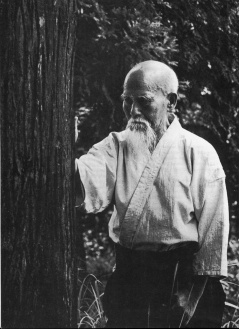
O’Sensei tiesho – compare the shoulder/breath relaxation exercises with those from Systema.
There are any number of discrete skills that can (and should) be practiced solo daily. Here are some suggestions in addition to those mentioned earlier:
Attacks: jodan/chudan/gedan tsuki; shomen/yokomen/gyaku yokomen; use empty hand and weapons (ken/jo/tanto).
Strikes: once the attacks are familiar – try hitting a pell with your weapons and the bag empty handed. Hit speed bags and heavy bags alike. Use a makiwara, or my favorite >Bob<. Steal a variety of strikes from other arts (for example: Systema relaxed strikes).
To break it down, think of practicing those elements of movement that can be done independent of a partner. The most obvious should be suburi in general. Suburi is essentially about repetition and then more repetition. The point of extended repetition is to force the body to figure out how to use a weapon efficiently – just keep swinging the weapon and you will be closer to the most economical path of motion. Suburi is faster and more fluid than kihon patterns.
Kihon movements are the fundamental building blocks – and some can be done independently of a partner. Kihon are prescribed and idealized movement patterns – closer to kata than energetic actions. Kihon should be done slowly enough to allow full intellectual processing of the movements – a high level of reflexive awareness. Follow this line of reasoning and you may develop heretical thoughts like adding kata to Aikido.
Just remember: because the ultimate goal of Aikido is to connect, to have an energetic exchange, solo training can only be a supplement and not a substitute for time on the mat. Nor are videos a means to replace competent instruction under a qualified teacher.
Keep Training!
___________________
Harder than it seems – try using a silk scarf to augment your solo training
_______________________
I have suggested earlier that re-contextualizing the movements is also a key to effective training. By classifying techniques in a matrix and by re-presenting techniques through narrative or graphical depiction is a means to better understand the material. Just remember your classifications will be an indication of your particular context and dispositions. An amusing aside to illustrate the point: In 1238, Alfonso X of Castile published Libro de los Juegos – The Book of Games. The book classified games according to categories sensible to his kingly status: games played on horseback, those played dismounted, and those played while seated.
In the 19th century, anthropology’s great achievement was humility. Cultural relativism and structure-functionalism arose as correctives to imperial arrogance; a way to see “the native” not as savage, but as human within a coherent order. Yet in the 21st century, those same theories can feel dangerous. When all practices are deemed culturally valid, cruelty masquerades as heritage. The Economist ran this story about witch killings in India:
October 21, 2017 p 43
Is there anything so utterly primitive?[1] (Yes, I use that term pejoratively.)
And India, by any measure, values education. According to 2019 data from the Centre for Global Development and UNESCO’s Global Education Monitoring Report, primary-school teachers there earn about four times the national GDP per capita, one of the highest ratios in the world:
What is education worth
In the United States and Britain, the figure hovers around 1.1 to 1.2×. The inverse correlation between national wealth and relative teacher pay is striking: the poorer the country, the higher the social premium placed on teaching. It suggests a tacit recognition that education is civilization’s most reliable lever for progress. Ignorance, it is said, should be forgiven because it shows a lack of access to information. And yet India is a country with a long history respecting education and teachers are demonstrably respected.
And yet ignorance endures. My patience for it wanes with age. I grow impatient for people to be better. Fear of otherness remains universal. Europe trembles at immigration, and demagogues feed on that fear, as John Lukacs warned they would. [2] Populism is the old tribal instinct in new clothes: the need to define oneself as not-them.
November 17th, 2018
And fear is justified by those bouts of violence by the Other: that all-encompassing label for the outsider. And thus we maintain our identities and define ourselves as being not-like-them.[3]
Is Aikido an antidote to such exoticism, the Way of Harmony made literal? Perhaps. One learns to connect with a partner, then with a dojo, a community, a nation, and, by extension, all of humanity. But I am not optimistic. Humanity remains mired in tribal reflexes. What I do believe is that honest training builds character. And character, once tempered, becomes a prophylactic against primitive fear.
John Stuart Mill would have understood. Civilization, he wrote, depends not on conquest but on the moral education of its citizens. To educate is to enlarge sympathy, to make the mind supple enough to recognize another as equal, even when alien. Aikido, in its best form, rehearses that lesson daily: tension without hatred, conflict without dehumanization. Education and practice alike are the disciplines by which we hold the line against relapse. A 19th Century reminder from JS Mill.
_____________________________
[1] Update 10.7.2020 – the persistence of “culture” as a limitation of human progress
Region is a strong predictor of female survival, literacy, autonomy, employment, and independent mobility. A woman with the exact same household wealth/ caste/ religion will likely have more autonomy if she lives in the South.
It does not seem to be a function of wealth, nor was colonialism a major factor. And cousin marriage, which is more prevalent in the south? Alice notes:
Southern women may have gained autonomy despite cousin marriage, not because of it.
Islam, however, is one factor:
In sum, gender segregation became more widespread under Islamic rule. Men continue [to] dominate public life, while women are more rooted in their families, seldom gathering to resist structural inequalities.
But perhaps most significantly:
Female labour force participation is higher in states with traditions of labour-intensive cultivation…
Wheat has been grown for centuries on the fertile, alluvial Indo-Gangetic plain. Cultivation is not terribly labour-intensive, though cereals must still be processed, shelled and ground. This lowers demand for female labour in the field, and heightens its importance at home.
Over the centuries, male superiority may have become entrenched.
Finally:
Northern parents increasingly support their daughters’ education, but this is primarily to improve their marriage prospects, not work outside the home.
There is much, much more at the link, including some excellent maps, visuals, and photos.
[2] John Lukacs tried to warn us against this populism. He learned history’s lessons hard and personally. His obituary from the The Times of Israel is copied (with links added) below:
John Lukacs, iconoclastic historian and Holocaust survivor, dies at 95
A biographer of Winston Churchill, the Hungarian-born scholar lamented the erosion of ‘civilization and culture of the past 500 years, European and Western’
NEW YORK (AP) — John Lukacs, the Hungarian-born historian and iconoclast who brooded over the future of Western civilization, wrote a best-selling tribute to Winston Churchill, and produced a substantial and often despairing body of writings on the politics and culture of Europe and the United States, has died.
Lukacs died of heart failure early Monday at his home in Phoenixville, Pennsylvania, according to his stepson, Charles Segal. He was 95 and had lived in Phoenixville since the 1950s.
A proud and old-fashioned man with a prominent forehead, cosmopolitan accent, and erudite but personal prose style, Lukacs was a maverick among historians. In a profession where liberals were a clear majority, he was sharply critical of the left and of the cultural revolution of the 1960s. But he was also unhappy with the modern conservative movement, opposing the Iraq war, mocking hydrogen bomb developer Edward Teller as the “Zsa Zsa Gabor of physics” and disliking the “puerile” tradition, apparently started by Ronald Reagan, of presidents returning military salutes from the armed forces.
“John Lukacs is well known not so much for speaking truth to power as speaking truth to audiences he senses have settled into safe and unexamined opinions,” John Willson wrote in The American Conservative in 2013. “This has earned him, among friends and critics alike, a somewhat curmudgeonly reputation.”
Lukacs completed more than 30 books, on everything from his native country to 20th century American history to the meaning of history itself. His books include “Five Days in London,” the memoir “Confessions of an Original Sinner,” and “Historical Consciousness,” in which he contended that the best way to study any subject, whether science or politics, was through its history.
He considered himself a “reactionary,” a mourner for the “civilization and culture of the past 500 years, European and Western.” He saw decline in the worship of technological progress, the elevation of science to religion, and the rise of materialism. Drawing openly upon Alexis de Tocqueville’s warnings about a “tyranny of the majority,” Lukacs was especially wary of populism and was quoted by other historians as Donald Trump rose to the presidency. Lukacs feared that the public was too easily manipulated into committing terrible crimes.
“The kind of populist nationalism that Hitler incarnated has been and continues to be the most deadly of modern plagues,” he once wrote.
He belonged to few academic or political organizations and was unafraid to challenge his peers, whether Arthur M. Schlesinger Jr., Hannah Arendt, or British historian David Irving. In “The Hitler of History,” published in 1997, Lukacs alleged that Irving was sympathetic to the Nazis, leading to threats of legal action from Irving and the removal of passages from the book in England. In recent years, Irving has been widely condemned because of his ties to Holocaust deniers.
Hitler and Stalin were Lukacs’ prime villains, Churchill his hero. Lukacs wrote several short works on Churchill’s leadership during World War II, focusing on his defiant “Blood, toil, tears and sweat” speech as the Nazis were threatening England in May 1940. Lukacs wrote that the speech was at first not well received and that instead of having a unified country behind him, Churchill had to fight members of his own cabinet who wanted to make peace with the Nazis.
“If at that time a British government had signaled as much as a cautious inclination to explore a negotiation with Hitler, amounting to a willingness to ascertain his possible terms, that would have been the first step onto a Slippery Slope from which there could be no retreat,” Lukacs wrote in “Churchill: Visionary. Statesman. Historian,” published in 2002. “But Churchill did not let go; and he had his way.”
One Churchill book attained unexpected popularity after the September 11, 2001, terrorist attacks. Rudolph Giuliani, then New York City’s mayor, held up a copy of Lukacs’ “Five Days in London,” declared he had been reading it and likened New Yorkers to the citizens of London.
Quietly published in 2000, the book jumped into the top 100 on Amazon.com’s best-seller list. But Lukacs was not entirely grateful. He noted that “Five Days in London” had little to say about how Londoners endured the Nazi assault, and he rejected comparisons between London in 1940 and New York City in 2001.
“The situation was totally different,” he told The Philadelphia Inquirer at the time. “As a matter of fact, it was much worse in England.”
More recently, “Five Days in London” was widely cited as a source for “Darkest Hour,” the 2017 film starring Gary Oldman in an Oscar-winning performance as Churchill.
The historian was born Lukacs Janos Albert in Budapest. Lukacs had a Catholic father and Jewish mother, making him technically a Jew, although he was a practicing Catholic for much of his life. For the Nazis, who occupied Hungary in 1944, being half a Jew was enough to be sent to a labor camp.
By the end of 1944, he was a deserter from the Hungarian army labor battalion, hiding in a cellar, awaiting liberation by Russian troops. Within months of living under Soviet control, he fled the country on a “dirty, broken-down train” to Austria. In 1946, he arrived by ship in Portland, Maine, his youthful affinity for communism shattered.
Lukacs was a visiting professor at Princeton University, Columbia University and other prominent schools, but spent much of his career on the faculty of the lesser-known Chestnut Hill College, a Catholic school (all girls until 2003) in Philadelphia where he taught from 1946-1994. He was married three times (his first two wives died) and had two children.
A pessimist by definition, he often expressed personal contentment. He wrote warmly about his enjoyment of romance, friendship, books, teaching and the rural life, the “pleasure of fresh mornings, driving alone on country roads, smoking my matutinal cigar, mentally planning the contents of my coming lecture whose sequence and organization are falling wonderfully into place, crystallizing in sparks of sunlight.”
“Because of the goodness of God,” he concluded in his memoir, “I have had a happy unhappy life, which is preferable to an unhappy happy one.”
__________________________
[3] Yet that right of self-determination and definition is a sacred right. The very definition of sovereignty. Look to the Sentinelese in their vigorous defense of their island. Survival International actively protects the Sentinelese’s isolation and both India (which has jurisdication) and the United States both refuse to prosecute the killing of misguided missionary John Chau. Is this the origin of the Prime Directive from Star Trek?
This is not a kihon-level presentation. The sequence of development presumes competency in basic lock-flow dexterity drills, the ability to keep connected pressure, and a familiarity with vectors.
It is a play off a standard shomenunchi – irimi tai sabaki exercise incorporating both the font hand and back hand intercept. The hand work is not necessarily tied to, nor as specific as, hanmi (gyaku v ai-hanmi) because the tai-sabaki is fluid in more dynamic or advanced plays. Foot movement at this level is presumed to be a method of conveyance and not as a reference point. The gestalt of the encounter dictates the foot position. Which is to say, you need to adjust your spacing (in time and space) according to the speed of your attacker’s approach.
The lines of action in this exercise are linear – but that is merely a pedagogical tool to limit variables. Once these skills are developed on a single line, then changing the vectors should be an easy adaptation.
CLASS OUTLINE
Ikkyo to Sankyo, direct Irimi-nage, and kaiten-nage logic chains.
Warm-up – shomenuchi, irimi entry
Goals: uke focuses on a good attack, nage focuses on a irimi entry with brush contact
Concepts to develop: spacing (maai), timing (True Times), creating an invitation for attack to lead uke.
Presentation: nage presents shizentai inducing uke to strike shomenuchi. Nage enters irimi to the outside flank with a rising (low to high) RvR brush block (glissade). In the terminal position nage has a pressure contact with uke‘s raised arm (the axis), on the same line, but facing the opposite direction. This is an indexing point, a transitional node to any number of subsequent movements. But the action needs be smooth – devoid of clunky contact and vector changes.
Second Presentation: nage presents shizentai inducing uke to strike shomenuchi. Nage enters irimi but this time LvR with a descending cut (as opposed to rising). Positionally nage will end in the same spot in reference to uke‘s body, but the vertical axis is now gedan (low line) v jodan (high line).
Transition to Jodan Tsuki.
Goals: uke focuses on a deliberate attack, nage must now contend with a point (rather than edge) attack. The attack is now more ‘real.’
Concepts to develop: no block, trapping counter, half beats.
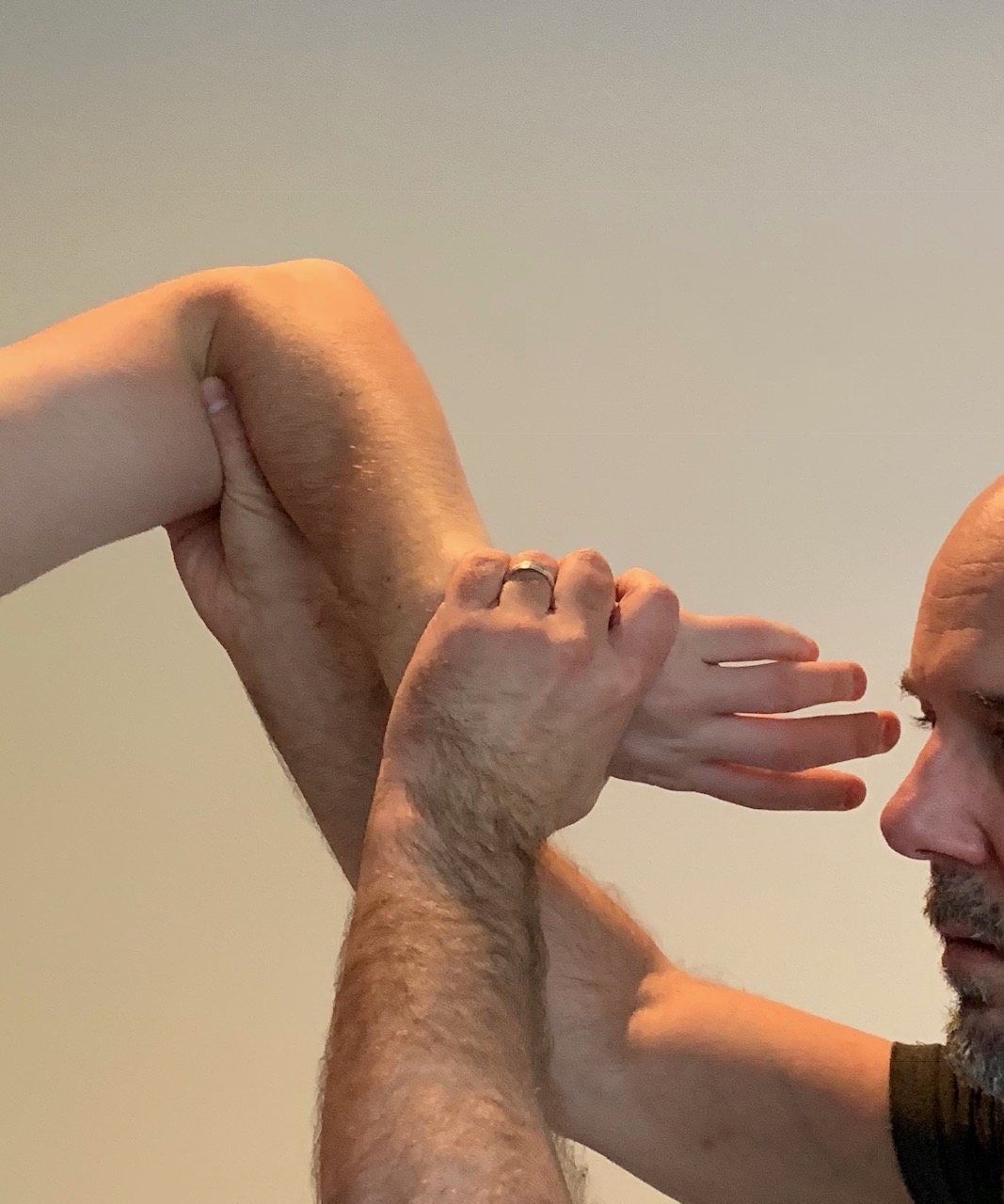
Presentation: nage stands shizentai inducing uke to punch to the face. Nage enters slightly with a cross-block irimi, but uses the free (back) hand to counter strike jodan on the inside line of uke‘s arm. The cross-block (RvR and LvL) is an indexing position. Nage‘s inside striking hand then rebounds on the same line to jolt uke‘s elbow forward toward nage while nage‘s index hand pressure strikes uke to the face along opposing vectors delivered simultaneously. This action will fold uke‘s arm and lurch him toward nage. The index hand then flows to grasp uke‘s contact hand and feed it to nage‘s strike hand (conveniently waiting at the crux of the elbow). Transition the hand grab for sankyo. This is an augmented flow sequence.
Kuden: The active application is to teach a strike-augmented sankyo. The concept is the introduction of a half-beat. The kihon level technique is ikkyo omote – but the inside line strike adds a half-beat that helps collapse the structural integrity of uke‘s arm. The brachial strike can therefore also augment ikkyo.
Nage is executing a linked series of actions, several are high dexterity, but each action is possible by putting uke in a time-deficit. Strike uke to keep them off-balance. Pressure contact keeps uke in your flow sequence. Only release pressure when you need to create the void you want uke to fill.
Second Presentation: nage stands shizentai inducing uke to punch to the face. Nage enters slightly with a front hand (LvR / RvL) irimi, but uses the front hand to tap uke‘s atemi just off-line, while immediately counter punching (palm to chin) under uke‘s striking arm. Done properly, this is an invisible strike. A slip-counter punch on the direct line of approach from the low-line.
Bunkai Skill Development: ura-ken (back knuckle) strikes to the inside brachial nerve. Rebounding strikes. Push-pull levers.
Developmental Presentation: from the LvR index, nage returns uke‘s strike back into the body – thus setting the logic chain for kaiten-nage.
Skill Development: keep connected to the striking hand as it retreats (chambers) for a secondary strike. Anticipate the counter and do not chase the encounters – pressure control from the first moment of contact.
As always – correct repetition is the key. All the basic body development needs to be employed: slight bend in the knees to keep the tanren connected to the earth, lower center of gravity; feet free to move; abdominal muscles engaged to support the spine and allow natural breathing patterns.