This is aiki-ken. It assumes coherence: both players recognize initiative, distance, and line. Real encounters do not grant that clarity. Entries will be broken, timing will be stolen, and the first mistake will often be the last.
The 4th kumitachi teaches a specific response to a thrust. A straight thrust can be decisive, but it is also the most dangerous moment in kenjutsu: you are extended, your weapon is compromised, your opponent is structurally intact.
A koryū critique would hold, if maai and timing are correct, the first tsuki ends the exchange. But this is not presented as kenjutsu, though it borrows from its constraints and consequences. It is not modeling combat outcome. It is modeling: connection under pressure, continuity through failure, sensitivity to line and timing. The sword makes error explicit.
The lesson is not how to win, it is how not to disconnect. And what to do once a disconnect if felt.
Initial Conditions
Both in migi-hanmi, chūdan-no-kamae (seigan-no-kamae)
Ukedachi lowers to gedan-no-kamae.
This creates an opening from the midline for the opening thrust – an opening that is also a trap.
Count
#1 – Chūdan Tsuki
#2 – Suppression / Line Break
#3 – Hidari Tsuki (uchidachi recovery)
#4 – Men / Kiri-Otoshi (decisive finish)
COUNT 1: Chūdan Tsuki
Problem
Because the maai is already established at close range, whoever owns centerline first can end the exchange.
Ukedachi Logic (Initiator)
Initiate with a direct tsuki to the trachaea. The kissaki is vertical and delivered as a thrust without telegraphing – a JKD “straight blast”
The structure is extended. That is the cost of initiative.
Uchidachi Logic (Receiver)
Do not block. Allow the blade to rise slightly, receiving the thrust on the belly of the sword, then redirect with a camming press-check downward.
The body shifts slightly off-line as the blade rotates from ukedachi’s outside line to inside line.
You do not beat the weapon; you change its path and orientation.
At the base of the press, your sword is on top: structurally dominant.
Principle
Initiative creates exposure. Control of line immediately becomes contested.
COUNT 2: Suppression / Line Break
Problem
Ukedachi’s thrust has failed and now is controlled downward.
If uchidachi resists, structure collapses and the exchange ends.
Uchidachi Logic (control phase)
Maintain pressure, but do not overcommit.
The goal is not to win the bind, it is to force the opponent into a predictable recovery.
Overextension forfeits control.
Ukedachi Logic (recovery begins)
Do not push back. Do not resist or try to reclaim the line through strength.
Instead: allow the downward pressure to continue, continue to maintain connection to feel blade position and pressure, and at the bottom of the press, release the bind and immediate hanmi change.
The sword drops, but the body reorganizes.
Principle
The moment you fight pressure directly, you lose both structure and time. Yielding preserves optionality.
COUNT 3: Hidari Chūdan Tsuki
Problem
Ukedachi has lost the original line and is momentarily exposed.
Recovery must occur before uchidachi converts control into a finishing cut.
Ukedachi Logic (recovery attack)
Shift to hidari-hanmi and re-enter on a new line.
Deliver a second chūdan tsuki from the opposite side toward uchidachi’s kidney.
This is not a reset, it is a continuation from a broken structure.
The power is identical: rear leg drives, hips align, back hand delivers
But the geometry has changed. You are now attacking from outside the original line of suppression and the blade is now flat (parallel to the ground), more lateral; a different problem for uchidachi.
Uchidachi Logic (adhesion + counter)
Retreat and absorb the thrust with uchi-komi. Do not disengage: adhere.
From this connection, initiate kiri-kaeshi to the thumb.
This is the moment of maximum opportunity.
If the timing is correct, ukedachi is cut here.
Principle
If the line is lost, change the line. If connection is maintained, opportunity persists.
COUNT 4: Men / Kiri Otoshi
Problem
Ukedachi has reasserted attack, but uchidachi has already initiated a counter (thumb cut). Both lines now exist simultaneously. Whoever controls the final line survives.
Ukedachi Logic (commitment to resolution)
Do not disengage prematurely.
Maintain connection just long enough to read uchidachi’s riposte, keep forward pressure and connection long enough to sense the extension, then release and step through immediately to jo-dan no kamae to deliver a decisive men cut.
The sequence is continuous. No reset. No chamber. The cut is not added: it is revealed through continuity of motion.
Uchidachi Logic (Kiri-Otoshi decisive)
As ukedachi releases to cut, recognize the moment of disconnection. The void signals danger. So, align vertically into jōdan-no-kamae and cut directly through center with kiri-otoshi. This line does not block or receive; it redirects through alignment and dominates the center.
Ukedachi’s cut is collapsed at the moment of expression.
Uchidachi’s timing is later but the structure is superior. Uchidachi enters in go-no-sen and resolves in sen-no-sen; not with speed, but through structural dominance.
Ultimately, kiri-otoshi arises not from seeing the attack, but from sensing the inevitability from the release.
Principle
The moment of release is the moment of greatest danger.
Final initiative is not owned: it is proven through line control.
This presentation of the 4th Kumitachi is an evolution from Chiba sensei who was taught the forms by Morihiro Saito. Saito sensei’s presentation is slightly different:
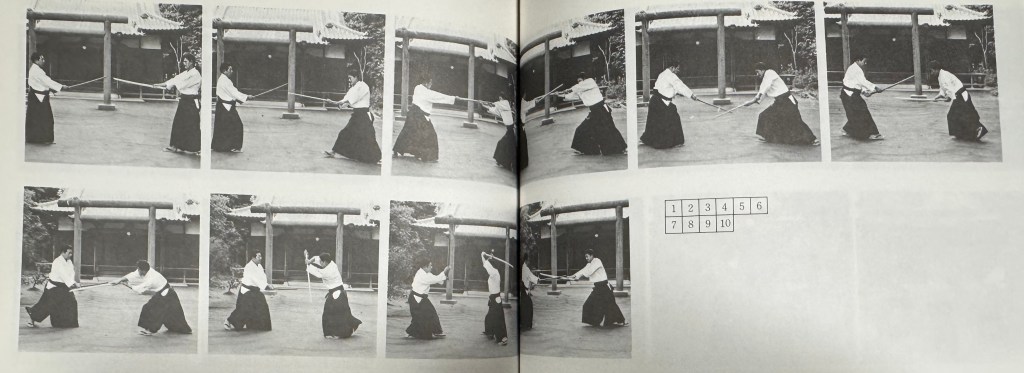
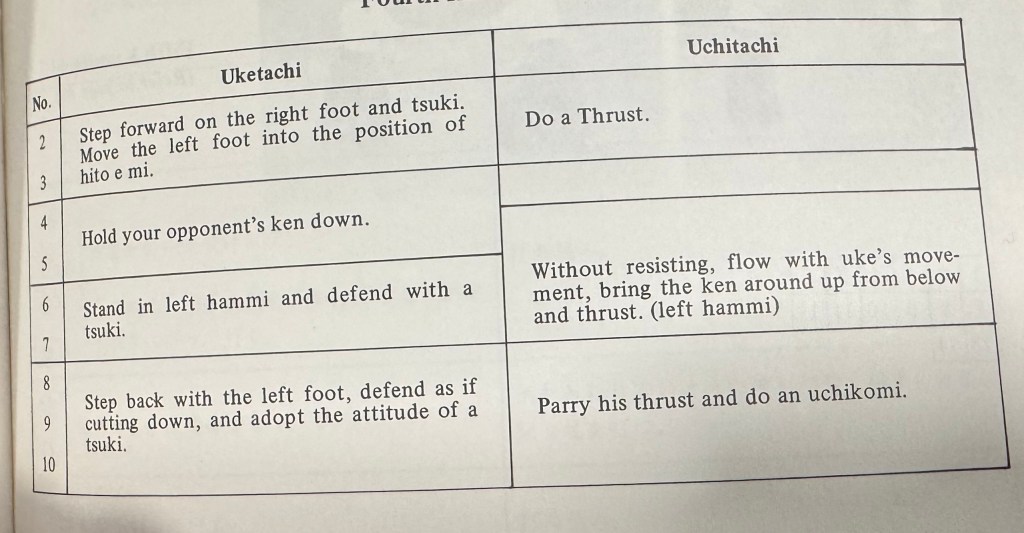
As presented by Saito, this is a compact instructional sequence: thrust (tsuki); suppression (press down); non-resistance (flow); line change (hidari tsuki); resolution (uchikomi). It is intentionally minimal, designed to be learned physically, not explained conceptually.
Chiba sensei expanded the pedagogy, and I have refined it further with the logic of bunkai (targeting purposefully).
Viewed attentively, the initial thrust is not just an attack, it is a necessary overextension. Loss of center is built into the form and the practitioner must operate from a compromised position and in a time deficit.
Because weapons are involved, the maxim, “Do not resist” is not philosophical. Key principles of Aikido emerge as somatic lessons: Resistance = structural collapse; Yielding = preserved awareness and optionality
The exchange is not broken between counts. Continuous contact enables: pressure sensing, timing recognition, and correct re-entry to the center line.
And the single most important lesson is: release is loss of information, therefore exposure, and it demands immediate action.
Saito’s version resolves with uchikomi. Chiba’s refinement introduces kiri-otoshi as structural conclusion – and he concludes all six kumitachi with the same sequence.
 Protective Arts