TYPES OF SPEED

“An attack must be executed with quickness, not speed. Attack with power, not strength. There
is a great difference between speed and quickness, power and strength. Think this through carefully.
It is the essence of strategy”

Miyamoto Musashi

Semantics are important – speed vs quickness.  Power vs strength.  What was Musashi driving at?  Power doesn’t necessarily rely on strength but rather on an understanding of the physiological weaknesses of the human body.  Strength is the inherent (or achieved) physicality of the body.  If you rely only on speed and strength then you must always be the stronger and faster to prevail.

But by focusing on power (target identification and acquisition) and quickness (timing) you can prevail against stronger and faster threats.  

Nevertheless, physical strength and speed are critical to develop, improve and maintain.  The following is a derived from Bruce Lee’s Fighting Method and the Tao of Jeet Kune Do – both are highly recommended additions to your library.   Bruce Lee was an innovator who constantly researched means and methods to improve both his physical abilities and the means to employ them.  He read widely and synthesized much of the traditional and (then) current sports physiology.  In the Tao he labels the physical attributes “qualities” and the means of employment “tools.”  This post merely summarizes his granulated classifications on the attribute of Speed:

PHYSICAL SPEED: Performance speed, quickness in a chosen motion (jab, thrust, kick, parry)

INITIATION SPEED: Economical Starting to a stimulus / Response Time

PERCEPTUAL SPEED: Visual speed to incoming attacks and openings.

MENTAL SPEED: Quickness of mind / Selection of targets, openings and moves rapidly

ALTERATION SPEED: The Ability to change direction quickly / many factors (balance, surface)

COMBINATION SPEED: Ability to deliver series of motions in combinations related to target.

SENSITIVITY SPEED: Contact Reflex / To change rapidly when touch contact occurs

FOOTWORK SPEED: Smooth, sure control of angles, placement and distance via footwork

HAND TRAPPING SPEED: Ability to immobilize limbs rapidly and in combination

One the hardest areas to train is perceptual speed – but I pass on these ‘tricks’ to developing perceptual speed I learned from Master at Arms James Keating.  Frontal vision, the “normal” habit of “looking” at the action to try to see it is a slow means of capturing information.  It is great for details and accuracy – the squinted concentration of the finite problem in front of you – but it tends to ‘lock’ your focus and that can be disastrous.  Focus solely on the knife and you cannot see the limb that manipulates it.  Instead, use your peripheral vision – turn your head slightly sideways to the action to find that you can “see” quick motion more easily.  This concept ties back to the No-Mind ideal – zanshin – taking in everything so as to respond to anything.  Take lessons from the natural world – peripheral vision is what a lot of animals do naturally to survive.

Look into my eyes

Tricks to help augment your peripheral vision.  Tilt your head away from the action.  Move your point of focus (1,000 yard stare) far past your opponent’s head.  Focus on the space around your opponent.  There are other tricks to explore.  And once you learn to use your peripheral vision effectively, then experiment with the ‘capturing of spirit’ – fix your opponent’s gaze to force their focus on you.  If you can increase your perceptual speed, the tactic of trying to limit your opponent’s is a logical converse.

It is remarkable to me that Bruce Lee was categorizing these differences – a scientific approach to better study and therefore improve upon human potential.

In reading Bruce Lee I am reminded of articles by Oliver Sacks.

As a neurologist, Oliver Sacks was able to study the physiology of perceptual speed and reveal its fascinating complexities.  This is a great starting point to delve the neurological differences that show the range of human potential.

A >link< to some of Oliver Sacks best essays.  He was also a frequent guest on RadioLab.

Imagine being able to harness the accelerated speed (tachypsychia) often experienced in emergency situations and the rapid and accurate movements (tachykinesia) demonstrated by some with Tourette’s syndrome. Some people with Tourette’s are able to catch flies on the wing. When perceived by a witness, this may appear as a superhumanly quick and accurate movement, but when Oliver Sacks asked one man with Tourette’s how he managed this, he said that he had no sense of moving especially fast but, rather, that to him the flies moved slowly.  Perceptual speed = physical speed?

KOKYUHO

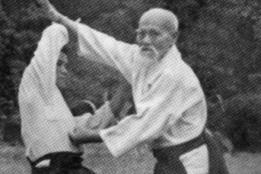
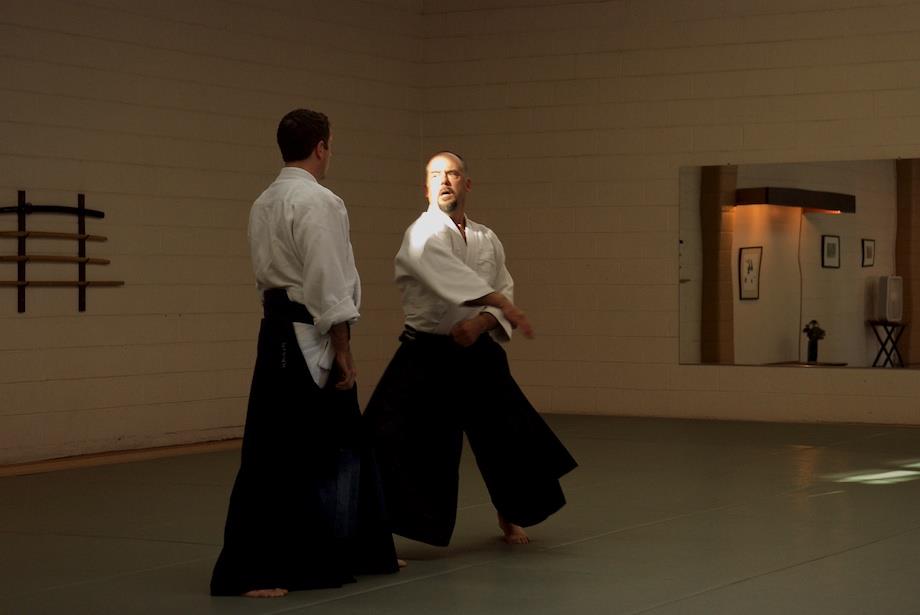
From seigan no kamai we explored the irimi entry which in essence is a slip to the outside line. Kokyuho from seigan no kamai is a cross body line – the lead hand remains in contact while the free hand strikes the opponent’s chin crossing the center line. From here we can take a humble breath exercise back to its origin as a neck/back break. The logic progression is simple once the premise of the entry is clearly understood.

So over the course of the past three months the exploration path has been: ikkyo to irimi nage to kokyuho. The actions lead ‘naturally’ from one to the other. Inside line to outside line to cross body line.

As a reminder the prayer-position leading to the split entries should help remind you of the combinations we have started to investigate.

Back to kokyuho.

The kihon presentation is as a breath exercise from gyuaku-hanmi (opposite hand grab). This is a starting position because it represents a simple and single point which could be a thrust as easily as a terminal point on a cutting arc. Hence it is a representation of a single point in time – isolated so as to eliminate extra variables. From the initial grab nage can focus on their motions executed in the correct sequence: allow uke to control the wrist, slightly drop the wrist vertically along the axis of the encounter while dropping the body weight through the knees (don’t bend the spine!), slide the front foot advancing to uke’s back (irimi), then turning 180 parallel to but behind the opponent to the shikaku. Once here, slip the free hand to catch the opponent’s wrist while extracting the grasped hand (rotate against the thumb). Keeping the pressure on the opponent’s hand you just trapped – recognize that the kokyu development is a necessary skill in order to execute the first application: to wit, snapping uke’s elbow. Bunkai #1. Foregoing the elbow destruction, we keep the downward trap while simultaneously raising your free arm (the one formerly grasped) straight up as if raising a weapon. Do not turn your hips or rotate the elbow: the correct path is a simple move straight up the axis. At this point the back foot steps forward – you are momentarily in a left foot/right hand or right foot/left hand position. Only after the advance do you then turn your hips (do not change the relationship of the arms, which is what is creating and maintaining the tension of the encounter) and slide bodily forward while the top arm descends rotating from the shoulder like a sword cut. So – the arm is coming down while the body advances. Collapsing the system projects uke (or better stated, uke escapes to avoid getting crushed/cut).

From here we move to Bunkai #2 which is the neck break. With the arm at the height of its extension, the move is simply to turn perpendicular (90 degrees) to uke’s body while wrapping his neck as tightly as possible. Then the kokyu deployment forces a simultaneous constriction (break) of the neck and the arm. Add a drop and the knee to the base of the spine and the true power of kokyuho is manifest.

Bunkai #3 was a presentation of a direct entry – no 180 blend nor 90-degree break, but rather a two-for-one beat exchange. Uke approaches (shomen, tsuki, whatever) and nage does a simple split entry – there is a subtle hip “wag” but it is far less pronounced, and therefore quicker and harder to see, redirect to simultaneously avoid, trap, hit. Done as a jo-dan tsuki with a knife and you should really understand the power the move should command.

All this from a simple breathing exercise.

The kokyu development isn’t really unique to this technique. But given the relative simplicity of the movement, I suppose it is easier to realize that the breathing pattern is a point of emphasis. As a rule, the breath pattern should be inhale on the rising and exhale on the descending lines. When you apply this concept to the technique, then the integration of movement and breathing generates the true power of the move.

Breathing and movement are inseparably linked. We use terms like shin-kokhyu (‘true breathing’) and the ‘rowing exercise’ to try to teach integrated breath/movement but there is more to the explicating the connection.

Breathing rates match movement rates.

It is nearly impossible to breath slow and move quickly. Try throwing a punch while exhaling slowly. We need to learn to time breath and motion appropriately.

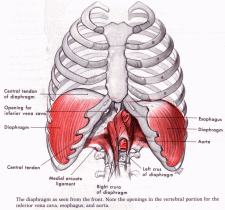
Most of the time Aikido breathing techniques merit a slower relaxed breathing pattern – slow breathing in general has a calming effect and slows movements. The inhalation pattern is slow in through the nose and equal measure in time, exhale through the nose. The diaphragm is the key muscle to focus on. Pull the air deep and hold then release. This is good training for solo movements, or technique executed with the absence of intentional power.

For kokyuho the general pattern is slow inhale through the nose while rising and then a sharper exhale through the mouth while closing/throwing. In the good old days, the exhale would be a kiai. So notice the pattern – slower approach/blend with a rising motion, then at the crest of the wave, the crashing quicker breath out.

As a rule, the Aikido breathing pattern tends to center on a more relaxed, slow/slow or slow/fast pattern. However, I have introduced other exercises which will require different breathing patterns.

Fast breathing is for fast movements (punching, slipping, fast footwork). Fast breathing provides energy for short-burst duration motions. The inhale is still best done through the nose, but the exhale should be through the mouth in short bursts – one for each punch, slip, etc., which also gives you a natural “beat” and an ultimate limitation of beats per breath. Take a breath, then do a sequence of shuffle advances and jabs – how many can you do before you need inhale again? Please remember that fast breathing does not mean a faster air cycle – a fast inhale, fast exhale cycle will only lead to hyperventilation. The goal of fast breathing is still a slow inhale, sharp exhale – like a boxer, you are constantly shutting off the exhalation through muscular contraction. The overall breathing should always be geared to a slow cycle but with explosive exhalations timed with explosive (short, sharp) movements.

Remember there are the physiological limits to these exercises – first predicated on your individual conditioning, but ultimately you are trying to give your body as much oxygen as it needs. And the purpose of focusing on breathing isn’t for meditative reasons, but rather to establish a rhythm and control. Control you breathing and you get to dictate the rhythm and pace of the encounter.

Working from gyaku-hanmi the basic presentation starts as tenkan to a back stretch – warming up. From the kihon tai-no-henko – keep the weight at the point of contact of the grabbed hand. Dropping with a slight forward pressure, then raise the hand with uke’s pressure under constant tension. Don’t forget a change of pressure is a ‘go’ signal to uke. With the hand raised above your head, uke’s elbow can become a weapon. So check it with a slight spiraling energy (i.e., start to manipulate uke’s spine and hips with a locking mechanism on the elbow and hand). Having raised the system with a shin-kokyu motion to its apex, the crescendo is the foot/hip moving past uke’s centerline while turning the hips and keeping contact with uke’s chin. Allow your hand to drop heavily to the conclusion of the movement. The ashi-sabaki is different here from the first presentation when we moved around the axis. In this presentation, there is a more muscular engagement because we are moving our hand to the apex of the axis and then moving the axis through uke to displace there center. Hence the strength of breath development: tanren development. The challenges is to remain ‘full of kokyu’ while traversing uke’s center. At certain times you may feel unbalanced – this is a common feeling because at the most critical moment it is likely the uke has both feet firmly planted while nage is mid-pivot. Working this problem out during training is the point – with time you will develop the ‘gravitas’ or ‘heaviness’ to solve the challenge of moving with balance and breath.

How can we help learn? First ‘cheat’ by which I mean use good physics. There is a logical grasping point – the obi/belt line. In the first presentations I showed the low-line lock of the elbow bar that creates the bottom part of the two vector line. The ‘old school’ (thank you Arikawa sensei) was to grasp your opponent’s belt pull their hips forward and use the ‘kokyu’ hand to force the head up and back. Done quickly against a less physical opponent and you snap the neck. Add a knee strike to the small of the back for the larger opponent. The point being, first that the only way to have the technique work is to have uke’s center in front of yours. The second point is that uke must take the last step. Okomoto sensei describes this as an ‘invitation.’ Meaning uke’s movement cannot be stopped early in order to execute a throw. Rather uke is ‘lead’ (suckered) to the point of their maximal extension before they feel the descending kokyu arm. Old school you simply pulled uke into position with superior leverage. The principal of kimusubi is more subtle but achieves the same positioning with (ultimately) less effort.

Continuing the progression – we move to the ‘ura’ presentation. I still contend there really is no ‘ura insofar as the ‘technique’ (the throwing part) is exactly the same as the ‘omote’ version, just that the ‘set up’ is longer because the dynamic at the beginning is different – ura is no more than an initial blend to a more energetic uke’s attack. Showing it from static, the intention from gyaku-hanmi is to extract the knife wielding hand (that is why it was grabbed in the first place, right?) with a tenkan motion (remember palm is up because you are about to rotate it out against the thumb) and with a decisive cork-screw of the hips insert the blade into uke’s kidney or on a descending line, sever the Achilles tendon. Yes, graphic because we need proper targeting to know we are in the correct position. Uke of course wants neither to occur, so retaining good contact with the knife hand, uke follows – forcing nage to try the rising line, leading uke forward and up to the crescendo of the ‘omote’ presentation again. Same terminal position.

Understanding that we are discussing concepts – principles of position – now remember the possible ‘techniques’ from the relationship we label as ‘kokyuho.’ First the elbow check hand. If uke rolls their head away from the kokyu hand, the one checking the elbow slips over into a ‘gross motor’ shiho-nage. Gotta come to class if you cannot figure out what I mean. Second is shoot through when uke tries to avoid the chin-control and take ude-kimi-nage. Or slip under for uchi-kaiten. All are progressions predicated on uke’s response. The final variant I showed was to slip the kokyu-hand under uke’s arm (rather than over for the chin control) and focus nage’s attention on a counter-grab to uke’s first attempt at an arm control which leads to koshinage.

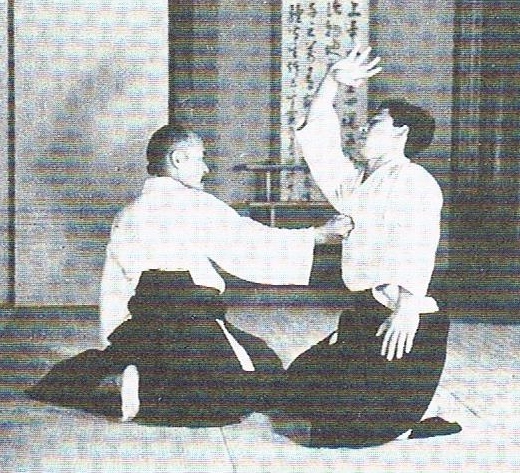
Briefly we explored the ‘Chiba sensei’ variation where the lead is with the ‘camming’ action of the forearm and hip lead. Most people incorrectly interpret this as raising the elbow (it may look like this, but that is why ya gotta feel) and it does resemble ‘elbow shield #1’ but the point is a relaxed shoulder and that ‘camming’ or rotating forearm that draws uke in close. From that relationship if uke’s arm is below the tip of the elbow, then nage may throw kokyu-ho. If uke’s arm is on top, then inevitably their pulse is exposed, so that leads to shiho-nage (‘high dexterity’ version). If uke stops moving and tries to plant, then because nage’s shoulder was relaxed, when the movement stops typically uke tries to control the arm, which means uke will inadvertently give nage the energy and opportunity to drive the tip of his elbow into uke’s clavicle with significant force. Please remember, that despite what it may appear, this exercise is not an elbow strike. It can be used as such – but that is a ‘simple’ line and we are playing on a higher energy-exchange.

Moving back to a high-intensity mode, the kokyu response to a straight thrust (jab, jodan tsuki) is a split-entry counter. Snappy training and a good mental exercise to build confidence. Just remember – whatever hand first makes contact stays connected to your partner’s offensive hand while the other moves in for the eye-jab. In class I reminded everyone precisely why I see a logic-connection between irimi nage and kokyu-ho. The simple reason is this: envision a straight thrust by your opponent. For simplicity sake, a right thrust. If you meet this thrust with your left hand forward, you will parry L to R (cross your body) allowing your right hand to proceed unimpeded to the opponent’s eyes (aka irimi nage direct). However, if you meet the right hand with the back of your right hand (panatuken) then your left hand proceeds to the opponent’s eyes (aka kokyu-ho). And as a final reference if the opponent’s right hand is parried with your left, then you will be on your opponent’s inside line, which takes you back to ikkyo.

I mentioned in class that I am trying to simplify the systemization of responses. Labels are great for compartmentalization, but eventually the dogged adherence to labels – discrete if-then responses – limits our ability to find connections. These notes, musings are by no means definitive. They are my idiosyncratic way to understand – to re-present the art to myself and hopefully provide some semblance of train-the-trainer ideas. Like all methods of understanding, these are fragmentary glimpses best understood and explored on the mat in movement.

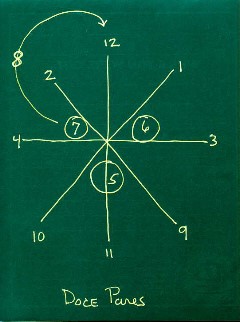
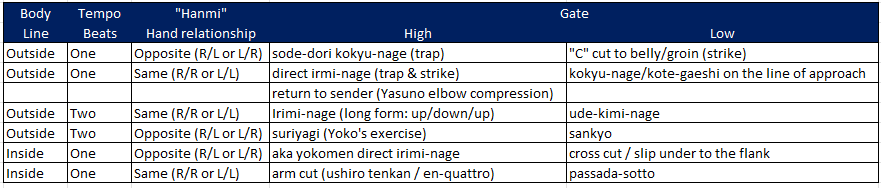
I leave you with this. Aikido’s responses are not infinite. There are precisely twelve ‘reference positions’ in monomachy: right v right (outside), right v right (inside), right v left (inside), right v left (outside), left v right (outside), left v right (inside), left v left (inside), left v left (outside), for the 8 one to one; then the two-hand positions of double outside (R v R and L v L), double inside, one in-one out L and R versions for the final 4 positions.  Thus far we have explored only three of the 12 – we have done RvR outside (kokyu-ho), LvR outside (irimi-nage), and LvR inside (ikkyo).

This morning I deviously introduced a basic sinawali (3-beat, forehand, backhand, backhand) pattern into the kokyuho line we are exploring together. Starting from a dynamic grab into tenkan then direct gyakuhanmi relationships we refreshed the memory of using arm tension to create the kokyu entry. Then a fast reminder on the two basic ashi-sabaki forms (Yoko’s pivot around the axis and Chiba’s moving the axis) and then the introduction of the third ‘grapevine’ direct.

The grape-vine is combined with a hand exchange/trap from the ‘low gate’ – and if you weaponized your front hand it is obvious why you cannot trap the high gate. The weapon also allows us to understand why the weapon hand goes to jodan no kamai’s position in Aikido (with the tanto in either saber or reverse grip). Exploring the use of the hip even on a direct entry is a key component in understanding kokyu’s line. We then reviewed the elbow lever and the slip to shihonage which represent the ‘standard’ relationship to the outside of uke’s forearm. Then we transitioned to the ‘inside’ line which expresses itself most often as ‘koshinage’ and I showed the three primary forms: thumb-elbow-lock (shihonage), checking both sleeves (sode-dori) resulting in a double-arm lock, and the kubishimi (neck) throw – but all executed from a hip check/pass like koshinage.

The culmination was a return to direct line, but with a 3 beat (sinawali) hand pattern. Statring gyaku-hanmi, the low gate hand is check 1, then the initial hand comes back over for check 2, then the initial low gate hand becomes the striking hand – 3 beats all done on the entry. If you were to add the 4th beat we would return to classic kokyuho arm position.

More kokuyu work in the first class with the emphasis on feeling the contact with Chiba sensei arm position (elbow shield 1). The challenges (focal points to work on) are, softening the shoulder, leading with the fingers (thumb) not the elbow, and at the apex of the move keeping the arm relatively static in its relationship to your hip. Trust the contact established with uke’s body. The throw is executed from the foot to the hip which is connected to the contact point. It’s about hip development not the force of the throw per se. We then worked on a “what if” uke backs away from the contact. The answer is the free hand that checks the elbow continues to ride up uke’s elbow line to the chin. A projection throw. Please note this is a continuation of the original intended throw and not a technique in itself – meaning I wouldn’t advocate this as a primary move. Just like the slip to the ‘gross motor’ shihonage, these are part of a logic chain in movement, but they are secondary responses, not primary. After that we tried to learn to leave the arm in its high position and float around and under it to perform a cut to the ankle. The emptiness we create by allowing uke to focus on the control they think they established provides nage the opportunity to move. We allow uke a single point of control to fix them to a single attack and allow us to find other openings. In the second class I returned to gyaukuhanmi ikkyo to focus on the camming action that provided the control on the axis of the encounter.  A lot of time on a ‘simple’ action but an important nuance to add to your repertoire of biomechanics. From that exploration of mechanics, we flowed back to the yokomen line in part to show how the camming action works in motion, but also to show kotegaeshi variants. Because it was the ‘advanced’ class the focus was on non-standard presentations – using the forearm trap to ‘return’ the blade rather than remove it. This movement is close to a ‘figure 4’ lock. Then we used a drawing line – which looks suspiciously like the ‘standard’ kotegaeshi except at the terminus of uke’s extension, the knife is immediately stripped with the free hand directly back into uke. Nice ‘tricks’ but the ai-ki part of the technique is the shin-kokyu motion necessary for them to be effective.

Kokyuho’s entry exercises – we started with 3 forms from gyuakuhanmi – standard tenkan, irimi, and direct. Reminders – while all 3 entries should be done with a unification of feet, hips and arm – there are levels of emphasis and isolation. Meaning, tenkan is a way of focusing first on the arm to arm relationship – either playing with the weight at the point of connection on the vertical axis or in leaving the connection still and focusing on the entry (looking to uke’s scapula – i.e. freeing the shoulders) before moving one’s body past and around the connection. Irimi’s entry focuses on the hip/feet because they are the prime movers – the hand connection is a given point. Then the direct entry is an emphasis on simply maintaining good skeletal alignment (that is rotate your elbow down and toward your front hip) in order to drive forward using the feet. All entries require breathing to be coordinated and postural alignment, etc., but I would still contend each discrete entry allows us to concentrate more on separate internal lessons.

From these body entries then we explored taking the ‘high gate’ and played the vertical axis to drop and control uke’s center. This is achieved by drawing uke close with the grasped hand as you shift forward the using the top hand to control uke’s elbow and drive through the femoral artery. This close contact exercise allows us to feel the shift in weight by using the hips – this is a very physical connection and should be an easy way to feel the effect of shifting balance when both players maintain an honest contact. I emphasize that this is an exercise – put a weapon in the grasped hand as a reminder that it is not a technique. Only the low gate works with a weaponized hand. Shifting to the low gate we can execute a classical kokyuho by drawing the trapped hand down and your free hand to its fullest extension. It is the created tension of the high and low line that draws uke’s center – and that allows the turning of your hips to displace uke. It isn’t an elbow smash (although it could be) or a horizontal transfer of energy. The line of action is closer to vertical. A bunkai is to show the weaponized hand in better motion – so imagine: uke grasps for nage’s weaponized hand, then if grabbed take the low gate extract the hand and the now free weapon is a neck slash (reaping the leg is optional).

ROKU NO TACHI (6th Kumitachi)

Monday was a digression from continuing to explore irmi-nage / no ura concept I had been flirting with. Because I was not feeling well and didn’t want to sweat over everyone, I moved back to kimusubi/ the 6th kumitachi. 

I tried to show both roles independent of each other – as simple kata, then to pair them, then to segment each ‘phase.’ As a reminder – the opening ‘guard’ is both players in segan-no-kamai – and once the kissaki of each blade finds the other, neither player wants to ‘give’ too much information, so then adopts waki-gamai to ‘hide’ the length of blade, the blade’s orientation, and to open the distance between each player. A reminder is that both players are still spirit forward, so the opening that is presented to each other is the head. That is a purposeful gambit. To provide an enticing one-hit one-kill target to the other. When the first player is baited and moves to shomenuchi, the responding move is to counter stroke to the initial attacker’s kote. First sequence can end here. The attacker sensing the threat to the wrist – immediately raises to avoid the wrist cut and quickly orients on the opponent’s head again. But sensing that threat our responder thrusts to the trachea before the attacker can complete the second shomen cut. But our attacker senses that threat as well so in raising shomen, cuts more briskly to close the opportunity to the thrust, forcing the responder to cover, receive the stroke, then flow to control the attacker’s sword while simultaneously moving to the attacker’s flank: a three for one exchange (think on that). The resolve of the attacker is undiminished. With his blade trapped, the responder could ride it up and decapitate, so the attacker must extract the blade with a hip dissolve and another attempt at shomen. Our responder sensing the attacker’s intent to extract the blade, follows / rides it to the full jo-dan no kamai stance of the attacker and finds the terminal control at the attacker’s wrist.

All the key parts of the exercise involve ‘sensing’ the openings. Of course, first they must be shown or taught explicitly (strike here at this time) and then the counter move – the poison/antidote, parry/riposte – type sequencing. The quality of the play on the blades must be light at first, but the goal is to have increasing pressure ‘sticky’ feeling so that the sword no longer is a tool but becomes a ‘natural’ extension. When both players are well connected then the actions flow without disjointed pauses, there is a harmony of motion. The flow can only take place when both players first present an opening, and then quickly follow a logic chain of – if this, then that, actions in equal measured beats (not actions, remember there can be multiple actions per beat).

Most of the night was a review of the steps. Setting up the logic chain. We didn’t get to play much with the connection, but we need to have the sequence confidently mastered first.

The second class was a brief review of the 5 elbow shields and the opening 5 steps of a kali drill. Again, simple body actions that we can use as discrete units of movement when I have to make an analogy. 

This Saturday opened with a quick review of shihogiri and happogiri in order to first establish the suriashi flow of the feet on the horizontal plane while simultaneously engaging the free use of the shoulders on the vertical plane.  In other words, I isolated the cutting rose on the ground and left us all doing only one of the 8 cuts in the vertical plane.  By isolating the complex movements to the feet I wanted to develop a smooth interaction of your body with the ground and build smooth rotational actions through the shoulders.  I then tried to illustrate that the same slide-strike action (from right and left hanmi) could be executed much more briskly when initiating the movement from the hip rather than the foot.  That exercise I need to think more upon to try to convey the action.

cutting rose 1.jpg
Cutting Rose – 8 Directions

That was all to re-introduce ikkyo and the timing of omote from shomen.  But we ran through that very quickly to play with connection through kaeshiwaza.  Introducing a counter for counter concept: ikkyo for ikkyo.  In this specific scenario I showed first ‘receiving’ ikkyo’s ukeme but right at the moment nage applies the wrist grab is the ‘go’ signal for the reversal.  Yes, it requires athleticism.  From the instant of wrist control you must allow your arm to remain in nage’s control and in the same place.  Thus, without giving information of your intent – explosively advance forward with your body, and once you have moved beyond nage’s shikko, snappily from the hips rotate your own shyuto over to trap nage’s hand and you will have executed an ikkyo reversal at about 90-degrees to the original line of play.  Hard to describe in narrative format.

Combining concepts and exercises.  From the neutral starting point of seigan no kamai with the back of the hands touching, we convey no information.  There is no ‘opening’ because there is nothing to sense.  Only when one player provides forward energy (the indication of a thrust) does the other respond by ‘absorbing’ the energy by moving back.  I demonstrated the seriousness of the exercise by putting a weapon in everyone’s hand.  If you don’t ‘absorb’ by yielding horizontal space (i.e. step back), you die.  This is a measure for measure exercise to maintain connection and maai.  It should be done with suriashi footwork.  Once the basic exercise was established, we moved to take the advancing thrust and pass it for irimi-nage’s entry.  We played that form of entry for a while.

The next stage was to play kaeshiwaza iriminage for irminage.  I emphasized here the ‘how’ to ‘take’ ukeme – or better phased the logic of receiving the force to preserve your life and simultaneously set yourself up in as advantageous a position as possible to get to your opponent’s shikkaku – i.e., how to reverse the action.  And please remember that there is a very specific ‘go’ moment for the kaeshiwaza to work – meaning there is a singular moment in time to execute the action.  If you miss the ‘go’ moment it is gone forever.  From a position of proper ukeme it becomes a straight forward advance while doing elbow shield 2 (chuburi for you iaido players) – remember that the target is the opponent’s head – not some nebulous area in space.  Weaponize the exercise and you should realize you are attempting to sever the spine near the base of the head.  Yup – martial (war-like) art – not dancing so get your metaphors and similes correct! 

The second class was a brief exploration of the direct irimi variant off a jo-dan tskui.  One handed it most closely resembles ashi-sabaki from gyuaku hanmi – that is the basic motion.  However it is executed from ai-hanmi – e.g., against a right cross, the right hand intercepts with a catching intent – and once the contact is established, the forearm rotates without breaking contact for a fulcrum effect to drive the opponent’ original thrust off line as you drive for a hand-spear to the eyes/trachea (again, proper targeting).  Put a dagger in your hand and this becomes eminently obvious as to what you are doing.  Ride this action past the target and you now have a ‘classic’ irimi-nage direct.  However, there is a serious refinement is what I am trying to describe – a pak-sao action, the connective smother that must happen against the initial thrust.  If the initial thrust is bypassed but not simultaneously controlled, a well-trained opponent will use the lack of control to retract and thrust again.

For you real geeks out there – an analogy to explore is Claude Shannon’s information theory.  It is by no means a great analogy, but instructive for some as a question: how do we separate information from ‘noise’?  When two people are physically connected like in Aikido we must learn to distinguish ‘information’ from ‘noise.’   When do we need to respond, when do we need to move – i.e., what is a threat and what is extraneous motion in our opponent?  This is why I insist that our actions seek targets – that is the definition of a threat: a directed attack toward a viable target.  Noise is anything other than a threat.