Old Magic – Exposure

“Similia similibus curentur.”
Let like be cured by like.

Hippocrates (attrib.), echoed by Paracelsus and Galen

This principle, later adopted by homeopaths and ridiculed by modern medicine, remains as stubbornly persistent—and surprisingly insightful—as any ancient folk wisdom. You’ll find it not only in medical aphorism but also in the logic of sympathetic magic, as described by James Frazer in The Golden Bough: the belief that a small token of the harmful thing itself, properly administered, holds the key to healing (or beating the electric chair).

Pliny the Elder advised rubbing the ashes of a scorpion’s head into a scorpion sting. Ancient warriors smeared bits of rust from a cursed blade into their wounds to “pull out the evil.” The practice remains in common parlance after a hard night of drinking – the origin of “hair of the dog” is a contraction of:“Take a little hair of the dog that bit you.”

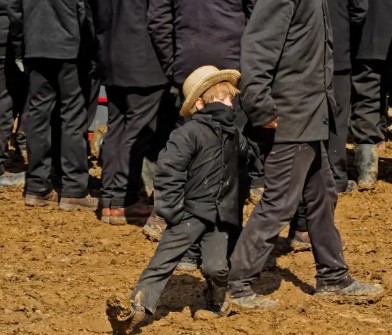
Perhaps we should not readily dismiss the idea, which as new scientific grounding, thanks to a series of elegant studies by Carole Ober and colleagues. In a 2016 New England Journal of Medicine article, further developed in a 2017 review in Current Opinion in Immunology (PMID: 28843541), Ober showed that children raised in traditional Amish farming environments exhibit dramatically lower rates of asthma and allergies, not because of their genetics, but because of their proximity to barns, animals, and microbial richness. Amish houses are full of what the modern world tries to eliminate: dust, dander, endotoxins. Early exposure to these allergens stimulates innate immunity because the exposures are mild, daily, and nonlethal. The immune system is not overwhelmed, it is trained.

This maps directly to what I described in my article Pain as a Teacher: the principle that adversity, in measured form, builds capacity, calibrates response, and teaches discernment. A student who has never been hit flinches at every feint. A child never scratched by the world develops allergies to life itself. Biological snowflakes.

We learn through discomfort and become more capable through experiencing it. A protected immune system, like an overparented child or a poorly trained fighter, becomes reactive, oversensitive, and prone to catastrophic overreach.

Frazer divided sympathetic magic into two laws: contagion (things that have been in contact remain connected), and similarity (like affects like). Both are at play in Ober’s study. Contagion: Amish children are constantly exposed to barn dust; particulate microbial DNA, animal hair, feed particles. Their bodies internalize the environment. Similarity: Their immune systems are challenged by irritants that resemble pathogens but do not overwhelm. Like trains like.

What is immune training if not the biochemical form of sympathetic magic? I use a similar logic in my classes when I provide demonstrations of bunkai and a staccato rhythm that punctuate demonstrations of ki-no-nagare. Expose the child to dust, and the body learns not to overreact to pollen. Strike the student gently, and he learns to defend against a real blow.

We laugh at the ancients for believing in healing relics and ritual bloodletting, yet it informed our modern immunology. We inject children with diluted toxins in a controlled modern ritual. We haven’t abandoned the logic. We’ve only changed the priesthood. This is not just a medical insight. It is a moral one. In every domain, education, parenting, politics, personal growth, we face the temptation to sanitize and protect. But the lesson from Ober’s research and from martial training is the same: overprotection breeds fragility. Controlled adversity breeds resilience.

Just as dust can inoculate, so too can pain, difficulty, and fear become allies in our moral and physical development. We do not conquer them by avoidance. We master them by exposure.

Ex malo bonum From evil, good[1]

_________________________________________

[1] Of course there is a footnote and a play on an old disagreement.

Seneca the Younger’s gave us the original dictum (from Epistulae Morales ad Lucilium 87.22) Bonum ex malo non fit, Good does not come from evil. His formulation is classic Stoicism; holding that virtue is self-contained and cannot arise from vice or wrongdoing. An evil man cannot do good acts. For the Stoics (which deeply informs my New England Pathology) the moral universe is a realm of intrinsic rational order, and any claim that good could arise from evil would imply that vice is somehow productive, which undermines virtue’s purity.

That reformed libertine, St. Augustine argued the opposite (in part no doubt to justify his own behavior). In his Sermon LXI (61) he offers a pointed and deliberate contradiction of Seneca’s conceptualization:

“Et hoc bonum est, ut ex malo surgat bonum. Non hoc dixit Seneca. Philosophus erat, et dixit: Bonum ex malo non fit. Et ecce fit: non ab homine, sed ab omnipotente artifice.”
(And it is a good that good arises from evil. Seneca did not say this. He was a philosopher, and he said: ‘No good comes from evil.’ But behold, it does: not by man, but by the omnipotent craftsman.)

St. Augustine’s argument is theological not philosophical. He needs to demonstrate the power of redemption. The cross as the ultimate evil turned to good. The crucifixion as salvation.

I must admit, my younger self rejected Augustine’s arguments as too apologetic, too philosophically weak – “God judged it better to bring good out of evil than to suffer no evil to exist – really? The whole enterprise of The City of God was silly. Why allow the Fall only to provide for the greater glory of redemption? A righteous clockmaker would simply make it correctly the first time.

Yet watching humans be human, I can only conclude we gotta learn the hard way. So perhaps St. Augustine was on to something.

____________________

Update 10/20/25

A 2015 study published in the Annals of Allergy, Asthma & Immunology concluded that there was “emerging evidence … regarding potential benefits of supporting early, rather than delayed, peanut introduction during the period of complementary food introduction in infants.” In short, early exposure to allergens was recommended.

These recommendations must have been broadly adopted because following the publication, and well reported by media outlets, were the results (this from the American Academy of Pediatrics): “We detected decreased rates of peanut or any IgE-FA in the period following the publication of early introduction guidelines and addendum guidelines. Our results are supportive of the intended effect of these landmark public health recommendations.”
The Meaning of Life

I learned about Sara Walker from a podcast with Lex Fridman. The entire conversation is worth the listen: Her conceptualization is brilliant and presented in an unassuming manner that belies the seriousness of the implications. Fridman’s long-format interviews are excellent in mining a guest’s breadth and depth of thought and I found Sara’s conceptualization of life fascinating, especially her use of scale to describe life as one of the largest structures in the universe because she incorporates time. Juxtaposing the size of life against a cosmic scale was an upending comparison.

There’s a line from Vonnegut’s Slaughterhouse-Five that always catches:

All moments, past, present, and future, always have existed, always will exist.

Vonnegut’s formulation is redolent of Nietzsche’s Eternal Return: that what has been will be again, with no variance and no relief. Both views load us with metaphysical weight.

Vonnegut’s Tralfamadorians see time all at once and thus perceive life – each moment from birth to death – laid out like beads on a string.

“So it goes”

Billy Pilgrim, the war-haunted protagonist, bounces along that string involuntarily, unstuck in time. Perhaps being unstuck is a glimmer to the scale Sara Walker is alluding to: Her radical definition of life, not just the materialist molecules, but rather the entire chain of causes that led to its existence. Life, in her view, isn’t just here-and-now. It’s stacked-temporally, causally, recursively.

When Walker says life is “large,” she doesn’t mean big like a star. She means large like an algorithm that’s been running for four billion years. Every cell, every limb, every language and habit and scar is part of a recursive computation that remembers, anticipates, and somehow carries time forward.

So maybe the Tralfamadorians were simply too introspective. They saw time laid out and determined because they saw the entirety of a solitary life. But Sara has a broader view still. Its not just the individual but the species, life builds with it.

But how would the compendium, that building of life be accomplished?

In the Dune saga, Frank Herbert imagines the Bene Gesserit who can access “Other Memory,” the full sensory lives of their maternal ancestors: Genetic memory. Science validates Herbert’s vision. Research into epigenetics has shown that trauma, malnutrition, even scent aversions can leave marks on DNA that persist across generations. Holocaust survivors’ children have altered cortisol receptors. Mice whose fathers feared cherry blossom scent inherited the fear-even if they’d never smelled it. These biochemical echoes result from modifying gene expression based on the experiences of prior lives. We are-quite literally-haunted by our ancestors – we have genetically learned from the pain of others.

Here’s where it gets personal. If Walker is right, if life is structured in composite time, then our genealogical archives might be more than nostalgia. It might be survival instinct. To know your grandfather’s path through the Depression, or your great grandmother’s flight from famine, is not just to “honor the past,” it’s to glimpse the inputs that shaped your own default setting. In this light, genealogy isn’t just biography, it’s system analysis. Your family becomes a lineage of recursively structured information flow.

[Let me be clear, I am not advocating a determinist model, this is not predestination by DNA – replacing a Calvinist damned at birth by God. I am merely pointing to the latest evidence that information can be transmitted generationally, genetically.]

Take Walker seriously and we are all discursive agents integral to the continued development of life: at the intersection of narrative, biology, and recursive memory. We are not poor players that strut and fret upon the stage, but key conduits that propel life through time. We are causal agents that generate novelty against the grain of entropy.

So maybe the real Tralfamadorian error wasn’t in how they saw time. It was in their fatalism. “So it goes” is elegant resignation. But Walker’s conceptualization is one of continued growth. You don’t escape your history. You ingest and metabolize it. You incorporate it into form and pattern.

Playing with a gastronomical analogy is fitting for a biological definition, but my default is Greek. And Walker by trying to separate from both the Vitalists and the Materialists, sildes back to Aristotle’s telos. Life as anti-entropy is purposeful. Walker posits life’s new telos. She doesn’t name Aristotle, but I hear his echo – perhaps she is a direct descendant? Let me dilate:

There’s a moment in every enduring story where something old is taken apart and reassembled: a king unseated, a city razed, a body aged. And yet, somehow, the thing remains itself. This is the dilemma posed by the Ship of Theseus: if every part of the ship is replaced over time, plank by plank, is it still the same ship? And if you reassemble the discarded parts into a new vessel, which ship holds the true identity?

Aristotle provides the necessary distinctions to solve the riddle. In his Metaphysics, he distinguishes between matter (hyle) and form (morphe), insisting that what something is depends not merely on the stuff it’s made from, but on the telos it realizes. A knife is not just metal; it’s metal shaped to cut. A human is not just flesh, but flesh patterned toward rational activity. And a ship? It’s a thing that sails. Its identity may not reside in the wood at all, but in the continued act of navigation and sailing: its purpose enacted over time.

Sarah Walker’s definition of life adds modern resonance to this classical framing. She argues that living systems are vast structures in composite time, not because they’re spatially enormous, but because they embody the memory of their own construction. DNA is not inert – it is historical architecture. Each cell is a palace rebuilt in reference to palaces past, with blueprints written in adaptive scars and recursive function. If the Ship of Theseus still sails, it does so because the information that makes it a ship continues to govern its becoming.

This brings us close to the Aristotelian idea of entelechy – the actuality toward which a potential aims. Life, for Walker, becomes a process not just of chemical reactions, but of sustained identity through time via information that acts as a kind of internal cause. The form is not static, but alive and evolving and intentional in the Aristotelian sense. It seeks persistence, adaptation, and propagation. Not because it chooses to, but because those that did not, are no longer with us.

Walker and Aristotle both, it seems to me, reject dualism (bad Descartes!) without collapsing into reductionism. The soul (psyche), for Aristotle, is not a ghost in the machine, but the form of a living body. It is the organizing principle, the actuality of a body that has the potential for life. So when Walker speaks of life as causal structure encoded in information she is, perhaps unknowingly, reviving an Aristotelian intuition: Identity is not in the pieces, it’s in the pattern. More precisely, it’s in the pattern’s persistence through change.

This also re-frames the Theseus dilemma: it is not the planks or even the continuity that matters. It is whether the ship remembers how to sail. If the function endures, if the pattern persists, if the structure recursively reaffirms itself-then identity is not lost. It is transformed, matured, tested.

And that is how I interpret Walker’s formulation of what life is. Not a continuity of parts, nor even of memory, but of capacity of the ability to generate structure that sustains itself in the face of entropy.

So the ship sails on. Not because it’s made of original wood, but because it still catches the wind.

___________________________

A Stoic coda?

As much as I liked that final turn of phrase, I am not satisfied that telos is the right idea to end on. What if information isn’t just structure—but story? Sara Walker’s formulation already nudges us in this direction. Life, as she frames it, is information with causal efficacy. In this view, a living organism is less a machine than a sentence in progress. And the human being? Perhaps the longest, most recursive narrative structure in the known universe. 

Walker has suggested that the arc of life includes not just biology, but our extensions: our tools, our language, our civilization. We are story-bearing, story-making entities, broadcasting patterns into space, encoding ourselves in stone, fiber, signal, silicon. Our survival depends on coherence: on keeping the story intelligible across generations. 

Thus our myths, scriptures, oral traditions, and epics are not mere entertainment or ornament, they are cognitive infrastructure. Stories do what DNA does: they remembered what worked, what went wrong, who we fear becoming, and what we hope we might be. The Iliad, the Upanishads, Gilgamesh, the Analects these are operating systems. 

Which brings me to the Stoics, who might have nodded gravely at Walker’s notion of life as causal structure. For the Stoics, the cosmos itself was Logos, which I capitalize because it is best translated not as ‘word’ but as ‘ordered rational speech.’ The Stoics believed the world was made, sustained, and understood as a kind of divine narration. God, they said, speaks the world into being—not once, but continuously. Creation is not an act, but a verb: an ongoing utterance. And as speaking animals, we are the image of God.

When we tell stories, we participate in that creative unfolding. To narrate is to bind cause to consequence, to name patterns, to cast significance. In that sense, storytelling isn’t just memory—it’s a microcosmic version of what life does: recursively structure the future using the grammar of the past, it is to make meaning resilient against time. 

So I give the final word to Gene Wolfe (Shadow of the Torturer):

Certain mystes aver that the real world has been constructed by the human mind, since our ways are governed by the artificial categories into which we place essentially undifferentiated things, things weaker than our words for them. We believe we invent symbols. The truth is that they invent us; we are their creatures, shaped by their hard, defining edges.

IPPON-KEN

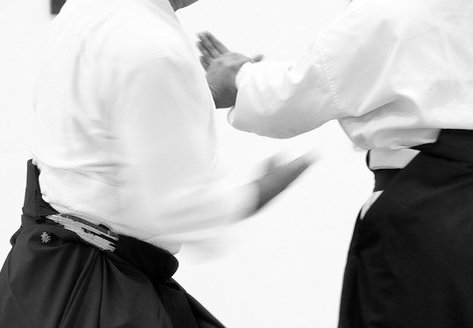
Atemi (当て身) is often misconstrued as a generic term to mean a “strike” or “hit,” but it means “to strike the body” and with the implication that it is striking a specific target.

Without any denigration of the sweet science – the pugilist art of Western boxing – which has incredible history and strategy, ultimately, has the goal of delivering a KO with a fully loaded transfer of mass. That is not what we are training.

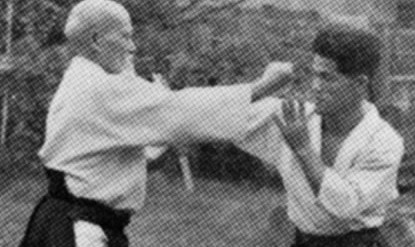
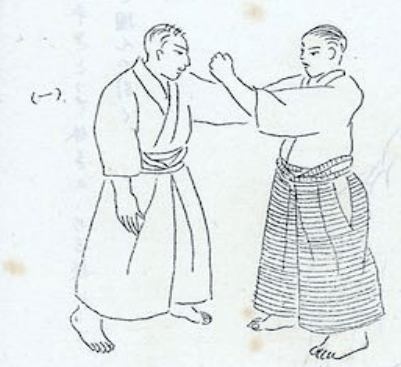
In his Budo Renshu, O’Sensei made clear and distinct uses of atemi. Some encounters merited a strike reminiscent of Western boxing – upper cuts and jabs:

Upper cut (or downward back-knuckle)
Straight blast

But concentrate on the less familiar.

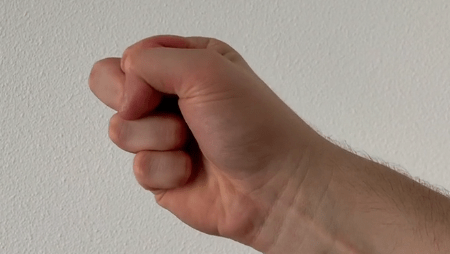
The single knuckle punch, often referred to as ippon-ken (一本拳), is a focused striking method found in both Karate and Tuite (Okinawan grappling and seizing techniques).

ippon ken

And its use was distinctly applied. The proper use of atemi usually requires strikes that are precise: targeting typically aimed at nerve centers, tendons, and (for the highly trained) acupuncture meridians. The goal of the strike is to create a neurological response – pain compliance, flinches, release reflexes – to facilitate the joint lock, throw, or control.

Ippon-ken is a punch where (most frequently) the second joint of the middle finger is extended slightly beyond the rest of the fist, concentrating force into a smaller surface area.

One of several variations

In this article I will mix lexicons, so a quick primer to disambiguate:

The Okinawan tradition uses tuite (取手), often translated as “seizing hand” or “grabbing technique.” In Japanese Jujutsu or Aikido, the closest equivalent is kansetsu-waza (joint techniques). But there’s a practical difference:

TermOkinawan (Tuite)Japanese (Jujutsu/Aikido)
ApproachLock follows a pain or balance disruptionLock follows kuzushi (off-balancing)
ToolAtemi embedded in kataAtemi sometimes secondary or omitted
LexiconRooted in Chinese influence (via Bubishi)Rooted in Daito-ryu or battlefield grappling

The refinement of terminology in Japanese (vs Okinawan) was driven home for me when my Kenpo instructor’s father told me “Aikido is like a laser, Karate is like a shotgun.” He was speaking both the to specificity of technique in Aikido’s curriculum vs the breadth of Karate, but I think also to the fact that Okinawan arts embed striking in the kata whereas Japanese systems tend to formalize and isolate terminology. Thus, in Okinawan, the ippon-ken isn’t a “strike” in isolation: it’s an inseparable part of an interlocking tactical sequence.

Tuite is not joint locking for its own sake, it’s structural exploitation. For a lock to work, the opponent has to lose structure or posture. Often, this can’t be achieved mechanically alone; pain or shock must create the opening.

Hence ippon-ken.

Examples:

  • When attempting a wrist flexion lock (nikyō) and the opponent’s posture remains intact, a sharp ippon-ken into the inside forearm collapses their resistance.
  • In transitioning from a lapel grab to an elbow lock, a knuckle strike to the floating ribs disrupts their ability to breathe or rotate away.

This isn’t theory. It’s anatomical reality.

An excellent reference to delve deeper is Bubishi: The Classic Manual of Combat translated by Patrick McCarthy – I recommend his work.

Often called the “Bible of Karate,” Bubishi contains illustrations and explanations of both vital point striking (kyusho) and small joint manipulation. In particular, its anatomical diagrams (Sections 28–32 in many editions) show targets such as: The medial biceps tendon; the intercostal nerve zones; the mandibular angle; and the radial nerve plexus near the wrist.

spear-hand to the intercostal

Many of these zones correspond exactly with the modern tuite targets or points of contact where Aikido effects a lock or throw (alas too often without a full appreciation of why that target was selected). The Bubishi doesn’t name ippon-ken directly, but its implied methods, sharp penetration with concentrated force, match the function of the single-knuckle punch.

A quote attributed to the Bubishi’s transmission of Chinese White Crane fighting reads:

“To strike with a small point is to cause deep pain without the appearance of force.”

This is exactly what ippon-ken delivers.

And while I have not shown all these applications in class, I have demonstrated the medial biceps tendon strike adopted from the “dirty boxing” taught to me by Master Keating, Panantukan.[1] Just as Okinawan tuite uses atemi to make the joint available, Panantukan uses similar percussive contact to make the opponent’s structure vulnerable to sweeps, controls, or disarms.

Both systems converge on this reality: damage isn’t the goal, disruption is. The damage follows the disruption.

__________________

[1] Panantukan incorporates knuckle rakes in addition to the single knuckle and expand targets to include the forearms, or inside the thigh to cause deadening effects. Furthermore, elbows (Master Keating’s Hellbows, Salute, and double-taps) are delivered to disrupt balance, but even more interesting are the gunting (scissor) strikes that simultaneous destruction of the attacking limb using knuckle strikes or ridge hands to nerve centers.