Thomas Jefferson was largely correct, but he got the French Revolution entirely wrong. He should have known better. Jefferson focused on protecting the potential that each and every individual is born with – the “unalienable Rights, that among these are Life, Liberty and the pursuit of Happiness.” He thought the French Revolution was an expansion of the American pursuit. It wasn’t. The French version tried to dictate outcomes through legislative pronouncements – “Liberté, égalité, fraternité.” A collectivist dream perpetuated by lawyer-tyrants like Robespierre who was no better than the hereditary-tyrants he executed. France wasn’t a principled revolution: it was a mob hit. And the Russian Revolution was the same. Just look at the outcomes.
France today is similarly deluded. I must admit jealousy at the fact they riot over a two-year increase in the retirement age, phased in over seven years, to the ripe age of 64! It shows that France’s financial education and understanding of government Ponzi schemes is even worse than the United States’. The peasants are still angry and deluded that there is some source of governmental wealth beyond what is stolen from the populous.
More critically, there is still a strange belief in the reified government, as if there is an “it” above the parasites who inhabit the structure. Those inhabitants are not moral agents – Plato’s philosopher kings – rather they are the same stuff of muck and guile that the rest of us are.
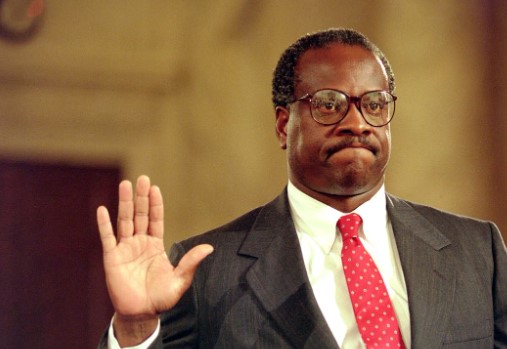
The current noise in the news at both the federal and state level serve as poignant reminders. The OLCC liquor scandal, Secretary Smokin Shemia Fagan, Clarence – Long Dong Silver – Thomas are guilty of naked self-interest. (And in Thomas’ case, I would think criminal tax evasion.) Ethics violations do immeasurable damage to the public trust. But that trust was always misplaced because it was predicated on the moral superiority of those who seek power. Lord Acton will always have it right.
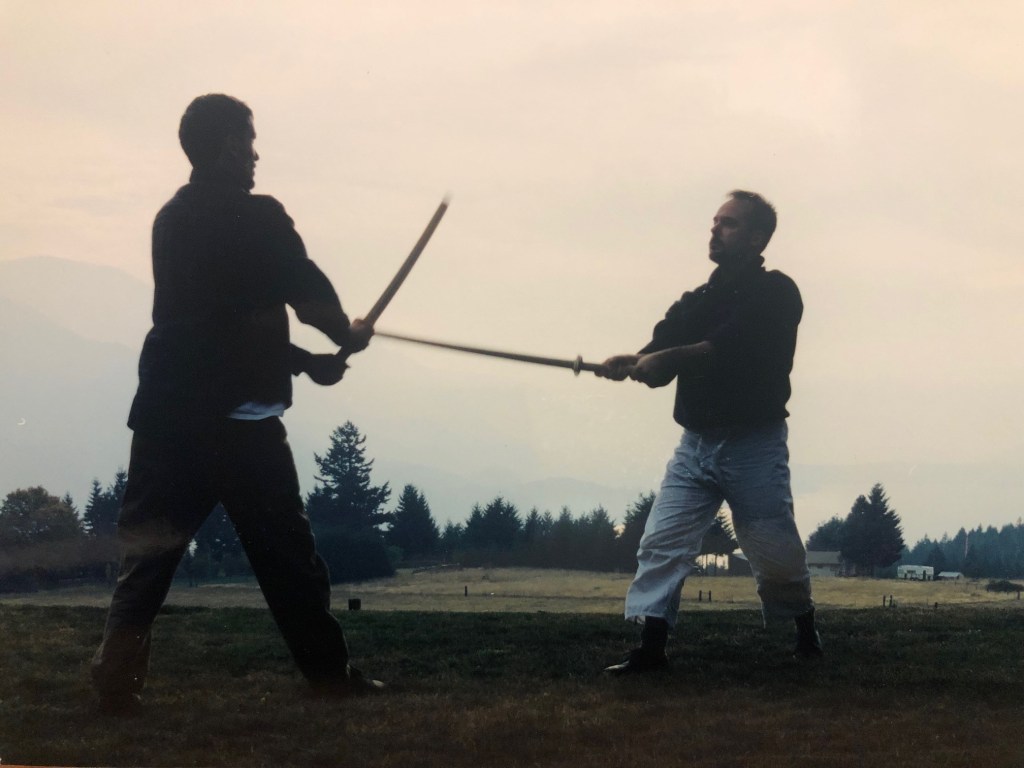
Aiki-ken at Ryo Bo Zen OnAlex and Lisa MIyaguchiCriag Capistran, Mischa Mulligan, Alex Leavens in France
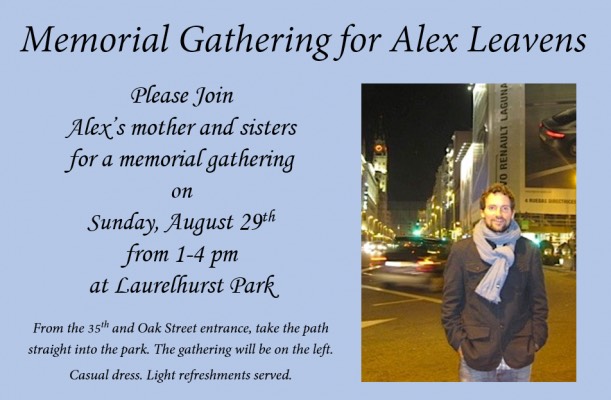
I posted this shortly after his memorial, but took it down almost immediately after because it was inadequate. It still is.
Alex was a talented Aikidoist and I had the privilege of being his sempai, training partner, and teacher. His Aikido had precision and power. He left the art too soon.
We didn’t stay in close contact once he and Asako separated and he left the dojo. Every so often we met by happenstance on the street and then at PSU where he was taking writing classes and I guest lectured on real estate.
I did reach out once to ask him to spend a day teaching Kyrian primitive skills.
Although I knew he had started writing, I never read any of his poetry until after he was dead. I had forgotten that he collected and restored axes.
Gonzalo Flores and Leslie Peterson met me at the memorial. A sad context to see old friends. It was difficult to speak with his sister and mother – what does one say to a grieving family whose son and brother took his own life?
Measure 110 which decriminalized possession of drugs is a great libertarian ideal – the state has no business regulating what any individual decides to do with or put into their body. The social benefit, thought legislators, would be that the burden on the criminal justice system would be lessened and provide greater justice to racial minorities who are disproportionately arrested for possession.
The Economist first reported on Oregon’s experiment and provided Portugal as an examplar, but quoted a salient warning from Portugal’s National Coordinator for Drugs and Drug Addiction, “Decriminalising without doing anything else does not lead to any improvement of the situation.” Oregon legislators ignored the advice and moved with ready-fire-aim implementation. None of the warnings heeded nor support systems implemented:
He warns policymakers that any plan to decriminalise drugs must consider four factors: accessible treatment, prevention, harm reduction and reintegration. In Portugal, first-time offenders go before a panel at the Ministry of Health and receive a warning. Subsequent violations within five years of the first offence incur either a fine or other administrative sanction, such as community service. Punishment is individualised. Someone struggling with drug dependency may receive therapy, while a recreational user battling with depression may receive mental-health care.
Portugal has the advantage of being a sovereign country – Oregon forgot that it is not and Portland in specific became a Lorenzian attractor for addicts. The derelict non-contributors who flocked to downtown Portland are not all home grown.
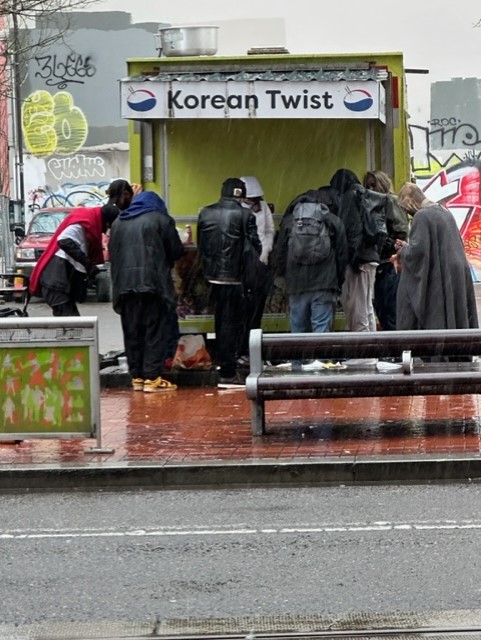
Roaches in the rain
Measure 110 became law on February 1, 2021 in the wake of the Floyd riots of 2020 and the defund the police outcry – inflamed by Jo Ann Hardesty. We now have a police force gutted by retirement, largely demoralized, and undermined by the DA (thanks for nothing Mike Schmidt). Any surprise that Portland has become an open air, use and abuse drug market?
Every day I walk our properties and see the impacts. I watch the fentanyl zombies with their tinfoil getting high in alcoves. They congregate in clumps and shuffle – it’s like walking through a set for The Last Of Us.
A week ago, I saw one of them frantically call out for naloxone to help a fellow zombie who had just overdosed. I watched some Good Samaritan actually look through his backpack to find some. It took a measure of will on my part not to stop him with a “Why bother?” Oregon is considering legislation to make Narcan easy to purchase to help reverse these overdoses. Why bother.
Legislators were reckless in allowing decriminalization of possession without guardrails around their public use (still a criminal act, just unenforced) and without a mandate for treatment for chronic abuse. Responsible adults should never be accountable for what they put in themselves in the privacy of their homes – but everyone on the streets of Portland has violated that civil contract. They have forsaken agency.
Reformers are incredibly dangerous in their righteousness. Yes, there were felony imprisonments, admittedly an inefficient outcome, but at least under criminalization, possession charges were a tool to force people into treatment in lieu of punishment. Now its a voluntary admittance which – shocker – hasn’t worked:
Trying to get people into treatment through citations does not work, says Keith Humphreys of Stanford University. Without meaningful pressure on drug addicts, he says, “there is no mechanism at all to get them to change their behaviour.” From the 4,000 citations issued in Oregon in the first two years of the policy, fewer than 200 people called the hotline and fewer than 40 were interested in treatment. It has cost taxpayers $7,000 per call.
The problem remains a human one. Reformers assumed addicts could respond rationally to incentives. This is the same inane lack of understanding that leads the same type to believe that harsher gun laws will prevent incorrigibles from committing horrible murders. Limiting access to the means of destruction will not solve the behavioral impulse to commit the crimes.
You cannot legislate human behavior or its improvement. That takes true education.
Education: 1530s, “child-rearing,” also “the training of animals,” from French education (14c.) and directly from Latin educationem (nominative educatio) “a rearing, training,” noun of action from past-participle stem of educare (see educate). Originally of instruction in social codes and manners; meaning “systematic schooling and training for work” is from 1610s.



 Protective Arts