Tik Tok

China is a real geopolitical threat because of Xi.

TikTok is Chinese owned and the potential for data mining is real. But Washington’s reflex has been fear mongering rather than analysis; turning a genuine security concern into an excuse for domestic control.

Technological advances have always favored tyrants, so we are right to be circumspect. But there is a very dangerous expansion of US governmental powers in the vague language of the Restrict Act. We have been here before and should recognize the clear and present danger in this proposed legislation: it is just as odious as the Patriot Act.[1]

Legislation predicated on fear is never prudent.

Under the Act, the Department of Commerce would identify and ban information and communications technology products that a foreign adversary has any interest in, or poses an unacceptable risk to national security. The current list of “foreign adversaries” includes China (as well as Hong Kong); Cuba; Iran; North Korea; Russia, and Venezuela. That list can change without new legislation by administrative fiat.

Protecting US interests is critical and restricting our governmental use and purchase of products and services from foreign adversaries should be a given. We shouldn’t be buying chips produced or software developed in China for use in governmental or military applications – clearly. But allowing the government to regulate and punish (with 20 years jail time!) its citizens who use these platforms and technology is a brazen over-reach.

I fear that the legislation will in fact be enacted.

Why do people forget the very purpose of the Constitution was to limit governmental powers and not enumerate them? True leadership is needed to avoid trying to solve problems with legislation. The Founders knew the frailty of human nature and built safe guards within the framework. Yet from the beginning we have chipped away at those bedrock restraints, usually in the name of safety or virtue.

My contention is that good men (not bad men) consistently acting upon that position [imposing “the good”] would act as cruelly and unjustly as the greatest tyrants. They might in some respects act even worse. Of all tyrannies, a tyranny sincerely exercised for the good of its victims may be the most oppressive. It would be better to live under of robber barons than under omnipotent moral busybodies. The robber barons cruelty may sometimes sleep, his cupidity may at some points be satiated; but those who torment us for their own good will torment us without end for they do so with the approval of their own conscience.

C.S. Lewis, God in the Dock

Too many historians of American politics laud the ambitious moralists without understanding the damage done. FDR’s New Deal and LBJ’s Great Society expanded governmental power to its current near-regulatory omnipotence.

Just read closely the implications of Wickard v. Filburn. The Commerce clause and the Department of Commerce is perhaps the single most powerful legislative arm the US government has in controlling the behavior of its citizens.

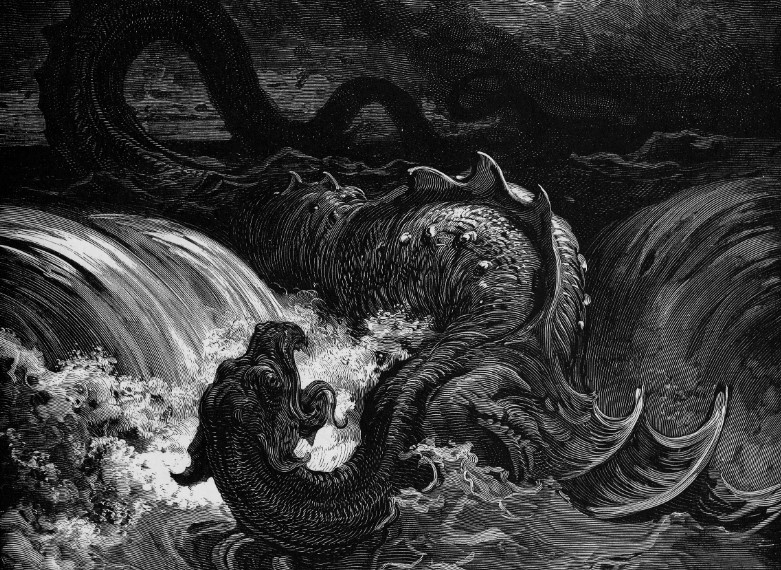
Tremble before Leviathan.

_____________________

With serendipitous timing, I decided to re-watch Rising Sun (1993) with Sean Connery and Wesley Snipes. I had forgotten the plot of the movie which is boiler-plate detective but is worth watching because it shows the importance of understanding cultural nuance, and more importantly, memorializes American fears about Japan in the early 90s.

The story revolves around an apparent murder connected to the Nakamoto corporation which is in the midst of sensitive negotiations for the acquisition of an American semiconductor company. The acquisition requires Congressional approval and after the murder, a key Senator – who was a guest at the party – abruptly changes his stance and signals he is now in favor of approving the sale. The game is afoot!

The parallels to our current concerns about China are striking. In the early 90s, Japan proved its industrial prowess – dominating (and decimating) US production in several sectors: primarily automotive and consumer electronics. (The movie also highlights early video imaging and editing technology – a key plot device that should heighten concerns on current AI capabilities.)

The political fears were palpable – three Republican members of the House destroyed a boombox in chambers in protest of Toshiba indirectly selling sensitive technology to USSR. The Coming War with Japan (1991) predicted the inevitability of a shooting war with Japan.

None of these fears materialized. Although Japan was running a mammoth trade surplus in 1993, that was no guarantee of economic success and in fact their domestic bubble was about to burst.

Although he doesn’t address the US fears of Japan (including Clinton’s hot-mic bashing) in the early 90s, Peter Zeihan provides a concise summary of the current state of relations between Japan and the US. Japan’s challenge to the US economy was brief and unsustainable, and more significantly, Japan now clearly understands its dependence upon the US.

Given this historical arc, does that mean our current fear of China is overblown? No – precisely because Xi has consolidated power in manner no Japanese minister ever could. A totalitarian concentration of power makes the entire nation state subject to Xi’s whims and makes his flunkies dangerously skittish. Until the people can assert their agency, China will remain an unpredictable but very real threat.

__________________________

__________________________

[1] I hate politicians precisely because of their dissembling character. In a hasty response to the attacks of September 11, 2001, Congress enacted “The USA Patriot Act: Preserving Life and Liberty.” Like most legislation, its title promised what its text revoked. The liberty of US citizens was trampled and the lives of suspect terrorists were made forfeit at the whim of US presidents. Bush II at least had vengeance as an excuse (petty as it was), but Obama – who won the 2009 Nobel Peace Prize for his “extraordinary efforts to strengthen international diplomacy and cooperation between peoples” (farce!) – happily renewed this travesty of law under the new sobriquet “The USA Freedom Act.” Legislation he as a Senator railed against, he endorsed when it was his turn to wield its power – and using it drastically more often than Bush II. So much for international diplomacy. Watch Judge Napolitano and spend An Evening with him.

Neptune’s Fountain

Las Vegas is a temple of the ersatz celebrating the vacuousness of gambled fortunes. For all the glitz and neon grandeur (quickly being replaced by LEDs), Las Vegas is usually an honest thief. Everyone knows that isn’t the Eiffel Tower, nor the Montgolfier balloon in front of Paris; New York, New York’s scale is wrong and isn’t as grand as the city itself; and the Luxor isn’t a monument for Pharaoh.

A room with a view

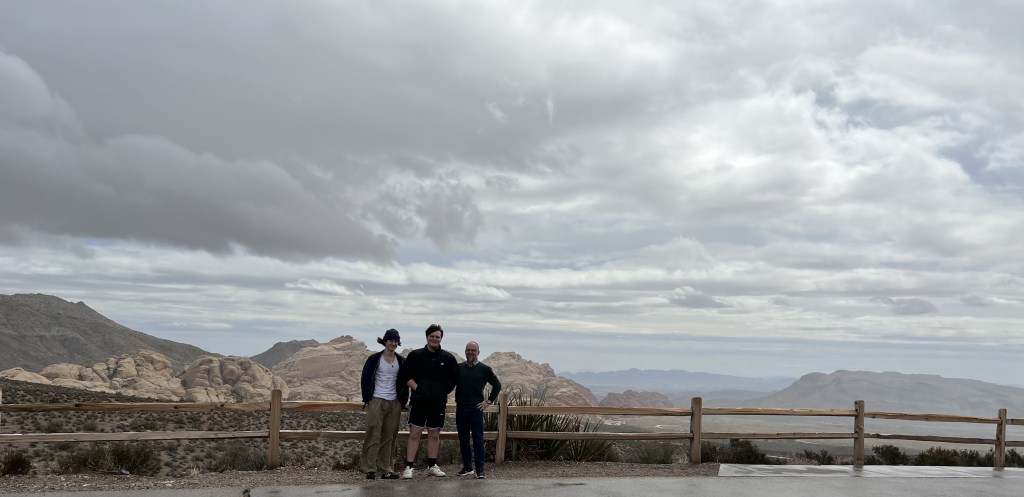
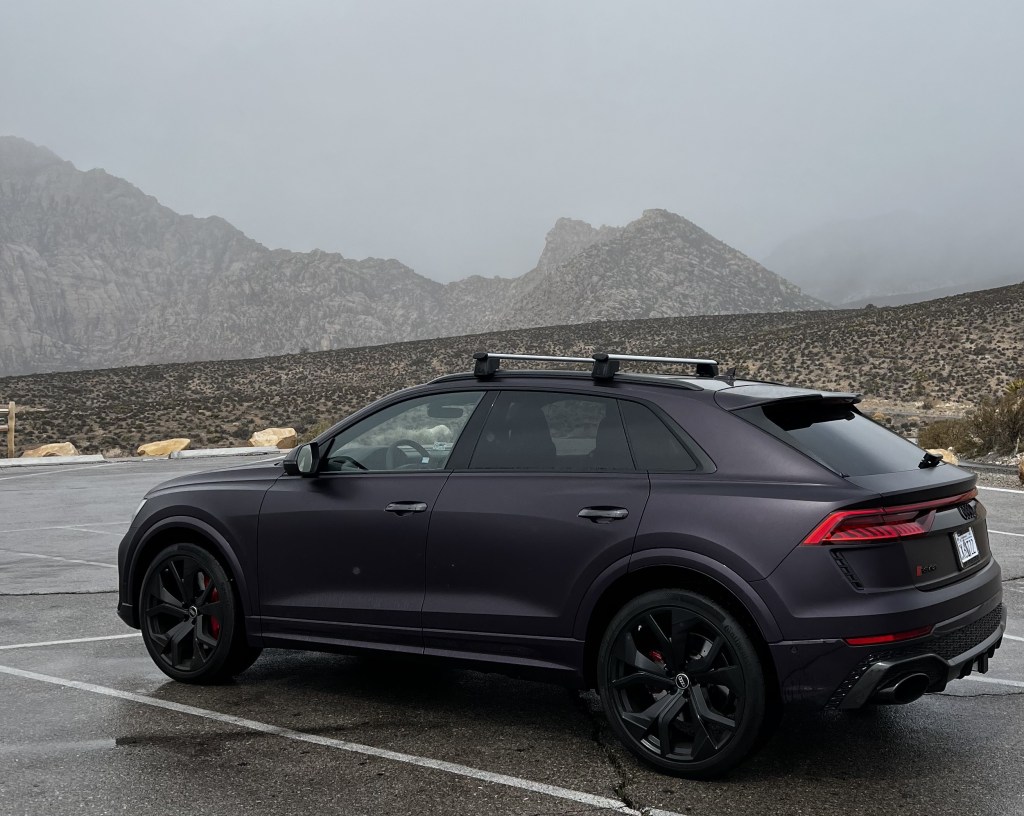
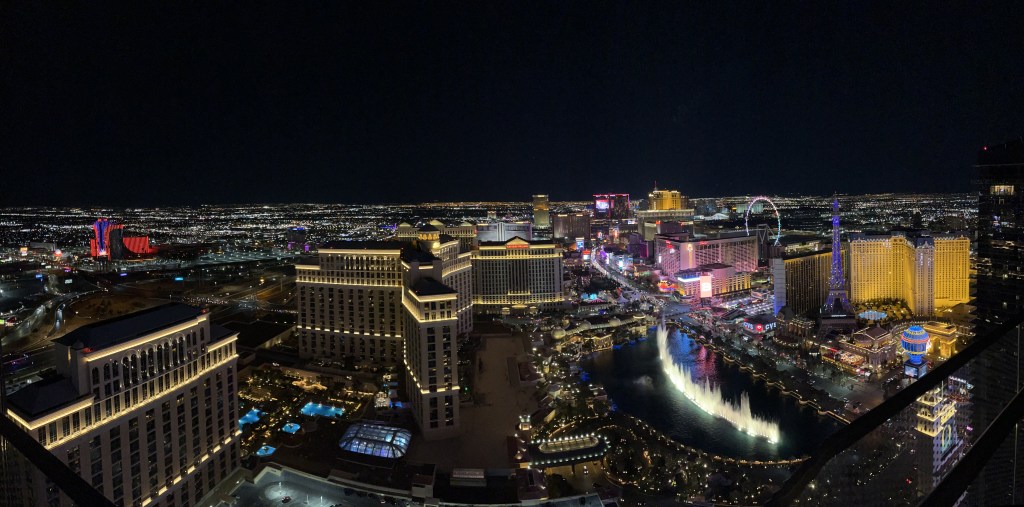
For Spring Break 2023 we stayed on the 58th floor of the Cosmopolitan with a commanding view of the strip. This visit we rented an Audi RS Q8 and took it to Red Rock Canyon. It was a cloudy and drizzling daytrip – reminding us all of home – and of the Painted Hills.

Red Rock Canyon

The car was the highlight of the trip for Adin. The RS Q8 shares the same engine as the Urus and is very quick off the line with a 3.6 second 0-60 while seating five people.

A Urus in all but name

It was a fun ride and it has a g-force display on the dash so you can prove how well it corners.

For Kyrian we did the chef’s nine-course meal at Superfrico – with fresh mozzarella made table-side.

Drinks and a show

Most of the trip we – as is typical for my family – walked the strip just taking in the sights and looking at the luxury shops at the Venetian and Caesar’s Palace.

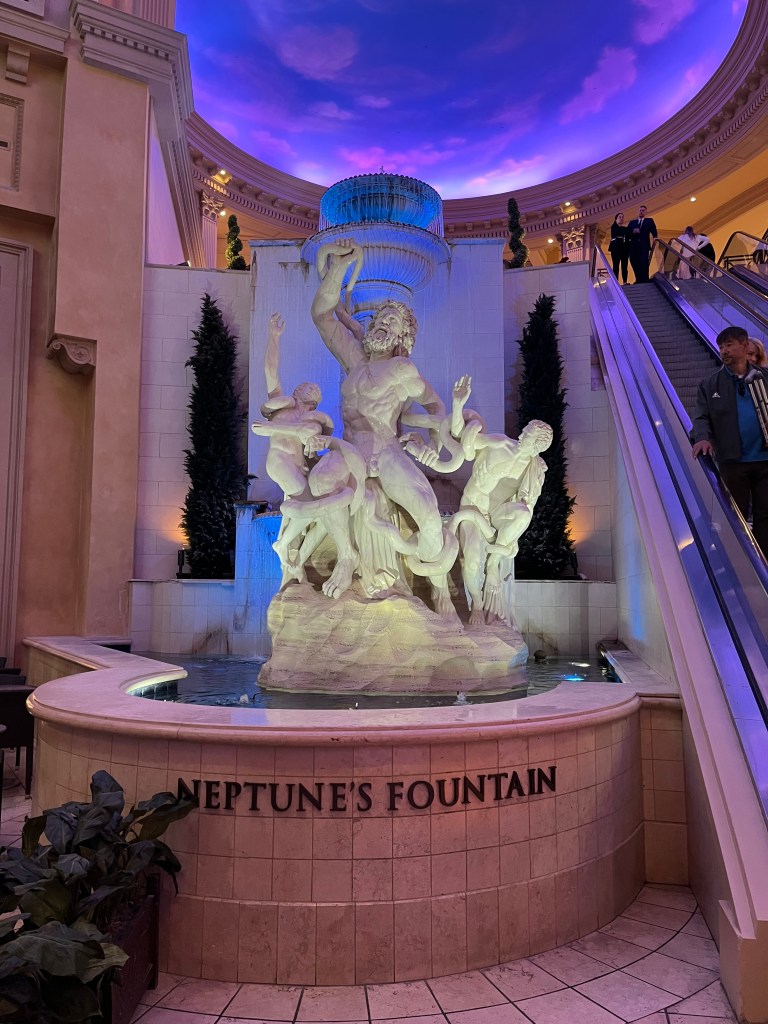
This trip, I noticed a fountain nearly hidden by an escalator in the Forum Shops labeled Neptune’s Fountain.

What’s in a name?

While I fully appreciate the curated shams of Vegas, a blatant error I cannot accept. This isn’t Neptune – rather, it depicts the death of Laocoön and His Sons.[1]

In Virgil’s Aeneid, Laocoön is the Trojan priest who saw through the Greek ruse of the horse and warned, “Beware of Greeks bearing gifts.”

Equō nē crēdite, Teucrī / Quidquid id est, timeō Danaōs et dōna ferentēs

Do not trust the Horse, Trojans / Whatever it is, I fear the Greeks even bearing gifts.

The Trojans ignored him. Despite the stratagem working, Athena sent serpents to kill Laocoön and his sons for his interference. Athena, ever-protecting her Odysseus.

The statue freezes the moment when:

Unswerving then
the monsters to Laocoon made way.
First round the tender limbs of his two sons
each dragon coiled, and on the shrinking flesh
fixed fast and fed. Then seized they on the sire,
who flew to aid, a javelin in his hand,
embracing close in bondage serpentine
twice round the waist; and twice in scaly grasp
around his neck, and o’er him grimly peered
with lifted head and crest; he, all the while,
his holy fillet fouled with venomous blood,
tore at his fetters with a desperate hand,
and lifted up such agonizing voice,
as when a bull, death-wounded, seeks to flee
the sacrificial altar, and thrusts back
from his doomed head the ill-aimed, glancing blade.

Aeneid, Bk 2

There are, of course, earlier versions than Vigil’s. A lost play by Sophocles makes Laocoön a priest of Apollo who is punished for violating a vow of celibacy (the Bibliotheca by Apollodorus follows this skein). Sophocles’ version is crueler than Virgil’s. In that version only his sons are slain, leaving Laocoön alone to suffer. (Quintus of Smyrna follows Virgil in making Athena his tormentor.)

Prophecy is dangerous for both the supplicant and prophet alike. The people of Troy take Laocoön’s death as punishment for striking the horse with a spear, proving that the horse was in fact a sacred idol:

Of his vast guilt
Laocoon,” they say, “receives reward;
for he with most abominable spear
did strike and violate that blessed wood.
Yon statue to the temple! Ask the grace
of glorious Pallas!” So the people cried
in general acclaim.

Poor Laocoön – damned if you do, damned if you don’t. He is the male Cassandra. Both are punished grievously by the gods for being right even while being ignored by humans.

Laocoön’s suffering was a precursor to what every Trojan would suffer as a result of their not heeding his warning. And Laocoön’s suffering was impossibly great.

Charles Darwin notes the impossibly furrowed brows that stretch unbroken in the marble from side to side. Darwin’s (1872) study of The Expression of the Emotions in Man and Animals sought to document the physiological responses to emotions. In specific, Chapter 7 addressed “Low Spirits, Anxiety, Grief, Dejection, Despair” with the chapter summary:

General effect of grief on the system–Obliquity of the eyebrows under suffering–On the cause of the obliquity of the eyebrows–On the depression of the corners of the mouth.

Charles Darwin. The Expression of the Emotions in Man and Animals. New York: D. Appleton & Company. (1872): 176

Darwin’s review of responses allowed him to comment on Laocoön:

The ancient Greek sculptors were familiar with the expression, as shown in the statues of the Laocoon and Arretino; but, as Duchenne remarks, they carried the transverse furrows across the whole breadth of the forehead, and thus committed a great anatomical mistake

Darwin (1872): 183

He provides for artistic license as a plausible reason for the impossible exaggeration:

It is, however, more probable that these wonderfully accurate observers intentionally sacrificed truth for the sake of beauty, than that they made a mistake; for rectangular furrows on the forehead would not have had a grand appearance on the marble.

Darwin (1872): 183

Darwin’s approach was scientific. For him, the statue was an example of art depicting emotion, just incorrectly.

Almost one-hundred years earlier, Ephraim Gotthold Lessing (1766) wrote his treatise on Laocoön, in critical response to Johann Joachim Winckelmann. I am not terribly interested in their debate on aesthetics[2], but Lessing makes pointed observations on the cultural differences in expressing pain. Lessing asserts:

A cry is the natural expression of physical pain. Homer’s wounded warriors not infrequently fall to the ground with a cry. Venus shrieks aloud at a mere scratch [Iliad V. 343], not because she must be made to represent the tender goddess of sensuality, but because suffering nature must have her due. Even iron Mars screams so horribly on feeling the lance of Diomedes that it sounds like the shouting of ten thousand raging warriors and fills both armies with terror [Iliad V. 859].

Lessing, 1766: 3-4

Even the Greek gods are sensitive to pain and express anguish audibly. This is in stark contrast to the Germanic sensibilities:

I know that we more refined Europeans of a wiser, later age know better how to govern our mouths and our eyes. Courtesy and propriety force us to restrain our cries and tears. The aggressive bravery of the rough, early ages has become in our time a passive courage of endurance.

Lessing, 1766: 4

And whence this aggressive bravery turned passive courage?

Yet even our ancestors were greater in the latter than the former. But our ancestors were barbarians. To master all pain, to face death’s stroke with unflinching eye, to die laughing under the adder’s bite, to weep neither at the loss of one’s dearest friend nor at one’s own sins: these are the traits of old Nordic heroism. Palnatoko decreed that his Jomsburghers were not to fear anything nor even so much as mention the word “fear.”

Lessing, 1766: 4

I smiled reading that paragraph. Only because I just binge-watched Vikings (2013-2020) did I understand Lessing’s reference.

Vikings starts with the exploits of Ragnar Lothbrok (Lodbrok) who sired sons who carry the series (and are historical) forward. It is Ragnar who “mastered all pain” when tortured and was executed by being cast in a pit to die “under the adder’s bite” by King Ælla of Northumbria. Palnatoko (Palnatoke) is the legendary hero of the Jómsvíkinga saga (Jomsburghers) which tells the struggle for power and control over Denmark and Norway – plot drivers for the series.

These Vikings embrace death and do not fear it because a warrior’s death assures entry to Valhalla. There is a wonderful blurring in the series between the pagan belief in Odin All-Father and the Father of All, the Christian god – they are presented as providing equal solace to human suffering. Belief in either can banish fear and provide succor to suffering with equal effect.

Not so the Greek! He felt and feared, and he expressed his pain and grief. He was not ashamed of any human weakness, but it must not prevent him from attaining honor nor from fulfilling his duty. The Greek acted from principles whereas the barbarian acted out of his natural ferocity and callousness. In the Greek, heroism was like the spark hidden in the flint, which sleeps quietly as long as no external force awakens it, and robs it of its clarity or its coldness. In the barbarian, heroism was a bright, consuming, and ever-raging flame which devoured, or at least blackened, every other fine quality in him.

Lessing, 1766: 5

Ragnar and his sons are driven by the need for recognition by heroic deeds – hence their constant striving and drive to move beyond. Achilles may start the Illiad seeking eternal fame, he actively decided his fate, but that was the decision of a brash teenager. By the end of the epic, we see him reconcile with Priam precisely because of shared grief: both having lost; Achilles, Patroclus – Priam, Hector. Lessing explains:

The poet has a deeper meaning. He would show us that only the civilized Greek can weep and yet be brave …

Lessing, 1766: 5

The Greek presentation of suffering is humanizing. Regardless of its impossibility, the depicted agony Laocoön endures shows us suffering as an undeniable common experience. For the Nord and Christian alike, suffering could be a key to a new kingdom.[3] The Greek knew the futility of suffering – there was no higher realm after death – agony was real, it had no intrinsic or existential value. Relief from suffering was granted only by the grace of your fellow man. Humanity defined by hospitality – xenia.

__________________________

[1] The history of the statue is much in question. The earliest reference is by Pliny the Elder in his Natural History where he lauded it as “a work that may be looked upon as preferable to any other production of the art of painting or of [bronze] statuary.” However, it isn’t clear whether the sculpture he saw was a Greek original creation or a Roman copy of a long-lost masterwork. In 1506, the statue was re-discovered buried in a vineyard. Pope Julius II dispatched a team of experts to oversee their excavation, including Michelangelo (see below).

[2] Lessing’s essay expands on the differences between the poetic and plastic arts (painting and sculpture). Using Laocoön and His Sons as the canonical example, he argues that it demonstrates the very different challenges faced by a visual artist from those that confront a writer. Lessing insists a writer can describe torment in as great detail as he wishes, a sculptor or painter can depict only a single frozen instance and thus must manipulate emotion to elicit our pity. Sculpted accurately Laocoön’s pain would be ugly – evoking the viewer’s disgust. “The demands of beauty,” Lessing insists, “could not be reconciled with the pain in all its disfiguring violence… the distress should be transformed, through beauty, into the tender feeling of pity.” Lessing’s arguments need to be revisited given cinema: the plastic and written arts have blended in ways his aesthetic theory did not contemplate. As indicated by the banner image which is a single frame of a mildly erotic video that plays on the columns of the main lobby of the Cosmopolitan.

[2] Michelangelo completed David before he ever saw Laocoön and some art historians claim it influenced him tremendously. They cite the posturing of the Dying Slave (1513), for example, but the facial expression remains beatific as the Pietà (1499). I see no deeper understanding of the human experience of suffering – rather Michelangelo continues with a Christian motif depicting suffering as a gateway without showing real agony.

Robert Ruark

We come to know characters in books far better than we can people in our own lives because characters are immutable, crystalline in their structured captivity. I stole that thought from Milan Kundera – there is likely something similar in The Unbearable Lightness of Being.

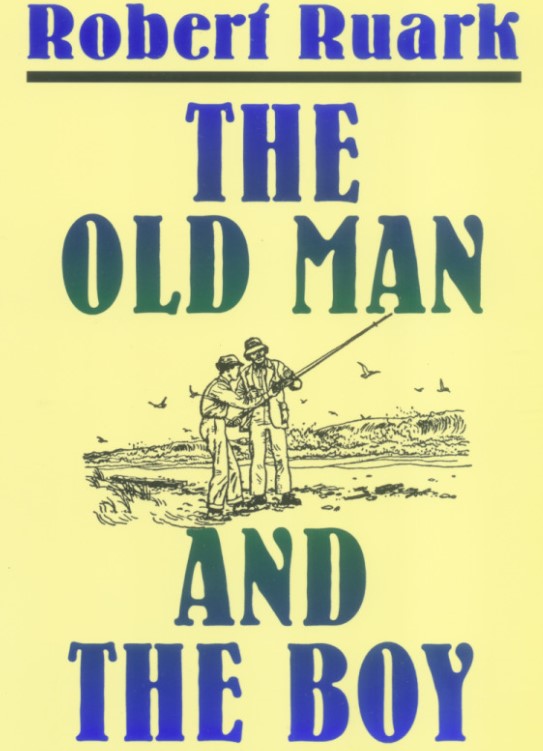
My mother sent me a book my father had wanted my boys to read – The Old Man and the Boy, by Robert Ruark. I read a few chapters which are clearly anthologized serial stories (as they were published originally). They are charming in a folksy wise man teaching the youth about life way. Ruark captures the innocence and optimism of an America soberly unaware of itself after WW2 – an America where hunting and fishing are taken for granted, when the incessant pressure of city-time wasn’t oppressive, when common-sense was in fact common and sensible because there was an implicitly shared understanding.

Because he never sent it while he was alive, he and I never got to discuss the book. He never mentioned to me that he had read it.

In thinking upon “Why this book?” makes me reflect upon my father. Did he see himself as the Old Man hoping to convey warm wisdom upon my sons? Upon me? Did he find idyllic memories of his youth in these tales – reminders of experiences I don’t believe he ever had? It would be easy to dismiss it all as too saccharine and too sentimental. My boys would have had no interest in nor even care to understand these stories – the context is too foreign to them. Despite a rural upbringing, from the stories my father told me of his youth, he never hunted nor fished extensively. He did take up fly fishing after he retired, so perhaps he can see himself there. But I am quite confident he didn’t do anything of the sort with his father. His father by all accounts was a loving and well-loved man. But he was a small-town banker, not a gentlemen farmer or woodsman.

I think that what my father responded to was the feeling of the book – its spirit. He was an artist, so I expect he wouldn’t be opposed to the terms. Ruark does manage to create an atmosphere of innocence that I believe my father wished for everyone he loved – a hope for good – and simple – outcomes.

By sending the book post-mortem, I see it as a totemic blessing. It serves as a reminder of the power of the idyll: a reminder to read Theocritus and not just Homer.