Kata dori is a shoulder grab with the distinct intent of a follow up strike: usually it is not a primary offensive technique. But it should not be demonstrated or perceived as a passive grab.
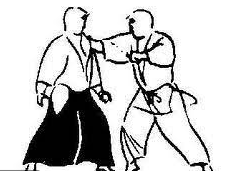
The banner line drawing from Aikido and the Dynamic Sphere nicely illustrates one possible follow up after the initial shoulder grab.
Because the shoulder grab is a precursor to a more violent attack, uke needs to learn to make the first grab intentional and effective. To do so, use the lower three fingers to grab and wrap the weave of nage’s gi into the palm of your hand. This is a binding action, not a snatch or pinching action driven by the thumb and index finger. The use of the hand grab exploits the hand strength developed in sword training.
As the hand wraps, uke drops their elbow with an inward spiral, tip of the elbow toward their own hip. With a tight and structured grab, uke can drop to break nage’s balance – effectively pitching nage forward and down. A shoulder grab should be done with the intent of pulling nage face forward to the ground.
Thus the tanren exercise. Uke grabs with violent intent and nage must learn to resist the throw by tightening the hara (belly muscles) so as to not be pulled head down / bend at the waist, while driving the heel with the quadriceps to remain resolute and firmly grounded. As a static exercise, this represents body development and would be just a fleeting moment during a dynamic encounter. Nevertheless it is an important developmental stage. As uke, learn to grab effectively and to throw with one hand. As nage, focus on internal stability and watch the timing of uke’s approach: learn to anticipate the moment of uke’s contact such that you know how to intercept it when the technique advances to ki no nagare flow.
From the static encounter, nage must learn to break uke’s structure / balance. The most effective method is a swift punch to the face. From the atemi, nage leaves the striking arm in place just below uke’s deltoid. This arm will be used as an active brace which will cam (rotate while striking) toward uke’s center while nage simultaneously draws the grabbed shoulder out and diametrically away from the bracing arm. To assist drawing the shoulder back, nage should throw his arm back to add momentum. By establishing an active brace, nage’s arms are moving in opposite vectors and uke is fixed at two points (their grabbing hand on nage’s moving shoulder) and just below the deltoid by nage’s camming arm. Nage further adds muscular energy by drawing bodily along the same vector as his grabbed shoulder. The result should be that uke is drawn off balance. The key lesson is to leave the atemi hand on uke’s deltoid and biceps and not to slide down to uke’s elbow, or worse, to pull uke toward you with the atemi hand. Inevitably, moving to the elbow or attempting a circular draw (e.g., while performing ushiro tenkan) will expose nage’s flank to a counter hit. This exercise is designed to develop horizontal mobility, i.e., moving off the line at approximately 90-degrees to the initial line of attack.
Once uke’s balance is taken (kuzushi), nage’s camming arm slides along uke’s grabbing arm to pin uke’s hand to nage’s shoulder. This is the kihon entry pattern initiated from the ‘triggering’ grab: stike (closing action), cam and draw (opening action), trap (closing action). From this action pattern, the basic kata-dori techniques emerge.
Mitsuteru Ueshiba – the Founder’s great-grandson
Once the structure is understood and ingrained in the body, then ‘blending’ can be added – which means, we introduce timing and dynamic movement as variables.
The Hombu presentations are the foundational techniques. However, as one explores the possibilities of ‘advanced’ timing and tempo the beauty of the encounter expands.
Bruno Gonzalez
Notice that the ki no nagare exploration is possible only because it is contextualized within the framework of sword and only when nage is ahead of uke’s intention. Nage must lead uke’s spirit – or more prosaically – nage is ahead of the OODA loop.
Review the earlier posts on kata dori >here< and >here<
My maternal grandmother’s sister invested the time and patience to complete the proofs required by the Mayflower Society.[1] That lineage, the Messinger–Taft branch, is documented cleanly from Plymouth Rock to me, placing my mother’s family within the same bloodline as President William H. Taft.
The Taft Connection
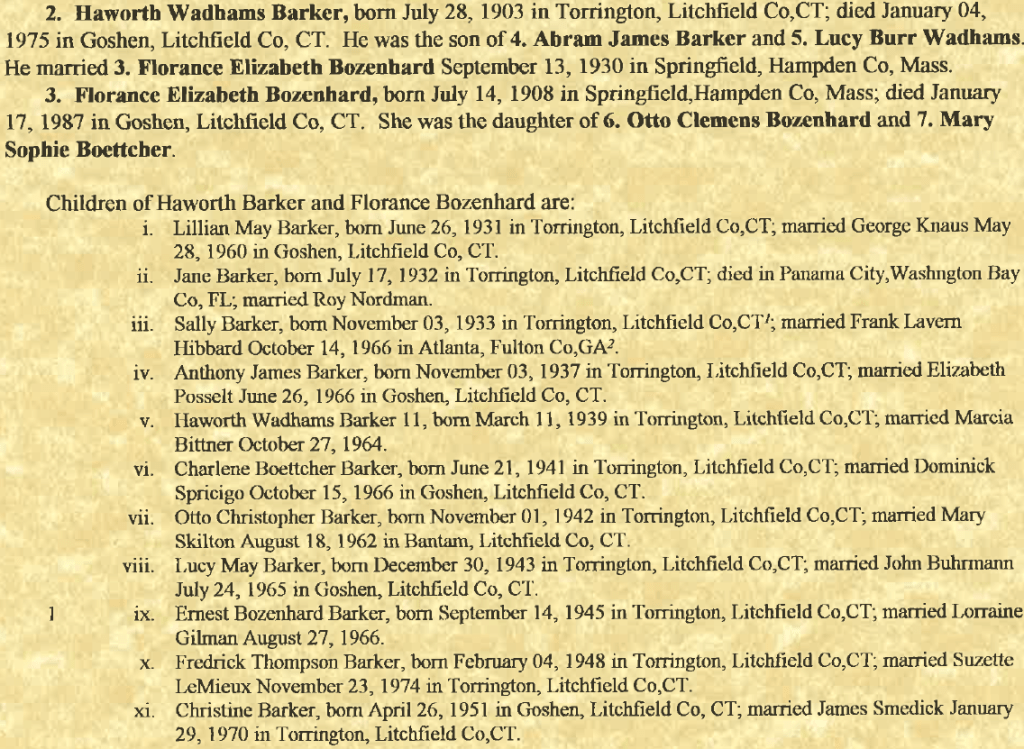
On my father’s side the Barker–Bozenhard–Wadhams line threads through Goshen, Connecticut, the Wadhams being both more prestigious and better chronicled. The men of that family helped build Goshen’s civic and agrarian foundations; their names cling to deeds and stone walls.
My father moved us back to Goshen when I was in 4th grade. Moving from Farmington was a cultural step down, but Goshen was closer to his new teaching post in Winsted and also a return to the hometown. The house my father bought from my grandmother had just come to her as next-of-kin (second cousin in-law) to Frederick Lucas. Frederick was the grandson of Frederick Allen Lucas, a Union soldier whose letters, transcribed by my father before they were donated to the historical society, reveal a young man both ambitious and insecure, striving to earn the approval of his future wife’s father, a Wadhams. Artifacts endure: I have Fred Allen’s (my 4x Great-uncle) Masonic sword and watch-fob.
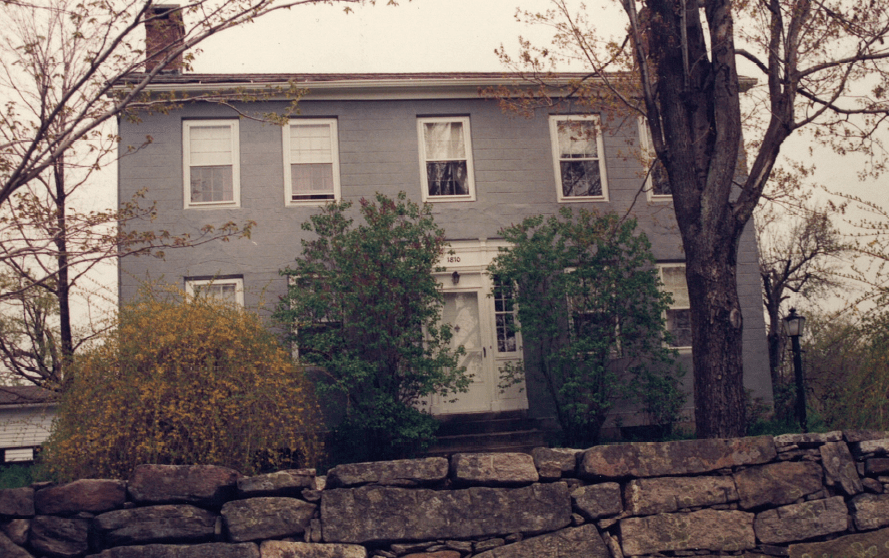
Our tie to Goshen is deeper. My father had ten brothers and sisters, most of whom stayed local, and we gathered for Christmas at my grandmother’s “new” house, in the family from 1810 to 1990.[2] It was “new” only because it began as a summer place; later John Hodges Wadhams, one of my more melancholic ancestors (he hanged himself in the state capitol), inherited it and made it his primary home.
One hundred and eighty years of unbroken family history in a single dwelling. As a child, I stayed there and absorbed the sensory residue of inheritance. I have direct memories reaching only two generations back, and fragmented stories two more beyond that.
Genealogical history follows an exponential pattern in theory: each generation back, the number of ancestral positions doubles. Two parents, four grandparents, eight great-grandparents, and so on. I’ve documented several family lines with reasonable precision, but the record begins to fray after the fourth generation. Assuming an average generational span of 28-30 years (a fair demographic mean across modern and early-modern periods) the arithmetic is straightforward, though the biology, as we’ll see, is not.
Ancestors
Relation
Year
Event
1
EGO
1968
Ty born
2
Parents
1940s
Father born 1945
4
Grandparents
1910s
Maternal Grandfather born 1914 Paternal Grandfather born 1903
8
Great-grandparents
1880s
Maternal GGrandfather born 1890 Paternal GGrandfather born 1868
16
2×Great-grandparents
1850s
Maternal 2xGrandfather born 1853 Paternal 2xGrandfather born 1840
32
3×Great-grandparents
1820s
Maternal 3xGrandfather born 1826 Paternal 3xGrandfather born 1811
64
4×Great-grandparents
1790s
Maternal 4xGrandfather born 1793 Paternal 4xGrandfather born 1765
128
5×Great-grandparents
1760s
256
6×Great-grandparents
1730s
512
7×Great-grandparents
1700s
1,024
8×Great-grandparents
1670s
2,048
9×Great-grandparents
1640s
4,096
10×Great-grandparents
1610s
Mayflower arrived 1620
8,192
11×Great-grandparents
1580s
16,384
12×Great-grandparents
1550s
Edward Fuller (~1575 d.1620/21)
Doubling Problem
Fourteen generations back is already the Mayflower era, yet the paradox is that most of those theoretical positions were already occupied by the same people. I can trace one verifiable thread to Plymouth, but that single thread is one among thousands of possible genealogical paths.
The math makes ancestry look boundless; genetics, in contrast, makes it sparse, because the number of ancestral positions doubles, but the DNA they could contribute does not. The irony is that our genetic inheritance is simultaneously vast and vanishing. The chart doubles, but DNA does not keep pace. Pedigree collapse means the same ancestors fill multiple slots.
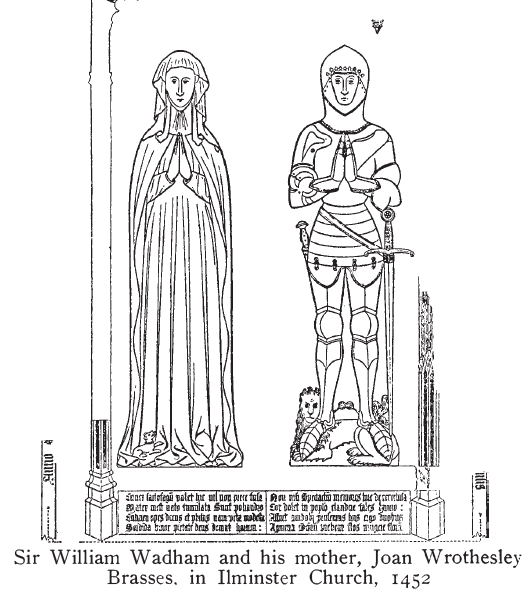
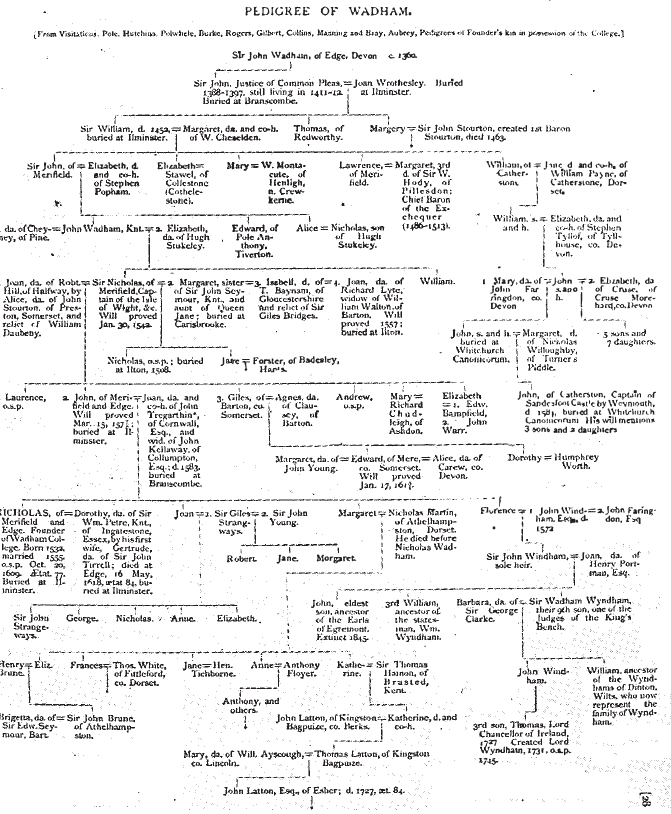
Along the Wadhams line, the paper trail reaches as far back as 1452 (about eighteen generations) far enough to touch the medieval horizon, where the mathematics of lineage meets the fog of history.
1452 pushing the written record
If one pushes hard, perhaps to 1360, but that is hypothesis, not proof.
There is a line to follow
It sounds impressive, but mathematically, tracing twenty-four generations back (roughly to the reign of Edward III) yields about 16.7 million potential ancestral positions. Even if we are conservative and halve that to account for overlapping generations and imperfect records, we are still talking about millions of theoretical forebears. The irony is that this is still within the span of recorded European history.
Chess and doubling (the grain-on-the-chessboard tale) is a bit too simple for human pedigrees.
Extend the arithmetic to Julius Caesar’s lifetime—roughly 84 generations (~2,100 years)—and the numbers go absurd: 2^84 ≈ 1.94 × 10²⁵ theoretical slots (~19 septillion), vastly greater than the ~100-120 billion humans who have ever lived.[3] Reality forces overlap; lineages fold back on themselves.
In truth, everyone of European descent today likely shares most of the same ancestors who lived in the late medieval period. What looks like a branching tree is, in fact, a densely woven net.
I am not making a Hobbesian argument. I do not believe that mankind is ruthlessly competitive. In fact, I believe the opposite. As a species we are cooperative and altruistic within the group and have learned to organize within ever expanding definitions of group-membership. Nevertheless, we remain tribal – and compete at the level of tribalism – but that definition is fluid. Religion was designed as a broad form of tribalism, acknowledging the ‘brotherhood of man’ simply through the mechanism of belief.
What an amazing concept! Dismiss the cynical boorish quips by Marx: religion is not an opiate but a solvent. Religion doesn’t dull one’s senses, rather, at its best, it expands inclusive conscientiousness. Small ‘c’ catholic means, “including a wide variety of things; all-embracing” precisely because it was inclusionary by conversion.
Alas, there does seem to be an upper limit to inclusion. We humans seem determined to draw tribal lines. The need to exclude runs deep, perhaps genetically so, and we require a dominance hierarchy in order to feel secure, to know where we all belong in relation to one another.
Back to New England.
Extensential guilt and fear as a debt to possibility. New England is an historical testimony to failed idealism: a constant reminder that we are not equal to our potential. Winthrop’s vision of a City on the Hill, to be the moral beacon to all nations was a failed experiment and one that failed early. That abject failure to achieve the aspiration has resulted in a genetic disposition to guilt almost as powerful as the Jewish predilection instilled by mothers. And the resulting lingering fear manifests in the moribund visions of H.P. Lovecraft.[5]
For myself it is expressed with sharp humor and making absurd or ironic comments in a deliberately impassive manner as a coping mechanism that belies an uncomfortable relationship with history, a distance from the present, and trepidation about the future.
Or maybe it’s simpler: hiraeth, a Welsh word for the longing to return to a home you can’t return to—or that never quite existed. The ache of nostalgia and unfulfilled possibilities.
__________________________________
[1] The Barker line has more tenuous connections to the Mayflower – my Uncle Tony’s observations are clearer than mine and recorded >here< but you must read through his posts to find them. (My Uncle Tony’s wife made the cutting observation that his family were “swamp Yankees” given that all the productive land had long ago been sold off so that all that remained was a small orchard and a large swamp behind the “new” house.)
[2] My grandmother Barker gave (live) birth to eleven children, her first when she was 23 and her last at age 43, in 1951!
Jane was later found to be alive – but that is another tale
[3] Visual comparisons of “humans who have ever lived” put the figure near 100–120 billion. The point stands: 19 septillion slots vs. ~10¹¹ actual people → massive overlap. Visual Capitalist presents this graphically >here<
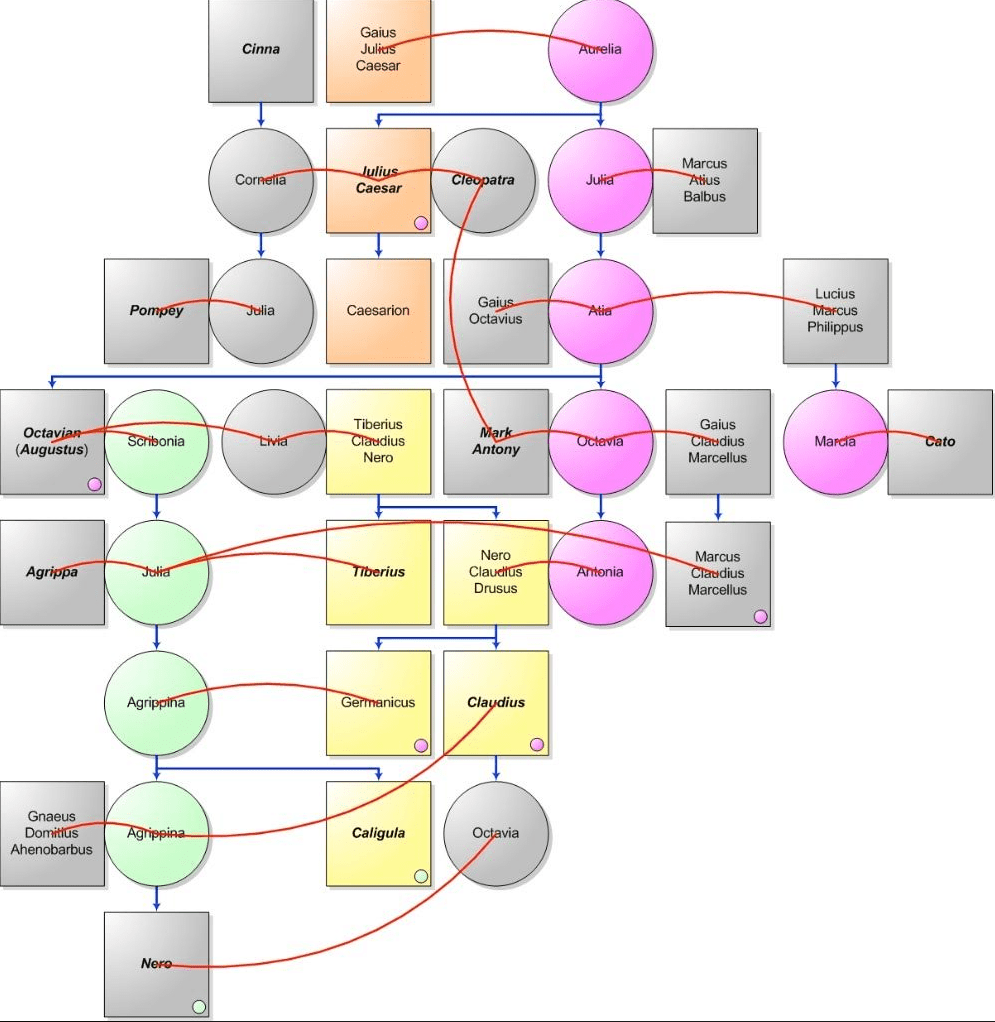
The follow the red lines – DNA is not always positional
DNA of the Early Roman Emperors and Famous Associates: Squares are males. Disks are females. Blue arrows show direction of descent. Horizontal blue bars bind siblings. Red curves join “spouses,” that is, procreative couples. In cases of multiple spouses, the child goes with the most tightly bound spouse. Yellow squares represent one strain of Y-chromosome DNA (YDNA) passed down via males only; orange another. Magenta disks represent one strain of mitochondrial DNA (mtDNA) passed down via females only; green another. Small disks within squares are males carrying the designated mtDNA, who could not, being male, pass it on. The result is a predominance of the mtDNA lines over the YDNA – that is, of the feminine connections over the masculine.
Serendipity: two seemingly unrelated sources collided to shape this reflection.
In Billions, a well-written drama series I binge-watched through season 2, Axe and his wife Lara are on the verge of divorce. When she hires a rival hedge-fund manager to audit her husband’s fortune, his lieutenant Wags resists showing her the trading history. Axe interjects: “Lots of people watch Bruce Lee movies. It doesn’t mean they know karate.” Knowing the trade record isn’t the same as reproducing the strategy.
Around the same time, I read an essay contrasting Founding vs Inheriting, summed up in one line:
We can also think of this as read-only culture, the ability to repeat what an ancestor has handed down – but not recreate it from first principles.
That line completed the circle. Watching Bruce Lee ≠ knowing karate; inheriting ≠ founding. The distinction is between replication and re-creation. And nowhere is that divide clearer than in martial arts.
The traditional teaching methods of many arts are exactly that: traditions; passed down, replicated, unchallenged. In this read-only culture, the art survives, but in a desiccated state: drained of necessity and therefore of meaning.
To preserve a form is not to understand it. To understand it is not to originate it. The teacher’s challenge is to lead students through all three levels of understanding.
The first task of a teacher is replication. Faithfully preserving and perpetuating form is essential, and difficult enough.
The second task is refinement: laying out a path for progress. At this level, the role of a teacher is to illustrate tips and tricks to further developmental progress. The first part of developing talent is avoiding doing anything stupid. Avoiding stupidity is easier than trying to be brilliant. Instead of asking, “How can I get better?” you should ask, “What’s hurting my progress most and how can I avoid it?” Identify obvious failure points, and steer clear of them. That is to say, the best teachers use various means and methods to develop a student’s skill.
At this level there are concrete pedagogical dictums. Show the flow but also provide opportunities for slow deliberate training (tanren). Why? Because precision is the key component to instill and speed, or velocity, is last component to emerge as flow, as a consequence of precision. And the pursuit of precision is the pursuit of excellence.
And the final task is inspiration: to breathe life into what has been learned, to make it generative again.
In Excellence, I followed Will Durant’s assertion that excellence is a habit: Establish the right habits in order to work continuously towards excellence – progress through continuous training. Although a good coach can drive player performance through demanding training and a brilliant coach can instill a purpose, ultimately, the drive to excel is inspiration.
Inspiration – to breathe life into something.
Dwell a bit on the implications of that phrase. Through our words and actions, teachers must provide life imbuing motivation. Great teachers can do that. But how?
Perhaps it results from my current course of reading, but the cliché “it’s not the destination but the journey” isn’t sentimental nonsense; it describes the dopamine system. What do I mean by that?
Cognitive psychology shows that the brain’s reward circuit fires not at attainment but at pursuit. The satisfaction lies in moving from A to B, not in being at B. Hence the belt system: concrete milestones sustain motivation, transforming a lifetime path into achievable segments. Cynics see a business model; psychologists see neuro-architecture. The hierarchy also re-creates dominance order, our primal way of measuring progress within a tribe.
In short getting somewhere isn’t necessarily what people want, because once you get there, you have to get somewhere else. The paradox: once you arrive, the reward fades. The tide recedes.
Therefore, the teacher must design a contradiction: discrete attainments that confirm progress, yet a goal so lofty it can never be reached. The pursuit of perfection is the mechanism of motivation. Set an impossible ideal, and the dopamine circuit never closes.
Ah, but how does one make a transcendent goal appear achievable so as not to short-circuit the system and de-motivate students who recognize the impossible standard?
I have no concrete answer.
At this time, all I can suggest is that the next level of transmission is ensuring students understand the purpose behind the forms. Understand and show bunkai so that the forms have a concrete purpose.
In closing, a quote intended to inspire:
Talent hits a target no one else can hit. Genius hits a target no one else can see.

 Protective Arts