Selling Confidence

To my ears, Trump is an inarticulate ignoramus with a heavy dose of meglomania. In a prior post, I linked to John McWhorter‘s analysis of Trump’s speech patterns. These YouTube clips summarize his conclusions:

McWhorter

McWhorter elaborates in The Atlantic and concludes that Trump is a walking “hot mike” with no sensible filter.

I agree. But as cogent as I think McWhorter’s analyses are, they fail to explain why so many Americans are bamboozled by his rhetoric. The Economist provides a probable explanation – the confidence of his delivery:
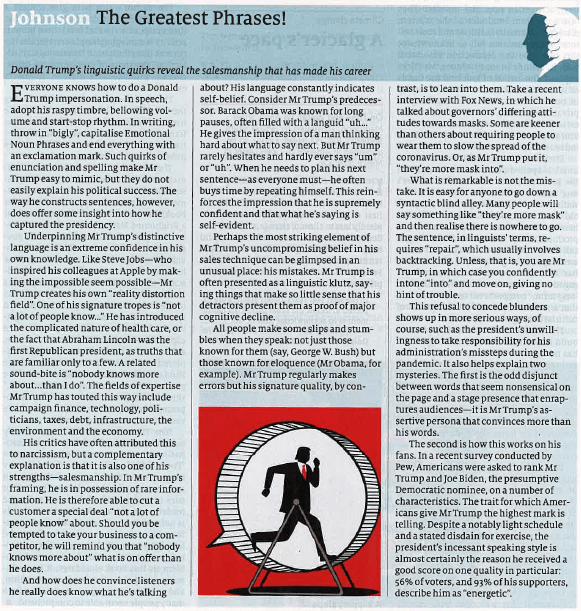
The Economist, August 8th 2020 p.67

Trump as confidence-man. Revisit the night of his win in 2016, he looks to me like a man uncertain of his fate: He used his processional walk to gather his composure before addressing the crowd. I am convinced that he was flabbergasted, entirely shocked to have won and he wore doubt on his cant of his eyes and the set of his jaw.

The look of confidence?

For him, the run for president was a continuation of The Apprentice. And only by using the time-honored “fake it until you make it” business technique has he survived. But the act has been subsumed and now the actor has become the role; over the ensuing four years he has “grown” – in accordance with Lord Acton’s maxim – power has become his purpose.

The gravity of any specific issue – Covid, China, Russian election interference, economic collapse, whatever – is less critical that the presentation of them, of how to play to the crowd. Spin and ratings take precedent over solutions. The confidence game and the Big Lie are constant techniques in the political arena, but Trump has taken the game to another level entirely. Or perhaps, it is more accurate to state he has taken it back to a previous time.

It is fitting that George Orwell’s Animal Farm celebrates its 75th anniversary today (August 17, 2020).

All Are Equal – sure they are…

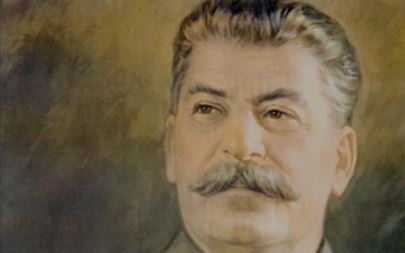
Despite his own democratic socialist bent, Orwell’s allegorical novel was conceived as a warning against what can only be described as an intellectual infatuation with Josef Stalin.

The idealized communism and propaganda that marketed Stalin as “Uncle Joe” was a convenient wartime fiction to make him a palatable ally, but Orwell was not fooled. He was keenly aware of people and tenaciously honest in his assessments.

Orwell lived and endured shared hardships with the working class to chronicle the social injustice and class iniquities across Europe, and therefore he was not blinded by the utopian lies about Stalin’s Russia that were in part perpetrated by British and American propaganda. Orwell’s was not an academic analysis. He had fought in the Spanish Civil War with Partido Obrero de Unificación Marxista (POUM) and experienced the Stalinist oppression of the Marxist idealism. Homage to Catalonia (1938) is a journalistic recounting of his time with POUM and served as the basis for his better known allegory.

Animal Farm was completed in 1944 and Orwell struggled to find a publisher. The manuscript was rejected by T.S. Eliot when he was at Farber and Farber.
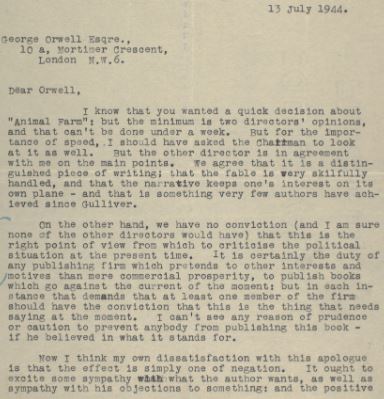
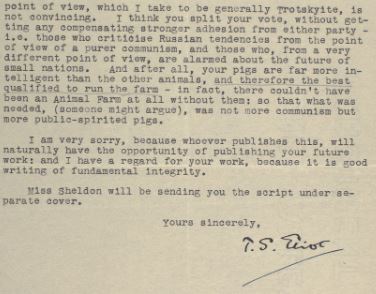
“We have no conviction … that this is the right point of view from which to criticize the political situation at the present time.”
“So that what was needed was … more public-spirited pigs.”

Eliot’s critical evaluation and reason to reject it:

Now I think my own dissatisfaction with this apologue is that the effect is simply one of negation.

Ah, the ignorance of a poet! Eliot could not recognize evil. For Eliot, I suspect his position was in fact reasoned and based on a critical evaluation of Orwell’s literary construction, but the realpolitik of 1944 wouldn’t abide the negation of an ally. The US and British used Stalin to help defeat Hitler, but the intellectuals were enamored of egalitarian idealism. This is a cautionary tale with currency on several levels – be wary of political expediency, Russian duplicity, and intellectuals who forget human nature!

Making Stalin palatable – propaganda has consequences

__________________

Stalin’s Secret Agents, by M. Stanton Evans.

Evans outlines compelling evidence that the Russians infiltrated FDR’s circle and influenced policy. While that may be true, the argument lays too much blame on espionage; we were complicit. It wasn’t just mavericks like George Patton who recognized the Russian threat, the British developed a contingency plan: Operation Unthinkable.

__________________

Orwell remains all-too-necessary 75 years on: his work decrying fearmongering, authoritarianism, tribalism, and historical erasure stands vigil against the easy manipulation of untempered human nature.

Political and polemical speech. Trump has played the crowd masterfully. Despite inherited wealth and elitist isolation, he connected with the common man. He showed empathy for their plight and gave voice to their fears. MAGA resonated and the throng gathered. Trump follows ratings because he plays to the masses. Frank Herbert feared charismatic leaders because they sway the crowd readily and deflect criticism effortlessly. Herbert had Kennedy in mind, but Hitler, Stalin and Pericles are earlier exemplars to fear and learn from.

______________

Here we go again: sheep want to be ruled and intellectuals think they know best.
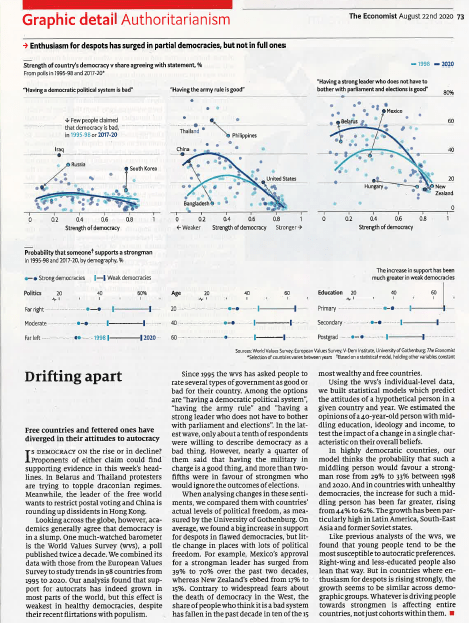
Yes – saw this one coming… sigh…

______________

I remain incredulous that a virus has become political, that basic hygiene is now a statement of political affiliation and mask-wearing is deemed an oppression of liberty. Living in Portland, it is all too easy to dismiss this perspective as nonsensical, but travel away from the urban core and the narrative is very different. We overnighted in Seaside and saw few masks among the locals. Our summer vacation took us through rural Illinois and Indiana; the Trump signs and flags are displayed proudly and prominently. The upper middle class, college-educated, urbanites who watch CNN forget at their peril that Fox News holds a powerful voting segment captive who will influence several swing states.

The political landscape in the US is violently binary in 2020 and the propaganda machine is Goebbels-worthy. The cranks understand how to manipulate the masses to play the Electoral College:

Every vote counts? Some more equal than others…

The danger of correct-minded liberals is the notion that they are clever and strong enough to resist the grip of totalitarianism. With Trump it’s easy to recognize his gaffes, arrogance, lies and power grabs, these the liberals know are clearly wrong. But liberals will remain ironically susceptible to the moralizing progressives, “public-spirited pigs,” who have the “real” solutions.

Heed Zarathustra’s warning:

Aber der Staat lügt in allen Zungen des Guten und Bösen; und was er auch redet, er lügt—und was er auch hat, gestohlen hat er’s.

Thus Spoke Zarathustra, Part I, Chapter 11, “Vom neuen Götzen”/”The New Idol”

_______________

Why Does Joseph Stalin Matter, by Stephen Kotkin

Part 1
Part 2

Kotkin illuminates the strategies Stalin used to consolidate power. The control of ideology is frightening. Then, read John McWhorter on the control of the far-left narrative.

_____________________

[1] Admittedly, the 1940 Time magazine cover is planted out of context. Stalin in 1940 was “celebrated” as the Man of the Year because of the Molotov–Ribbentrop Pact which tipped the balance of power in Hitler’s favor: he gained access to raw material from Stalin who got a non-aggression promise in return. However, Stalin was again on the cover in 1943 for the defense of Stalingrad – where the Soviets held back the Germans at a terrible cost. >More<
Pineapple Cheese

Goshen, Connecticut was a rather small settlement throughout the 18th century, but in the early years of the 19th century the population expanded. The center of town developed around the “new” turnpikes from Litchfield to Canaan (1799), from Goshen to Sharon (1802) and from Litchfield to Cornwall (1814), which made Goshen a commercial crossroads. Although there were several stores in the center then, when I was growing up, only one – Goshen General Store – remained. It was a true general store, that merchandised everything one might need; but with the advent of the supermarket, it went vacant in the 1980s. Goshen’s industriousness apex was around the Civil War, and I suspect has been in a slow slide to its nadir ever since.

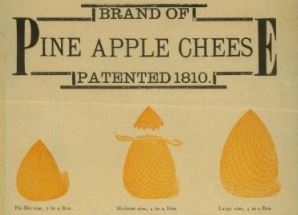
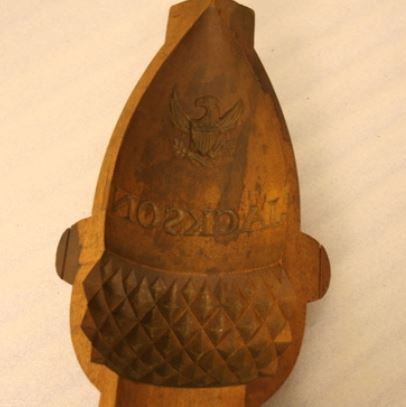
In high school I did a rather mediocre term paper on the development of Pineapple Cheese. I had come across an old mold that looked vaguely like a pineapple in what was then my grandmother’s attic and wondered what the heck it was. After some effort and research (prior to the internet, done the old way of sleuthing in libraries and the local historical society) I discovered that Lewis M. Norton [1] of West Goshen, Connecticut patented Pineapple Cheese in 1810. (Other sources, cite Myron Norton as the recipient and link to a letter dated October 13, 1830 as the issuance date, but despite a search of patents issued between the years 1808 and 1811 and 1830, the closest I could find was issued to R.P. Cunningham for a cheese press – X874 issued May 21, 1808.)

Pineapple mold – patent pending?

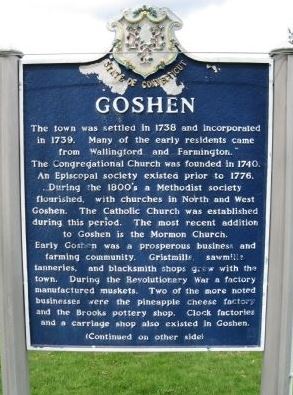
Regardless, the history of the cheese is deemed important enough to merit mention on the town plaque (along with the expansion of church denominations).

Town History

Pineapple Cheese, was cheddar made in the shape and color of that fruit. The cheese was painted with annatto coloring (Hibbard 1897:365). The shape was inspired by samples brought from Europe in 1808 and the domestic variety quickly became a favorite gift. The industry consumed most of the milk produced on local farms and it used thousands of wooden boxes each year, which were locally produced.

But why a pineapple shape? And why was it a favorite housewarming gift? I never knew the reason behind Norton’s choice for the shape, which I suspect had to do with the starry-priced fruit as explained in this BBC story:

____________________________

The rise, fall, and rise of the status pineapple

By Bethan Bell BBC News August 2, 2020

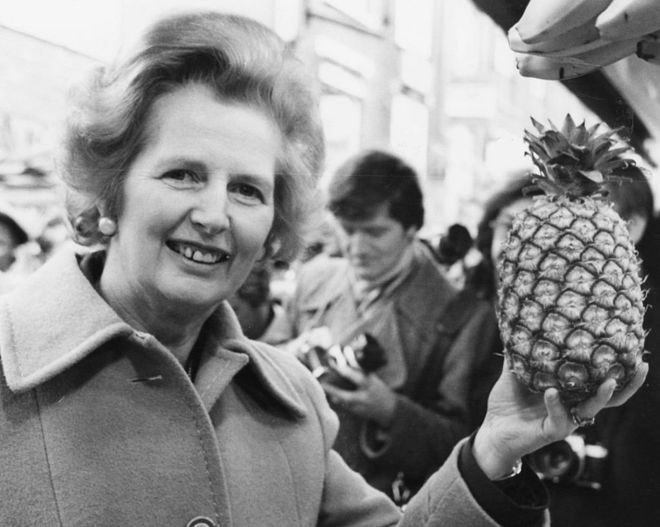
Margaret Thatcher (left) and a pineapple

Symbols have always been used to signal one’s status. Military insignia, family signet rings and heirloom watches; impressive properties filled with original art, expensive cars and designer handbags ensure a luxury lifestyle is obvious to all. But for about 250 years, all of these signposts of wealth and good breeding were ably fulfilled by… the pineapple.

Centuries before even the man from Del Monte said “yes”, the country’s must-have accessory graced the table at the very richest aristocrats’ social gatherings.

But the scaly sweet was too valuable to eat – a single fruit was worth thousands of pounds and often the same pineapple would be paraded from event to event until it eventually went rotten.

Later, a roaring trade in pineapple rental developed, where ambitious but less well-off folk might hire one for a special event, dinner party or even just to jauntily tuck under an arm on a show-off stroll.

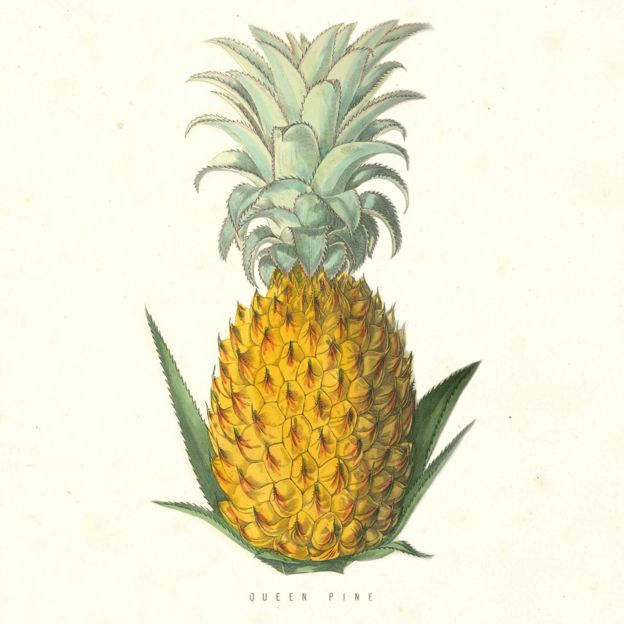
pineapple
Royal Status – pineapples were also known as King or Queen Pine

By the 1770s, “a pineapple of the finest flavour” became a phrase used for anything that was the best of the best. It’s played upon in Sheridan’s 1775 play The Rivals, when Mrs Malaprop confuses the word with “pinnacle” and exclaims: “He is the very pineapple of politeness!”

In a television adaptation of Jane Austen’s unfinished Regency novel Sanditon, Lady Denham’s grand luncheon has a pineapple in pride of place – although it is cut to reveal the inside is full of maggots, demonstrating the vast wealth of the character but also the transitory nature of the status symbol.

So why did pineapples seize the public imagination so violently?

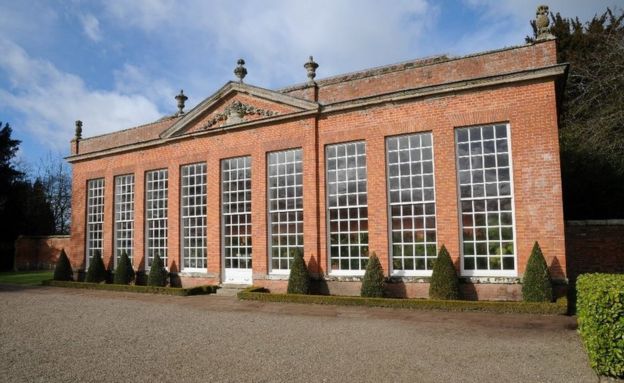
Stone pineapples are carved on an orangery at Hanbury Hall
The orangery at Hanbury Hall has carved pineapples on its roof, but only the very wealthiest could afford a pinery

The idea that pine apples (as they used to be known) are somehow associated with wealth and status is fairly well-established for those of us who enjoy a trip to a stately home.

Engravings can be admired on corbels and finials across the UK, remnants of a time when keeping up with the neighbours meant throwing lavish parties and displaying one’s riches.

The 16th and 17th Centuries saw a number of exotic foods brought back to Europe from the New World and Asia – and the pineapple became most associated with prestige and luxury.

According to Dr Lauren O’Hagan from Cardiff University’s School of English, Communication and Philosophy, “the pineapple was previously unknown in the Old World, so it was free of the cultural resonances of other fruits, which enabled people to create new meanings from it”.

For example, the apple was already associated with the forbidden fruit in the Garden of Eden, while pomegranate seeds kept the Greek goddess Persephone in the underworld for half the year.

But, as Dr O’Hagan says, the pineapple’s “exotic appearance” gave it a mythical quality, which was “enhanced by its golden crown, viewed as the symbolic manifestation of the divine right of king”.

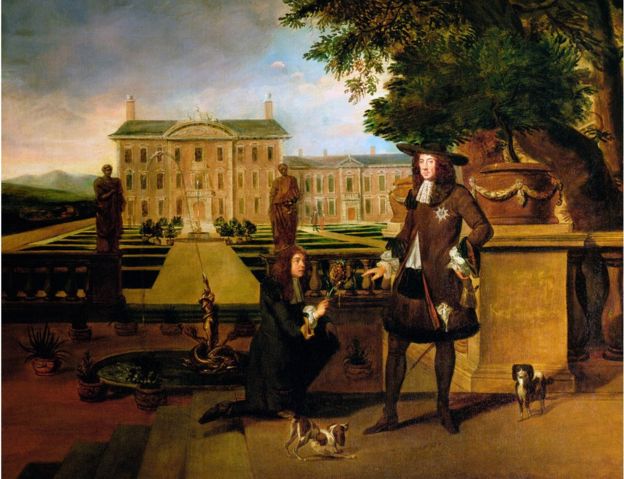
John Rose, the King's Gardener, presenting Charles II with a pineapple, 17th century. The fruit was supposedly the first grown in England, at Dorney Court in Berkshire.
Hendrick Danckerts painted Charles II being presented with a pineapple by the King’s Gardener, John Rose

The fruit even attracted a nickname: “King Pine”. And actual kings were keen to hop on the gilded bandwagon.

John Parkinson, Royal Botanist to Charles I, described the pineapple in the Theatrum Botanicum as “scaly like an artichoke” but “so sweet in smell… tasting… as if wine, rosewater and sugar were mixed together.”

Charles’ son and successor Charles II was so taken with pineapples that he commissioned a portrait of himself being presented with one – it was purported to be the very first to be grown in England, at Dorney Court in Berkshire, but it’s now thought to have been imported as a juvenile and merely ripened on home soil.

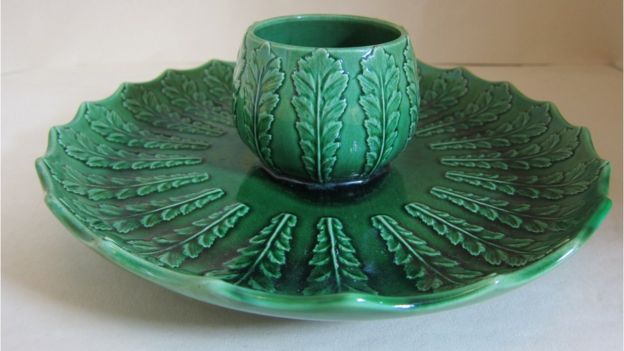
pineapple stand
A stand would display a not-for-eating pineapple in the centre of a platter of cheaper fruits

By the Georgian era, pineapples were starting to be cultivated in Britain. Perhaps surprisingly, the fact that they could now be grown in situ did not decrease the fruit’s cachet, but rather enhanced it.

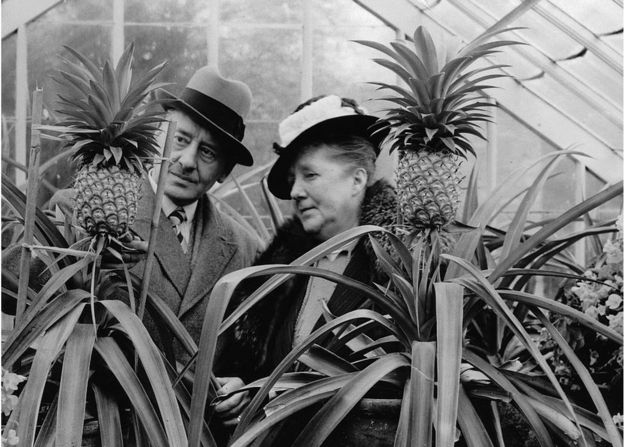
Waiting for a pineapple to be transported from the tropics was one thing; having the facilities and staff skilled enough to grow one at home was quite another, becoming a hobby carried out exclusively by the landed aristocracy.

Johanna Lausen-Higgins, from the Royal Botanical Garden in Edinburgh, says early attempts at cultivation were made in orangeries, which had been designed to provide frost protection for citrus fruit during the winter months, but they did not provide enough heat and light for the tropical pineapple.

The Gentleman’s Magazine of 1764 estimated that it cost £150 (according to the Bank of England’s inflation calculator, roughly equivalent today to £28,000) to build a hothouse, cover the annual running costs and buy the plant stock. And this expense was not guaranteed to give any return.

The Cabinet Dinner, or a Political Meeting
The Cabinet Dinner, or a Political Meeting by Charles “Argus” Williams, shows partly eaten pineapples abandoned on the table – indicating the wealth and wastefulness of the upper classes

“Heating in glasshouses during the mid 17th Century was provided by furnaces placed within the structure, but fumes often damaged or killed the plants,” Ms Lausen-Higgins says.

“Later, ‘fire walls’ were heated by hot air rising from furnaces or stoves which required constant stoking with coal. This was a dangerous method and many early ‘pineries’, as they later became known, burned down.”

On top of the risks of one’s pineapple investments going up in smoke, it took several years for the fruit to bloom.

A pineapple which had overcome all those hurdles was scarce enough to be valued at £60 (roughly £11,000). It was even better if it had shoots and leaves still on it, making it clear that it was homegrown.

in a pineapple growing house
People even started to carry pineapples under their arm as a sign of status, according to Dr O’Hagan

Concerned about wasting such high-value fruit by eating it, owners displayed pineapples as dinnertime ornaments on special plates which would allow the pineapple to be seen and admired but surrounded by other, cheaper, fruit for eating.

These pineapples were expensive enough to warrant security guards, and maids who transported them were considered to be at great risk of being targeted by thieves.

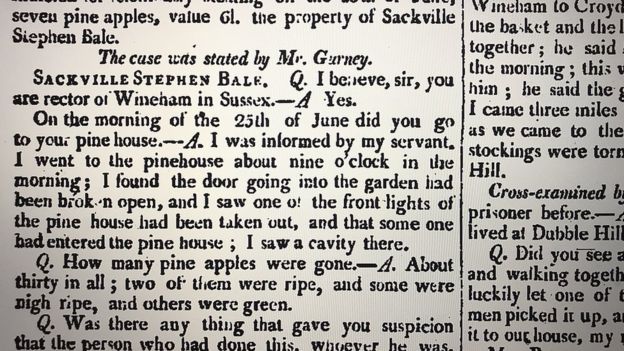
The 1807 Proceedings of the Old Bailey show several cases for pineapple theft, Dr O’Hagan points out, including that of a Mr Godding who was sentenced to seven years transportation to Australia for stealing seven pineapples.

court report
A transcription from a 1807 court case indicates the monetary value of pineapples

Because the ever-aspiring middle classes were anxious to get their mitts on the fruit but could not afford to cultivate or buy them, canny businessmen opened pineapple rental shops across Britain. Companies began to cash in on the fruit’s popularity and as with many crazes, the market for pineapple-themed goods exploded.

Porcelain-makers Minton and Wedgwood started producing pineapple-shaped teapots, ewers and jelly moulds. Ornately carved clock cases, bookends and paintings extended the trend from the dining table to other rooms in the house.

Outdoors, the pineapple was represented on carriages and garden temples. After all, if the fruit itself would not last, carved-stone pineapples on plinths would certainly be a lasting reminder to guests and passers-by of the wealth within a manor house.

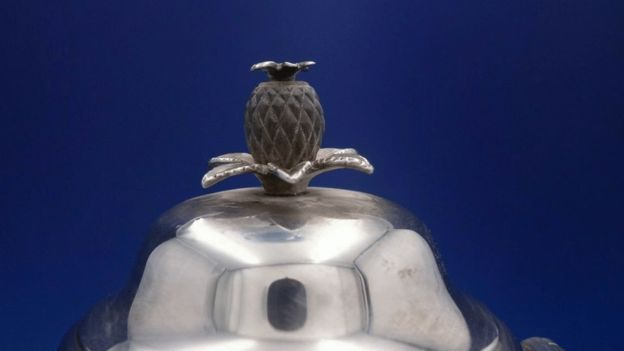
pineapple finial on teapot
The English passions of subtly demonstrating wealth and having a nice cup of tea were united in this pineapple-finialed teapot

But this superstar status was not to last much longer. Steamships started to import pineapples to Britain regularly from the colonies and the prices consequently dropped.

And it wasn’t just the middle classes who could afford a pineapple, but – horror of horrors – the working classes could too.

“What was once considered a luxury fruit could now be found cheaply on stalls and barrows in most cities and towns across the country,” says Dr O’Hagan. “At this time, working-class people eating pineapples even became used in satirical prints as a visual metaphor for the problem of progress.”

pineapple seller
A man selling pineapples for 9d – cheaper than potatoes, but maybe not as versatile

The pineapples so worshipped in earlier times were not only out of favour, but were becoming homogenised. In 1835, horticulturist Sir David Munro listed 52 varieties of pineapple.

Ms Lausen-Higgins says that only five strains remain in cultivation today, and of those, only the Smooth Cayenne and Jamaica Queen are readily available.

“From the 1950s onwards, pineapples were bred so that they fitted neatly into a tin. Fruits with a characteristically pyramidal shape, such as Black Prince, became extinct.”

However, some traces of Britain’s eccentric love affair with the pineapple remain.

Dog in pineapple costume
The craze for pineapple-themed goods remains strong

The Lost Gardens of Heligan in Cornwall has traditional pineapple pits, heated by decomposing manure. As in times past, growing the fruit is labour-intensive and time-consuming – it takes about seven years to grow a pineapple.

The gardens estimate that restoration and maintenance of the pit, fine-tuning of the growing methodology, and the man hours to look after the fruit means “each pineapple probably cost us in excess of £1,000”.

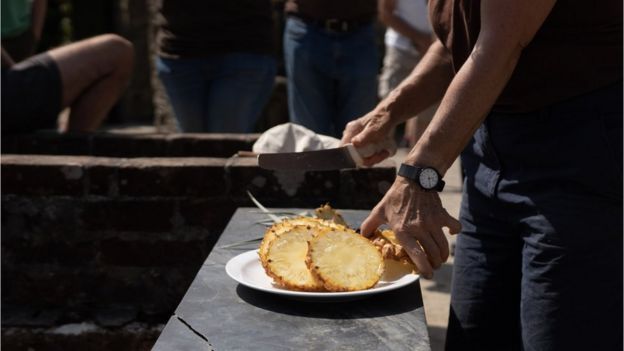
Despite this hefty price tag, Heligan’s 15-strong team of gardeners continues to produce the tropical fruit. In summer 2019, the first Smooth Cayenne to fruit at Heligan in more than two years was harvested.

Lost Gardens of Heligan
Image captionStaff at the Lost Gardens of Heligan shared the fruit that took seven years to grow

And King Pine is still gracing royal palates.

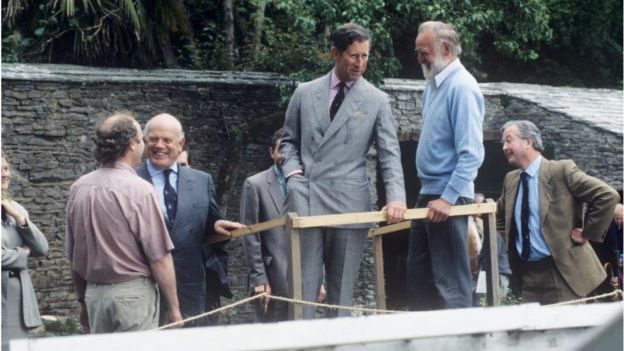
The second pineapple harvested at the gardens was given to the Queen (the first was tasted by staff in case it tasted like manure. It did not) and Prince Charles went to the gardens in 1997 to have a look at the first budding plant.

Prince Charles at the Lost Gardens of Heligan
Image captionPrince Charles looking at King Pine

Once the pineapple was on the menu for ordinary people and therefore off the menu for the nobility, the upper classes sought new ways to distinguish themselves from the masses.

Did they learn their lesson from the short-lived status and money-sucking nature of the pineapple? Maybe they could have invested in precious gems or impressive property.

No, they didn’t. Dr O’Hagan says the truly wealthy then set their caps at another luxury and difficult-to-grow food.

Celery.

______________________

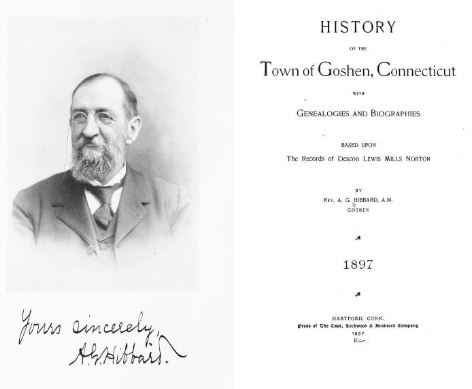
[1] Deacon Lewis Mills Norton provided the notes and material used by A.G. Hibbard in his History of the Town of Goshen, Connecticut (1897). Hibbard provides the biographical summary of L.M. Norton (b. 12/22/1783 d. 5/3/1860) as his introduction pp. 6-14.

Title Page

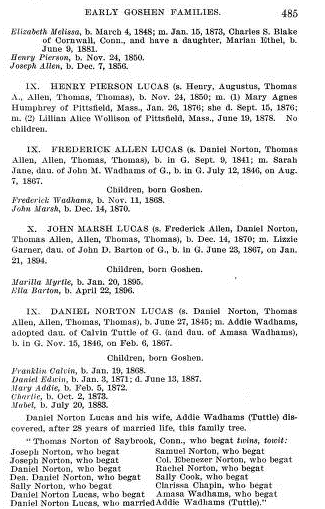
Fred Lucas is listed in the Preface as the authority who was to prepare a chapter on the Goshen participation in the Civil War, but illness prevented him. The coverage of The War of the Rebellion is brief (pp. 372-392). He also gains a mention along with his marriage to Sarah Jane (Jennie) on p. 485. Fred was the lucky one; four other Wadhams ‘ancestors’ (or rather, the cousins of John H., and God knows how many of his cousins who had other surnames) were killed in the Civil War trying to liberate the slaves.