FRED AND JENNIE: A Civil War Love Story
with letters edited by E. B. Barker
assisted by Anthony J. Barker
Copyright © 2002 Ernest Barker
All rights reserved
No part of this book may be reproduced by any means without the written consent from the publisher.
ISBN # 1-931413-81-9
Library of Congress Control Number: 2002102820
_________________
“Sergeant Major (afterwards Second Lieutenant) Frederick A. Lucas, received a wound in the left thigh at Cedar Creek, which disabled him for several months. He returned to the regiment just in time to receive another wound (a slight one) in the affair at Hatcher’s Run. He was promoted for gallantry at Winchester and Fisher’s Hill, and Colonel Mackenzie told the writer, just after those battles, that he never saw a braver man then Sergeant Major Lucas.”
History of 2nd CT. Vol. Heavy Artillery, T. Vaill (p. 210)
_________________
Author’s Statement
This piece is the result of a major housecleaning. Some years ago the “family home” was going on the market and a collection of letters that had been stored in the attic for generations came into my hands. When I moved back to Goshen, I bought the home belonging to the late, and last, Fred Lucas. It was here the other side of the collection was found.
I have taken the liberty to edit, as I felt necessary, to make the story flow. I have taken some liberties with the history of the CT. Heavy Artillery and with Fred’s history also. This is not meant to be a historically accurate tale in any fashion, but rather a “love story” of sorts based on real experiences of two young people during the Civil War.
Their earliest letters possibly started when he first was in the defenses around Washington, D.C., though the earliest we have are from May of 1863 and the last from 1866 at home again in Goshen. At first they were tentative and “homey newsy” with much “Sunday School goodness”. As they became more comfortable and infatuated with each other, the letters reflect this change.
As most of the relatives left today are related to me, the names have not been changed; the town is big enough to absorb any tourist that might come to see the sites. The Goshen Historical Society now holds the original letters, as they may be the best place to preserve this local history, along with other Lucas artifacts and they would love the company.
I would like to thank my older brother, Anthony J. Barker, for his input, guidance, verbiage, and general interest in this effort and my lovely wife Lori for her understanding and computer time and skill.
Ernie Barker
_________________
Foreword
Immediately after the McClellan Peninsular Campaign in 1862, President Lincoln made his call for 300,000 volunteers. In Connecticut, Governor Buckingham put forth his call, on the third of July, for six or seven new regiments. On the 22nd of July a County Convention at Litchfield declared an entire regiment should be raised from their hill towns and urged the towns of Litchfield County to offer a bounty of one hundred dollars to each volunteer.
One of these new recruits was Frederick A. Lucas, born in Goshen, Connecticut on September 9, 1841, the eldest child of Daniel N. Lucas.
As a young boy, Fred lived at home and worked with his father on the family farm during the summers, attended common school in the winters until he reached the age of twelve, at which time he entered the Goshen Academy under the guidance of James Q. Rice, the headmaster.
“As a boy, young Lucas was a great worker, energetic, and preserving; was never beaten at hoeing, or milking; held plow and followed the team as soon as large enough to swing a whip, and for several seasons milked the “mean ones” to the number of 15, night and morning, in his father’s dairy of 45 cows.”[i]
At the age of seventeen he taught school in Cornwall Hollow winters and helped his father summers. In July 1862, he, at twenty-one years of age, enlisted as a private soldier in Company C, 19th Connecticut Vol. (later the 2nd Ct. Heavy Artillery) under the command of his old teacher, now Captain, Rice. The young Fred had been anxious to enlist at the outbreak of the war but his father’s protests and argument that he could not be spared prevented him from doing so until 1862.
The newly commissioned Leverette Wessells called all these raw recruits to Litchfield on August 19th. From the center of town they would march into Camp Dutton on Chestnut Hill east of town. The local folks and family members gathered to watch their sons, brothers, neighbors, and sweethearts assemble. Many young ladies were passing out small testaments to the new soldiers as they moved from town into camp. This is where the two principals of our tale were to get their start.
Although Fred Lucas and Sarah Jane Wadhams had been reared in the same town, attended the same church periodically, and were in fact “cousins”[ii] of sorts, they were at this time little more than passing acquaintances. Sarah Jane, usually referred to as Jennie, had a testament left from the few she had bought and noticed a Goshen lad had not received one so passed it to him. This small act of almost indifferent kindness started a four-year correspondence that grew into something special.
Fred returned from the war with wounds and disease affecting him the remainder of his life. More importantly, he returned touched by the love that grew from their emerging relationship.
[i]History of Litchfield County Ct., with Illustrations & Biographical Sketches of It’s Prominent Men and Pioneers: J.W. Lewis & Co., Phil. Pa., 1881, p367.
[ii] Jonathan Wadham, a cousin of Sarah’s father, had married Daniel Lucas’s, Fred’s father, sister Polly Ann.
Chapter One
The Making of a Good Soldier
I was part of that new regiment- the Nineteenth Conn. Vols. Later we would become the Second Connecticut Vol. Heavy Artillery.
I, Frederick A. Lucas, am just one of many who felt the need to serve, and feel I did nothing more than my duty as I saw it at the time. Let me state that I did not serve to impress the young countrywoman to whom I wrote throughout the war and even later. Our relationship becomes a story all in itself. One that I would much rather tell than the war stories, but they are intertwined so both ought to be told or none. Let me state here, before I ramble further, that I am indeed proud of my record and service in the Army and have no misgivings having served and survived. I made some wonderful friends, lost some, learned much about the world beyond Goshen, and much about what I wish to do and be. Like thousands of others I will carry permanent reminders of the less “good times” with me for the rest of my life.
What an adventure this war thing seemed to be in the early months. Here I was just twenty-one years old marching into Camp Dutton with so many others from the Litchfield Hills. We were going to learn the arts of soldiering so we could save the Union. All at once this attractive young woman hands me a testament, saying she wishes me well. We drilled at camp in Litchfield for a spell of three weeks. It was while training in Camp Dutton that I was made corporal.
Due to the camps proximity to town it was frequently almost over-run by peddlers, women, and curious visitors of all sorts. Colonel Elisha Kellogg, having been sent from McClellan’s Army to drill the new troops, was quoted to say: “If there were nine hundred men in the camp, there were certainly nine thousand women most of the time.”[i]
We moved on to the defenses around our nation’s Capital as soon as he could make it possible.
…on the 15th [of September] having formed in line, and given three parting cheers for Camp Dutton, the long and firmly treading battalion, consisting of eight hundred and eighty-nine officers and men, moved to Litchfield Station, where a train of twenty-three cars stood ready to take them to New York. The journey was a continuous ovation. The deep interest everywhere felt in the Mountain County Regiment was attested by crowds of people at the stations and all along the railway, and by white handkerchiefs and white hands that waved us a farewell and a blessing from window and verandah and hilltop. The good people of Bridgeport and Stamford entered every car without ceremony and fortified the soldiers with melons, cakes and sandwiches, and with the last cup of real, civilized, cultivated, Connecticut coffee that they were to taste for months and years.[ii]
[i] The Goshen Voice, Bill Domonell, July-August, 1996, p.9.
[ii] T. F. Vaill, History of the Second Ct. Vol. Heavy Artillery, 1868, p.15
We, the 19th, arrived in Washington, D. C. on September 17, 1862. Nobody knew what to do with us. The Battle of Antietam had just ended. Things were confused. The regiment was sent off to sleep in the open, in the rain. In a few days we were assigned to reinforce the Defenses of Washington, which we would do for about a year. There, in the forts around Washington, it was more fine-tuning and drilling in the arts of war. Here I would be promoted to Sergeant and later to Sergeant Major and assume command of the Headquarters Guard.
Jennie and I spent that year sharing wishes and thoughts through the mail. Who would have believed it possible, but I think I was falling in love with this “cousin” through the mail.
How quickly the missives and thoughts and prayers of a young, attractive lady at home became all-important to me. Did I mention her intelligence too? In my humble opinion, she wrote beyond the norm of what others of her age would write. Yes, I did receive letters from other young ladies, but none so important to me as those received from “my cousin Jennie.” A feeling that was becoming reciprocal.
Normal School 20 minutes of 11
New Britain, May 1st/63
Friend Fred,
I received your letter yesterday afternoon and will answer it right away. I am rejoiced to hear that you and all the other gentlemen of the 19th reg. are well and I hope that you all continue to have good health.
Julia wrote that Moses did not look at all natural—she said they had a splendid funeral. I wished very much to stay at home until after the Funeral but I could not without losing my standing in school and Father thought I had better come to N.B.
…how long was it after Moses was first taken sick that he died? I feel deeply for the family for I think they will miss him more than any one of the others. I think Moses was a true Christian and I am confident that he is now happy in Heaven…
In your letter you said you were very tired–now Fred I ask you not to spend the time writing to me that you need for sleep. You don’t know how highly I prize the letters you write me but I should feel very sorry to have you write when you feel unable to do so. …
Isn’t it a splendid day? I feel almost perfectly happy this morning. I wonder what you are doing today? I wish I could happen to make you a short visit sometime. …
Now Fred I shall expect to see your photograph next letter-please don’t disappoint me! I will send mine in my next letter. I felt just like scribbling this evening and therefore I have written an exceedingly long letter-if you have no desire to trouble yourself reading such a terrible scrawl just let me know and I will try to be more sensible in the future. Good Bye.
Saturday morning… Fred I dread to hear from the 19th fearing that I may hear bad news-I will pray for you all,
Good Bye, from Jennie
Let me tell you about my cousin Jennie, or correctly, Miss Sarah Jane Wadhams. The family line does run together and thus, in the beginning, we called each other “cousin”. Her father’s cousin, Jonathan, had married my Father’s sister, Polly Ann. What is that? Something like second cousin once removed. For quite some time I was rather intimidated by the whole Wadhams legacy that Sarah carried. Let me quote from Hervey Brooks’ History of South End Goshen, Conn.[i], regarding Sarah’s great grand father, her father, and such:
[i] A history of South End Goshen, Connecticut, Hervey Brooks; written in 1858; published by J. N. Brooks, 1935. , p. 13.
Mr. John Wadhams, Sen., was possessed of an uncommonly firm and robust constitution, and up to the time of my first acquaintance with him in “South End” had always been a hard working, laborious man. Mr. Wadhams and his sons were for many years among the largest, the most enterprising and prosperous Farmers in the town.
The rocks they removed, the acres they subdued, and the sheaves they garnered, bore ample testimony to their energy and industry. About the year 1798, they commenced keeping a Tavern, and continued the business during 4 or 5 years, I suppose, until the Turnpike road took the travel from this road. If I am not mistaken, in 1801 they built a new house half a mile east of the old house, on the then newly built Turnpike road running from Litchfield to Canaan…[i]
It was the son, John Jr., who occupied the “new” house and in 1805, married the housekeeper Mary Rippley. They had a son, John Marsh, who was destined to be the father of the young lady in question. The boy lived what must have been a typical country life of the early 1800’s.
…In a pleasant home-but where, as he once said, “I found my play in changing work,” he spent his summers in work on the farm, and winters in school, until he had made such progress that he became a teacher during the winter months. He grew up to a tall and stalwart manhood.[ii]
He became a large part of the town as he grew into this stalwart adult.
…He took an interest in town and public affairs…he was an office holder…for almost fifty years, and with a single exception, filled every office of trust or profit within the gift of his fellow townsmen. During and after the [Civil] war, he was for several years collector of internal revenue for the district including Goshen and the adjoining towns. He served fifteen years as selectman and most of the time as chairman of the board, and to him must be largely credited the signal ability with which Goshen was carried through the drafts, enlistments, bounties, and extra expenses of the War of the Rebellion, without a debt or an obligation unpaid.[iii]
This is the stock from which she came. Not bad breeding were one looking for lineage on which to base a family. Why not go for the best one can get.
Her father wanted all his children educated and to be able to fend for themselves in this world. Something that gave her great pride and often much soul searching. Maybe it was the ties to Goshen and family and church that caused her to wax and wane on the idea of being a “Normal” lady at New Britain Normal School. She has that kind of spirit that frequently must find its way “out- of-doors” and into the woody fields; something more plentiful in Goshen than the City. These thoughts frequently became the topic of our rambling letters.
Normal’s Sitting Room
Wednesday Evening
New Britain, May 13th, 1863
Dear Friend Fred,
I enclose my photograph. I hope you will be pleased with it. I think it is a fair picture but would be much better if I had not looked quite so cross—I am a terrible cross thing naturally and I presume my picture is a good specimen of my looks during a good part of the time…
…I like you for one thing Fred-that is-you don’t try to write “stylish” letters-when you have anything to say you tell it plainly and don’t try to make people think you are anything more then you really are.
…it is rather curious that you soldier boys like to spend your time in writing to your poor little “cousins” at home. I can tell you that it is pleasant for us to get letters from our soldier friends. I was looking through your letter for the third time this evening…
…Fred, I always think of you Sunday more than at any other time-it always seems as though you were thinking of home and I trust that you were thinking of Jennie Wadhams among your list of friends.
Thursday Morning,
Dear Friend,
…we are not much better off then you in one respect- that of hearing reliable news- the other day news came that Richmond was taken and many of the people were quite confident that it was really so and enjoyed themselves as much as they could until they heard the true story…
…I assure you I should certainly accept your invitation to ride out if you should happen to call…
…You speak of the many temptations that surround the soldiers. I thank God that He enables you to resist those temptations—Fred it won’t make you any the worse man for going into the army I am confident. I often think how much I have to thank God for and I feel how little I deserve the many blessings he is so kind to bestow…
New Britain, May 21st, 1863
Dear Friend Fred,
…I am glad if you like my picture. I think it would have been much better if I had looked a little more pleasant. I think the photograph you sent me is a very good one…
…I have to study harder then I did last term and I am getting a little tired of school—I shall be glad when school closes and I have perfect freedom once more up in dear, old Goshen…
Friday evening.
I find myself much better this evening and will try to finish this note…
New Britain, May 30th, 1863
Dear Friend Fred,
…Professor Buckham says I am learning some good lessons particularly in patience. I do not think I should make a very good teacher for I am somewhat nervous and quick tempered. I have heard that you are a first-rate schoolteacher. Do you really like teaching? …
Fred, when do you think this war will be over? I am sure it cannot last much longer. I do hope everything will be settled by next Autumn but I hardly dare hope. …
…I shall be so glad when school closes so that I may be home once more for when I am in dear old Goshen I feel just as free as the winds…
I shall teach school next winter if Father is willing and thinks best. I have come to the conclusion that it is best for me to do just about as Father wishes…
New Britain, June 12th
Friend Fred,
Oh Glory! I am going to Goshen this afternoon-don’t you wish you were going too? …I think I shall come back Monday…
I have not sent word home that I am coming so that I shall surprise South End people. I have been excited all day…
New Britain, June 18th, 1863
Friend Fred,
…I had a splendid visit home-I came back to New Britain Monday. I had a pretty hard walk from Wolcottville home Friday night as it was raining quite hard. I suppose I was foolish not to hire a team at Wolcottville but I thought it was much easier to save a couple of dollars by walking six or eight miles than earn that amount of money some other way.
…Mr. Street had four cows killed by lightning last Friday evening. It was a good deal of a loss for anyone…
Ought she spend time at school or come to Goshen and teach awhile? Ought she use her dad’s limited money when she could be home helping with the house and family? Was there not something she ought to be doing to help the families of the soldiers in town?
All I could figure was that a young girl of seventeen years old might best work at finishing school, becoming a teacher, and make the best of what her father had to offer. I had done some teaching before going to the war and enjoyed it to a point. I let her know these and many other thoughts and feelings over the many years we shared during and after the “cursed war”.
What of my family you ask? We can trace our line in the New World back to the 1640’s in New Haven, Connecticut, and Boston, Massachusetts. The Lucas family first appeared in Goshen early in 1754. My grandfather died young after falling from a load of hay as the oxen bolted in a sudden thunderstorm. He left grandma with four children to raise and the farm to run. My father, being the oldest sibling, eventually bought out his sisters and at 22 years of age, with his 17 year-old wife, farmed about 165 acres. I feel we were much like the Wadhams family. We farmed over on the East side. They farmed the South end. We were educated and often teachers as were they. We somehow were lacking in some of the civic orientation that oozed from the Mr. Wadhams. I like to think of the words from Thoreau, describing the upland farmers, when I picture my father and his before him:
“You shall see rude and sturdy, experienced and wise men, keeping their castles, or teaming up their summer wood, or chopping alone in the woods; men fuller of talk and rare adventures in the sun and wind and rain, than a chestnut is of meat…greater men than Homer, or Chaucer, or Shakespeare, only they never got time to say so; they never took to the way of writing. Look at their fields, and imagine what they might write, if they ever should put pen to paper. Or what have they not written on the face of the earth already, clearing and burning, and scratching, and harrowing, and ploughing, and subsoiling, in and in, and out and out, and over and over, again and again, erasing what they had already written for want of parchment.” [iv]
“Rude and sturdy” seems just about right for my father.
June 29th, 1863
Dear Friend Fred,
…you say that you think I am a very “curious girl”. I should like to know why. I suppose it was rather strange for me to walk up from Wolcottville in the shower that evening but I thought something in this way-“Now Jane Wadhams, is it easier for John W. to earn $1.50 than for you to walk five or six miles?” and after thinking over the matter I concluded that I could walk. I have been taught that “a penny saved is just as good as a penny earned.”…
There is one young lady boarding at the same place I do that is very much troubled because I won’t dress a little more stylish- she thinks I might just as well wear one of my silk dresses some of the time but I hardly think it would look very well to see a farmer’s daughter rigging up in silk to go to school…
Dear Friend Fred, I wonder if you ever get real blue-do you? I judge from your letters that you are almost always cheerful and happy…
…My birthday comes in two or three weeks. I shall be 17 years old on the twelfth of July. I must put away my writing for a few moments for I see several girls coming in and if they catch me writing I shall have more questions than a few to answer. …
While we are in the forts protecting Washington, the war is being fought rather close to home. Lee and Longstreet crossed the Potomac around the middle of June. Ewell had Winchester surrounded. Hooker had abandoned the Rappahannock River line in what would prove to be one of the worst marches of the war due to the intense heat and dust. There was fierce skirmishing out beyond Harper’s Ferry as Lee’s army continued to move north into Pennsylvania. Near the end of June, Hooker resigned in a rage to be replaced in the middle of the night by George Meade. Then we all heard about the great battle at Gettysburg and the wonderful Union victory. Many of us thought the war would surely end very soon. The Connecticut boys remained in the forts and I continued to correspond with my dear cousin.
New Britain, July 9th, 1863
Dear Friend Fred,
… What good war news we have had lately. I think there is no doubt but Lee is badly whipped in Pennsylvania. Our news from Vicksburg is not bad…
Gen. Meade is a pretty smart fellow now I tell you. I think he will stand a pretty good chance to be our next President…
Our Regiment had recently been broken into companies and distributed at various “Redoubts” south of the Potomac River covering the approaches to Alexandria, VA. C and K Companies were stationed at Redoubt C, near Fort Lyon, Virginia. My time was fairly well occupied with drilling the boys in various military activities.
Redoubt C, Fort Lyon, VA.
Sunday, July 26, 1863
My Dear Friend Jennie,
I acknowledge the receipt of two letters from you, both arrived yesterday having been missent to “Eastern Penn.” And consequently detained. I had looked for your letter for many days and could scarcely account for the delay…
I suppose you are at home in old Goshen again today…
It is a most lovely morning… not a cloud to be seen, and a cool brisk breeze blowing…
Inspection came off at seven this morning and at ten we had divine services at the Colonel’s Headquarters. The sermon was very interesting and attendance good. We have splendid singing which adds much to the interest…
Yes Jennie “there is nothing which will fortify the soul against evil like earnest prayer.”…
…I expect to hear the results of the draft in the next letter from Goshen. There were four young fellows here yesterday from Wolcottville, skidaddles from the draft. They received a cold welcome from our company. …they were subject to the draft and have run away to avoid it- pretending they are to enter the service here. …I despise such sneaking- I can hardly conceive words to express my contempt for such men. Little better are they then traitors to our country’s cause and justly deserve the scorn and derision heaped upon them by soldiers here. …
From Fred
We continued to correspond while Jennie was no doubt enjoying “glorious” old Goshen, helping her stepmother cook and clean for the haymaking crews and I ranting about the draft dodgers and skidaddlers. Our letters were still newsy and fun and so important to me.
My room at home, Friday afternoon
Goshen, July 31st, 1863
My Dear Fred,
…we are having dull weather for haying just at present-we have some hay out that John cut Tuesday-therefore we are anxiously watching the weather hoping to see the sun shine before long again.
I suppose you have heard the results of the draft- none of those drafted in Goshen will have to go. …My Father went to see Governor Buckingham Monday to find out whether the surplus men who enlisted could be made available on this draft. I was very glad to know that John [Jennie’s brother] had not got to pay $300. I presume you think I am selfish not to wish John to go but I tell you I don’t like to feel that he must go. I want him to enlist and always wished him to do so, but I don’t want him drafted…
Friday evening, 10 o’clock
Friend Fred…I am supposed to be in bed by the people down stairs but I think I will finish this letter before I retire. I feel free from all Normal rules for a few weeks. Father is going to send me back next term if his “money holds out”…
Here I am sitting in my nightdress scribbling to you—good business isn’t it? Please write again soon as convenient. …
I trust you will excuse all blunders, as you know the Wadhams are a blundering set. …
Dear Friend Jennie,
The mail has just arrived but brings nothing for me today. Letters from home are scarce and very short, owing no doubt to the busy season and lack of time for our folks to write.
The prospects of our cause are now bright and promising and I trust will thus continue, in spite of the prevailing sympathy at the North with rebels at the South, in spite of the vacillating policy on the part of our government, the conflicting counsels and mental jealousies among the generals, in spite of the Virginia mud, none of these or all combined have effected a defeat or hardly a disaster for some time. The Confederacy is surely on a decline. Our victories are as a girdle of death about Secession. We are looking each successive day to welcome the news of the fall of Richmond and hoping that Lee might yet be captured with his retreating army. This accomplished and the war must soon close.
Last Thursday I spent the day in Washington: visiting the Capitol, White House, Navy Yard and Arsenal etc. I felt well repaid for the time and trouble. We have been here for almost a year in sight of the Capitol and until last week have never been permitted to visit Washington. Such is the strict discipline to which we are subjected…
Well Jennie you are now at home again, and away from those schoolbooks again. Don’t you feel lonesome sometimes? How are all the Goshen people? Who is dead, drafted, married or emigrated?
…but look upon the little circle of soldiers who are now writing around me and you will not hesitate to reply. The correspondence of each man is one strong prop to sustain him in his duties here and encourage him in his labors.
With respects to all inquiring friends and Love to Jennie,
From Fred
Redoubt “C”, Fort Worth, VA.
August 5th, 1863
My Dear Friend Jennie,
Your “last” is this day received and again I attempt to write my “Normal Correspondent” or as Virgil B. tells me sometimes “my Particular Friend Jennie”.
Do you exult over the escape of the conscripts of Goshen? Jennie, I don’t. Of course you feel differently on account of your brother being one of them. But we soldiers cry down all measures which relieve those at home, able as ourselves to bear arms for our country, from coming forward to our aid. Soldiers are needed and the call has been made. The opportunity is given for all to enlist who choose and I cannot see the propriety of excusing conscripts…
…I have too little confidence in my powers and sometimes when called upon to drill a squad of men I feel the lack of that essential quality to make a successful officer. I always get along well however and my detachment in artillery is one of the best drilled in the fort. My piece is an 18-inch seacoast howitzer throwing a shot weighing 65 lbs., a shell weighing 45, or a stand of grape weighing 76 lbs. I have fired in practice at targets with all these projectiles. I wish you could hear sometimes when we are practicing. It requires from four to ten pounds of powder to fire…
…Father writes me that he intends to make me a visit this autumn. I hope he will without fail. Goshen people don’t take as much interest I fear, in the boys who have gone out from them to face the dangers of this war, as they ought …
Those last remarks perhaps apply to only a few at home. I hope this is the case and trust it is. It is possible the fault found by those here who feel thus disposed is in a great measure without cause. It is a soldier’s privilege to grumble and by many is taken advantage of …
Thursday Morning, August 6th, 1863
Dear Jennie imagine me seated on a pile of twenty-four pound shot in the grateful shade of a bastion in the fort and with paper on my knee and pen in hand endeavoring to put a few thoughts on record for a letter to you. It is only six o’clock and there is a brisk breeze blowing yet I am writing bare headed and almost “a-la-disabille” on account of the heat. This is the day appointed by the President for Thanksgiving and prayer for the many and glorious victories of our armies in recent battles.
It was posted on the news bulletin last evening that Charleston was taken but it was not official…
Jennie I wouldn’t give you a dime for a peck of Confederate shin-plasters if I am warranted in using the term. “Rebellion is going down.”…
Well Jennie the mail man will come soon and there is a large party going to the Potomac to bathe; two good reasons why I should close this now. So Good-bye for this time. Remember me often to God in prayer that I may be able to withstand temptation & be protected from evil.
Please write soon as convenient and accept this from your true friend.
Fred A Lucas O.R.I.A
“Our Rest Is Above”
Redoubt C Fort Lyon, VA.
Monday Night August 7, 1863
My Dear Friend Jennie
It is now some three days since I received your last letter but have been very busy on duty all the time and have found no time to write you and even now am on post guard again. Some of our brother Corporals being sick brings the duty severe on those who remain. It is a breezy, cool night and reminds me of our Goshen August evenings and also of the scenes we enjoyed one year ago at Camp Dutton. I talked with several of the boys tonight about it, and we had many a hearty laugh as we recounted some of our adventures there. “Childhood Days in Soldiering” Col. Kellogg calls those days and they were such. How many times I have laughed to myself when thinking over our first lessons in camp life and our performances in drill and other soldier duties! We were indeed “green” and inexperienced then.
Jennie, my eyelids are heavy just now and stern duty alone can keep me awake. It is still as death save the breathing of the sleeping boys and the steady tramp of the sentinels as they pace their respective “beats.” These nights seem long sometimes. I always write to some of my friends if possible and thus drive away sleep. I fear you will get but a poor letter this time, for my ideas tonight are far from the clearest… We are again under “marching orders” but I think we remain here sometime yet. I see no signs of our leaving. Troops are rushing into Alexandria fast today. The city is full. About fifteen regiments were here at one time this afternoon. The Potomac is alive with vessels transporting them and their supplies. It is thought some very important movement is on foot but we know nothing what it is.
Conscripts, or rather substitutes alias $300 apology for soldiers are coming on rapidly and being sent on to the field. Oh! What a burning shame upon our nation that such is the result of the Conscription Act. Where is all the Loyalty, Patriotism, Love of Country etc. Has it all evaporated with our late successes? When we enlisted, Jennie, all was dark and unpromising yet we volunteered as did all the true soldiers come at the call! Will no man volunteer but must the government draft them! And even if drafted they won’t come but if by any means they can get exempted they do so. If not hire a rascal and cutthroat to go for them. I should not find fault with the men who come as substitutes, but with those who knowingly hire thieves and rowdies to represent them in this cause. But this cruel war will one day be over and we shall then return, if spared, to reason with those brave “stay at homes.”
That little testament you gave me one year ago is still my pocket companion and in that I have many passages and chapters marked. I read in it daily and never without thinking of the giver…
…I was on picket the other day and had quite an adventure. It is our orders there to permit no one to cross the lines after dark without the “Countersign.” Well about ten o’clock a Farmer came up from outside on his way to market. We halted him and found he had his wife with him, and three daughters from eighteen to twenty‑two years of age, one large veal calf, a lot of poultry, melons, beets etc.: all in a large lumber wagon drawn by two horses. We were obliged by the strict rules of picket‑lines to keep them there till morning. They slept in the wagon and seemed quite contented. The old man snored, the girls chatted good naturedly but the old lady scolded while calf‑y bleated and chickens peeped and roosters crowed: quite a variety of noises from the same vehicle. I endeavored to play the “agreeable” as best I could but being inexperienced met with poor success not so much as learning the name of the Farmer or his daughters. Upon leaving in the morning they gave us some fine melons which kindness we shall long remember…
I enclose you some flower seeds. The flower is commonly known here as “Adams Needle and Thread,” what the scientific name is I know not. …it requires five years for the plant to come to maturity and bear blossoms… it is a beautiful thing growing about three feet or more high blossoms blue and white with long taper leaves with long threads hanging from them like tassels or fingers…
Good Bye. From Fred
South Goshen
August 24th, 1863
My Dear Friend Fred,
Please excuse me for neglecting to answer your kind and welcome letter dated August 17th, until the present time. My Cousin Lucy Hodges has been spending a few day with me and I have spent most of my time amusing her‑she returned home this afternoon.
…this week we finish our haying. I shall be sincerely glad when we are through as we have made hay every fine day for nearly two months…
I cannot make it seem that a year has passed away since you left Litchfield‑ the past year has been a very pleasant one to me and I hope you have enjoyed yourself. You say that you are again under marching orders. I hope you will not leave Fort Lyon at present.
Fred, Patriotism seems to have died out almost in the North. I am sincerely sorry that such is the case. Because we have been successful in a few instances I think we should be all the more zealous. I suppose you will think as a gentleman told me a while since “that I was a `croaking Normal’ and that things would look different to me if I were a gentleman over eighteen”. I think I should enlist but perhaps not if I were in those circumstances. …
…I thank you very much for those seeds you sent. I shall certainly plant them‑ I can wait five years for blossoms well enough… I have been busy washing today and find myself a little tired this evening. I will bid you “Good Night”.
Through the summer we of the Nineteenth were called upon for nothing more difficult than drilling and target practice and drawing our pay every two months. Some were complaining for want of going to the front. Maybe I was too busy drilling my men; maybe she was still too busy cooking for the haying crews; but there was a lull in our correspondence that dragged on for about six weeks. I am not sure to this day why this void occurred, but thankfully she, once back to Normal School, resumed her writing.
[i] Ibid, p14
[ii] History of the Town of Goshen, Connecticut, Rev. A.G. Hibbard, The Case, Lockwood, & Brainard Co., 1897, p245-46.
[iii] Ibid, p246.
[iv]H.D. Thoreau, A Week on the Concord and Merrimack, Little Brown, Boston, Ma., 1954.
Tuesday Evening Oct. 6th
New Britain
My Kind Friend Fred,
I don’t know whether to think you have forgotten me entirely or not. It has been nearly six weeks since I wrote last but never mind. I shall for this once pass over bounds of propriety and write again before receiving an answer. I with four others have come back to our old boarding place this term…
I am a little tired tonight as I did not sleep any last night‑one of my fellow boarders is sick with diphtheria, …I got very homesick a week or two ago and wrote to Father and told him that I must go home. I repented and wrote again the next morning a letter of a different stamp. I had a letter from home today saying Samuel Comstock is dead. I always liked Sam very much‑he seemed to be a fellow of firm principle.
I want to teach school this winter Fred‑what do you think about it? I don’t know as I am capable, but I really want to try teaching. Now won’t you please tell me whether you think I should succeed well in teaching?
…has your Father been to see you yet? I hope he will visit this autumn for I know you would be delighted to see him… I will finish this letter tomorrow
Wednesday Evening.
…I think I am the happiest girl alive. I take solid comfort most of the time but sometimes I am blue enough. Do you ever get real discouraged and lonely? One of my Normal friends died day before yesterday‑she was a splendid girl. I can’t help thinking of her as I saw her just before she was taken sick-… I was with her during the last hours-she begged me to be ready at any moment to die, I said that it was [not?] too late for her to look to Jesus. Fred, I don’t think I am ready to die‑yet I may be the next one. I fear I have not been a faithful follower of the Savior. I love Jesus but I don’t see how it is that I am led to do those things displeasing to him. Remember me often to God in prayer. I never felt such a perfect trust in the Heavenly Father as I do tonight but I fear that I may go back into the old ways again.
Was W. Wadhams in your company? I heard yesterday that he died a few days ago.
Friday Evening, 71/2 o’clock
New Britain, October 16th, 1863
My Kind Friend Fred,
…I don’t think it is curious at all that I should ask your advice in regard to teaching this winter. I know you have had experience in teaching and are competent to advise me in the matter. My Father wrote me the other day saying he would get me a school if I wish to teach. You tell me I must “rely on my own judgment in the matter.” I hardly dare trust my judgment before getting opinions of some of my true friends as to whether I am competent or not for the office of a common school teacher. I know I shall need patience and self control and I fear that my temper would sometimes give way. If I teach I do not wish to do it merely for pay. I want to be a thorough, earnest “School Maam”.
…I did not know that you had left Redoubt C until your letter came. I hope you are pleasantly situated in your new quarters… When I was reading your letter the thought struck me that I should like to see men wash dishes‑you must be terrible awkward.
Goodnight…from Jennie Wadhams
Saturday Morning
…John H. has gone West buying cattle with a fellow by the name of Blakesley. I hope John will make a little money this time but I don’t know that he will.
How much depends on the result of elections in Northern States ‑it is quite true that the Copperheads are doing their best to carry out their treasonable designs against this Government‑ those hateful reptiles who rejoice in the name of Copperheads must be put down this time and the administration party come off triumphant. We have a good many Copperheads in New Britain that are hard at work against us, but never mind, we will beat them yet if nothing happens…
Jennie.
Saturday Evening.
My Dear Friend,
What a splendid day this has been. I have been off this afternoon in the woods after chestnuts. Father sent me a nice bag of walnuts by a gentleman who was buying Goshen butter & cheese. We are going to crack some this evening‑don’t you wish you were here to help us eat them? Let me give you an extract from father’s last letter‑he says:
“My Dear Girl, If I can get a desirable situation in a good district for you I will secure the place for a few months that you may give further development to patience. I intend to send you to school considerable yet. God has endowed you with native talents not far below mediocrity, & will hold me responsible that they be not hid in a napkin of ignorance. I want you to be a noble woman & I trust you will improve the opportunities given you to become one.”
Haven’t I got a good Father? I think he means to do well by all his children and I shall try to do all in my power to please him.
Tomorrow is Sunday‑I wonder what you will be doing. I will try to be truly thankful for the great privileges I enjoy, when I listen to services in church. Remember your dear little friend Jen Wadhams when you are thinking of friends at home… I wish I could see my soldier friends again‑what lots of stories you will tell when you get home again. Remember me to Willard.
Still the 19th used its days around Washington for drill and practice, drawing our quarter gill of whiskey and quinine and our pay. About mid-September Colonel Wessells resigned due to ill health. In October the regiment was brigaded with the First Connecticut Heavies under Colonel Abbott. We moved again, this time to Fort Ellsworth. At Fort Ellsworth, I was promoted to Sergeant Major and assumed command of the Head Quarter’s Guard.
Fort Ellsworth Va., Oct. 27, 1863
Friend Jennie,
Your very welcome letter was received in good time but circumstances prevented my writing sooner. Father and Uncle Charley have been here a week and with my other duties I have been continually busy with them. I have endeavored to show them all the “sights,” and the many places of interest inside the Defenses. Father started for home last evening. Uncle C is still here but will leave in a day or two. I am inclined to think you have a good opinion of my ability to advise you in regard to “School Teaching.” I refrained from giving my opinion on that subject for this reason. When I first thought of teaching I sought the advice of experienced friends, but afterwards found that no one could advise me or direct me so well as would my own judgment. …others can know nothing of the precise circumstances in which I would be placed when in control of a school. There are some general rules which I think should be adhered to in order to be successful as a teacher. Among them are the decided control of the school in charge. Firm and decided discipline, which will not allow of any doubt as to the authority of the teacher over her pupils, in the minds of the latter. A constant use of patience and perseverance on the part of the teacher whose example will necessarily influence those under her care to practice the same virtues. Kindness and Forbearance in the manner of administering punishment should occasion require this to be done, which I have found is very seldom in a well ordered school. Endeavor to rule by first gaining the love, respect and confidence of all your scholars. If you can do all this, you will be rewarded by success… You are certainly abundantly capable and I predict success to your efforts. When you get settled in your new vocation as School Ma‑am please write me how you are situated…
I would like exceedingly to be with you and help eat some of those walnuts. By the way would you not enjoy a ramble in the forests of Fairfax County Virginia after ripe Persimmons, Clirncopius, and fall Grapes? They are quite plenty here now but it is considered slightly dangerous to go out after them as Rebel Guerrilla Mosby and his gang are prowling about in this vicinity. Would you like an adventure of such a kind or ain’t you disposed to risk yourself thus? I feel sometimes as though I should fairly enjoy such an adventure. The time hangs heavy and I long for more active duties. When will this “Cruel war be over.” Operations either offensive or defensive seem to be at a stand still just now. Meade is busy repairing the damages done by the rebels in their last move upon him. Papers are dull, news is scarce and uninteresting. The Presidents call for 300,000 I hope will meet with a hearty response from those at home. We fear it may not, but hope it will. If we can have these to aid us the war will soon close. Rebellion will go down. I am confident that success will soon crown our armies and now if the men at the north will arise to our support the contest will be brief.
The “Foreign Fleet” which has made quite a stir in northern cities is going up the Potomac this afternoon. There will be a reception in Washington tomorrow.
Jennie, don’t you think me getting barbarous down here! I will tell you what I eat for dinner today a roasted “possum.” You smile. I know you do, and you think I must be a savage in my tastes. But I will assure you it was a palatable dinner. These animals are eaten here and thought quite a delicacy.
…you say you would like to hear some of my stories, my experiences while a soldier I suppose. I should have some laughable ones to tell you if I could see you. Father made us some sport while here. Soldiering was new to him. Two of our boys are gone from us never to return. Both died suddenly a day or two since. They were good soldiers but Death came and claimed them as his victims. …
Uncle C is just gone now. I would give a good deal to look into the old kitchen at home today. …a visit to Cousin Jennie too! I should like to see you Jennie. Our correspondence has made me feel well acquainted with you. Our letters have been plainly written and we have been punctual in writing. I look for yours with impatience and they are very welcome when they arrive. Are mine thus welcome to you Jennie? If not tell me so plainly, in you next, please. Be frank to express your feelings …
It had been almost a full year that we had been defending Washington and I too was getting antsy for something more exciting or active. We felt we were trained to the gills. We were ready and as sharp as soldiers could be; set us on the enemy and they would be ours. We common soldiers might have felt thus but the powers in Washington were not yet ready to put us to that use. Thus we continued drilling, practicing our skills, and doing picket duties in and about the defenses. Many of us did enjoy entertaining family and friends, as I had recently done, but not as frequently as when at old Camp Dutton.
While at Camp Dutton I had been elected a Corporal, and after a time of some months I had been promoted to Sergeant. One day while out serving as Sergeant of the Guard at Fort Ellsworth, an order came from Col. Kellogg, read at dress parade, commanding every non-commissioned officer to present a sample of his handwriting within twenty-four hours. Being on duty elsewhere I was not aware of this order until after “taps”. In order to beat the deadline I hurriedly penned a short statement on “Artillery tactic”, signed it and in my usual anxious way rushed it to the Captain’s tent. Whether it was my penmanship or the fact that I had been detailed for sometime drilling the new men in artillery, it came as a surprise when two days later I was commanded by special order to assume command of the headquarters guard, brass band, drum corps, and others. I had jumped about fifty other sergeants to the command of about eighty-five men.
Jennie and I continued to get to know each other through the mail.
“Our Rest Is Above”
New Britain, October 31st
Friend Fred,
Your welcome letter was received last night. I started last Thursday night with a company of teachers for Rockville, in Tolland County to attend a “Teacher’s Meeting”. I enjoyed myself very well and received many useful hints in regard to teaching‑ we stayed in Rockville until last night at five o’clock. Every one seems to be having a very good time and the meeting passed off very well. Just as we were about to leave Hartford Thursday night a man was killed by the cars‑he was stepping from one car into another and fell through and was killed instantly. I happened to be looking out of the window at the time and such a sight! I hope I may never see the like again. I slept but very little that night.
I am very glad that your Father has been to see you. You have got a first-rate Father, Fred and I know you must have been rejoiced to see him. I want to see my dear good Father but I must wait until Thanks-giving. I wish you could come home Thanksgiving. I hope you will all come next year but that seems a long time ahead.
I am very thankful to you for your opinions on school teaching and I shall try very hard to be a faithful teacher. I intend to have a fair education for a farmer’s daughter. I have but just commenced to learn and some times I am almost discouraged when I think how much is yet to be done before I shall have the necessary qualifications of a thorough teacher. I want to try teaching for a time and Father says he is willing that I should…
I don’t know as I think you are growing barbarous at all but I do think I should go hungry for a long time before I should eat “roasted ‘possum”…
One of the girls is waiting for me to go to walk with her. Good Bye for now…
Jennie
Monday Morning, 6 o’clock
My Dear Friend,
You asked me to pay particular attention to the questions on the last page of your letter. Our correspondence has been to me a source of much pleasure, and when letters do not arrive at stated times, I find myself feeling almost blue. Whenever you are tired of writing I hope you will be very frank and tell me so. As for myself you know I always say just what I mean at all times. I should suppose you would think me a dull correspondent I have but little to write that would be of interest to you.
I hope I shall get a letter from home today saying that I may teach school after Thanksgiving. I am afraid I shall not meet with very good success in teaching but I hope I shall get along passably well. I must study an hour this morning or my lessons will be poorly learned,
A letter from Cousin Fred will be very welcome at any time.
Your Friend Jennie Wadhams
Monday Morning 10 1/2 o’clock
My Kind Friend,
I was quite surprised to find a letter on my desk from you when I came to school this morning. I saw a notice in the paper that Colonel Kellogg was promoted to the higher office of Colonel. I am glad that Major Cook didn’t succeed in getting the office.
…you seem to think it quite a funny affair “drumming that poor fellow out of camp”. I feel real sorry for him and it seems too bad that he should have been treated as you say he was. I presume he has regretted many times that he deserted and it is quite likely that he will not be any the better man for the treatment he received after he was caught.
…I hope Father will soon write to me about a school. I am afraid he will not get me one for this winter. I wrote and told him to do just as he thought best in this matter. I am a little tired of attending school and I wish to try teaching for a term or two for a change…
O.R.I.A”
New Britain, Nov. 14th
My Dear Friend Fred,
Your letter came this noon and was very gladly received. You say you “hardly know how to interpret my reply to the questions asked in your letter”. I am sure I spoke quite plainly in my last letter when I said our correspondence has been a source of much pleasure to me‑I am very glad to have you for a friend and I place a great deal of confidence in you; whenever I am tired of writing I shall certainly tell you and I trust you will be as frank in telling me‑will you?
…in your next letter please give me a subject for a composition and perhaps I will send you the results of my thoughts upon it (and perhaps I shall not) at any rate I would like a subject. …I received a telegraphic dispatch from my Father a week ago last Tuesday saying my mother’s sister had died the day before. I went home the next morning and staid until last Monday. I had a nice time at home and came back to school with a plentiful supply of Walnuts and apples‑also a Goshen cheese. John H joined the “Masons” a few weeks ago. I have always been urging John to be a Mason but I did not suppose he would‑some of the Goshen people were very much surprised to see John in with the Masons at General Buell’s funeral. … Father wants me to stay at school this term and perhaps next. I am a good deal disappointed for I had set my heart on teaching. I think likely it is better for me to attend school for a while than to be a School ma’am.
Sunday Morning before breakfast.
It is a very stormy morning‑ the girls were wishing it would rain last night so that they might stay home from church and read. I hardly think a little rain will keep me home for I dislike to be absent from church and Sunday school one Sabbath even. …Oh, dear me! what a learned man you will be when you get home from the war, I expect that we poor little girl cousins will be astounded by the majestic appearance of our Soldier friends when they come home.
Your little sister Emma was quite sick while your Father was gone to see you. I saw your Mother at church last Sunday so I suppose she is nearly well now. …accept my kind regards to yourself…
Sunday Afternoon, 6 o’clock
Fred, we have been having a nice time singing since supper tonight… What a great thing it is to be a Christian. I have to keep a constant guard over myself or I am persuaded to do things that are not right‑it seems to me Satan is always ready to make me do something wrong when I am not keeping a strict watch over my heart. Is it so with you? …I hardly think I shall go to Goshen Thanksgiving as I was there only a week ago. I am completely tired of going to school. …it is study, study, until I am tired of the sight of books. I wonder if I shall ever know as much as other people…
Fort Ellsworth Va., Nov. 18th, 1863
My Dear Friend Jennie
I am in receipt of your last of the 14th inst. That looked for epistle was more than usually welcomed by me. I shall not soon again trouble myself as to the reception of my letters by you. I feel assured that our correspondence is mutually pleasant, and I now hope will long continue. You say you have great confidence in me as a friend. For this I Thank You. It will never be misplaced I assure you while the same rests in me. You allude to having often written things to me which you ought not. If such is the case I am sure I can not sift them out myself. What you write me is secure to me and me alone. Your letters are preserved as Sacred Treasures by me and seen by no one else. I like the plain, open manner in which you write. Such letters please me and in the authors of such I always have confidence. This same trust and confidence I have in you Jennie ‑as my letters often show in what is written to you.
Now to the questions of your last. You urge me to give you a subject for a composition. Still you do not agree to my proposal to send me the result of your thoughts upon it. I will give you a subject as you so much desire one and I shall certainly look for the composition. The subject will be one on which I have myself written, “What Constitutes a truly great and noble character?” It is a subject which will bear much thought. I hope you will please to send me what you compose on the Subject.
I know you enjoyed your short visit home. How nice it would be if we soldiers could only run home now & then. I think of this quite often when I hear of my friends at home visiting together… Then you are decided not to become a School‑ma am at present but to continue a “Normal Pupil.” Don’t feel the disappointment too much.
I am very much interested in Artillery and like the study exceedingly. You are slightly sarcastic Jennie, in your remarks concerning our return home. “How Majestic we shall be, and how learned.” I hope we shall know something of the implements of war and the manner of conducting such a campaign: and I hope we shall not lose all our finer feelings in respect to the common courtesies of life. The rough life which we lead here tends to blunt the manners of us all‑but does not cause us to disregard the wishes of others, or neglect our duties to them…
Thanksgiving is close at hand. I can well imagine how the folks at home will celebrate. They always have a great time there. I wrote Mother the other day to save me a piece of Turkey a slice of Plum Pudding, some Pie and Apple Sauce. I wish I could be there to eat with them.
Jennie—I must tell you of a “big” gun which is now mounted near us. I went to see it the other day. It is a monster. It’s length is about seventeen feet, weighs forty nine thousand four hundred and fifty‑six pounds, and throws a solid shot weighing four hundred and eighty pounds and fifteen inches in diameter. The “bed” or platform on which these pieces are mounted are built of large stone very strong and firm. The carriage is of wrought iron. Don’t you think such a gun would be a nice plaything for us soldiers? It is placed in the Water Battery on the south side of Alexandria and now commands the Potomac and the entrance to Washington by water from the south. There is to be several more mounted there soon. What cannot the skill of man do? This rebellion has developed the dormant energies of this nation to an almost miraculous degree already and still the work of improvements continues. Three years more and the vessel of war which now seem impregnable will be almost useless to us…
Jennie when I commenced this it was 10 o’clock last evening now it is four in the morning of another day. I am on guard and with a poor pen and by the light of a tallow candle far from me I have penned you this poor letter. I have written with the discordant notes of various kinds of music ringing in my ears. The music of twenty sleeping soldiers near me and scores of howling dogs outside the fort, for this city is full of dogs and on pleasant nights like this they delight to bark and howl constantly. Delightful music it is not! This is a warm pleasant night and so still and clear that I can easily hear the “sentinels lone tramp” as they pace back and forth at their posts. Now and then I can hear their cry ringing out on the still air as they challenge some one passing or approaching and then is sure to follow the cry for the “Corporal of the Guard Post.” Then down goes my pen and I hasten, musket in hand, to answer the call and ascertain the cause of alarm. I am getting awful sleepy, my eyes are heavy, and my head aches. I must lay by this scrawl of a letter and take a short nap.
6 o’clock AM
Nov. 19th 1863
Dear Jennie
I will now finish this and hope you will excuse its looks. I have had a fine “nap” on the bare boards with the “old flag” for my pillow. Do you suppose such a bed would make me Patriotic, such a pillow I mean. I feel quite refreshed at any rate if not more Patriotic than usual…
Good Bye From Your Friend,
Fred A Lucas
“O.R.I.A”
New Britain, Nov. 21st, 1863
Saturday Afternoon, 4 o’clock
My Dear Friend Fred,
…at 11 o’clock this morning I went up to the P.O. to get letters for myself and fellow boarders. I was very glad to find one from Alexandria for myself.
I thank you very much for the Subject you gave me and will write on it. I once wrote on the subject or one very much like it, but will write another when I get time. I don’t know about sending you the Composition, but perhaps I will…
I have been teaching one of the “Model Schools of New Britain” the past week—the teacher is very sick with diphtheria and Professor Camp asked me to take school for a few days. I liked it very much and got along very nicely. I don’t think I shall try to teach next week for I ought to be studying. I was very much disappointed when I found that Father did not wish me to teach this Winter. I told him that I would do just as he thought best though I would like to try teaching for a while.
Saturday Evening
My Kind Friend,
Supper is over and I find myself seated once more at my writing. I am tired tonight and would give almost anything if I could be home this evening where I could keep quiet—here I am constantly interrupted by one and another of the girls and I will confess that I have not much patience.
Oh of course I will show you the picture of myself and fellow boarders when you come home. You say that “the rough life which the soldier lead tends to blunt manners”. I don’t think that you will be any worse for the time spent in the Army.
I fear you are trying to flatter me when you say that I write “excellent letters”.
…Thanksgiving‑doesn’t the word bring to your mind bright visions of Chicken pie, Stuffed turkey, and Plum pudding? I want to go home but don’t know whether I shall or not. …
You say you write with a lot of soldiers sleeping near you. I suppose you are not easily disturbed. I always retire at 9 1/2 o’clock and the girls make a great fuss because I breathe so loud. We had lots of fun night before last. I retired early and was soon far away into dream land‑the girls on finding I was fast asleep dressed up an umbrella in my clothes and tied it to the stove pipe after which proceeding they awoke me. I pretended to be very mad at them but soon dropped asleep. When I arose in the morning I found my clothes laid nicely over a chair as I had last left them. I was somewhat surprised and asked why they did not leave the poor creature until morning that I might see her. Carrie Williams said she was afraid I would pay her up in some way she should not like if she did not leave my things as she found them.
I was very much frightened yesterday—one of my little scholars was out at recess playing with the other boys as usual‑when all at once he stood still and a moment after fell down in a fit. I ran out to where he was and raised his head on my arm—he was senseless for a long time and the Doctor came and said he did not know whether he would ever come out of it‑poor little fellow fell on a sharp stone and cut his cheek very badly. I held him in my lap while the Doctor was preparing to get him home. I was fidgety all day in school and my scholars felt as badly as I did‑you may be sure I was glad when four o’clock came…
6 1/2 o’clock
My Dear Friend,
I will finish this letter this evening if providence permits. Father and Mother have just come home and brought with them a remarkably nice looking lady from Canada[1]. I’m mad. I know just one thing‑she won’t room with me if I can help it.
What a cold stormy day this has been. I wonder what you have been doing. I went to school this morning and found three-scholars‑before noon I had eight.
Sunday Morning, 1 o’clock
Fred I really intend to complete this letter today. I have been very busy for a few days past and could not find time to write letters. The rest of my family have gone to church leaving me to keep house. It is snowing a little today‑we have had a storm of sleet which makes very nice sleighing. I never felt so blue in my life as I do today‑the fact is I am a very bad girl and ought to feel badly once in a while.
Your sister Mary came into my school last Friday and staid all afternoon. I had a very nice visit with her and tried to have her come down and spend the night …
It was noised about the other day that Father had gone to Canada to look out for men to fill the Goshen quota. I hope Father would not go into such a mean business and hardly think he would.
I suppose you heard what Father said in Society’s meeting‑he said some things that I think he had better not perhaps but he thought the people were very hasty. Mr. Doubleday says he intends to visit at every house and find out all he can of the people before he accepts the call. I think the Gentleman is smart enough to look out for his own interests. I was sorry that Father replied to the article in the Winsted Herald, for I think some will hate him worse than ever and he has a great many enemies already…
Sarah Jane Wadhams
In spite of her apprehensions she prevailed on her father to get her an appointment as a schoolteacher, beginning after Thanksgiving of 1863. After being orally examined by the school board she was appointed to teach the one room school at the bottom of Brush Hill Road, about a mile from her home, and within a hundred yards of her Uncle Jonathan’s house. Among her students was her sister Julia.
About this time in Alexandria, we, of Colonel Abbott’s brigade, were being inspected by none other than General Barry, Chief of Artillery of the Department of Washington. He made a rather pointed inspection of the Nineteenth Connecticut. Apparently the inspection and reports he carried to Washington regarding Colonel Kellogg’s command were very good for on November 23rd an order was issued to change the 19th Connecticut Infantry to a regiment of Heavy Artillery; thus we became the Second Connecticut Volunteer Heavy Artillery. Artillery is a much more honored profession than foot soldier infantry is. Further it was ordered that the regiment would be filled to the maximum artillery standards. There was quite a successful recruiting effort made. Unfortunately many of these new recruits were not of the same caliber as the original “old” Nineteenth. The first installment of sixty-eight new recruits arrived on the last day of 1863. New Years day, 1864, another forty-four men arrived, fifty more on the 6th, and 115 on the 10th. By March 1st the regiment received over 1100 new recruits of all sorts of characters and now contained 1800 men.
And lastly, there were about three hundred of the most thorough-paced villains that the stews and slums of New York and Baltimore could furnish…[i]
There was a story about one regiment’s role call in which many of the new recruits forgot under which name they had enrolled.
While we in the defenses of Washington continued our routine, the war ground along. The Union army kept a siege around Fort Sumter, pounding the fort almost daily. Cavalry from both sides probed the ends of the opposition looking for advantageous openings. Meade was pushing and being pushed along the Rappahannock River. As winter set in the war effort in the east settled down to minor skirmishes. In the forts and winter camps the troops organize horse races, cockfights and other varied entertainments and the officers found the newly constructed dancehalls fitting for a series of dances and balls. The veterans, being back in the same place and situation despite two years of fighting, advised the new troops not to knock down the huts if we were to move, as we may want them in the winter of ’64.
South Goshen, Dec. 4th, 1863
10 1/2 o’clock
My Dear Friend Fred,
I presume you are looking for a letter from Cousin Jennie by this time. Your letter came last night just at a time when I was feeling rather blue. I am teaching South End School—all the people in the district asked Father to have me take the school this Winter. I went to Canada the other day to be examined and Charlie Wing questioned me for two hours and finally said he thought perhaps I would do for the school and gave me a certificate. I think I shall get along very nicely. I was a little bit sorry to leave Normal School for I think there never was another School half as good and as to the teachers—they were all splendid. I mean to go back sometime and graduate if nothing happens.
You speak of the orderly manner in which your quarters are kept. I suppose you keep things much nicer than we school girls do. I am glad if you do though I don’t suppose you would if you were not obliged to. …
I came home the day before Thanksgiving. I spent the 26th at home with John H. We were all invited over to Cousin Lucy Hodges but John did not want to go and I told him I would stay at home with him—we invited Lyman Wadhams down to eat supper with us. I enjoyed myself first-rate. It is very lonesome at home. The Auction of the Uncle Norman place[2] came off last Tuesday. Walter Coe bought the house and part of Brush Hill. Your Father bought the east lot for about $550.
I tried writing on the subject you gave me for a Composition but I cannot satisfy myself at all. I would rather not send the essay to you.
You say you remember the time, when by the fortune of a play, you were compelled to kiss one of your cousins‑it was too bad that you should have been obliged to perform such a trying deed, I am sorry for you.
Oh dear, I must hear one of my classes in Arithmetic, Good Bye.
Jennie
11 1/2 o’clock
I have heard all the lessons and got my scholars busy at work printing their spelling lessons‑they like to print very much and I like to have them as it helps them learn their lessons and keeps them quiet. I received a letter from Professor Camp last night containing lots of good advise.
Did you know Captain Samuel Buels? He was buried last Saturday with “Masonic Honors”. John H. went to New York last Monday‑we expect him home tonight. I hope he will come for we are very lonely now Father and Mother are gone. Father says he will get me a pretty silver watch now that I have got to be a school teacher. I shall expect it at Christmas.
I got very mad this morning. I was coming to school and when I got to the schoolhouse I saw Dick (Julia’s pet lamb) running down the hill just as fast as he could. I shut him out of the yard thinking he would go home. I had forgotten all about him when just as I was hearing a class read, Dick pushes open the door and walked up to Julia; of course the scholars laughed and had a great time generally, while I drove him out and tied him up to the fence to wait and go home with us tonight.
I am glad you had a nice Thanksgiving Day. I saw your Mother the other day and she said she thought of you when they were eating their supper and wished you were home. I dread my work for this evening. Father told me to draw up some deeds‑one for your Father and one for Mr. Coe, and he said I might look over his papers and help him about settling up his matters as Executor on Mr. [Norman] Wadhams Estate. I like to do such work sometimes but I don’t feel in the spirit of it today. I should think you soldiers would be glad that Colonel Kellogg’s orders had gone forth that women should leave. …
Good Bye
Sarah J. Wadhams
Fort Ellsworth, VA.
Dec 13, ’63
My Dear Friend Jennie,
Have you looked in vain for my letter due some days since! I must reiterate my old apology of lack of time and excess of military duties… There you are now a school ma‑am Jennie. May you rule with due caution and wisdom: with success and pleasure to yourself and the pupils entrusted to your charge. Please tell me how you succeed, and if you like the occupation. … I was much pleased at your account of the visit you received from the “pet lamb.” I can imagine how you felt, and the effect produced on your school…
Jennie you will be able to perform your father’s public duties for him if you continue. Pity you are not a lawyer, or what is near to it, a lawyers‑daughter. …I am in hopes that furloughs will be granted this coming winter, but none have been as yet, but in cases of sickness or death in the family of the applicant for such favor, and then only in extreme or aggregative cases. An unmarried man-like myself for instance-stands a poor chance for such favors. It may be right, but I can’t see the justice of the thing myself…
We had a pleasant visit yesterday from Lucien Whitings sister Louise and two young ladies from Washington-his cousins with their brother. They were here during the afternoon. They were a lively, agreeable set of young ladies sociable and pretty. They left us several little things in shape of nice cake, apples, walnuts &c. for which we are truly grateful-and I mistrust a favorable impression upon the hearts of some of us; though I persuade myself I am not thus affected.
Do you read of the Russian Fleet and the officers, in northern papers? The fleet is still lying just opposite our fort in the river, and we see some officers and men daily. Salutes are daily fired either from the signal gunboats of our government at Washington or from the fleet. Yesterday the members of congress with their families visited the Russian admiral and his brother officers on board the fleet. They came at twelve and just as they arrived the fleet saluted them with several heavy guns. In the evening the President and his cabinet visited the fleet. The same ceremonies were gone through with for his reception and when he took leave for home, after dark, the entire fleet was brilliantly illuminated every mast and spar from top to bottom, while the heavy guns thundered again in honor to him and the engines on the river whistled and shrieked as if to see how hideous a noise they were capable of making. The rank of the President entitles him to all this bluster and the duty is impressive. The President is well worthy of it and I delight to see the honors shown him. “Long live President Lincoln.”
I was much surprised lately to learn of the means which are being devised by some of the Goshen men to fill the quota from that town on the coming draft. I think it is unjust to us who are here. I will not speak in this letter as I am prompted to do of those men and their conduct in this matter. I will use no harsh terms while writing to you, but if I could see them face-to-face I could give vent to my feelings in words probably not agreeable. Our company are indignant at the measures taken. I presume you will hear of more than one scathing letter of rebuke from us. Letters have been written to the Provost Marshall of New York City to inform him of affairs, and prevent if it be possible their success in that quarter. I hope they will fail in their undertaking. If they do not, you will hear still more, from the Fort Ellsworth boys, on the subject.
Sunday Eve…
Dear Friend,
I take the opportunity first afforded me to conclude my letter. It has cleared off, and is now very pleasant. I wonder what you are doing this evening? How I would enjoy such an evening at home now! Do you have regular preaching in Goshen now? How do the people like Mr. Doubleday: and how does he like the people? From what I hear I judge the community are either asleep upon certain matters or else they are averse to making known their feelings. I lately read a spicy article in the Winsted Herald in reply to an “essay” in a former number. I enjoyed the article when I understood the circumstances from which it originated… Our chaplain has lately been endeavoring to persuade the officers all to unite in signing the Temperance Pledge. This is a good undertaking and he has been successful in obtaining all but two of those present.
…Lieut. Rice has been looking over my shoulder this evening and some way or other has discovered who it is that I am writing to. He wishes to be remembered to you and send his respects. Will is here with us considerable, and is a jovial pleasant officer. Give my love to Aunt Ann and remember me to Henry.
Jennie, Please write soon as time and duty will permit and accept this from your sincere friend.
Cousin Fred A Lucas
[1] “Canada” was a localism for the village of West Goshen. It is a mystery who the “nice looking young lady” was, and why Jennie was so hostile.
[2] Our own home in Goshen, later named “Windy Walls” by Jennie’s nephew, Dr. Robert P. Wadhams. This was the home where some of the Jennie letters were found. The home was apparently purchased by (or for) Jennie’s brother John H. shortly after his marriage to Mary Pelton. This is the first I ever heard that the house was ever owned by anybody but a certified Wadhams, until inherited by Florance Barker.
[i] T.F.Vaill, p.45
New Years Day dawned rainy, foggy, and rather disagreeable in the Forts. Alexandria had kept up a roar and tremble all night with firecrackers, small arms and musket fire, not unlike the Forth of July back in Goshen. I was kept to my duties issuing clothing and arms to the new recruits and some of Meade’s army that was coming into the forts. One sad surprise occurred early in the New Year, that being the sudden death of good old Doctor Huxley. He had been in camp tending his son Henry and died while at dinner with his other son Edward. The news was kept from Henry, as he was too close to death’s door himself to deal with that tragic happening also. Jennie and I continued, as before, with our newsy exchanges, sharing the good and bad from our different locations.
“O.R.I.A.”
South Goshen
Jan 1st, 1864
My Dear Friend,
“I wish you a Happy New Year.”
Your letter of Dec. 27th is received. What a damp unpleasant day this is. One of my little scholars is very sick with fever. I took care of her last night and I find myself tired and a little cross this morning. I am glad you had a pleasant Christmas. I kept school till half past two o’clock with only three scholars. Mother & Uncle Isaac each gave me a pretty Photograph Album. …
There was quite an excitement at Goshen last evening. Mr. Hart sent Henry May to Sharon for a couple of Darkies to enlist. Hen brought them to the Generals’ for safekeeping. General and Fred shut them up stairs and left them till this morning when they took them (the niggers) to Bridgeport to sell them there. Some of the Goshen people are very much enraged at Mr. Cook. Your Father remarked in the store last night that “people who would steal gravestones would be likely to steal niggers if they had a chance.”…
I enjoy myself very much teaching school. I think I like teaching better even than attending the boarding school. I have but very little trouble‑‑I am as much of a Paddy as any of my little scholars, consequently I get along first-rate most of the time, of course I am sometimes bothered a little by some of them but nothing to speak of. My school is different in one respect from any I ever was in. I have no rules; therefore I never have to scold them for disobeying orders. I know I do not like to be ruled by any one and I think my scholars feel about as I do in that respect. I have always had a chance to do about as I liked and I always intend to have my own way if I can.
When did Henry Huxley die? We heard Monday night that he was dead. Doctor has not yet come home. I presume the funeral will be the early part of next week.
This is my last day at school this week‑tomorrow I am going to spin some stocking yarn-I don’t like to spin very well but mother says I must know how to do everything right. Have you ever read a novel entitled “Elpida”? I have just finished it. It is called one of Ned Buntline’s best works. John H. came home from New York last night where he has been trying to make money for a week past. Did you know Sammie Ives (David Ives son)? He died in the Army last week. Your Cousin Sarah Gaylord came to see me yesterday‑she seems to be a very good girl‑though a little aristocratic.
I must learn my lessons.
Friday noon
My work for the day is half done. I am studying Philosophy and Physical Geography. Father said I had better have regular lessons to take up my spare time. It is very dull in Goshen this winter—no parties‑‑no sleigh rides nor anything else—the gentlemen are all gone to the war and there is but little fun when ladies alone get together. Lately the war news has been very scarce and uninteresting. I hardly look into the paper. Have you read Jeff Davis’ Message? I read the whole of it aloud a few evenings ago‑he speaks very strongly against England. Oh dear me I can’t write in such a bedlam as this…
Friday Evening
My Dear Friend,
Father has just come from Goshen and says Henry Huxley is not dead. Mrs. Huxley had a letter from Doctor saying he is a little better. Doctor telegraphed last Friday “Henry is no worse.” and the telegram read “Henry is no MORE”. I presume the word was accidentally changed as the message is rewritten at one or more stations. They had wondered that Doctor had not come home. The young men’s Christian Association were making preparations for his funeral and John said the Masonic Brethren must get out to the funeral. Mrs. Huxley and Mary are having a general time of rejoicing this evening. I am so glad Henry is not dead. I hope he will get well enough to come home again. They were going to have the bell tolled this morning but John Brooks told him it was best to wait until the body came. Are any of the other boys sick? Try to take care of your health as well as you can for fear you would not get well if you should be so sick again as you were last year.
Good Night.
Remember Cousin Jennie
South End School House
Jan 25th 1864
My Dear Cousin Fred,
Oh! This is a splendid morning. I don’t feel a bit cross this morning although it is Monday, the sun is shining very brightly and the air is warm and Spring‑like. I enjoyed my walk to school very much and the only thing I regret is that I must be shut up in School all day… it is too bad that you can’t see home again now—but as Father is always telling me “never mind” if you can’t help it. I should think you would have some fun with the new recruits… though it would be almost too bad to laugh at them when you were once as green as they. You would laugh to see me this morning. I stuck a shawl pin about half an inch into my head Saturday night and am obliged to keep my face bandaged closely up. …
I have been planting some of those flower seeds you sent in a pot in the house—if they come up I shall transplant them in the Spring to the garden.
I suppose there is little hope of Henry Huxley ever being any better. Mrs. Huxley and Mary are taking the death of the Doctor very hard and they are waiting between hope and fear for news from him (Henry). I had hoped till within a few days that he might recover but we hear that he is failing constantly. I suppose Davis is very sick indeed. Mrs. David Lucas heard from him Saturday night that he would be very likely to die soon.
…I have sent for a new novel entitled “Priez” by Mrs. Evans the author of “Beulah”. Mrs. Evans is a very fine writer and I think “Beulah” is the best novel I ever read. I hardly ever mention a book to you but that you have read it. I don’t see where you have read everything. I thought I had read a great many novels but I don’t begin to have come up to you. John came home from New York Saturday Night‑he goes to N.Y. once in two or three weeks to see about some stocks where he has invested what he is worth (which isn’t a big pile)…
You say you “have no plausible excuse for coming home except to visit “friends”. I think that is enough and I am exceedingly sorry that you cannot come, but I suppose it is all right that you should be confined to muddy Virginia. Cousin Frank Wadhams has enlisted a second time for three years—he is to have a thirty days furlough soon. Auntie used every means of persuasion to induce him to come home but he says he couldn’t stay at home now after being in the Army so long. Do you think this War will ever close? I hear many say they are confident that we shall have peace in the course of eight months, but I have but little faith that such will be the case. I have a conundrum for you to guess if you can.
“What is the difference between a good soldier and a fashionable young lady? I’ll tell you the answer (One faces the powder and the other powders the face”)
Fred, I wish you to exchange that testament I gave you before you went into camp for one of a little different stamp. A lot of the girls were giving their soldier friends testaments and I bought a half dozen and as I was rather late in the day, I gave them to those who had not had them from others…
…Remember me often in prayer and rest assured that all you soldier boys are remembered at home. Write to me often if you have time. I am very sorry I cannot mend those gloves for you but as I can’t I would advise you to do it for yourself.
From your Aff. Cousin & friend,
S.J. Wadhams
South Goshen
February 13th, 64
My Dear Friend Fred,
Your letter came last Tuesday evening but I have been so busy since then that Saturday night finds me tired with six letters to answer. We all attended Henry Huxley’s funeral—everything passed very nicely indeed. There were thirty Masons present—all of them looking splendidly of course. Mrs. Huxley was very much pleased with the attention shown them (you know Mrs. H. thinks a great deal of show) the “Brethren” went down to the house immediately after coming from the graveyard & Mrs. Huxley and Mary shook hands with each one. I think Henry looked natural though very poor.
Deacon H.P Merwin came to me last Sunday and wished me to use my influence to persuade John H. to leave the Masons. I told him before I would do that I would ask Father to join them. Deacon said he hoped the church wouldn’t be Desecrated by the presence of Masons again. Lev. Hart says the only reason H.P. is Anti‑-is he is too terribly stingy to be anything decent. John Brooks[1] wishes to belong to the “Fraternity” but the family are very much opposed. Amanda says she hopes he will join the Masons if he wants to be a bigger fool than he is already. …
Parson Parmelee preaches in Goshen now. Mr. Doubleday was well enough to attend church last Sunday—he hopes to be able to preach soon. I can say but little in regard to S. School as I have been obliged to be absent for several Sundays past until last Sunday.
…I had a letter from Emma Curtiss last night and she says every one has got the “Itch” at school. I am glad I am not there.
Good Night ‑Pleasant Dreams
Saturday Evening 10 1/2 o’clock
Fred, I was so busy writing that I did not hear the clock strike ten and have broken my usual rule of being warmly tucked up in bed & sound asleep at this time. Henry Wadhams is quite unwell today. I think there is nothing serious the matter but there may be for anything I positively know as I have not heard directly from him since morning. I feel lonesome tonight somehow—I don’t know why. I hear that Ed. Huxley is coming home soon. I hope he will for Mrs. Huxley is so much afraid that something may happen to him if he stays in the Army…
Father & Mother have arrived—and insist upon my going directly to bed & when John M. says anything it must be done…
Remember me to Willard & accept kind regards yourself—
From Cousin Jennie Wadhams
We had been corresponding for nearly a year and a half. We had been sharing ideas, hopes, and dreams of various degrees of intimacy. Maybe I was a little rash in wanting a more firm commitment at this time. I have always been a little eager and anxious and the war news was making me more so. As I think about it now, we had seldom talked face to face, we were sort of strangers, what was I thinking? Who would commit romantically to a soldier who had been away from home over a year, and more over, who may not ever come home again? Could I become a fool for the love of a young woman?
“O.R.I.A”
S. Goshen Feb. 23rd, 1864
Tuesday Morning, 11 o’clock
My Dear Friend Fred,
I have delayed answering your letter till now for several reasons. I don’t know but you will be provoked when I tell you that I read a portion of your letter to my Father and advised with him–if you are displeased I can’t help it. I have always been very free to talk with Father on almost all subjects and felt it would be wrong for me to answer you without first consulting him—he tells me to write as I please but at the same time advises me to be very cautious.
Fred, I must confess that I like you and that I should regret to lose your friendship. Now Fred, I have written as you desired, plainly and honestly.
I am young yet to think much about these matters. Father expects to send me to school for a long time yet, and he tells me he thinks I had better be careful and not commit myself by writing anything I could be sorry for hereafter. I respect you very highly and I trust I have in you a firm Christian friend. I have for a long time placed great confidence in you & I hope that I shall never have reason to be sorry for having done so. You may call me “Dear Jennie” if you really care enough about me.
…my Father told me some time ago that he imagined I was getting a little fascinated with your letters—I assured him I was not, but I think myself he was right in his belief. I could say many things were I to see you that I would rather not write, I do not like to put upon paper anything that could ever bring me into a mess. I can see far enough into matters of this kind to be careful to keep clear myself, if I were to write as my fancy now dictates and at some future time write to some one else I liked better than I do you, you could (& would be quite likely to) bring forward some of my old letters— you are well aware that in some such way you could bother me very much if you chose to do so; although I have great confidence in you, I mean to look over matters thoroughly before saying anything that I might regret at some time. Mother says almost all girls have “17 year old fancies”. I tell her it is “easier to preach than practice”.
…as you say we were strangers when you left Goshen and perhaps I shouldn’t be at all pleased with you if I were intimately acquainted & vice versa.
Now Fred, I hope you will not be provoked at me for what I have written–these are my honest opinions. If I were to write as I am strongly tempted to I might regret it very much at some time. I know a young lady who wrote to a soldier friend very affectionately & of course the gentleman preserved the letters, after a while he died and his knapsack was examined by the Pastor and some of the letters perused by him; if he had said nothing about it everything would have been all right but he must tell his wife & she like other ladies must tell at Sewing Circle all she knew about the matter…
Please answer this as soon as convenient. Accept kind regards and believe me to be one of your true friends.
Cousin Jennie
On March 2nd Grant was confirmed as Lieutenant General and assumed the title of General-in-Chief of the Army of the United States. He surprised most northerners in announcing that his headquarters would be in the field with the army rather than in Washington.
There was an even greater growing sentiment against the war. A mob of “copperheads” vented their hatred of Federal soldiers on furlough in Illinois. Five men were killed and about twenty were wounded. Copperheads were showing up throughout the north as a major reactionary group.
S. Goshen, March 19th, 1864
My Dear Friend Fred,
Your letter came day before yesterday & was gladly received. This is a beautiful morning‑warm and bright. I was up quite early this morning and have been washing dishes and making pies‑don’t you wish you could have a nice, big piece of my pie just about this time? I am so sorry that you can’t come home. I have waited for this letter anxiously, hoping you would write that we might expect to see you in a few weeks. Please come home to vote, won’t you? …I have concluded that it is best to go to school this summer as my Father wishes— father and mother both tell me that it will be of great benefit to me to have a good thorough education even if I never teach. Is Willard really better? …
You tell how awkward you soldiers will be when you come home again. I think there is no danger of that. I sincerely hope you have not forgotten how to kiss a lady for I shall want you to kiss me when you come home.
Fred, I don’t mean to be contrary but I fear that I am not ready enough at all times to yield my own wishes to those of others who are wiser than myself. I was not joking at all when I said I was almost afraid of you. I am in a certain sense afraid of you. I don’t mean that I fear you betray my confidence or anything of that kind for I feel sure that you would shrink from anything so mean. I can hardly express my thoughts but I believe they are something like these. You are well aware that almost everyone in Goshen thinks you are just about right. I never in my life heard a word spoken against you in any way—you are so superior in everything to your humble Goshen correspondent that I am almost surprised to think of you being a good friend of mine.
Your Aunt sent a box to Willard last week filled with good things. I assume the contents will do him more good then all the medicine he could have. Father just came to tell me to put away my writing and get ready to go to Litchfield to put some money in the Savings Bank.
From your sincere friend, Jennie
Saturday Evening:
Friend Fred,
I came home from Litchfield late this afternoon and I seldom feel more tired than I do tonight. I have been passing a very pleasant hour singing with mother. We almost always sing a little while Saturday evening. When I am away at school I miss the pleasant family gathering in the old kitchen when twilight comes on. …
Did I tell you my experience as a Christian? When I was a little girl my mother staid at home from church with me and during the day she read me a simple story about a little girl who wanted to be a Christian. I of course was very inquisitive and wished to know what it was to be a Christian. Mother asked me who I said my prayers to, I answered that “I said them to Kate who slept upstairs.” I think mother must have felt very sorry that she had not explained these things to me before for she said “Poor little girl, not to know who you say, ‘Now I lay me down to sleep’ to…
…Fred, I am trying to improve one trait in my character. I must have more patience in little things. I know of no trait that needs cultivation more than patience.
Auntie says it is high time for me to go up stairs. I wish I might write longer but I must do as Auntie wishes for she never advises me to do anything she does not think is best.
Good night, Jennie
Thursday Evening, 24th, 1864
My Dear Friend,
Now Fred please don’t be provoked at me for not finishing your letter until now. I have been so busy for a few days past, that I have found no time for writing or anything else. We had a great fire near here Tuesday night—a house of Colonel Baldwins (the one that was formerly owned by Solomon Marsh of Litchfield) took fire from the chimney about midnight and burned down in a very little while. The house was occupied by William Kelley (an Irishman) and Mr. David Young. The fire was discovered at 1/2 past 11 o’clock by Mrs. Kelley who awoke and found the room filled with smoke—she awoke Mr. K who jumped up and ran for help without taking his children out of the house‑when he came back he ran into the bedroom for his oldest child who had been left‑ he was very much frightened and caught up the child when his reason seemed to forsake him entirely‑his wife stood by the window and caught hold of his arm and called to him to come when a beam fell and hit him causing him to be thrown back into the fire with the little boy in his arms‑both were burned to death, Mrs. Kelley was badly scalded on the face and arm. The house, barn, and wood house were burned. The wind blew very hard all night. Mrs. Kelley and her two little children will be kindly cared for by Mrs. Dempsey till a subscription is raised. Mr. Young and family are at Mr. Blakes in Litchfield. Mrs. Kelley had one child burned to death four or five years ago when she lived in Litchfield, I happened to see the fire when it burned the brightest.
Dan carried me to a party at Mr. Norman Norton in the evening. We came home at twelve o’clock and saw the fire but supposed it to be farther off or we should have gone down. Dan proposed going but I told him it was so very cold and windy that I would stop at home. He finally concluded not to go as he was quite uncertain where or what the fire was. The bodies were dug out yesterday morning and the funeral was held in Goshen Catholic church today. I never saw so large a procession of Irish out in my life.
Saturday Morning
Fred, I hope you are not quite out of patience waiting for my letter. I am determined to finish it this morning. I was called from home night before last to take care of one of my scholars who is sick with fever, and I staid till this morning. I must tell you about something that pleased me very much the other day. Last Sunday Addie Tuttle and myself sat on the back seat in Sabbath School. Dan saw us sitting there and so came and sat a little way off on the same seat. Mrs. Ann H Wadhams saw him and of course thought it “very improper” She came over and said to Dan & me. “If you are going to sit here I shall sit between you.” Dan said “I’ll bet a six pence you won’t”. She told me she would go up stairs and talk to my Father about the matter—she went up into the church and led father into a slip and told him how Dan and I thought it not best to have her sit between us etc. Father told her he “was not responsible for Dan’s actions and he thought Jane would be able to take care of herself.” he also told her “he should have been very likely (if he had been in Dan’s place) to have sat up a little nearer to a young lady if some old woman had tried to separate them. I am just a little bit provoked at Mrs. Wadhams and think the matter will not be forgotten till I have a chance to pay her up.
My school closed Thursday noon. I gave each of my scholars a picture worth a quarter of a dollar for presents‑they were quite delighted. Mr. Wing visited the school Wednesday afternoon and seemed quite well pleased‑he gave me great credit in teaching reading and pronunciation. I should dread another examination very much. Mr. Wing asked a great many questions.
Now Fred, you are coming home to vote, aren’t you? Please do! I am going back to New Britain the 20th of April to stay through the summer at least. I hope you will come home to vote…you will won’t you? This letter is somewhat disconnected and not very well written but I will make no excuses but simply say I have been busy & written only a little while at a time. Give respects to all my friends. Don’t let this lie very long with out answer.
from Sarah Jane Wadhams
Jennie had wished that I would make it home to vote. Maybe that was a bit of clairvoyance. I had been working in the Regimental Headquarters for a spell now when Col. Kellogg asked if I had been home since my enlistment. I informed him that I had not. Even though this was a period of “no furloughs” the Col. told me to “go to Adjt. Vail and tell him to make out a furlough”[i]. This was done, Kellogg endorsed the paper, and an orderly rushed it to Washington to be endorsed by the Sec. Of War and the Commanding General. I was then in possession of a “seven days from date” furlough. The first of my military career; would it be my last too?
While home I was able to spend some, though not a great deal, of time visiting with my “cousin Jennie”. Although we had been almost strangers when I went into Camp Dutton, we had grown into something of an item through the mails. To see her in a new and different light was a thrill. To speak directly rather than write was almost heart stopping. To look into and see her eyes! There were so many people and friends to visit in such a short period! And, yes, I was also able to vote that first Monday in April 1864.
I had another surprise waiting when I got back. I arrived about twelve hours early, my old anxious ways again, and was greeted by Col. Kellogg. “How are you Sergeant Major? Did you see your mother? Did you see the girl?” I made my replies where upon he replied, “You want a new set of chevrons, sir.”[ii] Maybe it was because I was tired from traveling but I truly did not grasp his meaning until later at dress parade when the orders were read promoting me to the rank of Sergeant Major.
Early in April there were two major changes in the North’s response to the war effort that would affect the Connecticut boys. On April 4th, the cold and ruthless Major-General Philip Sheridan became a cavalry commander; followed shortly on the 9th when Grant issued his campaign orders. As the army had been quiet since the fall Grant stated that now “Where ever Lee goes, there you will head also.”[iii] We would not know how these welcomed changes would affect us for a spell yet, so life in the forts continued.
Jennie and I continued our newsy hometown letters much as before, but with a little more intimate feeling running between the lines if not said in the open.
South Goshen, April 14th, 1864
My Dear Friend Fred,
Now my darling brother please don’t be provoked with me for not answering your kind and welcome letter before the present time. I came home from Torrington last evening where I have been staying during the past week for the purpose of collecting together the effects belonging to my Grandmother who died a few weeks ago. I was cheered when I read your letter but I was feeling so very tired that I did not attempt to write even to you… Fred, may I call you “Brother” in future? You seem very much like a brother to me‑so kind and thoughtful for my comfort and pleasure. …
I go to New Britain next Wednesday. I shall go to Mr. Hibbard’s to board. …I felt badly to have you leave the other evening Fred. I went up stairs and wanted to sit down and have a “good cry”, but knowing it would do no good I concluded to try and be a good girl and not whimper about something I could not help. I am going to have your initials put on the ring you gave me if you are willing—I intended to ask you if I might when you were home but forgot it. I am very glad you are promoted. I think Colonel K. was really kind to keep the position for you while you were home. You say you think of Jennie Wadhams hourly. I will not try to tell how often I find myself thinking of you. I don’t know of any one thing that there is a possibility of my losing that would give me more pain then your sincere, brotherly friendship. Fred, I want you to promise me one thing—if I write anything to you that is not exactly proper I wish you would frankly tell me so‑or if my opinions differ from yours on any subject I would like to have you show me where I am wrong.
I look at your picture every day and sometimes oftener than once or twice during the day. I am glad you are safely back with your soldier friends again for I know you enjoy yourself better in camp than at home. I regret that I cannot see you often. I hardly had time to form very correct opinions of you while you were home. I had almost expected to dislike you when I should see you but was agreeably disappointed. You said one thing the other evening that I want to talk a little about. You remarked that you had liked Jennie Wadhams better and better as time passed away since our correspondence commenced‑you said if we were to write a year or two more you should get to liking me pretty well and you asked if you might “hope” for something further or “conquer these feelings”. I have thought very much of the question since the time it was asked and it has troubled me just a little bit. Fred I would like to ask you if you could conquer all those feelings? I shall always remember with pleasure the evening you spent at our house—it being one of the bright spots in my life. I was sorry to bid you “Good Night” for so long a time. I hope and trust you will like to come home again. I know that seventeen months will be a long time but I think if we try to perform our duties the year and a half will pass pleasantly and profitably away.
Fred, don’t wish me the “sunniest side of prosperity and happiness” for I am not deserving of such wishes. We must all see “dark days” if we are truly “Christ’s children”…I am told that you, by your example and influence, are doing much good in the army. I am glad you did not lose your promotion by coming home. I have waited anxiously to hear from you in regard to the matter.
I called on Mrs. A. P. Wadhams this afternoon. She questioned me very closely about you but did not seem very well satisfied with my answers. I presume she will write you some things I said—if she does please remember that I was provoked to think she should ask such questions as she did and answered accordingly.
You remember that much was said about dancing when you were home. The “Association” are still much engaged about the matter. Francis Wadhams was to read an essay last week Monday evening plainly showing his opinion on the subject. Please write me just as soon as you have time after receiving this letter for your kind letters are always hailed with the utmost pleasure. Lately I either want to be writing to, or thinking of you the greater part of the time. Now Fred don’t think me a fool for writing the last four or five lines. I have never allowed myself to write anything quite like this to you or any one else before, but those are just my feelings and if I have spoken too plainly please do not hesitate to tell me so.
I almost hope you will not leave your present quarters this summer. I feel that you are perfectly safe from all danger there & I shudder when I think of the results of a great battle. Some of our brave soldier friends will be missing after the fight is over—others wounded & some will be left to brighten home with their presence. I hope you will be shielded from all danger where ever you may be and be permitted to come home to dear old Goshen again. Fred, I shall hereafter write to you just as freely as I would talk with my Father for I feel that you are worthy of confidence. Remember me to Willard and tell him everything seems to be all right at home. Please remember me very often in prayer & believe that you are never forgotten. With many kind wishes and a good night kiss, I remain
Your friend,
Sarah J. Wadhams
N. Britain
I have not written a very long letter this time but I hope you will excuse me if you do not find brevity compensated by goodness.
Jennie Wadhams
After my visit home and the receipt of this latest letter, maybe you begin to understand the change in our relationship. I hated to return but, in my usual need to be prompt, I had returned early, leaving behind those that I loved most dearly. The feeling was indeed being felt and expressed by my “cousin” at home. This mutual understanding would give me great strength in the coming difficult future.
[1] Amanda’s brother and Jennie’s first cousin; John Brooks and his brother Issac went into the dry goods business after the war, and later founded Brooks Bank and Trust Company. Sisterly opinions are not constrained by the fact that her brothers were destined to be leading citizens.
[i] History of Litchfield County Ct
[ii] ibid.
[iii] 1400 Days, The Civil War Day by Day, Bishop, Drury, & Gibbons, W.H. Smith Publishers, inc. NY,1990 p.179.
Chapter Two
Foot Soldier in Grant’s Army
We were receiving the war news in a fairly reliable fashion. Grant stated on May 3rd, that he thought the Army of the Potomac was in splendid shape and felt like whipping somebody. We were excited by this fresh approach to army thinking. A force of about 122,000 men crossed the Rapidan River one more time. This might be the last time.
On the 5th, Warren’s V Corps moved against Ewell’s II Corps at what was to become known as The Wilderness. Hancock’s II Corps was matched against A.P. Hill and Butler landed 30,000 Feds at City Point to make his move south. Grant, in over-all command, dispatched Sherman against Atlanta. This was the beginning of Grant’s campaign of attrition that he hoped would bleed the South dry. The Wilderness campaign raged for days leaving both armies exhausted and depleted. We had losses of 2,236 killed, 12,000 wounded, and 3,300 missing. The Rebels might have had 7,500 killed, wounded, and missing. Longstreet being among the newsworthy of the reb’s wounded.
In a new move for the Army of the Potomac, Grant moved forward rather than retreating. This move shifted the army toward Spotsylvania Court House to concentrate our forces against Lee’s defenses between the Ny and Po Rivers. Here the armies engaged in another major battle and we receive the sad news that Major General John Sedgwick, our much-loved Cornwall neighbor, had been shot by a sniper. Grant moved south again in spite of the heavy loses.
General Grant had been summoned to Washington to take command of all the armies of the United States; he made it clear he would do just that. When he needed reinforcements after the seven days’ of the Wilderness and Spotsylvania battles he cared little as to a regiment’s distinction.
About the 15th of May, we were ordered to move from our home forts in Alexandria to another set in the Georgetown area. Maybe the war powers felt we, the new Conn. Heavy Artillery, were indispensable to the protection of Washington. We had spent a year and a half in Forts Ellsworth and Worth; we expected to end the war here in Forts Corcoran and Ward. Little did we know our time had come. At one a.m. May 17th, 1864, while serving on the staff of Col. Kellogg, I received from a messenger and passed to the hands of Adjt. Vaill thus to Col. Kellogg the orders to move out and join the Army of the Potomac near Spotsylvania Court House.
War Department, Adjt. Genl’s. Office
Washington, May16, 1864
(Special Orders, No.438)
The Commanding Officer of the Second Connecticut Heavy Artillery will proceed at once with his command, to join the Army of the Potomac, now in the vicinity of Spottsylvania Court House.
Transportation from Alexandria to Belle Plain will be furnished by Captain A.S. Lee, A.Q.M. At Belle Plain he will report to Brigadier General Abercrombie for supplies, and for directions how to proceed.
Having arrived at the Army of the Potomac, he will report immediately to Major General Meade, Commanding, for duty.
By order of the Secretary of War,
E.D. Townsend, Assistant Adjutant General.[i]
Not ten minutes later, still in the most early morning hours, the horns in all the surrounding forts were sounding Reveille and the officers were barking, “Fall in”. The day was spent in packing and making preparations and by evening we were assembled, then moved out to the outer edge of Alexandria. Here we bivouacked at midnight. Early on the 18th, we were marching for Belle Plain in the pouring rain, reaching there, knee deep in mud, late in the afternoon. Under shelter tents with five days rations and one hundred round of ammunition we spent the night shivering with cold and wet and in anticipation of more marching and the front and thus the Second Connecticut became foot artillerists.
We arrived outside Fredericksburg on the 19th, on the 20th near the Mattapony River. Here we joined the great Army. The Connecticut Regiment was assigned to the Second Brigade, First Division, Sixth Corps. The army had been resting and awaiting reinforcement after the recent heavy fighting and we were it. On May 21, I was with the Second Ct. on the front line before the rebels for the first time. We were soon the extreme right on the line as the army again shifted to the left or southward.
After standing on the line, in the breastworks, for much of the day, we moved “to the left” late in the evening. Every day and often into the evening we were marching “to the left”, skirmishing, and marching “to the left”. At noon, May 23, we did pause long enough to receive our first issue of rations since leaving Belle Plain. The 24th, we crossed the river on pontoons at Jericho Ford and got into a lively skirmish; losing our first men, one killed and three wounded.
While resting near headquarters with the field and staff officers Major Hubbard suddenly asked, “What was that? I thought I heard a “thud” just now.” Major Rice not more than six feet away replied, “I guess you did, for I felt something go through me.” The sharpshooter’s projectile had passed through his scrotum and the fleshy part of his rump.[ii] This wound laid him up only two or three days.
I had held my position on the staff throughout those awful marches and at the Spotsylvania engagement so often at the extreme right of the army, during the night marches to Poumunky, and all the skirmishes in between, and now to Cold Harbor. June 1st, we found ourselves outside Cold Harbor.
The following twelve days of constant fire would cost every fourth man in the regiment dearly. I told my Jennie about the terrible Cold Harbor adventure. What a mess that affair was, and to be the 2nd Connecticut’s first major involvement. I got through this first experience with no injuries and surprisingly, at the time, little fear of facing the guns.
I can still hear the thunder echoing in my head of those days at Cold Harbor.
“The air was filled with sulphurous smoke, and the shrieks and howls of more then two hundred and fifty mangled men rose above the yells of triumphant rebels and the roar of their muskets. About Face! shouted Colonel Kellogg,— but it was his last command. He had already been struck in the arm, and the words had scarcely passed his lips when another shot pierced his head, and he fell dead upon the interlacing pine boughs.”[iii]
General Grant was later to write in his memoirs, “Cold Harbor is, I think, the only battle I ever fought that I would not fight again under any circumstances. I have always regretted that the last assault at Cold Harbor was ever made.” Among those killed here was Col. Kellogg. I selected four other men on June 2nd to go out between the lines to retrieve our Colonel’s body. I held charge of our beloved commander’s corpse until a detail could be found to move him to the rear and on to home for burial.
9 O’clock A M, June 4th, 1864
Battle Field of Cold Harbor, VA.
My Dear Jennie:
I will take the opportunity given me of a temporary respite to write you once more. I have thought of you very, very often during the terrible hours of the last three days and thoughts of you have strengthened and supported me in those trying hours. Ere this reaches you, if it ever does, you will probably have heard the saddening news of the losses in our gallant regiment. You are of course anxious to know the true results. I will give you the list of casualties in general, but have not time for details, those you will see very soon in the home papers for I have assisted this morning in the report which will be forwarded for publication. Total killed, wounded & missing up to last night amounted to 321 of which 70 were killed & about 50 missing. No Goshen boys are dead. Quincy Adams, Bartholomew and Cleveland are wounded. Willard received a slight wound, but not to put him off duty. “C” Company lost three & about fifteen wounded. I will give you some description of our battle. It commenced at about 3 p.m., June 1st by artillery firing on both sides. Our regiment was first placed in reserve and lay for one hour flat upon the ground between the artillery fires of both sides with their shot shell & grape whistling & exploding over and among us continually. Many of our men were wounded here. The first lines were ordered to charge on the rebel entrenchments and take their batteries. They tried to do this, but were soon repulsed and came back retreating in greatest confusion & disorder. Our Col. asked leave to lead his regiment in a charge, it was granted and with arms carefully loaded & bayonets fixed on we went with shouts & yells, charged the rebel works, rushing over and through the thousands of retreating troops who had been on before and failed. Now & then a man would fall wounded or killed, but we never halted & with good line steady and unbroken. Our brave Col. led us on: he was in front and waved his sword, swung his hat and cheered on his men. Oh, it was a gallant charge; never did a body of men face the enemy in better style. For one mile we charged the foe and drove him from his breastworks and took probably 2 or 3 hundred prisoners. Gen. Upton was with us & he gives us the greatest praise. “Brave men” said he “you have done nobly, more than I asked of any troops.” Before starting on the charge we threw off everything, but our arms and ammunition and when we returned where the things were left; which we did the next day when relieved by another regiment —our knapsacks and all extra articles were gone & now we have not so much as a sheet of paper to write on or anything else. I have now no blanket or anything at all, but just what I have now got on, one poor suit of clothes and my arms and accoutrements. & hundreds of others are in similar circumstances. But I am feeling very thankful that I am thus far safe and sound. I have passed through scenes of carnage which I can never forget and which I never again hope to experience. I have seen men fall by my side, shot & dead at once, numbers wounded and lying helpless on the field crying for aid and assistance & a drop of water to moisten their parched lips & no aid could be given, for all well men must fight. This is war without romance. It is the reality of the picture. Glowing accounts of magnificent charges, gallant repulses, heroic daring: battlefields running red with blood and covered with the dead & dying of foes & friends: these fill the papers of the day and please the public taste for excitement, but to be engaged yourself in the hand to hand conflicts of these “charges” & “repulses” and to witness yourself the groans & cries, curses & prayers & dying agonies of those who have fallen in their struggle is far a different thing. Yet this is our duty and we are here to fulfill it & thus far we done nobly.
We have won a name which is a credit to the 2nd Conn. & old Litchfield County, but at a great sacrifice for such things are always bought thus. Our dear Colonel fell shot with three balls. He was killed about four rods beyond the rebel works while cheering on and most gallantly leading his men in the charge. I took four men and bore his body off the field the next day. It is now on its way home for burial. Major Ells had a leg shattered. Captains Wadhams & Dean are both severely if not mortally wounded all brave & efficient & beloved officers. They all fell at the head of their troops in the front rank of the charge. Jennie, I was terribly surprised-so to speak -at my own coolness and that of our boys during the battle. I saw very little of fear or hesitation exhibited on the part of any. Our officers done nobly and led the men most gallantly.
The fighting still continues and the air over and around me is filled with flying balls as I write. Our regiment is lying at a temporary rest just now on the reserve after the deeds of the charges I have described. We are liable to be called into the charge again at any moment but I think not as we have suffered so severely.
Jennie, if you receive this please write me immediately for I am longing to hear from you again. I think of you very often and trust you remember me. My life is in the hands of God and I am willing to trust myself to his care or mercy. If I fall in this campaign it is thus ordered and it will be in a good cause and I trust while in the performance of my duty as a faithful soldier. But I trust I am destined to outlive this war and now look forward to a time of peace and quiet and the comforts of civil life. Whether this will be realized He only knows who rules all things.
I would gladly write more, but duties compel me to close for this time. Please excuse this writing. I am lying on the ground with my paper on a rebel cartridge box.
With love and respect, I bid you another affectionate Good Bye.
Frederic A. Lucas Sarg. Maj. 2d.Ct.A
P.S. Direct all letters to my name and title Washington, D. C. and write “To be forwarded to the regiment” in one corner. Will is well & sends regards to you. Goshen Boys are generally pretty well. Maj. Hubbard now commands our regiment. Maj. Rice was wounded several days ago in a skirmish we had at Spotsylvania, but is with us and on duty.
Yours etc.
Fred.
Afternoon, Same Day.
My Dear Jennie:
A mail has just come for our regiment, the first time since we left the Defenses. Our regiment is now lying on the ground & under the whistling, bullets of the enemy are reading their letters. A curious and interesting sight to contemplate. I received two letters from you one dated 20th & the other 28th May. Dear Jennie, I am most happy to hear from you & the lively, cheerful tone of your letters does me good at this time. Sharp firing is kept up today & the artillery is used on both sides. I am very tired and feel anything but in a writing mood. We have slept little for a week past and our duties have been severe. Last night we lay down to sleep-lay on the bare ground, with nothing under us or over us but the bare earth and starry skies-for a sleep, when all of a sudden a tremendous yell and the crashing and crackling of thousands of rifles broke on our ears & the air over our heads was black with balls and other missiles. The rebels were trying to break our lines & took this sudden way to charge upon and surprise us. But in one moment our Artillery opened on them & our boys in the rifle pits manfully stood their ground. On the enemy came, with yells and cheers, but our grape & canister was too thick for them & they soon fell back repulsed and defeated with their dead & dying in heaps behind them. Soon afterwards another attempt was made on our lines some two miles south of us & with the same result. The lines were quiet for hours afterwards aside from a little picket firing & now & then an Artillery shot to keep up the time. One of Gen. Upton’s aids was shot in the head while standing near me yesterday, he was not killed. Gen. Upton’s horse was killed by a shell about the same time. Also Sergt. McGraw of Co. B. I might go on & tell you a long letter full of such details, but you will hear enough beside, & time will not permit me. Sharp shooters keep up a lively fire on us & wound now & then a man. They climb the tall thick pines & there concealed they pick our men at leisure. But now & then our men catch them & a wounded reb Sharp shooter has just been carried by. The prisoners, which our regiment has taken, have been mostly from the Carolina’s and it is touching to see how they conduct themselves. As a general thing they all claim to be union men and to have been conscripted into the rebel service. We do not credit these stories from all. During the charge our regiment made a rebel Major was taken & I kept his sword for two or three hours but in a sharp fight afterwards I lost it. A rebel Colonel was shot and taken prisoner & I think since died on our hands. The rebels appear to be well supplied with arms & ammunition but on examining the haversacks of those killed & wounded their provisions seem free from salt almost entirely. Hoe-cake & bacon are the principal rations found. I was forced yesterday to make a breakfast out of the contents of dead rebels haversack. We have suffered much since we left Belle Plain. Forced marches and without food or water loss of sleep etc. have tried us severely, and we look somewhat thin. One night we marched 27 miles with less than half an hours rest on the road & no water. We were close after a Division of Lees Army & no talking was allowed not a loud word spoken. I have seen a dollar offered & refused for one small hard tack, & the same for a drink of water. When passing by a house I have seen the soldiers catch a calf, sheep or pig & in the twinkling of an eye, cut the animal up alive and rush off with their trophy of bloody quivering flesh. Hungry men will do almost anything when driven to such straits. I have seen the men shoot poultry in a farmer’s kitchen where the women had hid them for safe keeping while the army passed by. But the careful housewife was outwitted & must needs run for dear life or be struck by the bullets sent after her pullets. Jennie, there is much of fun and interest to be seen while with a large army or the march. But a battle is a mixture of scenes and pictures which nothing can describe and which no one can realize until they become eye- witnesses.
Jennie, I am very grateful to you for your promise to write me weekly. Your letters will reach me wherever I am, if alive, & I will write you often as possible. I have your pictures yet & think of you often. No one can tell what lies before us. A fight is looked for tonight. Who will fall! God knows. We will all do our duty with His help & may He protect us.
Tell Mary Huxley that Ed was not in our fight & is well & that his position will not bring him in battle right away if ever. The Guns are now thundering on both sides and balls are whistling like bees in our vicinity.
It is growing dark & I must bid you Good Evening. Mail leaves in ten minutes and with a Write-soon & Good Night Kiss I remain your Aff. Fred.
I have seen Will since your letters came & he says “Give love to Jennie.”
F.A.L.
Thankfully, I could share my concerns with Jennie. I found solace in sharing with her. She kept me sane. She kept me grounded. Sarah’s letters were full of Goshen news. In her letters she filled page after page with her thoughts and insights about the people in town, what it was for her to be a “Normal Lady” in New Britain, and reminders of Christian beliefs while I was being introduced to this very unchristian thing called war.
This was real life she was passing on to me. What I was about was not real. The yelling, screaming, and crying; some of it mine at night, was so far removed from my life’s experiences in Goshen that it could not be real. How long could this bad dream go on? How much shoe leather can a soldier grind into dust?
We were in the Cold Harbor area by June 1, 1864. Most of the nasty action took place between the first and fourth of that month. It seems Cold Harbor is about thirty miles, as the crow flies, to Petersburg. I think we marched hundreds getting to the Petersburg area. I know we dug about that many miles of trenches. I swear we forded the Chickahominy, James, and Appomattox Rivers a dozen times getting to and establishing the front before Petersburg. I recall June 16 with a smile. After fourteen days of crawling, fighting, and marching in the same clothes, under the Virginia sun, we had time to bathe in the James River. What joy! By the nineteenth it was back to digging trenches around Petersburg. On one of the marches shifting around Petersburg we happened to stop next to a Colored regiment that we were about to relieve. One of our men remarked that it looked as though they had had a rather rough time of it in these trenches. The reply came back that:
“Yes, we have, as rough as we care for. We have to die for eight dollars a month, while you get thirteen for the same business. That’s what we call rough. It’s poor encouragement, anyhow.”[iv]
“The “posts” were holes dug in the ground by bayonets and fingers. The deeper the hole, the higher the bank of earth in front; and the pickets very naturally kept digging to strengthen their position. …
The morning (20th) revealed a magnificent line of earthworks which had grown up in the night for our protection. Had they sprung by magic, like the palace of some Arabian fable? No. Our worn and weary men knew where they came from.
This was the most intolerable position the regiment was ever required to hold. We had seen a deadlier spot at Cold Harbor, and others awaited us in the future; but they were agonies that did not last. Here, however, we had to stay-hour after hour…”[v]
And stay we did until late on July 9. We were ordered to move out to City Point again. This time we boarded boats, and except for the numbers of men on board, it would have been a nice cruise down the James. Where we were off to we did not guess until the next day. We found ourselves back in the forts surrounding our capital. Compared to marching, boating is the better way to travel. Did we expect to stay long? Don’t bet money. It seems Old Jubal Early was terrorizing the greater Washington area and in fact was on the doorsteps of our fair Capital. General Augur’s troops in Fort Stevens consisted of hundred-day men, invalid corp. men, and citizens and clerks from various government offices. They were under fire even as we marched in to relieve them.
This newly massed force, brought up by boat, was put under the cold calculating command of General Sheridan. It was not long before Early gathered he had something more than raw troops before him and it was time to turn back toward safe Virginia. Grant came up to confer with old Phil and let it be known that he was to clear the valley of all rebel forces and not leave anything in the way of forge or staples behind that might feed that army in the future. The “bread basket of the south” would be no more. This was more of Grant’s efforts in the way of attrition.
For the next month we played a serious game of cat and mouse to the Shenandoah Valley and back. We chased him through wonderful places like Snicker’s Gap, Poolesville, and Leesburg. We forded the Shenandoah River and entered Berryville, about-faced and went back to Washington with Mosby’s guerillas at our rear. We got about one days rest in the Forts and set off again. On to Harpers Ferry and Bolivar Heights, across the Monocracy River near Fredrick City, we marched back and forth.
Finally on September 2, we pitched camp in a pretty spot near Clifton, Virginia, for two whole weeks. What awaited us were our next encounters with Jubal Early at Winchester and the length of the Shenandoah Valley.
[i] T.F.Vaill, p.49
[ii] ibid., p.53.
[iii] T. F.Vaill, History of the Second Ct. Vol. Heavy Artillery, 1868, p.68.
[iv] T.F. Vaill, p.73
[v] T.F. Vaill, p.74.
Chapter Three
Up and Down the Valley
Sometimes we did not know where was rear or where was the front during this Shenandoah Valley experience. We spent some time moving into then out of the valley. Jubal Early and his rebs were constantly feigning an attack here or there.
August 3, 1864, we were on the banks of the Monocacy River; the fifth, we were near Sandy Hook and Harpers Ferry. Sheridan took command of the Middle Military Division about this time and moved us all into camp at Halltown on the sixth. By August 10, we had seen Winchester, Clifton and Berryville. On August 11 we pursued Early up the valley to Kearnstown, Newtown, and Middletown. We went into camp on both sides of Cedar Creek. How soon will we be back to this place?
In the meantime, Early was just north of Strasburg gaining reinforcements from Kershaw and Fitzhugh Lee. Sheridan decided that Halltown would be the most defensible position so off we go on the 16 of August. We settle into camp at Flowing Spring on the 18th.
Shenandoah Valley, VA., Aug. 7th 1864
3 miles below Harpers Ferry, 6 miles from Martinsburg
My Dear Jennie
Yours of the 30th July is at hand. You are of course excusable for not writing oftener. …I am glad to hear that those 13th boys are allowed their furloughs home. May they have a good time of it. …I feel like laughing when I read your remarks concerning our return to the “Defenses.” We were disappointed but now joke over it and have many a hearty laugh over our trials. Jennie you seem worried about my reenlisting. I hardly think they will get me as a soldier for another term, although I am not at all discouraged or disheartened. If I live & remain an enlisted man for about 13 months longer I think I will come home to civil life…
Today is Sunday again & my thoughts naturally turn to the home Sabbath where it will be indeed a day of rest to all. We arrived here at sundown last night, completing a march of nearly 25 miles since 11 o’clock on Friday Evening. We were at Monocacy and where I last wrote you. Had just lain down for the night & all were asleep when the bugles sounded the shrill “pack up” call & up we sprang to prepare for a move. The whole 6th Corps crossing at the same time. Guns & Caissons Horses & Wagons Infantry -Cavalry & Artillery all were hurried pell-mell into the stream & crowded in the darkness of a cloudy foggy night through that dirty river. It required a long time to reform the broken & scattered regiments & it was nearly midnight before we were formed in “marching line” on the road to Harpers Ferry. We marched all night with no rest and until 9 o’clock in the morning. We then halted for two hours near Jefferson & took breakfast. Then pushed on to Harpers Ferry & on to where we now lie. There is a very large force here the 6th, 8th & 19th Corps & other troops beside, the 13th regiment beside the “veterans” who are here with us.
Fred Wadhams is here & looks quite well. Several others from Cornwall & adjoining towns whom I once knew & have not seen since the 13th left for the war are now here. They are generally looking well. U. S. Grant is also here with our expedition & we are now anticipating lively times in the S. Valley. Lee is reported to be moving a large force up this way & Grant is bringing a large one to meet him. Possibly before I write you I shall see fighting again.
I have a letter from home & Mother says she has not heard from me in two weeks. My letters have been lost of late. I hope you will receive this, also the one written while we were at Monocacy.
It is very warm at present and large numbers of men fell out from the effects of the heat yesterday. Water is, happily for us, quite plenty and very good. The region hereabouts will soon be swept clean of all that is available for our use. Corn apples & other fruits are fast disappearing before the “invaders” & fences are vanishing quite as rapidly. Swine & Sheep & cattle & poultry are doomed to certain death.
How does Aunt Ann bear the news of Willard’s death? I am grieved that I was not able to see him once more before he died. Letters to him are coming to me by every mail from which I infer that his friends have not learned of his death. I miss Will very much. It seems as though nearly all my friends are going now.
Jennie, I wonder where you are today; wonder if you are at church. Would you like to look at us now: you would see a region of country of miles in extent covered with soldiers & their animals & trappings: tired out & now resting from yesterdays severe duties. Here & there a little group reading their testaments together, others cooking, other playing cards, others smoking & talking & large numbers lying on the ground fast asleep; while many are writing hurried letters to loved ones at home.
The mail leaves at 11 & I must hurry. Goshen Boys are generally very well but we are all much fatigued with sore feet; and many are lame, the effects of severe marching. This life in the field is a hard one & a perfect contrast to the “Defenses of Washington”
From your Sincere Friend
Fred A. Lucas
Hdqrs 2nd Conn. Artillery
Camp in the field near Clifton, VA.
3 O’clock A.M. Sept. 13 1864
My Dear Jennie:
I have been up all night hard at work preparing our Reg’l Muster & Pay Rolls for sending in the morning mail, which goes out with the train very early. I have been unable to write you a letter for this mail & only catch this moment by accident from the duties of the office. Our regiment has not been paid in four months now & all are eager that our rolls be got in, there-fore nearly all the officers in the regiment have worked all night to finish their papers for the mail. Mail comes only once in three days, & leaves as often.
I am very well & am having good times nowadays here in the field. I am kept quite busy with the duties of the Adjutants office and my own & have little time to spare for even my friends at home. I received a good letter from Mother tonight & was happy to hear that all were well at home. I have heard nothing as yet from the draft in Goshen. Hope to get all the news soon.
“Little Mac” has taken a peculiar position if the Camp Rumors are true of him. I hear he accepts the Chicago nomination but repudiates the peace platform of that convention. Is this true or is it all a humbug? Goshen boys are generally well. C. Company has just come in from a three days turn on picket. Their lines ran through a large orchard laden with beautiful apples & having a hand cider mill they have made a fine mess of cider. Quite a treat to us soldiers.
Jennie I am sorry I have no long letter for you this time but believe that I remember you continually.
Good Morning with a Kiss
From Your Affect. Friend, Fred
We rested fairly easily here for a couple of weeks; a little skirmish now and again but not much. Then at 3:00 a.m. on September 19, we are off again to Winchester. It seems the whole force was on the move. The Second Ct. crossed the Opequan Creek behind Wilson’s Cavalry and formed up in a ravine that crossed the pike road just outside Winchester. Here we were held in reserve for a while. All hell broke loose as Early’s troops broke the center of the front near the 19th Corps. General Russell, who had been watching the affair from a rise near the front exclaimed, “Look here! It is about time to do something! Upton, bring up your brigade.”[i]
The Battle of Winchester started for us in a big way. As we moved into position we came under fire and returned the same for the first time that day. A long hard day it would be; a final day for many. At about the start of this action a shell killed General Russell. The Second Ct. formed the right half of the movement to plug the gap. We were successful in stopping the advance and started turning Early back. We moved from depression to depression pushing him farther and farther.
About three o’clock that afternoon, after a regimental charge and some by-the-right movements, we found Early’s front again and poured in some heavy fire. Here too we found Early’s artillery or did they find us. Our Major Rice was cut almost in half; General Upton lost his quarter pound of flesh, and Col. Mackenzie, his horse and a little thigh. Eventually we chased the rebels through the streets of Winchester and beyond. Finally the Second Connecticut Heavy could taste its’ first sweet victory. We chased him through the night until the rebels sat on top of Fisher’s Hill south of Strasburg.
From the line of battle formed on September 21, we marched “by-the-right” up a steep and winding hillside. Our new position on the 22nd was at the top of Little North Mountain directly opposite Fisher’s Hill. Here we started breastworks and pitching camp. Now and again the rebels would place a shot or two our way. No sooner did we get things underway then orders for a general advance were issued. How like the army.
We moved out, down the steep slope just as the rebels started to throw shells and shot into our breastworks. Down the slopes and across the tumbling river that separated the two mountains and up the rocky slope.
“… How they ever got up is a mystery–for the ascent of the rocky declivity would now seem an impossibility to an unburdened traveler, even through there was no deadly enemy at the top. But up they went, clinging to rocks and bushes. The Second Connecticut was the first regiment that reached and planted colors on the works from the direct front. …”[ii]
Once we got them on the run, we kept at it all night again. We ran Early through the valley until noon on the 26th of September. Then, about nine miles below Harrisonburg, near Mount Crawford we went into camp.
Come October 6, we began retracing our steps down the valley figuring that Early and his army were about done. Our cavalry was using the burn technique behind us in hopes of removing any sustenance for rebel armies from the valley.
We marched on to Front Royal on our way to Petersburg we thought. Grant and all the powers-that-be figured that Early was returning to Lee. Everyone felt the Valley was no longer an issue of this war. We left the Eighth and Nineteenth Corps in the Valley “to hold the fort” as it were. The Sixth, with us of the Second Ct., rested at Front Royal until October 13.
Headquarters, 2nd Conn. Artillery Camp at Harrisonburg VA., Oct 5th 1864
My Dear Jennie:
For once, I think I have a little time to myself this morning. Col. Mackenzie is away on Gen. Court Martial & left me nothing of importance to do. I will write you a letter Jennie. It is a very warm day here with no air stirring and few clouds moving -nearly as hot as a July day at home. Our regiment is ordered out for a drill exercise and is now maneuvering on the field nearby. The numerous brass hands of our army are now practicing on all sides of me: and with the bedlam of drill & the music of the scores of different instruments ringing in my ears I am well confused. This has been a good quiet rest for us, and just what we most needed after a whole weeks fighting, watching & severe marching. You at home no doubt think we soldiers can fight one day & march the next the year round. But you are greatly mistaken; the intense excitement occasioned by an engagement always wears upon all who are engaged & tells strongly upon their physical powers: and long rests are necessary and cannot be avoided.
As near as I can learn the enemy are lying below Bridgewater & have been reinforced lately. We received an addition of Seven Thousand troops, two days ago. A light engagement came off near Bridgewater on the 3rd but with no results to favor either party. The firing was principally by artillery and the losses very small. On the evening of the 3rd some bushwhackers fired upon our pickets and killed one man & wounding three more. They fired from the thick woods & the men injured were sitting at the picket fire eating their evening meal. Yesterday an Aid-de-camp on Gen. Sheridan’s’ Staff ventured outside the lines, taking six mounted orderlies with him. Only three of the orderlies returned, and they brought the news of the death of the remainder of their party—all butchered by these bushwhackers or Guerrillas—their throats were cut from ear to ear. Last evening the country for miles south and west of us was lighted up with the burning buildings, hay & grain stacks, & all combustible material except the dwelling houses of the women & children: done in retaliation for the brutal & inhuman murders committed in their vicinity.
Harrisonburg is a very pretty place about as large as Wolcottville, Conn. It has a fine bank, three large churches, a large Masonic Hall kept in the best style of any I have visited in Virginia. Several large hospitals, wagon shops, mills, &c. The churches are nearly all used as hospitals for rebel soldiers and are well filled, with rebel nurses with them. These hospitals are far from being kept in the order, neatness or regularity of ours at the north, but the men get good care and are well fed. The people here are compelled to give all required assistance to them & I think do so with pleasure…
…the workshops & mills are going to ruin rapidly or are already destroyed by the armies: nothing is kept in operation to encourage labor of any kind except just what is absolutely required to gain a daily subsistence for the poorer classes. I could not help but note the great contrast exhibited in every street between buildings and the yards & gardens. Flowerbeds were planted all round the houses & pots with flowers & shrubs in every window & portico and the gardens were in perfect cultivation with finest vegetables of all kinds neatly cared for and arranged. While right beside these “beauty spots” stood the dirty deserted shops & mills &factories, windows gone chimneys broken off and piles of dirt & litter strewn about the doors. This cruel war has thus brought ruin and suffering on hundreds of pleasant villages in the Old Dominion, and years of prosperity will not fully repay the damage done. I have visited several families here & found many nice people. One family in particular I think a great deal of and am much indebted to them for acts of kindness done me. I have been there several times and taken many a good meal at their table. I repay them as best I can with giving them my rations of coffee & sugar & salt pork all of which are very scarce have no idea how delightful such a dinner is to here & greatly needed by the citizens. …Once it was only foolishness to mention such things, but now it is with pleasure we speak of such “good fortunes”.
While marching along the sidewalk of one of the principal streets of the place yesterday I met a group of young ladies standing by the gate of a fine old mansion. They were evidently watching us (I had a friend with me) & we noticed the fact. After we passed them we heard one remark, “Well if that ain’t Henry Campbell then I am mistaken” and added in a lower tone “I am a mind to follow them & ask him”. Here was a chance I thought to make an acquaintance, and I suggested to my friend that we walk back and ask for a drink of water & enter into conversation with the young ladies. He was a wild chap ready for an adventure & readily consented. Back we marched and after politely saluting the party asked for a glass of water, if they pleased. The beverage was soon produced and with it a nice pitcher of sweet milk. No questions were asked in regard to “Henry Campbell” by the ladies, no doubt upon a closer view they saw their mistake. I expected some sport out of it for my comrade was competent to act as “Henry” or any body else if he could make an “adventure” by it, & I calculated he would. But I was glad afterwards that everything was as it was, for I found the young ladies agreeable & accomplished: two had been educated in Richmond and lately came from the rebel capitol. We had a long and pleasant conversation with them, but slightly dampened by the fact that they were strong rebels and were very forward to express their sentiments and in the debate cast many an undeserved slur upon our soldiers. This was enough to spoil, for me, our interview. I was urged to repeat my visit but think my duties will not allow, besides I had rather fight an armed rebel, than argue with a determined woman. I like a frank, outspoken secessionist and can somehow respect them for it, in many instances and I like to listen to the spicy denunciations of the rebel women of this valley, but to become a visitor at such a family would not be very agreeable to me. The young ladies are very pretty, dress well, educated & accomplished: sorry they are not for the “union”, for if they were I might recommend them to some of my bachelor friends as worth their notice and attention…
Good Bye. Your Friend, Fred
Oct. 5th 7 o’clock P.M.
Dear Jennie,
I am well nigh tired of my pen, but will again write something for you. It is a pleasant evening, a little cloudy and quite warm. The soldiers are all in gay spirits and the camp is ringing with their noise; singing, laughing telling stories &c. as they gather in little groups about the quarters of some comrade. Politics, Religion, the War & the future President are being ably discussed, while songs of olden times, ballads and psalm tunes are heard from different quarters, or among other parties the victories of this campaign and the dangers & hair breadth escapes of the many engagements, are being rehearsed for the twentieth time by those who are never tired of their relation. I am alone in the tent erected for my accommodation while writing. A noisy cricket is chirping in my writing desk and the bustle of the camp comes plainly to my ears.
Thoughts of home and home friends crowd themselves upon my mind and I can but wish I were there for a brief time, or could meet with those I love, so far away. Jennie if I am ever home sick it is when I am writing to friends at home or reading a communication from them. At other times my mind is occupied so wholly by the duties of my position and scenes about me, that I have not time to meditate upon such things, yet I always have those same friends ever on my mind, in a measure, even in the severest hardships or most exciting engagements.
I have often thought of the privileges we enjoyed while about the “Defenses”, when we could write almost daily and hear from friends as often. But I have no disposition to complain. One “once a week” mail does very well and letters are all the sweeter for their long intervals, if several come at a time. There used to be a stir when the mail came at Fort Ellsworth, but it was nothing to the excitement of such arrivals here in the field…Jennie, I still keep the little testament you gave me while in Camp Dutton and the little book often reminds me of the giver. It has been with me through all the marches fatigues and battles of the past season & although getting worn and dirty will yet be the book of instruction and the daily guide of my life for the service before me. It’s precepts and promises are often the cheering comfort of my dark hours…
One peculiar train of southern character I have not described to you. It is the almost universal habit among the middle- aged women of smoking tobacco. You will notice this wherever you go here in the valley, the fact becoming more noticeable the farther up the valley you are. Pass a house anytime of day or night while the inmates are stirring, and you will see the mother & grandmother (if there be one there) whiffing away at their large pipes, busily engaged at their knitting, sewing, or cooking &c. I was shocked at first by this but have now become used to seeing it and think little of it. The young ladies are more careful and only now and then do I see one with the pipe in her mouth. Great numbers of the women, young and old “take snuff”. Also and some chew the vile powder as men chew tobacco. You may think I am trying to impose on you by telling such stories but such is the fact -and among the “aristocracy” too. Think of a Goshen girl chewing snuff or smoking a pipe from force of habit. But such is one of the most common things among Virginians…
A Litchfield paper found it way to us lately bringing the list of drafted men from Goshen. Not quite the list I wished to see, but several names were good ones, and hope they will do their duty. Goshen boys present with us are all quite well, in fine spirits and good soldiers. Like myself all wish to hear oftener than they do from people outside the camp but no one murmurs or complains. One thing troubles us slightly. We are so far away from the supplies that we suffer some for a few necessary articles of clothing. Many are almost shoeless & several are barefooted,. I wear one shoe tied up with strings to prevent its falling in pieces from my foot. We hope to get others next week and before we march. Other clothing is plenty enough here and altogether we are well cared for everyway.
Jennie, would you like to know the figures of my report book this day. Here they are. Officers present, on duty with the 6th Corps 23. Officers absent sick & wounded, 21. Officers absent on sick furlough, 2. Officers absent on detached service 4. Total Officers absent 27. Enlisted men present on duty 656. present sick 54. Absent sick & wounded 580. Absent with leave 36. On detached service 18 without leave 17 in arrest 10. These are the consolidated reports and will seem large to you I presume, especially the sick & wounded list, as indeed it is, and testifies to the manner in which we have suffered during the campaign.
And Jennie, I received a kind letter from a young lady up north the other day, in which she spoke very flatteringly of Miss Jennie W. and recommended the latter young lady to my notice…It is already beyond the hour of retiring and I must put out my lights. I go to a hard bed on the damp ground with only a “rubber” under me to protect me from the soil & a “woolen” over to keep me warm, but as pleasant dreams come there and as sweet, refreshing rests, as ever blessed me while home. A consciousness of duty done brings ample rewards for all the many deprivations of a soldiers life, and if spared to see the final success of our efforts here, & to return home, a citizen once more I shall never be sorry, but on the contrary proud, that I once belonged to the Army of the Shenandoah Valley. My pen is bound to see the end of this sheet & I am sure you are glad it comes so soon so Good Night with a kiss to dream of.
From your ever Aff. Fred A Lucas
Serg. Maj. 2nd C.VA.
Dear Jennie,
(The 2nd. Ct.)…has reached here again on its backward march from Harrisonburg. I write in the greatest haste. The mail is being collected here where I am & will leave in ten minutes. I am well tonight but very tired and footsore. Firing is going on in our rear & probably a Guerrilla fight is in progress. It is very cold here tonight the boys will suffer a great deal from the want of clothing. Four letters from you dated Sep. 24 & Oct 1 are in my hands but not yet opened I have not time to look at them if I write you a word. I wished to tell you of our march here &c but cannot this time. Excuse the large envelope it is government size & one of my officer sizes I have no other this time.
On the morning of October 13, we were marching off toward Petersburg by way of Ashby’s Gap, White Post and Millwood, when we heard “right about!”
By early morning of October 14, the Sixth had rejoined the Eighth and Nineteenth again near Middletown along the north bank of Cedar Creek. The Sixth, with Horatio Wright in command, was positioned on the right and near the rear, the Eighth on the left and the Nineteenth in the center.
[i] T.F. Vaill, p94.
[ii]T.F. Vaill, p106.
Chapter Four
Cedar Creek or Hold the War, I’ll Be Right Back
Old Jubal Early had been reinforced somewhat bringing his infantry to about 18,000 men with 1,200 cavalry. Lacking forces for an open attack against Sheridan’s 30,000 men, his only alternative was surprise. He tried a mid-night move in complete silence. The surprise was complete. They routed the Eighth Corps, then the Nineteenth followed suit. We, being somewhat to the rear, tried to cover our boys in their retreat and maintain some sort of order in our withdrawal.
A stab of searing heat! At first I felt very little; a quick burn as from a sulfur match. Then by the Gods the gates of agony open up. My left thigh looked like a leg of lamb in the butcher’s shop window. I had received a rebel minie ball at fairly close range through my thigh. Thus ended my first hand knowledge of the events at Cedar Creek and a few months of the war.
It seems that a story got going that Sheridan, who had been in Washington, came riding back through Winchester at about the same time as Early’s rout of the Union forces at Cedar Creek. Supposedly he met the retreating forces, whipped them around, and charged back down the pike that afternoon pushing Early back through the camp we had just left in great haste. This may be the way it happened. It is often written up that way in the news releases and in recent books and poems. I would not know for sure, as I was being borne off the field and to the rear with the many wounded from Old Early’s surprising move. Later I was able to read Sheridan’s account to Grant:
Cedar Creek, 10p.m., Oct 19,1864
Lieut. Gen Grant, City Point: I have the honor to report that my army at Cedar Creek was attacked this morning before daylight, and my left was turned and driven in confusion. In fact, most of the line was driven in confusion, with the loss of twenty pieces of artillery. I hastened from Winchester, where I was on my return from Washington, and found the armies between Middletown and Newtown, having been driven back four miles. I here took the affair in hand, and quickly united the Corps, formed a compact line of battle just in time to repulse an attack of the enemy, which was handsomely done at 1 p.m.
At 3 p.m. after some changes of the cavalry from the left to the right flank, I attacked with great vigor, driving and routing the enemy, capturing according to last report, forty-three pieces.
Wagon trains, ambulances, and caissons in large numbers are in our possession.
General Ramseur is a prisoner in our hands, severely and perhaps mortally wounded.
I have to regret the loss of General Bidwell, killed, and Generals Wright, Grover and Ricketts wounded—Wright slightly wounded…
P.H. Sheridan, Major General”
I feared for my leg. I knew that the usual treatment for most such injuries was a quick shortening of the offending limb. Not a pleasant prospect to contemplate. Thankfully only muscle and not bone was damaged. After ambulance wagon rides to the rear and then some train shuttling I found myself in fairly good care in Baltimore.
At the rear, we heard that the losses of officers for the combined Union forces was so great there were only six officers on duty with the twelve companies. Sheridan’s forces remained at the old camp on Cedar Creek until the 9th of November, when the combined effects of scarcity of fuel and distance from our supply base made a move to Kearnstown necessary. Here they remained until December 2nd. Early continued to skirmish in the valley for a spell but detached what remained of his army back to Lee at Richmond and Petersburg on the 13th. This move effectively ended the valley campaign and the Second Ct. with most of the VI Corps headed back to Grant and Petersburg.
The elections came off early in November with Lincoln winning 55 percent of the popular vote over George McClellan. The Republicans and Unionist also increase their majority in the House and Senate; a fairly strong mandate that there would be no negotiated peace with the Confederate states.
Sherman, at this time, was tearing Atlanta apart and preparing to continue his march to the sea and Savannah. He, with his 60,000 men, each with twenty days rations, marched toward the sea with out much in the way of Confederate forces to oppose them. All this good war news aided our spirits tremendously.
Patterson Park Gen. Hospital
Ward Lincoln, Baltimore, Md.
Sunday Afternoon, Nov. 13th 1864
My Dear Jennie,
I was once more the pleased recipient of a kind letter from you dated the 6th and one post marked the 17th which arrived today while I was at dinner. I was much pleased with your description of your trial over that “Poetical Essay”: but, I think your composition a good one & certainly an original production, which adds very much to its merit. I should like very much to be favored still more with the perusal of your school exercises. Don’t be afraid of my criticisms Jennie, but please send me your compositions now & then. Will you?
Yes, Uncle Abe is surely reelected. The “Old Ship” will yet weather the storm and come out with flying colors, victorious & triumphant. Little Mac is bound to fall into insignificance now I think, & yet we fear our magnanimous president may be influenced by party thinking or some other motive to give him a command in the service somewhere. It may be policy to do this but I cannot help distrusting favorable results from such an action. I earnestly hope if McClellan is placed in the field, that the 2nd Conn. may never be under his command. I have no faith at all in him as a leader of union soldiers.
I did not receive an answer to my letter regarding your conduct in attending parties & social gatherings with other young gentlemen during my “absence.” The letter went to my regiment and is now in the hands of the chaplain or mail carrier. I have written for all letters due me & which may arrive there, but have received no reply yet. Jennie, I have all confidence in you and can only reiterate what I have already written you. To speak plain English Jennie, I think the girl who chooses to act falsely during my absence will likely to prove unfaithful after my return. Is it not so? And I have no suspicions—none in the least—that my Jennie will do either.
You are very kind to go out in the storm to get papers to send me, but you ought not to do so. Not that I would not be very glad to receive them but I can wait for favorable weather much better than to have you endure a rainstorm. I shall look with pleasure for your magazine and thank you for your kindness in sending it. It must be quite a task for you to teach under the sharp criticism of all your fellows, but I think if anyone could do it Jennie Wadhams can.
So you are to visit Goshen on the 23rd. I hope to be there also but cannot say with any certainty. I have made written applications for a furlough, but it must necessarily be delayed awhile as the “Surgeon in Charge” under whose eye it must come for approval is just now absent on important duties in the city. I hope to see home at Thanksgiving and trust I will. If so I hope to be able to enjoy a good visit with you at home.
This is a cool windy day uncomfortable outdoors even with an overcoat & muffler. I am now able to get out on the park grounds and walk about quite well. Yesterday I guess I walked half a mile, but today I am pleased to remain by the fire. My limb is being lame and sore from the exercise of yesterday. Soldiers are returning from their furlough. Some to attend elections; some with grave faces at the thought of service again and the late “Good byes”, others wide-awake and careless, ready for whatever may come before them. I have made one good acquaintance here in the person of the Chaplain. I have spoken of him before I believe. Yesterday he met me on the park & locking arms with me, drew me forcibly to his office, where he seated me in an armchair and then assaulted me with a battery of questions for an hour. I told him all I knew or dreamed of in regard to my pedigree, past life, occupation, future prospects, religious experiences &c. &c. He is a very peculiar man, but I respect him very much. He tendered me the unlimited freedom of his extensive library and urged me to visit him very often. He insists on calling me “Major Lucas” while addressing me and I can scarce repress a smile whenever he speaks to me thus. While conversing yesterday on the differences of creed and church government between the Congregationalists and the Presbyterianists [sic] he made this remark a characteristic one it was too and will serve to show you wherein lies his peculiarity. “When I presume to introduce one of your northern Congregationalists as a preacher, to my people here, I am obliged to make him a Presbyterian because we Baltimore folks don’t know hoss about you Yankee Congregationalists.” I laughed heartily. He went on “We Marylanders know no such denominations and my flock are as ignorant as kids concerning it.” He always intermingles his conversation with many kind expressions like these. “My Pet”, “My Son”, “My Soldier boy” &c. He is a kind fatherly old man and takes a great interest in his work here. I took a volume from his library and found it quite interesting. It is entitled “Whip Hoe & Sword” written by an aid-de-camp on Gen. Banks Staff and the story laid in Louisiana during the present war. It is not a thrilling book by any means but simply a plain collection of criticisms by one who appears to have soldiered with his eyes open, and his ideas at work, and who now tells his stories with impartiality.
Directly opposite my window is situated the amputating room and I can now look upon the several surgeons of this institution busily engaged cutting off a man’s limb. I have witnessed many bloody sights during the last six months and often shudder as I recall the scenes which are past, but this is another result of our vocation and unavoidable.
In your last letter you referred to a certain young lady who had manifested some interest in “you and me”. Your suspicions are correct Jennie; and I cannot help endorsing your ideas concerning the lady in question. If I had any doubts on the subject they would all be dispelled by her letter to me—which I never answered—for what young man, unless he be very nieve and inexperienced, could respect a young lady under the circumstances existing in this one’s case, who would ask him for his photograph and in tender words of flattery fill a whole sheet full of compliments, and “insinuations unmistakable”, when she had never seen me and could know nothing of me but by hearsay. She is a flirt I believe, but we better not continue this for I dislike thus to speak of anyone. My opinion must not be published Jennie, for Aunt Ann would be incensed if she heard of it. I have done my duty in forwarding her the letters to Willard which she sent him after he went to hospital, and if I continue to remain her debtor, for her very tender epistle received long ago she must conjure reasons of her own invention for I cannot enlighten her as regards my neglect.
I will tell you one thing more concerning my hospital life here & then close this letter. The fact that I had a commission very soon leaked out after my arrival & I was surprised one day by my surgeon addressing me as Lieut. Some of the 2nd Conn. patients here had told him all about me. Since then I have been universally called Lieut. Lucas by all the patients & nurses. But this is not my story. We have a colored girl named Henrietta to wait upon us at meal- time. She is a very intelligent girl and well educated. She thinks the Lieut. ought to have something extra on account of his rank, and therefore I am sure to get a cup of custard, or plate of pudding, or cup of milk or boiled egg every meal. I dislike that a preference should be shown without better reason & have disclaimed my right to these dainties, but they still come to me & I usually distribute them to the patients near me.
Two men from our regiment died here last week. I knew nothing about them until saw their corpses on the way to the burial yard with the national flag wrapped around them. One of them was a particular friend of mine Sergt. Judson of Co. I. He was an amiable Christian young man, much beloved by all who knew him. He was wounded much like myself but was taken with bleeding & died.
Jennie I must close this. I have written a long and curious letter. Write soon as convenient and accept this from your
Loving Fred, Good Night with a Kiss.
My furlough came through after almost a month at the hospital. The Surgeon in Charge felt I could make the trip home with little discomfort. How good it felt to be on my way home, if even for just a month. How long ago, and how many miles marched and men fallen, was it since last I saw dear old Goshen?
I would spend the month at home trying to visit everyone, in spite of the weather up north, when I ought to have rested my wounds. How could I resist? It did not do my leg much good and for this I suffered somewhat. Most of all I wanted, somewhat hesitantly as I am still somewhat intimidated by the Wadhams name, to visit with and state our case to Jennie’s father, but that was not to be.
Goshen, Conn. Dec. 22, 1864
My Dear Jennie
Yours of the 19th came in due time and I am much pleased with its contents. In regard to your suggestions I will say that after leaving you at N. B. I concluded to see your father at his house and have a long, plain talk with him. Yesterday was the time I intended to see him, but it stormed hard before I could get away from home and my wounds having now broken out again I dared not risk so long a ride in such a storm. Jennie I shall write your father a plain, candid letter before many days, telling him everything and asking a frank reply from him. He must be well aware of the feeling existing between us Jennie, for our long continued correspondence, my visits to you, and the terms of the letter you read to him about a year ago -all must have been seen and noticed by him. It is right and proper that I should see him and tell him all: but as circumstances prevent this I will write him plainly at an early date. You can talk with him on the subject when you get home if you wish -if you do write me all about it Jennie. It is a cold, tedious morning and the snow flies hard, piling our road with large drifts. I cannot leave now until tomorrow. My wounds are very sore and painful today -I hope when I return to hospital that I shall be able to keep quiet and give them a chance to recover. I intended to have called at several places where I have not been, and at Aunt Ann’s also, but this hard storm prevented me from doing so. Jennie I hope you will conclude to remain at school a good while yet. I wish you to do so for good reasons and if your father is willing and anxious as you tell me that you should continue at school I wish you would do so.
I shall start for Baltimore tomorrow. Please write me soon & as often as convenient. My life in hospital will be lonely and monotonous and I shall very often look back towards home and friends wishing I could look at them again. Your letters have ever cheered and encouraged me and I trust ever will while absent.
The few months now before me are full of dangers and uncertainties yet I am prepared for whatever is before me and shall ever strive to meet my duty cheerfully and manfully wherever it may come.
I dread the Good Bye tomorrow and wish I were well away already. Jennie, I must be brief with this letter and close soon. Father is going to the center and I must send this by him that you may get it this week.
I regret very much that I cannot see you again Jennie. But as you say “never mind”—we will be patient and abide the time of my return. With my best wishes for your welfare and future happiness I bid you a Good Bye for the present. A kiss and God Bless you.
Your true friend
Frederic A. Lucas, Sergt. Maj.
2nd Conn. Artillery
While home, just before I started back, Lincoln and the Union got a wonderful gift from Sherman. On December 22nd he forwarded to the President the message:
“I beg to present you, as a Christmas gift, the city of Savannah.”[i]
So ended my furlough and I headed back to the hospital in Baltimore and the war. Nearly a month at home did my spirits some good no doubt, though my wound was very sore after the ride back. I didn’t want to go, yet knew I needed the rest the hospital would afford. The rest I could not really get at home for the desire to see everyone and visit everywhere so fond to me in my pre-army youth.
Who wouldn’t want to spend Christmas in an army hospital?
Dec. 24th, 1864, 12 n.
U. S. Army Gen. Hospital
Lincoln Ward, Patterson Park
Baltimore, Md.
My Dear Jennie:
You perceive that I am back at hospital once more. I am now sitting on my old bunk just as I was one month ago when my furlough came to me; just as I have sat many times before and as I generally sit when writing you from here. It is noon and the boys are at dinner. Hospital fare is uninviting to me today. My visit home has spoiled my appetite for the diet given out here- tough beef, smoky soup, muddy coffee and poor bread completes the “bill” today- much poorer than ever before since I entered the hospital.
I arrived here at nine o’clock this a.m. tired and sleepy and lame- found but few of the faces here that I left a month ago- nearly all are home on furlough or transferred to other hospitals. Corpl. Wills is still here but not doing very well. Poor Fellow! I am sorry for him. He is a good boy and I pity him. He will probably never be able to use his right arm again. My old nurse is gone home and now I am assigned a young German, a fine fellow, but little acquainted with the English language. I like him and think he will do well for me. All the beds are full again and I felt in a strange place when I first came in this morning.
Several paroled prisoners from the rebel slaughterpens of Libby Prison and Andersonville are here; sick with loathsome diseases contracted during their sojourn in rebeldom. I have been talking with one of them and his stories of the barbarous and inhuman treatment by the soldiers and officers in charge of rebel prisons are enough to shock the feelings of anyone however much accustomed to like scenes.
My journey down was a pleasant one- pleasant I say- it would have been had I not continually kept in mind the thoughts that I was then leaving all behind that I cared aught for and going to duties dangerous and uncertain. I fell in company with a young lady from Litchfield going south with her father. She had acquaintances in my regiment and noticing my red stripes opened the conversation. I enjoyed a long and agreeable visit with her and bid her good by without learning her name or destination. The ride after daybreak this morning was beautiful. When the sun rose we were crossing the Delaware River and the picture then presented I shall long remember. For miles above and below the river was frozen over with coarse rough ice and the plains and hillsides all covered with their white mantle of snow, the windows of the many pretty houses looking mingled green and gold as the rays fell upon them; every particle of ice and snow sparkling like a diamond and the bushes and trees imitation of pure silver. I am not an artist, neither can I describe even such a landscape scene but I felt much like lingering to look again as the rapid train hurried us on to other sights.
More than once today was I reminded of the coming Christmas. The “Tree” was being fitted and filled in many a house in the city and noisy boys and girls were out after evergreens, holiday presents, “knick knacks”, confectionery, &c. &c. to complete the scenery preparations. Baltimoreans make much of this anniversary and lively times will be had in this city.
I could not see your father but wrote him a plain letter. He knows our feelings and the wishes of us both. I am anxious to get his reply and trust it will be agreeable, sanctioning all we wish. I will write again very soon. I am very tired and sleepy now and have a severe headache. Would gladly prolong this chat with you. Wish I could see you now if but for a moment. I might have staid till after Christmas & escape punishment but by thus reporting ahead of time I am complimented by my superiors and gain their esteem. “Duty is often exacting” Jennie.
Write soon. A Kiss and Good Bye from your loving, Fred
So the months in the hospital crawled by. My wounds did heal enough after a bit that I was able, maybe not very willing, to return to the front lines again and regain my former place with comrades-in-arms. The Connecticut Second had moved back into the trenches before Petersburg. Back to those “posts” we had so gladly left months before. It was here that I got word that a promotion to Lieutenant was coming my way.
[i] 1400 Days, p.216.
Chapter Five
A Fighting Soldier Once More
The siege lines around Petersburg and Richmond had turned this area into a vast wasteland. The once idyllic woodland surrounding these cities had supplied the soldiers with fortifications, trenches, shelters and fuel. Now stumps, dirt, and mud created a dismal landscape. Mix the dusty Virginia soil with cold wet snow, march across it a few times, and guess at the amount of sticky mud with which we soldiers lived. Frequently it was so cold the men would sit by the fires all night with little or very poor sleep.
In the early part of January we received new Springfield rifles, replacing our old Enfield. This called to mind how a year ago, almost exactly, we “old soldiers” in the forts were trading our polished and burnished muskets for fifteen dollars and their newly issued musket to the new recruits; they wanting the “look” if not the military skill. In that year these old Enfields had seen us through many nasty times.
Life in the trenches was not all bad. With Mackenzie in command of course we had full dress inspections, but the cleanest man did get a furlough. I, being a field officer, did not qualify. Happily, men from the 2nd Connecticut received these furloughs almost continuously. Some evening we would hold lectures at one tent or another. These might start as religious discussions but frequently dip down to talks of love, war, and other destructive arts.
Rebel deserters were coming into our line on a regular basis. Colonel Hubbard recorded forty during a forty-eight hour tour of duty. Often we got newspapers from them and truly enjoyed reading the New York news with a “southern point of view”.
The Second Connecticut was on the extreme left. We extended our line to the left towards Hatcher’s Run. The rebels did try a few attacks here and there throughout our lines, but with no success. None except they put a minie ball through my hand in one of these frenzied skirmishes, and I just back from the hospital too. This would lay me up but a week.
I recall February 20th as being one of those noisy nights on picket duty as deserters came across in large numbers. I called upon a detail of men to go out with me to gather the muskets and equipment thrown aside by this large group of deserters. One soldier remarked that he hoped Grant would not move the army for if we stayed long enough the Johnnies would all come over before the 4th of July.[i]
Jennie and I kept the chain of letters flowing north to
south and vice-versa.
Camp 2nd Conn. Vol. Artillery
In the field before Petersburg, VA.
Feb. 23d 1865
My Dear Jennie:
Permitted a little leisure today, although under arms and awaiting an expected attack by the enemy. I will improve my time by writing you. It is raining quite hard and the heavy drops make merry music on my canvass-roofed house. Fires are comfortable, and the bright blaze in my fireplace renders my quarters bright and cheerful. The boys on picket and guard today are having a rough time of it in this cold rain. And our mud—
Oh! Jen, if you could see us wade sometimes you would laugh & pity us alternately. Since I last wrote you I have been very busy. I am in temporary command of “G” company and consequently have many things to attend to. Desertions from the rebel lines in our front are continued; 4 coming in yesterday in broad daylight and 21 last night to our regiment.
Gen. Lee is reported to have massed his troops on our front preparatory for a charge on our works. This is why we are all under arms today. An attack was expected last night and all lay on their arms prepared for action at a moments notice. We occupy the front line and I predict that if the enemy charges the 6th Corps here, they will meet with a warm reception. The “fighting 6th” has never yet been whipped in battle, and I am confident it yet retains in good measure, the qualities which so often, on many a hard fought field, have brought honors to its flag and name. All the officers were ordered to Regl. Hdqrs. at 10 o’clock last night, to listen to the reading of orders from Gen. Meade, concerning the plan of action in case of attack. These orders are strictly private and we are not allowed to publish them or even to inform our men of them. But if they are successful—and everything bids fair—I am sanguine in the belief that Gen. Lee will regret the assault on our lines. This may—after all—prove to be nothing more than a feint on the part of the enemy, and no battle come off here at present, but certain we are that troops are massed in our front and appearances present a threatening look.
Jennie, you don’t want me to muster for three years again do you? Not even if I get a Captaincy in two months from now, with prospects for further promotions someday. This is my situation Jennie, but I am decided to accept of no promotions which will prolong my term of service. I am satisfied that if I faithfully fulfill my engagement for three years I shall have done my duty, at least for one term. There will be time and opportunities enough for me to serve my country and her cause, after a respite at the expiration of my term, if I then feel disposed or the exigencies of the times require my services as a soldier. Prospects are very flattering for me, and the honors held out to me are truly tempting, but after long deliberation and weighing well all things concerned I conclude it best to decline all these favors. My wounds are some trouble to me yet, and three years more exposure will scarcely be repaid by the honors of military titles, pay or emoluments. I tell you this Jennie because I am frank to tell you everything. I am to be again promoted -to a 1st Lieutenancy, my commission being already applied for by my colonel; but if it does not reach me in time for me to muster before the 11th of March I shall decline its acceptance at all. I am now higher in the military grade than I ever anticipated or hoped to get. I have received all my promotions only because I earned them -having had no one in the world to aid me or work in my behalf. To rise from a private to 1st Lieut. is something which no man need be ashamed of although some have done better in the same length of time. …Gen. Mackenzie has repeatedly said that he should secure my promotion and to use his own words “Shove me right along up,” but the delays necessary will bring me on the last 6 months of my term and oblige me to go in for three years if I accept. I am thankful for the kindness of all my superior officers but their well- meant favors must be declined.
I understand Congress is to raise officer’s pay. I hope the report is true and that the law will pass. If so my pay will amount to $140 to $150 per month now.
Jennie, when we turned out to form line of battle at 4½ o’clock this morning, by some mishap I tore an awful rent in my pants, new ones too they were, and now I must hurry to get them repaired before some duty calls me out with them. What a life this is where men must do their own darning and mending, reinstate loose buttons, wash their clothing and wear it without ironing, do their own cooking, scour their own knives and forks and tin ware and wash their own dishes. I wonder if the girls are chuckling over these things, with the idea that they will marry a returned soldier, and be benefited by his knowledge of house wifery and culinary matters? I’ll bet some of them are…
Good Bye for the present
Your loving Fred
Siege duties are often long and laborious, but they also offer more freedom to the officers while others do the majority of the guard duty. I found more time to spend writing to my Jennie; the rainy days helped by allowing us to remain in our quarters. Sherman kept pounding away in the Deep South, occasionally sending up some good news. The rebel deserters kept coming across in larger and larger numbers. Jennie and I kept writing.
Camp 2d Conn. Vol. Artillery
In the field before Petersburg, VA.
9 0’clock A.M., Tuesday, Feb. 28th, 1865
My Dear Jennie:
Another very rainy day, a little leisure, and thoughts are wandering far away to you: I seize my pen and paper and resolve to talk awhile with my dearest friend.
Your letter reached me two days ago just as I was despairing at its delay, and I have felt happier since its perusal. Jennie, just take a peep into my quarters at this moment. See how pleasant and cheerful everything appears: and how comfortable (?) too. We think so, who enjoy it, though we know those home patriots of patent-leather and starch, canes and kid gloves, broad cloth and cologne, would not agree with us. Our fire burns brightly, our roof never leaks, tactics will afford instruction, letter writing will wile many an hour away while frequent calls and pleasant chats with brother officers will relieve the monotony of the day. …I have been boasting of my fortune in being allowed my quarters in this rough storm. It was foolish of me for any moment may bring the order sending me out in the rain, or the bugle note to “pack up” and march regardless of bad weather or ought else. Such is the uncertainty of our time and the liabilities of our everyday experiences.
This is “Muster Day” for all the troops, and we are waiting the signal “to assemble” and answer to our names. The last day of every other month brings the Muster and all who are present and answer to the calling of their names are entitled to their pay. “Twill take but a few minutes yet we shall get pretty wet before the ceremony is concluded. Jennie, what glorious news we are continually receiving from Gen. Sherman! This is very encouraging to our troops. Sherman is now the “war word” of our boys. Shotted salutes are fired all along our lines at the receipt of each report of important victories, and have the effect of enlivening our boys, while they depress the spirits of rebels, …the desertions from the enemy continue unabated. For the week ending yesterday they numbered 371 in[to] the 6th Corps, averaging 53 per day. This alone must have a very demoralizing influence on Gen. Lee’s army, and if long continued will greatly weaken his strength. …Waiting, constitutes many parts of the ingredients composing a soldiers’ experience, and patience is a virtue acquired by compulsion, if not naturally possessed by us. An old adage—”Ignorance is bliss” without the remainder of the sentence, is often applicable to us, for if many times we know “the reason why” of our movements we might feel less like prompt submission to our leaders though the cause might not be injured by our action.
One o’clock P.M. Feb 28th
Jennie, muster is over and we were but a trifle wet-as the storm subsided at the time we assembled. It is renewed again now and beats heavily on our roofs. There are happy souls in camp today despite the cold rain and deep mud. A chorus of voices not far from me are merrily singing those good old fashioned songs I used to listen to years ago in the long evenings at home when my Mother would gather us about her in the old kitchen and entertain us with her voice. How still we all would keep till the song ended and then how we would urge its repetition or ask for another! Those pleasant days come back to me sometimes when in the midst of important duties, but always to bring pleasant feelings, and my only regret is that I cannot live over again the days of my earlier boy hood. And then will follow thoughts of my present position, my many and weighty responsibilities, more important now that I am an officer. Jennie, reflections and meditation on my position and duties ever cause me to feel better, braver and more determined to know and do my duty.
Jennie, your last letter referred to me as sick and off duty. I am happy to tell you that I am quite well again and meet my duties as they appear, performing my part of everything.
Jennie, if wishes would effect anything I would wish to see you. You are constant in my thoughts and my heart is ever with you. Please write often. Good Bye with a kiss and God Bless You.
Your Aff. Lover Sr. Fred A. Lucas, 2nd C.V.A.
Early in March there were some interesting happening on the siege line. A group of Johnnies, supposedly out gathering firewood on neutral ground, drove their team of six mules hell bent for leather into our lines. The rebels, on their line, firing after the deserters. The deserters took their mule team to Meade’s headquarters and received payment for them.
There was a collection among the regiments for a monument to General Sedgwick. Little enough to honor one of the most loved warriors in this army.
General Meade’s daughter was married in our rough old church on March 9th. Who knew we had women among us?
Buckingham received a majority of the votes from us soldiers for Governor of Connecticut; these carried back to the state by election officials sent down on that duty.
Sherman was in Fayetteville, North Carolina, tearing up the place, destroying the arsenals, machine shops and foundries. He reestablished communications with the rest of the Union army after a long absence. His march of 425 miles had taken the fifty days he expected and consumed most of the supplies Lee’s beleaguered army needed at Petersburg.
Sheridan had been out destroying the Virginia Central Railroad and the locks on the James River Canal. He returned to Grant’s army around the 19th after some difficult but successful forays into rebeldom.
Maybe the best news for us came on St. Patrick’s Day. That was when we received the news that Mackenzie was going to the cavalry with Sheridan, and they are most welcome to him.
On Picket before Petersburg, VA.
Saturday, March 18, 1865
My Dear Jennie,
I wrote you a very hasty note yesterday, compelled to do so by the press of duties and lack of time. I am on picket again today and a very comfortable pleasant time seems in fair prospects. This is a beautiful day, sunny and warm for the season, brighter and warmer than the majority of pleasant Maydays in old Connecticut. While you up north are doubtless shivering with chilly high winds and trembling over rough lumps or abrupt snow banks, we are sitting or lying on the soil of Virginia with no fire or need of any, comfortably warm—here we are, the boys watching the movements of “Johnnie Reb,” each taking his turn at the end of every hour as his name may be called by the Sergeant, some who have had their first turn are now engaged in a game of “Old Sledge” under a clump of tall pines near by; yonder lies a confirmed Novel Reader on his back at full length on the ground devouring the contents of “Bleak House” oblivious to all else, even the sharp crack of the enemy’s rifles as now & then they send a spiteful “Near any you Yank” over to our line in the shape of a minie ball; near him sits a Corporal with a letter on one knee and blank paper on the other,…your Fred is on a pile of pine boughs, not so soft or easy as the spring sofas or patent lounges of the “sitting room” at home, but nevertheless a good position; my paper is resting on my knee, the sun shining fairly on it; to my right hand lies our camp and the string line of works, the forts and guns of Grants Army, the never ceasing hum of bustling troops reminding me of a disturbed bee hive, while the crowds of “blue clothed men” mingling and traveling in every possible direction resemble strongly the appearance of some gigantic Ant nest such as I have seen in Maryland in some of the sandier portions of the state.
To the left lies Rebeldom, at hailing distance the pickets of the enemy are watching us as closely as we do them, while at intervals the taunting epithets from some bitter saucy “Gray Back” comes to my ear…now and then the bugles of our army, its drums, bands, and car whistles come to us from the right, and as if sheer mimicry to these sounds of army life their counterparts greet our ears from the left where are collected in force our enemies.
…Gen. Mackenzie is among us no more, we hope forever. We have been abused one and all by this selfish & tyrannical man and when the order came for his removal yesterday caps went up with a will and hearty spontaneous cheering rent the air in every camp under his command. …Gen. Mackenzie is placed in command of the Calvary Corps in the “Army of the James.” This is promotion and earned by bravery in the field, but the 2nd Brigade is happy at any means by which they are rid of their late Commander. Col. Hubbard is in command & is liked very much by all. Col. Skinner commands our Regt. I am in command of fifteen (100 men) posts on the picket line today and have two other officers to assist me.
Jennie, I have just been out to exchange papers with the enemy. I received a few copies of Gen. Grants order in regard to rebel deserters who came into our lines, and was commanded by my superior officer to endeavor if possible to get them into rebel’s hands. I approached near their lines waving a “Herald” and a “Chronicle.” They would not come out to meet me but wished me to come inside their lines. I “could not see it” as the soldiers say and after a short talk with the rebels I returned to our lines. Some of the men thought a private soldier would meet with better success, as they would notice my uniform easily. I sent out a man but he effected nothing and left the papers tied to a bush between the lines. …Yesterday was St. Patrick’s Day and the 2nd Corps celebrated the anniversary by a great horse race. A very fast nag from New York was there and a great crowd collected to witness the sport. A Col. from a New Jersey regiment came on the track with a beautiful horse and challenged everything which could be brought against his beast. Ditches were dug and hurdles raised, fences built etc. to be run on or rather jumped by the racers and the sport commenced. But it was fated to end in a sad catastrophe to the Colonel. He was thrown from his horse while jumping over a fence and the animal falling rolled over his rider and badly crushed him. He lies in critical condition today, and tis thought cannot live long.
Jennie, I will send this to camp by my cook who has come with my dinner. It will go to City Point tonight I think. Tomorrow is Sunday and I shall think of you often. I hope you will not forget Fred, but remember him very often. Don’t forget to pray for me Jennie; that I may be faithful to my profession and ever do my duty and the right. …
“Good Bye” Darling and accept
from your loving Fred
Camp 2nd Conn. Vol. Artillery
Before Petersburg, VA.
9 P.M., March 22, 1865
My Dear Jennie,
I have been wielding my pen since daylight this morning -except one hour spent at recitation this evening, but I must talk with you a while yet before I lay it by. I am tired and fear my letter will be a telltale of this fact if I do not first confess it to you. I have been engaged all day with the inventory of the property in my company; arms and equipments, clothing and ammunition, camp and garrison equipage now in possession of each man. I am placed in command of Co. “B” and thereby made responsible for all this property. … Besides the ordinary duties connected with my present post I am called upon to settle all the accounts of every man who has died or deserted or been discharged from my company since it left the Defenses last May. All this has been entirely neglected by commanders who preceded me and now the Adjutant General of the United States orders me to do it. I have tried hard to avoid this perplexing job, but Colonel Hubbard will not relieve me nor give me a superior officer to command my company. Poor Me! An officer, verdant and inexperienced in such affairs, with nearly a years business of war’s effects on a company of men to settle with Uncle Sam, the direct control and management of the renowned “Beef Eaters”…my company are very well behaved and give me but little trouble, though I am compelled to carry a “stiff upper lip” and be strict and stern with them. You perhaps remember the kind of men they were when Lieut. Cook brought them to Goshen for the ladies to wait upon, on their way to Camp Dutton. Colonel Hubbard told me I was “the man to control the “B’s” and I considered it a compliment to my discipline, although I would have chosen another company. I am gratified at the daily improvement in drill and personal appearance of my men, as well as in their conduct and deportment among themselves. I always work with a will at whatever I undertake and I can see that my efforts with the company under my command are not in vain. …
Jennie I am pleased to hear that you are so well commended by your teachers for your success with your class. I am sure you have deserved it all. Jennie, I know you can teach an excellent school. I have not the least doubt of it, and I know too that you would like to display your ability in that very thing. Jenn now aren’t you just a trifle obstinate, or do you think me the one possessing that attribute indicated by the emphasized adjective in the line above? It is possible, perhaps very probable, that you will “do pretty nearly as you like for a while after you attain your majority.” I hope so -and hope you will like to do about the right thing. …
Jennie, now that you are home in old Goshen it seems you were nearer me someway. I wish I could ride down to “South End” and see you. Now Dear Jennie, please tell me all the Goshen news and all how you enjoy yourself at home. I am anxious to get your next letter as I always am and wonder what it contains. …My heavy eyes and tired spirits tell me to write the last line & fill the sheet, my heart says send a kiss and “God Bless You,” I say Good Night.
From, Fred
…We have heard musketry & cannonading in that direction all day and know that a hard fight has taken place. Carloads of prisoners went by this afternoon and a number of citizens, black & white, also. Gen. McKenzie commands a force of two or three thousand cavalry and is with Sheridan now. Lieut. Wheeler of our regiment is in his staff and stopped to see us on his way by yesterday. He says “Mack” is “in his elements” now. It is rumored that the South Side Rail-Road is where Sheridan is going and if so, some terrible fighting must ensue before many days, or hours even. Gen. Lee is very active of late and keeps us wondering what may be his intentions. Now he displays his forces in front of the Army of the James threatening an attack, then he transports large bodies of men to his extreme right at Hatchers Run & soon again we find his troops massed three battle lines in depth in front of us. He either does not comprehend Grants plan or wishes to deceive him by making believe fight with no real intention of acting on the offensive. From our lookouts we can see all that transpires in rebeldom for many miles inside the enemies lines, so that nothing of magnitude can be effected there except in darkness or in very foggy weather without our knowing of it. Jennie, I am very tired and very sleepy. I have given you an outline of our work since I last wrote you. I cannot predict what will transpire before I write again. Our lines here are comparatively weak now or we would go to help Sheridan, and possibly we may go as it is. Orders have just come to be ready to go at any moment when called upon. Possibly before I write again I shall have experienced another battle. If so I trust I shall be able to boast of a victory for our side and more laurels gained by the brave 2nd Conn. boys.
I do not like this fighting. I dread the thoughts of an active campaign, but still if such are our leader’s plans I am ready to execute all that falls to my lot. Col. Skinner told me today “Lucas we are making History.” I could but agree with him there but remarked that I devoutly wished the material for this Rebellious History might all be framed very soon and this “cruel war” honorably ended forever. The boys say “Only five months and a bit” and already count the weeks to elapse before September. I ought to close this and get some sleep if possible for I expect sterner work tomorrow and should be prepared for labor.
I wrote Dan today, he is to be home after April 1st I suppose. I could enjoy the music of the quiet farm a while myself now and would willingly exchange for it my chances among whistling lead & iron of these death dealing missiles. Jennie, I must close this poor letter. It tells of itself that I am tired & weary. It is getting late now and we shall probably turn out before morning. Write me soon again and remember me always,-that I am exposed to danger and death and need strength to do my duty. Pray for me often. With many kind wishes for your happiness and welfare I bid you Good Night. I am ever your true friend
Frederic A Lucas
Lieut. Co. “B” 2nd C.V.A.
(I am very tired & write in haste.)
Goshen Boys are well and none injured during the late engagements
[i] T.F. Vaill, p.144
Chapter Six
The Beginning of the End
Around March 24th, Lee realized he must leave Petersburg with his remaining 35,000-man army rather than face being over run by Grant’s 125,000-man army. The rebels tried one final break-through near Fort Stedman that eventually failed, after a near success, costing Lee’s forces another 4,000 men.
April 1, 1865, Grant made his successful attempt to take Richmond and Petersburg, the Connecticut boys and I witnessed that glorious sight of the nights cannonading. We had been stationed on high ground between the lines of heavy guns; about mid way between friend and foe and from that vantage point we were spectators of the next day’s battle. From here for the first time, after years of nasty toil, as Vail put it “the faithful soldier’s of the Republic saw day light.”[i]
Lincoln, Grant, Sherman, and Porter all met at City Point on the 26th to celebrate the Union results, even as Grant was preparing to extend and wrap his lines around Richmond and Petersburg. After initial set backs at Five Forks and Dinwiddie Court House, Sheridan got in front of and Warren on the flank of Pickett, and they drove him from the area. Sheridan’s ferocious pursuit captured nearly half of the Confederate forces.
On April 2, 1865, a dawn attack along the entire line allowed the 2nd Connecticut to lead the Northern elements that ended the siege of Petersburg.
It remains a disputed fact as to whether we were actually the first into Petersburg because Colonel Hubbard had ordered our colors left behind as we went into the skirmish line earlier that day. Some one else’s flags flew over the city. Grant had, at last, pushed Lee out of his strong defensive position. Colonel Hubbard was appointed provost of Petersburg and was the government and law for a short spell. The Second was then sent back to its old camp, packed up its gear, and after a few hours rest we were to join in the pursuit of Lee’s army. There was to be very little sleep allowed to the Second Connecticut. On our way, however, we passed and saluted President Lincoln, who with Admiral Porter was inspecting the rebel defenses.
There was yet some heavy marching before us as we started in pursuit of the fleeing army. Over the next week Grant planned to chase Lee on a parallel course to the west and south thus preventing him from connecting with Johnston’s remain forces. After our salute to Uncle Abe we marched until dark, bivouacked, then up and on the march again at 5:30 a.m. for another couple of hours. At a two hour break the news came that Richmond had fallen. Great joy spread though out the force. Confederate officers and infantry were passed through our lines to the rear all day. The afternoon was spent wading through swamps and marches until eight o’clock in the evening. The morning of the 5th we marched. Extra rations were issued at noon as it was thought we would have more heavy marching the following day. How unusual. We marched all afternoon carrying this extra load. Reveille sounded at 4:30 a.m. on the 6th and by 5:30 we were advancing upon the enemy front. Under the late General Sedgwick the Corps had earned the epithets “The Flying 6th Corps”. Now with Wright in command we were to keep that title. Once, while passing some of Grant’s “foot cavalry” I ran into a jovial looking Sergeant among the men and kidded him about being on foot carrying musket and accoutrements. He, not liking marching any more than we “Heavy Artillery”, replied, “You see when we started on this trip you had the lead and we were mounted, but you march so like the Devil, our horses played out and now we are compelled to take muskets and act as dismounted cavalry.”
We could hear shot and shell whistling ahead and to the right. We moved forward to the west and north, we passed by Mackenzie and his Cavalry; we passed 1500 prisoners heading to the rear; we march on toward the sound of battle. There was to be no rest. We moved into position, we the front line and the Sixty-Fifth New York the second. The order sounded and we were away, up the hill, at once under heavy fire along the line. The rebel force were about played out, as were we, but we got them on the run and stayed after them. Later in the day General Ewell, his staff, and several thousand of his men were taken prisoner along with his wagon train, guns, caissons, and small arms. We were presented to Generals’ Sheridan, Wright, Wheaton and Hamblin before moving another mile, when at ten o’clock, after an incredible day, we went into camp. The 2nd Connecticut fought its last fight at Little Sayler’s Creek (or Sailor’s Creek) in Virginia, on April 6, 1865. I remained in command of my company on that hard chase after Lee’s fleeing army; in the fight at Sailor’s Creek, when three of my men captured flags; and at the “great surrender at Appomattox.”
The Northern pursuit continued until Sunday, April 9, when Grant accepted Lee’s surrender at Appomattox Courthouse. The 2nd was camped within a mile or two, at Clover Hill.
Camp 2nd Ct. A, near Clover Hill, VA.
April 10th, 1865
Dear Jennie,
I have time but to drop a line to you. You will know of the success of our armies before this reaches you & I will not attempt to give details. I will tell you the stories of our past weeks experiences at some future time, when I come home or when duties are not pressing as now. The Army of Northern Va. is destroyed. Lee surrendered yesterday. Such a demonstration was never before known on this continent as was exhibited in our army when this glad news came to us. Generals & men of all grades were wild with joy. Old comrades embraced each other and with tears exchanged their congratulations. All that we have endured & suffered is now well repaid to us by this great & glorious triumph. Yes we now feel that our country is safe, our government strong and rebellion crushed forever. I would like to tell you all that we have done since last I wrote you from the picket line before Petersburg; of the fighting there, the glorious charges and triumphs, the capture of forts, works, prisoners, guns, &c. and the triumphant march through the principal streets of Petersburg, the forced marches since in the pursuit of the enemy, our captures of tired men, artillery, trains &c. skirmishing continually with his rear & the terrible fight of the 6th [Sayler’s Creek] & its glorious results. I would tell you of all & much besides, the country through with we have traveled, its people &c. The enthusiasm of the blacks & the high spirits of our troops, our songs and demonstrations denoting a great triumph as we marched through the towns & villages on our way. Twould be a long & I am sure an interesting history, but you should be with us & see it all to appreciate even a small portion of the actual truth. I am just a little proud of the old B Company for what it has done lately. At the charge on Petersburg two of my boys captured each a stand of rebel colors & at the battle of the 6th my 1st Sergt. took the colors of the 55 Geo. Inf. Our regiment has captured 4 flags within a week now & 3 of them were taken by my company. I send mother a photograph of a rebel officer whom I took prisoner myself and then he gave me his sword & pistols, which I shall bring, home with me. We took 12,000 prisoners there & the 2nd Ct. done more than her share of the captures. I sent 20 to the rear in one squad. Some who were more successful sent as many as 40. They lay in the back till we surrounded them. One of my men took Col. Pegrine of the 53 Geo. & his Major also. Mail is going, Good Bye.
I am well & we are all in high spirits—full of hope—looking for final peace in a few days. I have rec’d no mail in 8 days. With love from,
Fred In great haste
How soon the good cheer would change. The news was slow in catching up with us at the front. But while we remained ignorant of happening in Washington D. C., we had reason to rejoice. We had done yeoman service; we had marched like others in mud, rain, dust and heat. We had faced the gun and done our duty nobly.
Near Berksville VA, April 15th 1865
My Dear Jennie:
A very rainy day, cold and disagreeable; shelter tents for our slight protection, rubber blankets to sit upon and my military valise for a writing desk, thus I am prepared for another letter to you. Yours with the paper came yesterday, the first news I have received from home since we took Petersburg. There was a lively time in the 6th Corps when the mail was distributed each man had letters from friends & all were eager to peruse them. “Good news” was the universal cry in our camp. “Gov. Brick” is reelected. “Hurrah for old “Connect.” We are now encamped in thick pinewoods with fuel & water convenient & plenty, where we can get full rations once more, cleanup and recruit again. We have had a very hard campaign of two weeks and had become well nigh exhausted with marching, fighting & exposure. We had slept very little during the whole time and never removed our clothing at all, often marched from 4 a.m. till midnight & with scanty rations. But we were continually encouraged by our brilliant successes and with the hope of the final victory which awaited us and which we realized at last in Lee’s surrender at Clover Hill on the 9th of this month. During our chase after his retreating army each succeeding hour brought new hope to us. On every mile of the ground we found his abandoned trains, baggage, forage & artillery; wagons burned or burning, caissons destroyed, ammunition blown up, horses & mules killed, lining the roadside and his tired & discouraged troops hiding in the woods, swamps, & buildings. Often we were compelled to ford streams & wade miry swamps to save distance or avoid injured bridges, with many other trying and vexing troubles but our boys in spite of all hardships and fatigues kept up good spirits and never murmured. We broke camp each morning before break of day & commenced our march singing gaily the patriotic songs of the camp & field & when the troops tired & exhausted stretched out for a short rest at night, the same gay and jubilant spirit manifested itself in singing, shouting, joking and laughing. I never knew such a trying march so easily performed before & I never saw such a happy army as ours has been since April 1st/65.
In connection with this I will tell you an incident which occurred one evening and which greatly pleased me. We had marched all day with little rest, over terrible roads, in deep, sticky, clayey mud, and the troops were extremely tired. We were plodding up a steep hill, in deep mire but few words were spoken for all were out of breath and too tired to talk. Marching in company with me were two Lieutenants of my regiment, one a very good soldier, kind, generous & gentlemanly & very brave. He has often distinguished himself in action & has been highly complimented for his courage & soldiership; but he has one fault; he will swear like a trooper, especially if anything vexes him. The other officer was a calm, sober, sedate fellow, one who never gets angry or excited and his great foible is that he will think aloud and publish to the world what is passing in his mind without being aware of the fact himself. Suddenly a little bird perched on a pine top over us broke out with a clear loud note in a pretty song, breaking the still monotony of the hour & causing a thrill of pleasure in the mind of all who heard him. The boys cheered the little bird and in a moment all were in good humor who just before felt ready to drop down where they were walking. Well my sober minded friend was affected in common with the rest & as usual announced his soliloquies “The birds sing for joy” ‑”Freedom reigns today” “Yes, all are free” “The slave is free” “Thank God, Slavery is dead.” My other comrade could bear no more and with a oath he broke in upon the first speaker and in a tone which startled him yelled out “Yes, and we killed it to, and God knows we never shall know of its Resurrection.” The scene together was so peculiar and striking, the change so sudden from the dull, drooping manners of the troops to the lively, cheerful look, afterwards; the contrast between my two comrades both of whom thought alike & alike enjoyed the triumphs of our cause in the overthrow of the “Southern Institution”; the picture as I then realized and enjoyed it will long remain fixed in my mind & I have taken pleasure many times since in thinking of the scene. I will tell you something of the blacks and their reception of our troops. I would tell you many stories in time allowed but a few must do now.
All along the line of our march the negroes met us with enthusiastic rejoicings. Old men and women, young people and little children all crowded to see “Massas Linkuns boys” “The Yankee sojers.” Old women blessed us, and the young ones smiled their thanks—and in clean gowns and snow white aprons were very attractive to our colored servants. An old man met me one day, his frame bowed nearly double with labor, age, and sorrow; his hair white and long. The tears were raining down his face—he was overcome with joy at the sight of our army. He pointed to a crowd of blacks near by and said, “Massa, dare is my childer, one day ago all be slave, now you make all free —free as dirt Massa, and he stooped down and lifted a handful of soil and sprinkled it before me. Another time we met a party in the woods. A young man, his wife and two little ones. The negro himself was a curiosity. He was perched on the tops of a beef barrel & was extemporizing poetry to the passing troops.
I never knew such joy in all my life
You brings me Liberty and gives me life
You frees my babies and my wife.”
“The 6th Corps comes with its big red cross
It drives Bobby Lee on his fastest hoss
And Sailor Run he swam across
Where Massa Linkun’s boys were boss.
This is what I caught as I passed him and when I went out of sight he was still there entertaining the pleased soldiers with his rhyming. He was certainly uncommonly shrewd for a slave and I think he must have had some book education. His wife stood beside the barrel, with arms folded, she was neatly dressed and looked intelligent while the little cunning papooses sprawling on the leaves munching hard tack given them by a soldier, half naked, and scared at so many men & guns, provoked a laugh & a comment from every squad. Another old man was at work with oxen & cart in a field through which we passed. His aged wife, children & grandchildren were with him, something like twenty of them, male and female. They were huddled in a crowd to see us pass and were cheering, and talking with the soldiers all forgetful of their oxen and their work, when all at once a “Bla’at” and the rumbling of the cart reminded them of their labor. One of my boys ‑a wild scapegrace had run around to the team & getting in the cart had fixed his bayonet & proposed a rapid ride across the field. A touch with its sharp point was enough to send the cattle bleating & roaring, jumping & kicking along the field & the cart bounding pell‑mell, my soldier squatted in the bottom of the cart body waving his cap & yelling & urging on his team with the bayonet. The darkeys all ran for their oxen crying “Stop Massa.” O Gorra, Massa, Don’t run off wid our Bullocks” &c. This was a ludicrous scene and ended with the upsetting of the cart and a thorough ducking of the “B” boy in a pool of deep water. The negroes caught their team all safe, but I fear have some suspicion of the Yanks and their pranks.
I might tell you many stories similar to these if I choose, some jolly scrapes and gay times among the pines of old Virginia and rough trials and exposures and hardships the brighter side of which picture I choose to give you. I have hurriedly written a few details of our experiences in the last few weeks. I have said nothing of our fighting, the battle scenes, & pictures of pain and grim death which I have witnessed. ‘Twould be useless for me to tell all these things; we who have been forced to face such things alone know what it is and we would gladly leave much that is painful & forget it. I am glad that I have realized my wish so often expressed to see the fall of Petersburg & the defeat of the Army of Northern Virginia. I have now been engaged in every battle with my regiment. We have been under fire sixteen times in different battles and skirmishes. I have been wonderfully preserved and am grateful that such is the case. We are now anxiously waiting for news from Sherman & hoping to learn of Johnson’s surrender. If he intends to fight we may have to go & fight him, if he does not, our fighting must be nearly done.
I have been very busy during the campaign with the command of my company. The men who captured the flags from the enemy are gone to Corps Hdqrs. today with their colors and will probably get furloughs for them. It is raining hard & my tent leaks, my desk is a poor one and everything is inconvenient for my writing. I hope to hear from you again soon and to get a long letter from you. I had a large bundle of trophies from Secession, papers, rebel letters &c. &c. which I intended to have sent you but by accident our pack horse was lost & they went with him. I was very sorry for I know you would be pleased with the things I had collected.
Jennie, I think we will all come home in 5 months bringing peace with us. Write often.
I am as ever your true friend
Fred A. Lucas
Camp 2nd Conn. Vol. Artillery
New Burkville, Va., April 20th, 1865
My Dear Jennie:
I would gladly have written you some days ago, but have been extremely busy of late with duties connected with my company. We have moved camp since I last wrote you & now have a pretty place for our tour. I am now relieved from responsibilities of a Company Commander by the promotion of Lieut. Skinner to the Captaincy of Co. B. Yesterday I was engaged all day in the transfer of public property; books, records, &c. to him. I worked all day in filling out blank invoices & receipts and when night came was too tired & sleepy, but glad to feel free once more from the responsibilities of my command. A Commandant of a company is bound for several thousand dollars of property the slightest loss of which he must fully account for and satisfy the government, or lose the value of it from his own pocket. I am now clear of this but may be ordered to a new command at any time. Your letters mailed the 11th inst. are received. I am pleased with their perusal, but a little pained to know of your parents’ dissatisfaction with our engagement. Jennie, if we are happy and contented with our choice it matters little, whether even our friends approve or disapprove. I am certain of having performed my duty to your father in my correspondence with him, and have no compunctions of conscience on that score; yet I am greatly pained to feel that he dislikes me, and all the more so, because I am as I am ‑not rich, not a lawyer, not a noted politician; but instead, a farmer, destitute of a Collegiate Education and destined to work my way through the world self made if made at all. Jennie, I trust the future will be bright for us and I have hope that all will be well in time.
I am not well today. I have been suffering with a severe cold for a week and feel worse than usual today. We have our Monthly Brigade Inspection this afternoon.
Yesterday, the troops were all excused from labor and observed the day as sacred to the memory of our late President. Capt. S. and myself alone of the Officers devoted ourselves to business. All the army is mourning the death of our “Uncle Abe.” Such a contrast I scarcely ever noted as was evinced in the manners of officers & when the telegram came to us announcing the murder of Lincoln. Nearly all doubted the truth, and cherished the hope that it was a hoax, but the facts came too plausible and well founded to admit of any further doubts. Grief, sorrow, revenge, and disappointment exhibited their signs everywhere, and numerous and most emphatic were exclamations uttered as these feelings predominated in each soldiers breast. At the service last Sunday our regiment & the 121 N.Y. joined together & listened to an address from Dr. Adams of the latter regt. Dr. is an eloquent speaker and when he referred to the murder of our beloved President scarcely an eye in that large audience of rough & sunburnt men but was wet with grief and I might say also that not one among them but felt more than ever before his duty to his nation & cause, and a stronger determination than ever to be faithful in the countries service. Jennie, if our troops had known of this assassination previous to the last battle at Sailor’s Run I am fearful that a large number of rebels who are now enjoying life and the liberty of Parole would then have bit the dust and filled a soldiers grave, for I know that the 6th Corps. with the feelings, which for several days have influenced them would never have taken so many prisoners. A terrible blow is this to our army and navy the country at large. But if terrible to us it is very terrible to the rebel cause. We can never give our enemies this leniency they might have rec’d. before and under the new administration I am certain that the leaders of Rebellion will be justly dealt with by a stern hand. Two weeks ago I could have pardoned even old Jeff Davis himself I believe; so flushed & pleased were we with victory & success that all feeling of animosity was gone almost, but when the saddening news came to us of the vile murder of our Chief we could not help but give way to the prompting of human nature and encourage the thoughts of vengeance on the perpetrators, aiders & abettors of the foul crime. Yesterday at noon the batteries of our Corps. tolled a requisition for the dead by firing our guns for half an hour. We are acting History now!
Jennie, your letter of the 13th came just now. Nothing would please me more than to see you today and visit with you. From the time of this last note I think you were much elated with our successes and I laughed heartily at your peculiar remarks when referring to the retreating rebels. Do you prefer so much to teach school this summer. I shan’t say a word more Jennie, but when September comes I will visit your school and find fault with your whole system of management, school, government &c. see if you don’t now Jenn. I am going on picket tomorrow I think; will you bring me my dinner, ’tis only a mile from camp, and you like such little rambles you tell me. I wish you could visit my house now ’tis a beauty ‑and I wish you could see it. Four of us live here in a house ten feet square covered with canvas for a roof & surrounded by pretty thick pine trees, dark green & luxuriant our yard is swept perfectly clean and is getting quite green. Our residence is a bower, like a picnic at home is our camp now. We are enjoying ourselves very well but are anxious to do something beside rusticating in these pine woods not that we want to fight. Oh, no, we hope never to be called upon to do that again, but we want to get up north somewhere & if done with as fighting men to be allowed to leave the field for home and quiet again. We are now settling company affairs and squaring books & records, long neglected in the campaigns of the past year, parades and reviews vary the days duties, while our brass bands & drum corps keep up the swell of pleasant music from early dawn till late at night. Jennie, I hope you will enjoy yourself at home if you remain there this summer we will come home by the 4th July but expect to stay till September at least. I write in haste as mail leaves early and I have to look after my company and prepare them for the Inspection this afternoon. Gen. McKenzie is here but I have not yet met him.
Good Bye with Love
Fred
We were sent south 120 miles to join Sherman’s campaign against General Joe Johnston’s rebel army but with our luck and love of marching Johnston surrendered before we arrived, and so we about faced and marched back again four days later. I commanded the rear-guard of the 6th Corps on the famous march from Danville to Burkesville after Johnston’s surrender. My company and six others had the honor of marching back the way we had come, on guard duty, while the rest of the corps went by rail cars. At Burkesville we paused ten days guarding the supplies shipped there to be disbursed for the relief of the Negroes and residences.
Marching again on the 17th, we made about six miles in an easterly direction; when we were about-faced again back to Burkesville. Now we were ordered onto the train that would move us to Richmond. Here we went into camp for five days.
On May 24th the corps started for Washington on foot again. We passed in review before General Halleck. Of course the weather turned foul and we spent many days on the muddy roads and nights in the cold wet woods. The first of June found us about three miles outside of Washington where we went into camp.
On the 8th of June came the grand and final Review of the Sixth Corps. Reveille sounded at three o’clock, and at daylight the Divisions, Brigades and Regiments, in numerical and ranking order,-first the Division of the Red Cross, then of the White Cross, and lastly of the Blue Cross-were on their way to Washington. They crossed Long Bridge and closed—in-mass on Maryland Avenue, the head of the column resting at the Capitol gate, and the rear hardly clearing Long Bridge. At nine o’clock the order was given, “By the head of column take wheeling distance;”—and with cadenced step, and muskets at right-shoulder-shift, the shining host moved down Pennsylvania Avenue, amid the loud acclaims and waving flags and handkerchiefs of thousands of spectators who thronged the walks and peopled the windows and roofs on either side—and who never for a moment imagined—dear innocent souls!—that the soldiers were not enjoying the pageant as much as themselves.”[ii]
Enjoy our selves I don’t think so. We marched at about four o’clock in the morning toward Washington all dressed in what remained of our finest. The dust was rising, as was the temperature. We stood at dress parade an hour or more as the officer in charge got the parade organized, the 100 degrees of sun burning down. With the fourteen pound musket and all the buckles and strapping of dress uniform we moved to the Treasury Building and passed the White House grounds reviewing stands where General Wright and the new President Andrew Johnson with other celebrities stood to receive us.
There was an intolerable three- or four-week delay as the General Staff tried to demobilize the army and find enough transport to send us home. Twelve men in Company C (formerly the finest company in the band-box regiment) “mutinied”, refusing to do work that they judged to be useless. They were Court-martialed and sentenced to a month of hard labor and loss of pay-but were mustered out, in mid July 1865, before the sentence could be imposed.
“On the seventh of July the original enlisted men of the Old Nineteenth were mustered out at Fort Ethan Allen by Captain Van Horn, and on the 9th left for New Haven, under charge of Major Cleveland-one hundred and eighty three men,-all that remained of the eight hundred and fifty who left Camp Dutton on the 15th of September, 1862.”[iii]
I was not among them, having been promoted to officer grade; I had stayed behind to assist in organizing the demobilization. On August 18th the balance of the regiment, and additions from other partially disbanded regiments, were mustered out, arriving in New Haven on August 20.
“After partaking of a bounteous entertainment prepared in the basement of the State House, the regiment proceeded to Grapevine Point, where on the 5th of September, they received their pay and discharge; and the Second Connecticut Heavy Artillery vanished from sight and passed into History.” [iv]
[i] T. F. Vaill, p. 159.
[ii] T.F. Vaill, p. 360-61
[iii] ibid. p 864.
[iv] ibid. p. 366.
Fred’s tale continues—with a different slant—in the soon to be released by Purple Door Gallery Press:
Excerpts from:
My Dear Mother: from Your Dutiful Son
Transcribed and edited by Ernest Barker
Fort Ellsworth, VA., Jan. 9th, 1864
My Dear Mother:
… Yesterday I drilled a squad of twenty all day. The non-commissioned officers have their hands full at present and will have for weeks to come. I have five new recruits in our squad now all fine boys and good soldiers. In my family I have one Machinist, two Shoe-makers, two hatters, two Photographers, 1 Shirt Maker, 1 Surveyor, 1 Oyster dealer, 3 Farmers, 1 Medical Student. Quite a variety of callings duly represented, all of us now become soldiers and engaged in the same cause. …
Monday, Jan. 18th, 1864
A rainy day in camp. How it patters on our cotton roof, making merry and ceaseless music for us. Such a lounging sleepy set as can be seen in our quarters. We are crowded thick as a Saratoga Hotel in the height of the Watering Season. “No room for any thing, no chance to stir, not even to write hardly …
Newton, Va. 4 P.M. Oct 20th 1864
My Dear Mother
I received your kind letter this afternoon. It found me in rather a hard fix for one who never knew by experience the suffering of wounded men. But you must not worry concerning me, Dear Mother.
Thus far I am doing quite well, I think. I have a serious wound but my surgeon tells me it is not fatal nor will I lose my leg if it does well. It is a hole about the size of a man’s finger through my thigh about 3 inches below the groin. The missile went clean through coming out behind. It struck the bone but just far enough one side of the center to cause it to glance around and not shatter my leg. It is terrible sore & lame and I am tired of lying here with it but I am determined to keep up good spirits and make the best of everything.
I will give you a brief description of the battle. We have been lying here at Cedar Creek for some days & expecting an attack…
Your Dutiful Son,
Ernest Barker has transcribed this collection of letters from Frederic Lucas to his mother. These cover the war years of 1862 through 1865.
At this time, because of the quality of the writing, it is felt the Dear Mother letters will stand as a “letters” book.
Chapter Seven
Home Again to Civilian Life and Love
Just because the war ended and we, the surviving soldiers, finally made it home to all the honors and acclamation and what ever the state and hometowns could heap on us as we got off the trains; and were wondrously greeted by one and all, doesn’t end our tale. Jennie and I continued to write. She could not leave New Britain Normal School just yet; we still had to deal tenderly with her father; and I had to establish myself in some profession that might support a wife and family in the near future. We knew this was to be, just how or when was a slight problem. Our love, respect, and desire had grown full and fat like a spring blossom. Maybe once or twice our desires got the upper hand.
Very soon after arriving home, I moved to West Goshen, often referred to as “Canada” by the locals, and took a job with a storekeeper named Nathaniel Hart, of Hart Bros. and Company at West Goshen. As an under-clerk, beginning at the bottom of the ladder, and on small wages, I began by doing the work of a green-hand, building the fires in the morning, sweeping, and stocking the shelves, etc. This was a very good position to work my conversion back to civilian life.
I was still suffering somewhat from the malaria fevers and the leg wound and this position gave me time to heal. Thousands of men were unable to make the adjustments, and took off for the western frontiers. At the store, I was successively promoted until I received a salary equivalent to $1200 per year. I debated briefly about taking a job as overseer of a Virginia plantation, even going so far as to travel to New York City once or twice to meet with the men in charge, but was persuaded to stay in Goshen and keep up shop-keeping. She might have come south with me but even I could see her heart wasn’t in it. Love determines many fates, does it not? Thus I remained in West Goshen, rooming at a local house, working diligently learning the fine art of shop keeping, and writing whenever I could steal a moment. I suffered gladly at the hands of my co-workers; I guess I carried a blushing, smitten countenance. Jennie continued studying at Normal School, though maybe at this point more to please her dad than herself.
West Goshen, Conn.
Nov. 20, 65
My Dear Jennie:
It is 9 p.m. and I am tired. This has been a long day to me‑ though I have been busy continually ’till now. I was called before daylight and sent to Milton without my breakfast after a Mason to work on the factory building. Came back about 8 o’clock‑swallowed a few mouthfuls‑drank a cup of coffee and rode to the center and back. Since then I have worked at cheese and waited upon customers. We forwarded 3700 lbs. of Cheese today, and trade has been very lively. So much for my days work Jenn.
Now, did you expect me last evening, Dearest? I ought to have gone down and enjoyed a visit with you and should have enjoyed myself better all the week after a chat with you. But I labored with a severe headache last night and did not feel well enough to visit South‑End. I spent the evening with Charley at the store, wrote a letter‑ very brief‑ to a soldier friend and went to bed a 8 1/2 o’clock. But I did not feel at all satisfied with myself and have thought of Jennie all day long. No sooner than a leisure moment came tonight than I resolved to talk with you awhile.
The store is full of men talking of everything—Charley sits near me on the cracker barrel and quizzes me about my writing. Philo Cummings has been joking me again tonight—for several days every time he has met me he appeared much pleased about something and always remarked with a laugh “We ask $2.00 for our best.” I could not understand him and tonight I requested him to explain. He talked a while about “School‑maam”, pretty girls‑bashful clerks &c. until I became enlightened. I remember the time you bought the pound of tea from me, and asked him if I guessed rightly. He said I did and then bored me about my blushes‑‑my disconcerted manner when talking with you of the virtues of Green tea &c. Well, I might have been “dashed” a little when you were there, I will confess I felt a trifle awkward, as I never feel when trading with someone else.
I did not see you at church last Sunday. I was there but felt terrible tired and sleepy all day. We had two dull, prosy sermons—am I wrong to talk so of Mr. Doubleday’s labors?
How did you spend the day? Jennie, write me a letter this week please, will you? I heard of your fighting the fire we saw the other morning. I thought it nothing worth noticing as everything was so wet with heavy dew, but after we got home I thought myself very foolish for my first opinion and was afraid something serious might result after all. Have you decided on a school yet? How I dread the idea of your going off, Jenn! I shall be lonesome enough while you are away Love‑no one to whisper my love to or tell my weeks experiences to on Sunday evening. The brightest hours of life now are those I enjoy in your society Jennie. I used to think when the war was ended I would not be deprived from often seeing you—and must you be a schoolgirl yet, and we be separated for a long interval? If such is fate I must submit as best I may “but t’will be with ill grace and hard to endure”. Jennie, I will repeat a thought often expressed by both of us‑the pleasures in store for us in the future, we will study, labor, learn, and love till time and circumstances grant us all we now hope for, and together we enjoy and mutually accept the destiny of Heaven concerning us. I may be writing earnestly now but I always pen my thoughts as they occur to me. For you I work and lay all my plans. You are connected with every hope of success or pleasure in the future so wonder then I write strongly to you and confess so plainly such thoughts & feeling. Jennie I hope to see you this week. Will you be home?
Good Night Your, Fred
West Goshen, Conn.
Nov. 28, ’65
My Dear Jennie:
I have well read your letter and now for the first leisure time since its arrival I will try to reply. Jennie, I have nothing to forgive—I am much surprised at the manner in which you view matters of which we are writing—that you did not denounce me without reserve is wonderful to me. I expected & deserved more than this. Only your true love for me could ever influence you to treat me thus. I am convinced of the statement I once made to you of the equal guilt attached to man & woman in any department from the path of virtue or propriety.
I still hold the same opinion and cannot excuse myself. Woman has more to contend with than man—not only her own passions but those of her tempter. Jennie, we are yet true—I do not—cannot doubt this. I have nothing to forgive you—I cannot forgive myself. We will be better for this lesson Love, both of us. “Sunshine” will beam henceforth on our plighted love. The cloud which for a day darkened our path and brought sorrow and regret is passed now, and tonight I am happy again with thoughts of My Darling.
Let us brood no more over this, but resolve by future faithfulness towards each other to redeem all that has been amiss. Dearest I have suffered with the thought of the danger to which I exposed you & now that you escaped and we both innocent of worse sin than was committed I am happy. I have written one or two plain things in this note but you will appreciate my reason and know the necessity. We are now better acquainted and it may not be for the worse. I want to see you again soon‑more than ever before. I know you will permit me. If business allows and weather permits I will meet you during this week some time. I am tired tonight and it is late. I write in haste.
Jennie, let us write no more of this and both be happy again. Write me by Thursday Morning Mail if you get this tomorrow.
Destroy immediately.
Good Night 12 P. M.
Yours as Ever, Fred
Sunday A.M.
My Dear Fred:
Your letter of the 12th came this morning. No one has been to the office this week and for that reason I had not received your letter till now—my time is somewhat limited but I cannot rest easy without writing a little this morning.
I’m quite well again now and am feeling gloriously. Monday and Tuesday I felt bad enough…
I cannot conveniently be home this evening. I’m sorry for I want to see you very much, but never mind—a week will soon pass away and if nothing happens to prevent I hope to see you next Sunday night.
My jockey is done. I hardly know whether I think it is pretty or not. I hope you will like it for I shouldn’t have had one except as you wished me to so much. Mrs. Wadhams sewing society was a complete success last Thursday‑thirty‑seven present, all seemed to be intent on having a good time.
Has Dan recovered from rheumatism yet? I have been very busy this week. I am now quite engaged in knitting mittens for Christmas presents to two or three of my little friends. I have lots of work to do; also a little visiting which I mean to do this week if I can‑our folks want me to go to Torrington to spend two or three days and I think I will go this week. It is so cold today that I hardly know whether to attend Church or not. I presume I shall go however for Father will be too busy with his cattle to leave home to attend church.
You seem to be worried about my conduct if I go to school this winter. Fred, I don’t want to go to school ever again and nothing will reconcile me or make me willing to be housed up for the purpose of study, if I must I can attend school for an indefinite time yet. I don’t intend to say anything more about the matter this winter for my fate is fully decided and I am now disposed to make the best of it‑though I think father is mean enough to make so much ado about my education. I expect to make the most of any time while in Normaldom for heretofore I have not stood at the foot of my class in anything. I don’t aspire to the highest position but I always mean to leave a record on the teacher’s books that shall be no discredit to me—and one that I am not ashamed to have exhibited to my friends. I must not write longer now for if I go to church it is time to get ready.
I shant be home tonight but next Sunday I will be very glad to see you if you can make it convenient to come down. If I am at home this week I will write to you.
With ever so much love I am as ever,
Your Darling Jennie
Goshen, Conn.
Jan. 14th, 1866
Sunday Evening, At Home
My Dear Jennie:
I have been at church all day & attended S. School. Mr. Doubleday gave us two good sermons full of thought‑well written and well delivered. The first was addressed directly to Young People and touched upon Amusements, Decision of Character, Fear of the World or Popular Opinion etc. The other was upon Women’s’ Influence For Good or Evil, In the Church or the World, Over Man in all stages of life, and the Dependence of Man upon Women for Comfort, Happiness & prosperity, etc,etc. I have been much interested today. Mr. D. is no advocate of Women’s Rights and denounces the attempts of those who speak in public or adopt masculine pursuits. His chief point of argument was to prove Women’s mission to be that of training & teaching her off‑spring; and he declared her to be responsible for the moral, civil, and physical development of society in all its bearings. He extolled the merits of the faithful, virtuous, constant ones, wives, mothers, sisters, & daughters, and pictured their mighty influence over the opposite sex with whom they lived or over whom they held authority—and in glowing terms descanted on their exhibitions of love, kindness, and fidelity. And then he drew the contrast and painted the evils, the sorrows, & rights of those who were tempted and fell victims to the wills of wicked women etc. His sermons were short, terse & pointed. I was much interested and think he did better than usual today.
It has been cold & blustering since 11 o’clock, much like March weather. I intend to go to West Goshen tonight. We have considerable business planned for tomorrow and must commence early. I went to Litchfield with a Telegram Friday Evening—did not like to go alone & took Ocky with me—we went down & she wished to trade a little & we visited the stores together. I wished you were with me, Jen. I thought when I passed your house, what a nice ride we would have were you home. Mary is about the same as when I last wrote you. She has eaten something today—sits up about 2 hours daily now. She is in good spirits tonight and has been chatting freely with me. I can see no very encouraging signs of her improvement‑ but I hope yet!
Your Father and Mother were in the store Friday & staid sometime. I traded a small bill with them—buttons & tobacco, $0.10 in all—cash (no discount).
Yesterday I settled the cheese acct. with Geo. Caul. He has been buying for the Harts, up in Mass. amounting to nearly 70,000 lbs. and almost $13,000. Caul was here and settled accounts for the season. Will work again next year. He is with a cousin of his and has a store in Cold Spring Berkshire Co.
My Dear Jennie, I would give almost anything to see you tonight‑‑how long will it be before you wish me to come down to N.B.? There goes Dan off for the woods on the run and the direction is strongly suspicious of resulting in “Addirs” having a bean. Frank says Dan is in search of a cure for Dyspepsia. Dan was sick yesterday & Frank thinks a prescription of “few hours in Calvin’s Parlor” would be a pleasant & effectual remedy. Charlie Barnum is at Mr. Harts, sick with “Quinsy” a perfect “Old Maid” too. Jennie, I have to go to the store now and must leave my letter. I hope to hear from you again tomorrow. Do you enjoy yourself, Dearest I am constantly thinking of you Darling, and can scarcely wait for the next letter from you. Considerable remark has been caused by your going away to school this winter and some strange hints have been thrown out to me by anxious old women and not a few young ones—anxious apparently on my account & wondering what the “fuss” is all about. I am a “Know Nothing” & keep my own counsel always but sometimes feels my face burn when impertinent questions are asked me. Jennie, I can only laugh at their foolish curiosity & bless you that we are yet loving constant & faithful—enduring a separation only temporary and imposed by others. Think of me very often Love, and kindly; you are the object of all my love, next to God, and for you I plan all my present & future projects.
Good Bye with a kiss, Jennie,
from your Fred
West Goshen, Conn., Dec. 17th, 1865
My Jennie:
Tis now two hours since I rec’d your note from your hand at the church. I have finished dinner and hurried to my room at the store to write you a few words. Jennie my Sunday Evening will be a dull one this time. Charlie will be here soon but my mind will be at South Goshen in spite of myself.
This has been a long day to me though interesting. I have been at church all day, and at Sunday School. Last week was a very busy one. I worked hard night and day‑found a leisure hour one night after nine o’clock and run up to Singing School. Friday Night also was invited to escort “The Curly Head” to the same place and found time to comply at 9 P.M., enjoyed an hours sing, went home and worked till midnight. We have 200 Boxes Cheese to be forwarded to New Haven tomorrow. We load them at 3 A.M. for the early train. My sleep will be a short time you see.
Jennie, I tried to get a fair look at your “Jackey” today but could not. I like it very much from the poor view I had of it. I mean to see you with it before long.
Jennie, I am lonely just now‑I wish I might drop in and see you. I feel dull and spiritless. I have worked hard and slept too little lately. But we will have easier times after this month. 2000 more cheeses in store with what may come in to dispose of and then our worry will be over for a few weeks. My employers talk of sending me to New York for a while, but nothing definite is yet decided on. They have also intimated that I might be required to go South on business matters, but everything is foggy yet for both propositions. Say nothing of these things to anyone. Tis very doubtful if I go either way at present. You inquire after Dan? He is better‑was at church today.
Jennie: I sometimes wonder how great a proportion of my time I spend in thinking of you. None too much of course but ’tis nearly all the time. Your face is found engraven on Cash Book, Day Book, Ledger, Invoices etc. and even on the Cheese Boxes & Tubs in the back store: the prints, Delaines, Cloths etc. etc. of the salesroom and innumerable list of articles all about me.
Much of this is for memories‑
Much perhaps will be forgot:
But the word that told me you loved me‑Love
Oh that will not! Oh that will not!
This has been a bustling week for the whole village here. The Miller & Blacksmith have worked day and night. The other evening about 11 o’clock I left my paintbrush and run away from my work awhile to breathe the air alone. I heard the hammer on the anvil & and looked into the shop. Saw Kimball pointing horse‑nails and his wife sitting near him engaged in knitting. The shoe‑makers were pounding away above, and I could hear the girls laughing with them. At the Grist Mill I found Alexander grinding meal and his “better half” tending the “Hopper” for him. I went back to work with the mental ejaculation that “I wasn’t the only one up late with business” though I couldn’t reconcile my lot to theirs, they had the advantage of female society and wives to cheer them. I worked with cross & tired men, sociable as the commodity we handle. Jennie, I don’t know what to do at meeting this long evening. I must do something, guess I will go up to the schoolhouse. Would go up and see “Curly” but am satisfied with the rations I get at meal hours without seeking “extras”. “Affectation Doubly Distilled and Refined”‑A monstrous quantity in 103 lbs. Avoirdupois with curls pomades, false teeth etc. Jennie, if you don’t burn this I won’t forgive. I have given expression to an invective which would discard me from the house on the hill if published.
Write soon
Yours etc.
West Goshen
Jany. 20th, 1866
My Dear Jennie:
Yours of the 16th came to me Thursday night. It was a long & interesting letter. I think more and more of these favors from you. My Jennie’s “thoughts” are always gladly received and often reviewed after the first perusal.
Jenn, I am glad you enjoy yourself so well & like N.B. this term. Your last trial at school will not be very tedious I think from your late confession. Thursday evening I attended a concert at Wolcottville given by “Father Kemp’s Troupe of Old Folks.” 17 appeared on the stage, men & women: sang sacred & secular songs, quartettes etc., had a brass band with them and gave a good entertainment. The house was crowded completely full, all standing room occupied. Nearly all the young people from Goshen were down. J. Cook carried Amanda & Anna Palmer. Issac carried Alice Lyman & a Miss Belden. Dan with Addie. H. Wooster & wife. Fred & Bessie etc. I went late & rode with Mr. Barnum, stood all the evening and went home a tired boy.
Yesterday I was sent out to find a lot of good Fall Butter to fill an order rec’d. from a Seaside friend of Mr. Hart’s. I rode till noon about town & finally collected all I required, and sent it to the Railroad. In the evening all the Harts, old & young paid H. Wooster & lady a visit & had a pleasant sing. I was driver for the crowd & of course came in for a share of the sport. We had a pleasant time, heard some good music & enjoyed an agreeable visit.
Today I have been very busy in the salesroom & cheese room & have done a good business. I am very tired tonight and glad tomorrow is Sunday. How good it seems to have Sunday come after a hard week’s work‑and more especially when we used to see each other on those long evenings Jennie.
Now I have told you what I have been doing since last I wrote you and will fulfill my promise to tell you a story referred to in my last letter. It is something, which occurred at Narville’s Concert. Mrs. Rice noticed my humble presence there unattended by Miss Jane Wadhams and of course her “experienced mind perceived something wrong somewhere”. She “must explore the mystery and ascertain the cause of the trouble.” She knew there was a fuss, a fight at South‑End, or Fred would have Jennie with him, she knew. In such a strain did she regale some of the eager listeners about her, all seeming glad to devour a choice bit of gossip, such as a few Goshenites grow fat upon you know, till someone informed them of the fact of your absence at N.B. and spoiled all the scandal set afloat by a curious Mrs. R. As it happened I was a listener to a part of the confab & had the benefit of the rest from one of the party afterwards. I enjoyed it, but was a little bit surprised at the avidity with which certain people bite at the gossip of others, and scatter scandal of their neighbors, unfounded, & foolish as untrue. I care little for the opinions of these foolish simple-minded women whose chief occupation lies in watching others and telling “the news”. “Spinning Street Yarn”, is a trade well followed in the Center and a few there have become experts in the art—they can invent when occasion requires and manage to keep up the excitement on one thing or another—one person or another—it matters little who or what, so there is something to talk about. I find we are not “all the talk”, several couples are in the mill and catch all their share of grinding from the gossiping set of silly old maids and anxious young widows, any of whom would jump 40 feet to get out of a state of Celibacy and who watch with deep solicitude their well laid “Man Traps”. Poor Souls— (Poor Fools) I pity them.
This is a dark, drizzly, rainy night, & but few customers are troubling us. I hope tomorrow will be fair for I dislike stormy Sabbaths always. I was home a few minutes Thursday Evening: saw Mary and talked with her awhile. She was feeling well or in good spirits & had sat up 2 hours that day. Yesterday she felt still better & eat more than usual. Today I have heard nothing. Hope to get over home tomorrow & see her and will try to tell you Monday how she is then. She is a “Model of Patience” & I cannot but admire her disposition as exemplified in her quiet, patient endurance under present illness. I am hopeful she may yet fully recover and we may have her with us again as of old.
Mrs. Barnum has been reminding me tonight of my “deprivance of Sunday Evening privileges” advising me to get “Another String to my bow” and “find a girl in every port and not mope, long faced and disconsolate around Canada Village because one pretty face is gone.” I listen very complaisantly to her gibberish talk and she always has her say out—no doubt satisfied in her mind that she has made an impression on “One of our Clerks.”
The “Cotton Mill” is early completed. Brayton, the chief engineer has been gone to Lowell and other places for several days & no tidings received of him. “Where is Brayton” has become a byword here now, & bothers the Cotton folks exceedingly.
Jennie, I am pleased to know of your attention to your health, & that you take considerable exercise in the open air. This will benefit you & I hope you will practice it. I think from your description you have “good times” occasionally in school. I can imagine how you “Raise Rim” now & then in the absence of teachers. It is to be expected and will be practiced in all schools generally. Jennie, your extracts from the book you have been reading, are excellent and indicate deep thought and fine feeling on the part of the Author. The sentiments of your quotations are excellent & meet with my approbation. I would like to read the work you have and think it must be interesting and instructive. Charlie wishes very much to read Beulah and I think I will try to get it for him from Julia. I think he will be interested in it. Now Jennie, I must think of bidding you “Good Night”, I am tired and sleepy and although my pen would gladly write much longer if I could think of anything I know would interest you, in line of news, gossip, fun etc. in old Goshen.
Jennie, I thought to myself after reading your last letter, how often I had made this remark in my mind after reading your letters—”What a Dear Good Girl, my Jennie is to me.” I have often, very often, repeated this thought inwardly, to myself when I am favored with your long loving letters. I wish I could see you tonight Darling. I wonder where you are & what you are doing. Happy I trust, and thinking of me. What a peculiar courtship ours has been Jennie? Did you ever think of it? And the Future, Darling, how much we look for in the “Good Days Coming”. Success, & Prosperity, Love & Happiness; a Happy Home & Heavens Blessing. Are we striving to fit ourselves for such enjoyment Jenn? Do we deserve all this, and is this the goal for which we are striving in our daily labors, studies and plans? Jennie, tis 11 o’clock and I bid you “Good Night”. Will write more possibly if time & circumstances permit before Monday. A kiss to you & Prayer for your welfare.
From, Fred
Jany 21st, 1866
My Dear Jennie:
I will write a few lines to you before leaving for the store. I have been to church half a day today & listened to two sermons in behalf of the Freemen—one by Mr. Doubleday, the other by an “agent of the Freeman’s’ Relief Association”. Attendance at church was but few—none from your house this morning. Aunt Em’s husband is here. I will tell you—confidentially Jennie—of his special business. He has come to get me to go south as Agent or Overseer on a farm of 1200 acres lying on & near the battleground of Spotsylvania, Va. Said farm is owned by a New Yorker‑there are large mines near it owned by the same party, which will be worked next spring. He is very urgent, and insists on my going, promises very flatteringly and warrants me a lucrative and pleasant position. I am not yet prepared to give him an answer—the idea of becoming an overseer of so large a plantation, controlling negroes and mules, raising corn, wheat, and tobacco, never till now entered my head. I could do it if I tried and succeed too, but I am not yet decided to leave old Goshen. I must make further inquiry and think a while before making any bargains.
Mary is sitting up now, near me, and Anna is brushing her hair. She is not feeling well tonight and her appetite is failing again. She sends love to you and says she would like to see you tonight & hear you laugh again. Dan will carry me over tonight and I mistrust by his impatience for me to be off, that he will not return directly home again. We are thinking of commencing our Inventory of Goods this week. This will be a long and tedious job for us and I dread it. I understand that the Goshen ladies are to work for the Freedmen and are to form a Society for that purpose, a worthy object, and I wish them much success. I have been invited and urged to attend the Devotion at Mr. Johnson’s. I cannot say whether I can or shall comply, but I think they will have a good attendance and a fine time.
Aunt Ann still keeps close watch over me & is greatly concerned for my welfare. She wonders‑she mistrusts‑she guesses‑she thinks‑she anticipates‑she surmises, till I laugh outright at her conversations and get disgusted. I am evidently an object of her deep solicitude, and yet she cannot be satisfied exactly why it is so. She cannot determine anything certain on which to build her suspicions, but is very anxious on my account, always when I meet her. “Her Boy,” she hopes will do well and not be foolish enough to get trapped by anyone into anything which will be cause for regret.” I laugh at her conclusions every time I see her. She seems almost insane at times over others affairs.
Alson Sanford has accepted an Agency worth $1000 per year from a publishing house in Hartford as a solicitor of Subscriptions for new books. He is to travel in Pennsylvania I believe.
Jennie I am off to the store now and will bid you “Good Bye” for this time. Write me often and fully of everything Jennie. I have written you harshly I fear of some things in this but we talk as we please together Darling, and why not write as plainly? Tis only for each other’s benefit Jenn, and the world is none the wiser for it. I have written in haste and without review.
Excuse all you notice which is exceptionable and believe me now as ever your devoted friend.
F. A. Lucas
West Goshen
Jan 31st 1866
My Dear Jennie:
One of the very best of letters came from your hand to mine yesterday. I have perused it several times and find in it many good and valuable ideas. Jennie, I must say it is one of the best letters I ever read. You thought well and deep and sensibly when you wrote me last—but I laughed at some remarks you made—those, which referred to the probable course you, would pursue—not what you know (as you said) you ought to do. They seemed scarcely apropos to the rest of your letter. Dearest, your conclusions—as a whole—please me and I agree fully with you. We think alike in principle and I anticipate our actions in life will be actuated by principle and that we live decidedly by its impulse. The more I am possessed of knowledge of yourself and your womanly qualities, as I learn them by letters and familiar acquaintance, the better pleased I am and more satisfied with my “choice for life”. When I read your long letters, so full of natural, spontaneous thought that I can see & hear your very face & voice‑as it were—I think I am reading your mind and probing your nature, and learning—as is my wish to do—my own Jennie. No Jenn, I am not displeased at your “Sermonizing”—on the contrary, such letters are full of study for me and in them I find many good thoughts and rich sentiments. I would like to get many such from your pen Love. You get, now and then, one such from me. Jennie, we are possessed of very strong decided wills. We are both naturally “independent” and think ourselves capable of “steering our own canoe”. Tis all right, Jennie—I wouldn’t give a cent for a wife with no such decision of character—but there is a difference between willfulness & stubbornness, and action which is the result of a sense of duty and moral right. Jennie, I am no believer in such authority as permits a man to tyrannize over another or over his household. The husband is the “Head of Household”—or else no fit man for a husband. No family is properly managed or fittingly situated in which “petticoat government” presides in authority, or is managed by an “apron string scepter” wielded over the head of a weak minded, yielding specimen of “henpecked humanity” & a saucy circle of noisy children. The wife should be obliging, kind, good natured, submissive, and anxious to aid & assist her husband in the duties of life. He should be equally kind, good-natured, obliging and yielding to the wife of his choice in all things. But I am convinced the husband ought to be the controlling spirit of the family circle & direct its general management.
Now, my Jennie, I have replied at some length to your opinions in your last. I find them (mine) to agree with yours in general principle. We need borrow no trouble for the future but better anticipate all of the pleasure and domestic happiness. Love should smooth all the rough places & reciprocated affection make mutual confidence to leave no place for dissension or distrust to find room. Care and anxiety are designed for all of us. We are worth little to the world without it. Nothing else can develop the better natures of men & women or throw from them an influence on society and the world. Why, I should be lost without any care or responsibility. I have always had a load of some kind to bear and whether as a clerk, an officer in the army, or in looking after the concerns of a large farm, I find much pleasure in knowing I am doing something and hold at least a small lever which moves the machinery of the world.
A wife‑a true wife‑is one which delights to know she lightens this load upon her husband, and assumes with pleasure the duties of her station. It is perfectly natural for you to dread the entrance into such a sphere of duty and your reflections are but to be expected from any thinking woman who is weighing well the costs “of Matrimony”.
I am….
West Goshen, Conn.
Feb 5th, 1866
My Dear Jennie:
The store is filled with excited men this evening debating the merits of the “Perkin’s Will Case”. I think everything looks favorable for Mrs. Perkins, at least prospects are good for a disagreement of the part of the Jury.
Since I wrote to you last I have enjoyed some “good times”, worked hard, had some fun, grown fat, stopped chewing tobacco etc., etc. I will try to give you details of some of my experiences. Friday evening our Sunday School made a “descent” en masse on the residence of Superintendent Hart, completely surprising the family and taking possession of the house. About 70, I think, of the young people were there. A handsome present was given Mr. H. who acknowledged its receipt with a neat & happy speech. Music, Singing, and Social Dances & Plays occupied the party till a late hour and we all went home satisfied and pleased having passed a pleasant evening & enjoyed a Reunion of Sabbath School. Sunday I went to church and was made the victim of a practical joke by Dan. Mrs. Barnum dared me to sit with her, she being the only lady from the Harts at church. I refused but invited her to sit with me, supposing no one from our house would be present. Dan happened to be on hand and heard our conversation. He went right to our seat & finding Addie there kept her in the slip & when I came with Mrs. B. refused to come out & compelled my lady to enter outside him & sit between him & me. Of course a few pairs of eyes were upon us & I felt abashed. If I have a chance I will pay Dan off with interest some time.
Well, Sunday Evening I came over to W. G. with Mrs. H’s people. After putting out the team I went into the store. Very soon in came Mr. Smith Beach all excitement & out of breath, and ordered me “up to the church forthwith”. I inquired why, but he was so excited he could not understand but insisted on my going right along with him. I finally brought him to his senses enough to learn that “his girl was to be married & he wanted me Stand up with t’other one.” I went up and found the wedding party at the Minister’s & that the ceremony was to take place then. Well I went through the show and bore it manfully. A crowd was present & all wondered how I came to be there. It was a ludicrous scene, decidedly rural. Groom in Rubber Boots & Overcoat, Bride in Cloak & Black Lace Vail & I in full winter custom overcoat & overshoes, & bare- handed. As is customary at Weddings & funerals tears must be shed & white handkerchiefs displayed. I looked around the party & spied Wm. leaning against the ceiling like a great calf, wiping his face with a red silk handkerchief. The scene struck me as being more like affectation than reality & so silly too that my “risibles” got the better of me & I giggled audibly just as Mr. Johnson pronounced the sentence “What God hath joined together etc.” Well, it was fun for me & I enjoyed the scrape hugely. Of course I rec’d an invite to the wedding party & accordingly accepted, going home to tea with them & playing the agreeable to Miss Lucy A. Beach, sister of the Bride. I had a nice time at the party in the evening, beautiful cake, wines, confectionery etc. were offered as entertainment. I came home about midnight feeling highly honored that I, a perfect stranger, should be thus complimented. I am called a very “Lucky Fellow” by the people here. I have laughed a great deal today thinking over this last scrape. When I come down I will tell you all about it & many things I cannot write tonight. The wedding party called on me tonight on their way to town.
Jennie I am coming down on Saturday if weather & circumstances will any way permit. I will stay over Sabbath with you & we will have a nice long visit once more. I am anxious to see you. N. R. is in N. Y. this a.m. I think of seeing N. Y. after I leave N. B.
It is late & I have written in the greatest haste. You can scarcely read it. I will interpret when I come on Saturday if you wish.
With all love I am yours
Fred
“‘Keep thy heart with all diligence, for out of it are the issues of life.”
New Britain lies about forty-five miles southeast of Goshen but the trains run on a handy schedule from Wolcottville, only nine miles ride from home. Often those forty-five miles seemed a world away. Being busy with the store it was not always convenient to make the trip when desired and thus letters had to make do more often then not. How I wished to see her much more often.
Added to my duties at the store were those of being elected constable in the town. Often these new duties sent me on late night flights to arrest all sorts of local hooligans, more often then not drunk and sometimes mean. Little did I realize how often elected office would come my way in the near future.
West Goshen, Conn.
Feby. 18th, 1866
My Dear Jennie:
I have yours of the 16th before me. You inquire the results of my visit to N.Y. I cannot yet inform you as I do not know. I left my proposition in writing with Mr. Wychoff & allowed him 3 weeks to consider & accept or decline. His plans are not yet fully matured & he was not quite ready to close a bargain with me.
I am glad you deny yourself the company of the Soapstone Jennie, this item in your last pleases me. Our last plain talk did me good Jen. I love you better after it and can now appreciate you and your qualities as before I could not in a certain sense. Such conversation is uncalled for and wholly wrong except in the one case where parties are engaged & contemplate marriage. The better we understand each other before marriage Jen, the less liable will we be to repent our love and fewer will be the disappointments of the reality of wedded life. If I go to Virginia this spring I shall feel very much pained to leave you, Dearest, & if I could only take you as my bride should feel happy enough. I may not go at all and shall not unless money tempts me. Mr. Hart had a talk with me last night and promised me a good situation here if I would remain, spoke highly of my ability as a clerk and wished me to stay with him. Jennie, I am ambitious to do something “paying” and to make a “mark” somewhere. I love old Goshen, all my friends are here, ties are strong to hold me here, but if chances look favorable for a better field elsewhere I must forgo all, even friendship, and home, and strike for myself. I am now sure you will be firm, true, & constant, and ’tis all I care for to prompt me to action & labor.
I had a good time in N.Y. in spite of the rain & wind. Heard Phillips speak in Brooklyn, went to Barnums & several places of interest & amusement. I came home Wed. evening by Naugatuck, found Capt. Skinner, Lieut. Vail, and several friends on cars bound for Winsted, went home with them & enjoyed a pleasant party at Camp Hall, came back to Goshen next day.
We are sending cheese away rapidly now—about 150 daily, 150 goes at 3 a.m. tomorrow. Tis snowing and Mr. Hart wishes me to go to Cornwall on business for him. It is a case of necessity and I must leave my pen & be off. I have expected this and hurried to write all I could. Ellen has just been here and traded a little, sends her love to you. Mary is about as when I saw you.
Good Bye Jennie, I have been so much hurried since I came home & worked so hard I could not possibly write you & when I thought this time to do it anyway tis too bad to be thus interrupted. I will send you a narrative containing some lines written by Maj. Fenn, formerly Capt., of the Goshen Co.
Hart calls me. Good Bye Love
I can’t write more before mail leaves tomorrow so I close this as it is & hope you will excuse…I will think of you even if I cannot write.
In greatest haste, Your Friend,
Fred
West Goshen, Conn.
Feby. 24th, 1866
My Dear Jennie:
I rec’d a note from you tonight and was reminded of my own duties letter‑wise. I hasten at my first opportunity to write you. This has been a week of hard labor, night watching & excitement. Jim Conlin was seriously & it is thought fatally wounded last Sunday Night. He came from Gen. Cook’s with Herbert Griswold, Larry & Hugh Doyle & Joe Sherry. When they reached Kelley’s Corner Larry & Hugh left them and in front of Darin Thompson Jim fell insensible on the ground. Joe got a carriage & they took him home, when a gash 3 inches long & 2 inches deep was found in his left breast in the region of the heart and nearly severing the left lung. No holes were found in any of his clothing, but a broken rum bottle was found in his shirt. All sorts of stories were afloat the next day & suspicions of foul play were entertained by many people. Griswold went off to Canton to work. Finally on Wednesday night Jim sent for me and confessed what he claimed was the true story. He declared Sherry was guilty of intentional murder, and that he stabbed him with a knife, pulling up his shirt to do so, & that G. pulled Joe off him & interfering saved his life. I immediately consulted the Harts, Foster Cummings & Wing, and went for L. D. Allyn Esq. Grand Juror. This was at 6 P.M. We talked until midnight and came to the conclusion that it was our duty to arrest Joe & hold him to trial. A number of Irishmen were also informed of Jim’s story of the affair & were greatly excited, threatening to have vengeance if the law did not punish Sherry. Papers were made out—a warrant for his arrest placed in my hands as the Constable—and I went down and took Joe into custody. I found him in bed and not much surprised by my midnight visit. When I brought him before the Justice he put other papers in my hands for the arrest of Griswold in Canton. I put Joe under Keepers & went off at 1 A.M. for G., found him and got back to Goshen at Noon, after a ride of 50 miles hard traveling. Court sat and adjourned till next morning—yesterday—I had the prisoner on my hands & thought him guilty, as did the community generally. Of course I slept little that night. The trial yesterday lasted from 9 A.M. till dark when Joe was discharged, no proof sufficient to convict according to law being brought against him.
The Irish are much excited and Joe’s life is threatened. He goes armed today and will for some time. I had to step between him and two Irish girls yesterday & found my hands full to protect him from violence. I am afraid something serious will yet result from this.
Besides this stabbing affair & trial, we have sent away nearly 1000 boxes of cheese this week. Trade has been very brisk and business driving. I have had no time at all to write you & have slept little for five days. You will pardon me for neglecting you of late, I have thought of you often and wished I could see you or even find time to pen a note to you. I am hurried tonight and it is now very late. I am writing like lightning and you will be cross when you finish this reading. It rains terribly & mud is deep. I’m sorry for I like sunny Sabbaths. Will write more before Monday, Good Night
Monday Eve, 10 o’clock
February 25, 1866
My Dear Jennie,
I will write another line to you and mail my letter. I wished to write a long letter last night but could not. I was obliged to serve a writ & subpoena on 9 persons—heirs of the Hillhouse Estate—ordered by the Supreme Court of Hartford County & put into my hands yesterday. It took me till very late and I reached home at about daylight. I have had all the Constable duty in town thus far since my election to the office and have another job tomorrow to serve a writ for the Harts.
We have been very busy all day and trade quite lively. The store has been full all evening and I am tired. Gallups Concert comes off tomorrow night and we are anticipating a good time.
I wish I could see you Jennie, I think of you every hour Darling. I have [been] busy continually since I came from New York & could not possibly find time to write you. My Chum Charlie has gone to bed & calls to me to follow him.
Jennie, would you be pleased to have me come to N.B. and attend the closing exercises of the term and come home with you? If your father is not to be there I would like if circumstances permit to do so, but unfortunately cannot promise decidedly.
N. R. Hart went to N. Y. this A. M. Cheese went off again today, and we send more tomorrow. Hart tried to engage me for a year today and I gave him a little encouragement. I have heard nothing more from my N. Y. friend concerning the Virginia plantation.
I have had charge of your S. School Class for 2 weeks past and enjoyed it well. They are a smart set of wide-awake boys and we have good talks together. I hope you or your mother will relieve me soon for I feel incompetent to teach them, as they deserve.
How does your Contraband profit? How do your Pillard friends get along? Give them all my kind regards. I am indebted to them for their kindnesses & attention to me while their guest, & hope the acquaintance lately formed with them may not soon be forgotten. My respects to funny Mrs. P. and my bother P. and friend Oliver. Tell the latter I am ready to teach him how to catch trout or pickerel, shoot a partridge or a hare, and I think some other interesting pastimes peculiar to country life & our Goshen hills.
Jennie: I would gladly pen a long letter tonight but it is not best. My mind is of you and my heart is with you constantly, our future is before us and ours to enjoy together. Tis pleasant for me thus to think of you ever My Own Jennie. If it is our fate to wait long for the consummation of our wishes it will only serve I trust to strengthen our love & confidence, extend our mutual acquaintance and perfect our knowledge of each other, & it will be well for us to thus be prepared for life & its duties, that we may meet few disappointments and realize what is to be our experience as partners through life, & may our better knowledge of each other increase our love and God grant a smooth sunny sky without clouds, a happy evergreen Honey‑moon to last all our lives, living long & loving better, faithful to our early vows and earnest to the end. Tis late. I write hastily, pleasant dreams of your Fred, with a Kiss from him
West Goshen, Conn.
Sunday Evening, March 11, 1866
My Dear Jennie:
I must drop you a line before retiring. It is now very late. I have been engaged with Mr. Hart talking over my Virginia scheme. I have rec’d. a fair offer from the firm in New York, presented it to Mr. H. for his opinion. He said he hoped I would always do well in life, he wished not to interfere in any way, yet he offered me an inducement to remain in his employ. I shall know in one week more whether I stay in Goshen or go South. I dread to go away but if I can secure a good salary think it best to do so.
You will be displeased to have me go to Virginia I presume. I am sorry if it pains you, but you must not think I am going yet awhile, it is yet uncertain and you must not think of it, nor say anything about it to anyone.
I will write again soon if possible, must stop for this time, tis so very late.
Good Bye from your devoted friend
Fred
write me again soon a good long letter
A kiss from Fred
{On the back of this letter is a penciled note by Jennie: March 18th… I’m hardly willing that Fred should decide to go South but if he does I shall try to make the best of the matter.}
West Goshen, Conn.
Mar 14, 1866
My dear Jennie:
Your note of the 13th came tonight. I have but little time to write you: have been very busy all day, trade very lively and business driving.
You gave me a good letter but scarcely what I looked for. Mother came over to see me yesterday and felt very bad at the thought of my going south. She talked against my leaving and cried some. I cried a little too just because I couldn’t help it & felt mortified that I should give way to so much sympathy in public. No one was in to see us but Charlie & he knew nothing of what caused my weakness. I may not go and scarcely think I will. I have heard from New York since I wrote you last, but nothing of importance concerning Virginia. I sold my horse to father yesterday for a fair price. I hope to see you again soon, Dearest, & wish I might be with you a while tonight. I am tired & feel blue, & I have a severe cold: wish you were here to prescribe for me. I’ll wager ‘twould be a dose of Homeopathic Medicine.
A lady was here today who evidently “wears the breeches” in her household, and her poor “hen‑pecked” husband was an object of pity. I tried hard to sell him a coat and showed him a dozen or more, but his “lady”!!, would have none of them and I lost a trade. She acted so confounded mean I at last became angry a trifle and asked the poor fellow if he “never made a trade on his own responsibility.” “No,” said the virago, “I always insist on being consulted.” I told her “I didn’t believe in such things & if I ever married should buy my own jackets and set my own Barposts I thought.” I knew nothing of it when I made the remark but a neighbor told me afterwards that the woman had pulled up her husband’s posts many times when she felt displeased with his taste or work.
We have laughed over my mistake considerably & Charlie tells me I have lost a customer by my careless remark. So wags the world and we can’t help it.
Excuse great haste, tis 11 o’clock & I have the money to look after yet,
Good Night, Fred
West Goshen, Conn., 11 A. M.
Sunday, March 25th, 1866
My Dearest Friend Jennie:
Your note under date of the 23rd inst reached me last evening: I am very sorry not to have written you more fully and frequently of late. I can only offer the old excuse—and well I know ’tis seemingly a poor one to you‑of “business, business & a lack of time.” This is a very busy time with us‑and we have very little leisure ever in this institution—settling accounts with everybody, the details of trade and minor matters etc. continually pressing every member of the corps in some quarter. Last week I was much engaged in the affairs pertaining to the “Big Surprise” at Mr. Hart’s, making arrangements & preparing necessary supplies etc. I was exceedingly busy in this way and with everything else to attend to found no opportunity to write my “Darling” as I all the time wished to do. I was very sorry you could not be present at the party for I am sure you would have enjoyed yourself very pleasantly. I am thinking of a nice time we will have soon after you come home and when I shall be pleased to see you—a little “Social” party for a few friends—the details of which I will give you next Sunday Evening if permitted then to visit you. I am glad to think of seeing you again soon, it seems like a long interval now since I left you in the depot in New Britain and we will make amends for the separation in a long happy visit with each other. I am pleased to hear that you feel sure of success at examination. I know it must be a source of pride & gratification to you to pass through so creditably.
You refer to my Virginia project & I must say that I feel very grateful to you for your manifest interest in my success. I think in spite of the smooth way you have in touching upon my going off “way down south”, I can plainly detect a hidden feeling of regret and anxiety on your part, signifying as much to me as plainer terms could do‑that your goodness & self-denial were put to a severe test. This reminds me of a visit Mother made me the other day and a remark she had made while here. She was urging her reasons why I ought not to go south. One was that it would cause you much pain & anxiety, and she said she believed there must exist an attachment between us‑that there was evidence of it, and that my leaving you for a year would be hard for both of us etc. etc. She grew warm in her argument and insisted upon her right to dictate from her age & experience—a mother’s love, care & sympathy. We had a long discussion and debated at length on both sides. Mother cried & I felt in a fine mood for it—believe I did too, just a little. Jennie: I have the best mother ever a man was blessed with. I thank God for it and no act of mine shall ever intentionally cause her sorrow. It is natural she should object to my going South after my long term as a soldier and the ideas connected with a sojourn in Virginia arising from the operations of the last three years. I do not blame her for this exhibition, but love her better for it. Father has said little—he never does—but is emphatic in his objections to my going. But Jennie, I think after all I will not go just now, it is probable I will remain here in Hart’s employ another year. They want me and have made me an offer which I can accept and consider that I am doing well. “Nychoff & Co.” offered me “$800 and Expenses Paid” for one year to go to Virginia. I can do well & remain here‑get a good salary & learn the detail of a good business in one year & I think I will stay in all probability.
This is a stormy windy day up here & no one is going to church from here. Charlie lies on the counter & seems to be dreaming of something pleasant as he watches the smoke of his cigar curling in wreathes over his head. He asked me if I am writing a sermon. I told him yes and he bet me a “smoke” that he could guess my text. I bet with him and he said it was “Jennie” of course. I paid the bet for I would not lie to him after such an agreement.
Your father was here Friday and staid 2 hours. I had a little conversation with him in a general way, but did not think it best to enquire if he was intending to go to N.B. for you. Mrs. Barnum & Fred are not as good friends lately if appearances are to be indicative of the situation: he don’t go there as much as formerly. It is whispered that she has “sacked” him, but I don’t believe a word of it, for I think she would be the last one to break friendship with him ever, intentionally. The “Dorcas Society” came here by an agent yesterday and requested Charlie & me to donate the Cotton for a bed quilt now making for the “Brown Girls.” We agreed to do it if they would invite us to the quilting and have it in a “big house where we could run around chummy with the girls.” I leave my writing now to smoke with Charlie, a habit I indulge in once a week or so if occasion favors. Wonder where you are & if writing me at this hour.
Sunday Eve. 7 P.M.
My Dear Jennie:
I will drop you a line tonight though I have little to write you perhaps. I attended church this afternoon here & listened to some very good remarks from Mr. Johnson. I have been engaged since in preparing a Concert Exercise for next Sunday. It will be from Isaiah & with questions & answers‑the former propounded by Mr. H. to each class one‑the answers to be several verses of scripture on one topic, for variety there will be reading in concert & music with perhaps short speeches. Mr. H labors & studies a great deal for the Sunday School and I often talk with & work for him for its benefit. He is a faithful & very worthy man and fills his office most admirably every way.
I get up at 3 A.M. tomorrow to load an invoice of Cheese ordered last evening.
Am going to bed very early tonight to make up lost sleep now due me on account. Please write me a long letter this week & meet me at church next Sabbath if you can. Only one week more & I hope to see you,
My Own Jennie.
Mary is about as usual of late. I have not seen her for a week now. You must go & see her as soon as you can. It will cheer her to see you Jenn and she would enjoy a talk with you. I will carry you up there some evening. I close & hope you will accept; & excuse past remissness on my part.
With all love towards you I am ever:
Yours, Fred A. Lucas
Monday noon.
Jennie I have engaged to remain here one year longer from April 1st: a good position & fair salary. No more crying about my Va. enterprise at present. Fred
My younger sister Mary died April 4th, 1866, only 26 year of age. She had been ill so long, some good days but many bad ones, but always with good spirits. This loss was very difficult for all of us, especially for our mother and baby Emma, only five years old. Everywhere in the home there was a reminder of the oldest daughter and sister. Tears rained for many months at the homestead.
West Goshen
April 8, 1866
Sunday Evening 11 P.M.
My dear Jennie:
I thought of you this long evening: & often wondered if you had been expecting me. I came over this P.M. from church. It snows hard & I little thought of its clearing off at sundown. I was reminded of one duty which I had entirely forgotten & but for the thoughtfulness of Mr. H. I should have neglected. It was to prepare an Essay to be read before the Y.M.C. Association tomorrow evening. I had not given it one serious thought. I have prepared my task, hastily and unsatisfactorily to myself. My subject is Castes in Religion. I have filled a sheet of foolscap and used some plain language‑expect a discussion & hope I shall provoke one, it will give spice to our meeting.
Mrs. B. is away in Naugatuck. I shall not be troubled there for a short season. I am glad to get back to my work again. Mr. H. tells me they had hard times while I was away. We have new goods in & cheap, if you want to buy & will be sure to buy of me I will please you. I left mother feeling much better. She cannot go out of the kitchen without giving away to grief yet, everything speaks of Mary.
Emma cries often and we well know why although she will not tell the cause of her sorrow. The great burden so cheerfully borne by mother & Anna is now taken from them & they most of all of us feel deeply the loss.
Jennie, come over & see me if you can & call on your friends in West Goshen. I hope to be able to see you this week & want a long talk with you on a Subject, which I have thought upon much but never yet mentioned.
Write me a note if convenient.
In haste‑tis Midnight & I am tired of my pen & must rise early for work.
Your Fred
2 P.M. 9th
I am off now to S. Norfolk with a load of Goods to deliver to a Cealbush, some $75 worth. A rough job, snow knee deep, will be home about midnight.
Fred
West Goshen, Ct.
Sunday Afternoon
May 6th, 1866
My Own Dear Jennie:
I feel much inclined to write you a long letter tonight but my head is full of quinine and I am about sick. I had an ague Chill yesterday & was forced to go to bed & shake it out with a high fever following. I have attended church this P.M. but did not feel able to sit up.
We have had a very busy week and sold a monstrous pile of goods. We have rec’d an average of 20 Tubs Butter per day of 40 lbs each & sent it off daily at the early train, 3 A.M. from here. My rest has been much broken & I have worked very hard.
On Friday night Fred Cooke placed a writ in my hands for the arrest of Harry Sedgwick of Cornwall Hollow on a charge of Fraud & Forgery. I went up alone & called at his father’s house, enquired for the old gentleman. He was out & a lady went for him. I went to the parlor & was splendidly entertained with singing & music from a piano‑they little guessed my business. I did the agreeable handsomely to 3 young ladies & when a good time came inquired for “Henry”. Was told he was across the street in at a neighbor’s. I seized my hat & put out thanking them for their attention etc.: arrested my man & brought him with me. The trial came off yesterday but proved a fizzle & he was discharged. A new warrant for his arrest is now made out & was given me to serve, but I refused to do it on the ground of ill health & deputized Charlie to take my place. I had the Chill in court yesterday & felt more like sleeping than riding tonight. This Sedgwick used to be Anna Palmers old spark I believe & is a nephew of Gen Sedgwick, my old Corps. Commander. He is guilty of forging a note for 250 dollars over his mothers name & giving it to Fred for a pair of mules. He is about 18 years old but a fast young man, drinks some and follows other bad practices. How he will come out I can’t tell if Charlie finds him tonight.
N. R. goes to N.Y. tomorrow to buy more goods. We fill up every week lately. Our store & salesroom is crowded every afternoon with customers. I think the firm never did so heavy a business before. I have to get up at 3 A. M. again tomorrow to load 25 tubs of butter bought yesterday. I like this rush of trade & business, it just suits me to jump into it so.
But hang the “Shakes”. I hate them & have swallowed about 14 quinine pills today hoping to break up something if I don’t kill the ague. My hand trembles now so that I can scarcely hold the pen and you will laugh at my style of course. I shall look for a good letter from my Jennie tomorrow evening. How I want to see you tonight Love. I am a little blue I’ll confess—to be expected with the shakes, tired & weak as they leave their victim. Tell me how you got to school again and all the news from N.B. Give my respects to your Pillard friend’s individually—all of them. I shall feel strong again tomorrow & will write you when I can. Write me often if but a note Darling & let me know all how you get along. Saw your people all at church today & ours too. With my love I am
Fred
West Goshen, Conn.
May 9th, 1866
My Dear Jennie:
Your letter of Monday came this A.M. Glad to hear from you again. Hope you are having a good time & enjoying yourself. I have worked very hard today had a heavy trade & done a big business. Another order for a large invoice of Cheese tonight. I go tomorrow morning early to buy it. Now if you were only at home I would take you with me. We are doing a fine business this spring. We send off our butter daily at early train. 13 discharged. Frank at home, in store today.
Mr. Northend [?] of N.B. was here today. I sold him a cheese to go to N.B. I inquired of him concerning the Pillards etc. but chose not to mention your name as he had friends with him.
Harry Sedgwick was tried again Monday & bound over for a further hearing week from Saturday. It looks squally for him, I think. Tis nearly 1 o’clock & I will retire. Have wrote a little note to Mr. P. concerning butter etc. will enclose with this. My ague is better but I am not quite well again. Write often & excuse this I am sleeping before finishing each line & can’t write more.
With my love Jennie Dear
I am as ever, Your Fred
West Goshen, Conn.
10 o’clock P.M.
May 17th 1866
My Darling Jennie:
I wrote you a hasty note yesterday: & receiving a very welcome letter from you tonight deserving my immediate attention I now try to reply to it. Dearest I thank you for your frank and considerate appeal to your father—a copy of which you sent me. I am glad you have plainly told him of our wishes. I fully endorse your action & cannot see how he can deny us his approval. I shall wait with some anxiety for his reply. You are dearer to me every day Love & I more than ever feel that you of right should be my wife now. Your expressions of love for & confidence in me are words to cheer & encourage me as I think of them: and your oft repeated resolutions to be to me a faithful & devoted wife have long ago thrown bright sunbeams on my path. I believe they will grow brighter & clearer—more cheering & encouraging as time rolls on & we tread the path together, hand in hand, partners in joy & sorrow, successes & reverses—man & wife. My wife will be to me the one only friend I have—in the truest holiest sense: & I hope to be to her such a husband as shall win from her the return of all my love & confidence. This is a theme on which I love to dwell now & I hope it is not all a boyish passion or delusion—I know it is not—I believe it will endure & I hope to be one of those happiest of men who court their wives always. My honeymoon I trust will not end in a season nor in ten years—what do you think of such sentiments, Jennie? Your note to your father was a good one & I think he must see at once the propriety of an acceptance of your proposition. Send me his reply—won’t you?
I read John’s wife’s letter with some interest—am glad you favored me with it. She is a warm hearted affectionate woman & I think she makes John a good wife. Her hints to you are not bad—as she concludes by advising you to marry if you are ready.
I am glad you are enjoying yourself so well in N. B. As to my coming down this summer I can only say that I want to very much & will if possible, but cannot now tell you when or how. It is “Fred” here & “Fred” there, “What’s the price of this. How do you sell this?” from morning till night while Charlie is away. & Cheese & Butter orders to fill almost daily, a thousand little things to look after, which somehow have fallen into my care & all depending on my attention, tis hard for the firm to spare me an hour from business: yet if I can I shall certainly come down & see you. I was up most of last night & get up at 3 tomorrow morning again. 27 tubs butter go this time to market N.Y., N.H., Stratford & Bridgeport orders to fill. N.R. is gone to N. Y. again for goods—one of the firm is there most of the time. We are selling piles of goods & get additions weekly now. Very soon we will be forwarding 100 to 300 cheese daily—only a few weeks more & we will be deep in the cheese trade. I am tired & sleepy & my note will tell the tale, I fear. Write me often as you can & always excuse my scratches. It is funny that my love letters are poorest written. My business communications are gotten up with care but my talks with you often want an interpreter I believe. Jennie, tell me what your note brings from your father, I wait impatiently. Give respects to your N.B. friends & accept a Good Night Kiss from
Fred
West Goshen, Conn.
May 20th, 1866
My Own Jennie:
How do you do this beautiful Sunday afternoon—more than ever do I want to see you tonight Darling. ‘Tis so sunny and comfortable and such a nice time for a long pleasant ride. Your folks were all at church today. I had a chat with Julia & she gave me a photograph of herself—a very good picture & very like her. I am under orders from the “Y.M.C.A.” to attend a meeting tonight in the Newcombe District. I am to speak from the 7th and 8th verses of the book of Matt. N. R. Hart & Cummings go with me & a few from town.
Jennie, how do you get along? I want to see you very much. I am wishing for your return.
I am nervous today & my hand trembles. We were all in the store & worked till 12 last night. I was to bed at 1 o’clock, did not rise till 9 this morning. Friday night we rec’d an order for 150 cheese. I rode Saturday forenoon & bought them & helped prepare them for market in the P.M. Last night’s mail brought an order for 150 more & off I trotted to buy them‑rode S. Goshen & E. Street before 11 o’clock & found 100—will go tomorrow for the rest. We rec’d 29 tubs of butter yesterday & prepared them for market last night. I get up at 3 A.M. tomorrow to load the 150 cheese & the butter for the early train. We are working hard & doing a heavy business. People from out of town are patronizing us extensively. We are paying 37 1/2 c for Butter. 15 c for Spring Cheese: the latter is shipped to West Indies & the South.
We are having very interesting meetings now & a few have been lately committed and joined the church today. N. A. H. came home from N. Y. Friday with a stock of watches etc. I lent him some money to go into this speculation; his mother went security for him. I hope he may do well but I hardly believe he will prove sharp enough to live by his wits without labor.
Trees are looking nicely now & it does me good to get out of the store riding for cheese. I am a lover of nature you know & love to study its works. The fields & trees are now so fresh & green & the woods full of flowers & fragrance. I wish I could be with you now & enjoy a ramble with you.
I am anxious to hear the result of your letter to your father. He looked at me in a searching way today I imagined. Julia said to me that he had rec’d a letter from you last week. I asked no questions, nor did I betray anything in my looks or manner which she could make anything out of. She has a pretty hat & cloak & I thought today she looked very pretty indeed. I do not feel like writing someway tonight. I will throw myself on the counter & rest awhile, a piece of cotton for my pillow. Wish I could rest in your lap Darling instead. Jennie I am thinking of you ever & comparing my present position with what I hope for in the future—it makes me feel dissatisfied but I cannot help it—& it gives me comfort after all. It may be that I will write a word more before mail time tomorrow. If I can I will. This is very poor but it corresponds to my spirits just now. Write me often Darling & accept this with my love.
Your affectionate
Fred
Monday A.M.
I am off buying cheese today; it rains a little now but looks brighter. We had a splendid meeting last evening. Amanda was there with Henry. The house was full & they were pleased to see us, pressed us to come again soon. It is most mail time. I was up from 2 till 4 this A.M., must get off now for a long ride.
Fred
I had been working very hard and very long hours peddling our cheese and miscellaneous other good and making myself into a fixture at the store. Spending what free time I had writing to Jennie rather than grabbing some needed sleep probably didn’t help my weakness toward bouts of malaria fever and the shakes, but I wasn’t about to tell her that, nor give way and not write; she was too important to me. I had to move home when the fever got really bad and happily my sister Anna was there to lovingly tend to my needs. I wished it could have been Jennie, but New Britain was just too far away.
Goshen Conn., May 26, 1866
At Home, 10 o’clock A. M.
My Dear Jennie:
I am about to tell you that I am again the victim of Fever & Ague. I was attacked Tuesday while out buying cheese and have had a chill every day since. After my third one was over & I found it no use to try to stay in the store, I came home. This was on Thursday. Doctor Brundage has visited me daily since I was taken down. Mother & Frank took care of me Thursday night & H. A. Wadhams last night. I have eaten nothing of consequence since my attack, but have swallowed half a cord or less of Bilious Pills, Powders, Quinine, Anodyne etc., I am under the influence of these drugs now & have a Bees nest in one ear & a waterfall in the other (Not a ladies—pardon the joke) my eyes are much swollen & I am very weak. My chills have come on about 3 P. M. lasting over an hour, during which I suffered a severe siege of vomiting, then a burning fever & head ache for two hours followed by terrible sweats wetting my clothing complete so that they change me throughout. Doctor declares if I will swallow all he orders me to I will be all right in a day or two. I am taking medicine every hour now to break up the chill of this P.M. If I succeed in doing this I shall have affected an important point towards recovery. This disease has been lurking about me for some time & now I intend to get well rid of it, if Brundage is capable. Your long affectionate letter of the 21st inst is here. Mr. Hart sent it over with a kind note from himself. He is a good man & those who know him best—best appreciate his qualities. Your father was in the store Wednesday Evening. I was in my room sick with the fever, after my chill, and did not have a chance to see him.
6 1/2 O’clock, P.M.
Jennie, Doctor has just been here staid with me an hour. Says he is most happily disappointed in finding me so well. I have had no chill today & am decidedly better. Doct. now tells me he thought me a candidate for a fever certain, Bilious or typhoid‑my tongue & other symptoms still indicate it. I am ordered to eat nothing except stale bread, crackers, rice or starch for three days to come & are to continue my medicine with some slight change. I hope I have conquered my disease or at least am on the safe side of it. I had thought to be able to go back to the store next week—but Doct tells me it will not be safe at all to exert myself as I should if I went there. If such be the case & I am able to come to N.B., weather etc. being favorable it is barely possible I may be down the middle or latter part of the week. I will not promise but if my employers are not driven hard by Cheese Orders or other business I think I can consistently get away.
This has been a most beautiful day. Noah Hart writes me that they have an order for 300 cheese for a vessel just come in, but tells me “by all means stay at home & recuperate & conquer the Shakes”. In his note today he says, “Fred, we appreciate your merits as a salesman and agent—you have worked too hard of late—we can not do without you just now, but get sound & well before you attempt to enter again into the labors & excitement of this very busy season.” I am tired & must rest now, Jennie. I have written slowly and at leisure but have wrote little interesting—unless the details of my own case may be.
Sunday Afternoon
My Dear Jennie
My impulse is to write a few words more. I imagine you cooped in by the severe storm today. Our people are all home & except Anna & myself all asleep now. Anna takes good care of me, brushes my hair & waits me & brings me the hourly ration of Quinine. Wish you were here too, though in good spirits & better yet your presence would be another antidote‑if not for disease of body t’would ease a malady of the mind”. I am better today but very weak and have considerable fever yet‑am taking medicine every hour. I shall try to ride over & visit the boys at the store tomorrow but shall not attempt business myself.
Lizzie is home from her school—returns tomorrow. The newly wedded couple of which I wrote you a while since were here yesterday—acted like two doves‑”billing & cooing”, kissing & caressing—why the rest of the world was nothing at all. I don’t suppose they imagined there existed such a possible thing as a company of young people looking at them‑watching them more closely from the fact of their late marriage—who were feasting on their every movement and laying up for future fun every foolish act or silly speech. Well of course they wished to sit close together, and had a perfect lawful right to whisper when they pleased, kiss as often as they chose or even count each other’s fingers a multitude of times. Why ought we to have laughed about it. Sober Dan decided after due consideration that “their conduct was perfectly natural & for his part he was glad to see the bride manifest such a spirit of perfect satisfaction.” What he implied by the last of his remark will be better understood by those who have known her as a girl before marriage.
Jennie, I am tired & cannot write long. You must not expect me too much for I think it very doubtful if I come down, for on further thought I know I am wanted for something soon as able to do anything. I must not neglect my employers or their interest & unless I am strictly forbidden by my Doctor must get to work soon as able to go to it. I will see how the “tide turns” with me, possibly you may see me there. Thank your friend for his letter to me & give them all my best respects & good wishes. Love to yourself. Goodbye for this time
Your Aff. Fred A. Lucas
Anna sends love to you.
New Britain, May 27th, 1866
My Dear Fred
How have you kept yourself from getting lonely this long rainy day? I have been sleeping all day. I’ve had a glorious time though Mrs. Pillard says I can’t sleep tonight. Prof Carlton wants all the girls to wear gymnastic suits to school. I have almost finished mine but I don’t intend to wear it in the street and I shall be ashamed to go into school with it on tomorrow. Of course these bloomer dresses are the only proper ones to wear to practice gymnastics but I know I shall feel mean in mine at school.
Mrs. Pillard says to tell you to come down on the 8th of the month if you can because that is Oliver’s birthday. She says for me to tell you that she won’t have you tired out sitting up all night but that I may visit you on Friday night and Sunday night while you may have a good night’s rest the intervening one.
I don’t suppose you can leave the store longer than two days and I told her it would be useless for her to send the invitation but we would like to see you if you can make it convenient to be here on the 8th. I do hope you can come on the 9th and spend two days anyway for I want to see you so much.
I am enjoying myself pretty well this term, as of course I should be living here at Mr. Pillard’s. I haven’t anything to write this time and I don’t feel in the mood for writing anyway tonight—perhaps I’ll fill out this letter in the morning. Come down next week if you can leave the store.
Good Bye with my very best wishes and also a kiss.
Your Darling, Jennie
New Britain
June 19th 1866
My Dear Friend Fred,
I have just received a good cheerful letter from you—just such a one as I always am pleased to get.
You have ere this received mine written last week. I’m sorry I send that letter and have been sorry ever since. I never did feel quite so bad in my life as I did at the time it was written. I know you think it was foolish for me to have just the ideas I do at some times but I can’t prevent these blue days that make me so unhappy sometimes. I fear the letter will give you pain and for this if no other reason I regret sending it. I now look at the matter with a pleasenter face and now that the past cannot be recalled there is no use in troubling myself too much with regret. If you love me truly and sincerely as ever I am satisfied—if not I will try to act in such a way as to deserve all the kindness ever shown me by the very best friend I have in the world. I’m sorry I said some things in my last letter to you. I meant them at the time but those unkind feelings are all gone now and truer and better thoughts and purposes have taken their place. You have always been a very kind friend to me Fred, and your true affection I prize beyond everything else in the world. Please don’t remember any of the unkind thoughts and expressions in that last letter against me. I am sorry now Fred that I ever allowed them to exist for a moment in my mind. I was feeling so badly that day and I can remember some things I put on paper that must have seemed harsh and unjust to you.
Fred, I love you very much and I hope I shall never feel thus towards you again. I dread to receive your reply, which will probably come tomorrow. I only hope you will be a little more kind in your expressions toward me then I deserve. I must go to recitation now and write some other time.
Wednesday
I have just twenty minutes leisure and will add a few words to my note of yesterday and send it that you may receive it tomorrow. The Senior class are invited to Mr. Barttell’s this evening. I hardly think I shall go for if I do I shall be bothered to fix up and it won’t pay for there’ll be no fun at all. I have been invited three times to go to Mr. B’s to spend the evening and I don’t know but I really ought to go this time. I don’t want to how ever and shall not if I can frame any decent excuse for remaining at home. We are now preparing for examination and every one seems to have plenty to do in school.
I am more at leisure than I have been heretofore for I never shall come back and consequently I am not anxious to gain position, as I should be if I were to remain here longer. I expect to leave a fair scholarly record on the books here when I go from the school—this is all I care for.
I wore my bloomer suit Monday for the first time since you were here. I like it well enough but I am ashamed to wear it in the street here.
You must be careful of your health Fred. I fear you are injuring yourself very much working so hard—try to look out for yourself the very best you can. I might just as well tell you to go through everything “hit or miss” as to ask you to be careful for you never will shirk anything. Mrs. Pillard wrote to you yesterday she told me—she is funny as can be but I like her first-rate. Henry Clemens came to see us last night‑‑he invited me out riding but I told him it was contrary to Normal Regulations for ladies to receive company anyway and I must abide by rules.
I hope I shall hear from you tomorrow.
With my best wishes and a kiss I am,
Your Jennie
West Goshen, Conn.
July 1st, 1866
My Dear Jennie:
I am in receipt of two letters from you, which came to hand last week & are still unanswered. Jennie, there was much of comfort and encouragement to me in those two letters. I found in them your very self just as I have for days anxiously waited and wished to see you. Dearest, you need be troubled no longer. You ask me to forgive you. Why I have nothing to forgive—nothing to forget. I am not one of those who treasure up such things. Even if I felt deeply wronged, Jennie, after such a full frank expression as you give me I could hold out no longer. I have studied you for three years & flatter myself have learned you pretty well—I was confident all would terminate in good feeling between us—although I was much troubled by the tone and tenor of your letter. Be assured my Dear Jennie that my love for you is nonetheless for this. No Darling you could have devised no prettier piece of strategy had you wished to—to keep me at your feet. I thought I knew you well, and felt sure of your love & attachment. I was equally sure that you wrote me while excited & under a “fit of the blues.” You are equally well acquainted with me, Jennie, and it is unnecessary for me to make declarations as to myself or our future either regarding our conduct as lovers or our experience as husband & wife. I am more hopeful now than ever before that we shall be happy in our marriage relation. Jennie, this is our first quarrel, isn’t it? How well it has terminated. “The course of true love never did run smooth” is an old proverb. I have often thought that ours was an exception—unless we consider the opposition of your friends—a matter which has caused me some very unpleasant feelings many times, but which now I care less about. Jennie, I don’t know what I can write you more to assure you that as regards myself we “are on the old footing” of love & friendship. I have never cherished an unkind thought towards you, Darling. I have never been weakened in my love & respect for you. Do you really think I have? Do not allow such suspicions to trouble you‑they will bring grief & pain & regret when you ought to be happy & joyous—they will, if nurtured bear the seeds of distrust & jealousy the blight of any young heart and the ruin of many a once happy pair in their relations of love & marriage. Jennie, if you love me as I think you do, you will believe me when I tell you that my love for you is true & deep—that my aim in life is to make you happy & contented as my wife and partner. I am sure you will be. No longer permit your heart to give place to any other feelings than those of love for me & confidence in me.
This is a most beautiful day. I felt too tired to attend church and wished to rest. We have had a hard weeks work, a heavy trade & have moved a pile of cheese. Yesterday we sent 8000 lbs to depot for shipment on Monday to the West Indies.
Charlie is home for good & we will have easier work. Brigham may leave again perhaps. I hope he will. Ed, Charlie, Bob & myself are a force to run this machine without him & all are better pleased to do so than to have him here. J. L. & family are home again—4 more ladies are expected from the city to board here. Two of them are young, I believe. They have some girls at work in the Cotton Factory—boarding at J. L.’s. The cotton works don’t seem to go off very nicely & the stockholders are a little gloomy over it. Their dividends this year will be minus—”and something to carry”, I think.
I have not yet filled Mrs. Pillard’s Order for Butter because I am waiting for a farmer to do so who will give me a very nice article. We have 200 tubs in store but I choose to let him do it rather than select from this stock. The butter will be nice as can be found when I get it.
Jennie, I would like very much to see you today. I don’t know when I have wished to see you more than now. When do you come home? What are you to do the 4th? We have nothing at all on foot in Goshen; presume I shall work at Cheese all day.
It is so pleasant today I almost regret that I did not go to church, but I felt tired out this morning and dreaded any exertion. What are you doing today, Jennie? Wonder if you are not writing me a long loving letter! Jennie, I shall look for letters from you this week—hope I shall not be disappointed. Write me when you can & let me know when you are to come home from school. I will close with renewed expressions of my love & regard for you, remaining now as ever before your faithful & devoted lover:
Fred A. Lucas
It is 3 P.M. & people are returning from church. Good Bye.
Fred
West Goshen Conn.
Friday, P.M.
Dear Jenn,
Your note of yesterday with the very kind favor accompanying was received this morning. I intended to reply by this evenings mail but business was so pressing I found not a minutes time to frame a note to you till now when it is too late. Accept the sincere thanks of Charlie & myself for the gift of cake etc.—we discussed its merits in haste and a style which indicated our appreciation of such a nice lunch. …
Concerning your query as to whether you ought to take a school this winter I really cannot tell you. You best know what you ought to do before spring in the event of your father’s favorable decision concerning the important subject of your “leaving home” then. If he “sides” against us Jenn we have but one alternative‑to submit to the decree. If you are to wait till Monday till you write to Cornwall I will try to see you and it may be your father also if he is at home. I am much hurried tonight & was up nearly all last night at work with cheese etc. I am to watch at H. Wright’s tonight.
In haste, Good Bye
F.A.L.
Saturday, A.M.
Jennie I could not send this last night as no one was over from town. Will you give the note enclosed to your father as soon as you receive it if possible? I will if he permits have a talk with him on Sunday Evening.
Your sincere friend,
F. A. Lucas
Life continued this way for quite a while. I, working like the devil, as is my way. Jennie finished up her education at the Normal School. Even after she came home, when neither of us could make the necessary time to travel across town, letters had to make do; “but never mind” as she might say “we’re young yet”.
We dealt gently with her father by letters, interviews, and discussions. I guess he finally got the notion that maybe I made the grade and might be good enough for his daughter, a hard man to convince. But in my historically anxious way I, with Jennie at my side, worked hard enough to finally prevail.
On August 7th, 1867, almost two years to the date after Adjutant Vaill of the Connecticut Vol. Heavy Artillery received the mustering out order, Miss Sarah Jane Wadhams became the loving bride of Frederick Allen Lucas. We’d kept the gossip mill rolling for the better part of three years, but “never mind”.
We resided in the village of West Goshen, living a fairly normal country storekeeper life, rather uneventful on the whole. Fifteen months later, Frederick Wadhams, our first son was born, followed two years later by John Marsh, named in honor of her father.
In the spring of 1869, I was elected a representative to the General Assembly for the first time, where I served on the committee on roads and bridges, and on other minor appointments. My father-in-law and I were to serve alternately for quite some years, not, mind you, that there was any competition between us.
In September of 1869 I took on a partnership in the wholesale grocery house of Giddings & Company, of Bridgeport, Connecticut. This became Giddings and Lucas, but after six months an opportunity came about to purchase the business where I had trained after the war in West Goshen. Preferring a country life, specially that of Goshen, Jennie and I withdrew from the Bridgeport house, and in association with Frederick E. Hurlbut and Wilbert M. Allyn, both of Goshen, formed the firm of Lucas, Hurlbut & Allyn, succeeding that of the Hart brothers.
I remained the senior partner of the firm, now Lucas & Allyn, my present associate being Eugene E. Allyn, who also served his apprenticeship and learned the business “from the bottom round” in this same store. Our place of business had for many years been noted for its trade in English dairy cheese made by the farmers in Goshen and adjoining towns. Hart Bro. & Co. had shipped more than 40,000 boxes from here in one year, most of it going to the West India traders. The trade is still strong and flourishing, and is now in our hands, that of Lucas & Allyn.
In 1877, Jennie and I made extensive changes to the old Miles homestead and outbuilding. We modernized the interior, did some retaining walls in the front beside the roadway, and now have a very pleasant, spacious, healthy, and finely situated home, over-looking our store and the village of West Goshen, our “Canada”.
Later, by peer pressure and a “need” to keep the history and story of that “cursed war” before the people, I took up a little speechmaking to veterans and other social groups. I was no stranger to public speaking, having done some in the past, so this was not a problem.
SPEECH by FRED LUCAS:
Given on Decoration Day, May 30, 1874.
And now, old comrades, I have a sentiment to offer which all good soldiers will indorse: it is that tribute should be paid to-day to the patriotic women of Goshen—no less a tribute than which we pay the other sex.
It was not for woman to shoulder the musket, wear the sword, or carry the lance. Her sphere was at home, working, waiting, hoping, praying; to work for the absent soldier; to wait for the glad tidings of his success, or, it may be (and, oh, how often for Goshen women!), news of his suffering and death; to hope for his return and the close of the contest; to pray for his safety and success of his arms. Her sphere to encourage by her love, strengthen by her faithfulness to duty, and cheer by her abiding faith in the future. As Goshen soldiers, we pay tribute to Goshen women, and each of us who had a loving mother, a trusting sister, a devoted wife, or cherished sweetheart either, are glad to day in the memory of her patriotism, and her prayers during the dark days of our absence.
To the mother and daughter, to the wife and sweetheart, of the late war belong a large share of the victories won and laurels gained by son, brother, husband, and lover, as, while we waited around our picket- fires and watched with anxious thoughts our time at the vidette-post, while we faced death in the noise and smoke of battle, or struggled with disease and loath some wounds in the hospital wards, we ever knew and remembered that she thought of us, that she prayed for us; and whether we came home upright in stature, as when we left, or feet foremost, whether mangled and broken, with loss of limb and crippled for life, we never failed to believe that she kept a “light in the window” burning brightly always for us; and while we give honor to the strong arms and stout hearts of our heroes, the dead and living, we divide the praise due to loyalty and devotion, and render brave women her share, who by her very weakness, through love, faith, prayer, and patriotism, made the strong stronger, the brave braver, the cause more righteous, the end more glorious, the triumph more honorable.
Although I did not especially enjoy nor have much available time for public office I served when called by my peers and the town folks. I was elected to the legislature now and again, worked on a committee to compile the record of Goshen’s involvement in the Rebellion, served off and on as a constable, grand juror, chairman of the Board of Education, treasurer of the town deposit funds, and continually as Postmaster of West Goshen. Generally living a life of civic involvement not much different from that of my father-in-law.
LAW OFFICE of
C. A. PALMER.
Sharon, Conn., Dec. 14 1885
Hon Frederick A. Lucas,
Kind Sir:
The time is near at hand for you to take your seat in the General Assembly; and allow me to congratulate you on your success on your election.
For my part, I was glad, elated, yes, delighted to have you stand favored with so large a majority.
It revealed in a high degree the sentiment of the people, their estimation of your many good qualities, and gratitude for your usefulness as a townsman when they turned out, democrats as well as republicans and cast their votes almost united for your election; and not only do the people of the town to which you belong and of which you are the head intellectually and morally, award you this encomium, but you share the perfect confidence and universal respect of the people so far as your acquaintance extends.
And in my opinion the only criticism to which you are open, is your political belief upon which it does not come under my jurisdiction to comment.
I desire to ask you this favor: when you meet the Sharon representatives, please refrain from mentioning that I worked on both sides of the heap; it was a damned unconscionable thing for me to vote any other than a democratic ticket, but in your case I measured my conscience according to the object toward which my desire was directed, that I might see a noble man in a noble place, however much he might disagree with me politically.
I am, Sir, Your humble serv’t.
C. A. Palmer
In spite of John M.’s initial opposition to their marriage, Fred proved to be possibly more satisfactory as son-in-law than John H. was as a son. Sarah’s father lived to the ripe old age of 85, dying October 10, 1896, witness to his son-in-law and daughter’s growing family, business success, and civic acclaim.
Frederick, weakened by sporadic bouts of malaria and other wartime health difficulties, died on April 16, 1902, nearly 61 years old.
Sarah Jane sold the family store, moved closer to family that had migrated to Waterville, New York, died at age 62, on March 30, 1909.
Frederick W., the first son would live for 74 years, dying in 1942, and John M., the second son, would attain the age of 68, dying in 1938.
__________________________________
History of Litchfield County Ct., with Illustrations & Biographical Sketches of Its Prominent Men and Pioneers: J.W. Lewis & Co., Phil. Pa., 1881, p367.
Jonathan Wadham, a cousin of Sarah’s father, had married Daniel Lucas’s, Fred’s father, sister Polly Ann.
The Goshen Voice, Bill Domonell, July-August, 1996, p.9.
T. F. Vaill, History of the Second Ct. Vol. Heavy Artillery, 1868, p.15
A history of South End Goshen, Connecticut, Hervey Brooks; written in 1858; published by J. N. Brooks, 1935. , p. 13.
[1] Ibid, p14
History of the Town of Goshen, Connecticut, Rev. A.G. Hibbard, The Case, Lockwood, & Brainard Co., 1897, p245-46.
[1] Ibid, p246.
[1]H.D. Thoreau, A Week on the Concord and Merrimack, Little Brown, Boston, Ma., 1954.
[1] T.F.Vaill, p.45
[1] History of Litchfield County Ct
[1] ibid.
[1] 1400 Days, The Civil War Day by Day, Bishop, Drury, & Gibbons, W.H. Smith Publishers, inc. NY,1990 p.179.
[1] T.F.Vaill, p.49
[1] ibid., p.53.
[1] T. F.Vaill, History of the Second Ct. Vol. Heavy Artillery, 1868, p.68.
[1] T.F. Vaill, p.73
[1] T.F. Vaill, p.74.
[1] T.F. Vaill, p94.
[1]T.F. Vaill, p106.
[1] 1400 Days, p.216.
[1] T.F. Vaill, p.144
[1] T. F. Vaill, p. 159.
[1] T.F. Vaill, p. 360-61
[1] ibid. p 864.
[1] ibid. p. 366.
________________________
ERNEST BARKER, Fred and Jennie: A Civil War Love Story (Goshen, Conn.: Purple Door Gallery Press, 2002). PRICING INFORMATOIN, NUMBER OF PAGES.
In Fred and Jennie: A Civil War Love Story, Ernest Barker offers an intriguing combination of primary documents and a fictional narrative. This novel approach is even more compelling because, unlike the majority of published Civil War letters, it includes both sides of the correspondence. As a result, the personalities of both Fred Lucas and his sweetheart, Sarah Jane Waldhams (known as Jennie), are equally elaborated. Through the use of transcriptions of original letters and an unorthodox (yet highly effective) fictional narrative faithful to era in tone and style, Barker recreates the world of a young couple coming of age in an era torn by war.
Goshen native Lucas, a twenty-one year old farm boy and seasonal school teacher, enlisted as a private in the 19th Connecticut Volunteers (later the 2nd Connecticut Heavy Artillery) in July 1862. In chapters with titles such as “The Making of a Good Soldier,” “Foot Soldier in Grant’s Army,” and “Up and Down the [Shenandoah] Valley” Barker takes us along with Fred’s regiment as he experiences both the boredom of guard duty and the thrills (and terror) of battle. Wounded at the battle of Cedar Creek, Fred convalesced in a Baltimore hospital and wrote to Jennie of the sights, sounds and grisly realities (“Directly opposite my window is situated the amputating room and I can now look upon the several surgeons of this institution busily engaged cutting off a man’s limb.” p. 101) of hospital life. As a result of this wound Fred is given a furlough to visit home for nearly a month at Christmastime in 1864. He returns to Connecticut for good when he is finally mustered out of the army in August 1865.
Barker’s book traces the development of Fred’s relationship with his distant cousin Jennie as it blossomed into a deep and abiding love over the course of the next five years. Formal letters addressed to “Friend Jennie” developed into heartfelt declarations of love and devotion for “My Dear Jennie.” Discussions of the “nature” of marriage and the role of men and women within it provide a fascinating glimpse of gender roles in the mid-nineteenth century North. Fred appreciated Jennie’s independence and “decision of character” but nonetheless had specific ideas about the proper roles of wives (“obliging, kind, good-natured, submissive, and anxious to aid & assist her husband in the duties of life”) and husbands (“the controlling spirit of the family circle & direct[or] [of] its general management”). (p. 158) Apparently Jennie also spent a great deal of time pondering the ramifications of marriage. In early 1866 Fred assured her, “It is perfectly natural for you to dread the entrance into such a sphere of duty and your reflections are but to be expected from any thinking woman who is weighing well the costs ‘of Matrimony’.” (p. 159)
Jennie is a fascinating character-even more so than Fred, I would argue. She comes from a leading family in Goshen. Her father wants her to be well educated, a noble wish that has good and bad results for our young lovers. Good because she is able to articulate her own feelings and thoughts in a way that endears her to both Fred and the reader; bad because her schooling necessitates the separation of Fred and Jennie for what seems like an interminable period of time. She attends the Normal School in New Britain, boarding away from home with fellow female students (with adequate chaperonage, of course) and partakes of all of the extracurricular activities made available to a “Normal.” At one point during the war, however, Jennie takes a term off from her studies and works as a teacher (“school ma’am”) in a local school. This situation provides an interesting window into life on the Northern home front, particularly the experiences of both schoolchildren and female teachers.
Perhaps the greatest strength of Barker’s book is its discussion of concepts familiar to those who study the Civil War era. Fred and Jennie engage in earnest discussions of what motivated soldiers to enlist, to fight, and to remain in the Union army. Fred grapples with feelings of alienation. One only wishes that Barker had placed these themes into a larger historigraphic context, contextualizing these experiences within the larger body of Civil War literature.
Patriotism and the meaning of duty to one’s country also was a frequent topic of discussion. The federal draft was a point of contention between the two, affecting morale on the battlefront and concepts of “patriotism” on the home front. Fred was livid at “the escape of the conscripts” when a group of able-bodied men from his hometown-including Jennie’s own brother-who were drafted in the summer of 1863 were not compelled to serve. Jennie agreed with Fred’s view of the duties of male citizenship in principle, but could not bring herself to endorse the conscription of her brother, John (“I presume you think I am selfish . . . . I want him to enlist and always wished him to do so, but I don’t want him drafted. . .”). (p. 14) Later that summer Jennie bemoans the dearth of devotion to the Union cause that she finds in and around Goshen, declaring, “Fred, Patriotism seems to have died out almost in the North.” (p. 20)
Other themes present in the letters include the role of religion and the significance of literature in the lives of everyday Americans in the Civil War era. Religion lay at the core of Fred and Jennie’s lives, as each struggled with issues of temptation and obedience. Although Fred encountered the various vices of army camp life on a daily basis, it was Jennie who wrote, “I have to keep a constant guard over myself or I am persuaded to do things that are not right . . .” (p. 32) Apparently there were also sexual temptations, not all of which Fred and Jennie were able to withstand. Barker’s fictional comments at the outset of chapter seven (“Maybe once or twice our desires got the upper hand.” p. 140, italics in original) suggest this, as does Fred’s letter of Nov. 28, 1865, in which he expresses great relief that they were “both innocent of worse sin than was committed.” (p. 144) Literature also played a large role in their correspondence. The well-educated pair displayed a familiarity with a wide variety of titles, particularly novels.
Despite its subtitle, the book is actually a wartime and postwar love story; the longing and loneliness continues long after the fighting ends, as the lovers are once again kept apart, this time by the demands of education (hers) and work (his). Although the love story is supposed to drive the book, the account of the war-from both his perspective and hers-is often far more compelling. Consequently, once Fred is discharged from the army in late summer 1865 the story seems to stall. On this count it seems Barker could have pared down the postwar portion of the book without losing the sense of urgency and longing between Fred and Jennie.
Other minor shortcomings of the book include a befuddling use of citations in which endnotes are used for the Foreword and some chapters while footnotes are used in other chapters. There is also a bizarre switch from the familiar first-person narrative of Fred Lucas to an unnamed second-person narrative on the last page of the book. Granted, it would be tricky to have Fred record his own death in 1902 or Jennie’s subsequent death in 1909, but this problem could have been solved by Barker in a different, certainly less jarring, way.
In short, Fred and Jennie is an innovative look at mid-nineteenth century America that combines fascinating primary sources and a fine fictional narrative. Readers will get from it what they bring to this book. Scholars of the Civil War will see interesting examples of larger historical themes and trends. Civil War enthusiasts will see a story of two complex, articulate individuals who struggle with the joys and frustrations of a long-distance relationship forged in the furnace of war.
Christina Ericson Hansen
Gettysburg College
FRED LUCAS and THE CIVIL WAR
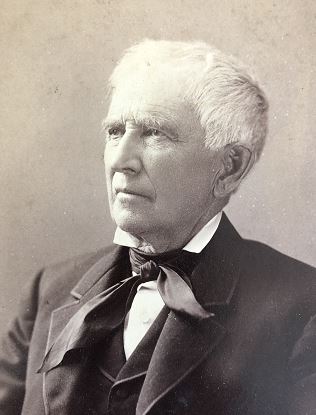
When I first arrived in Oregon I remember being puzzled by the conspicuous lack of graveyards. In Connecticut they are omnipresent. The dead outnumber the living. The weight of the past is heavier and it seems like every memorial is a tribute to the sacrifices made during either the Revolutionary or the Civil War. School history lessons concentrated on these formative periods and hastily covered any “modern” events that occurred after Lincoln’s assassination.
My family connection to Connecticut starts at its founding; my ancestors were on the Mayflower, served in the Revolutionary War, and I grew up in the house bequeathed to my paternal grandmother by her second cousin (once removed) whose grandfather was a celebrated Civil War veteran. [1] New Englander’s are frugal and rarely throw away even the most mundane journals. Most record the weather and market prices, but some of them are historically significant and much of the correspondence between Frederick Lucas, his mother and his future wife were preserved and came with the house. My father sorted and transcribed Frederick Lucas’s correspondence and self-published it in two volumes – Fred and Jennie was the first, and this post contains the second, which focuses on correspondence with his mother.
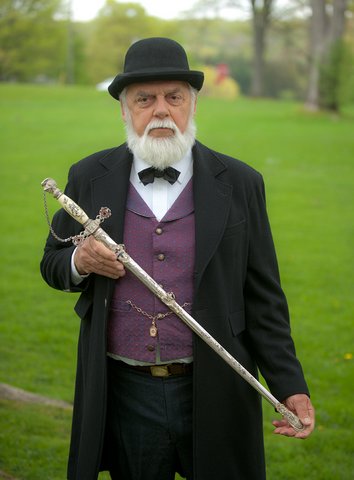
The photo is of my father posing as Fred and holding his Mason sword, which I have in my collection. My father gave lectures as Fred and what follows is a short biography that served as an introduction:
___________________
MY DEAR MOTHER: I RECEIVED YOUR KIND LETTER THIS AFTERNOON. IT FOUND ME IN A RATHER HARD FIX FOR ONE WHO NEVER KNEW BY EXPERIENCE THE SUFFERING OF WOUNDED MEN.
Thus writes Frederick Allen Lucas to his mother Marilla on October 20, 1864 shortly after the battle at Cedar Creek, VA.
BUT YOU MUST NOT WORRY CONCERNING ME, DEAR MOTHER. THUS FAR I AM DOING QUITE WELL, I THINK. I HAVE A SERIOUS WOUND BUT MY SURGEON TELLS ME IT IS NOT FATAL NOR WILL I LOSE MY LEG IF IT DOES WELL….
IT IS TERRIBLE SORE AND LAME AND I AM TIRED OF LYING HERE WITH IT BUT I AM DETERMINED TO KEEP UP GOOD SPIRITS AND MAKE THE BEST OF EVERYTHING.
I quote these lines from one of his many letters home to convey an image of the gentleman we are paying tribute to today.
I don’t doubt that there were many such men from this time period that served in the Civil War, and those wars before and those after, but there are few so close to home and so well-documented as were Fred’s service years and his life following the war, as he settled back into Goshen, went into business, married his lady friend of five years, and become one of Goshen’s leading businessman and citizen.
His mother, Marilla Price, one of twelve daughters of Benjamin Price of Goshen, can trace her line back to a British soldier of the Revolution, captured and confined in Litchfield, who when paroled, married and settled in Goshen.
On Fred’s paternal side the line goes back to James Lucas, a landowner and Trial Justice near Manchester, England.
Frederick Allyn Lucas was born in Goshen September 9, 1841. He was educated in the local school on the east side and attended the Academy. He spent his summers working with his father on the family farm and after the Academy taught school for four winters.
On August 8, 1862, about a month before reaching his majority age, he enlisted as a private in Company C of the Nineteenth Ct. Infantry being raised by his former instructor and head-master James Q. Rice. >more<
Lucas was made a Corporal September 11, 1862, promoted to Sergeant in February 1864 and Sergeant-Major in April, 1864.
Fred served on the staff of Colonel Kellogg until the Colonel died at Cold Harbor, VA, June 1 1864, and then with Col. Mackenzie.
Fred was wounded at the battle of Cedar Creek, VA during the Shenandoah Campaign with Sheridan, on October 19, 1864. Before his wound was fully healed he rejoined his regiment at Petersburg. He received another wound at Sailor’s Creek that confined him to camp hospital a few days.
He never missed a battle with his regiment and held a prominent position in every engagement. Fred was offered a promotion to First Lieutenant, which he declined (the official record indicates he mustered out as a Lieutenant). In March 1865, now General Mackenzie in the cavalry under Sheridan, urged Fred to join his staff as Aide-de-Camp with rank of Captain but Fred declined this offer also. In both cases he cited his troubling leg wound and the continued exposure and stress of army action bothering that leg. Fred mustered out on August 18, 1865.
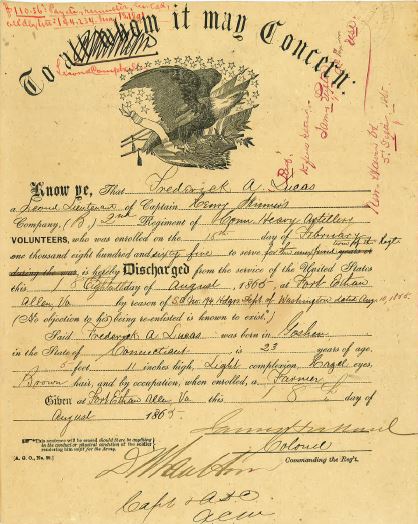
He returned to Goshen and engaged as a clerk with Hart Brothers & Company in West Goshen. Here he worked for four years; the last year being the “Cheese-man” of the company. In 1869 Fred partnered with a dry-goods firm in Bridgeport forming Giddings & Lucas but returned to Goshen in 1870, buying into Hart Brothers forming Lucas, Hurlbut & Allyn.
On March 5, 1877, Wilbert Allyn withdrew and the firm became Lucas & Hurlbut. In April of 1879 Hurlbut sold his share to Eugene Allyn and the company was Lucas and Allyn. Four years later, on November 1, 1883, Fred, being in rather poor health, sold his interest to Eugene Allyn and retired.
He worked as a guardian, a trustee and an executor for many Goshen citizens. Acquired nearly a thousand acres and 150 head of livestock.
He served in many town-office positions also as Representative in the Legislature in 1869 and 1886; as Senator from the 18th district in 1887 and 88. Alternating with his Father-in-Law, John H. Wadhams.
Fred died April 16, 1902, age 61, no doubt from complications incurred from his war wounds. From his writings he frequently tells of customers finding him wrapped in blankets; reclining on the service counter at the store; suffering from unexplained chills. This was probably the result of blood poisoning, that he carried all his life, from a bullet hit that fracture in his thigh bone. Frederick Lucas risked his life to preserve the Union and to free the slaves. He believed in the righteousness of the cause.
________________

_____________________________
MY DEAR MOTHER,
From
YOUR DUTIFUL SON, FRED
Civil War Letters from Frederick A. Lucas to His Mother
Edited by Ernest B. Barker
Author’s statement
How they came to be
As with so many old New England families nothing of any value or of the slightest interest was ever discarded, but rather stored in the attic. Here family treasures and mementoes would remain, possibly never to be seen again by family members. All too frequently the homestead would be sold after the last family member died and the estate cleaned out in the most expedient way possible. Happily the grandson of Frederick Allen Lucas saw some “interest value” in his grandfather’s Civil War period letters to his mother and donated them to the Goshen Historical Society.
I became an interested partner in the Lucas letters and family history after buying the estate, with household contents, of the last surviving Lucas. Among the items was a collection of letters from Sarah Jane “Jennie” Wadhams, my grandmother’s aunt, to Frederick Allen Lucas. I had previously gathered a collection of letters from Frederick A. to Sarah Jane that had been stored in her, and later my, family home for many generations. These, being “love letters,” may have been thought too personal by the relatives to pass into the public realm. Irreverently, I decided to collect and edit these letters in my book, Fred and Jennie: A Civil War Love Story, and passed the originals on to the Goshen Historical Society.
I have been working with the Historical Society transcribing the collection from Frederick A. to his mother for two years. Adding these to the Fred and Jennie transcriptions will round out the Historical Society’s Lucas collection, making a fairly complete Civil War period history of that Goshen family.
I have been very careful to maintain the character, spellings, and punctuations that Fred used, changing or adapting to today’s idiom only what was unclear or nearly unreadable due to penmanship or ink and paper conditions. Hopefully there are very few errors and Fred will forgive those.
~ Ernest Barker
Prologue
When Fred Lucas mustered with the 19th Connecticut Volunteer Infantry on the Litchfield green in August of 1862, Sarah Jane Wadhams handed him a small “testament” and wished him well. Fred and Sarah had grown up in the town of Goshen but were “strangers” in that they were nothing more then nodding acquaintances from church and other town functions. This act of passing him a bible, as many young ladies were doing that day, started a correspondence lasting more then four years.
As in every war there seems to be a lot of “down time” between the thrilling excitements of engagements. Fred used his down time to write letters. Several times a week he penned one to his sweetheart Jennie and one to his Mother or “Friends at Home”. Interestingly he seldom if ever mentions Jennie in his letters home to mother and family.
After a year and a half they were still “feeling their way” through the mails:
“O.R.I.A”
S. Goshen Feb. 23rd, 1864
Tuesday Morning, 11 o’clock
My Dear Friend Fred,
I have delayed answering your letter till now for several reasons. I don’t know but you will be provoked when I tell you that I read a portion of your letter to my Father and advised with him—if you are displeased I can’t help it. I have always been very free to talk with Father on almost all subjects and felt it would be wrong for me to answer you without first consulting him—he tells me to write as I please but at the same time advises me to be very cautious.
Fred, I must confess that I like you and that I should regret to lose your friendship. Now Fred, I have written as you desired, plainly and honestly.
I am young yet to think much about these matters. Father expects to send me to school for a long time yet, and he tells me he thinks I had better be careful and not commit myself by writing anything I could be sorry for hereafter. I respect you very highly and I trust I have in you a firm christian friend. I have for a long time placed great confidence in you & I hope that I shall never have reason to be sorry for having done so. You may call me “Dear Jennie” if you really care enough about me…
My Father told me some time ago that he imagined I was getting a little fascinated with your letters—I assured him I was not, but I think myself he was right in his belief. I could say many things were I to see you that I would rather not write. I do not like to put upon paper anything that could ever bring me into a mess. I can see far enough into matters of this kind to be careful to keep clear myself, if I were to write as my fancy now dictates- and at some future time write to some one else I liked better than I do you, you could (& would be quite likely to) bring forward some of my old letters— you are well aware that in some such way you could bother me very much if you chose to do so; although I have great confidence in you, I mean to look over matters thoroughly before saying anything that I might regret at some time. Mother says almost all girls have “17 year old fancies.” I tell her it is “easier to preach than practice”…
Fred was able to obtain a furlough at the end of March 1864. This was the first opportunity he and “Jennie” were able to sit and converse in a more intimate way.
As Fred had many friends and relatives to visit and Jennie was attending school in New Britain, they did not spend very much time together. Fred would not get another chance to visit her until after getting wounded in the Cedar Creek battle of October 1864 and a month in the hospital at Patterson Park, Maryland. He would be granted a month long furlough though his leg was still sore and inflamed due to the mini-ball wound in his thigh. He would return to the hospital before Christmas because his wounded leg created problems that he felt the hospital better able to care for.
Goshen, Conn. Dec. 22, 1864
My Dear Jennie
Yours of the 19th came in due time and I am much pleased with its contents. In regard to your suggestions I will say that after leaving you at N. B. I concluded to see your father at his house and have a long, plain talk with him. Yesterday was the time I intended to see him, but it stormed hard before I could get away from home and my wounds having now broken out again I dared not risk so long a ride in such a storm. Jennie I shall write your father a plain, candid letter before many days, telling him everything and asking a frank reply from him. He must be well aware of the feeling existing between us Jennie, for our long continued correspondence, my visits to you, and the terms of the letter you read to him about a year ago—all must have been seen and noticed by him. It is right and proper that I should see him and tell him all: but as circumstances prevent this I will write him plainly at an early date. You can talk with him on the subject when you get home if you wish …
The few months now before me are full of dangers and uncertainties yet I am prepared for whatever is before me and shall ever strive to meet my duty cheerfully and manfully wherever it may come.
I dread the Good Bye tomorrow and wish I were well away already. Jennie, I must be brief with this letter and close soon. Father is going to the center and I must send this by him that you may get it this week.
I regret very much that I cannot see you again Jennie. But as you say “never mind” —we will be patient and abide the time of my return. With my best wishes for your welfare and future happiness I bid you a Good Bye for the present.
A kiss and God Bless you. Your true friend,
Frederic A. Lucas
Sergt. Maj. 2nd Conn. Artillery
On this furlough, the author believes, Fred proposed to Jennie. There was mentioned in another letter a ring Jennie wished to get inscribed. This may have been an engagement ring. The war years would continue. Fred would serve with great gusto and valor, and receive another wound at Hatcher’s Run. He, along with the remaining Connecticut 2nd Heavy Artillery (formerly the 19th Conn. Infantry), would muster out in 1865.
Upon returning home to Goshen, Fred would take a sales clerk position with a local dry goods store, eventually buying the store in a partnership.
It is the author’s position that Fred may never have “faced” Jennie’s father, John M. Wadhams to ask for her hand, even after returning home a “war hero”, but rather, as the following letter indicates, the whole thing may have gone through the mails.
West Goshen, July 15th 1867
Mr. J. M. Wadhams:
Dear Sir:
In full compliance with your expressed wishes I have waited till this day for the fulfillment of my long cherished plans regarding my claim to your daughters hand & heart. I would be clear of all charge, like disrespect towards you, or indifference to your feelings, I would be perfectly honorable in this matter. Jane is now old enough & our constancy to each other for three years is ample proof of our love. If I ever want a wife it is now, if I ever marry Jane I ought to do it now, if we either of us ever marry at all it should be to each other. I am able now to have a wife if ever I shall be. I have ($3,300) thirty three Hundred Dollars at interest beside my salary since April 1st. I am getting this year a salary equal to ($900.) Nine Hundred Dollars probably, & have become acquainted with business so as to “know enough to get a living”. I offer these statements to show you where I stand today, pecuniarily [sic].
It is our intention to be married next month probably. Certain rumors have reached my ears which have given me much pain & anxiety— to the effect that you would not countenance our union. I hope this is not true & that the event of my marriage may not be clouded with your displeasure. I wish to be gentlemanly & honorable in this matter. I am conscious that I have been in the past.
Will you grant me your consent to marry your daughter? Had I not plead this suit before my request might have been couched in different language & with less of a business air. I cannot feel fully satisfied & shall never be equally happy without your hearty endorsement & plainly expressed consent to our marraige [sic] union.
As a young man commencing in life: as a man who considers the effect of such a step & the opinions of the world: as a man who would be faithful to duty & the responsibilities connected with married life: as one who is sensitive to the future happiness of the woman he loves, I ask you now, after years of waiting and a patient submission to your requirements & wishes, for a full frank consent to a marraige between your daughter Jane & myself? Circumstances render it desirable that I take this method of communicating with you in this matter, if desirable I will at any other time meet with you & talk of it.
I am Sir,
Very Respectfully
Your Obt. Serv’t
Fred’c A. Lucas
Goshen July 17 1867
Mr. Frederick A. Lucas
Dear Sir: Yours of the 15 Inst is received, and to allay any doubt you may have I will say, that I shall not put any obstacle in the way of Jane’s fulfillment of her promise to you of marriage, at any time that you and herself is convenient.
She left home today for Hartford with my wife to procure dress goods etc.
With regard to intimations that trouble you, they are not based on any assertions of mine, but inferences drawn I think by your Aunt Polly Ann, from my failure to answer a direct enquiry of hers relating to the circumstances of Jane’s marriage with you.
Respectfully Your
J. M. Wadhams
Frederick Allen Lucas
(September 9 1841- April 16, 1902)
History
Frederick Allen Lucas was the eldest son of Daniel Norton and Marilla L. Lucas. He was born in Goshen, Connecticut, on September 9, 1841. He lived at home, worked on his father’s farm during the summers, attended the common school, and at the age of twelve entered the Goshen Academy under the tutorship of James Q. Rice. At seventeen, he taught school in Cornwall Hollow, and continued to teach each winter, helping his father summers, until July 1862.
When the Civil War broke out Fred was anxious to enlist at the first offered opportunity, but his father argued that he could not spare him. Fred being a dutiful son was prevented from shouldering a musket until 1862. In July, his old teacher, now Captain Rice, helped raise Company C, 19th Connecticut Volunteer Infantry (afterward the 2nd Ct Heavy Artillery). Fred enlisted as a private with his old teacher.
The 19th mustered on the Litchfield green on August 21, 1862, and from there went into Camp Dutton, in Litchfield, for two months training. While in Litchfield, Fred was elected Corporal. Shortly, the regiment was moved to the forts around Washington D.C., and here he was advanced to Sergeant.
While serving as Sergeant of the Guard at Fort Ellsworth, VA., an order came from Colonel Kellogg commanding every non-commissioned officer in the regiment to present a specimen of their handwriting within twenty-four hours. Fred placed his first thoughts on paper, the question “Artillery tactics; what is understood by the term artillery?” He proceeded to answer that question briefly. Signing his name, he rushed it to his Captain’s tent. Two days afterward Fred was much astonished to find he had “jumped” fifty other Sergeants to the command of the Head Quarters Guard, brass band, drum corps, and others, in all about eighty-five men. Whether his penmanship had anything to do with this Lucas never knew. It might have been due to his skill as a drillmaster in both infantry and artillery tactics, for he had been detailed almost constantly for many previous weeks on this duty. He served well in this capacity and was granted a furlough during a period when none were being given. He returned early and was greeted by Colonel Kellogg with, “You want a new set of chevrons, sir.” Fred did not know what he meant by the last remark until that evening at dress parade he heard the special order read making him Sergeant Major.
While the 19th served in the forts about Washington D.C. they became the 2nd Connecticut Volunteer Heavy Artillery. Grant, needing more foot soldiers after the Wilderness Campaign, pulled them in to active duty as “marching artillery”.
Fred served as Sergeant Major during the march from the forts to eventual duty at Cold Harbor and that continuous “12 days of fire”. Here Colonel Kellogg was killed, and Lucas selected four men to go with him between the lines to bring back the body of their beloved commander.
After Cold Harbor, Fred served with the 6th Corps at Petersburg; under Sheridan in Maryland and the Shenandoah Valley; in the battles of Opequon, Winchester, and Fisher’s Hill; Harrisonburg; and in battle at Cedar Creek. At Cedar Creek he was severely wounded by a mini-ball through his left thigh, sending him to the rear and a hospital in Baltimore for three months. While recuperating he was promoted to 2nd Lieutenant and assigned to Company B, 2nd Ct. Heavy Artillery.
Colonel Mackenzie, in writing Connecticut Governor Buckingham, said he “wanted Lucas commissioned for gallantry and soldierly conduct in the battles of Winchester and Fisher’s Hill”. Further the Colonel is quoted in Theodore F. Vaill’s History of the Second Connecticut Heavy Artillery (1868), referring to Fred:
“Sergt.-Maj. (afterwards second lieutenant) Frederick A. Lucas received a wound in the left thigh at Cedar Creek which disabled him for several months. He returned to the regiment just in time to receive another wound-a slight one- in the affair at Hatcher’s Run. He was promoted for gallantry at Winchester and Fisher’ Hill, and Col. Mackenzie told the writer, just after those battles, that he never saw a braver man then Sergt.-Maj. Lucas” (p.210).
Fred rejoined his regiment at Petersburg, just in time to go into the fight at Hatcher’s Run, where he was again wounded, a slight one in the hand confining him to his quarters for about a week.
Lieutenant Lucas was present with, and participated in, every engagement with the enemy by the 2nd Connecticut Heavy Artillery. He was honorably “mustered out” August 18, 1865. He was in the grand review of the 6th Corps and Sheridan’s Cavalry at Washington, June 8, 1865.
Upon his return to Goshen he found employment in the store of Hart Bros. & Company in West Goshen, as an under clerk. Here he was successively promoted until he received a salary of $1200 per year. Later he had the opportunity to purchase the store, forming the firm of Lucas, Hurlbut & Allyn.
Frederick A. Lucas married Sarah Jane Wadhams, the eldest daughter of John M. Wadhams, of Goshen, August 7, 1867. They had two children, Frederick Wadhams, born Nov. 11, 1868 and John Marsh, born Dec. 14, 1870.
In the spring of 1869 Fred was elected a representative to the General Assembly. He would hold this elective office repeatedly, frequently alternating with his father-in-law. During this period he spoke before many civic organizations keeping the Civil War fresh in the minds of the public.
Frederick A., having been bothered most of his life by the negative health effects of the war, died April 16, 1902, at 61 years of age. Sarah Jane died March 30, 1909, their sons, John in 1938 and Fred W. in 1942.
A speech by Fred Lucas:
“And now, old comrades, I have a sentiment to offer which all good soldiers will indorse: it is that tribute should be paid to-day to the patriotic women of Goshen,- no less a tribute than which we pay the other sex.
It is not for woman to shoulder the musket, wear the sword, or carry the lance. Her sphere was at home, working, waiting, hoping, praying: to work for the absent soldier; to wait for glad tidings of his success, or, it may be (and, oh, how often for Goshen women!), news of his suffering and death; to hope for his return and the close of the contest; to pray for his safety and the success of his arms. Her sphere to encourage by her love, strengthen by her faithfulness to duty, and cheer by her abiding faith in the future. As Goshen soldiers, we pay tribute to Goshen women, and each of us who had a loving mother, trusting sister, a devoted wife, or cherished sweetheart, either, are glad to-day in the memory of her patriotism, and proud of her love, her faith, her sympathy, and her prayers during the dark days of our absence.
To the mother and daughter, to the wife and sweetheart, of the late war belong a large share of the victories won and laurels gained by son, brother, husband, and lover, as, while we waited around our picket- fires and watched with anxious thoughts our time at the vidette-post, while we faced death in the noise and smoke of battle, or struggled with disease and loath some wounds in the hospital wards, we ever knew and remembered that she thought of us, that she prayed for us; and whether we came home upright in stature, as when we left, or feet foremost, whether mangled and broken, with loss of limb and crippled for life, we never failed to believe that she kept a “light in the window” burning brightly always for us; and while we give honor to the strong arms and stout hearts of our heroes, the dead and living, we divide the praise due to loyalty and devotion, and render brave women her share, who by her very weakness, through love, faith, prayer, and patriotism, made the strong stronger, the brave braver, the cause more righteous, the end more glorious, the triumph more honorable.”
History of Litchfield County, CT.
With Illustrations & Biographical Sketches of It’s
Prominent Men and Pioneers; J.W. Lewis & Co.
Phil. Pa.; 1881, pages 367-370.
THE LETTERS:
Headquarters 19th Regt. Connecticut Vols,
Col Wessels, Company C
Alexandria, Va. Sept. 22 1862
Dear Mother
How are you and all the folks getting along at home? I wish I could look in and see you for a few minutes and come back to Virginia again. Not that I am homesick at all. We are all getting along very well, though not one of my squad are drilling this afternoon. Those who were on guard last night in the city are excused while Williard has something of a cold & as for myself I am very sore under my right arm, just as I was in haying time, and I am lying off to get recruited. But I am Corporal of the Water Guard today and am busy part of the time. The regiment are having a good drill today and I am sorry I can not be with them. They are having a mock fight—loading and firing at a halt & on the march. Our regiment are getting pretty thoroughly drilled, with all our guard duty etc. Albert is here has been here two days. He was sent here with the other paroled prisoners. Their camp is only a few rods from ours. There has been I believe about 15,000 sent here from Richmond and other places. They all look miserable enough the most of them were barefooted, without shirts or blankets, with scarcely rags enough to cover their nakedness. Albert looks better then he did when I saw him in Baltimore. But he is very poor and awfully round shouldered. I don’t wish to have you tell his mother what I may tell you concerning him, except that I saw him. He does not take care of himself in my opinion or has not I should say, but is careless. Henry Huxley has been somewhat unwell for a day or two but he is getting better and probably will do duty tomorrow. There has been a fire in the city today; it did not amount to much however. No damage to the world if it had swepted down several blocks. Prisoners are being brought in every day. They are sent to Washington and farther north from here. We hear curious stories from home concerning us here. How we are sickly & dying; how one Lieut. is shortly to be discharged and sent home & others to numerous to mention. How you continue to hear so much is more than I can tell. We have something to keep up the excitement all the time. I have had several clinches with prisoners which I have been detailed to arrest; but I have not as yet received a scratch. I got hold of a hard customer yesterday. But I soon convinced him that he was in error by a peculiar process of stopping his breath. I have not allowed myself to strike a person yet, and will not if I can possibly help it. Some who are arrested are drunk and saucy and we have to use means to prevent their injuring us; they are often armed with bowie knifes and revolvers and do not hesitate to use them sometimes.
I wish I could hear very often from home. I have written considerable since I came here and wish I might be remembered. Tell all the friends to write and tell me all the news; all that is going on. In fact write anything news, fun or love and It will be most acceptable.
Love to all the folks, this from your
Loving and Dutiful Son,
F. A. Lucas
My Dear Mother your letter is this moment arrived and I hasten to reply to enclose in Mary’s letter. I am pained to hear of Sam’ death, but glad to know that he died so nobly. How very, very many such noble men are sacrificed in this war. It must be a sad blow to his wife and parents. But it is some consolation to his friends to know how bravely he fell and how like a christian soldier he died. If I am ever placed in positions of danger like an assault or charge, I trust I shall be able to do my duty, if I fall I hope to fall as did Sam, bravely fighting in front of the enemy. And to die a calm peaceful death as did he with such perfect faith and trust in God. You write me that you are discouraged Mother. Why feel thus? We are having splendid success in every quarter. Can we expect greater things? But I think I know something how you feel about it. When bad news comes to you of the death or suffering of known and tried friends your thoughts will turn to me and you naturall picture me in their condition and imagine me the subject of suffering and death. Now I fear friends at home do not realize that we really enjoy a great many comforts and are pleasantly situated. While we remain here we are comfortably and in every respect well cared for. Thank God that we have such friends at home. My Mother is an expression which moves the heart of the hardest soldier. Yes, and a loving letter from Mother will serve to cheer us in our dark and trying hours, for we have them. Do you ever have these feelings in your christian experience Mother? Times when you almost distrust God’s goodness to you and the truth of his word? When you feel that you are weak and coming far short of what you ought to be as a faithful servant of Christ? I have many such hours in, my experience. Hours when everything looked dark and doubtful and a christian life one of the greatest trials if not impossible. But these hours are always followed by days of bright and joyous trust in the love of God and a perfect dependence on his mercy and power to save all who come to him. Army life is indeed one of the greatest trials to a christian. He must put on the whole armor of faith and keep on the alert continually, to ward of[f] the attacks of foes within and without. If through the grace of God I am able to go through this war with faith in God & a hope in Christ I trust my life will be one of love to Him and devoted to His cause and service. Remember me in your prayers daily Dear Mother that I may be enabled thus to serve my Lord and Master.
I am glad to hear of Amos Geers’ release from the rebels. He will have much that is interesting & instructive to narrate when he returns. Although he has undoubtedly suffered much in his term of service, yet if he returns sound in health and limb, he will never regret the term he was a soldier. If I was to leave the service now I would not take a farm for my experiences in army life. As regards the drafted men from Goshen I am very sorry they are to be exempted, I cannot see the propriety of thus letting them off. Because my name is on the list of those who have gone out from Goshen to the war, I can see no fair play in the fact that another man is relieved from coming also, by that act of mine. Certainly that is the only way to equalize the draft through the state, but it is provoking to us soldiers to hear how easily the “home patriots” slip their necks from the halter and slink the responsibilities of the times. Many of those who worked eagerly to persuade others to enlist and promised much on their own endeavors for the salvation of the nation are now sneaking from their plain duty and evading the responsibilities of true and loyal citizens. We feel such to be the case and that fact if nothing else serves to make many discouraged. We have good times now and as for my being sick I think I am enjoying the best of health. Although the weather is extremely hot yet it affects me very little. We take a good swim in the Potomac almost daily and except when on duty we take things easy. I suppose you are doing haying rapidly and working hard now. Wish I could help you. Well, this is the second long letter I have written to Goshen today and I am tired of wielding the pen. The other long letter was addressed to—ahem— no matter; you asked me once. So Good Bye, write soon, Fred
Camp near Alexandria, Va.
Wednesday, Oct 8th 1862
Dear Mother,
Yours came to hand last night and right glad I was to get it. You cannot imagine how much good a letter does us soldiers, especially those which come from home and near and dear friends. When the mail comes, we rush like mad near to the Captain’s quarters eager to see if there is anything for us & if there should be a letter, then how the long faces brighten and you might sometimes observe a soldier boy hiding behind a tent to read his letter and you might see the tears running down his cheeks as he reads for then thoughts are turned back to his home and the pleasant things he left behind him. The roughest men we have are often seen in tears as they read from those they love. We have some fine times here though we have to work pretty hard and a great deal of our work is night work. I have slept on the pavement and on counters, bare floors and such easy beds for the last few days, what little sleep I have had which is little. I have got used to sleeping anywhere can lie down on the bare rocks and sleep soundly. If you were to pass the Provost Marshall’s office any night you would see about fifty soldiers standing, lounging and sleeping all around & ready to obey any summons from the officers to go to any part of the city to break up disturbances, to quell riots, shut up liquor shops, arrest prisoners, or do any duty necessary to keep good order in the city. We often have to perform unpleasant and disagreeable duties, often to arrest and imprison those whom we feel to be upright and honest citizens. Every one so arrested are marched to the slave pen, a dirty miserable hole. Often it is that respectable persons are thrown in here, on mere supposition, and compelled to lie with the vilest of the vile. Men, women, and children are thrown together, black and white, of all grades and conditions. I often feel sorry for some that are sent there. For myself I should about——- be shot as imprisoned in the Alexandria slave pen. The paroled prisoners are all exchanged and are being sent to their regiments. There are about seven thousand within a few rods of our camp; they are going daily. Albert is among them and expects to go daily. Three hundred of the sick and wounded were discharged from the convalescent camp yesterday; they were a happy set of men I can assure you. Although they were nearly all as it were more dead then alive, yet they could appreciate the blessings of a discharge from service. I cannot imagine what excuse this government can have for keeping these men. Many of them are crippled for life and the greater part of them are forever rendered unfit for active service. I visited the military hospitals yesterday and such a sight I never before witnessed. Several there have lost their limbs, one or more; one man lies with the sore stumps of both legs and one arm. One has lost both eyes, a ball struck him in the right eye cutting it from his head, passing through his nose cutting out his left eye, thus forever destroying his eyesight. I conversed with him soon time; he was glad to see me. I asked him how he felt in regard to the rebels. He said if he had one eye left, he would show his disposition by shouldering his musket again and fight to the end of the war. I could but wish it were so. I admire his pluck. When I left he wrung my hand & begged me to visit him often. I promised him to do so if possible. He is the son of wealthy parents. He has not permitted his friends to know his condition. And he will not until he is well & allowed to go home. How will his friends fell as they receive him? But I might go on and tell you what I have seen & fill many pages but I cannot, the picture would be dark and to you it would appear startling and horrible, but to us who see so much it is only an expected accident which moves us only momentarily. I will say one thing in regards to these hospitals, they are kept in the greatest degree of cleanliness, not a room in any private house in Goshen is cleaner or neater than these buildings. They are as still as can be; in a room containing hundreds of sick & wounded not a word is spoken above a whisper. Men lie suffering from the severest wounds and see their comrades die by their sides, see them born away to their graves, and this occurs almost daily. Our Reg. have to bury these soldiers, they are buried with military honors, and have each a stone placed over their graves with their name, Reg,, Co., & state on it. The soldiers’ grave yard is very pleasantly situated, the graves are placed in good order, the stones all of a size, and everything neatly arranged.
We had another start up in camp last night as out picket returned after dark the Captain in charge ordered the men to discharge their pieces. Now this is contrary to all military law, to fire after sun down or in fact to discharge a piece unnecessarily after nine o’clock in the morning. Well, no sooner than the order was obeyed than we heard the long roll beating in every direction in the camps around u the officers crying “fall out men, fall out quick” etc. and in the clear moon light we could see the different Reg’s. forming in double quick time. Ready I presume for any emergency. Lieut. Col. Kellogg immediately dispatched his orderly in great haste to the Captain ordering him to appear at his quarters. From what I have already written you concerning Col. Kellogg you will imagine what the ignorant officer caught.
In regard to our remaining here I cannot say. Everybody in the city talk as though they expect us to stay. They treat us first-rate although there are many secesh here, who cloak their malice with smiles and but rejoice at every mishap to our troops. I love to catch and arrest such men. I can tell pretty well what a man’s principles are when I get hold of him as a prisoner. We are very gentle and careful of those we arrest if they conduct themselves properly but if not we sometimes have to use harsh remedies.
The boys are all well. Will is on picket duty today. I shall probably go on picket again to night and sleep on the soft side of a brick near the Provost House. Such is soldier’s life. In good health I like it. We are drilled when not on duty and are getting prepared to fight if called upon. Gen. Sloug told us that he never saw a Reg. appear as well with the same experience as ours. Col Kellogg wants to go to the front and fight. Col Wessels says he don’t want his men to be all cut up this winter. He says there are well drilled troops enough lying still that should take the lead.
I would like to go a blackberrying on the mountain about this time, pick apples and drink a little of your cider. We talk about these things everyday and we think considerable that we do not divulge to each other. I have written as much as time will permit if you appreciate the good a long letter does a soldier boy you will give me a good one as soon as possible. Give my respects to all. Kiss Emma for me & I was going to say one other girl, but I forbear.
Write soon, Your Son, Fred
Camp near Alexandria Va.
Dec 16/62
Dear Mother,
Yours of the 12th is received. Was not surprised to hear of snow banks & cold weather up north. We have had splendid weather for a few days past such as you never enjoy at this season. But we had a heavy rain for several hours last night. How the wounded below us must have suffered. The reports in camp this morning is that Burnsides is whipped & his army cut to pieces. The 133 N.Y. who have relieved us of the city picket duty are ordered to Fredericksburgh and the report is that we are also under marching orders, but we are kept in constant fever (those who are foolish enough to beleive everything they hear). I credit none of these stories in regard to our Reg. For myself I would like to strike a blow myself in a pitched battle with the rebels. Our boys are eager to be called to the front. If we go God grant that each may do his duty trusting in Him who is able to sheild them from the shafts of death.
We had a very busy day in the city yesterday. More than 40 rebel prisoners passed through on their way to Washington. Scores of our wounded from the fight passed by. One squad were new recruits. Nearly every man had some trophy of the battlefield. One with his left arm broken had 3 muskets on his back. He took them from the hands of dead rebels on the field. Another with his scalp nearly torn from his head, himself streched in an ambulance, and still clung with the greatest tenacity to an officers broken sword. Nearly all had some traitors weapon as a memento of the “Battle of Fredericksburg”.
Many of the citizens & visitors here have been down there & returned and from them we glean much that is interesting and instructive. If I may be permitted to give my opinion of permitting persons to visit the battlefield just now, I should say that it is nothing less than a license to spies. The city is full of those who would gladly avail themselves of such an opportunity to transport news to the enemy. We arrested, last night, a man dressed in ladies clothes and a woman in mans attire, they were spies and citizens of this city. Also three men employed in the same business. What the penalty is I do not know, but the greatest thing aiding the rebs is this class of traitors.
We have received our back pay up to the 1st Nov. I have had some photographs taken. They are not very good ones, I look too cross. I will send you one. The boys in my squad will all exchange with each other & I will send you a picture of each brother. Please keep all neat and clear untill my return. One I have already sent you. He is in a hospital in the city now and I think it doubtful if he ever returns to the Reg. His lungs appear to be badly affected. He has recovered from the measles but is left very low. Harlan Benedict, a nephew of Aunt Caroline Price, died last night in the hospital, has been sick several weeks. Was better, went on duty and taken down with the brain fever.
His friends here telegraphed to his friends at home. Whether he will be sent home I have not learned. His father is Sam Benedict. He, Harlan, was a fine fellow & an old acquaintance of mine. Thus they leave us, the best men we have apparently are the first to fall thus far.
In a former letter you inquired if it were neccessary to write “care of Cap. Rice” on your letters to me. Yes untill further orders as soldiers say. The Cap. is anxious to return to his Co. But is not permitted to do so. As far as the Reg. is concerned he can benefit us more in his present condition. He is just the man for the place. If we are ordered away from the city he will lead his Co. Henry Huxley is fast improving, sits up nearly all day, but has not left the house yet I beleive. I spent part of the day last Sunday with him. I attended church morning & afternoon in the city. The church I attended is on Washington Street. A methodist church, a fine building. We has a splendid sermon. There were a great many soldiers present. You inquire concerning Fred Cook. He is on his pegs again. As the old saying goes “If we can say nothing good of a man say nothing.” If I report none of his indiscretions, I shall be held liable for nothing, stories lose nothing travelling to Conn. & back.
We are all obliged to purchase two pairs of white gloves. They are to be worn on parade & reviews & inspection. Col. Kellogg declares we are ahead of anything in this division. Not a man is permitted to show himself in the ranks on parade or inspection without his leather nicely blacked, his arms in good order, and not a dirty spot on his clothes. Last Sunday one man was put in the guard house because his knapsack was not regularly packed.
As my time is limited I must close this. There are those potatoes, onions & meal to be bought for the Co. And a lot of nice logwood, coffee, mule, beef etc. to be sold to raise the funds. Don’t let the boy ride my colt. They will spoil his shape. If the war ends previous to May 1st as you predict I shall be on hand (if nothing happens to prevent) to drive the Arab myself. The vest you sent is a splendid fit. I am under many obligations to you for it. I never had as good a garment before.
Dec. 17th
I had no opportunity to finish this last night as I expected. All the non-commissioned officers in our Reg. are obliged hereafter to meet twice a week in the Captains quarters to recite lessons in Military Tactics. They met last night for the first time. Not a man knew his lessons in our Co. We had considerable sport during the recitation. All the Field & Staff officers recite to Col. Kellogg twice a week. The boys are in better spirits today.
News from Burnside is more favorable and the junction of three large divisions below to make a descent on Richmond. It is hoped that our troops may be successful at both points. If so, the traitors are whipped.
Col. Wessells is improving slowly. He has taken rooms in a house close to the camp where he can overlook the grounds and witness all the movements of the Reg.
No more at this date as duties are imperative. Please write soon as possible and tell me all the news.
Respects to inquiring friends.
From your son, Fred A. Lucas
Fort Ellsworth, VA. Jan. 1st, 1864
My Dear Mother!
I wish you a Happy New Year! Now have I not got the start of you!
It is a rainy, foggy, disagreeable morning, anything but a pleasant anniversary to us soldiers. It rains almost continually now, and we get tired of doing nothing but lie in our quarters and stay dry. Our reading is scarce and monotonous, guard duty comes only once a week, and under such circumstances soldiering is irksome. Our pleasant old squad of boys has at last been broken into by the advent of new recruits, three of whom are assigned to our tent. They are three brothers, sons of Dr. Calkins of Wolcottville. I think they will be good soldiers and fair tent-mates. Company C received nine more men yesterday—all of them good stout fellows and promising soldiers. You have no idea what a striking contrast there is between new recruits and old soldiers. The former appear stooping, lounging, careless, and gaping. The latter straight, firm, quick, and manly. I had no conception of the change wrought in men by fifteen months of military service. About seventy-five recruits arrived yesterday which were distributed among the different companies according to their own choice. One man who was a first Lieutenant in a nine- month regiment entered company H as a private. I think he possesses a good share of Patriotism. He is sure of rapid promotion if he can secure the good will of his commanding officer. We were mustered for pay again yesterday. Shall probably get our greenbacks in about a fortnight.
Although a very stormy night yet in spite of the rain the citizens of Alexandria kept up a roar and tremoult in honor of the birth of the New Year. From midnight until morning there was a constant snapping of fire- crackers and small arms, muskets etc. I awoke from a dream of Home and imagined a Connecticut Fourth of July was dawning. I was very soon aware of my mistake by the entrée of Liut. Rice and a posse of soldiers. Squad No. 4 were taken by surprise, and at short notice all found themselves in an incongruous heap on the floor. Not a word was spoken until some of our boys piteously inquired the cause of the unexpected assault upon us. No reply was granted except a gruff “I wish you a Happy New Year”. We soon discovered who our leading persecutor was, and then knowing the affair was only a Joke, we went in to them, and although they had the advantage of us, we being in our night cloths- a-la-dishabilles- yet we soon rendered our quarters too hot for them and they beat a hasty retreat in disorder, amid a shower of old boots, shoes, and fire wood. No serious accidents resulted from the contest except a few bad rents in the little clothing we happened to have on. Lieutenant had made his Grand Rounds and thought to have some sport with us; whether his anticipations were realized or not I cannot say, but we are resolved to pay him up in his own coin at some future day.
Whitney returned on Tuesday from his furlough. He had a good time; found his family much better than he had expected and left them in good circumstances. Whiting’s young lady friends have been here again and staid several days. They occupied Lieutenant Sanford’s tent and had a gay time. They were in our quarters several times daily. I was sorry to see them depart for Washington this morning. Mrs. Lyons will return once more before going to Connecticut. Lucien has a thirty six hours pass to the Capital to visit with them. Pretty ladies secured the favor for him which all…
(rest of letter being lost.)
Fort Ellsworth, VA. Jan. 2nd, 1864
Dear Friends at Home,
With the deepest regret and great pain I now take my pen to inform you of the sudden death of our mutually be loved friend Doctor Huxley. He died suddenly and without warning while quietly eating dinner with Edw. at the latter’s quarters in Col. Smith’s house just east of the fort. He was in his usual health and jolly and social as ever, up to the moment of his death which was instantaneous. Everything possible was done to resuscitate him but all means failed. Doctors Plumb and Hazard were immediately called, both of whom hastened to him too late to aid in saving his life. Their decision is that he died of Apoplexies Fit. This will be a sad and I fear a fatal blow to Henry. Surgeon Plumb says he will not allow him to know of it at present but it is almost impossible to keep such a thing from him. Henry is so low and so serious that I fear for the result if he does hear of it. Edward is almost crazy over his father’s death. It is in deed a sad blow for family, friends, and the community at large. Colonel Kellogg, the Chaplin, and several officers are now at Col. Smith’s called there by news of the affair. I saw the doctor only an hour previous to his death and had a talk with him. He had just returned from a visit to Henry and appeared well and jovial as of old. He said he considered H a little better. You have doubtless heard of this affair before this reaches you therefore I forbear writing further particulars at this time. His body will be embalmed and forwarded home tomorrow. Edward will doubtless get a furlough if Henry’s situation will permit.
We have had snowstorms; six inches fall of snow. It is fast disappearing and will not last long. A portion of Meade’s army are coming in. The Eleventh regulars are encamped under our fort and others expected. Willard tells me that you are looking for me up home on furlough. Don’t look any longer at present. I have no idea of coming home just now, if at all before my term of service expires.
Excuse me as I write in the greatest haste.
Write soon, Your Son & Brother,
Fred A. Lucas
Fort Ellsworth, VA., Jan. 9th, 1864
My Dear Mother
On guard again and a cold night but still, cloudless and beautiful. The ground is covered with a mantle of snow some four inches deep and the noise it makes when tread upon tells us it is cold. For two days past we have had the coldest time since we first landed in “Dixie”. Soldiers are reported as having frozen to death at their posts while on duty at the front. We suffer nothing compared to this however. The Potomac is frozen over clear across it and steam tugs fitted for the purpose are kept running to cut open a channel for other craft. Navigation is obstructed and little or none is being done. About a hundred men designed for our regiment are frozen in on board a transport and there they lie awaiting warmer weather. They are down toward the bay somewhere. One hundred and twenty came today, eleven to our company, most of them good soldiers. One arrived in a peculiar condition. He had been enjoying the Delirium Tremors for some days and tonight he is making the air hideous with his unearthly noises. A new thing for our company.
Yesterday I drilled a squad of twenty all day. The non-commissioned officers have their hand full at present and will have for weeks to come. I have five new recruits in our squad now all fine boys and good soldiers. In my family I have one Machinist, two Shoe-makers, two hatters, two Photographers, 1 Shirt Maker, 1 Surveyor, 1 Oyster dealer, 3 Farmers, 1 Medical Student. Quite a variety of callings duly represented, all of us now become soldiers and engaged in the same cause.
Mrs. Lyon paid us another visit this week, staying one night in camp. She leaves Washington for home on Monday. I have just learned who those relatives of Lucien’s are: Mrs. Woodruff is Darwin Writing’s sister. I was astonished to hear of it. They brought it out themselves and were desirous of claiming relationship to me. The young ladies of whom I have previously written you, and whose charm I have already portrayed to you wish to call me- something- I really do not apprehend what myself- on the score that their “uncle married my cousin.” I don’t know whether to feel happy or disappointed at their claim and exposures. They are pretty and agreeable and an acquaintance formed there gives me a convenient resting place when on a visit to the Capital, besides a capital dinner and a social chat away from the blunt ceremonies- or rather the lack of ceremonies- of camp life. Mrs. W. is a splendid looking woman and a perfect lady. A younger lass came with Louise the last time. She is about fourteen and a perfect little witch. She enjoyed being in camp and we had a pleasant visit with them. I suppose Doctor’s remains have arrived and perhaps the funeral is over. You will see Edward no doubt and get all the particulars. Please write me all about the funeral, how the family are etc. Henry is about the same. His prospects of recovery are a little brighter but everything almost is yet against him. I think he has got the Quick Consumption if he recovers I doubt if he ever does a soldiers duty again. He has been informed of his father’s death and stood the shock much better than expected. He seemed to be expecting something of like nature to happen. He remarked when told of it “I expected it. The climate would kill him.” His mind is very weak and of course he does not comprehend fully the true state of affairs. How does Mrs. Huxley stand the shock of Doctor’s death? How are the pecuniary affairs of the estate? Are the family worth anything? Should Henry die the expenses would all be defrayed by his brother Masons, and a Masonic Funeral at his burial. I hope he will eventually recover, and I have not yet given him up, although Surgeons and nurses are discouraged. Corporal Eldridge is on duty once more and looks quite tough again. We are happy to see his round face in the ranks at the accustomed place. New Additions to our company have extended the line so that we can hardly recognize it. Soon there will be a great change in our officers. Another Major when we number twelve hundred men, some thirty new commissioned officers, and a host of promotions in the ranks. Artillery companies when full have eight sergeants and twelve corporals whereas we have now only five of the former and eight of the latter. One captain will be made Major, and the best sergeants made Lieutenants. As to the promotions among the lower grades time will determine who the lucky or more efficient ones are, as the promotions will doubtless b made according to merit.
Captain Rice stands a good sight to be Major as he is the ranking Captain. I hope he will get the position although I should be very sorry to lose him from our company. Well, Mother, write me often and excuse me if now and then I give you, as I do this time, a poor dry letter. It is two o’clock in the morning and my eyes are heavy and I am getting nervous, so Good Night
From Your Aff. Son, Fred
One word concerning Cook’s Darkey scrape. The boys all agree with McCabe that if they were Congressmen they would vote him a Gold Metal and a Pension for life.
“Bully for the General”.
Fort Ellsworth, VA. Jan. 17, 1864
Dear Mother
I received a letter from you a day or two since and a package last night by way of L. Hart. Those Ginger Snaps were “bully” and the paper and stamps very acceptable. In regard to shirts I am not immediately in need of them but if you have time at present to make them, I would like to have you and send them when you have opportunity. If Father has any offer for my colt which is all he is worth, why let him go for all me. From your description of him I conclude he is a fine animal, but I have a long time yet to soldier it before I can drive him. If you can get a big price let him go though I am sorry to lose him.
L. Hart and Wm. Griswold arrived just before night and are now soldiering in camp. Griswold slept with us last night and declares he loves such a life. We have just returned from a regimental inspection. All the recruits were out, some in blouses, some in uniform with out arms etc. Our regiment now makes a long line and when filled up and armed and drilled will be fine. Company “C” now numbers one hundred and thirty four men besides officers. I have been kept so busy for the last week that I have not had time to write a word to you. I am drilling, drilling, drilling, green recruits all the time from morning till night; and besides am in charge of drawing the clothing for them as they arrive. I also take my turn on guard duty. You can perhaps imagine how much spare time I have.
Monday, Jan. 18th, 1864
A rainy day in camp. How it patters on our cotton roof, making merry and ceaseless music for us. Such a lounging sleepy set as can be seen in our quarters. We are crowded thick as a Saratoga Hotel in the height of the Watering Season. “No room for any thing, no chance to stir, not even to write hardly. I am bunked away on the backside of the house, and trying to collect my scattered thoughts so as to bring them to focus of my pen, to write but do as I will, not a stray item of news can be found. Boys are all well: Milo is back to his company again and is ordered to the cooking department on duty. Huxley is about the same. He will go home on furlough or discharge when able to bear the journey. Willard has just received a consignment of Butter from home and is selling out to the boys. It is very nice but costs us thirty-seven and a half cents per pound. I expressed sixteen dollars of my pay and my last state order to N.R. Hart who will doubtless receive it and deliver to you soon. It will cost you twenty-five cents to pay expressage. If you please will you tell me in your next the date and amount of each sum which you have received from me since I left home.
Has Mary left Uncle C’s yet? I received a letter from her lately but have not yet had time to answer her letter. You must excuse my remissions in writing for I am obliged to work every moment day and evening. Please write often and accept this from your son,
Fred
P.S. When we get these green horn soldiers learned how to Right Face we shall have easier times, I trust. Don’t look, at all, for me this winter. I shall not apply for furlough and expect none. Good Bye
Your Aff. Son
Fred
Fort Ellsworth, VA. Jan. 20/64
Dear Mother,
I am on guard again tonight and profiting by the opportunity given me, am trying to pay off my waiting correspondents. It has been a very pleasant day, but cool and the traveling muddy. We have just ha d a heavy rain and the ground is becoming very soft. “Sacred soil indeed”. Nothing can be so loving as southern mud. It does possess most tremendous adhesive qualities and such sticky properties as render it decidedly disagreeable. One of the worst features of a Virginia winter is the deep mud and long rains. Were it not for these they would be very delightful. And then just look into our quarters, a perfect Bedlam continually. Twenty men busily engaged- when off drill- at various duties, some scouring mess kits, some trading muskets, some blackening boots or polishing accoutrements and brasses, some arguing politics or discussing tactics: can you imagine how thick we are? And then consider my daily duties just now. I am in charge of drawing from the Quartermaster the clothing, arms, and accoutrements for the recruits as they arrive and then issuing it to them, keeping the books connected with the business etc. Besides I am in charge of a large squad drilling them in infantry and artillery. Also to learn long lessons in tactics, our recitations coming twice a week. Then comes my usual guard duty, and all things together render me about as busy as possible. I hope that the recruits will learn their duty soon, that we may be relieved somewhat of our arduous work. Drilling recruits is in many ways similar to school teaching. We have the same duty of controlling and governing as in school except with more strictness and greater severity. Among the recruits we get, now and then, a hard case to deal with. Occasionally you might notice in front of our parade ground a soldier with a long rail on his back and from the steady march and measured beat you would soon conclude the duty was compulsory: and again another man is seen in rather a disagreeable predicament, with his back to a wheel of a big gun, his hands and feet stretched out- a “Spread Eagle Crime”- snowballing in the ranks or is saucy to an officer, impertinence to superiors, or similar offence You doubtless think this cruel treatment to “brave volunteers”. If a man conducts himself properly he will never be served thus: it is only the class who persist in disobedience, and who try to evade orders while on drill. Good soldiers are seldom punished. Of our original company only one man was ever punished and he but slightly. The new arrivals are not quite as good soldiers generally though many of ours are fine fellows. I am inclined to think that people at home little know how much we have done as a “Fancy Regiment”. The recruits have received new muskets from Washington Arsenal just like ours when we drew them. The old soldiers are trading their muskets with them and getting from ten to fifteen dollars “boot” money. This shows what our scouring has done for us. I am proud of my musket and fifteen dollars is necessary to trade with me. There is the same difference between our other traps which constitute a soldier’s “paraphernalia”. But I have often written of these things, and will talk of other matters.
I have wrote nearly all day, answering Uncle Charlie’s letter a week old, and another from a fair correspondent nearer home. I am thinking you are depending on my coming home this winter. I think it very doubtful if I ever come on Furlough, unless some stern necessity calls me. I have no plausible excuse to offer in an application for Furlough and probably shall not apply. Then don’t look for me until my term of service expires, or this “cruel war” be over, for I mean to see it out, which event I hope will occur at an early period. Our army will be well reinforced the coming spring and the campaign will be shape and decisive. It is thought we shall get a siege train, and go to the front, if so, action preparations will soon commence and the “leaves of absence” will cease to all.
(no signature, possibly another page missing)
Fort Ellsworth, VA.
January 26th, 1864
Dear Mother, yours of the 22nd came this afternoon. Also a letter to Willard saying you were wondering why I did not write you oftener. Now Mother the reason is simply a lack of time and a dearth of news. I could simply repeat my last letters, if time permitted even this, but the trouble is I cannot find the time. I came off guard this morning and immediately went drilling recruits all day. I am kept at it continually, from which it is natural to infer that I am a fair drillmaster. I conclude that you are doing well pecuniarally. Won’t Father be trying to buy another quarter section soon?
You ask me if I am to be promoted to Captain? I hope not at present. When I am I promise to inform you of the good luck. It is possible that I may get a trifle higher than at present ere I leave the service. Time will tell. Willard was promoted to Corporal yesterday. Manson and Newcomb to sergeants. My turn comes next but I must not prophecy in my own case you know. We were called out today to exhibit ourselves to some “sprigs of aristocracy” who condescended to visit us. Among these were a daughter of Gov. Curtin, she that was Kate Chase and others. The ladies expressed themselves greatly pleased and left us with many assurances of their regard and often repeated “God Bless you all”.
Tonight the barracks at Fort Williams are dedicated by a dance. Shoulder Straps are expected to attend with their ladies. Ours are thus honored tomorrow night. After wards the rank and file take the building for a place to shake the foot in and right merry times we expect to have too.
Company “C” is now full to one hundred fifty men. Two more are added to my tent. One is a fine young fellow who has been clerk for seven years in the Merchants Bank, New York, but whose patriotism drove him out here a private soldier. The other a young Vermonter, wild, saucy, and full of fun but a good soldier and tent mate. You see we are much like riders in omnibus, always liable to make room for one more. But we go into more tents this week and will then get better accommodations.
George Bentley is promoted to Wagon Master of the regiment. Has a horse to ride and is in command of the quadrupeds of the Quarter Masters Department. His rank is the same as sergeant. The Brass Band can now be plainly heard discoursing sweet music to the play of pretty slippers and the gratification of shoulder strapped dignitaries. The band plays well and of course the Virginia girls dance well. Officers are jubilant and the ladies happy, but I am tired and my hand refuses to write, as my brain to dictate. Indicting a letter under such circumstances is nearly an impossibility-therefore I close with an Affectionate Good Bye.
from Fred
Fort Ellsworth, VA. Jan. 30th, 64
My Dear Mother
Long ere this you have doubtless learned of the death of Sergeant Huxley.
Henry died on Thursday afternoon at one o’clock. He had been lying in a stupid stat for some days and his death was not unexpected. His body is being embalmed and will be expressed home in a nice coffin. The funeral expenses will all be paid by his brother Masons of the regiment. We have written a paper and circulated it procuring a contribution of about one hundred and ten dollars subscribed entirely by the members of the “Masonic Fraternity”. I trust the brothers at home will turn out and do the usual honors to the remains of their deceased worthy brother. I hope the fair illustration of the principles which govern the “Order” are thus exhibited in the case of Henry will do much to remove the harsh prejudice and much of the ill feeling which exists at home towards the institution.
Another good boy is gone: gone to his long home. Died for his country: not on the field of battle amid the noise of carnage and strife: not from the lead or steel of armed rebels: yet an honorable death at the hand of disease. Henry will be much missed by us all. He was a good soldier, a worthy friend, an exemplary Christian. I considered him one of my most intimate friends and shall long miss him from our camp and quarters. His death will be a sad blow to his Mother and friends at home. The family are indeed sorely afflicted. Ed has a heavy load on his shoulders and much of the care and support of the family must necessarily fall on him. Please write me all the particulars of the funeral and the circumstances of the affairs at home.
In my last I alluded to the expected “soiree” at our new barracks. The affair came off and we had a merry time. Night before last the officers at Fort Worth assembled at the barracks there for another “kick up”. They had about thirty ladies with them, and when at the full height of enjoyment, and the building shaking beneath the merry tread of light footed and lighthearted damsels with their shoulder strapped partners, suddenly their pleasure was dampened, and their laughter changed to the most intolerable sneezing accompanied by the most disagreeable itching sensation- for the night was warm and muggy- and cayenne pepper, when people are in a state of perspiration, will set them scratching tremendously. Colonel Kellogg was writhing, he boiled over with anger, caused the whole garrison to fall out armed and equipped and marched them back and forth for three hours, to find if possible who the guilty parties were. The midnight drill did not have the desired effect and the offenders still remain unpunished. The pleasure of this third evening of the officers’ dance was of course somewhat marred by this meanness on the part of someone. If the person or persons be ever discovered their punishment will not be light. The non-commissioned officers and privates had their time after the officers, no ladies invited.
We have received another lot of recruits of about a hundred. It is not yet decided how to dispose of them, but I think it quite probable that a new company will be formed of them. A train of cars was fired into by a squad of rebel guerillas, on the road below our fort, night before last. The train stopped at the water tank to water the engine. (Father knows where the tanks are) twelve shots passed through the cars. No one was killed. A squad of cavalry immediately went in pursuit and captured two men and their horses, wounding two others who escaped. Mosby and his band are prowling about us continually and now and then give some one a “surprise party”. I expect they will give us a call some night. If they do they will meet with a warm reception.
It is a foggy morning and no drill today for the first time in a long season. The boys are busy preparing for inspection tomorrow: cleaning, polishing, blacking, and scouring. Yesterday I drilled recruits all day, recitation last evening, I feel very much like a schoolboy when the holiday comes, but I must fix for tomorrow and adjourn my letter till time permits its conclusion.
Sunday Evening Jan. 31st, 1864
Dear Mother, I again resume my pen to write you. This morning I went on guard but am relieved tonight for the good and agreeable reason that another strip is added to my arm and the one on my pants trebled in width. I was promoted at Dress Parade to be Sergeant (vice (?) Huxley deceased. I have performed the duties of corporal for a long time. Captain Rice is and ever has been very tenacious in regard to the rank of his non commissioned officers, were it not for this I think my promotion would have come much sooner. But my turn came at last and now I am a sergeant. My pay is increased thereby four dollars per month and my duties rendered easier though the responsibilities are considerably increased. I have drawn a new coat and my promotion will cost me quite a trifle. Frederic O Wills was promoted to corporal to fill my place. Whitney will be promoted soon. Willard makes a fine corporal and supports his stripes commendable.
I visit Alexandria tomorrow on a pass; wish it were old Goshen instead. I should like to surprise you about noon. I would like to tell you of a little time I had at one of the “F.F.V’s” a short time since. I was sent out in command of a squad of men. Patrolling in search of hidden muskets, other arms and ammunitions. In course of our search we came across a fine house surrounded by shrubbery and flowers (although in the winter) and everything appearing like thrift and good management. A middle aged women and three pretty daughters met and apparently welcomed us as we entered. I told them my business and stated farther that I should examine every nook and cranny of the house. They all volunteered to escort us, and looked so very innocent that I felt ashamed to suspect them. To make my story short I looked and re-looked assisted by my men until I fell in love with my fair escorts, when upon the point of bidding them a sad and affectionate “Good Bye” six rifles and a host of other things were found by accident in a crib of corn cunningly concealed by the golden ears from view. We returned to camp with our booty determined never again to allow ourselves to be outwitted by “Dixie Lasses”.
Sunday night in camp:
All is quiet for us considering the number gathered here. Several are writing home, some reading, others studying, a few playing games of different kinds. it seems much like Sabbath eve. I cannot help but wander in my thoughts to my old home and the loved ones gathered there. Tis a long time since I bid farewell to you and started for the field of war. Yet it seems but as a dream to me. I cannot realize that we have endured so much, that we have done so much, or been gone so long. Please write me often as possible and not blame my delinquency.
Yours in love, Your Affectionate Son Fred A. Lucas
Fort Ellsworth, Va. Feb 6th, 1864
My Dear Mother,
Your very brief favor of Thursday last came this afternoon. I hope Dan will enjoy his sojourn in the Metropolitan City and have a good time generally. Mother, it is utterly impossible for me to come home at present. I consider it useless for me to make applications for furlough. A dozen men are ahead of me, who have already applied, and who will be served first—all of them even cannot be accommodated as only one man is allowed to be gone at a time from our company. In case of urgent business like the death of friends or similar cases I might get the furlough, but the simple excuse “To visit friends” will not procure one. You will have to write often and feel content with writing untill opportunity is given me to come home and see you. I would give almost anything to be at home tonight, but duty will not permit, and I can only heed its mandates
Three years is a long time to serve as a soldier but “never mind” as –(Jennie)- says, everything will turn out right one day. You congratulate me on my promotion. Thank You! You of course do not understand why I was not promoted before. In military, rank is everything, and unless vacancies are made, promotion cannot occur to fill them. My duties are considerably lessened but my responsibilities are increased. When I do guard duty now, it is with a sword in place of musket and as commander of the whole post guard. I have a pass every time when coming off guard and next week intend to visit Washington. I wish to visit Congress when in session and also to call on my young lady friends there. I have been cordially invited to visit them and shall certainly accept if I go there. They claim relationship to me on the score that Darwin Whiting married my cousin. I shall go “cousining” to Washington, Wouldn’t you?
Today I have been busy issuing clothing to the men and preparing for inspection tomorrow. Member of Congress John H. Hubbard and wife are at Colonel Kellogg’s quarters visiting and the regiment will be paraded for their benefit. Governor Buckingham is coming to see us next week. I predict that our company will lose three of our old Sergeants by promotion soon. Hyde Tyler and McCabe will get shoulder straps I think, leaving Griswold First Sergeant of our company. Captain Rice will be Major unless he is jumped. If he is promoted, Leuit. Sanford will probably be our next Captain. We have done all we can to secure him to us as such. Our Company appointed Willard, Calvin, and myself a committee to draught a petition to Colonel Kellogg that he be our Captain in case Captain Rice be taken from us, and every man signed the petition. I was chosen as the one to present the document to the Colonel. I did so with a few remarkable remarks and a great show of military courtesy and parade. It was well received and I was assured that it would be “all right” (You will please say nothing of this untill the promotion is made). We are all very sorry to lose Captain Rice but if he must be succeeded by anybody we wish Sanford to be the man. Sanford is a fine officer an efficient instructor and a good man. He is very through and strict in discipline when on duty but when off duty is free to play and mix with the boys like one of their number. But woe to the man who seeks to evade or shirk his duty if Sanford is aware of it for he detests such a disposition and will punish the offender. Our Glee club are out again tonight singing for some pretty ladies near by. Leuit. Sanford is with them. I wish I could sing with them, I should enjoy going with the club now and then.
My promotion was the cause of sending me out of my old squad, as was Willard’s also. I am put in command of a new squad of men, all recruits but one- Corporal Smith. I have fourteen men; a jolly set of fellows, well disposed and agreeable, a nice tent and everything going our way. Being chief of the squad I am “Monarch of all I Survey” when at home. My squad is composed of men from all quarters; one from East India where he had served in the British service- the Sepoy war and other duty; another has just returned from his third cruise on a Whale ship and is chock full of his yarns and stories of the sea, another is a soldier lately discharged from the 13th Conn. and reenlisted again, two are workmen from Colts Pistol factory which I hear is now burned. Such a body of men will not allow each other to get lonesome. Although green recruits still I flatter myself my squad will not be badly beaten after a little time. I have the honor already of having the “quietest” squad and the best order in the company.
The Glee Club dedicated my quarters last evening by singing the Old Easter Anthem and many other good things. They can sign a little better than any other body of signer I know of. The other day I saw one hundred and sixty-four deserters from the rebel army who came into our lines and gave themselves up as prisoners of war. They are the remnants of a Kentucky regiment who recently attempted to desert in a body and leave the southern army but were prevented by a brigade of other troops who fought them and killed half or more of their number. At last they have succeeded in escaping. Others are coming daily in small squads. The great talk in camp is now, that we go the Chattanooga in the spring. I don’t believe the rumor and don’t wish you to yet a while. Mr. Eldridge is here. He came at noon today. Corporal Eldridge is poorly off yet. His disease has gone into his knees, either from medicine given while sick or other cause. We have several cases of Mumps among the new recruits. Some of them are very sick. Calvin is getting better I believe. Goshen boys are generally pretty well all around. Do you know whether Ed Huxley is thinking of getting a discharge or not? I surmise he thinks of leaving the army.
It has been a warm pleasant day but shows signs of a storm tomorrow which I hope will come and give us soldiers a day of rest. Farmers have been busy ploughing all around us but of course have not sown anything. Our regiment is now filled to about sixteen hundred men. We expect to be eighteen hundred strong very soon. Our Colonel finds quite a job on his hands when attempting to drill us, so many recruits among us, green ones too. Good Night
Sunday Morning, Feb. 7th, 1864
Dear mother it is a cloudy, damp morning. We have not yet received orders for inspection but are preparing for one. When you have an opportunity please send me those shirts you have for me. I shall need them pretty soon. How are Uncle Henry’s people, Aunt Lucretia and all the other folks. Who preaches in Goshen now? Are Howe and company any better off now, after their trouble and pains taking? Goshen voters ought to give David some prominent public office? Won’t they this coming spring?
Well, I must bid you Good Morning. Duty bids me close. Please write often, and tell me all the news. Remember me to all inquiring friends and believe me your Affectionate Son, Frederic A. Lucas
Fort Ellsworth, Virginia, Feb. 10th, 1864
Dear Mother
It is a cool, but very pleasant morning. I am in command of the “police” today and do not drill. Will “splurge” a line or two to you. Our regiment is kept moving now days. We are permitted little leisure. Drill one hour and a half before breakfast on Artillery. drill on Infantry from ten to twelve. Drill from two till half past three in the afternoon. Dress- Parade comes at sundown. Such are our duties when nothing else is assigned us. Saturdays and Sundays being excepted, the first day for the preparation, the latter for the execution of our weekly inspection. You perceive that we do something beside Guard duty. Police Study and recite. Colonel Kellogg is bound to bring up his new recruits to the standard of the old soldiers as soon as possible.
Calvin is returned to camp again looking very well. The general health of our company is quite good. Some cases of Mumps still exist, none of them just now very serious. Willard is well, goes on guard duty today. You may look for news of a lot of promotions of Goshen boys soon, we being entitled to twelve corporals and eight sergeants in Artillery. I will mention no names till the promotions are secured. Company C will do great things in these promotions.
I see by the papers that Sedgwick is temporarily in command of the Potomac Army. News of the last two days is interesting and we are impatient to learn the results of the next week. We expect a fight on the Rapidan ere long.
Willard has returned. Says he saw Father while home. Lieut. Rice has returned from a furlough also. Please send me some stamps soon if you please. Good Morning. Write often, and accept this from Your Affectionate Son,
Fred
Fort Ellsworth, Va. Feb. 9th, 1864
My Dear Mother,
I have just returned from a horseback ride of about five and twenty miles to Mount Vernon and surrounding country. Mr. Eldridge accompanied me. I came off guard this morning, received a pass till 1 o’clock tonight and I think I have well improved it. Mount Vernon looks bleak and dull at this season: the flowers are not in bloom, trees are leafless, with but a few exceptions of evergreens: yet the associations are the same at all times: the Mansion, the Tomb, the Gardens, all remain as their former owner planned and arranged them. The same beautiful walks: the same splendid views, the river with its sails and smoke stacks flitting along its rippling water: the grass plots and parks where He once walked and sported, and where his pet deers and favorite hounds played and fed: the stables, outhouses, and groves: the rooms where he received his friends and visitors, where he dined his family and company: and the one where he slept and finally died; the instruments for surveying which he used himself; his old knapsack, pistol holsters, chairs, and bedstead, all are of interest to the visitor and command his attention. The associations connected with this place render it one most desirable to behold by every American citizen.
We had each a good horse and equipments, and enjoyed our ride finely. Corporal Eldridge will probably receive a thirty days furlough soon and go home to regain his health and strength. He has recovered extremely slow lately and it is thought necessary to sent him home to get well. One of my squad has either deserted or been murdered in Alexandria I don’t know which to think about it. He is the soldier of which I before wrote as being just returned from India and who served through the Sepoy War. I had formed a high opinion of him and cannot believe that he would play the deserter. He had all his bounty money with him, and I fear has fallen a victim to some treachery at the hands of some villains of this vicinity. His name was Charlie Flannagan and he disappeared on Saturday evening last. Desertions are becoming quite common among the recruits. Company E has reported eleven deserters, Co. H three and tonight more are absent. We style these fellows as “Bounty Jumpers”. They are of a low class of men, enlisted from New York and other places with the express intention of pocketing the bounties and then running away. I think if a few of them could be caught and shot, it would prevent further trouble on that score. Shooting is but good enough for the scamps, they well deserve it, and if retaken I think some will get it.
A squad of recruits arrived for us on Monday numbering one hundred and one men. They are kept and guarded for the present in one of the new barracks. A new company will be formed of them. The old companies are now filled to their maximum and two new ones will be formed. Their letters will be M and L. They will have to be officered from the regiment unless Governor Buckingham chooses to interfere. The last men are fellows from every part of the known world, deserters from the rebel army etc. etc. but I think there are many fine men among them. Our regiment now numbers about seventeen hundred men. The other hundred men, which we are lacking to render us, a maximum regiment will arrive shortly. The 2nd C.V.A. will be the finest, largest, most imposing, and (as we soldiers say) the “bulliest” regiment south of the Potomac. Our number of detached duty men will not be increased, consequently our regiment, on drill, or inspections and reviews, will be about three or four times as large as formerly. Colonel Kellogg is proud of his boys. He is pleasant and agreeable now-a-days. He has realized the results which he so much desired. He has secured the “Eagle” on his own shoulders, brought up his regiment to become the finest, noblest, and best drilled, and most perfectly disciplined regiment in the army, securing to them the most honorable position possible that of Artillery in the Capital Defences, and lastly of filling up our ranks to the maximum number of eighteen hundred men, to the advancement of numbers of his old and tried friends who stood by him in his times of trouble and adversity, when others in office were trying with their might to accomplish his ruin and drive him in disgrace from the army.
Fort Ellsworth, Va. Feb. 11th, 1864
Dear Frank,
We have had a knapsack review today on the plain south of fort Ward. The whole Brigade was out together. Governor Buckingham and General De-Russey reviewed us. They were accompanied by several other officers and a few ladies. The marching was excellent considering so many were new soldiers, but the weather was somewhat cold and our fingers ached with nothing but white gloves on. The good old Governor looked us over and seemed greatly pleased to see us. If I have a chance I shall surely cast a vote for the old fellow for his reelection this spring. I believe he thinks a good deal of us “Connecticut Boys”; he confessed as much in his eyes as he passed me today. Long live Governor Buckingham. He made no speech to us this time, the weather was too cold and the square of soldiers too large to talk to. Our brigade makes a file of men now, numbering about four thousand men. We had the music of two drum corps and a brass band to march by. Traveling was excellent, the ground frozen, and very smooth. I am feeling pretty tired after the day’s duties. It is the hardest day we have seen in a long time.
What are you driving at now days? I hear little from you lately. The boys are busy writing home having a little leisure time before dress parade. I have a “Bully” squad of boys in my new quarters, good clean, honest, lively fellows, full of good humor and obedient and obliging to superiors. Flannagan has not yet been heard from. I fear he has been murdered in Alexandria, I do not believe, as yet’ that he is a deserter. Yesterday afternoon we received orders to fix up in our best style, boots blackened, brasses scoured, white gloves on, and everything in shape, for a visit from some notability or other, no one knew who. We fixed up, got up in our tallest shape; brushed, blacked, scoured, and polished from tip to toe; white gloved and well in agony. No one came and here we sat untill night, when we ungloved and resumed our usual clothes and serenity of mind and features, partook of our usual supper, and felt thankful for the not unusual false alarm which allowed us to remain in our quarters during the cold blustering afternoon.
I fear some of the fields of grain about here will suffer from frost if this weather continues. Farmers are ploughing all about in this vicinity and a few fields are already sown. I saw one lot this side of Mount Vernon containing, I judged, at least a hundred acres, quite green, with the spring rye. It was the same cornfield of which I believe I wrote you before. The corn stacks still remain, the grain being hucked, the stalks restacked, and the rye sown all around the stacks. This is the way the Virginia farmers do their work. Not quite as through as New England people are! How do you prosper at school? How does the teacher suit Goshen people? Has father got up his wood pile, done his threshing,, finished logging etc.? Has he disposed of my colt yet? How does the Arabian look this spring? I hope to receive a letter from home tomorrow. I was disappointed in getting none today. Several new visitors have appeared among us within two days past. Charlie Wheeler’s wife is back here again. Charlie cannot live without her.
Frank, our fort is overrun with monstrous large rats. Rats caper over us all night, hold council in the center of our quarters, dance cotillions on our bedclothes, hold dress parades and have reviews under our bunks, and go through battalion and skirmish drills about the tent. They bite our noses and ears, knaw holes in our blankets and clothes, squeal and squabble the dark hours through to our great inconvenience those who wish to sleep. Now and then a sentinel challenges, and not receiving the countersign, will impale on his bayonet a large long tailed fellow, and is dubbed the Lion of the night by his brother guards, he exhibiting afterwards the trophy he secured. Goshen boys are all well I believe. Everything is quite lovely, and the long necked fowl seems suspended at the tallest elevation. Frank, I have got the blues tonight; am homesick as a casset lamb, and sorry to write you the Good Bye for the present. Write soon,
Your Affectionate Brother, Fred
Fort Ellsworth, Va. Sunday, Feb. 12th, 64
My Dear Mother,
This morning dawned clear, calm, and beautiful, with every sign of a pleasant day before us. Orders came for regimental inspection at Colonel Kellogg’s Head Quarters at 11 o’clock, without knapsacks. We were there at the time appointed, the regiment was formed in line and the inspection commenced. But ere one half the companies were examined the wind arose and in twenty minutes blew a perfect hurricane and is not yet abated. Sand and gravel filled the air and render the atmosphere dark and almost blinding. A number of the tents are blown down and the boys are thinking this smacks of “life at the front”. Our chaplain depended upon preaching to us after inspection but the sudden change in the weather frustrated him and he is now distributing tracts and papers at our quarters with his hat tied down over his head and ears, a picture of “helplessness in a gale”.
Tomorrow we have our normal monthly inspection by Lient. Col. white- of the 1st Conn. Art. We expect a drill in Infantry and Artillery besides a knapsack inspection and any amount of questioning in the science of gunnery.
Captain Rice is jumped by Ellis. I am sorry Captain was not made Major. He was the ranking captain and well titled to it. But Colonel Kellogg’s recommendation was the prime cause of Ellis’ promotion. Ellis stood by the Colonel and remained his firm friend through all his troubles last year while Rice was a biter enemy and wished to crush him from the service. Now, the Colonel remembers who his friends were and has not forgotten his enemies. Captain Rice would make a fine Major and I hope soon to see him filling the position.
Seventy-five men are now detailed tonight from our regiment to go out to Vienner and work for the Engineer Corps cutting timber. The same number are to go from the 1st Conn. Who they are, or whether I am one or not, I do not know yet. If I go it will be in command of one of the parties. They will be gone ten days and will take their rations with them. Ed Huxley has got a Lieutenancy I hear. The officers have aided him to it. Company “C” has as fair a record thus far as any one could wish. Six of its enlisted men from the ranks have already secured commissions, and not a man has been court marshaled thus far, or hardly one punished. It speaks well for us, does it not? With less than half our term of service expired. Also one Lieut. promoted to Captain. I received a letter today from Hannah Drake also a paper from Ed Beach. When I received the paper I knew the address was familiar but I could not decide whose it was untill I opened it. How does Edward prosper? How do you like the marriage of Elisabeth Bunnell and Philo Miles? Hoe does Wolcott and family get along? I also received a letter from Elisabeth Gaylord. Where is she, and what kind of girl do you consider her to be?
I wish Father to go to Henry Beaches’ and engage him to make me a pair of new boots. I wish them to be of the same size and style and material of those I had of him when I enlisted. He has the size recorded on book. Now I want a good pair; well made and durable, and if they prove otherwise I shall consider myself privileged to have a pair proportion of the cost refunded. I wish them like Will Wadhams. Be sure you impress Mr. Beach with the fact that I desire a good pair or none and of the same size of the first. I wish them soon as possible; and get them cheap as you can. Please write me what you do about them. I hope to get the shirts and boots soon before we go to Chattanooga or with Burnside on his secret expedition.
No more for this time. Write often and believe me your Obedient Son,
Fred A Lucas
P.S. I depend on you getting me a nice and good pair of Boots.
Fred
Fort Ellsworth, Va. Feb. 13th, 1864
My Dear Mother,
Yours dated the 10th arrived this afternoon. I am sorry not to be able to come home with Dan and Mary from New York. I presume they have had fine times and seen many new and interesting sights. I was gratified to hear of the good attendance of the “Fraternity” at Brother Huxley’s funeral. Do you not imagine that we Masons are evildoers, and the “craft”- but a craft crew of scrape-graces! I think the “unbelievers” of Goshen are somewhat weakened in their prejudices against the institution, yet this is but one instance of the many results of its governing principles. I am not at all surprised to hear that Sergeant Sperry has reenlisted. I think Albert will try a second term of service when his first is expired, if not before. Whitney, Waterhouse, and Calvin Davis were promoted to Corporals and Dayton the ex-clerk of Merchants Bank, N.Y., is promoted to Sergeant, Sergeant Hyde, McCabe and Tyler are promoted to Lieutenants. The companies to which they are assigned is not yet known. I will write you when I learn which they are. Company C still rules the day in the promotions. Sergeant Griswold will be our Orderly Sergeant now. Other promotions were read on dress parade tonight -in every company. The best soldiers of the old 19th are now going up. Our company is being turned upside down by these promotions. Captain Rice is really jumped by Ells. Ells is our second Major. I am sorry that Captain is not promoted; yet I am glad we are not to lose him from the company. We are going to purchase the sergeants their swords and belts when they don their shoulder straps. They are good boys and I am glad to see them go up. Their promotion carries me up a little further. I now rank as fourth sergeant of our company. Fifty new recruits arrived yesterday. I was on guard at the new barracks last night in charge of the new men, one hundred and fifty men; none are allowed outside the building with out a guard. They will be thus confined untill organized and officered. I passed a sleepless night and have good reason for giving you a poorly written letter. Governor Buckingham paid us a visit this afternoon. We were called out and drilled on the “big guns”, had our quarters inspected, and were highly complimented for everything. The Governor is a good old man and I believe thinks considerable of the Connecticut boys.
Good Night: Fred
Fort Ellsworth, Va. Feb. 21st, 64
My Dear Mother:
I once more endeavor to write a letter while on guard at our post. It has been a warm, pleasant day but with many signs of storming in a short time. Alexa. looks much like as if she were wading in a snow bank- with a large bright circle around her, plainly discernable through the hazy clouds, the air is very hollow and the noise and din of the bustling city comes distinctly to us, varied with shouts of the soldiers-veterans returning by squads and regiments-from home, and now going to the front-howling of multitudes of the courser species- a special nuisance to us continually, -shrinking of engines and the rumbling of trains, with the oft repeated challenge “Who comes there” of our sentinels,-who seem to have more than usual to attend to tonight. Did I feel disposed to sleep I fear circumstances would not permit me with such a tumult about me.
The boys had an inspection at two o’clock today followed by a regimental inspection at headquarters. Hyde is assigned as Lieutenant in Co. G, McCabe to Co. K, Kilbourne of Co. A is assigned to our company. He is a kind of “milk and water” officer and has been for a long time spoken of as “Buttermilk Kilbourne” by the men of the regiment. He received the name on account of his mustache which is white as milk on one side and dark on the other. Hubbard Tuttle of Co. E, a son of the Tuttle who was murdered in Torringford, is promoted to a commission. Six months since he was a private in the ranks. Influential friends and his good soldierly abilities secured him this success. Our regiment is now more then full, over nineteen hundred men, but this includes those who have deserted etc., since we were made artillery. Our recruiting officers will return I think this week. I might mention more promotions in the regiment by (sic) you will see them in the county papers.
Our fort was honored by a visit today from three couples of Vermonters, young people “seeing the sights”. I concluded I had a nice visit with them. Mrs. Rice is here I have had two good visits with her already. She appears much more agreeable and condescending then formerly. I rather like to chat with her (Burn this portion when you have read it).
A newspaper correspondent by the name of Goodrich is here with Col. Smith and we are “shown off” to him almost daily. Well anything to secure a fine name aboard!
I received yours speaking of my shirts. I wish my boots had been finished and forwarded with them Please see that I get a good pair and foot the bills and charge to my account with the other things ordered.
I cannot write with some many other things piercing my mind. All my guards are raw recruits and I am kept busy all the time instructing them. Has George Spring arrived home yet? Please write often and believe me your obedient son, Fred
Scott’s 900th and the 153 New York started for Texas on transports last night. I knew many fine boys in those regiments and I bid them Good Bye as parting with brothers almost. God Speed them on their journey and grant them success.
Chattanooga and the front are our sensation words just now. I will prophecy nothing. Time will determine what our fate will be.
Fred
Fort Ellsworth, Va., March 1st, 64
My Dear Mother
March has indeed appeared in the Lions garb: with a severe storm of snow and sleet- freezing as it falls: but I think will turn to rain soon. I could not write you before on account of the duties which engrossed my time. Saturday I went on guard in the morning and such a tour of duty I never before experienced. I had a dozen prisoners in charge, returned deserters from our regiment, arrested at different points between here and home, by government detectives. They are ugly and desperate fellows, old sailors, state prison birds, and participators in the late New York riots. I ordered to confine them in the dark, bomb proof, and thinking to give me trouble they set fire to the place, and before I was aware of what they were doing the smoke was pouring from the ventilators in huge volumes. I felt mad, and at first thought would have stopped its egress and made them eat smoke awhile; but I remembered our magazine with its twenty tons of powder, and fixed ammunition and getting help I soon extinguished the fire. I then reported the conduct of my prisoners to the Officer of the Day. He commanded me to take out the entire party and tie them on the wheels of our large guns. It was a long job, but I tied them thoroughly and with a will. You can form some idea of their punishment when I describe it. The wheels are the size of cartwheels but heavier. The man is taken and placed with his back towards the wheel, and his arms and legs stretched straightly out and firmly tied. It is a hard punishment but when men insist on jeopardizing the lives of hundreds, in revenge for being arrested for desertion, they but deserve the trial. Some were in citizens’ clothes, and yesterday were compelled to disclose who were the parties that fitted them out. Citizens of Alexandria have thus worked for Secession and aided in the escape of scores of “Bounty Jumpers”. Arrests were made yesterday and I am sure the parties will be summarily dealt with. If the soldier is liable to punishment by death, why not the traitor who aids him to escape! Sunday brought a Brigade review and yesterday came an inspection and muster for pay. Sunday morning the three new lieutenants of our company were presented with their swords, sashes, and belts. Speeches were made and the occasion was an interesting one to all. The boys regret to leave the old company, but no more than we regret to part with them. They are fine looking officers and will all be popular fellows wherever they go. I think Quarter Master Lee will succeed Captain Rice in command of our company. Lieut. Sanford ranks too low (so Col. Kellogg thinks) to be made Captain now, Willard went to the hospital yesterday. He was attacked with symptoms of the mumps but has not yet got them. He is not seriously ill and I hope to see him back again in a few days and think he will be. He was taken about three days since. Aunt Ann must not worry concerning him, he will be taken care of if sick, but I think he will not be long. James Quinn went with Willard. Jimmy is not very sick but his symptoms are worse then Willard’s. The other boys are generally quite well I think.
We have a prisoner here who belongs to Moseby’s Guerrilla band. He will be tried in a day or two. He was caught inside our fort when he came to spy out the conditions of things here. The Guerrillas have been burning up the Government wood, nicely seasoned for their bonfire, and lying about a dozen miles to the south and west of us. We have witnessed the effects of their mischief in the long huge lines of fire for three days past, and yet smoking. These marauders are busy with such doings and are prowling about our vicinity continually and I expect will yet do us some fine “sell” one of these days, when least we expect it and while feeling most secure.
It is thought that we are to move before long to “parts unknown”. Our destination seems to be about equally divided between Meade’s’ army, Texas, and Chattanooga. Anywhere but the former place. There seems to be little honor or glory to be attained with the Potomac army, little but defeat and disaster has as yet attended its efforts. I hope the Spring campaign will wipe out the stain which rests upon it. Nothing but an overwhelming victory over the rebels in Virginia can do it. There is great strife between our regiment and the 1st Conn. and N.Y. troops to secure the single train from Washington to leave this spring for service in the field. Which will get it?
Yesterday and today it has rained very hard and now there is little sign of good weather. Deserters still come in and are being picked up in all directions. What can be done with them I cannot imagine? Our regiment is materially changed from what it once was. The old 19th of 800 Litchfield County, sober, honest, country yankee boys, was quite a different body of men from the 2nd C.V.A. of 1900- a conglomeration of good fellows, mean men, scamps, scapegraces, state prison refugees, drunken seamen, and “Bounty Jumpers”- the last mentioned class being the vilest of all and deserving of the least sympathy. But I ought not to thus write concerning the petted 2nd Conn. I shall occur the curses of my entire regiment if I do and perhaps get my head shaved and be drummed out of camp just for a foolish scribble. But it is no wonder that I should feel a trifle grunty about it and say harsh things unmeaningly after dealing with such characters as I have been obliged to while on duty. Yet the 2nd is not an exception in this matter. Other regiments have suffered, and much worse then we, from the same cause, and I venture to say that the 2nd Conn., now stands higher than any other regiment in it general character.
Colonel Kellogg is very kind and agreeable to us here and his lady is a splendid woman. She takes particular pains to converse with us soldiers and often talks with us as though she felt an interest in our welfare. She is the very contrast of the rough old Colonel, but she wears the unmentionables I think. You may think a man who would permit a woman to control him is not fit to be a Colonel over nineteen hundred soldiers, but I do if the lady be Mrs. Kellogg.
Corporal Thorpe, Judd, and Sherry are promoted to Sergeants in our company. Who will fill their places as corporals is not yet known. Major Rice looks quite well in his double-breasted coat and gold leaf and is a fine rider, a good horseman and a good-looking field officer. Our boys are purchasing for him his saddle and bridle. We thought it best to show our appreciation of his services while with us, and we have thus displayed it in a valuable and substantial gift.
I suppose you are thinking of again filling up the cheese racks and butter tubs, and instead of fife and drum, base horns, clarinets, and cymbals you have the sweeter music of young calves, tiny swine, and bleating lambkins, with the morning assurances of cackling pullets just becoming interested in the “Spring Campaign”, and the louder demonstrations of pompous Chanticleer from off the eminence in the cow yard. Our Reveille is “some pumpkins” but the music connected with the large farmhouse “beats it all hollow”. Oh! for a good long look into the old kitchen one of these busy mornings! but paper is full, yes full of nonsense, but I had no news to write and my pen was unruly. Write soon and often. From
Fred
Fort Ellsworth, Va., March 5th 1864
My Dear Mother,
Yours of the 1st came two days ago, and I have neglected a reply untill now on account of a pressure of duties I have been engaged in, writing on government documents for the officers of the garrison and found no time to write you. It is raining and shinning alternately today, much like April Showers. It is cleaning for us soldiers and you could appreciate it if you were here to witness our scouring. Willard came back from hospital this morning looking quit fit and strong. He is apparently a sound man again and will be all right in two days more. My boots came by Pendleton and are all I wish them to be thus far. Major Rice is with us yet but I expect will leave soon. Mrs. Rice bears the extra honors of her husband’s position with much modesty and a magnanimity worthy of herself. I have had several pleasant chats with her since her arrival and I think her last sojourn with us is much pleasanter to all parties than her former visits were. Soldier’s wifes[sic] are coming daily and if not soon prohibited a young city of pine shanties and canvas homes will be erected here.
The letter from N. R. Hart was one enquiring kindly after my welfare- spiritually and otherwise. I answered him in a gentlemanly and cordial manner for although I once wrote his name in a letter to you and coupled it with uncomplimentary epithets yet I still respect him very highly and shall ever hold him in much esteem. I should be exceedingly happy to aid in raising the new flag staff in old Goshen, but regret that I am obliged to decline accepting your kind invitation to be present. Be careful not to leave the pole inclining to the southward, lest it influence the principles of Goshen citizens, or be thought by visitors as indicative of the conditions of the political atmosphere of our native town. Let it stand upright and perpendicular, defiant to the storms of war and anarchy, and emblematic of the governing principles which prompt the sons of Goshen to take arms in a country’s defense.
March 11:
I enclose this which you perceive was in reply to your last and penned long since. Excuse this delay on my part and write often as possible. Your son, Fred
Headquarters, 2nd C. V. A
Near Fort Ellsworth, Va., March 11th, 1864
My Dear Mother
You are looking for a letter from Fred I presume, and wondering why it does not come. You also wonder at the date of this sheet. In explanation of the first I plead part carelessness and part a lack of time and opportunity. I commenced a letter to you several days since but neglected to send it to you and duty prevented its completion.
I am now on detached duty away from my company, at Colonel Kellogg’s Headquarters, about a mile from the fort. I am in command of the Colonel’s guard at his quarters. My force consists of fifteen privates, and three corporals besides myself. I have a sort of superintendence of about fifty men, consisting of the drum corps and brass band. The latter are not exactly under my charge, yet I am in some measure responsible for their good conduct through night season. I have plenty of music as they are playing continually in practice. I am under the Colonel’s eye a great portion of the time and must be a soldier continually .My duties are not heavy and rather dull than severe, as there is much less bustle here then in camp. I have roll call of the soldiers here twice daily and report the results to the Adjutant. Guard mounting at nine A.M. when all are obliged to turn out in full dress and shining too, when the cleanest and “best got up” private has a pass given him to visit the “defenses south of the Potomac”. Corporals and myself have passes every three days if we wish. You see I am in good circumstances at present. I don’t know how long I may remain here, perhaps only a short time. Sondant started for home today. He will see you probably. Bill Wadhams went with him. Also Beuham of New Hartford. I felt just a little homesick when they went off and vainly wished I could go with them. A visit at home is very desirable and I hope I shall be able to see you one of these days if we remain here.
A rebel spy was captured on the highway below the fort recently and brought here to the Colonel. After a hearing of the case the Colonel sent him to Washington where he will be tried by a Court-Martial. He was a southerner, and had in his possession papers of drawings of all the forts south of the Potomac, and the names of the troops, and their force in garrison.
Kill Patrick’s cavalry are now here, what remains after the raid to Richmond. They came up the river and landed yesterday. Large numbers of the men are reenlisting and going home to show their bronzed faces and honorable cuts and scars received in many a severe fight with the rebels during the last three years. They look rough, ragged, and toil worn and show signs of the past hard work and fighting, but they feel excellent over their doings around the rebel capital and tell tall stories of their experience.
The Virginia Legislature now in session in Alexandria yesterday passed a bill freeing all the slaves in this state and prohibiting the holding in service of all negro minor children except as apprentices in the same manner as white children. The city bells were all rung, flags were displayed and a salute of a hundred guns was fired here in honor of the event. This is a great thing for a Virginia Legislature to accomplish yet it was done with only one dissenting vote. I conversed with a Virginian resident here today and I could easily detect the bitterness of feeling which filled his mind and which he tried in vain to suppress. It causes an immense elongation in the features of the secesh here and you could easily identify that class when you meet them in public. You see them in small groups at the street corners, or in a friends yard, and if you notice closely you will remark the angry gestures and fierce looks, the decidedly “done up” expression of them all, for now their property “in human chattels” is forever lost, while on Virginia soil. Three cheers for Virginia! It is at least encouraging that a Legislature can be made in this state, if men so unanimously in favor of the emancipation of her slaves. The day will come when even we soldiers, who now so heartily detest the soil, and hate the state, will willingly term the first “sacred”, and the latter as the “Mother of Presidents”.
Another soldier of our regiment has gone to his long home. His body was carried by this afternoon with the usual escort of soldiers and the band playing a funeral dirge. It was an attractive spectacle to many but sad and solemn to me, as it reminds me of friends and comrades who have gone the same way, forever gone from us, and I could not help thinking: Who will go next? The one who died today was a recruit and belonged to Co. I. I have not learned his name. Willard I hear is better, but I have not seen him in two days, as I am now away from the fort.
My box arrived some time ago, everything in nice order. Those shirts are just the things. I observed that the package was plainly marked “Paid”, but having no certificate to present at the express office I was obliged to pay the expressage on it. Did you prepay the charges on the box or not? and if you did, did you preserve the receipt given you by the agent at Wolcottville. If you have preserved it please sent it to me as soon as possible that I can produce it at the office in Alexandria and get the money refunded which I have paid here. I should have thought it all correct if the mark spoken of were not on it and evidently put there by the agent at Wolcottville.
Four more deserters are just brought in. What can be done with so many I cannot imagine. Some must be punished I think by death for severe measures must be resorted to as a preventative of further examples of the kind.
I must write Aunt Ann for Willard and duties compell [sic] me to work in haste. Please write often and don’t wait for me. I am exceedingly busy at present. The storm still rages, but is turning into rain. With many regards I remain,
Your Dutiful Son,
Fred A Lucas
P.S. Enclosed you find a photograph of one of my new squad. His name is Abbott and he is a sailor of three long whale voyages, having visited nearly every part of the known world. He is a good tent mate and a fine soldier. Fred
Headquarters, 2nd Conn. Vol. Artillery
Near Fort Ellsworth, Va. March 17th, 1864
Dear Sister Mary,
I have a little leisure this afternoon and will improve the opportunity by again writing you. Have you forgotten me entirely: or have you discovered a correspondent somewhere else, who monopolizes all your spare time and thus prevents you from writing me?
If the former, I beg leave to inform you that I still exist, and think as much as ever of my elder sister: if the latter reason be true, I must say that if your sojourn in New York was the cause of it I am sorry you ever visited that metropolis, unless the chap who has thus “cut me out” of your letters, is worthy of you, in which case I should deny myself the pleasure of hearing from you- if not willingly- with all the graces possible under the circumstances.
Well Mary how do you get along this spring? It seems an age since I saw you and a long time since I heard from you. By the way, I have just thought your birthday came recently. I beg pardon for forgetting it. I should have sent you something if I had known it in time. Will was here and reminded me of it. How fast the time passes. Weeks and months glide away and I do not realize their duration. I am now on the last half of my term of service and it does not seem possible. But when I look back to what we have done and where we have been, and compute the time which we spent at the several places where we have quartered, I find I am right. I looked for a letter from home today but was disappointed. I expect one tomorrow “anyhow”. Do you hear from Aunt Em lately? If so, what does she write? How does Corporal Eldridge do? Is he ever coming back again, or is he going to be discharged? He was “jumped” in the last promotions in our company. Thorpe, Judd, Sherry and Pendleton are promoted to sergeants, and Balcon, Vaill, Orson, Miner, and Charley Adams are corporals. Tomorrow our regiment commences the artillery practice again with balls and shells, canister and grape shot. The targets are being erected today- and are nearly a mile from the guns and about ten feet square. We had another “scare” Tuesday night. The garrison at Fort Worth lay at their big guns all night, and at the other forts were in readiness for action. Colonel Kellogg did not retire at all but was out all night preparing for emergencies. No “Moseby” came however. We wanted him to make a dash on us however, as a large force of Kill Patrick’s cavalry were lying near Alexandria and would have given him a warm reception. They were the men who made the raid on Richmond, and went to the front again yesterday. Last evening Col. K. and Lady gave a party here at their residence. Quite a large company of officers and ladies were present. The band was in requisition and played beautifully at intervals during the evening. I went to my quarters and retired at ten; when they broke up I don’t know, but the last sound I remember was the music of the band. How do you like the Proclamation for two hundred thousand men, issued yesterday? How do Goshen “Conservatives” like it? General Grant is where he can look after the Potomac Army now, and I think some thing will be effected if possible. We think Grant will put the troops in motion, and look for some severe fighting during the spring months. I am now situated in the easiest position which I have yet occupied since I became a soldier. My duties are very light, and quarters splendid, with good men under me and plenty of good rations and a good cook. My quarters are a square wall tent such as are used by officers, with a good stove, table and benches and good bunks. Three corporals and myself occupy this tent and we live “cosily” enough. I think it a model “Bachelors Hall”. Wish you could look in and see us some of these pleasant days. You would be convinced that my present soldiering is not very tedious or laborious. I can go where I please, when nothing special is demanding my presence here, it being only necessary to apply for a pass to the Adjutant. I can visit Washington or Alexandria frequently. Have you seen Sondant or Bill Wadhams since they went home? Are our folks still expecting that I shall come home? I wish I could go home and see you all this spring but I am confident no furlough will be allowed me. The way to secure one would be for some influential man at home to intercede with my company officers for one for me. It might procure one and might not. But don’t do any such thing. I choose to do my own engineering in all matters pertaining to my advancement in soldiering
Headquarters 2nd Conn. Vol. Art.
Near Fort Ellsworth, Va., Sunday Mar. 20th, 64
Dear Sister Anna
Now for a letter to you. It has been a very pleasant Sunday here, sunny, warm and breezy. An inspection was ordered at headquarters at two o’clock, but orders coming to Colonel Kellogg to the effect that he was in temporary command of this brigade, he saw fit to countermand the inspection, and there was none. Colonel Abbotte is relieved from the command in order that he may act on a committee appointed to consider certain measures pertaining to the United States Coast Survey. Another “scare” was felt along the line of the “Defences” last night. “Moseby’s Guerrillas”, “Stewart’s Cavalry” etc. was the theme of all conversation during the evening up to the time when the drum beats the signal for cessation of all talking, putting out the lights etc. Every soldier not residing in Alexandria on garrison duty was removed from the city & ordered to their respective regiments forthwith. All the theatres and places of business were closed up: brass-cannon (6 and 12 pounders) were stationed at the entrance on King, Duke and Washington streets with troops to work them: detachments of soldiers were posted at short intervals all along the principal turnpikes leading to it: pickets were thrown out from our fort and others and the sentinels on guard duty were instructed to use utmost caution: the men all slept with clothes on ready for any alarm. Thus passed another night but no Moseby, no Stewart came to trouble us. Various rumors are afloat in camp contradictory of course; if there is danger of attack no one knows it beside a few, if no danger no one is certain but a few, and in either case that few will keep their own secrets while all of us are kept prepared for the worst. Guerrillas are prowling about us continually. While two men of the 1st Conn. were returning from their duty at Vienna lately (I told you of a large squad of men from the 1st & 2nd Conn. sent out there) they were caught by a band of Guerrillas. They were put in the charge of two of the band armed with shotguns. After the others were well away our two boys of the 1st thought the chance of escape worth trying for and “pitched in”. The result was that they killed their captors and then made “tracks” for home with the guns for trophies.
I received a nice little letter today from Eddie Wadhams. Eddie thinks Seymour will be Governor of Conn. this year, but declares “Old Abe” will be President again. Well, Anna, I am going to the Seminary Chapel to attend service this evening and it is nearly time to be ready. I enclose you a photograph of one of my new acquaintances, his name is Wheeler and was formerly a clerk in New Haven I believe. His picture was taken when he was a citizen. He is now with me here at Headquarters. What are you and all the folks doing now a days?
The band is out and playing for the Colonel and his Staff. It plays finely. Yesterday some new instruments were added to it. Those last purchased cost $230. The officers of the regiment pay for them. They are now playing the beautiful and touching tune “Who will care for Mother now!” It is beautiful. Did you ever hear it played by a band? I am hurried as time flies rapidly just now. Please excuse the shortness and the penmanship of this letter.
Write soon as you receive it and believe me your loving Brother, Fred
P.S. There is considerable talk of men being sent home to vote, but I do not depend on it much.
Willard is on duty again and looks tough and rugged ever more.
Write soon, Fred
Headquarters, 2nd C.V.A.
Near Fort Ellsworth, Va. Apr. 6, 1864
My Dear Mother
I am at my post of duty again all right. I am agreeably surprised to be the recipient of further promotion; I am now Sergeant Major of the 2nd C.V.A. and occupy the prettiest position in the regiment. I am now on the Colonel’s Non-commissioned staff and my duty is here at his office. I bid Good Bye to musket and straps and buckle on a sword instead. I also bid guard duty, picket, police, fatigue etc. the same compliment. My pay is now $21 per month and a “sight” for a commission some day. But I must tell you of my ride to Dixie. I reached N.Y. at 8 p.m. and in company with three fellow soldiers who were also returning from home, I perambulated the city for three hours visiting several places of interest among them the Sanitary fair and Taylor’s’ Saloon on Broadway. At 12 we again moved on towards our destination. When we reached Philadelphia it was snowing and at Baltimore raining which continued without abating untill this morning. I reached here at 2 p.m. yesterday. The “boys” met me with noisy demonstrations and overwhelmed me with questions. They were feeling disappointed over their furlough arrangement. The papers came for them to go but were immediately followed by orders countermanding them; caused by the removal of the 13th N.Y.A. I found Goshen Boys all well as usual. Lieut. Fenn is Captain of C Company. Cal Davis will probably be Sergeant to fill my place, who the corporal will be to succeed Calvin I don’t know.
I am in great haste and con write little this time. In future you may direct my letters as follows:
Sergeant Major Fred A. Lucas
Headquarters 2nd C.V.A
Near Ft. Ellsworth, Va.
With love to all and the hope you will write often, I close,
Yours in great haste,
Your Aff. Son Fred
Headquarters, 2nd C.V.A
Near Fort Ellsworth, Va., Apr. 10, 64
My Dear Mother
At the close of another Sunday afternoon I resume my pen to write you. It has been a warm, sunny spring day since ten this morning, but is muddy after yesterday’s heavy rain. This last storm was severe and the streams were raised unusually high. But everything looks beautiful tonight, the grass is getting quite green all about us, the robins are becoming plenty and enliven us with their presence in our grove. This is a pleasant place and I think I now have the pleasantest situation in the regiment. My duties are light and easy. I have a large officers tent with good stove, table, bed etc. Carrel North lives with me. He is Adjutants clerk. My duties are to receive and keep the daily morning reports of all the companies in the regiment which I consolidate in a blank book for the purpose. All changes by death, desertion, transfer, or promotion are to be noted etc. Every ten days I make out a report of this and forward to brigade headquarters. When in camp together my duty would also include the detailing of the number of guard required of the companies. While in garrison I escape this. I am to be present on all drills of the regiment and assist the Adjutant in his duties there. I think my position as Sergeant Major preferable to a Lieutenancy aside from the honors and chances of being higher. I now rank next to a commission and above all other non-commissioned officers. My dress is changed a little; six stripes on my arm in place of three-in the shape of an arch. I tell you this because I thought you interested to know. I have heard firing out front this afternoon but what is going on we cannot learn. I visited the company- I call it my company and always shall but I no longer belong to it- found the boys all well. Company inspection has been order of the day. I have no more knapsack now and no more musket-a sword is my weapon. Cal Davis is promoted to Sergeant to fill my place. Col. Kellogg is in command of the brigade, temporarily. Col. Smith has applied for a discharge. Two men from C company have died since I returned; Cone of Torrington & Butler of Waterbury.
What is the news at home? How do you all do? Wish I could look into the old kitchen for a little. How is Emma? Does she remember me? The band are playing for the Colonel. Tis a beautiful evening and the music is sweet and stirring. Please write me all the news concerning all those in whom I am particularly interested. Remember me to all who inquire and excuse what may be thought arise in this.
From Your Aff. Son
Fred A. Lucas
Sergt. Maj. 2nd C.V.A
Headquarters, 2nd C.V.A., near Fort Ellsworth, Va.
Thursday Evening, April 14th, 1864
Dear Friends at Home
I would write you all if possible which appears easiest done by thus addressing you collectively. I am alone in my bachelor quarters; my mate (Correl) is engaged in his duties in the Adjutants office. My fire burns cheerily and all my surroundings are as pleasant as any soldier could wish for; yet I am feeling a trifle lonesome and that will mar the pleasures of any soul- while the fit is on, you know. I have been busy today writing on Regimental Documents. The regimental monthly inspection came off today. Inspected by Lieut. Col. White-of the 1st Conn. My books were examined by him and I was the happy recipient of many compliments for the neatness and correctness of my work and general appearance of my accounts. in these monthly inspections everything is thoroughly examined even the private books pertaining to the affairs of the troops; and written statements of their condition forwarded by the inspecting officer to the War Department at Washington. It has been a cloudy day and a little chilly but the grass is growing finely here and the ground is quite green. I saw Peach trees in blossom yesterday and some shrubbery about the house here is already in leaf. A little more is said about our leaving but I know nothing definite and really care little about it. I think however we shall not leave. I sent my Carpet-Bag home today by Milo Barber who will leave it for you at the center. Milo is discharged and I think will secure a pension as he is working for ????. Mary may “set her cap” for him now, He has been a faithful soldier and earned laurels in the cause of Freedom- a worthy prize for some fair one.(?) I brought in a deserter yesterday. I was out walking for a little exercise and entered an oyster shop to see what might be seen when I discovered a man there who left us nearly a month ago. I recognized him by a deep scar on his face although well disguised otherwise. I took him by the collar and led him about a mile home without letting go of him. He knew I was in earnest and dared not fight. My looks told him better. I am promised the reward for his arrest. He is a rough fellow, an old sailor, but stout and able bodied and cost government seven hundred dollars; therefore I thought best to “nap” him. I enclose this with my two first non-commissioned warrants which I wish you to carefully preserve unsoiled for me. I think much of those documents-they are valuable mementoes of my soldier days and I wish to keep them to look at after I doff the blue and don the citizens suit. My grandchildren will one day look upon those in wonder and think Grand Pa a big man-years ago. (How are you Grand Babies) Burn up this letter.
The boys are still doing picket-duty and also fatigue at Fort Ward. Battalion drills are not often now. We had a little time in the office tonight. Colonel was absent an Adjutant Vaill feeling quite lively we had a dance. Music was furnished us and we shook our feet” tripped the fantastic extremely” for an hour very pleasantly. It done me good after the days duties. The band are out again playing for the Colonel. They have some new pieces tonight; one a funeral dirge is beautiful sad and sweet. I have just finished an interesting book entitled “Cudjoes Cave” which I have read during leisure hours for a week past. It is a good story, laid in Eastern Tennessee at the outbreak of the rebellion. Goshen boys are all well I believe. I have little news to write. Everything moves on in the same monotonous way with little change. Nothing is heard from the front lately. Sutters are coming in which is a good sign of warm work soon. Several veteran regiments are now lying near us awaiting arms and orders; among them the 10th Conn. I believe. I heard from the Goshen boys in the 1st Conn. yesterday; they were all well. They will be home soon I suppose but I think Goshen will not long hold them. I looked for letters from home today and yesterday but was disappointed. Now don’t neglect me but write often if but six lines at a time. Let me know all about the affairs all about everywhere.
Excuse this hastily written sheet and don’t let it wait long for an answer.
Your Aff. Son & Brother
F.A. Lucas
Sergt. Maj. 2nd C.V.A
Headquarters, 2nd Conn. Vol. Heavy Artillery
Oak Grove House near Fort Ellsworth, Va.
April 23 rd, 1864
My Dear Mother
Your letter of Sunday evening last arrived yesterday. I was glad to hear all were well at home, but sorry to learn of the deaths you mentioned. I think you will reckon considerable on your new neighbors of Bruce Hollow!
It being Saturday, we are having easy times today. A party of ladies having made a descent upon Headquarters this morning and carried off all the “shoulder strapped” on a pleasure trip to Mount Vernon, we who are left are lying off on our “oars” and “school don’t keep at all”. Tomorrow we have a huge Brigade Review and Inspection at Fort Ward. It will be an all day job I think. Sunday Evening, April 24th, 1864
Dear Mother, I left my letter yesterday and was not permitted to finish as I expected untill now. Brigade review came and passed pleasantly with the usual drill and accompanying exercises. General De Russey reviewed us, accompanied by his staff. A rich joke was prepared for our Colonel & officers in which they were intended to figure as “prominent ignoramuses”, by Col. Abbott. A new battalion move has of late been practiced in the reviews of the army, but the troops of the “Defenses” have never before practiced it and Col. A. thought it a nice thing to fit his own regiment for the occasion, and then order(ed) the 2nd C.V. out and give them a surprise, by commanding maneuvers which none of our officers could execute. But a friend kindly informed Col. K. of the trap laid for him and his troops, and accordingly this morning early, our boys were called out and put through the new drill for an hour. When the brigade was formed before the reviewing officers, what was Col. A’s astonishment to find the 2nd not only prepared for him but much superior to the 1st in everything. He could only hang his head and wonder. Col. K is feeling good tonight over his success. The officers of the 1st are envious and jealous of us and the same time afraid of our success, and practice the most contemptible measures in their intercourse with our regiment.
The day has been quite warm and pleasant untill near sundown when it clouded over, and now commences a light rain. The grove about the house is leaving out and in a few days will be almost green.
Did you receive my letter containing my non-commissioned warrants?
I saw Willard this afternoon. He was here at my quarters. He is now one of the color corporals and belongs to the “Color Guard”. Calvin is now become tough and is well again and is at present on duty as “boss” the Ellsworth Fatigue party in the repairs on the Fort there. I like my new position better than any I have ever before held in the service and think it the pleasantest situation in the entire regiment. I am confident Col. K likes me, and he compliments me often for the manner in which I conduct myself here. I tell you this that you may feel assured I am doing well, but this boast is intended only for you and no one outside the “home circle”. Lieut. Sanford informs me that he is the “happy possessor of another heir to bear his honored name” and thinks of calling the boy “Redoubt-a rebel Virginian”, for reasons proper. His wife was with him while our company was quartered at “Redoubt C., Virginia”- therefore the appropriateness of the name for the baby.
A new regiment just organized has arrived and are now lying near us, under cover of shelter tents. They are the 31st Maine and are a fine looking set of men. Troops are being hurried past us to the front daily but we are still kept quiet in the defenses. What a trial it is to be thus considered too good for the field and sufficiently reliable to protect the capital from the enemy! Col. K has thus far tried in vain to get us away and indications of leaving are as few as ever.
How is Seymour Eldridge getting along now? I hear nothing from him lately. Write me what the august “association” are doing in regard to the “amusement question”.
I can write you but a poor letter at best for news is scarce and simply a monotonous repetition of the usual daily routine of duty. I am gaining in flesh lately and am now much heavier then when home. Good living, comfortable quarters, and light duties with no night work or loss of sleep are affecting this for me. Henry Wing has visited us. He is a reporter of a New York paper I believe. Wonder if he will give a favorable account of our regiment. Please write often and tell me all the Goshen and home news.
From Your Aff. Son
fred A Lucas
Sergt. Maj. 2nd C.V.A
Headquarters, 2nd Conn. Vol. Artillery
near Fort Ellsworth, Va., May 10th, 1864
My Dear Friends at Home,
The ever welcome “home letter” came some days since, but I have again been a victim to procrastination: and am still your debter. We are having the warmest weather I ever experienced at this season. I hear upon good authority that the thermometer has stood at over one hundred degrees above zero for several days past. Everything in the vegetable kingdom is growing most amazingly fast down here. Trees are in full leaf and throw a nice refreshing shade about our quarters; the grass is ankle high where the soil is good, and spring flowers fill the air with their pleasant fragrance. News from the army is good today, but we have been on tiptoe for a week past as the very air seemed to breed conflicting reports and while one hour presented the Potomac Army as whipped and routed the next sent them on the triumphant march after the fleeing rebels, toward Richmond. The 1st Conn. are preparing to go out and I presume ere this reaches you will be on route. Orders came to them this morning. They will probably go on a siege train. I was at Fort Richardson yesterday and saw Charley Porter. His time expires in about ten days. I don’t know whether those whose terms is so near closed will be sent out or not. Eli Perkins was here with him. He has now gone to the Seminary & Hospital. Parsons Spencer of New Hartford (the silver pitcher man of Bingham notoriety) and Dana of Winsted were here on Sunday and both addressed the regiment. The speeches were good. I hear that Mr. Perrin is coming to see us. I should like to see him, Hope he will come and preach to us. Albert has had an attack of fever & ague and I don’t think will go [to the] front if the regiment does. I heard from him by way of Charley yesterday. It will be hard for those boys whose time is so near out to go into the field now. Citizens living in this neighborhood are planting corn now and better weather I never saw. The season for bathing parties in the old Potomac, nice naps under the grateful shade of the old oaks, and those fine sings in the cooler breezy evenings is now with us. while the fighting and killing is going on in the distance, and we are all eager to learn the results, lying off at our ease in the quiet of the defences, we ought to feel thankful that we are thus favored. And still I can but wish I was there. Every carload of brave and enthusiastic soldiers which goes by tells me I ought to bear a hand in the fray. I cannot help feeling thus yet I suppose we are doing our duty where we are. Government tells us that the most reliable troops are wanted in the Defences, and that none are more reliable or in better condition than ours, therefore we cannot be spared unless in time of greatest emergency. Col. Kellogg has endeavored by every means in his power to get us put in charge of artillery train and put into the field but the War Department will not listen to his wishes. Doubters you at home are jubilant over this. But we old soldiers are not. The general feeling is in favor of going out and bearing a hand in this campaign.
We are not to be paid off this time as usual and I am in want of money if we do not. Please send me ten dollars by return mail in your letter. My wages now are twenty-six dollars per month beside bounties but in the station where I am I use considerable change. If we were paid as usual, I could get along but with no chance of pay at present I am in want of the “Ten”. Goshen boys are all well as usual I believe. Willard is very well. I am getting along nicely. Col. likes me & I like my position first rate. It is very pleasant in every way. Lieut. Col. Smith has resigned and left the service. Major Hubbard will probably be our next Lieut. Col. I suppose the Connecticut Legislation is now in session. I hope they won’t forget to give us authority to vote for Uncle Abe Lincoln this fall. He must be reelected some way and we want to bear a hand in it.
Please write often with all the news.
Your Fred
Excuse this sheet, I have written in the greatest haste. How is Eldridge?
Will he come back again?
Headquarters 2nd Conn. Vol. Artillery
near Fort Ellsworth, Va., May 13th, 1864
My Dear Mother,
Your letter dated the 8th of May came today at noon. You need have no fears of our leaving at present if I am any judge of the “signs”. Nothing looks much like our moving now, and yet we are liable to receiver orders at any hour. The 1st Conn. Arty. are now lying in camp under shelter tents near Alexandria, the soldiers whose term of service is just expiring are with the rest and I think will be taken along if the regiment moves this week. They are now awaiting the loading of the seige[sic] train on board the transports. Their destination is not known, some think to work in the attack on Richmond, others that a point farther south will be the landing place. Their place is supplied by the 9th New York Artillery which is a large regiment numbering about 2,500 men, but far from being well drilled or under good discipline. The 1st and 2nd Conn. are superior to all the troops I ever yet saw. Our Colonel has repeatedly applied to the War Department for orders to take the field but as yet with poor success. We are told that we are “too good to leave the Defences and cannot be spared”. A flattering excuse truly, but one which causes us to wish to leave all the more strongly. If we are thus capable why not permit us to display our capabilities by facing the live foe. All the old soldiers of the regiment are eager to go front and this has become a common subject for grumbling and complaint. News from the fight now in progress comes in hourly and is generally encouraging, although thus far nothing decisive seems to be accomplished, and one losses are terrible. Thousands of our bravest and best troops are rendered “hors-du-combat” or slain outright and many of our most efficient and competent leaders are already sacrificed. But everything looks like a continuance of the struggle untill Victory does crown our army. Grant is determined and his troops equally decided and I trust a complete defeat of Lee and Longstreet will soon be accomplished and the rebel hordes driven from this state forever. In the death of General Sedgwick our army and nation has sustained a most severe and irreparable loss. This disaster has thrown a shadow of gloom over all the troops. His body has been forwarded to his friends for burial. I wish you would write me of the ceremonies at the funeral. For two days past we have had alternate sunshine and heavy showers with an occasional clap of thunder and flashes of lightning. I never saw trees and grass grow so rapidly in my life. I measured the new growth on an oak which hangs over my tent this morning, and found it was nearly eighteen inches on some branches. Grass is waving high and the farmers are planting corn here and have been for a week. You speak well of the East Street School Ma-am. I predict that Dan or Frank will be smitten with her before the school term expires. Write me if they are, will you? If she is much like Correl’s wife she is a fine young lady. Correl asks me to inquire after her, so if you have anything interesting please let me know in good time. I should think Libbie would take the South End school on any terms. If she intends to teach much it would be policy for her to accept the school. Will Charley Patrol “double files” and take him a wife before returning to his regiment? I am glad to hear of Eldridge’s improvement and to hear of his expected return to us. I had feared he would not be able to return. Goshen Boys are all well as far as heard from although I have not seen them for some days. I have been exceedingly busy writing and arranging official regimental documents for a week past and write this in great haste. I have a busy time just now on account of finishing up the business connected with our recruits and deserters. The Colonel and his staff have now gone to pay a complimentary visit to the new regiment in our brigade. The band are playing some stirring music and my hand will keep time to their strains in spite of me. I have just heard a shouting in the yard and wondered what was “in the wind”. Now I guess the cause for I hear a newsboy crying “Another Union Victory”. “The rebel Stewart captured”, Twenty thousand prisoners taken”, Lee sues for a cessations of hostilities”, etc. etc. Good news for our side if true. I shall sleep well tonight for I am beginning to think something will be accomplished here in Virginia. The secesh faces are mightily elongated here abouts now a days for things wear a dubious look and Grant is reputed so skillful and courageous that they fear for the results of his battle now progressing. One thing I must mention to you. A pair of little wrens have commenced building a pretty nest inside my tent and directly over my writing table. I shall not disturb them but move my table. They have become so tame that I can feed them like hens with crumbs thrown down at my feet. I shall be able to catch them soon. I already think much of them and my pet wrens are quite a curiosity to all who visit me. Please write often and excuse my seeming delays.
With Love to all and a kiss to little Emma,
I close, Good Night, Yours in great haste
Fred A Lucas
Sergt. Maj. 2nd C.V.A
Hdqters. 2nd C.V.A, Fort Corcoran, Va.
May 17th, 1864
Dear Mother, we are now packing up for the front or elsewhere I know not where. We came here day before yesterday since which time Col. K has been acting Brig. Gen. Last night at twelve we received Marching orders again & now we are off to the field. Active service is before us and I trust our boys will all do their whole duty. They are all in high spirits and ready for work. Where we land no one can predict not even our Col. We march as far as Fort Albany tonight and leave very soon. The bugle call is now blowing for to fall in. I am in fine health and ready for action. Good will be with us where ever we may go and I rely on his protecting power to shield me. If we go into the field of battle I trust we may all acquit ourselves as becomes brave and honorable soldiers. I mean to do my duty and my whole duty and may I be aided by God thus to conduct myself ever and in all circumstances. I am tired after writing all day very rapidly, finishing up regimental business papers. We are all tired after our late move here. We are now lying N.W. of Georgetown and about ten miles from our late Hdqtrs. I must bid you Good Bye as I have much to attend to yet and little time to prepare the same. Write me very often but direct to Washington D.C. and I shall get the letters as they will be forwarded wherever we are. Orders are issued prohibiting the army in front from corresponding with those at home and possibly I may not be allowed to write you. But I shall ever think you are remembering me and such thoughts will support me in my dark hours. In greatest haste I bid you,
Good Bye,
Fred
P.S. I have expressed a box of things to you today. You can keep them untill I call for them. If we should return here and go into Garrison I should want all again. N.B. Preserve all I sent in that box. Fred
White Oak Church, Va. 9 o’clock a.m., May 19’ 64
Dear Mother, we are now about six miles from the city of Fredericksburg. We are now halted for a rest of one hour. The boys stand the march finely and the way Pork and army biscuits are now being demolished is a caution to hungry souls. Water which is drinkable is hard to be found and we miss this more than all the rest. Many of the troops have thrown away all but rations, ammunition, arms, and one woolen and one rubber blanket. This is truly a desolate country. War has stripped every vistage of civilization from the land even the trees and bushes in the vicinity of the route we have travelled. We have passed several old rebel encampments and have seen the marks of skirmishes and fights. Trains of wounded men are continually coming in from the front and those who die are buried on the way. But I am foolish to tell you this: but you know we are coming towards the seat of war.
12 (?) noon, 19th May:
We have just halted for a rest on the bank of the River opposite Fredericksburg. We are on a high table land overlooking the city which lies close to the river and less than one quarter mile from us. We left Aquia Creek at daylight this morning instead of last evening as we expected. Our boys have marched finely; only 2 or 3 having fallen out yet. You will have to pay postage as I am out of stamps. It is thought that we are to go on to Spotsylvania Court House. Col. is gone for orders now. I cannot realize that we are now lying on the ground over which the armies of the contesting parties in this war have fought in combat. Grass is knee high and this field luxuriant. Mother I wish you to preserve what you receive in the box I sent you and in regard to the other packages marked Private and directed to S.J.W in case I never live to return home to take care of them you will do my wishes and give them to her unopened. I do this because I think it proper and honorable for me. If I return I wish to find those articles kept for me and not trifled with. I trust my wishes will be wholly complied with in this matter and believe they will. Mr. Chaplain offers to see my letter sent home and so I have written these lines. Goshen boys are all right and several have told me to remember their names to you, Bill Wadhams, Willard, Ed Huxley, Cyrus B., Cal J, etc.
With Love to all, Good Bye Fred A Lucas
(across the face of an express company receipt)
I hear that the Army are to be prohibited from writing home while at the front so you will not hear from me very often but know that I am in splendid trim and ready for what ever may come. I like this chance which I think is now given us of taking part in field service. We are bound to do something if the chance be given us. Look for something which is worth recording from the 2nd Conn. Good Bye for the present and remember us soldiers as I know you will, Love to all
(A note from Willard Wadhams to his mother added to the tail of Fred’s)
My Dear Mother, We are now at Fredericksburg, expect to march onward in a few moments. Am well & happy but rather sore after marching continually for two days. Have only time for a word.
Your Aff. Son
Willard Wadhams
Aquia Creek- Belle Plain
Sundown May 18th, 1864
Dear Mother
We arrived here this afternoon and are to march onto Fredericksburg, are to leave here in one hour. Such are our orders now. It is raining & we are given six days rations of Hard Tack & pork, extra ammunition and have thrown away our clothes, prepared for a fight. Grant needs us doubtless and we are ready & eager to aid him. Boys are in high spirits and when next you hear from us Glory may be mixed with the name of the 2nd Conn. Art.
Good Bye, Don’t worry for me Mother I am going to do my duty. Love to all
2 Brigade, 1st Division, 6th Corps, Army of the Potomac,
near Spotsylvania, Va. 9 a.m., May 21st, 1864
Dear Mother
We arrived here about 4 p.m. yesterday and are now lying on the battlefield of Spotsylvania, south of the rebel entrenchments and near Grants and Meade’s hdqtrs. only a few rods from them. These Generals are living just as we are in shelter tents on the ground. This is action service & real soldiering with no boys play about it. At dark last night a party of 300 men from our regiment was sent out digging intrenchments all night while the rest of us lay in line of battle with arms loaded for their protection. We are assigned to Gen. Sedgwick’s old corps now commanded by Gen. Wright and shall see fighting soon.
I am writing with my paper lying on the butt of a rebel musket found lying on the field. This is a busy place and a great many folks here. Picket firing is kept up continually and the lines are close by us. We are beyond Spotsylvania about half a mile. Firing is kept up daily and I hear with good success to our side but the 1st Mass who came on two days before us have been whipped once and the 15 N.Y. also. I am feeling “bully” this morning but my eyes are heavy for lack of sleep and I am somewhat tired. Goshen boys are all right and the regiment in fine spirits.
D. Munson is by me & sends respects. Will also and Ed Huxley. I don’t know that this will ever reach you but if it does you will know that we are where soldiers work and bleed & die for the cause & nation. We are in a Corps which is now renowned in many a battle and under a Gen. competent to lead. Firing is becoming general along the picket line & I must close on account of my duties. Write me as my letter is directed with name, reg., etc. in full.
Your Dutiful Son
F.A. Lucas Sergt. Maj.
2nd Conn. Vol. Art.
I write in great haste and you will excuse a poor letter won’t you
Evening, June 2nd 1864
On the Battlefield in Reserve force, at Gains Hill or Cold Harbor, VA.
My Dear Friends at Home
I am just informed of an opportunity to send letters home tomorrow morning & will write you for I know many an anxious heart is asking for tidings from us. We are now resting from a very severe battle one of the hottest fights I think considering the troops engaged of this campaign. It commenced yesterday at about
three o’clock. Artillery fire on both sides opened this action. We were formed as sort of a reserve force and lay for about one hour on the ground directly between the fire of two sides the balls & shells flying thick and fast over our heads- meanwhile & occasionally wounding some of our men. Our front line composed of old veterans of many a hard fought field, succeeded in carrying the first line of rebel works but were unable to hold them & broke in great confusion & retreated. Then came our time & throwing off everything but weapons and ammunition we charged on the enemy. Our brave & gallant Colonel led us like a perfect hero as he was wounded by a ball just as we charged on the rife pit. His leg is shattered & I fear will be amputated. Cap. Dean is shot three times but still alive. Cap Wadhams is shot through the hips & I think must die. You will probably see a correct list of our killed & wounded soon & time will not permit me to mention many of them. Reinforcements have arrived today and the fighting still continues.
We must go in again tonight and this rest is but temporary for us. Enough that we have now tasted of the Bloody battlefield & done our duty nobly, won a name of honor, done all we were asked to, drove the enemy from his entrenchments & lying under a galling fire the entire night, held what we gained until relieved at nine this morning. Our commanding General gives us greatest praise. But, Dear Friends this is the bright side of the picture. The romance of war is never realized: its reality is far a different thing. The description of brave & impetuous charges, valiant deeds of heroism & personal exhibitions of daring & courage look well on paper and please the public taste but the real battlefield with it’s (?) & carnage & bloodshed, pain & misery, groans & cries, curses & prayers of the wounded & dying is indeed a scene which my pen cannot describe. But we have already (?) ourselves to (?) such things as matters of course & we soldiers are not affected by them as we once might have been. But today, as we brought in our dead & wounded and found who they were I witnessed many a sad meeting. Brothers have found brothers among the dead, fathers their sons & sons their fathers & old and familiar friends the same trial. I was in charge of Col. K’s [Kellogg] body for several hours & it was a sorrowful study for me to note the sad feelings of our boys as they passed by and took the last fond look of our beloved Colonel. Col. was rash& impetuous & doubtless sold himself by his daring. We lose in him a most efficient & brave officer, a man who has made us as a noted regiment and one to whom we owe much gratitude. Five out of nine of our color guard were hit but none mortally. Willard was slightly scratched on the left knee. Just enough to draw blood I believe. Our colors suffered some being considerably riddled & the staff broken, the spearhead shot off. I am safe and sound with only three holes in my clothing and good for action at any moment. The pits which we took were lined with dead rebels & I think their lose was much worse then ours. Fighting still goes on & we are anticipating much worse fighting soon. We have a very large force & have Beau regard’s army to contend with. I am writing on a rebel cartridge box and on paper taken from a rebel knapsack. My breakfast this morning was a hoecake from a rebs haversack.
I can but feel it almost a miracle from God that I am alive and unhurt. I lay for hours during the fight & one charges subjected to a fire like a heavy storm of hail. Thousands of balls whistled by within a reaching distance I think. Shells exploded in close proximity to me, their fragments flying all about me & I escaped. I wondered we were not all killed for the ground where we (?) was thick pinewood & they had all the advantages of position. We lose many men from rebel sharpshooters who post themselves in the tops of thick pines and pick of our men at leisure, (?) from our right.
My Dear Friends at Home, don’t worry about me. I know you will, but it will not protect me in battle and will afford you little satisfaction. I put my trust in God and leave my life wholly in his care, willing to submit to his righteous will & judgment. If I fall in this campaign it will be at the post of duty and in a good cause. Do with my property as you please if I am killed. I have no further directions on that score. If you failed to receive my letters from Belle Plain & Spotsylvania you will please know my wishes in regard to some packages contained in an Express box I forwarded before leaving the Defenses & you will execute my wishes by doing with them as is directed on the outside of the package, of course not until you are sure of my death.
Give my love to all the friends & tell them I am anxious to hear from all of them & if they will write I shall get them soon in someway. Write often and all the news.
Killed, wounded & missing in our Regiment tonight amount in all to about three hundred.
Of course many will come in as they are scattered among other troops in the fight. I judge the killed will not reach seventy.
Good-bye for this time. Artillery is flying over us again.
Love to all.
From your loving son & brother
F.A. Lucas
Sergt. Maj 2nd CVA
Battlefield of Cold Arbor
near Chickahominy Swamp Va. Sunday Morning June 5-64
My Dear Mother, I was most happily surprised yesterday to see an enormous mail come on the field for our regiment & to receive the nice package of several letters from my dear friends back in Connecticut. 2 were from you, 2 from another “particular” friend, 1 from Aunt Sylvia, 1 from Sarah Gaylord & 1 from Torrington. It does me more good then you can appreciate to receive these tokens of remembrances. It was a curious sight to see our whole regiment lying here on the ground, flat down to avoid the constantly passing shot, shell and grape from the enemy, which were hissing, screeching, and exploding over and among us. Since the terrible & gallant charges in which we were engaged during the first of the fight & in which the 2nd lost so heavily & fought so nobly we have been favored with a sort of respite until last night when half our regiment was sent to the front picket line & is now there.
The fighting early this day is very light near us. Only brisk fire between the skirmishers & an occasional shot from the batteries. Sharper work is looked for before night & active preparations are going on. It is & has been for twenty hours foggy & raining. The enemy seems resolute and determined to break our lines. Desperate bayonet charges are made daily on both sides but thus far have resulted most favorably for us & disastrous to the rebels. This fight has now been in progress four days. We have gained considerable ground & taken a large number of prisoners. But our losses are heavy and we have not yet gained a victory. But we are not to be whipped and feel bound to thrash them anyhow. There is a very large force here and our line of battle must be many miles in length and from three to five lines deep. Artillery is planted all along the line & arranged for crossfire on the enemy where needed. Grant’s headquarters are said to be near us, but I have not seen him for three or four days.
Yesterday our regiment was ordered for another bayonet charge but Gen. Upton who commands our brigade refused to allow us to attempt it as the ground was directly across the wet runny Chickahominy Swamp where the foe could bear upon us his cross fires from artillery & annihilate us. We were ready to try it but our Brigade Commander would not do it. He said we had shown our mettle already & he would not have us sacrificed. And he was not put under arrest neither for when he explained the grounds of his refusal and showed the Division General the impossibility of the thing being a success his views were allowed to be correct and no charge was attempted.
Last night while I was snoozing on the bare ground rendered soft and easy by the rain & with a thick fog and inky blackness of the night air for my blanket I was awakened by what I thought was a tremendous volley of musketry. I thought the enemy right among us. I sprang to my feet and clutched my arms ready for action. All was apparently quiet in our regiment, nothing unusual going on, for the constant whistle of flying balls is more matter of course with us. I soon found the cause of my alarm. A battery was to be planted and it must needs be done at night when the rebel sharpshooters could not pick of(f) the men at work. Some three hundred axes were whacking with lively strokes into the thick pine trees near us & sounded much like an attack of musketry. The trees fell rapidly and when daybreak came this morning a large cleared lot was seen where at dusk last evening was thick woods: & yonder is planted behind thick works four large guns which bellow in thunder tones their address to Johnny Reb & from whose mouths fly out the iron hail of grape canister & solid shot dealing death & destruction to the foe beyond the swamp. And this is the Sabbath Day! How differently from the quiet days at home.
An hour may see us in hand-to-hand struggle with our foe or stretched in death upon the works where we now crouch from the missiles of the enemy. I was again brought to realize the death of our old comrades when the large mail of yesterday came in & brought piles of letters for them. Oh the sad news that must go to so many homes, that terrible bayonet charge has clad many a home circle in the garb of mourning. I sympathize with all these friends for some of the finest, noblest boys I ever knew are among the number of slain. Sergeants Payne of Cornwall, McGrane, McBurny, Capt. Wadhams & a score of other brave and gentlemanly soldiers, beloved by all who knew them; we must ever feel their loss. Our Chaplain is doing a good work for us since we left the Defenses. He works continually for our comfort, attends to the sick and wounded, takes care of our mails, sends home the mementoes of the boys who die to their friends & in a thousand ways serves us continually. Those who used to find fault with him up in the Defenses are now his admirers.
Goshen boys are generally well. Cyrus B is wounded slightly & Jim Quinn also. It is curious that none of the Goshen boys were killed in the charge. Lieut. McCabe was sick in hospital and not engaged in the fight. I have not heard from him in two days, then he was quite sick. Ed Huxley was not with us in the fight. He was back attending to his duties as Quarter Master. Please assure his friends of his safety if they have not already heard which I think they must.
You inquire about my duties in battle and if I carry a knapsack & sword, sleep on the ground, have a tub, ride a horse etc. Now I will reply to these inquiries. My duty in the field & on the marches is to receive the reports of several companies, keep the list and strength of the regiment, make out the reports and forward them: assist the adjutant in forming of the regiment in line of battle and its moves on the field, besides many other duties which I cannot give full details of. In regards to knap-sack all our officers & soldiers in the field are compelled to carry all they have on their backs either in knapsacks or otherwise. Only the Col., Lieut. Col., Majors & adjutant are allowed a horse. The majority of us have nothing but what we wear on our backs. I have not a rag but my poor suit, which was good when we started but lying on the ground for three weeks has changed, has badly soiled them. All fair alike from the Gen. down to the private soldier, sleep on the ground and eat the same rations. It is a common sight for us to see our General ride past galloping on his horse with one hand guiding his steed and the other holding the hard tack on which he was knawing.
My weapons are a sword and “seven shooter” but in the charge the other night I lost my sword and took a dead mans musket & accoutrements & went through with them. I afterwards got hold of a rebel Major’s sword which he surrendered when he was made a prisoner but I had no scabbard & in a shape “scrimmage” afterwards was forced to drop it as my time was occupied wholly by my musket. I am praised for using my musket and called a “bully Boy” but I am lacking a sword & want one badly. You may send one in your next letter if you please, one of good ring and mettle four feet long, with steel scabbard. My right arm is good yet & I feel like swinging a heavy weapon.
Willard is well and sends respects to all the friends. The fog is rising and the day grows brighter, balls are getting thicker and shells visit us more often. I must close this dirty sheet and hope you will be able to interrupt most of it. It is written under difficulties if I know what my situation is & you will excuse of course. With the hope that this will soon reach you and meet a quick response and that this campaign will make us victorious over secession, & end the Rebellion, return those of us who remain to friends & home to enjoy the blessing of peace & quietness. I will close leaving you & all of you with myself also in Gods hands.
Good Bye, Fred
Monday, June 6- 1864,
Battle Field of Cold Arbor, Va. 12 n.
My Dear Mother, I have just received a letter from you dated May 30th & have just ten minutes to write you before our mail goes out. I wrote you yesterday. We are just where we then were & the bullets and shells are flying just the same old way. Now & then a man gets struck, one was killed close by me this morning. The missiles come a long distance, as there is a bad swamp between us & the rebs. They keep up constant fire on us which we return at intervals. Last evening they made a charge on our works but were nicely repulsed with lose to them & none to us. The dead rebs are now seen lying outside our works where they fell.
Batteries are being planted here and our position is being strengthened continually. I think we have a very large force to fight against here. Several of the other Conn. regiments are here also & charges are made daily at different points.
I have just been to a shallow muddy stream and washed out my cloths & put them on to dry. Many of us have taken on boarders and skirmishing for Graybacks in our under clothes is a daily necessity.
Our Regiment is divided into two battalions; one half at a time being on the extreme front and relieved at every evening. We are becoming used to this life and flying balls are scarcely winced at now however close their proximity to us.
Goshen boys are all doing well I believe. I sent on ten dollars as I do not want it here at present. We (?????) at Belle Plain.
I am a thus far in fine health even-though ragged & dirty& Willard is ditto. I write in extreme haste & must say Good Bye.
From your Aff. son
Fred
Cold Arbor Va. June 9th 1864
My Dear Mother, An agent of the U.S. Christian Commission has kindly given each man in our reg. one sheet of paper and one envelope. Mine will go to you directly. I am still alive and in good health with a fine appetite & fair prospects considering the circumstances.
The 2nd C.V.A. now lies one mile in rear of the extreme front line of battle & has thus enjoyed a temporary rest of two days but tonight we commence duty in the extreme front again.
Where we now are we are comparatively free from the annoyances of shot & shell but still visited by them. (???) suffer some from them. Everything has been more quiet along our lines for two days, but last evening a smart artillery fire blasted a short time & continued at intervals during the night.
The pickets on our front & the rebel pickets met yesterday at several points & by mutual agreement had a friendly talk, made exchanges of food etc and visited together. The officers of either party could not prevent them & many are the interesting stories to be told now of this meeting. Our men wear badges of red or white or blue to designate the division & Corps to which they belong & this mark was a puzzle to the rebs. One old rebel, after being informed what these emblems meant seemed much affected & with tearful eyes exclaimed: “Red, White & Blue, I have lived happily for half a century under that dear old flag & now here I am in a war against it.”& after a moments thought he threw down his rife & rushed into our lines.
There appears at present to be active preparations going on here for a long siege. Lee will of course holdout as long as possible & he has a very large force here & Grant will stick to him until he affects something decisive. Batteries are being planted by our troops continually & our works are being strengthened also. We seem to gain a trifle nearly everyday as a new breastworks is taken somewhere.
The 8th Conn. lies near us & I see Ben Page often. He is very well. His regiment is much reduced in numbers & his company numbers only 25 with officers. Ben is the only Corporal left. Goshen Boys are doing well. All in fine spirits & good health generally. Capt. Fenn is much liked by all his men. He is a very plucky boy & during the fight of June 1st & our terrible charge he proved himself a cool, brave & efficient officer. It is much with Fenn as with our regiment in the sight of veteran troops of our Corps. They thought because they had been through so many fights & gained such a reputation as the “Fighting Sixth” enjoys, that we could do nothing & whenever they met us, greeted us with “Horary Heavies, How are the Washington Pets?”- “White gloves & shiny brasses” etc., but since June 1st not a word has been heard like this. They now admire the 2nd & are proud to tell that we belong to their Corps. It was the 2nd Heavy Conn. “who drove back the advancing foe and dispossessed him of his works, caused him to fall back across the swamp & then held the advantage gained for seven days under a galling fire. And they did this with the demoralizing influence of thousands of “skedaddling” veterans beaten back in confusion & retreating through our lines breaking us & hindering & confusing our men. Our Gen. kept near us during our charge & the praise he gives us is tending to raise us in the estimation of all the troops. We are to have a new Colonel soon a Captain McKinsley of the Regular Army. He was recommended by Gen. Upton & a petition has been sent to Gov. Buckingham that he be made our Colonel.
We are so near the rebels now that when our bands play in the evening the rebel bands will strike up & return the music across the swamp.
Our rations are more varied now. We have Pork one day in four, Beef all the time, Hard Tack all the time, salt, pepper, & vinegar, coffee & sugar. We have seen no vegetables since we left the Defenses.
Well Mother, you have by this time learned all the sad tidings of our fight and seen the misery of those who have suffered the loss of their dear friends. How grateful we all should be that Goshen was so much favored & that so few were lost. You are worrying for us, I know you are, but you know that He who looks after the sparrows will take care of us as well. We will trust to his care &leave ourselves in his hands.
With love to all inquiring friends and more especially to Father, Sisters, & brothers I close with the hope you may receive this & reply soon.
From Your Dutiful Son
F.A. Lucas, Serg. Maj.
2nd C.V.A.
If you will send me some stamps I would like it. I wrote you last time so hurriedly that I sealed up the stamp sent me before I knew it.
June 12th 1864, Cold Arbor, VA.
Dear Mother, you are wishing for news from us & are continually anxious to hear from me. I will write you again to inform you that I am yet well & in good health. We still remain where we were when I last wrote you but think we shall march again soon. I cannot comprehend the position of things here nor understand what is going on. Yesterday we thought we were in for a long siege on the rebels, but this afternoon the 18th Corps has left & report says we are to follow.
Time will tell & we wait with patience. Shells continue to explode among us quite often & casualties occur daily. Today a man was shot through the head in Co, D. He was acting as a sharpshooter & yesterday killed a reb sharpshooter who was posted in a tall tree. Today he himself was shoot.
Our new Colonel is with us & in command of the Regiment. He is an inferior looking officer but I think knows enough after all. He has commanded very strict & I think will equal Col. K. as a disciplinarian. He is quite a young man scarcely 25 years of age I judge. He was attached to Gen. Meads’ staff & was Captain of the Engineer Department. Gen. Mead objected to his leaving but Gen. Warren urged his promotion & the War Department complied. Doctor Hazard is soon to leave us. Heavy charges are preferred against him for Cowardice during our fight. Neglect of Duty & of the men under his care etc. He chooses to resign rather then risk a Court Martial & will go soon. He is a coward of the first water & we are generally glad to lose him, though he was a fair surgeon when whiskey was scarce. Dr. Plumb is appointed Brigade Surgeon & is reputed as the most skillful man in this division. He has charge of all the amputations. Goshen boys are all doing well.
We get no mail lately. It will come all right, I think in a day or two when I hope to hear from you once more. Write very often.
There is a little fighting going on here now. Every few hours the Artillery will open & the rebels will reply & for a little time a lively game of shot & shell play will be kept up between them. This amounts to nothing more than to ascertain the locality of each other’s batteries with now & then a few lives sacrificed on both sides. Since I last wrote you I have drawn six good potatoes and a tablespoonful of “Sour Krut” so that I can say I have eaten once more of vegetables.
The tall portly sergeant who visited you the first of April is reduced to a slim specimen of a Serg. Maj., in length of course the same, but in circumference- most wonderfully collapsed. My shadow as well as my self grows beautifully less & surplus flesh troubles me little. I am in good fighting trim and can stand many a hard knock still. I would like to have you look at me just now. I have washed my shirt & hung it up on a stick over my shelter & am seated on the ground under my tent writing. Pantaloons & boots on alternately engaged driving off the pesky flies who will bite my back & writing you this letter. Willard sits by my side & is snoring sweetly as if at home & no rebels existed. There, Will has rolled over & declares he has not been asleep at all-. Well, Mother, I want you & all the folks at home to write me. The letters will come through- thanks to the Christian Commission and will be a source of great comfort to me here. Give my respects to all who might inquire & excuse the careless ness & hastiness of this as well as any dirty sheet.
With the hope this “Cruel War” may “soon be over” and that we “may meet again” after Rebellion is crushed and the Union restored.
I close with a Good Bye
From your dutiful Fred
P.S. No letter for me today & no letters permitted to be sent out. I will lay this by & mail when opportunity is given.
Litchfield Enquirers have come & very curious accounts of our loses. You have not yet seen the correct list but I hope will soon have one. The Editorial is a good one but hardly does us justice after all.
June 15th 1864. 10 o-clock a.m.
1 mile from James River; 2 miles east from Charles City Court House, VA.
Dear Mother, since I wrote you the other sheet enclosed we have march many a long mile. We left Cold Arbor that afternoon & marched with little rest for twenty-four hours, slept one night & marched all day & now are here encamped in a ripe wheat field in sight of James River. We are probably to proceed up the river towards Fort Darling & may move any hour. It is a beautiful day but was a cold damp night. The climate here is bad, the days hot and dry, the nights very cold & heavy dews. The water is scarce & poor & usually effects all alike bring on a Dysentery which weakens the troops.
I am pretty well yet & endure the fatigues of the campaign as well as the average of the boys. Goshen Boys are generally well. We like our new Colonel very much.
Whiting, Bill Wadhams & E. Cleveland of C Company are promoted to Corporals. Eldridge is reduced to a private again.
We have no stamps & all our letters go without prepayment of postage but folks at home will not grumble I hope. You are all glad to hear from us. This war costs us in the field something more valuable then dollars & cents & which you at home can know anything of. We look for a reward for this in the capture of Richmond & the Defeat of Lee & trust both will be effected err long. With Love to all I remain your
Dutiful Son
Fred
June 19th 1864
One mile east of Petersburg VA.
In the works just taken from the rebs. came here three hours ago. I am all right & Goshen boys ditto. No time to write at all Mail goes in two minutes. Your letter of the 10 just came. Glad to hear from you. The 1st Conn are near us. Expect to fight tonight & hope if we do to take the city before us.
Our boys are tired from long marches & loss of sleep & rest but in good spirits generally.
Will is quite well & has had a chance to write a good letter home. Wish I had time
Hope to hear often from you all write me your letters will come through
Love to all the Folks.
Fred
In the Field near Petersburg VA.
June 21st, 1864. 3 o-clock P.M.
My Dear Mother
Once again, while lying under the music of screaming shot & hissing shell, whizzing balls & exploding missiles I take pencil and paper in hand & in the (?) quiet of a horizontal position, behind a comparatively safe earthen work I propose to give you a brief description of our position. We are lying in the second line of works from the enemy and less than half a mile from the rebels.
Yesterday we lay in the first line about forty rods from the Johnnies and were relieved last night. We go back again tonight. We are constantly under fire from pickets & sharpshooters who are posted behind the houses & buildings of the city, in chimneys & upper windows, tall tress etc. Our boys reply when a good chance is given them. We have thrown up high works of dirt and are quite safe. Now & then a man gets hit but our losses are very slight.
The artillery of both sides are playing upon each other with shot and shell. Ours are sent into the city, while those of the enemy are thrown at our batteries. We can plainly hear the town clocks of Petersburg as they tell the passing hours & the whistle of the engines on the Railroads. A whistle from one of these iron horses always draws a piece of cold iron from our field guns & then back will come the “thank you” from the Johnnie Rebel Batteries.
Petersburg appears from where we are to be quite a city. I should think about the size of Alexandria. I can see seven churches or public buildings looking much like them. there are several beautiful residences about us, splendid houses with rough, jagged holes torn through them, chimneys knocked off & windows shattered, the effects of war on the premises. Now & then our boys find provisions, meat, salt, & tobacco etc. The rebel gardens here are being made good use of. “C” company had a nice dinner today of Beets, Squash, New Potatoes, & Greens. There is the best land here which I have seen since I left Conn. Large fields of wheat & Rye ripe for harvest & very heavy crops. Corn as high as my head, & the oat field between us & the enemy of equal height & very heavy.
Last night I saw some of our boys sleeping on the feather beds taken from the deserted mansion near by. Nice beds these are for tired soldiers & a good use to which rebel property can be put. I have become so accustomed to the (?) ring of cannon & the cracking of rifles that I can lay down anywhere on the ground and sleep sound and sweetly. Water here is very good. much better then any we have before seen. the sharpshooters have good range on the watering places & keep the canteen fillers dodging & the water riled. I am in with the “color Guard” a squad of ten. Color Sergeant Soule(?) & nine color Corporals. We have dug a hole about six feet deep and over this raised our shelter tents. It makes quite a nice cool place and we lay here on the ground like ten pigs in a dry goods box.
This morning I felt a terrible itching sensation in the region of my spinal vertebrae & judging as well as my military knowledge assisted me concluded that a force of “gray backs” had made a desperate stand there and were about to attack my rear. I hastened to prepare for battle, pulled of(f) my clothing, threw out my line of skirmishers, mustered my forces and with greatest caution advanced on my skulking foe. The charge was gallant & desperate and continued for an hour. The enemy were forced to beat a retreat and I followed close upon them, but owing to the tangles thicket of the rough surface of woolen garments was successful in catching only one of the assailants who very soon paid the death penalty for their crimes. Similar attacks have been made in several places lately & go where you will, you will see a battle in progress & blood being spilled. When the season becomes advanced and the Virginia Mosquitoes are hatched they with the present tormentors will keep us busy and leave little spare time or extra blood. We have plenty to eat and of fair quality, but sleeping accommodations are poor and a citizen’s bed would be a luxury. You have of course read the sounding titles of these Virginia cities, county seats & villages. Cold Arbor is a fair specimen of the majority. this noted place consists of one old brick house with a log barn attached & riddled with shot & shell. Gaines Mill has three buildings about as fine in architecture as your hog house or a good horse shed. But here everything has a better look & houses & lands present a fine appearance. Virginia is reduced to a great degree & the soil of the state is in many places almost barren. The fields are still laid out with the old corn & tobacco rows but there is not vitality enough in the soil to sustain or generate a crop of weeds. All along our line of march from the swamp of Chicahominy to Petersburg were strewn the dead bodies of mules & horses “mustered out” by the excessive toils of the campaign. Small squads of hero slabs are seen at short intervals marking the last resting place where lie the bodies of those soldiers who have fallen there. And there they lie unknown & far from kindred or friend. Over whose graves, ere a few short months be past will pass the plow & spade & be grown the crops of the resident farmers. Tis sad thus to moralize but I often think such things and wonder to myself if it be my lot thus to be left beneath the soil of this desolate land.
One man in Co. E has just been killed, was shot through the body, His name was Everetts. He was a recruit. One man was just wounded in a Maine regiment near us. He will die, was shot in the side. I think Grant is continuing his flank movement around Petersburg as the cannonading tonight sounds farther off in the distance & our cavalry has moved that way.
We like our new Colonel very well. He is very strict- but in a far different manner from Col. Kellogg. He uses no superfluous language or extravagant expressions and I never heard him use any profane words. He is a man of little style and no dignity- of appearance but is a man well informed, self-possessed, of few words, and very decided & I think of good judgment. He has been with the army ever since the war broke out and always in the field where he has had opportunity of learning all the “arts” of warfare.
The only thing I fear of him is that he will keep us in the field longer then some men might. We met the 1st Conn. at their guns back near Paumekey. They are having very easy times, nothing to do but go through their daily drill of target practice at rebels, at their safe distance & eat their soft bread and lay at their ease. Keep their brasses scoured and cloths clean. We are quite a contrast to theirs and the difference between infantry and Artillery is plain to be seen. It is thought by some that we may get some big guns and possibly be brigaded with the 1st Conn.
Early morning June 22 1864
We are about ten miles distant from where I laid by my writing yesterday. We took up our line of march at dark & with no rest landed here & slept till daylight. Where we are I cannot tell, I only know that we marched toward the rising moon nearly all the way. I think we are near our left flank and are to approach the Railroad below Petersburg & cut it if possible. The accounts of our fight at Cold Arbor in the county papers are about as correct the prognostications of an ice bound weather- cock. Curious it is that we have no one here who can inform the Litchfield & Winsted Editors something of a correct manner of the conduct of that battle. You ask me how badly Maj. Rice was wounded. He was but little hurt & kept from his saddle only about ten days. The ball only grazed his thigh & groin. J. Quinn is not dead & not badly wounded. I hear J Palmer is not wounded nor Wm. Beach of Goshen. Goshen boys are doing well. Serg. Newcombe is sick but not very seriously. Doctor Calkins of Wolcottville came into our camp a few minutes ago. His looks plainly showed his surprise at our change in external appearance. He laughed & cried both at the same time. One of his boys was wounded at Cold Arbor. Willard is well. He received two letters from home yesterday. I wish I could get letters oftener. Well I suppose Albert & Charley are chuckling over their escape from this campaign. Well they may for I should chuckle some if honorably rid of it myself, but under present circumstances I am satisfied where I am. This is pretty rough living and is a trifle too barbarous to suit even my tastes and habits, but if it will accomplish the object intended I shall be perfectly satisfied. But I cannot see how the taking of Richmond will crush the Rebellion if we fail to catch Lee’s army also.
We steadily pursue our weary way of fighting & digging & marching asking no questions and doubting not the good reasons with perfect confidence in our leader. Grant is at present the man of the Potomac and has the confidence of all his troops. Rations are issued this morning and I close with love to all folks.
Write often and accept from your dutiful son
Fred
In the Field near Petersburg Va. June 25th/64
My dear Mother, Your letter dated the 22nd came this morning. I was glad to hear that all was well at home. We are doing no fighting now. Yesterday & day before all was quiet in our front although hard battles were fought on either side of us. We are now lying in the extreme front and doing picket duty by two companies at a time, the rest of the regiment remaining in the works.
During the day of the 22nd, our regiment became engaged with the enemy- or rather the advanced line of skirmishers belonging to our regiment. They were thrown out to feel the way to the Rail Road from Petersburg to N.C. & skirmishing through the thick woods were surprised & nearly surrounded by a force of rebels. The enemy charged on them killing several & wounding about a score & securing about as many more as prisoners. This estimate is too large I think but the exact figures I have not yet received. Corp. Orson W. Winn of “C” company was killed, shot through the breast & shoulder & died almost instantly. His body was found just today & buried in the woods near where he fell. Orson was a fine, noble, soldier and one soldier we shall all miss very much. He was ever ready to do his duty & ever done it faithfully. But with him as with our laminated Col. Kellogg, he had a dark foreboding of evil before him & during our time in the field was often heard to remark that he feared he would never survive the campaign. Seelye Richmond was wounded by a run away horse, had his arm badly broken. Wm. Wadhams had his two/ first fingers of his right hand shot through with a ball. Will not lose them but is laid up a while. Col. McKinsley had two fingers shot off his right hand & his horse shot under him. Lieut. Knight was badly wounded in the head. Lieut. Hempstead shot through the lungs. Many other casualties, too many for me to give in detail. But our boys inflicted some injuries on the rebels as several dead bodies were found next day when we advanced on the ground and found the enemy had fallen back. The R.R was taken & track torn up, & we heard no Engine whistling mockingly at us now. The note Rebel Gen. A.P. Hill’s Corps is lying the other side the R.R. & we expect a dash with his boys anytime.
This is a perfect “Howling Wilderness”, nothing but thick tangled pine trees filled with under brush, rendering it necessary to cut roads in all directions- for the wagon trains with supplies & the batteries of guns & the ammunition. On the 23rd the wind blew up quite strong & favoring the enemy; they set fire to the woods in front of them & down upon our lines came the scorching devouring flames. They rolled up sky high, hot & seething & with a cloud of cinder ashes & smoke to suffocate an army. It was by great effort we succeeded in checking it’s purpose & now everywhere we go all is black and grimy with the ashes & filth of the conflagration. No cozy, grassy nock to lie down on, no soft evergreen shrubs to make a bed of when comes in but all is crisp, Black & sooty. Besides there is no water here except as we dig deep in the swampy marshes and wait for it to soak in. And then it is so poor you would not really wash your feet in it while at home. Horses are suffering terribly for want of drink & many are dying. It is now nearly a month since rain has fallen here. The weather is terrible, warm & yesterday 3 of C company were sun struck.
I am with Co. C for the present & acting as file closer or Lieut. if you please. But this is only a temporary think (sic) & as for a commission I have no thoughts of one & if this is to be the life for three years I want none.
Will is well & sends respects. We drew some beautiful bacon yesterday lately captured of the rebels. I will give “Our Dear Southern Brethren” credit for one thing. They can put up the best of “smoked broad-side”. I enclose a token taken from the pocket of a dead rebel. The letter was never opened till I tore the envelope. It was given me by the man who took it off the body. How do you admire the style of it. The sentiment is good but the chirography! Numbers of our boys have such things as knives, inkstands, pencils, pictures etc. etc. taken from the rebel dead but I have little taste for such things.
(A quarter page remains missing; this unidentified loose page may fit here)
There is considerable sickness in the regiment as will of course result from the severe duties we are performing and poor water. Serg. Newcombe is sent to the rear quite sick I believe. Co. “C” endures the hardship quite as well as the majority of them. N. Bissell is gone as waiter for Cap. Fenn who is on Gen. Upton’s Staff. He now gets clear of all fighting & has easier times. Last night our whole regiment marched two miles and worked till midnight throwing up entrenchments. To show you whether our duties are trifling or not I give you the estimate of our force now & when we left the defenses. My figures are reliable for you know I keep the books & ought to know. About 1550 effective men started from the Defences. Today’s Report puts up 1163 including present sick. One months labor from Belle Plain to Petersburg has told heavily upon us. We have seen harder times than the usual tenor of my letters would doubtlessly imply. I have always felt cheerful & wrote the brighter side of matters. You at home can never know a thousanth (sic) part of what this war is costing & yet I will not grumble, on the contrary I think I am candid in declaring that I am glad to be here. Yes, from the bottom of my heart I am satisfied to endure all this only that we may finally be successful. I have been longing for months to see this part of the service & I cannot yet repent that we are sent to the front. Thus far our record is fair & bright and I trust those who survive the campaign will never know any disgrace from acts of his regiment. The Battle of Cold Harbor was not without its good results even to us if we indeed did suffer from the loss of so many brave & good men. The terrible hours of that contest with the multitude of agonizing pictures & death scenes & sufferings brought many men to the “thinking point” and to inquire within himself if he was ready for such things. Among many whom I am certain are now serious if not reclaimed entirely are Bill Rice & Lieut. Sanford, both of whom were professors of Religion when we came out, but who had become backsliders & careless while in the Defences- are now once more on “praying ground”. Both have talked with me & I am happy to tell you both are once more “fully persuaded to live with faith in God & as serving his righteous cause”. I wish some members of the Y.M.C. association would immediately write to Bill.
Well Mother you at home are wielding the weapons of peace, we here the implements of war. May the time soon come when the “sword will be beaten into plowshares & the spear into pruning hooks, when instead of this trade of shedding another man’s blood can be substituted the tilling of the soil or working in the various trades and sciences of civilized civil life.
With love to all the folks I am your Aff. Fred
Sunday Morning, June 26th 1864.
My Dear Mother, Another Sabbath day has dawned on the forces of our large army and a clear, cloudless beautiful morn it is. All is quiet in our immediate front & aside from the ever-present bustle & confusion of a large army; it is very quiet with us. There is a fight in progress far to the right & has been kept up lively all night. This morning the musketry & cannonading is continuous & quite plain. I don’t know where it is precisely but think it farther to the right & between our men & Petersburg.
We now hold the ground as far as the R.R. but cannot yet control that as the enemy have posted heavy batteries & defend it. Our troops sent out to demolish the track were attack & a large number taken prisoners. They had stacked their arms near the R.R. & were busy at work when surprised and routed; the stacks of arms are so located that they remain where they were left by the captured troops, neither we nor the rebels will permit the other party to approach them. An engagement will yet occur over the muskets & perhaps a sever battle will be the result of it.
An accidental shot from some careless or cowardly fellow will often throw the pickets into a smart skirmish with each other. Last night our regiment was ordered to pitch their camp and were flattered with the prospect of a little rest, but this morning an additional detail of two companies was ordered for a reconnaissance toward the enemy which looks anything but a rest for us. It is most oppressively hot this morning & here is these low pines without a breeze stirring & not water enough to “wet our whistles” with is anything but pleasant.
Oh! Mother! We are to have soft bread tonight if nothing prevents. It is on the way to us. Will be only two days old they say & Oh! what a luxury for us. And a whole log for each man. (?) we fat though. We draw rations of whiskey often now. But it is fiery and burns one’s stomach like a live coal. I think it of little benefit to the men except in cases of sickness. We have no cause for complaint in regards to rations. Government serves us most liberally & with good quality considering the distance and the impediments of the transportation.
How I should like to sit in an easy chair in the middle room this morning or “take it easy” on the lounge and have a visit with you all: then to ride to church and once more see something of civil life and the attendant blessings. Why Mother, I have hardly seen a respectable citizen since I left Ft. Corcoran & I know I have not seen a respectable women since we left Fredericks burg. Nothing here but bronzed faces of tired and duty worn soldiers, rough & ragged & dirty, one moment in preparation for a battle, the rest quietly squatting in the dirt “munching” hard tack & pork or bacon & sipping their hastily prepared coffee: the next moment on the march with the clouds of stifling dust annoying their breathing organs and filling every nook & crevice in their accouterments forming a thick coating over all: or perhaps the next moment you see them resting & right where they stood at the word of command Halt rest! there they lie with arms in hand, rations and ammunition, everything they posses still strapped to them and watch them one minute only & you will count by scores the sleeping soldiers. Does this not look like a tired lot of boys. You don’t know what it is to be tired. Boys at home who never endured this campaign never knew what it was to be actually fatigued. One thing more. Our Corps is & has been always the foremost in almost everything. Gen. Sedgwick was always a hard working man & it followed that his Corps must work hard too. “The Flying 6th Corps” was one of the epithets given to his command. Now that Gen. Wright has succeeded him, we still keep the reputation good.
A joke does us good sometimes. I give you one of our latest. While on our last march we overtook and passed a regiment of cavalry which were compelled to give up their horses & shoulder muskets & ad. as infantry. Well, they don’t like the idea any better than we Heavy Artillery boys do & it plagues them to laugh at them about it. I ran across a lively, jovial looking Serg. among the men & sang out to him & inquired why they went a foot. He looked daggers at me but being a sensible man concluded it best to choke his anger & feel good over our mutual misfortunes. He hesitated a moment and I saw that he was loading for a practical shot at me. He looked at our long regiment flying by his own & laughingly bawled out, so our boys all heard him too. “You see when we started on this trip you had the lead & we were mounted but you march so like the Devil our horses soon played out & now we are compelled to take muskets and act as dismounted cavalry.”
Mother you will have to pay postage on this letter too as I want my stamp for another place. Postage stamps are as dear & scarce as good water. There are none to be for any recompense. Now please write me a good long letter when you get this. You will excuse the looks of this for I have described the “lay of the land” where we are to you. If you ever get hold of Leslie’s Illustrated New Paper of a late date you will see a picture of Steven’s Battery at Cold Harbor, VA during the fight. We lay on the ground directly in front of the guns and their shot & shell passed over us towards the enemy this was at the commencement of the fight & previous to the charge. The rifle pits taken by us were a mile from the battery. Brass Bands are now playing finely and old solemn tunes which we used to hear in church at home. It sounds sweetly and is appropriate for the Sabbath even here in the army and in face of the enemy. Last night I heard some fine signing in camp. We are not all used up yet you see but have some fine feeling left yet.
Yours in Love & accept from your Dutiful ,Fred
Friday P.M.
Mrs. Lucas
I received a letter from Fred last night and he enclosed some memorandum notes for me to read, and wished me to give them to you together with a letter. Enclosed find all.
Sarah Jane Wadhams
Camp in the Woods near Petersburg, Va. July 3rd, 1864
7 o’clock a.m.
My Dear Mother,
This is one of the most beautiful mornings I ever saw, cool, breezy & balmy. a morning which compels one to feel happy in spite of himself-in spite of all the noise, bustle & confusion of a large army in force before thee-in spite of the liability at any moment of pitched battle with the enemy with all the dreadful results of such an event sure to follow-in spite of the watching, waiting, weary marching, and hard fighting- Yes in spite of all this one must feel good on such a morning as this. All is very quiet along our lines just now though some heavy firing was done about midnight near the right of the line. Yesterday was one of the most quiet days I ever saw for the 4th of July. The anniversary opened with a salute- National or otherwise-of a few big guns on the Rebels, throwing their missiles far over into the Confederate Door Yards, but no reply being given the firing soon ceased and nothing of the kind was heard during the afternoon. During the afternoon our boys had a lot of fun over a coon. a large one was discovered posted on a limb of a high tree in the center of the camp. It being the “Glorious 4th” the boys thought it not improper to have a little noise & sport over the animal. Soon a nibble fellow, whose former occupation as sailor had rendered him skillful as a climber, was up the tree with an ax on his back & soon brought down the coon on the head of the crowd below. I hardly know which was ore scared, the coon or the boys. Now for a catch game through the woods & a lively time there was of it. Officers participated in the race & soon the coon is caught. Now for some fun. It is proposed to raise a purse and give it to anyone smart enough to capture the coon after being sent up a certain tall, slim, smooth tree in the camp. The reward is offered & Mr. Coon quickly climbs the tree. Now the sport is renewed again & many a loud hearty shout goes ringing out through the woods as the discomfited fellows are after another attempt-the experiment & fail. Not one could bring down the coon & axes are resorted to & the tree cut. Now for another race & a noisy scrap through the woods: but it is of no use. The frightened animal is again captured & again let loose for another chase until the sport is ended by a dog who interferes and as is common with our canine friends tastes the coon & ends his career. Don’t you think this a curious play spell while lying in force in the front line before the enemy? Your letter of the 28th came to me yesterday. I was very glad to hear from you. I would like to be up home & attend the “Tableaux” of the 4th. I hope you all had a pleasant time of it. My health I think is daily improving. My sore throat is nearly well & appetite much better. Willard is very well & sends respects to all. Goshen boys are all generally quite well and endure the duties of our life extremely well. We have had a very easy time of it for three days past but are liable any hour to be engaged or sent into a battle. I think Grant does not wish to fight Lee but to simply surround & hold him inside the entrenchments of Petersburg & Richmond. If he can cut off all supplies from Lee he will then have the rope around his neck and all that is necessary is to slowly tighten the cord & choke him down. This will take him but it is preferable to charging their works & losing so many lives.
Can you send me a handkerchief or two by mail? If you can tie them up safe and leave one end of the envelope open so that the postmaster can see what they are and no extra postage will be charged. Also send me in your next letter a little money; five dollars I think will do it at a time. Give respects to all friends and write often as you can.
From Your Affectionate Son, Frederick A. Lucas,
Serg. Maj., 2nd C.V.A.
Pooleville, Maryland, July 13th, 1864
My Dear Mother
While lying in waiting for orders to take up our line of march I again, I will drop you a line to let you know where I am. I am now feeling quite strong and well again. We had a hard march yesterday. We were surprised at leaving the trenches below Petersburg & had a beautiful voyage down the James & up the Potomac to Washington & found Washington folks frightened all most to death, but a dash from the Petersburg boys upon the rebels outside the forts soon reassure the citizens of our Capital & they now breath fine again. Our Corps had a brisk fight with the rebels before they beat a retreat & the enemy were never so much astounded as when they saw the old 6th Corps after them. They thought us down at Petersburg. The enemy were completely routed & large numbers killed. Some two hundred were taken prisoners. We have since been following close on their track and capturing prisoners constantly. They have done little damage here but to cut the telegraph lines & rob citizens of food & cattle. Where we are now lying was the scene yesterday afternoon of a sharp fight about two hours before we reached here, the rebels left in a hurry.
Where we go now I don’t know. Whether on after the rebels or some other place. This is a beautiful country and in a flourishing & prosperous condition. I would very much like to give you a long detailed account of our route from Petersburg to Washington but I cannot now. Write me as usual and my letters will direct. Goshen boys generally are doing well, although the severe marching of the last two days has been trying for all.
Willard is back at Georgetown sick I think. I found him unwell just after the column had started & could not stop to look after him. He will be taken care of all right & may join us today.
Your Aff. Son, Fred
Sunday Morning, July 30, 1864
In the field south of Petersburg, Va.
My Dear Mother,
I have not written a letter for many days but being at a little leisure this morning I must write you a short one. I would gladly write a long letter today but the heat is so very sultry & sweltering that I cannot do it without great exertion. I have been down sick for a week but never intended you should know of it untill Will told me that he had mentioned it to you in a letter& so I will tell you I have had one of the worst sore mouths & throat I ever had. A kind of canker I think. I was also suffering severely from Diarrhea & have been a used up man lately. I was threatened with being sent to Washington for treatment but have kept with my regiment thus far & by the aid of Serg. Munson, who acted for me have kept up with my official duties. We returned here yesterday from a successful raid on the P. & N.C.O. R.R. having torn up & destroyed many miles of it & burned the building at the Reams Station. We found the place deserted almost entirely & houses well filled with choice provisions. Upon digging in the garden & lots adjoining we found wines, Liquors & meats hid in the ground. The force which went further on to destroy the Danville road, I hear was captured by the rebels. Among them were a body of our first Conn. Cavalry. I hear our men lost several pieces of artillery there.
Tomorrow is the “4th”. Glorious place this is to enjoy the Anniversary. Quite a picnic we will have, lunch on hard tack, toast over coffee. Speechify with powder & ball and “Sing the song of Marches hard & Many”.
Mother I am certainly better & I think improving. Don’t worry about me if W. had not told stories of me I should not told you I was sick untill quite well again. Would that be right Mother? Well, give my respects to all who inquire, you must excuse a short letter this time. I hope to hear from you today if I don’t I shall be disappointed. Write often as possible. Willard is very well & endures the duties of this campaign first rate. Goshen Boys are generally well I believe. From Fred
2 miles west of Harpers Ferry, Va.
Shanandoah Valley, Aug. 9th, 12 a.m., 1864
My Dear Mother; Two days ago I rec’d a letter from you & was very glad to hear from you. You say you have heard nothing from me in a long time. Just as I feared-my letters have been intercepted on the route by Guerrillas & the mail all destroyed. I hope you will get this one & think you will without doubt. I would have replied to you immediately if possible but the Adjutant is sick & all the regimental clerks sick leaving the work all in my hands and keeping me busy every moment when not on the march. I am in good health and all right thus far. You have of course learned of Will’s death. I am sorry that I am not better acquainted with the circumstances of his sickness and last hours. I know nothing al all of him after his last attack. The letter he wrote was from the day after I left him at Washington. He was then very cheerful & thought himself in good quarters & well taken care of & not very sick & wished me not to write anything home to frighten his mother. The next news I had was a notice of his death from the Surgeon of the hospital where he died. I have now lost one of my best friends. I shall long miss him and his death will leave a void which will require a long time to fill. I fear Aunt Ann will mourn his loss too deeply. Will had not been well for a long time but kept on duty & lingered with the regiment long after the time when he ought to have gone to the hospital. But like many others of his disposition he chose to suffer much & do a soldier’s duty than to leave his post in a time of danger & hardship like our duties at Petersburg. The long and hard marches in Va. I think was the cause of his death. They killed more men than the Cold Harbor Campaign. We left Monacacy at midnight Friday night and marched here with little rest, arriving about sundown Saturday. The 6th, 8th, and 19th army Corps are all here in a body & lying in position. It is reported that Lee is approaching up the valley with a large force to meet us. Gen. Grant is reported here & sharp fighting is anticipated. The 13th Conn. lies near us. Fred Wadhams has been twice to see me & sends this word to Mrs. Oviatt: “Tell her that Fred thinks of her as often as ever & letters from her would be just as gladly rec’d.” Perhaps it would be well to direct his letter to Co. G, 12th C.V. as he is in that regiment now. The weather is extremely warm & we suffer much from the heat. I rec’d the money you sent me but want 5 dollars more now. We get no pay here in the field yet, and I need something to keep up life sometimes when rations are scarce or unfit to eat. Please send it in your next letter. Water is plenty where we now are & very good.
Evening after sundown:
Dear Mother, we probably march before daylight tomorrow morning- on a raid down the valley. I think our troops, if they do not meet with the enemy in large force to oppose will repay the Chambersburg fire & lay in ashes some of the rebel towns below. Charlestown is but a few miles below and is one of the worst rebel places in Va. here it was that “Old John Brown” was hung & kicked & ill treated in every manner. I would like to light a torch & put the houses of some of those old traitors there in flames
6 o’clock A.M. Aug. 10, 1864:
We are now all packed up for a march but which way none of us can tell. We are much like oxen when yoked for the day- we have little idea what is before us. Our Corps Commander, Gen. Wright, keeps all to himself. Yesterday a Rhode Island regiment here with us reenlisted for 3 yrs or the war. Do you think they are wholly demoralized? or do you imagine them all natural fools! last night we received a good lot of new potatoes; 6 number to each man and assure you my breakfast this morning tasted the best of any meal in three months. I had good beefsteak; potatoes, hard tack, coffee & sugar. We get a good supply of rations nearly all the time; pork & hams with the above quite often. Wm. Beach wishes me to say that he is all right; says he has not heard from home in a long time. It is quite cool this morning but signs are favorable for a hot day after a few hours. The nights are quite cool & the days very warm yet we have few cases of the fever & ague among us. The troops here were all called up at 3 ½ o’clock at which time a beating of sheepskin & blearing of bugles & brass horns I never heard of. The mailman is coming so good bye.
Write soon & often, your dutiful Son,
Fred A. Lucas; Love to Aunt Ann, her letter is received I will answer when time permits.
Opposite Ashby’s Gap; 7 miles west & 7 from Winchester
6 o’clock a.m., Aug. 12th, 1864
The “pack up” call is sounding & I hasten to note a word of our whereabouts ere we take that “line of march”. We have enjoyed a fine rest here since sundown last evening, beside a fine stream of water where we have washed, bathed, & rinsed our sweaty clothes. Nearly all of us have had mutton steak for breakfast. A large drove of sheep was shot last night for us & afforded us a rich treat for our morning meal. A cavalry fight occurred on this ground just prior to our arrival here in which the rebels were badly whipped & have left for parts unknown. A dead rebel is now lying near me-also his dead horse & his trappings. The rebel will be buried before we leave. His name- learned from the papers found on his person is Sergeant Samuel R. Strann, 3rd Va. Cavalry. He was shot through the head with a carbine ball. In my notes of yesterday I spoke of heavy cannonading towards Winchester. Here was a position of the fight. When we left the place where I wrote last we changed our course to a southerly direction & proceeded on a parallel line with the Blue Ridge, passed Snickers Gap as far as we now are. The boys of the 12th N.Y. are having a play spell just now. One half the regiment lies on either side of the creek& the boys while waiting to “fall in” are having a mock battle. The weapons used are mutton bones, ears of corn, green apples, chips, etc. Now & then a man gets struck & slightly bruised which only adds zest to their spirit & the rest all laugh at his misfortune.
Camp near Strasburg Va., Daylight A.M. Aug. 13/64
“The Bugle blast is sounding” Tis time to pack up & [????] our morning meal and while my portions fry & boil I will pen a memorandum line or two. Here we are near the north fork of the Shenandoah River & not far from the junction of the two main branches. We are nearly opposite Manassas Gap & about 2 miles from Strasburg. Yesterday we followed close upon the track of [of] the retreating rebels, took 14 prisoners & some horses & wagons. At dark when we halted for the night they were about five miles ahead of us. They have quite a large force if infantry; some cavalry & a large wagon train. Our cavalry continues to harass their rear & bring in their stragglers. It is thought they will make a stand somewhere below & that we have to fight them.
xxx 4 hours later. We are now lying at rest in a large grove below Strasburg. The rebel wagon trains have just disappeared from view around the distant mountains, but their picket line is thrown out to protect their rear & we are halted to decide upon something. Strasburg is thoroughly secesh & its citizens have aided the rebel cause as much as possible. Tis a well known fact that its people are at present generally engaged as scouts, spies, & guerrillas for the enemy. When we halted here & a chance for a rest was given the troops, the soldiers went to forging on quite an extensive scale. Every man secured his haversack of prime green corn, new potatoes, apples & plums. And then the luxuries which the boys found in town. Scores of hives of honey, jars of pickles, preserves, cream, & milk, sides of bacon, smoked beef and ham, eggs, chickens, turkeys, geese etc., butter & cheese, flour & bread, everything is taken which the rich, slave holding aristocrats of this rebel town have saved up for future use or for market. Our Commanding General finally placed safety guards at this several places where such property was found, but too late to “save the bacon”. I was surprised this morning to meet Wm. Keenan among the soldiers of the 8th N.Y.A. He was a member of my school in Torrington & lived at Geo. Whiting’s. I meet some old familiar faces nearly every day. A squad of rebel prisoners have just been brought in. They were out visiting with their friends in this vicinity & were captured by our men.
Sundown same day: Two hundred men of our regiment are now gone on picket. The rebels are about two miles from us in force. Our cavalry has gone around to attack their rear. Breastworks are to be thrown up tonight. Our artillery is in formation. We await the results.
7: o’clock, A.M. Aug.14th, 1864: This morning finds our whole Corps back again on the same ground where we lay night before last. We returned here during the night & have drawn 4 days rations of pork, hardtack, coffee, Sugar & soap & one days ration of fresh beef. Our picket is still out but no demonstration has yet been made. A quiet Sunday morning in camp again. Oh for a Goshen Sabbath once more!
10 o’clock A.M.: I have just received a letter from My Dear Mother. Have read & reread it. I am no more astonished at the report that we are in Washington than at the stories of Corbin’s & others death. Corbin is missing & probably a prisoner. Abbot was taken by Guerillas but allowed to escape after being robbed of everything he had. Wm. Wadhams is in Washington. At the time you mentioned when so many fell out on the march, we had a hard time of it but they nearly all came up soon after we encamped. Our marches are often long & hurried & have killed many men. Whether necessary & unavoidable or not, is not for me to say. I endure them very well but often feel as if it might be my last march perhaps. I will give you as you request the names of the Goshen boys & where they are at present. I write what I have learned here & may be mistaken in regard to some of them.
Serg. Pendleton: Present with Co. & well
Serg. Griswold: Present with Co. & well
“ Davis: “ “ ‘ ‘
“ Sherry: “ “ ‘ ‘
“ Newcombe: last heard from at New York-doing well
Absent sick in hospital
Corp. Adams: “ “ ‘ ‘-home on furlough
“ Vaill: “ “ “ “convalescent camp
“ Wm. Wadhams: “ “ “armory square hospital, Washington
“” Lucien Whiting: present & well
G. Bentley: absent, sick in hospital; Washington
Soudant” “ “ “ “
Wm. Adams: present & well
A. Allyn: “ ‘
Bartholomew: absent, wounded; Philadelphia
W. Beach: present
Z. Beach; absent—unknown
D.C. “’: present
Dan Curtis: “
G. M. “”: “
Hobart Griswold: “
S. Hunter: “; Driving team on forge train
H. Ives: present
A. F. Miner: absent unknown
H. D. Priece: present
J. Quinn: “
J. “’: absent. Washington
Royal Stone: present- stretcher bearer
G. Stewart: “
C. Wheeler: “
Milo Young: absent; sick at City Point, Va.
Major Rice: present & well. Lieut. Rice: sick in Washington; Lieut. Huxley & McCabe: present & well; Lucas all right. The above is a list of the Goshen boys & their whereabouts as far as known to me. This campaign is using up a great many men but Goshen suffers less than many towns & loses fewer men comparatively.
I wrote you about the time we marched from Harper Ferry. My letters previous to that were stolen by Guerrillas. We have seen pretty rough times & often find it difficult to write even a line home. I feared the news of W’s death would seriously affect Aunt Ann. I hope she will not grieve to deeply. Willard was her idol & I know she must mourn long & heavy.
Evening after sundown:
Picket firing has been lively along our lines all the afternoon. I have as yet learned of no casualties to our boys. Another rebel spy was hung by us this noon. He was taken at dark last night, tried by drum head court martial & found guilty& hung today, the second instance I have seen since we came on these raids; the first was at Poolsville, Md. I am quite well now & think most of the boys are doing well. I hope there will be no fighting here as I dread the results to our boys. We have suffered so heavily already. If it comes I am ready for it & shall do my duty like a brave man. I am ready for anything & shall not evade my duty. I hope we may be victorious & defeat the enemy. Mail goes out tomorrow early & I must get this ready tonight. Tis dark & I close. I am going to prayer meeting tonight out on the field. Good Night.
Your dutiful son: Frederick A. Lucas
11 o’clock A.M., August 11th, 1864:
Our Corps is now resting upon the summit of a high bluff near the pike from Harpers Ferry to Winchester and about one mile from the town of Berryville. There is a sharp fight in progress not far in advance of us. The cannonading sounds very plain. Our Chief officers are out with reconnoitering parties & we anticipate a brush with the enemy before many hours. We have marched about six miles this morning. It was very warm but we were fortunate enough to find woods most all the way. Yesterday we marched about a dozen miles. We passed through the city of Charlestown where “Old John Brown” was hung and through the very field where the tree upon which he suffered stood. I saw the jail where he is said to have been confined. Charlestown is now almost entirely deserted; the streets overgrown with weeds & grass, the public buildings-churches, factories, shops, stores, & schoolhouses all are hard in ruins & utterly demolished. Some of the finest houses I have seen in this region are located here & now lie masses of brick & stone, bored through & through with shot & shell & crumbling to the ground. Only a few citizens remain in the place & they keep clear of the passing troops The darkies always turn out, all shades, ages & sexes & with uncovered heads wide open grinning mouths & starry eyes, they line the streets of the larger villages through which we pass. Every village & city where ever we go has apparently more or less union people living there. The stars & strips are seen sometimes a tiny flag no more than four inches square & sticking in the upper windows of the house, perhaps a young lade or little child will be out at the gate or standing in the doorway waving the “emblem of our liberators” & complimenting us as we march by. Now and then a large broad flag is seen at the residence of some daring citizen who fears not the vengeance of rebel Guerrillas or his rebel neighbors & thus frankly shows his colors regardless of all consequences. Such people are “respected and encouraged” by our army for it requires some courage & great daring to thus boldly raise the stars & strips even when a large union army is passing for tomorrow the federals will be gone & possibly the same village be occupied with rebel Guerrillas. This valley of the Shenandoah is rich & fertile & abounding with choice crops of all kinds of grains & fruits; the former besides corn is now harvested & the large trim pretty yellow stacks are seen in almost every field. All the grain is stacked here & now & then we see the threshing machine busy at work turning out the crop into bags & piling the straw. Corn is just getting in prime order for roasting & I dare say some of the Va. farmers will think “the crows have been in theirs” for green corn is good & we are all agreed upon it & there is about 10,000 of us. Apples are very plenty& getting ripe. We have all we can eat of them. On the plain below where I am writing I can see quite a ludicrous scene. Some half dozen soldiers are chasing down a couple of hens. Clubs & stones are freely used but bushes are plenty & hay stacks good protection& the hens long-winded & plucky & the boys pretty tired. But perseverance will accomplish great things & the hens are caught. Now for a squad of shoats lying in the dirty pool beyond. Wallow on you gay pigs. Enjoy your cool bed of sticky mud & the nice shade of those bushy willows. Enjoy it while you may for soon the “boys” will be in your track and you will fill many a soldier’s haversack. Pork steak is indeed a temptation & a slippery muddy pig affords good game for those who delight to secure such luxuries. There they go, piggy squeals like as piggies only can; soldier throws stones, clubs, & shoots his musket! Pig gets hit in the leg or ear, raises his voice a key note or two, takes another short turn in his course & poor pig runs into a trap again, for he is met by another boy who plants his bayonet through piggies’ body & thus puts an end to piggies’ life. I have often laughed, when all alone, as it were, by myself, as such scenes as these appeared in my mind. Often have I seen the men & women of some of these large farms chasing the same fowls & pursuing the same pigs with the soldiers. This is fun & the boys laugh & run while the wenches & farmers scold & swear & run after. Such are some of the scenes of soldiering in rebeldom.
Tuesday Morning, Aug. 16th, 1864
My Dear Mother: the mail did not leave yesterday as I anticipated & I write another line or two that you may get the news as late a date as possible. We moved camp again yesterday about a mile to the rear. The men sent out on picket have not been relieved yet but probably will tonight. They are having good times they say-all the corn, apples, fresh pig, mutton, fowls, honey etc. they care for. The rebels levied one tenth of everything on the people here, it being there own country. We are not as merciful for we take the remaining nine tenths & call for more. Yesterday afternoon there was a skirmish on the line with considerable cannonading the precise results of which I have not learned. The enemy have prepared a very nice & ingenious trap for our troops in the narrow passage between the mountains, having planted several large cannons so as to sweep the road & rendering it certain destruction to our forces when arriving at a certain point. But our cunning Gen. Sheridan, who is in command of this department, divined their plans & ordered a halt in time to save the catastrophe to his men. Now we lie in position here this side of Strasburg & the rebel the other side& in the mountain pass beyond.
It is a beautiful morning but quite warm. We have very hot weather now continually, but as we are lying in camp & have easy times, we do not suffer much. Yet we may move in one hour so uncertain is our stay. The 19th Corps left at midnight last night, where they have gone we do not know. We have fine spring water here & a large creek to wash ourselves & clothing in. This is a fine country here & well cultivated. There are many fine large houses & pleasant residences. But the war has deluged the country & almost ruined the appearance of everything, fences & outbuildings having suffered badly. Fremont, Banks, Pope, Sigel, Hooker have each had their turn through this region. Also a portion of Rosecrans’ army & now Sheridan takes his turn. Do you wonder the people are almost discouraged & wish the war to end? You at home think you suffer the calamities of war & growl at taxes, drafts, etc but have you lived for three years where the armies have marched & fought, burned your fences & building, killed your stock, & robbed you of all your household supplies & worst of all- conscripted your husband & sons & taken them forcibly from you? Don’t complain then, of your losses or the heavy burdens you have to bear in consequence of this rebellion. Connecticut knows nothing compared to the states of Maryland & Virginia, has suffered nothing at all; Virginia having been guilty of casting the vote which made her a rebel state, she must now reap the harvest of the seed she has sown. Goshen boys, present with us are all doing well. Our numbers are getting reduced & we miss the face of many an old & dear friend. Will is missed very much & often spoken of by the boys, he was a favorite among the company. I shall long feel his death & mourn his loss. It has made me homesick & sad many hours during the last three weeks. But it is the will of Him who overrules in all things and we should submit to all His decrees.
From Your Aff. Son, F.A. Lucas
8 O’clock A.M., Aug. 17th, 1864. At breakfast in field near Winchester Va.
We had marching orders at 10 o’clock last evening & packed up and moved off. We have marched all night & now halted for an hour to cook coffee & eat our breakfast. Our cavalry burned several buildings & destroyed considerable other property on the route. What our destination is or why we have left Strasburg I don’t know. Perhaps the enemy has gone around the mountains & is making attempts on our rear, or else they are to be allowed the privilege of quietly retreating home with their booty, or following us & thus leaving their strong position on the mountains. The march has been somewhat hurried & the boys are tired & sleepy. It is a warm morning but cloudy & not close, a brisk breeze blowing renders it comfortable.
Twilight Evening Same day:
Well, here we are, supper eaten, chores done, & sitting, lying, lounging, or foraging, about 7 miles from Winchester on the way to Harpers Ferry again. But it is possible we may “About Face” yet for Cannonading is distinctly heard now in rear of us, probably upon our rear guard. Our Cavalry have burned all the flouring mills & public buildings the stacks of hay & grain barns etc. private residences were unmolested & household supplies undisturbed, but everything which could be of use to the enemy on this raid was destroyed or taken. All the cows & calves, horses, sheep, & swine were taken & a bleating, whinnying, noisy drove they made. We marched through Winchester this afternoon. This is a very pretty city & was previous to the war a beautiful & prosperous place. Something of its former beauty still remains & one thing I will confess is I saw many very beautiful ladies there & the prettiest faces I have seen for a long time. The people were much troubled for fear we would burn the place but nothing there was molested. Our rations are used up & we have no supplies & forge for them. A continual string of stressed sheep, swine, calves, & fowls are now coming into camp. It is dark & I must stop. Besides I am very tired & must lie down to rest. 8 A.M., Aug. 19th, 1864: In camp near Charlestown, Va.: Yesterday we marched all day. It was a dismal rainy day and the roads were muddy & slippery. We halted one hour at noon & during that time mutton was killed more than could be brought away. Last evening we drew rations again- four days. We are now waiting for the “pack up” call & expect to go on to Harpers Ferry, but do not know. I am quite well & have lived better during our raid up the Shenandoah Valley than ever before since we entered the field. I expect the mail will leave during the day. I hope so for we have had none go out since we left H.F. I sent you my memorandum notes during the last week & call them a better letter. Write soon & write often. Love to all the friends. Remember me to Aunt Ann especially.
Kiss Emma for me & all the rest, Your Son, Fred
Charlestown, Va., Aug. 20th, 1864, Saturday Eve.
My Dear Mother: Your kind letter has just come to hand with Five Dollars enclosed thank you for it. I can say no more. It is now 8 P.M. & lights must be out directly. I am quite well & never fared as well before since we entered the fields as for three weeks past. We forge for all we wish- have a whole sheep on hand now just killed for my squad of five good fellows, who mess with me. Ed Huxley is here & quite well. We are finely situated just now but move camp early tomorrow morning- but only a short distance. I suppose you wonder at this short letter but the Adjutant is very sick & his duties are [?] on me & keep me very busy while in camp. I wrote J.W. (Sarah Jane Wadhams EBB)& enclosed a lot of dirty “Memorandum notes” written while on the march during the last ten days. She will give them to you after reading them I think. Mail leaves early in the morning. I hear & if so I cannot write any more this time. I hope to be able to write oftenner hereafter. Goshen Boys resent are all doing well. Don’t wonder that they do not write often as you will not when you read of our doings in my “notes”.
We have had some severe trials but on the whole have fared very well. Don’t worry unnecessarily about me Dear Mother, I am thus far doing well & trust to weather all the storms of this campaign. I am not at all discouraged but look for streaks of bright daylight through the dark clouds of the present moment. Write me very often & give me all the news. I think of you all often & sometimes wish I were with you but duty tells one I am in my right place already. I pity some of the poor fellows in Goshen & some I don’t pity at all. I will add more in the morning if time permits. Meanwhile Good Bye & a Kiss for the girls.
From Your Aff. Son,
Fred A. Lucas
Monday Morning, Aug 22nd, 1864.
Camp near Harpers Ferry, Va.
Dear Mother: we are again back to the same identical place we occupied before we went out on the last trip to Strasburg. Yesterday morning about 9 o’clock while we were quietly enjoying a Sunday morning service in camp, the pickets were suddenly heard to open a brisk fire & in one minute the tune went around the whole line & the attack became general. It was as sudden as a whirlwind. The long roll was beaten the bugles sounded the call “To arms” & such a commotion. How the tents came down & the knapsacks tied up in five minutes all the troops of our Corps were in fighting order. Lines of battle were immediately formed; the pickets & skirmishers strengthened with reinforcements & the fight went on. The rebels were obstinate & worked with a will but our men held their ground firing & drove back their skirmishers as far as their support, when we were compelled to fall back again. Thus the fight continued all day each side gaining ground & losing again alternately. The enemy opened on us several times with their batteries but ours did not reply on account of not having good & accurate range & a desire to save our ammunition until an opportunity presented when some good would result to the use of it. Then guns were well ranged but done little damage to our troops. 2 horses were killed close by me & the Colonel of the 1st Vermont was killed. Our regiment did not have a very active part in the engagement but were occupied in building breastworks nearly all day & supporting a battery of Field Guns. None of our men were injured by the firing but a few were captured & taken prisoners. They were out forging and were taken by the rebels on their first advance. At night the firing nearly ceased as is usual & we lay in the works until about One o’clock this a.m., when we were all brought quietly away and rapidly marched to this point arriving here at sunrise. The troops being put in position for battle & the enemy are now pounding at our rear keeping up a brisk fire with some cannonading. I hardly think we shall have a fight here. My idea is that the enemy are trying to attract attention here while they make a strike at some other point thus keeping our forces here & leaving the way clear for their operations elsewhere. It is a beautiful morning, clear & cool. The mail is leaving & I must close.
Love to all at home.
Write soon, Your loving Son,
Fred A Lucas
Mail did not go yesterday.
Monday Evening, Aug. 22nd, 1864
Camp near Harpers Ferry, Va. Twilight
My Dear Mother: since I wrote you the hasty note of this morning we have moved our position about one mile to the left of our line. We came here about noon & our brigade were put in preparation for a bayonet charge through the thick woods in front of us- but a very heavy thunder shower coming up just at the time & rendering a necessary delay; the order was afterward countermanded & we now have orders remain all night. Constant skirmishing has been kept up all day on the picket line & is not yet ceased. Some artillery has been used on both sides. Our reg’t. has not been put into the active portion of the works yet, & consequently have suffered no losses.
I wish I but possessed the art of pencil drawing I would give you a sketch of the scene before me. Ten minutes ago all was calm & quiet in our immediate vicinity- the soldiers awaiting patiently for orders- wet & dirty from the heavy showers-when the command came to prepare for a nights “rest”, then came the commotion. “Bedlam let lose” in such a scattering to & fro & how the fences flew & vanished & yonder about forty rods from camp were several large wheat stacks of fine ripe grain. Did you ever watch an ants nest; a large ants nest when disturbed at their labors? If so imagine those same ants as so many soldiers & each one laden with about four sheaves of wheat & hurrying with his burden to the place where he intends to lie down for the night. I would give Five dollars for a correct picture of the scene I have described. Not less than five hundred bushels of ripe wheat are now lying on the ground & furnish beds for the soldiers of the 6th Corps. A rebel signal station can be plainly seen from where we now are. It is situated on the summit of one of the highest peaks of the range of mountains to our left & gives the enemy every opportunity desired to notice our movements.
Tuesday Morning, 7 o’clock: We are now packed up- ready for a move somewhere. The picket firing has commenced pretty lively this morning. Each side occupies about the same position as did last night. News comes to us this morning that our cavalry made a charge on the rebels yesterday during the heavy thunderstorm & surprised them while under the shelter of rubber blankets, screening themselves from the severe rain, captured about five hundred prisoners without firing a single shot. The troops of the 18th Corps also made a charge on the enemies’ lines & drove them back some distance but I think gaining no considerable advantage except in position. Several of our sick & wounded who have recovered, fit for duty, came on to us yesterday. They report that several artillery regiments have returned to duty in the defences. We are hoping that the 2nd Conn. may be ordered back soon. Our Col. is a Regular Army man & chances for promotion being far greater while in the field service he doubtless chooses to remain with the 6th Corps chasing rebels through Virginia. I sometimes think that the great objective of this rebellion is to make Brigadier Generals- but often at what a cost! It is a beautiful morning, clear, cool, delightful- although slightly damp under foot but we have plenty of wheat straw, clean & sweet, to lie upon & the boys are generally improving it. Breakfast is cooked & eaten & crockery washed & put away- canteens filled & accouterments slung. But behind me sits a group of men scarcely prepared for a sudden move. They are the commissioned officers of the company near where I am sitting. Their occupation at this moment is a peculiar one but one which has now become most fashionable throughout this army. Brigadiers & Colonels, Surgeons & Chaplains, Majors & Captains, & soldiers of all grade & rank down to the private, all without exception take their turn at the self same duty. You ask what it may be? It is catching lice. Watch the operation of that afore mentioned group in my rear. Mark how eager their looks, how close their watch, how careful their examination, as they follow the winding of each seam & gusset & wrinkle. Do you notice that particular movement of the hands now & then whereby the two thumbnails are brought flatly together with considerable force & a slight snapping noise results from the motion? Well now, every such movement of the hands & every such meeting of those two thumbnails is but the death blow to another Louse. Who can estimate the number who thus fall a sacrifice to the dislike of the human beings on whose person they delight to dwell? But do not think that we soldiers- although we are dirty, ragged & lousy- shall become so habituated to such a condition as to accept it from choice. Do not fear that we may form any lasting attachment for sweaty faces, grimy hands or filthy clothing or that we shall here after be requiring that ventilators be left in the knees or seats of pants or elbows of shirts & coats or even in the toes of our shoes. Although we are now in the garb & condition of soldiers in active service, men prepared to fight & whip the foe if possible- daily witnesses of scenes of horror, blood shed & suffering, ourselves often the subject of marches & trials terrible to undergo; knowing the want of everyday comfort from constant experiences often feeling the effects of hunger, thirst, heat, & fatigue- yet after all, we have not lost our manhood or fallen victims to the demoralizing influences of our condition. We are the same men in reality we were two years ago- yes, we are as yet “human & Goshen Boys” especially were they to return today would reappear to old friends at home none the less good, noble, or honorable, rather the more so from the lessons they have lately learned.
Goshen Boys all well. Love to all at Home.
Your Aff. Son, Fred
Headquarters, 2nd Conn. Artillery
Camp near Harpers Ferry, Va., Aug. 26th, 1864.
7 O’clock P.M.
My dear Mother
Your letter of the 13th arrived this afternoon & being at leisure this evening & having the Adjutants quarters “all to myself”, will hasten to reply. I was much rejoiced to get your kind letter & to learn that all at Home were well. You say you have not heard from me by letter since the 10th Inst. I have written you once- at least- since that date—probably you had not time to receive my last when you wrote. I acknowledge that I write but seldom & their very poorly but my time of late has been wholly occupied when not on the march with the business connected with the Adjutants & my own office: the former officer being quite sick having thrown considerable extra duty upon me. Mr. Vaill went to hospital again this morning & Lieut. Sanford is now acting Adjutant. We have been very busy for two days past. We have drilled & cleaned up- and prepared for Inspection & today said inspection came off. It was our usual monthly Brigade Inspection & we were Inspected & examined by Captain Milue, Aid-De-Camp to Gen. Wright. The contrast between the general appearance of our regiment today & what it was five months since cannot be described. From 1700 men it has dwindled down to about 700 present for duty & the bright, blue, clean & new clothing highly polished boots, cartridge boxes & belts & the burnished, shining muskets with glittering bayonets & bright brasses & better than all the noble, healthy, stalwart, soldierly look & bearing of all the men is materially changed. Clothing is far from clean- boots & blacking have given way to coarse, rough army shoes- bright muskets are well covered with the marks of the field & of their exposure-& their the severe duties of our present campaign & the experiences we have had during three months past, with the absence of all drill in arms or nice maneuvers have tended to make the men careless & awkward & have taken from us greatly the attraction we once possessed when in the line of battle. But this is but the natural consequence of life in the field & all troops are like affected. We can still “skunk” anything about us, at anything call for drilling or fighting.
I will give you a brief history of our doings since we left Winchester. We lay a day or two at Charlestown where I last wrote you. The rebels getting the better of us there in their position & signs being evinced of danger from their flank movement on our right, we fell back to where we now are, just in time to save Harpers Ferry-& ourselves (I think). Since we arrived here constant skirmishing has been kept up & a brisk picket fire also. Bayonet charges have been made every day thus far at different points on the line. There was one at 4 o’clock his P.M. on the left probably by the troops of the 8th Corps- the result I have not learned. One made yesterday by a division of the same Corps resulted in gaining considerable ground & taking about 60 prisoners besides killed & wounded. Our loss being about 30 killed & wounded. Our Corps thus far has been lying a little in the rear as a reserve force & consequently has lost none. The “Fighting 6th” have for once been “excused” from the extreme front. The Battlefields of the Wilderness, Spottsylvania, Cold Harbor & Petersburg told heavily upon this gallant Corps- and it is not too late perhaps for Harpers Ferry to be added to the memorable list. You were slightly misinformed in regards to our forces losing 200 baggage teams. We lost only about Forty I believe. We have suffered very little in the loss. Goshen Boys are doing well. Geo. Curtiss- Colby’s son in Law went to hospital today quite sick. Wm. Adams is sick but not seriously. Bill Beach is a Corporal to fill Willard’s place. I am glad of his promotion. Bill is a good boy as are most of our Goshen youths. I am glad you are doing good to our sick boys by picking berries etc. but be sure these “goodies” are sent to reliable persons for distribution. Glad you are getting high prices for produce etc. but we pay here when we buy anything extra. The Five dollars came all right. My candle is out & roll call is beating. With love to all the friends & all who inquire, I remain as ever
Your Dutiful Son,
Fred A Lucas
Serg. Maj. 2nd C.V.A.
P.S. I now feel as well as ever in my life & am actually growing flesh daily.
Don’t worry unnecessarily but do write very often.
Excuse mistakes, I fold without reading.
Redoubt C, Fort Lyons, Va.
Friday Morning, Sept. 4th 1863
Dear Brother Dan
Having a few minutes leisure this morning before mail goes out I will write you once more. It is quite a cold and damp morning for this season and for Virginia. The prospect bids fair for a rainstorm soon. A detail of five men is made this morning to go out to Warrenton to guard a train on the Railroad, to return tonight. It is thought we shall be called on regularly hereafter to do this duty. Each company furnishes the same detail. The rebels often cross the track and now and then make a descent on the passing train. There will be just excitement enough to make these rides interesting. The ride will take us through the track of Lee’s army on his grand raid up and back again to Pennsylvania. Yesterday afternoon we had a great skirmish drill under Col. Kellogg. These drills are hard work and keep us stirring lively, but it is sport for us after all. The forward march upon a concealed enemy, the retreat, and the rallying, the loading and firing while on the run, or falling flat on the ground, loading while lying on his back in the deep dirt, grass, brush, or briars, and then jumping up firing on the enemy, retreating and falling again, etc. This drill is full of excitement but hard work for us. We have a squad detailed daily now for fatigue duty repairing the intrenchments about the redoubts. The Accotink Home Guards shot a rebel spy day before yesterday. He was prowling about their vicinity and they arrested him, putting him under guard. He attempted to escape and was shot by a negro boy about a dozen years old. Upon examination, papers etc. found on his person proved him to have been a rebel spy. Doubtless he well deserved the punishment received. The little darkie is quite a Lion among the Accotink Guards I assure you and feels quite smart over his deed. These Guards are not enlisted men in the service, but are bound by their own oaths and byelaws. They are citizens and work their own farms, but keep their arms constantly with them and when the signal of “danger or help wanted” is sounded they are ready for action and can instantly repair to their rendezvous. They have caught several spies, guerillas, rebel runaways and such characters and are doing good service to government and the cause. Another spy was caught and brought in by the German pickets on our line yesterday. he was searched and his papers and $20 dollars taken from him. He asked to leave his quarters for a moment and a guard was sent to take care of him. When outside the fort he bid the guard good bye and left for parts unknown. The sentinel endeavored to stop him but failed and the rebel succeeded in getting away. Those Dutchmen are careless soldiers and are getting noted for such foolish accidents.
I should like to hear when you or Father will arrive in Alexandria. Hope you will one or both come soon. How does the watch I sent you suit you? Does it keep good time? What are you doing now? Busy of course. Farming always brings work at all times. Will sends respects. We are all right, in good health and spirits, plenty to eat and drink, and to wear and enough to do.
Excuse a short and dry letter. Write soon, From, Fred
Camp in the Field, Clifton (near Berryville) Va.
Sept. 7th, 1864
My Dear Mother,
Mail came to us yesterday but brought me no letter and neither did it take one from me to you- pardon my delinquency as I intended it should. But now I will strike out for a good long one & endeavor to make it at the very first opportunity. It is a cool, breezy day but sunny and comfortable, and quite a contrast to the heavy storm of cold driving rain which we have for two days past experienced. It was a disagreeable time to us and some must have suffered I think. The mud became quite deep in moist places and with nothing but rubber blankets for flooring and our canvas tents for a shelter clothes damp and perhaps wet through, you can perhaps imagine how we passed the time for 60 hours: yet we were a jolly set some of the time and a merry crowd might often be found during the most inclement part of the rain. We are here before the rebel lines again, having followed after the enemy on his retreat from near Harpers Ferry. We were suddenly brought to a “stand still” on our advance, and halting soon heard the rumbling of artillery and rattling of musketry ahead. We were formed in line of battle prepared for a contest with Johnnie Rebs. Our brigade was placed in support and had a fine view of the battle without being engaged in it. The 19th Corps bore he brunt of the fight and must have lost heavily- about 300 in killed, wounded, & missing. The 13th Conn. was in support & not engaged. The enemy drove our troops back at first and seemed about to give us a sound whipping when our men rallied with vigor and charging upon the foe soon drove him back to his old ground again. The fight was a grand & magnificent scene if one could but forget the accompaniment of the misery & suffering results from such contests between armed & determined enemies. The bayonet charges & counter-charges were bravely done on both sides & the war of artillery & sharp crackling of the Rifled muskets gave a coloring to the picture which would at once excite the admiration of the beholder. At first the artillery commenced with a single grunt only at long intervals gave the enemy its “feeling” salute, and then the thin reports of smaller arms denoted that the battle was opening: soon comes the increased roaring of the big guns & the multiplied volleys of the smaller ones: now rising high, loud & tempestuous, as the troops grow more excited and determined, or as either party gains an advantage; now dying away for a time & succeeded by furious yells & stirring cheers, as the bayonet becomes the main weapon offense & defense and the conflict is hand to hand between man & man. Such is the picture of battle at a little distance, if I but add an accurate description of the lurid clouds of sulphurous smoke which envelope the combatants; & give the “personalities” of the leading characters who fill the scene- the Generals & their staff officers as they ride to & fro with hurried orders; the countances of brave soldiers as well as timid subjects of cowardly fear; the individual instances of moral and physical courage displayed; and finally the deepest and more most important point of the picture, the many causalities. If you would know the whole, you should visit the field, when the fight is over, assist in bearing off the dead & wounded, listen to their groans & dying agonies- follow them to the hospitals & observe their treatment there- their lack of kind care and nursing, good food or comfortable covering-: and then the life long suffering entailed on many by the loss of limbs & severe wounds- all this is but the dark side- yet it is true of every painting of the kind, and the most lasting impressions are gained from it. You may think that I am writing elaborately on this one thing but I am putting in pencil my thoughts as they come to me, while meditating on the battle of Saturday Evening last. I thought at first when the contest was raging “How Grand” but afterwards when the large party of stretcher bearers passed by to the field of battle & the long line of covered ambulances filled with the wounded came rolling along to the rear, my feelings changed somewhat, and tender chords were touched that had not moved before: the passions only were excited at first, but the latter half of the lesson was an appeal to my hearts tenderest feelings for I saw at a glance not only the poor fellows themselves but their homes & the ones who must also suffer there. We are encamped on a pleasant slope facing the south & close by several large springs of beautiful water, extensive cornfields whose only failing is that it is getting pretty hard to eat, large orchards & droves of fat sheep and swine, poultry, honey etc. all of which, except for that in private houses under care of safe guards is given to our army for our use and foraging parties keep the camp well supplied. A fine quarter of mutton is now hanging at my shelter post. Don’t you wish you could eat supper with me, Mother? We have become so skilled in the preparation of nice dishes that we think we can make a little better soups & stews with the same material than any mistress of the culinary department in the first class Restaurants at home. If you don’t believe it I will convince you one day when the war is over. You will be surprised at the palatable dishes which I can easily make up of meat & hard tack with pepper & salt. We have various ways of mixing corn, apples, hard tack & meats with seasoning and making first rate dishes such as you or anyone else would pronounce excellent. Geo. Sperry paid me a visit on Sunday. He is looking finely for him. I was very glad to see him, as were all the Goshen Boys. His regiment is lying near us & those who were temporarily assigned to the 12th Conn. have gone back with the “veterans”. I have not see Fred Wadhams in several days but Geo. reports him well. The Rebels are thought to have left their works as little sign is seen of them today. There has been no firing for two days past. Goshen Boys are all well & like myself getting fat & corpulent on the foraged rations of the Shenandoah Valley.
Sep. 8th, 1864. 12 O’clock; noon.
It is curious weather with us today. This morning was perfectly clear & beautiful. The sun rose bright & warm without a cloud on the sky or horizon. Now it is foggy and raining steadily. Here we are all cooped up under our little “shelters” some singing, some telling stories, joking & laughing, others writing & many sleeping while now & then you can find some uneasy, faultfinding churl who insists upon troubling all about him with his whining complaints on his suffering as a soldier. But as a general thing I must candidly declare that of all classes of men, I believe none are so cheerful, so merry or light hearted under suffering or misfortune as are the soldiers. One good reason being, I suppose, because they enlisted for such experiences & somehow expect them as a portion of their dues. Sergt. Griswold, Sergt. Morrison, Sergt. Pendleton; a young scamp by the name of Geo. Warring, & a wide awake boy he is, hailing from the Shaker Village near Pittsfield, Mass., & Virgil Bissell & my self, are now quartered together in one long house made by buttoning our canvases together & forming one long low tent. Our “Irish Girl” (Theodore Pendleton) is just now busily engaged out in the rain near by over a fence rail fire, frying our dinner of Pork & apples, & such dishes of fried apples I never eat, even while receiving the Pedagogue honors at the best table at home. Would you like the receipt? Here it is: Take your pork and fry it right for eating; leaving the pork grease in the frying pan. Slice up your large sour apples in thick slices without paring or coring, but be careful to take your dish off the fire before the apple gets too soft. Season with pepper & sugar to suit the taste. Try it for breakfast tomorrow Mother. The enemy has evidently vanished for no signs can be seen of his presence today. The 19th Corps are now passing by on their way to the rear, probably towards Harpers Ferry again. Really this campaign in the Valley is like a game of chicken; when the players have two men each; a continual play back and forth across the board & no real advantage gained by either party. First we chase the rebels up to Strasburg capturing a few prisoners and giving them trouble besides, then we take the back track again & are just as closely followed by the rebels; pound at each other for at week at Harpers Ferry & then off the Johnnies go up the valley again & we after them until here they make a stand & both sides go to pounding again. Now this has ceased & some thing is in store for us erelong. We are quite anxious to learn the result of the draft in Goshen. Rumor says it has been postponed but we do not know if the report be true. Agents have visited the army for the purpose of procuring substitutes but I think have met poor success. The old soldiers who have born the burdens of the war thus far think but ill of those “broadcloth veterans” of the “Stay at Home Corps”, who have all the time been fattening on the profits occasioned by this very war & who now dare to offer their shinplasters as a temptation for further sacrifice by others that they may luxuriate in fat things at home unexposed to the many casualties and sufferings of a soldiers’ life. I think most of these substitute agents have learned severe lessons in their experiments among our Corps. They have gone home with the impression firmly fixed in their minds that this has been poor business for them & that all the patriotism in the world is not measured by Greenbacks. We hear that MacClellan is the nominee for president at the Chicago Convention. Just what we expected. Wonder if his friends depend on a large soldier vote for him, if so they will be disappointed I think, though many are yet MacClellan men.
10 O’clock A.M., Sept. 9th, 1864
My Dear Mother
“All quiet along the lines” is the report again this morning- repeated & reiterated for the ten-thousandth time since this war began, yet it is still acceptable to the soldier, however full of fight he may feel. Company “C” has gone on picket duty today & will probably remain for two or three days if we do not march. Company Drill is the order for the morning & our camp is sounding to the tread of the maneuvering troops and the many commands of the several officers. It is a pleasant morning, the storm having cleared away during the night. Our quarters are seeming much pleasanter than yesterday. Fred Wadhams is here and looking finely, reports Geo. Sperry as well & sends his regards to all the Goshen friends. What are you all doing at home now? You write nothing about the girls lately. How are they; what are they about now a days? I suppose Father & the boys are driving the farm work as of old & if I remember rightly not allowing the farm work to drive them. A waggon [sic] train has just come in from Harpers Ferry and reports Guerrilla as numerous in our rear. The train lost four waggons [sic] by being captured by them. Now how these Guerillas get there seems a mystery to many but to me it is quite clear. Here we are in the enemy’s country where nearly every citizen is strongly rebel. Well we pass over the country & are obliged to fall back to Harpers Ferry again. The enemy follows us on our retreat & have ample time to make all arrangements. In a week or so the rebels fall back and (in my opinion) leave a force behind in the villages & towns and scattered all over the country, disguised as citizens. Well, when we have passed by, they arm themselves & procuring horses, are at once the Guerillas which infest this whole border & make us so much trouble. I hope to get a letter from you today. I hear that a mail is to come to us & one will leave us today, if so I shall send this letter if possible. I hear far to seldom from home & wish the boys & girls would write. Business calls me now & I must close this rambling letter. Give my respects to all inquiring friends and write often as convenient.
I am very well & so are all the Goshen Boys at this date. Corp. Beach sends regards & Sergt. Morrison ditto.
From Your Affectionate Son
Fred
P.S. Write me all the Goshen news. The results of the draft etc. Fred
Hdqrs. 2nd Conn. Artillery, Sep. 11th, 64
Camp near Clifton (Berryville) Va.
My Dear Mother
Having a little leisure just now- thanks to the thunderstorm which is preventing a regimental inspection- I will employ myself in writing you a short letter. We have had alternate sunshine & showers for the past three days- and I think our rainy term has commenced. I have received no letter from home in a long time & am getting anxious to hear from you. I am sure you cannot all have forgotten me or all too busy to write me. I am quite well but kept very busy with the duties which involve upon me now. Our regiment is lying in camp where it was when I last wrote you & where we have been for a week. We are disturbed by no fighting lately and all is very quiet in our vicinity. But still we keep up the same degree of vigilance, as when rebels are near us & picket duty is the same as then. But our boys soon learn that the enemy is gone from our immediate front and venture out beyond the former limits. Thus they manage to replenish their haversacks, & today “C” company procured a large fine hive of new honey. “C” company are now all on picket duty on our front lines and no enemy being near they are having good times. They are lying in a large orchard laden with beautiful apples, and bake, fry, & stew- and beside have found a new hand cider mill and are grinding out the apple juice by the pailful. I have had my canteen filled two or three times today & with my friends have had several drinks of new cider. Some of the boys are boiling it down to keep with them. Geo. Sperry is here this afternoon. His regiment is lying only a mile from ours. He is well & sends regards to you & the other friends. I enclose you my bounty check of Ten Dollars which you can dispose of for the face of it I suppose. If we get paid soon I shall not need the money, if we don’t I shall- but cannot sell the check for what it is worth here. Gen. Cook would find plenty of such papers to purchase now if he were here. What are the Goshen people about this fall? How do the MacClellanites like his letter of acceptance of the nomination at Chicago & his repudiation of the platform built for him to run upon? Do they think it a very consistent policy for them to trust him on such conditions; or do they think his policy a consistent or honorable one thus to accept a nomination based on principles & then to repudiate & condemn those very principles. How is the popular feeling in Connecticut this fall? Has the last draft made many McClellan men? Cyrus Bartholomew has just returned to duty again. He is quite a stranger having been absent since the terrible night of June 1st when he was wounded. He is looking very well but not so tough and hardened as we who have been exposed of late to all weather & the sun & night air. I heard from the Adjutant Vaill yesterday. He is in Washington & quite sick in the Officers Hospital. His complaint is Chronic Diarrhea. Lieut. Wheeler is with him & sick with the same complaint. Capt, Gold has resigned his commission & it has been accepted by Gen. Wright. He is now in Washington engaged in settling his accounts with the government. Lieut. Sanford will probably succeed him as Captain of Co. G. Goshen Boys are all well.
Sept. 12, 1864
It is a cold chilly day here & the boys are shivering in camp. I am very busy today with copying sick reports of the regiment. You will excuse me for not writing a better letter. Mail is coming but whether I receive anything today or not I have not learned. Ed Huxley is here & is very well.
Good Bye, Write often:
Your Aff. Son Fred A. Lucas
P.S. Please write me if you receive this & the State Check enclosed. Fred
I write in greatest haste, please excuse; Love to Aunt Ann.
Clifton, Va. Sept. 18th 1864
My Dear Mother,
Your letter dated my “birthday” has just arrived. The mail leaves directly & I hasten to write a word to you. I am well as usual but kept hard at work on regimental business & have no time even to cook my rations. We have had a Brigade review today by Gen. Upton, which was a success. Gen. U.S. Grant is reported here with us but I have not yet seen him. Probably he will find work for us soon. All our Cavalry has gone out today on a reconnoitering expedition & we can hear firing in the distance, probably a fight is going on. We have just drawn four days rations & are now under “marching orders” again. It is thought we move tonight. Goshen Boys all well. Avery Miner is here & fat as a bear, never looked better. Avery Allyn is with the company & better.
No news of importance besides the mail never waits.
Your Son, Fred
Strasburg, Va. Sept. 21st 1864
My Dear Friends at Home
Have you heard the news! We have whipped Gen. Early & all his rebel troops in the Shenandoah Valley. Such a glorious victory has not been achieved by our troops in months. President Lincoln has already officially thanked Gen. Sheridan for his success & the paper was read to us five minutes ago. It is now going the rounds of the troops & read by the Colonel of each regiment & the cheering is deafening to hear. One hundred guns are to be fired in Washington today in honor of it. I would that I were able to describe what I have passed through during the last two days. I can give you a volume if time permitted & stationary was plenty, but a brief detail must suffice. We broke camp at 3 o’clock on Monday morning & marched probably about 10 miles, the advance troops engaged the enemy before our arrival. We were soon formed for fight & advanced in line of battle on the enemy. At this moment the time was a critical one for our side, the foe was driving our men & advancing rapidly. The 2nd Brigade (our brigade) was ordered to charge on the enemy. And a gallant charge it was too, and nobly did the 2nd Conn. conduct themselves, the tide of the battle was quickly turned and in half an hour afterwards the “gray backs” were retreating before us like frightened sheep. Our Commanding General rode to us & told us we had “saved the Day”. The fight lasted until night, when the enemy was completely routed with great loss. Oh! it was a brilliant victory .Our regiment was engaged al the afternoon and now comes the worst part of my letter. I must chronicle the casualties. Major Rice was killed by a shell which struck (h)im in the bowels & exploded horridly mutilating his body. He fell about 4 P.M. Lieuts. Hubbard & Candee also killed & 10 others wounded. Co. C lost 3 killed & 9 wounded. The killed are Corp. Wm. Beach, Jeremiah McCarthy, & Peter Burke. Wounded; Sergs. Cal Davis& Sherry, Corp. L. Whiting & others. I am ordered to make out a list for publication & time doesn’t allow me write you. I am sorry, very sorry. You will get all in the Winsted Harold. I make it now for Adjutant Sanford. I am all right.
Fred
Woodstock, Va. 8 a.m., Sep. 23rd 1864
My dear Friends at Home,
It is with the greatest pleasure that I tell you of my own safty thus far & the brilliant victory of yesterday. Yesterday we again whipped the rebels terribly, captured 18 large pieces of artillery & hundreds of prisoners besides numbers of waggons (sic) etc. We drove the enemy from the works in the mountains of Strasburg & have followed him on thus far- about fifteen miles. We have now halted for breakfast & to draw rations- shall go out again in an hour. No Goshen men were injured yesterday & only one man from “C” company- Barnes of Torrington. Serg. David Wouster of Plymouth was shot dead; the ball passed through his heart. Only about a dozen others were wounded. The color sergeant was again struck down wounded in the wrist- same place when Cal was hit on the 19th. Our regiment has again covered itself with glory. Never was better fighting done, or braver men to do it than our 2nd Conn. Boys. Our Col. is a perfect bulldog in a charge. After the fight was over last night & when we were having a temporary respite Col. Mackenzie called me out & complimented me most highly for my conduct & bravery through the engagement. I give you his own words to me: “Serg. Major, I am pleased with your conduct this day. You are a cool, brave, worthy soldier. You have proved yourself such today. I noticed you & I admire you. I shall commission you as soon as circumstances will permit me, your commission will date from this days work. Go & do your duty.” It is needless for me to say that I was pleased with his compliments & promises. I am satisfied thus to gain a promotion by my own merits. I hope success may go with us as we continue but think more fighting is before us with love to all who inquire for me, I remain as ever Your Aff. Son & brother Fred
P.S. It is my wish that you keep the matter concerning my promised promotion a “Secret” until it be fully consummated. Good reasons of my own are why I require this of you. I tell you it now because I thought it would please you to know that I had done my duty well. Don’t say anything about it at present. Fred write often
Hdqrs. 2nd Conn. Artillery
Camp at Harrisonburg, Va. Sept. 27th 1864
My Dear Friends at Home,
After a week of severe labor & intense excitement it is with little spirit that I now commence a letter to you. I feel it my duty however to write a brief one that you may know of my whereabouts and that I am alive and well. Our army is now halted and encamped on the grounds outside of the city of Harrisonburg Va. During the week past we have fought two terrible but very successful battles: having given the enemy an unparalelled(sic) whipping & routing him thoroughly from this valley. The battle at Winchester was a most splendid victory & the one at Strasburg none the less brilliant for our side. Since the latter occurred we have been chasing the rebels up, on their retreat towards Richmond. We fought them all one day- last Saturday_ being close on their rear & near their train. They marched in heavy line of battle extending across the valley from one ridge of mountains to the other & kept back a skirmish Line to protect them & we marched as fast as we could walk fighting them all the way. The high, rough, & precipitous mountains on either side of the narrow valley saved them from being flanked & captured, as our troops could do nothing but follow after them & fight their rear. Many prisoners were taken & some supplies. Their Artillery was reduced to three guns- we having captured all the rest at Winchester & Strasburg. These they used during the retreat but with little effect as we gave them no time to get good positions for them. It was a sight worth viewing to witness the retreating enemy before our rapid advance. We were hurried on until all our troops were exhausted & night coming on we halted & the rebs made good their escape. Our cavalry are after them now & I can hear cannon in the distance & know a fight is progressing. We found five rebel hospitals in this city with eight hundred rebel soldiers in them: also a large number of union soldiers left here since Hunter’s fighting last May. We are now 110 miles from Harpers Ferry, up the valley, and somewhere near Thoroughfare Gap, I think. The people here are all “good rebels” and have full faith in the success of the Southern Confederacy. They put a pleasant face on these present reverses for their cause and tell us blandly that “all will come out right in the end”. A citizen here paid our Colonel a visit this morning. He said that he came from Richmond last week, that Flour was worth $375.00 per barrel there- confederate scrip of course- It is worth $150.00 here in Scrip. Calico dresses cost $150 a piece, other articles in proportion. The farmers here have silver & gold but it cannot be got hold of with paper money. Coffee & sugar will bring the specie & a good price. This is proof I think, that they do not quite like to give up all for the Confederacy. The 2nd Conn. Artillery are now the talk of these troops. Sheridan’s whole army call us the “Fighting Regiment”. We occupied the front line of battle & led the many charges made by our brigade during the week past, & with gallant style & so successfully as to gain the respect & admiration of all who were engaged with us. The 2nd Conn. Artillery has now obtained one of the finest reputations and fairest records of any regiment in the service. We have suffered severely & lost many of our best men. You will find all the casualties in the home papers as I have myself prepared the lists & know they are forwarded for publication. Major Rice was struck by an exploding shell & mangled badly: he was instantly killed & buried on the field. His grave is marked & the place can be found easily by any who wish to visit it. Wm. Beach was hit in the breast by a minnie ball. He died the same night. He told those who were with him that he knew he must die & that he was at ease & felt no fear of death. He died nobly- a brave, faithful soldier. Give my respects to his parents & friends & assure them of my sincere sympathy with them in their loss.
The boys are all in fine spirits and although worn out with the duties just passed through yet are willing to cope with Early at his pleasure.
We get no mail & have had none since we broke camp at Berryville. We shall get one soon I think. Write soon & often I know you are anxious to hear from me & hope this will reach you. I send it back to Harpers Ferry by way of a man going back & not by any mail. Give my love & regards to all who inquire & especially to my particular friends.
Your obedient Son etc.
Fred A. Lucas, Serg. Maj. 2nd C.V.A.
Camp at Harrisonburg, Va.
9 P.M. Oct. 1st 1864
Dear Mother
The train with rations has just come in & will return immediately. In great haste I pen you a line that you may know of my existence & still good health. Our Corps returned yesterday from a turn up the valley near Staunton. Had a good time, no fighting, plenty to eat & found no rebels except a few hidden prisoners. Where we go from here or when we leave is but a matter of conjecture with us. Some think towards the defenses again, others say the other way. Good news came to us tonight of the late victory at Deep Bottom. Verily we are giving the enemy a rough time this fall. The mail is not yet distributed but I hope to hear from you tonight. We are all in fine spirits and hope our present success will continue. We have destroyed all the forage as far as Staunton, burned all the mills & public property & I think crippled the sources for supplying the rebel army here in future. Goshen boys are doing well- those who remain-By accident I saw today our Col’s report of the part taken by his command in the late battles & was most agreeably surprised to see my name written in full as one of the men who particularly distinguished himself by coolness, bravery, and gallantry. Mother, I scarcely ever expected to see my name prominently used on the roll of honor like this & am proud to feel that I have done well in the sight of my commanders & met the enemy like a brave soldier. I do not tell you this to boast but to let you know I am doing my duty. I know it will please you to hear of it even from my own pen.
I am now very well & want for little beside a pair of shoes which I hope to pick up some way for I am nearly barefooted. We are a great distance from any supplies & of course cannot expect to get any clothing so far away.
Excuse my haste but this is the busy time with me. My monthly papers being made out today. I have worked very hard since daylight.
Love to all. Write often
From Your Dutiful Son
Fred A. Lucas
Serg. Maj. 2nd C.V.A.
P.S. Tell J— I will write her a long letter as soon as time & circumstances will permit. She will excuse I am sure my apparent neglect. Fred
Camp at Strasburg, Va. Oct. 8, 64
Dear Mother
I have but one minute to write you. I am well and just received your letter of the 29th. Cook & Brach are heard from but we were a hundred miles or less from them. Goshen boys are well. I have no time to write more.
Love to all, Your Fred
Hdqrs. 2nd Con. Artillery
Camp at Front Royal, Va. Oct. 12th 1864
My Dear Sister Anna
I received your kind and welcome letter sometime since but have had no time to reply before & cannot now as well as I would wish to. Our Corps is now lying in camp here. A large force has gone out today “C” company with them on a foraging & reconnorting expedition. A large drove of cattle has just come in- picked up by them. The Alexa. & Front Royal Railroad is being put in repair I hear & if so a direct line of communication will be established as far as here. Guerillas are thick here and trouble us some. I am quite well as are all the Goshen boys who are with us. I have a good pair of shoes again & am ever more a happy man. Write soon & believe me
Your Affect. brother, Fred
Headquarters 2nd Conn. Vol. Artillery
Camp at Cedar Creek (near Strasburg) Va. Oct 15th 1864
My Dear Mother
I received your letter containing the sad news & particulars of Lieut. McCabe’s death & burial on the evening of the 13th while we were in camp at Millwood. I was much surprised when I first learned of his death for I had great hopes of his rapid recovery, although I well knew his wound was a severe one. I am glad to learn that he found a “friend indeed” in Washington, who tendered him a “brothers service” in his time of need. I feel sorry for his family for they must feel their loss heavily. They are poor but will not suffer, for McCabe was a worthy man and his “brethren of the craft” will see them cared for. I dropped Anna a line from Front Royal. We left there the next morning early, under orders to report at Petersburg: marched all day untill near night & when about to cross the river & mountains at Ashby Gap the order was countermanded & we halted for the night at Millwood. While here we heard cannonading in the direction of Strasburg and at 2 a.m. next morning broke camp again & resumed the march. We came rapidly on until we reached our preset post at Cedar Creek, a distance of about 20 miles. We found that the rebels were in force again at Fishers Hill & had attacked the 19th Corps during our absence and driven it back some distance. We prepared for a battle & felt that we were called upon to reenact the scenes of Fisher Hill over again. But no fight came off & today the enemy is gone again, retreated up the valley with our cavalry and a force of infantry in pursuit. I think we shall have no fight here this time. The rebels declare that they like no better sport than to whip the 19th Corps, but when the “Cross” of the fighting 6th comes in sight then they look for a place to run away on. We were a happy set of men when we heard that “Petersburg orders” were countermanded. We had much rather fight here than go back to dark Petersburg again. You inquire after Fred Wadhams. He is a prisoner among the rebels. His regiment retreated from a charge made by the rebels at Winchester & about forty men taken prisoners. George & Fred were among them, but when we charged on the rebels & drove them back, in the confusion George escaped but Fred did not. The 13th were not well handled at either fight if I am any judge of such things. You speak of sending me money. I am in want of some & have been but have not written for any, in hopes we would be paid off before this. I wish you would send me some next mail. Five or ten dollars if you please. We are all tired out with our hard marches of late & none feel much like writing. Goshen boys here are doing well.
Sergt. Griswold is quite well & his wife need borrow no trouble concerning him. Trouble comes soon enough & is severe enough without borrowing in advance.
We had a cold spell of weather of late, so cold as to be quite uncomfortable, especially during the night season. A portion of the regiment are going out on a foraging excursion this afternoon. We are cleaning out this valley most effectually. This morning a long train of waggons(sic) passed by loaded with the white-citizens going north. Hundreds of them are leaving for Maryland & Pennsylvania. They are compelled to go either north or south or starve as our army has laid the country desolate of everything. Go south very few will & go north is the only alternative left them. I wish you to write me all about Major Rice’s & Corp. Beaches funeral etc.
Tis a chilly cold day & will rain tomorrow without doubt. I am tired & must rest when I can do so. Would gladly write you more but am not in a mood for it today. Write soon & often with all the news. From your dutiful Son,
Fred A Lucas
Serg. Maj. 2nd C.V.A.
P.S. I send a kiss to Emma. Hers was a sweet one. Tell her so for me. Yours in haste-Fred
If you hear from any of our boys at home or elsewhere please write me for I can not hear often from them when on the move as we are now. Cal Davis will doubtless get home before long. Fred
7 P.M. Oct. 16
We draw 4 days rations tonight. Tis thought we march or fight tomorrow. We have been under arms since morning prepared for action. No mail came tonight with train no time to write more. I am well haste compels me to close here. If we fight I trust it is to gain more victories. God is with us and our trust is in him.
Good Bye, Fred; Write soon & often. Send me the money I spoke of. Fred
Newton, Va. 4 P.M. Oct 20th 1864
My Dear Mother
I received your kind letter this afternoon. It found me in rather a hard fix for one who never knew by experience the suffering of wounded men. But you must not worry concerning me, Dear Mother. Thus far I am doing quite well, I think. I have a serious wound but my surgeon tells me it is not fatal nor will I lose my leg if it does well. It is a hole about the size of a man’s finger through my thigh about 3 inches below the groin. The missile went clean through coming out behind. It struck the bone but just far enough one side of the center to cause it to glance around and not shatter my leg. It is terrible sore & lame and I am tired of lying here with it but I am determined to keep up good spirits and make the best of everything. I will give you a brief description of the battle. We have been lying here at Cedar Creek for some days & expecting an attack. Yesterday morning the 8 Corps were not out watching as usual & at daylight they made an attack on the 8th. It was a complete surprise. Our left flank was turned and the 8th & 19th Corps sent skedaddling for dear life- a perfect panic having come on them all. The 6th Corps was brought up to support them & had the brunt of the battle at last to encounter. Sheridan was absent in the morning but came up at 10 o’clock formed the scattered masses & opened a new the contest. Today the rebels are flying for life towards Richmond again & our army has gained a splendid victory. God be thanked for our final success. I can well afford to suffer much if our cause but succeeds. Our regiment is well nigh annihilated if accounts be true but do not credit all I hear yet. You will see the list of sufferers in the papers. It will be incorrect of course all such reports are but you will get it far better there then I can give you. I am in a hospital tent on the ground, stowed thick with others. Men are dying around me & having limbs taken off continually. I hope to be sent north in a short time & think I shall be. I was hit about an hour after sunrise, we had no breakfast before fighting. I was carried to the rear & to an ambulance by some of my comrades. Sergt. Munson was one of them. He is unhurt I hear. Our army was in full retreat when I was hit all but our brigade which was fighting with valor & desperation. We were kept there by our Col. untill the enemy were within six rods of us before he gave the order to fall back. They out numbered us many times at that point. I expected to be a prisoner all the time after I was hit until I was in the ambulance Corp. Vaill was wounded & fell into their hands but was rescued in the latter part of the day. I am writing this lying on my back on the ground, my paper on my tin plate. I am tired, lame, & sore & you will excuse more this time. Write often & direct as before, my mail will be sent me. A letter from J–. cheered me this afternoon. Love to all the friends, tell them I am all right thus far. My turn came and I must bear the torture. Tis only the rough side of soldiering & to be expected. God grant that this bloody war may cease soon & the rebels be whipped effectually & peace restored.
Confidential : (I suppose my commission came today but I shall not accept it just now) Your dutiful & Aff. Son, Fred A. Lucas
Martinburg, Va. 9 a.m. Oct. 24 1864
My Dear Mother
Thinking the folks at home might be glad to hear direct from Fred I will drop you a few lines myself. I am now sitting up on the front bench next (to) the alter of a large brick catholic church & enjoying the first good seat I have known for a week. My wound is doing well but has not been dressed more than twice yet. It is utterly impossible to give proper care to any when so many are suffering. This church is filled, one half nearly are rebels, one a rebel officer of high rank, I am not sure what his title is. We arrived here about four o’clock yesterday afternoon. Were transported in the government supply waggons. It was a terrible ride for all of us, every moment one of pain to me. I was much better when I arrived than I expected however & this morning am feeling very good. The distance traveled was about 30 miles the first 8 were made night before last and then the train halted in the city of Winchester, right in the heart of the city and stopped till morning.
I must bid you good bye the order comes to move & we take the cars for a northern hospital somewhere, Phil. I hope.
Your Son, Fred
Patterson Park Gen. Hospital
Ward Lincoln, Baltimore, Md.
Oct 26th 1864
My Dear Mother
With greatest pleasure I again commence a letter home. I arrived here yesterday morning at 4 o’clock. It was a very hard ride for us all & we suffered much from pain. My wounds were dressed only twice from the time I was hit, just after sunrise on the 19th, till I came here: they are doing well now & pain me very little, discharge very freely but will be dressed twice daily here & not allowed to get dirty- or to smell bad. I am placed in rather a disagreeable predicament for me, having been habituated so long to very active life. Here I am flat on my back the greatest part of the time, with a hole through the thick of my thigh, a running festering wound. But I am getting my ration of the “bitter” now, others have had theirs & I will take mine. This is all right and I am satisfied. I shall be a well man after a little time again & then I will once more be fine. I tell you what I want you to do Mother if you will. Write me by return mail and send me some money (by return mail for I may be moved). Be careful to put on the full directions very plainly. Send me ten dollars. I have lost everything but just the clothes I had on me & my sword & canteen. My pants & drawers were cut off me & thrown away when I got here; they were soaked with blood & smelt dreadfully. One more thing for you to do Mother. Make a Thanksgiving supper this year with the expectation that Fred’s chair will be filled by himself. You know it has been vacant for two years past. This is a very pleasant hospital on very high grounds directly east of the main city. We have good diet, good nurses, good surgeons, easy spring beds, nice clean white sheets & pillows, everything in good order. Only one of my regiment is here in the ward with me. Corp. Fred Hills, Co C from Wolcottville. He is badly wounded with a ball through the right shoulder. A few others from the 2nd Conn. are in the other wards I believe, who I have not yet learned. xxxxx I put by my pencil to have my wounds dressed. The nurse & surgeon tell me they look very nicely and are promising a rapid recovery now. This is a beautiful day, warm sunny and comfortable. Why was I not hit earlier in the season that I might enjoy this Indian summer time on my furlough home? Well, Mother, now I don’t want you to worry concerning Fred for I think him in good hands & well cared for. It is probable that I shall be sent to Philadelphia as soon as I can get about with the help of crutches, which will not be many days I think. Send my love to all the friends who inquire. A letter from any or all would be a relief to me during the tedium of hospital life & would be responded to soon as circumstances permitted.
Hoping this will tend to satisfy your anxiety for me and find all at home in health& prosperity. I close with a Good Bye to all for this time.
From Your Aff. Son,
(address) Frederic A. Lucas
Sergt. Major, 2nd Conn. H. Artillery
Ward Lincoln
Patterson Park Gen. Hospital
Baltimore, Maryland
Patterson Park Gen. Hospital
Ward Lincoln, Baltimore, Md.
My Dear Mother
Your kind note of the 27th came this morning with $10 enclosed. I am obliged to you for it. I am doing nicely but cannot sit up yet as my leg is quite lame and will not admit of moving much. My wounds are become clean and commenced healing. They are very ugly looking holes, the one in front as large as an old fashion cent. I am well taken care of nothing lacking but plenty to eat. We are kept on very small rations now. We have to buy extra food, apples etc. My Friend Corp. Hills is doing very well, his wounds have troubled by bleeding some but he is doing very well generally. He expects his friends down to see him in a little while. You need not expect me home next week for cannot come as soon as that. I was offered a furlough last night but declined for I think I had rather wait than risk injury to my wounds. Besides you do not want me now as much as by & by when I am better able to care for myself. Write often & give me all the news. I want the particulars of Major Rice & Corp. Beach’s funerals & the list of casualties at Cedar Creek. The mail leaves soon at 3 o’clock & I close with an Aff. Good Bye to all at home.
From Your Aff. Son, Fred A. Lucas
Patterson Park Gen. Hospital
Ward Lincoln, Baltimore, Md.
My Dear Mother
I was disappointed yesterday in getting no letter from you and will write you this morning to let you know how I am getting along. I am doing finely. My wounds are gaining very rapidly. I am doing better than any other patient in this ward according to my nurses account of me. My wounds are healing very fast & my limb is entirely free from swelling and but little sore. Yesterday I sat up by the stove for some hours & today I have my pants on and am enjoying a rocking chair by the fire again. I shall try to get home pretty soon if possible. You may send me fifteen dollars by the return mail. I may not need it all but I intend to purchase some articles here which I will need when I rejoin my regiment as an Officer. Hills is doing very well but does not sit up yet. It is a rainy dreary morning. I hope to hear from you today. With Love to all at home & regards to all who inquire after me. I remain as ever
Your Dutiful Son
Frederic A Lucas
Sergt. Maj. 2nd Conn. Arty.
Patterson Park Gen. Hosiptal
Ward Lincoln, Baltimore, Md.
My Dear Mother,
I thought I would write you a line today to inform you of my condition. I am doing nicely, my wounds are commenced healing & now give me no pain, the swelling has nearly left my limb & I am improving rapidly. My bodily health is very good, appetite good. I can use my leg none as yet but flatter myself I shall be able to in a week more. My nurse tells me I will walk in 3 weeks. I hope so for I am already tired of this confounded “horizontal”. I want to get out in the air again. This coal heated atmosphere tends to make me homesick. Nearly all who are able to move are being sent home to attend the election. I was offered a chance but declined. I voted for Uncle Abe the last thing I done on the evening preceding the morning on which I was wounded. I am glad I did not allow my feelings to get the better of my judgement for I might now be at home & possibly lose a leg for my foolishness. Mother, I am coming home just as soon as I can & think there is no damage to my wounds. My friend Hills is doing nicely & improving daily. All the patients in hospital were mustered today according to law for pay but none get any without their description lists are obtained from their regiments. I shall get no pay then. Government now owes me $155. for my back pay. 5 months pay & my wages as Sergt. Major. are $26 per month. I wish I could get it. I shall want more money to get home with if I get no pay but you need not send until I ask for it. I hope to hear from you tomorrow, a long letter full of good things. Please write very often and accept this brief apology for a letter from Your Aff. Son, Fred A. Lucas
Nov. 5th 1864
Patterson Park Gen. Hospital
Ward Lincoln, Baltimore Md.
My Dear Mother
Your letter of Nov. 1st came to me today noon. I have looked for it for two days past and was rejoiced to hear from you. Mother, I can walk across the room now without the aid of staff or crutch and my wounds are doing beautifully. All swelling has gone & my limb is comparatively little sore now. I sit up all day in a rocking chair or lounge on my bunk or walk about the room to exercise my leg. I am really getting along most remarkably fast. Surgeons & nurses all tell me so. I have learned nothing yet from the regiment, where they are or who is left uninjured. When I can go home I cannot tell but I hope pretty soon for I am now in a condition to enjoy a furlough. I know nothing about George at all & have no means of hearing. I have received no letter from Anna. It probably went to the regiment. I have written them to have my mail forwarded but may never get it. You may make me some woolen shirts if you please. Get some good dark cloth, fast color, and make very narrow collars (or rather no collars at all). & narrow wristbands. Make them large. You need not send them until I know whether I am to come home soon or not.
Friend Hills is doing well, sat up today & wrote a left-handed letter to his mother. She will be surprised to get it. I have written all his letters heretofore.
Please write often & all the news from the boys which you may hear. I am doing all right now and everything promises a quick recovery for me. I hope so for I am getting anxious to rejoin my command again & take part in the Valley service under gallant Sheridan.
Good Bye for this time
Your Dutiful Son
Fred A. Lucas, Sergt. Maj. 2nd Conn. Artillery
Patterson Park Gen. Hospital
Ward Lincoln, Baltimore, Md.
Nov. 7th 1864
My Dear Mother,
My thoughts are homeward turned again this morning & I take my pencil to write you a few lines informing you of my rapid recovery & prosperous condition. I am now sitting up by the fire cross legged with my writing on my lame leg, and the picture of a lazy, nothing to do soldier I certainly am. I can now walk all about the ward & take care of myself almost, but am quite lame yet, In one week more I think I shall be able to walk out doors and limp but little, but it will require a long time yet to heal my wounds. One is nearly closed now & little sore but the other is quite large although doing very nicely. I am getting bleached up with close confinement indoors and I think am growing quite thin in flesh, but my bodily health is very good and my physical strength little impaired. Hills is doing well, sitting up in bed this morning.
Tis raining very hard here this morning but is quite warm for November. Tomorrow is elections & we soldiers are anxiously waiting to learn the results. Uncle Abe is our man & we hopefully trust that he will be reelected. I have learned nothing from my regiment yet & wish I could hear from the boys some way. I am anxious to see the listing of causalities for I do not know yet who is injured even in “Co. C”
Write soon & often,
Love to all at home
From your Son, Fred
Patterson Park Gen. Hospital
Ward Lincoln, Baltimore Md.
Nov. 10th 1864
Dear Mother
I made written application for furlough yesterday. I think I will get one in the course of a week. I am doing as well as ever, improving very rapidly. I shall probably reach home next week if my papers are successful. Write me immediately & give me the residence of Uncle Charlie Barber. I have forgotten the street & number. Write by return mail as I may not get it before I receive my furlough. I think no patient ever recovered as rapidly as I have. It is all owing to my perfect health when wounded I think. Hills continues to get along well. I wish he were able to go home with me. I have no news to write. Election returns thus far are cheering for Uncle Abe. Bully for that. Good morning.
From Your Dutiful Son, Fred
U.S.A. Gen. Hospital
Patterson Park, Baltimore, Md.
Monday Morning, Nov. 14th 1864
My Dear Mother,
I have been looking for a letter from you for several days past but have received none. I hope you have written me & that todays mail may bring the looked for missive. You are probably looking for me home about these days, but I am sorry to tell you that I have not yet got my application approved as the “Surgeon in Charge” under whose eye it must come for approval has been engaged on important business in the city and not yet able to attend to such matters. But I am encouraged by my Surgeon that I will get the furlough & hope to be home in time for thanksgiving. I am still getting along very well & can now walk out doors on the park grounds and about the hospital. On Saturday I walked about half a mile but yesterday I was sore & lame & kept to the house, but this morning I am all right again. We are having alternate rain & sunshine here. Tis quite cold this morning. Hills is doing well.
Mail leaves at 9 o’clock & I must close. Hope to see home this week yet & don’t give up the idea.
Write me when you get this.
from Your Dutiful Son,
Fred
U.S.A. Gen. Hospital
Patterson Park, Baltimore, Md.
Nov. 16th 1864
Dear Mother
It is with pleasure that I write to inform you that my furlough has been approved “by the Surgeon in Charge” and is now gone to Gen. Wallace for his signature. I shall probably get the document in time to leave Baltimore by the 9 o’clock P.M. train tomorrow or next day. I cannot tell you with any certainty. Fathers wish to meet me at the depot is mine certainly if we can make it practicable, but I am really unable to say when I shall be there, nor can I guess within twenty-four hours, so uncertain are all things a-la-militaire. I am now pretty sure of my furlough for a disapproval of any approved paper from a Chief Surgeon is a rare occurrence anywhere. Yet the War Department has just issued very strict orders in regard to furloughing soldiers and the hospitals are about to be thoroughly inspected & all who will do sent to their regiments forthwith. I am certainly unfit for the field & will be a long time & feel sure of my furlough, still it is yet uncertain even with me. I am still doing nicely & my wounds are improving rapidly. Hills shoulder is shattered; the bones are now coming out the wounds. We had hoped it was not but the case is settled now by the pieces of broken bone coming out. He is doing well however but will not see service in the field again I fear. In great haste I am as ever your dutiful Son.
Fred A. Lucas
Sergt. Maj. 2nd Conn. Artillery
U.S.A. Gen. Hospital
Ward Lincoln, Patterson Park, Balt. Md.
Nov. 18th 1864
Dear Mother
I am sorry to be compelled to inform you that for some unaccountable reason my furlough is to be delayed. The fault in my opinion is chargeable to my ward surgeon whom I fear has been acting the part of anything but an honorable man with me. Others have been suffering from the same course of underhanded conduct on his part. When I do get my furlough now is very uncertain; and I am not even sure of any at all now. But I..(am).. determined to use one more plan…(?)… a piece of strategy of my own to ..(?).. & beat him at his own ..(?).. to put my plans at work tonight and will report progress to you early next week.[spaces reflect torn corner] I cannot possibly be at home now at Thanksgiving as I had fondly hoped, unless my plans are remarkably successful. If I find I am unable to get home I shall soon apply to go to the field & join my regiment.
I regret very much that I am not able to be at home next week and I think that sneak of a citizen doctor who has prevented me deserves some thing placed to his credit by me and he has it too and when I do leave his ward either on furlough or to rejoin my command he will hear something to his disadvantage.
I am doing finely as regards my wounds and am all right but my feelings which just now are completely riled.
From Your dutiful Son,
Fred A. Lucas Sergt. Maj. 2nd Conn.
To the friends at Home, I wish you all a Merry Christmas
U.S. Army General Hospital
Ward Lincoln Patterson Park
Baltimore, Md. Dec 25th 1864
Dear Mother
I have written a long letter already this afternoon and I will now write you. I arrived here about nine o’clock yesterday after a pleasant journey, but was very tired, sleepy, and lame. I found the hospital filled full again and nearly all the old faces gone home. Crabtree is gone on furlough and my new nurse is a young dutchman- a fine fellow well educated and kind but knows little english yet. Hill is not as well as I hoped to find him, is quite poor and weak. He will never do more service in the army. Today we had a fine dinner of everything good & desirable. Bill of fare- beef, mutton, chicken, turkeys, oysters and vegetables etc. etc. Everything passed off pleasantly and satisfactorily to all. Every man who was able to walk was called out and sent to the tables. About five hundred were at table. Baltimore is very lively and the people here are celebrating Christmas with great éclat. The streets are full of noisy boys yelling and blowing unearthly toot horns, street fights are common and the police little hindrance. It is not to be wondered at that riots are frequent here. Last week the young boys of the city formed themselves into two parties for a sham fight, and the result was one in earnest with clubs, stones, pistols etc. Four were severely wounded & one killed. Where the boys are thus brought up to fight and carry deadly weapons for self defense is it strange they often defy civil authority and raise riots on all holidays & extra occasions?
Baltimore is full of iniquity to the brim but martial law has kept much better order here than existed previously. My wounds are both open again but now they will rapidly heal & before many days are past you will hear from me at Petersburg. I dislike this hospital life and feel like once more entering upon active duties of the field. If it were the warm season I would go tomorrow if my surgeon would permit me to but I am yet afraid of my wounds. Write me very often all of you. I will write again soon. There is little interesting here to tell you, beside I am nervous today and my hand trembles badly. I will mail Anna a paper which I have read today. Please send me the Enquires each week & the Herald too both together. Excuse my short visit to Aunt Anne’s I regret that I could not see her more and others I wished to call upon. I wish Father to settle with Henry Beach for my boots right away. I ought to have done so before leaving home but was not able.
Now Mother, remember I am just a little lonely & have symptoms of homesickness after my furlough and a cure exists in your letters. Excuse this poorly written letter and accept from Your Aff. Son
Fred
U.S. Army Gen. Hospital
Ward Lincoln, Patterson Park, Baltimore, Md.
3 o’clock P.M. Friday Dec. 30th 1864
Dear Sister Anna
I am seriously ill this afternoon Sis and am driven to the remedy of pen and ink as a temporary relief. You are curious to know the nature of my malady? I cannot describe it, nor would I if I could. The truth is I am just a little ashamed to have the feelings. Furlough on the Heart is what ails me and nothing can be more disagreeable.
I am homesick Anna, that’s what’s the matter. The bay with its beauties of varied sail and steamers, the forts around it, with their bright guns glistening in the sunshine, and whitewashed quarters of the garrison, the cleanly uniformed sentries pacing their weary beats, bright and shining in their army blue, noble and soldierly: the city of Baltimore with its long streets all alive with hurrying crowds of all ages, sizes, and sexes: business men with care in every feature, clerks as plainly stamped “Official Business”, pretty women promenading for pleasure or the exhibition of costly attire and personal charms-as often displaying the follies of taste and fashion as the skill of the artist and milliner or the weight of “Papa’s” purse, while in the same motley group pictures of want, famine and poverty are plainly and quickly seen. Here is room ad opportunity for the study of nature but today the scene has no charm for me. My thoughts are roaming homeward and I must again talk through the medium of pen and paper with the dear friends there.
How have you all been since I bid you Good Bye just one week ago? What is the news at home and in old Goshen? Has Dan gone to Bristol yet, and what will be his address there?
This is a sunny day, quite pleasant but chilly outdoors. Travelling is quite good in the city and people are out enjoying the weather and walking. I was out in the city all day yesterday and walked so much that I am lame and stiff today. My wounds are steadily improving but discharging slightly yet. It is dull and monotonous here most of the time. We have music in the ward from fife and violin, plenty of reading matter, beside a Lyceum which meets every week for debate. I am principal disputant on the next question which is: “Resolved that absence from home and friends has a greater tendency to develope the firm feelings of man than his presence with them.” I speak on the negative side and lead the debate before an audience of two hundred probably. It is a trying place for me but I shall make a bold attempt to gain the decision. My new nurse is a splendid fellow, kind and agreeable. He is an educated man and a son of very wealthy parents. He is an exile in this country from the German Medical College at Heidelberg. He became engaged in a student duel there and seriously wounded his antagonist, was obliged to flee from the country. He has passed an examination and will probably get an appointment in the army soon. He often entertains me with his interesting stories of german life and customs, his colledge scrapes etc. I have been copying some manuscript papers written by a lady at this hospital for publication in the Baltimore papers, so I think I can say I have been writing for the press. Our diet here is poor enough now, much worse than the fieldfare I think. Do you hear anything from our regiment? I am anxious to learn their location & what they are doing. The hospital is filled now- a crowd of paroled prisoners are here and many are suffering from loathsome diseases contracted in southern prisons. Some have the scurvy and their teeth are so loose they almost fall out of themselves. You need to see those poor fellows to know the sufferings they have undergone. Hills is not gaining much and is quite thin, weak, and pale. He has no use of his arm & I fear never will have. He is plucky and keeps up good courage and being possessed of strong & vigorous constitution will be likely to recover in time. Supper bugle is sounding and I go to the tables. It will be dark when I return and I shall be compelled to defer my letter till tomorrow.
8 o’clock A.M. Dec. 31st 1864
Good Morning Anna,
This is the last day of 1864 and although ahead of time I bid you a Happy New Year. It is snowing hard this morning but there is not the slightest wind stirring, and the cedars in the park are bending beneath their heavy loads of the feathery burden. It is early now and all is quiet in the city- if we except the yells of newsboys with morning dailies and the milkmen’s bells. Two hours later and Baltimore will be all alive with a heterogeneous mass of moving humanity. Bells will be jingling and fast nags and gay turnouts in great demand. Gay robes and rich furs will be seen in ample profusion and while the snow lasts all who can afford the luxury will vie with each other in the display and dashing appearance of “My trotter & jumper”. Mother’s letter came last evening and was gladly received. /she is apparently anxious for me, fearing I will go front before fully recovered. I shall endeavor to take good care of myself and prevent taking cold if possible. But I shall probably rejoin my regiment soon if my wounds will anyways permit. My Doctor is very kind and attentive to me since my return. I think the course I adapted to secure my furlough tended to raise me in his estimation and I know he admires my daring impudence in applying to the department headquarters contrary to all rules and regulations. I play some jokes on him occasionally and he takes all very civilly and coolly. Were he not a citizen I should not presume to take such liberties, as it is not military at all.
Now Anna, I have written you a long scribble this time and shall expect a long one in reply. Tell me all that is going on if you please. I am to write for the surgeon today and it is now time to commence. He offers me a clerkship here but the position is not permanent and it would be dishonorable for me to accept it after fit for field duty. I will rejoin my comrades and share their duties and dangers. This is the only course which will satisfy myself for by so doing I can feel I am performing my duty. We are getting splendid news from our armies lately. I think our cause looks brighter every day, and although it will require time and sacrifice to secure ultimate victory and conquer the rebellion yet I am sure this will be accomplished.
With love to all at home and many good wishes for your welfare & happiness,
I remain your Aff. Brother
Fred
P.S. I close in haste.
Camp 2nd C.V.A. 2nd Bgde 1st Div, 6 Corps near Strasburgh, Va.
Nov 6th 1864
Friend Frederick
Your letter of Oct 27th reached me by way of R. Frink the next morning after the last return train had left or I should have been able to have given you a more immediate reply. We are on the same ground that the Johnies hustled us off from on the 19th but Fred they crossed it quicker than we did, on their retreat, and left as many evidences, hard looking ones too, as we, in the morning of being badly, very badly whipped. We were glad to hear from you & that you were doing well, also F.O Hills from whom we could hear nothing of or learn whether he was in our hospital or carried off by the Rebs & hope you will both do well & soon be able to join us again. I presume you have learned of all casualties on the 19th, we are lonesome Fred, but they call us the Bully Heavies. Lt. McKinney is in Com’d of C & G; Morrison is acting 1 serg of I; Stone of A fills or tries to fill yours; Griswold is all right & the other Sergts of C as to myself I got into a warm place that morning before I was aware of it, but it did not worry one much, came out all right. Dinner Pail & all its contents we had for supper at ten that night, on the ground that we cooked it on in the morning. I have been working at the Muster Rolls of C & G since the 9th am all alone in my glory & have but one more days writing to do to complete them for both companies. It has been quite cold for the week past & our camp life in the Field grows more (?) everyday still keeps up our hopes of wintering in the forts, time will tell. Warren is going home on a furlough his mother is quite sick. Your knapsack was saved by some one & some of its contents given to Morrison. A sash which he proposes to give to the Adjt., a Bible & Memorial which I will mail to you with this & a Photograph of your piece of Silk which I enclose with the bible of course. You will want it to show to the Doctor- to convince him you have something to live for an interest here in this vile world below. I have made inquiries for your letters & fin only one which I send with this. Morrison has sent one to Hills, is letter to his father. I will see that your mail if any comes is sent to you as soon as I hear from you again. All join in sending love & resps. to you both.
yours, Theire
Camp 2nd C.V.A.
front of Petersburg, Va. Feb. 9th, “1864” (ought to be 1865)
Dear Mother:
Do you wish to see another scrawl from Fred’s pen. Well a scrawl it shall be for I will be in great haste & go to bed immediately upon its conclusion- a go to bed offense truly! I have not slept five hours yet since I wrote you last Sunday. I told you of the boys being packed up for a move. Well, at 8 P.M. we men have been moving & fighting ever since I have been outdoors since I came but I hope to sleep under cover tonight. We have made two long & sever marches & fought one battle. The fight came off Monday night at Hatchers Run on the extreme left of our lines& resulted in lengthening our lines & driving in the rebels some miles. The 5th Corps lost considerably, the 6th little.
The 2nd C.V.A. charged on the enemy but were thrown into an ambush & surrounded on three sides but owing to favorable circumstances were rescued & suffered a slight loss. 1 killed, 1 mortally wounded & about a dozen wounded. Charles Wheeler received 4 ball holes in arm & breast, all flesh wounds however. I am suffering from Quinzy (sic), the result of long exposure & my leg is lame from a hurt in the late battle. I am tired & sick today & can write no more. I will write you again soon. We moved camp this morning and are now several miles nearer the (?) of our lines & about five from Petersburg.
Write often & believe me your Aff. Fred
I saw Gen. Mackenzie today & had a talk with him, he has just returned from furlough.
___________________________
Epilogue
Why reflect on the Civil War? As Edmund Burke warned, “Those who don’t know history are destined to repeat it.” And repeating it we are. In 1849, well in advance of the Civil War, Thoreau published Civil Disobedience. The essay codified his argument against both slavery and the Mexican-American War – a premonition of 1861.
Civil Disobedience deserves a more prominent place in political discourse. Along with Frédéric Bastiat, Thoreau was a man of principle and their arguments should inform the current discourse. But who reads seriously the works of authors written more than 150 years ago? Doomed we are.
___________________
[1] In addition, there is a probable, but not thoroughly-researched or documented distant connection to John Brown the abolitionist. [See also Fred’s entry of Aug 11, 1864.]
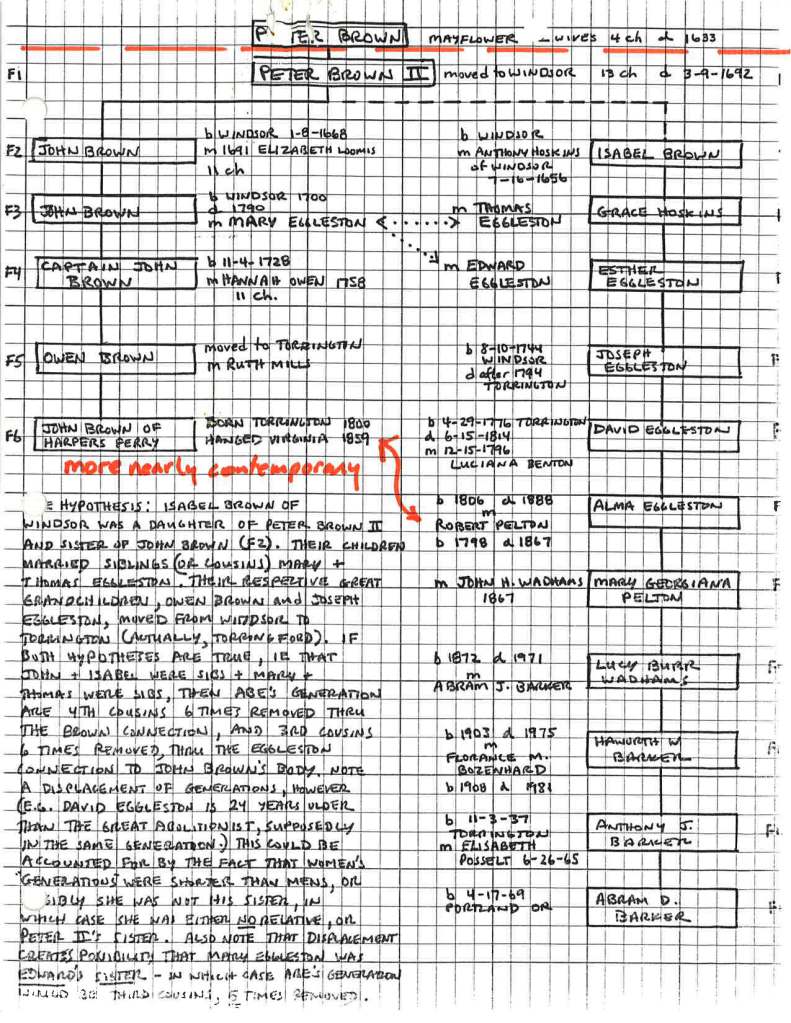
The connection appears to be valid – 4th cousins 6 times removed – to John Brown (1800–1859) and is best understood as a collateral kinship through the old Connecticut Eggleston network. The Eggleston lineage is documented in my SAR lineage descends from Revolutionary War patriot Joseph Eggleston and traces back into the early Windsor-area Eggleston families. John Brown’s direct Connecticut line intersects that same Eggleston family through Mary Eggleston (1702–1789), who married John Brown (1700–1790) and became the mother of Capt. John Brown (1728–1776), the abolitionist’s grandfather. The result is a credible explanation for the traditional association of being “a cousin of John Brown.”
___________________
 Protective Arts