DO WHAT DOES NOT COME EASY

Read through these posts and a recurring theme, a lietmotiv, should emerge: what is the most effective way to teach, and the corollary, how do we learn?

There are numerous rules of learning. Malcolm Gladwell popularized the metric that it takes 10,000 hours to perfect a skill in Outliers (2011). That magic number implies a huge time commitment: 2 hours per day, 7 days a week, 52 weeks a year takes almost 14 years to get 10,000 hours. Before getting discouraged, Gladwell is on record that the 10,000 hour rule does not apply to athletic performance – although I have seen others use it as the magic number of repetitions needed to master an athletic skill. And importantly, that is the number to master, i.e., become one of a very elite, high-requisite-skill minority. Of course anytime an idea gets popular – and Gladwell makes his living popularizing ideas – others try to debunk it (qv. Fast Company and the cited study).[1]

I start with Gladwell because his is a simple numerical metric: clearly we need to dedicate time to practice in order to master any skill. Earlier posts have covered the need for time on the mat. If we assume that shodan is the attainment goal – not to mastery, but to be able to replicate and demonstrate the curriculum – the required training hours are between 780 and 1040.

The quality of the hours spent is critical. The easy rubric is deliberate practice. Earlier posts have alluded to the need for mindful and honest practice even in solo training. Developing excellence in a martial art requires the additional quality of grit and perhaps even enduring pain.

While military drill-sergeants can force discipline with brute methods, in the civilian world you need to be self-motivated. It’s all too easy to not show up, or to not train hard, or to assume the teacher will give you the information. A consumer mentality where by paying for it, the art should be packaged for you.

I do believe there are normatively better ways to teach and learn. My teachers have continued to evolve and refine their teaching methods in their pursuit of Aikido. And I too play with different ideas to foster student (and my own) development. I have not found the best way. When I do, I will patent that method.

A recent article by Cal Newport had the brilliantly provocative title “Flow is the Opiate of the Mediocre” [2] and outlined training strategies that are broadly applicable:

  • Strategy #1: Avoid Flow. Do What Does Not Come Easy.
  • Strategy #2: To Master a Skill, Master Something Harder.
  • Strategy #3: Systematically Eliminate Weakness.
  • Strategy #4: Create Beauty, Don’t Avoid Ugliness.

Because the strategies are from a pianist, the clarifying examples need Aikido analogies.

#1 – Avoid Flow: The point in the article is that weaker pianists play through their pieces, while the better ones drill and practice only the more difficult parts. This admonishment is somewhat ironic. I have very rarely seen, and almost never present, Aikido as it is ultimately played. Meaning the true flow of a multi-step encounter with attack, counter, counter-attack is rarely a goal. In general, we do avoid flow and practice only a small segment of an encounter. But the deeper point of drilling the more difficult aspects of the encounter applies. I will often segment lessons to train to the most difficult aspect, for example: a punch to the face requires conditioned mental fortitude to avoid a flinch response.

#2 – Master Something Harder: purposefully make a movement harder in order to master the underlying movement. Ever since beginning this experiment, I have been adding complications – beats, half-beats, staccato rhythms, targeted strikes, etc., – to make kihon movements unfamiliar. I have purposefully avoided Japanese terms to make it cognitively less familiar, to break mental maps and force students to make new (and hopefully deeper) connections.[3]

#3 – Eliminate Weakness: this is the entire goal of training! The strategy here is to isolate skills to develop where you are weak. For example, train gyaku-hanmi not with the idea that it is an end to itself, but rather with the deeper realization that it is a way to develop your response to chudan tsuki. And make sure to train your non-dominant side at least as much as your dominant (“I’m not left handed either…”).
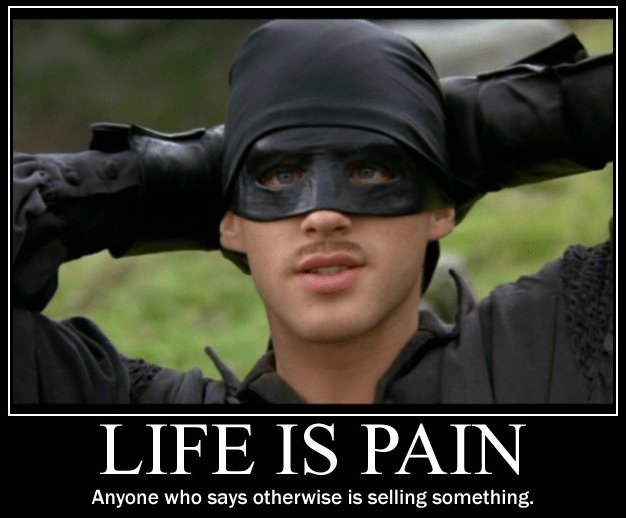
Life is pain
The Dread Pirate Roberts

In The Princess Bride, Westley became a superlative swordsman under the neglectful Dread Pirate Roberts whose only guidance was – “Goodnight, Westley. Good work, sleep well, I’ll most likely kill you in the morning.” Westley was a self-motivated student and learned from everyone and anyone who would teach him. The citation may be whimsical but there is a level of seriousness: This (2019) Royal Society published study implies that teacher designated study was less relevant to improved performance than practice alone. In short – keep training!

#4 – Create Beauty: the quote is from a pianist, but is true for every art:

“Weak pianists make music a reactive  task, not a creative task. They start, and react to their performance, fixing problems as they go along. Strong pianists, on the other hand, have an image of what a perfect performance should be like that includes all of the relevant senses. Before we sit down, we know what the piece needs to feel, sound, and even look like in excruciating detail. In performance, weak pianists try to reactively move away from mistakes, while strong pianists move towards a perfect mental image.”

Precisely! Move towards a perfect mental image. The challenge is finding the perfect mental image. Throughout these posts are links and references to those who are my inspirations – and read carefully – they are not limited to just martial artists alone.

Do note that we must balance the distinction between a martial art and the science of movement. What I mean is the artistry of movement must aspire to be beautiful, and because its application is martial, it must also be scientifically efficacious. I believe that the two are inextricably linked. Proper targeting is scientific, and the path of least resistance is physiological, so combining those two aspects is where artistry manifests.

___________________________

[1] Malcolm Gladwell covers a wide range of topics – see an earlier reference >here<

[2] A provocative title because it plays off Csikszentmihalyi‘s (2008) Flow: the Psychology of Optimal Performance which I reference >here<

[3] The largest barrier to learning is our experience, what we already know often acts as an impediment to progress.  >Listen to Hidden Brain<

SITUATIONAL AWARENESS

Recursive attention: we pay attention to what others pay attention to. Think of any accident. Crowds form in part because when one person stops to watch, that attracts more people – the size of the group paying attention to the event increases the percentage that others will also pay attention.

Capture

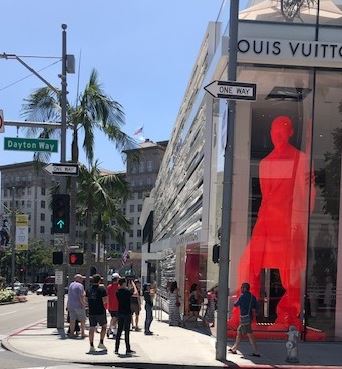
Inextricably related to what attracts our attention are social goods – the shit we buy, wear, and consume – that act as an indicator of group association. People pay attention to those markers and pay stupid amounts of money for social distinction. Recently I visited Rodeo Drive because my children wanted to see the Louis Vuitton X Exhibition. Although I have no interest whatsoever in fashion, I was impressed with the quality and artistry of the presentation and craftsmanship on display. Walking farther down the street was the Louis Vuitton store itself, so we went in. I was flabbergasted to realize that people actually pay extortionist pricing at these stores.  After a moment’s reflection on Thorstein Veblen (1899) and Pierre Bourdieu (1984) it made more sense – conspicuous consumption as a means of distinction. Paying outrageous amounts of money for branded clothing is irrational, whereas my choices are pragmatic and reasonable. I clearly do not belong to the social class that uses fashion as a means of distinction.[1]

What the heck does this all have to do with situational awareness?

What we pay attention to is culturally conditioned. Most often we pay attention to indications of social position and group membership; who we identify with and where we stand within the group.

Broadly understood, fashion is an overt display of membership. Gang affiliation is branded – colors, logos, tattoos, etc., are markers of inclusion within the group and threat identification for the rest of us. (Interestingly, visible tattoos may also be an indication of poor impulse control…)

Situational awareness is threat identification within your current geographical local.

You were conditioned to pay attention to social cues – so now learn to be specifically aware of those cues that represent a potential threat to your personal safety.

Earlier posts allude to Col. Cooper’s color matrix and situational awareness. You should be living in condition Yellow at all times. But how does one develop awareness?

An excellent resource is Mark Hatmaker, his storefront, and his blog. Highly recommend! For awareness dills – start with Warrior Awareness Drills.

Other markers to pay attention to: Language is an obvious display of group membership. 

1984
Newspeak – it’s politically correct

How you use language, both your lexical choices as well as your grammatical habits will display your social position. I like to mix registers to create a bit of uncertainty. How you discuss a topic will be as revealing as what the topic is when sizing up a potential adversary. (Be wary of the Newspeak movement – language is being manipulated for political reasons. It always has been, but do not be blind to the process!)

Pay attention to the physical tells. Paul Ekman is the inspiration behind Lie to Me and offers training in reading Micro Expressions. I have not taken any classes but am intrigued, despite a recent study that showed those who have taken the classes do no better than the average person at discerning lies.

Personal protection is a personal responsibility. I firmly believe that. You are responsible for you and you cannot abnegate that responsibility to anyone else. So you need to pay attention to potential threats.

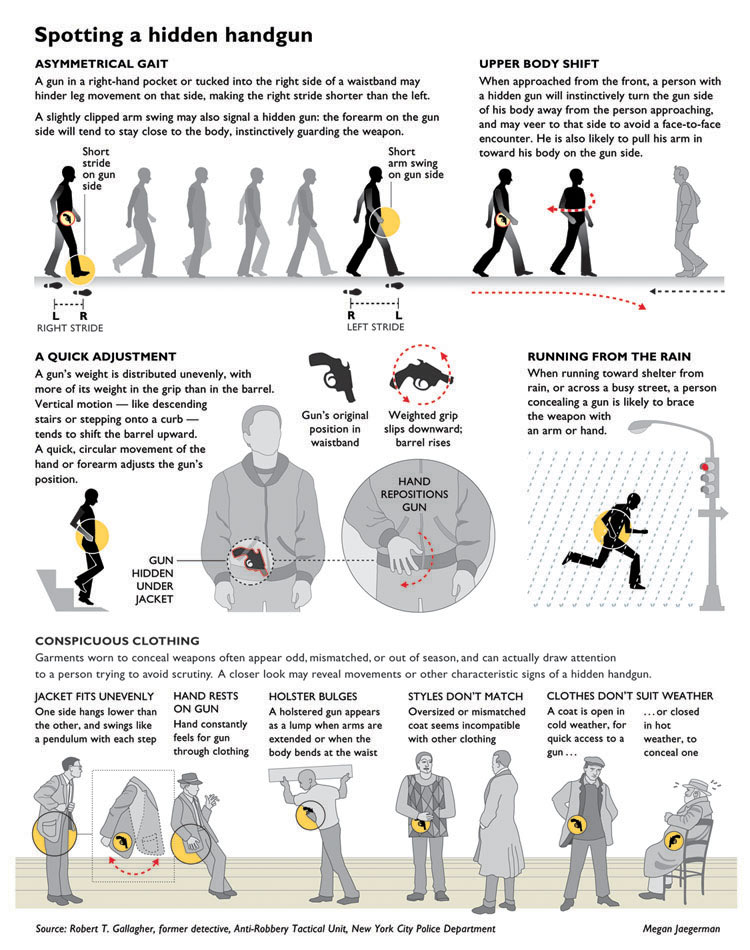
spot a gun.jpg
Learn the tells

Yes, the rule of law is part of the social contract and I also am a staunch believer in the Golden Rule, but I also am a realist. I know that others can and do break the social contract and violate the rule of law. And I also know that in those crucial moments when seconds count those brave first responders are only a minute away. You are your first line of defense.

_______________________

[1] The commodization of luxury – the proliferation of gourmet coffee, the necessity of cell phones, all the trends towards the pampering of the self with little niceties indicates a trend towards making luxury items necessities. The lack of real and visible distinctions of wealth – corpulence was once an overt sign of wealth (easy access to rich food), now access to cosmetic surgery that vacuums the effects of rich food. Material displays of gold, diamonds and other items once covered by sumptuary laws are no longer good indications of real wealth: paste diamonds, knock-offs and counterfeits all cause haute-coture designers concerns. Credit cards also allow easy access to things and can support a life style beyond one’s true means. Class accent and other indications of well birth are systematically undermined by Texans in the Oval Office.

RYOTEDORI – KIHON

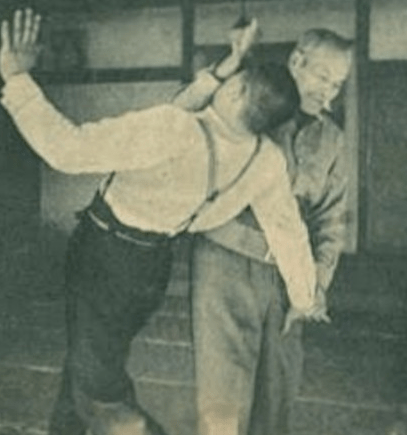
At first glance ryotedori is an inane attack. Two hands on two hands: Who does that?[1]

Contextually I have presented it as an means of controlling an opponent’s un-drawn sword. Uke approaches the pin nage’s hands to his hips to prevent deployment. Nage learns weapon-retention and countering. This post is a focused exploration but review the broader discussion on ryotedori as indexing:

Ryotedori, Ryotedori 2, Ryotedori 3, Ryotedori 4, and the related Prayer Entry

Isolated skill development.

Front Hand

Because nage must learn how to use two opposing vectors, we started class with gyaku-hanmi to show the use of the forward hand. The forward hand provides the initial de-stabilization by shifting uke’s center to the “dead angle” shikaku. From the grab, nage must (a) rotate the grasped hand palm down [c-cut], (b) shift forward toward uke’s flank (c) drop weight [often going to his knees]. This teaches kuzusu (崩す). Movements should be taught and practiced with bold movements at first and refined to the smallest amount necessary to create an unbalancing.

Back Hand

Nage’s back hand is used for the atemi. To ensure the strike is properly delivered, uke will grab both hands, but nage will need to focus on keeping the front hand in stasis. From the initial encounter, nage executes a half step to bring the back foot in line with the front while executing a (reverse) cork-screw punch with the back hand. The cork-screw is an augmented release from uke’s grip – nage rotates his grasped palm from pinky to ground to palm up while aligning his elbow inward toward the hip which is driving forward with the half-step. This releases the grasp and executes a centerline atemi to uke’s head.

This is a tanren development: Resistance training that allows uke to learn how to control an opponent with a forceful grasp. Uke will develop greater grip strength while keeping the fundament (abdominals) engaged, shoulders and elbows soft – a swordsman’s grasp. Nage learns to defeat a strong arresting grab with body mechanics rather than rely on timing alone.

Movement

Combine the two actions. The front hand starts to draw uke off line while the back hand creates the opening with a strike to complete the destabilization. Nage can now move to the flank. The atemi hand contours from the highline strike (to the face) to follow the shoulder to brachial to elbow, and the front hand continues to draw tension to the outside line. This is analogous to drawing the sword. The handle-hand draws the sword forward while the sheath is pulled back – opposing vectors to speedily clear the blade. This is an analogy to provide context not an explanation of a technique, but should remind the practitioner to keep the atemi hand (now at the crux of uke’s elbow) applying outward pressure toward uke’s center while the font hand draws uke out.

Focal Point

At the kihon level, nage has actively changed the relationship by dictating the dynamic tension – the focal point is uke’s elbow. Recognize that this new relationship is now gyaku-hanmi, and know that you can solve two-handed attacks by changing them to one-handed attacks. Logic chains.

In this narrow exploration, we used the dynamic tension to execute a sumio-toshi throw. With uke’s arm outstretched, nage controlling the crux of the elbow and with uke partially destabilized, nage executes an angle change and drops to complete the throw.

At the tanren level, nage keeps the abdominals fully engaged, spine straight and with uke’s body weight relatively static (i.e. a loaded throw, no energetic augmentation)

Once the basic physics and physiological mechanics are understood, then we add movement.

Movement

More dynamic encounters add timing and therefore the need for kimusubi.

Uke is now advancing – closing the reactionary gap – which means nage has to adjust and flow. Nage must encourage uke to take the front hand (bait), or alternatively, snatch uke’s oncoming fingers (small circle jujutsu) and the atemi morphs from a pugilistic punch to a soft pallet strike with the fingers (yohan nuketi). Nage thereby extends uke while entering, and the soft pallet strike fixes uke on the horizontal plane and then lifts uke’s center on the vertical axis. Because uke’s center is lifted, nage’s strike hand can then flow to the focal point on an elevated plane, so the sumio toshi throw now has the added power of a change in the horizontal axis (uke spins) and then a more precipitous change in the vertical (uke’s rotational point is higher making the fall greater).

This version has a dramatic visual impact when both players are in harmony. Theatrical flair!

From sumio-toshi we moved to a low-line strike (dropping reverse c-cut).

From a high-line setup, we can also move to any entering-under throws (uchi-kaiten).

________________________

[1] Indexing – you will see moments in Kali where the players are in a ryotedori relationship (see >here< at 1:20 for example) but also notice how quickly the solve it back to a one-handed relationship in lock-flow. So read my opening rhetorical question – no sensible player attacks with ryotedori, but all players who use traps in their art will inevitably wind up in a 2 on 2 relationship. Augment these skills by adding a knife to your flow sequences and watch how ryotedori evolves.