MULLIGAN SENSEI – JO WORKSHOP 2019

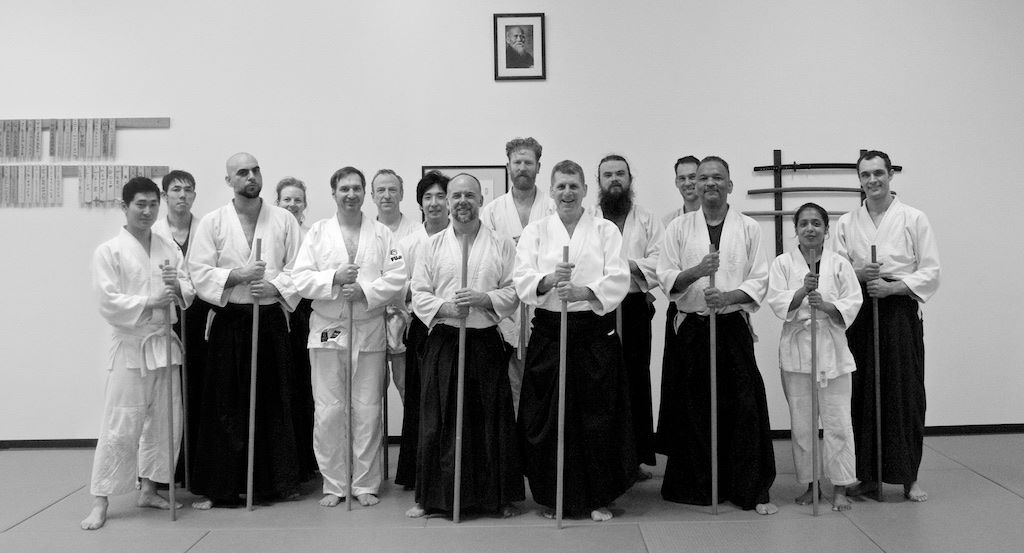
Group jo 2019 smiles

Mulligan sensei visited Portland Aikikai for a workshop (February 2019), the first seminar in the dojo’s new location. Portland Aikikai has the great benefit in long associating with Chris Mulligan who, from the dojo’s founding, was its primary weapons instructor.
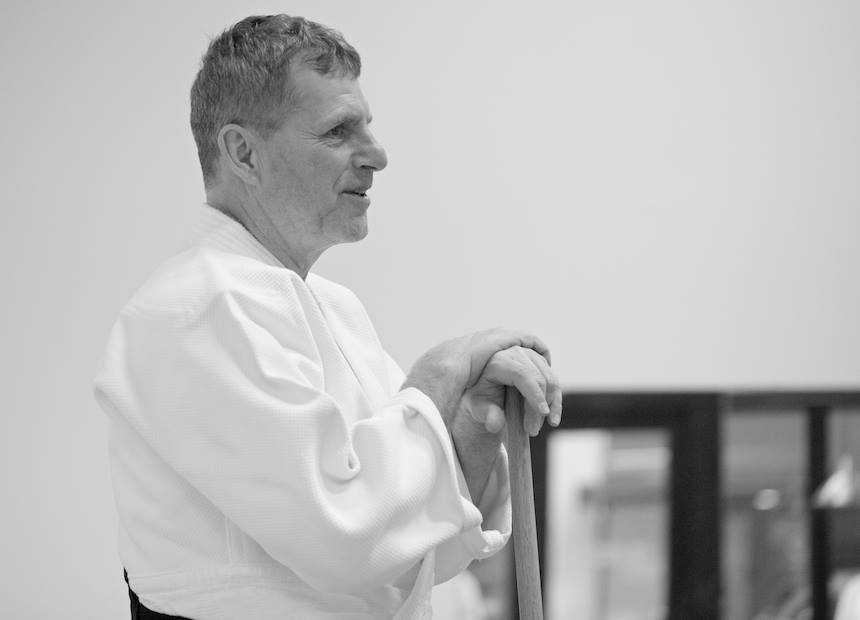
Mulligan Portrait
Chris Mulligan Sensei

YouTube for more by Mulligan Sensei

There are definite ‘styles’ in the use of weapons in Aikido primarily because the post war generation looked outside of Aikido for additional training. Saito sensei codified the 20 jo suburi and maintained the takemusu kumi-jo of Aikido at Iwama, but others expanded beyond that curriculum to augment their understanding and depth.[1]

In earlier posts, I have mused over the fact that the use of weapons is the foundation of the art, and that the empty-hand forms are nothing more than weapon movement stripped of the context of budo. Nevertheless, weapon work is usually an ‘advanced’ form of training in Aikido and it makes a certain amount of pedagogical sense: weapon work requires a higher degree of accuracy and mental focus.

As I watched during the seminar, it was clear that the basic handling skills are being transmitted, as are the forms. The next step is to cultivate and hone a sense of gravitas, a sense of directed purpose behind the movements.
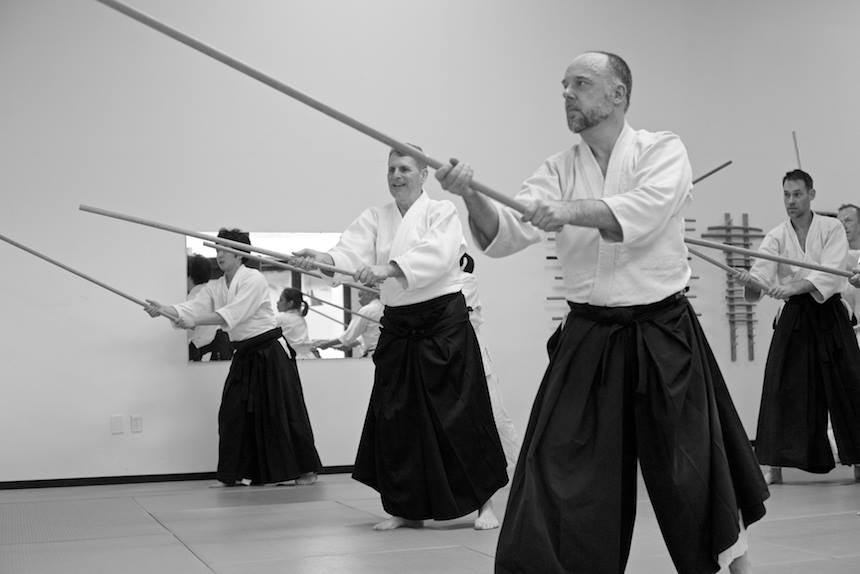
Group Yokomen2

How you approach training determines the results. If your goal is simply to learn form and follow the kumi- (or kumi-ken), then rote memorization is all that is required. Beyond the forms is bunkai, the application which requires a more serious level of dedication.  For that, you need think about progression and your training should be focused on functionality.

Focusing on functionality requires that all the exercises and drills should simultaneously progress toward being able to apply what you are learning. Training should develop the ability to actually perform the technique. As an example in the , just ask yourself: can your covers truly receive a full power strike?
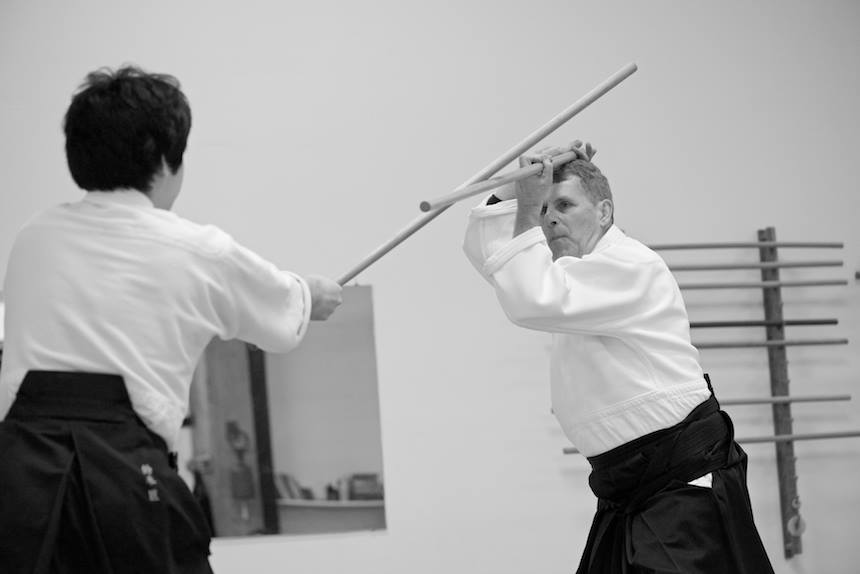
Mulligan makiotoshi
Takumi and Mulligan sensei

As you learn the form, if you are serious, you need learn application. Remember, the form follows the function! The forms are not empty kata, they are responses to strikes at directed targets! So do not become overly enamored of learning the sequence when you cannot actually receive a powerful strike or deliver one with martial vigor. The cultivation of the spirit of Budo is to be fully dedicated to the action of the moment: focused attention on what is necessary at that time.
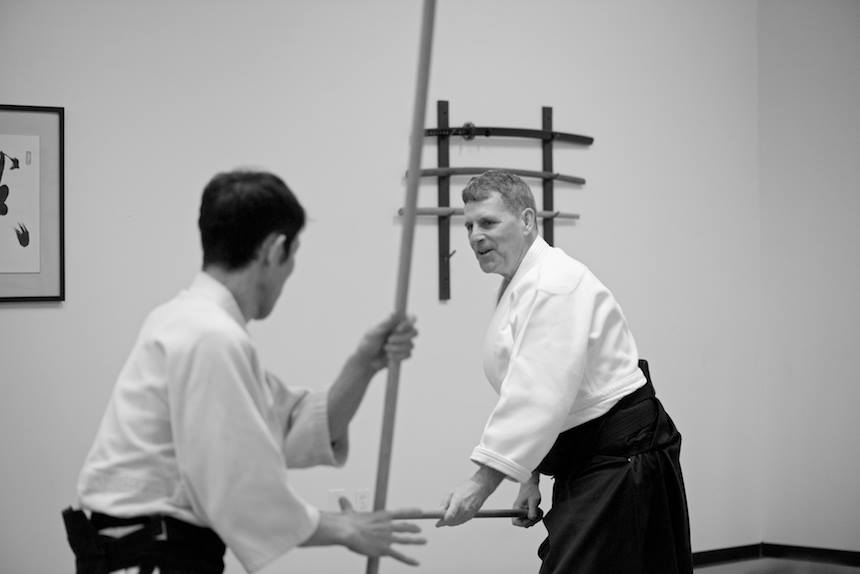
Mulligan hits Jun
Jun and Mulligan sensei

This sounds simple, but it is easy to become distracted from focusing on application. You can get lost is a progression of drills and replication on the paired forms without ever learning how to use them.

Mulligan sensei focused on limited action-responses to emphasize application. If you are able to do each of the actions with purposeful determination then linking them in a sequence (8-count, shansho, any of the kumi-) becomes a logic-chain resulting in a continuous flow.

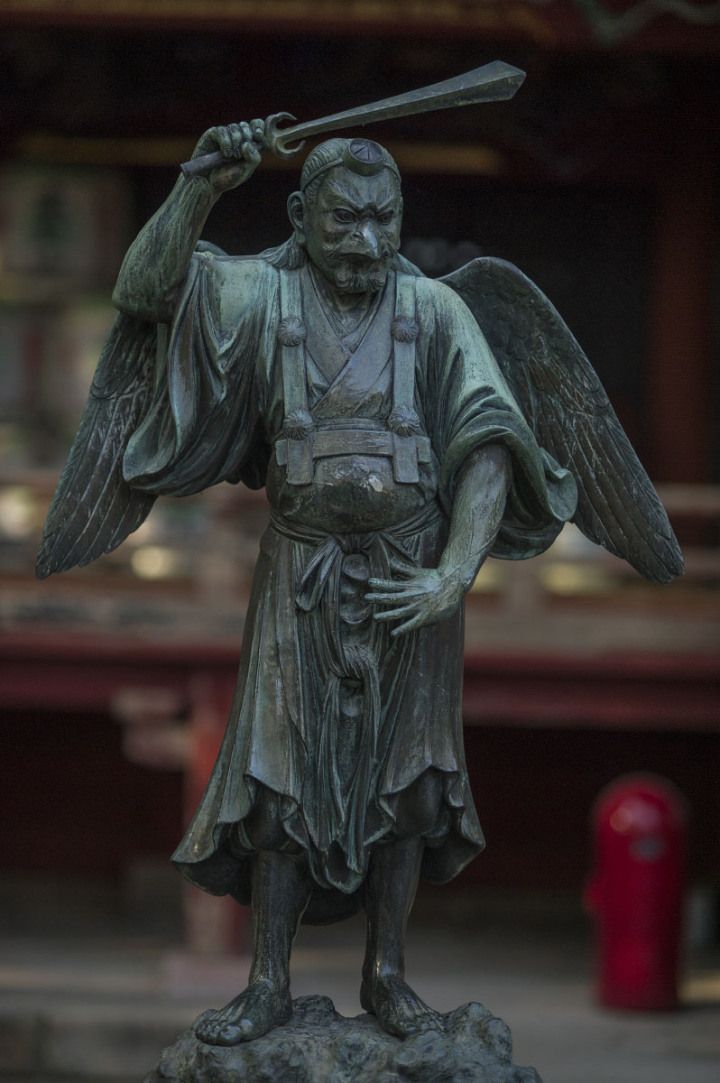
Remember, all of these cool flow sequences are made-up! In the good old days, you may have learned from a mountain Tengu, but the weapon forms in Aikido are all recent developments. There is no magic in the sequence – dissect the sequence and find each segment in the logic chain and be able to make that action work.
Often we can get distracted from the basic actions because a progression/flow sequence is simply more fun. Once we get familiar with a sequence it is fun to do it faster and continue to improve – but there is a pitfall in working on the flow to the detriment of efficacy. We can forget that the flow may be the ai-ki lesson, but the budo is in the stop-hit. Learn both and you are on the path to mastery.

Hence the need for a clear and purposeful training to learn the physical skills necessary to apply the art (bunkai) in addition to the memorization of patterns.

First emulate the teacher. The monkey-see monkey-do stage is inevitable, but it is only a transitional period to learn the basic movement pattern – the form. Learn to mimic and copy the form of skilled practitioners. Emulating correct movement patterns is the easiest way to begin to develop a mental model. Video footage is helpful – learning by watching others can help you develop the ability to visualize the technique. (And watching video of yourself is an amazing feedback device.)

Internalize the external visual presentation and you have your mental model. Now learn the purpose of the technique.

Mulligan sensei was explicit in showing the target (hit the thumb/forward hand) en route to the killing thrust. This is the importance and power of context – understanding the purpose. You need to know what to do, when to use it and why to deploy that technique. Everything has its purposeful place in time. You need to be able to gauge the success of your training in achieving the expected outcome. Understanding the technique’s purpose adds depth to your mental model: know the form and what it is for.

With the basic model of form and purpose developed, students now need to begin to feel the technique as applied. This is where I have seen the training methods change over the years.

Although he did so only mildly during the workshop, Mulligan sensei would count out loud the number of times he hit me in training or during demonstrations. Yokomen, makiotoshi counter, striking my hand, “One.” Next strike, “Two.” Somewhat playful, but the lesson is real: learn to strike with earnest intent, learn to maintain contact, and be prepared to get hit. This requires fortitude. Are you willing to take a hit to better understand the technique? Pain as a teacher. It may be a necessary method to achieve excellence.

Chris Hit Ty.png
The killing thrust

But there are ways to soften the blow. Look at the older video footage of Chiba sensei when he encouraged the use of hockey gloves to protect the hand, allowing full contact strikes. Proof of concept is in its execution at speed. You need to see and feel the technique. Visualizing the technique is the first step in internalizing the technique, but feeling it is the somatic integration.

You need to see the technique demonstrated correctly often so that you can maintain an image of it so you can hold it in your mind’s eye. Notice how Mulligan sensei developed a kata for the movement patterns in Sansho? If you can correctly see each node in the pattern, then linking the nodes becomes easier. But each number in the kata must be executed perfectly – pay attention to the footwork, body position, body mechanics and the hand movements. The kata will allow you to refine your skill and improve your ability to visualize. The easier you can visualize, the better you should be able to reproduce and instantiate the movements.[2]

While refining your mental model, the next state is to improve the quality of the mechanics – the raw physical deployment of the moves. The basic movement pattern needs to match your mental model but reproducing the movements consistently can only be done through repetition. Suburi is necessary – you cannot do 1,000 cuts incorrectly. The point is – push beyond your physical limits and the only way to continue to cut is with correct (effortless) form. You need to repeat that correct repetition until it is a habit – excellence is a habit.

Now add pressure – both mental and physical. Increase the muscularity of the strikes and the speed of the deployment. Do your mechanics break down – get sloppy? Progress until you can steadily gain in power and speed. Your visual acuity will increase as your mental model incorporates these variables – you should begin to compare your performance against the expected outcome. Did it work? It is your moral obligation to ensure that it does.
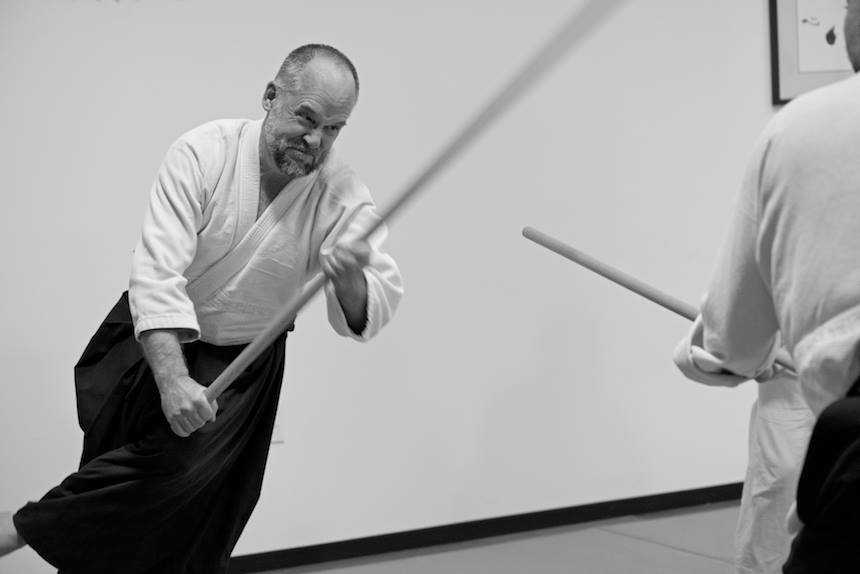
Ty striking face
Hit the target!

______________________________

[1] Simply watch video of Saito, Yamaguchi, Saotome, Chiba, Nishio, Tissier sensei as an entry into the stylistic differences.

[2] Review Chiba sensei’s basic jo responses – and note the later incorporation into Shansho. But do note that these refinements are all derivative as is Chiba sensei’s batto-ho.

 All Photos by Russ Gorman (except the Tengu)
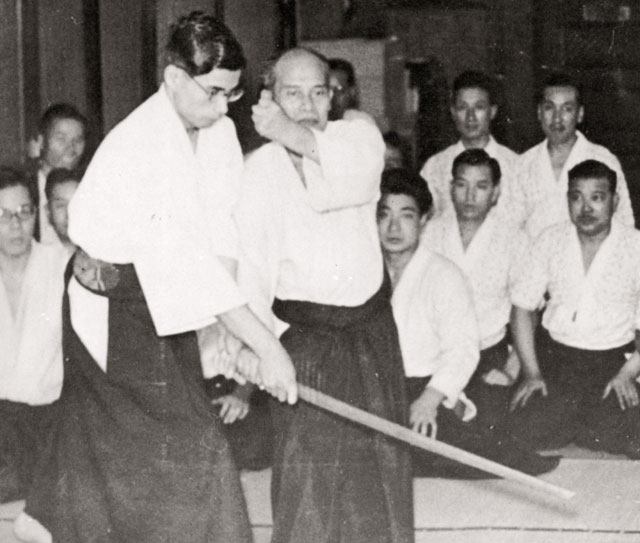
SWORD TAKE-AWAY: Tachidori

Testing for shodan requires demonstrating weapon take-away techniques against tanto, jo, and bokken. Simplify the phrasing and the concept we are discussing is disarms.

Here is the secret: all empty hand techniques in Aikido are disarms. You have been doing nothing but disarms since your first ikkyo omote. Aikido is not an unarmed art.

I have discussed the limitations of techniques over concept, so we start at the level of concept. Moving from the universal to the specific.

In response to any attack at contact range we can only either move to (1) engage or (2) evade. Both responses require a decisive mindset and purposeful movement to achieve the Prime Directive: Don’t Get Hit.

Engage v. Evade

To engage your timing needs be superior to your opponent – you are inside their OODA loop. Evading is a response to inferior timing (or a deceptive stratagem) and you need to avoid to break your opponent’s OODA loop.

A digression on Evading.

Kisshomaru Ueshiba recounts in his book Aikido (1985)

In spring 1925 a navy officer, a teacher of kendo, visited the Founder and asked to become his student.  Then during a conversation, they happened to disagree over a trifle matter.  Tempers rose.  They agreed to have a match.[1]  The officer dashed forward to strike him, swinging his wooden sword.  The Founder dodged his sword very easily each time.  The officer finally sat down exhausted without having once touched him.

Ueshiba, 1985:153

Evasion and the avoidance of conflict is the highest evolution of combative skill. To constantly avoid contact with a determined and trained opponent would require a level of budo that I can only dream about. Imagine being able to constantly slip Evander Holyfield’s punches until he stops from frustration and exhaustion, or contending with Bas Rutten by continuously evading a clinch. To prevail by evading would necessitate being far better skilled and better conditioned than your opponent. The more pragmatically minded Ed Parker pointed out that if you do not stop your assailant in the first attack, then you are not fighting one opponent, but two. Fail to stop the attacker on the second engagement, then you are fighting three opponents. Simple math. Longer encounters are equivalent to multiple opponents. Time is your enemy, draining your resources. Even ‘effortless’ techniques take energy. In the Newtonian universe I inhabit, you cannot win by defending. Hence the need to engage.

The logic chain (order of operation) for every encounter is:

Prime Directive = Do Not Get Hit

Do Not Get Hit = Engage with superior time, Evade to gain superior time

Engage = use timing and footwork to get inside or outside the weapon’s arc

Engagement is shorthand for gaining superior position (shikaku) by use of footwork (irimi, entering, tenkan, blending), and timing (kimusubi and atemi). Engaging as a concept is the most difficult phase of every encounter. Most difficult because it is the most ephemeral and easiest to miss. Hence O’Sensei’s poetic phrases to describe it in his “Secret Teachings of Budo” (Budo Training in Aikido):

#27     Embody ‘Yang’ in your right hand  / Turn the left into the passive ‘Yin’ / Then guide your foe

#12     Should an enemy come running and strike / Avoid him with a step to the side / Then attack in an instant

Thus the initial engagement determines the outcome of the encounter. The greater the skill gap between you and your opponent, the earlier the outcome is determined.

Determination of the encounter however requires technical skill such that you can first control your opponent’s actions, then counter their original intent. Notice that these last phases are what most ‘techniques’ will focus on because these are the physical skills to refine.

At the conceptual level[2] for every encounter we must:

Evade                    don’t get hit

Engage                  enter to a superior position

Control                 deploy a response that limits your opponent’s actions

Counter                ensure that your opponent cannot continue hostile actions

We have aspirational goals but the outline is very straight forward and requires dedicated practice to achieve.

#8     Progress only comes with constant practice / Build up and kept to oneself / Do not hope for ‘secret teachings’ / They will lead you nowhere

Keep training!

Control and Counter – the techniques.

In the Aikido curriculum tachidori is the defense against a katana – a two handed sabre. Therefore, the assailant is always in a fixed relationship to his weapon – holding the sword right hand forward (by the tsuba) and left hand near the base (there are no left-handed samurai). Furthermore, because the proper use of a katana in combat was with a levering action, the swordsman’s hands are at least a span apart.

The attacker starts seigan no kamai and raises the sword to assume jodan no kamai to execute shomen.

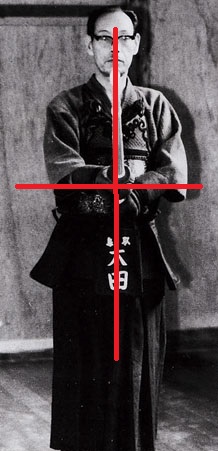
Shomen, the overhead strike (Angle 12) bisects the body and provides a clear separation between the inside line and outside line. In tachidori – anything to nage’s right is the inside line and anything to nage’s left is the outside line when in context with the opponent’s sword.

Kamae
Define your quadrants

The first response is the direct response:

IKKYO – direct. As soon as uke starts the upward raise of the sword enter boldly to execute ikkyo. Because of uke’s relationship to his sword, this can only be done RvR (assuming right hand dominant opponents). Timing here is the key. Catching uke on the rise with superior timing you execute ‘omote’ and if with inferior timing ‘ura.’ But with either engagement, your lower hand must catch the opponent’s upper arm to stop the strike while your upper hand contacts with the opponent’s right wrist area. Recognize how you must use your right hand to control the sword. The reason for ikkyo’s pin is fully realized when you see how your opponent’s sword further limits uke’s options.

gokyo with atemi
Ikkyo, Gokyo – whatever, control the upper arm!

IKKYO – can be done from the inside line with inferior timing (blending). Uke strikes and nage responds with ushiro tenkan. As nage moves ushiro tenkan, cut your right hand between uke’s hands and grab the handle between your opponent’s hands. As uke raises to escape, add energy and lift straight up and then arc over, just like in tsuki ikkyo. The difference will be that nage will manipulate the sword such that the extraction will be more similar to nikkyo omote. As you extract the sword, move the kissaki toward uke’s head whilst levering the pommel out and away (uke’s hands will act as a pivot).

sword disarm with atemi
Superior position for ikkyo, kokyu-nage, augmented decapitation…

AUGMENTED DECAPITATION – a variation on the ikkyo blend. Rather than lift and arc the sword after grabbing the hilt, nage shifts back, drawing uke in, then snappily punches the sword toward uke. As uke spins to avoid the atemi, the sword will be vertical (perpendicular to the ground) and uke’s back will be to you. Drop the kissaki and with your left hand, reach past uke‘s head to grasp the mune in a pinch grip and close the edge toward uke’s neck. Uke is now at the point of bargain.

Build your mental matrix. Write it out so that you can graphically represent the options available to you on each side and each level. 

APPROACHGATEINSIDEOUTSIDE
DirectHighgrab sword with left hand, palm strike to chin (irimi nage)grab sword with right hand strike, palm strike with left (irimi nage)
 Midaugmented decapitationgrab sword with right hand, grab neck with left, drive pommel into uke’s midline to throw
 Lowparting two apricotsparting two apricots
BlendHigh kokyuho
 Mid hijikimi
 Low udekiminage
One conceptual schema

The variations are numerous but finite. (Don’t understand the descriptive labels? Come to class!)

______________________

[1] As a biographical anecdote in Aikido written by his son, Morihei Ueshiba is revealed as being all too human here. Tempers rising over a trifle leading to a duel? (Chiba sensei reports O’Sensei telling the story in a different manner >here<) 

[2] Acknowledgement to Pete Kautz, who was inspirational on the sequential framework. See his summary >here< and look for the universals that Master Keating admonishes us to find!

LOGIC CHAINS – Ikkyo to Kotegaeshi

The flow of any given technique can be broken into constituent elements that are linked in logic chain: an if-then series based on the openings and opportunities.

Another way to understand the logic of a technique is to ask – what if this doesn’t work? What is the backup plan?

As an example – here is one possible logic chain outline for shomen-uchi kotegaeshi “advanced” from the initial encounter of shomen-uchi ikkyo omote:

IF     Superior time (nage is ahead of uke’s OODA loop) – THEN, ikkyo omote

IF     Inferior time (nage is slow, behind uke’s OODA loop) or

IF     Uke counters, THEN, Slip under to kokyu-nage

Uke retains balance ->

Quickly turn hips to execute:

{mid line -> shihonage

{high gate-> kokyuho

{low gate -> udekimi-nage

-> Uke moves to escape

-> Switch hands to kotegaeshi

Each step in the chain represents a point in time during which the relationship between nage and uke is subject to change. The roles of uke and nage are convenient fictions useful for training but can result in dangerous ossification in thinking.  To move beyond a mechanical understanding of any encounter, you must understand that there is no such thing as a nage or an uke.  Ultimately those are dangerous labels that can habituate you to playing a role.  There are no roles in combat – there are only active agents!

Approach every encounter with the proper mindset and the hidden budo of Aikido manifests. Move beyond the monkey-see monkey-do manner of training and learn to see.

The narrative of the encounter.

Seeing your opponent before you, you quickly strike shomen to defeat him. Your opponent intercepts your strike and begins to take control using ikkyo.  Knowing the trick, you drop your weight to come under and begin to counter your opponent – ikkyo for ikkyo.  Your opponent feels your reversing energy and surprises you by clipping your chin with an elbow and turning under your arm to execute a throw.  Feeling your opponent using your momentum against you, you accelerate and step beyond your opponent’s arc to catch your balance and turn to make a horizontal cut.  Your opponent knows that this is your only plausible response and counters by keeping control of your cutting arm and turns his hips so as to move past and again accelerate your strike, taking you past.  Your opponent is now behind you.  Quickly, you adjust by stepping forward to cut from the opposite side, but again, your opponent is savvy.  Your opponent steps beyond your arc again – moving down your arm, from the elbow to concentrate at your wrist and cuts over to disarm you, kotegaeshi.

Play that sequence and watch it in your mind’s eye. Can you follow the action?  Then put yourself in the other role.

Your opponent raises to execute an overhead strike. As soon as he begins to raise for the strike, you move in to close the distance and trap the arm on the rise.  You then move in to displace your opponent’s balance and cut his arm down with ikkyo.  You opponent is strong and knows how to use his balance. He catches his balance and begins to reverse your control.  Feeling that your opponent can over-power you, you see an opening created by his intent to counter.  Keeping your hands in their original position to not telegraph your intent (your top hand in contact with the wrist, your bottom grasping your opponent’s elbow), you relax your bottom arm, fold the elbow to drive the point up and into your opponent’s chin.  Your opponent was caught unaware, but rolls with the strike but your atemi broke his balance and momentarily raised his center.  You caught the initiative and pivot quickly to carry the momentum of your opponent’s counter to execute a throw – pushing his arm arcing out and down (kokyunage).  Your opponent is well conditioned and the blow was glancing only.  Before you can perfect the throw, your opponent recovers and feels the change in acceleration so goes with it – using your energy to his advantage to get ahead of the throw.  He plants and begins to counter you with a horizontal cut at your belly.  As soon as you sense the throw will not work, you know your midline is exposed, so you prepare for the cut.  When your opponent begins the move, you take the cutting arm (in fact you never left contact) and accelerate it and turn your hips to get on the outside line.  From the outside line, you drive forward and, grasping your opponent’s wrist like a sword, you raise it with the intent to turn under and do a cutting throw (shihonage).  Sensing your intent, as you move your hands up your opponent’s arm, your opponent steps forward and away to avoid your raising throw and begins a cut from the other side.  Feeling the potential escape, you move forward quickly and change hands while isolating the wrist to finally disarm your opponent with kotegaeshi.

You should be able to watch the encounter from both perspectives – you are both agents in each of these encounters. At any given moment during any encounter the openings and opportunities will present themselves.  Learn to anticipate counters, to see openings, to sense vulnerabilities and lapses in your opponent’s control.  Learn to close your own gaps to maintain a constant level of control so as to not create openings where you are vulnerable to a counter.   Learn that the control must be firm but relaxed to better feel changes in vectors of force.   Too much tension creates a lever where your opponent can find a fulcrum and use your strength against you.

The narrative is the flow, but see every point where the story could have ended sooner.  For example, the simplest encounter would be:

Your opponent lowers his guard to create an opening on the highline. Sensing the advantage, you quickly raise and execute shomen, striking your opponent down.

The first If-Then:

You lower your guard to create an opening your opponent must take. Your opponent strikes shomen, so you step in to catch the strike on the upswing in order to dominate the center and take your opponent with ikkyo.

The second If-Then:

If you are being taken ikkyo, then you must get ahead (move away or under) of the descending cut in order to rebound it with your own counter cut. (Ikkyo is makiotoshi after all so the back and forth at this step between similarly skilled combatants until one elects to change strategies.)

Extrapolate and find each step in the narrative, and the narrative for each step – and you should be able to create the logic-chain. If-this, then-that, so as to develop a parry-riposte mentality that can move to a constant connection so that your Aikido becomes more than vacant choreography.  To have connected flow, you need to know why you remain connected (ki musubi).

The pragmatist stays connected to better sense and control the movements of his opponent. The flow is a result of the constant contact resulting from a continuity of intention.  The intention of both players is to win the encounter.  “The purpose of Aikido is to kill.”  Hyperbole, but a cogent reminder of the seriousness of the game we play.  But it is only with seriousness and intention from both participants that the beauty of the art emerges.

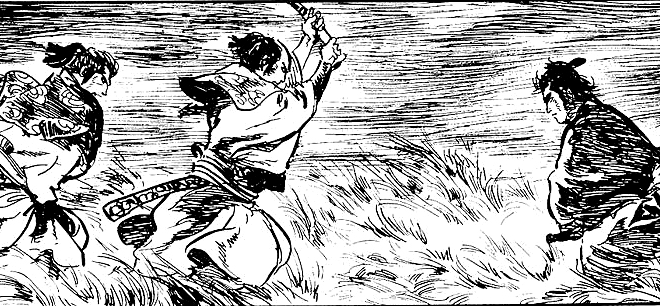
Be like Itto Ogami (Lone Wolf and Cub) – always have a plan!