8 COUNT KUMIJO

Muso Gonnosuke Katsuyoshi developed the from the longer bo staff after his defeat by Miyamoto Musashi. A good retelling of that tale is >here< (An example of learning from defeat: pain as a teacher.)

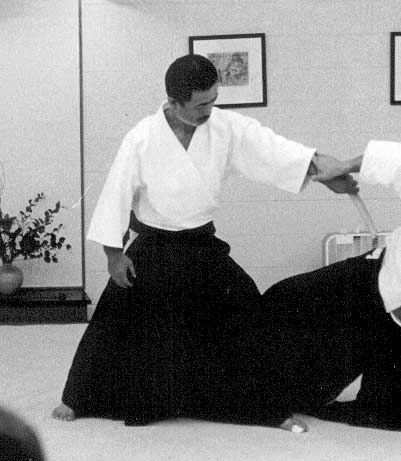
The use of the in Aikido more closely resembles jukendo (bayonet) techniques than it does koryu arts like Shinto Muso-ryu.[1]

o sensei jukendo.jpg
Because I used the bayonet not a stick

Saito sensei preserved, refined and systematized the Founder’s weapons teaching and later innovation by Chiba sensei drew on the constituent movements from the basic patterns to make sansho. Other instructors studied the koryu more directly in order to expand their art and find connections in the movements among ken, , and the empty hand. Nishio sensei is a good example. Whatever the path the ultimate goal is to better understand the potential of human motion.

There are any number of systems to learn that will augment your skill with a – but they all share basic movements which must be learned as a foundation. The 8-count kumijo is a short path to learn several of the primary motions.

The 8-count kumijo can be done as a solo kata, but in its paired form each player benefits from feeling the weapon to weapon impact as well as learning timing and spacing. The intervals of distance and time are critical elements of every encounter and in this paired exercise both players mirror each other’s movements:

  1. Junte chudan tsuki
  2. Cover
  3. Yokomen (#1)
  4. Hasso
  5. Yokomen (#2)
  6. Stab to the rear
  7. Strike leg / block
  8. Strike hand

Reset to start the sequence again.

Begin in left hanmi and mark the starting position of your feet. At the end of the 8-count sequence you should end exactly where you started.

Junte chudan tsuki. Lower your center with your quads and draw the jo back until the tip is nearly hidden by your front hand. Your back foot (R) will reach behind you to lower your hips but your energy will always continue to project forward. When the motion is complete, the should be parallel to the floor. Your weight distribution should be loaded to the back (R) foot and your front (L) will be light – akin to nekodachi.*

nekodachi.jpg
*cat stance

Your back leg and hand are the power source, your front leg and hand are directional guides.  Chudan tsuki is an explosive thrust. The toe of the front foot starts to advance as the back leg (already coiled with potential energy) releases and the back hand pushes the forward – the front hand keeping the tip on target. The release of energy is like an arrow being released: the back hand is the released bow string, your legs are the limbs of the bow and the front hand the arrow rest. As the front foot takes its closing advance, the back foot continues to push forward and the back hand starts a curling snap to culminate nails up under the armpit. The back foot then slides to meet the front back (R) instep nearly at the heel of the front (L) foot. The path of the is straight but the curling action of the back hand makes the tip spiral – so that at impact with the target it penetrates more easily.

Osensei jo.jpg
Look at the tip of my jo

Learning to read the maai is critical. As an instant feedback mechanism, try actually striking a post (pell) it will prove very informative! Even when you strike square and true you will initially be surprised at the amount of force your body must absorb (equal and opposite reaction physics). Strike off target even slightly against a rounded target and your will go skidding across and past (leaving your flank murderously exposed). As a thrust tsuki is designed to transfer the most amount of force possible over the smallest surface area to penetrate armor and viscera. The spiral has combative purpose both on entry and on withdrawl.

The spiral on the withdraw leads to your second action.

Cover. The covering action at its most basic is to guard against a yokomen strike. But it needs to cover the entire left flank because you will not know which target level your partner may attempt. Therefore, the cover needs to protect head to foot. As you withdraw your from the tsuki, the tip spirals down to your foot as you draw the back hand over your head.

IMG_0086
You’re younger, get lower!

You must sink your body below your rising back hand and turn your hips toward the oncoming strike to receive it with sufficient power. Turning behind your also provides more cover. The must fully interpose between you and your opponent’s weapon. Your L hand is low enough on the to prevent a low line strike from disarming you and your fingers are free enough that a mid line strike will not skid up your to dismember them. The lesson here is that you cannot rely solely on your grip and shoulders to block. There is a rolling (camming) action in the and your legs will take some of the energy – do not push your into the oncoming strike! As a cover there is a great deal to study. Once you have mastered the cover, then learn the bunkai.  A block is a strike. The sequence of tsuki to cover can be a dual attack – first the thrust to the belly, then the severing of the Achilles tendon. The cover is spiraling hook to your opponent’s lead leg. Your front hand directing your attack whilst the back hand imparts the spiral energy and raising arc. The budo of Aikido is not at the surface.

Yokomen. From the cover position the top hand (R) slides down while leaving the in the exact same place and the low hand (L) crosses in front of your right arm to grasp the top of the . The new top (L) hand then snaps down and the bottom (R) hand then arcs to strike your opponent’s temple as you move bodily to the right (your opponent’s left flank). In the paired exercise, if both players attack with precision and determination, each should stop the other’s with a single clash. Should you hear multiple bouncing strikes (a tap, tap, tap), then there is a lack of proper energy and control. The crucial lesson is the angle of the attack. Too often yokomen is delivered at a looping angle – too much horizontal action. It should be a snappier acute angle to be a quick downward strike. The lessons from weapons transfer to empty hand.

hasso.jpg
hasso

Hasso. From the extended yokomen, slide your top (R) hand forward toward the tip of the at least to the midpoint as you use your back (L) hand to pull the bottom of the back toward you without changing the position of the angular plane of the . The back hand will push the down and around with the front hand acting as the ball joint pivot. Simultaneously step your front (R) foot back as you turn your hips. The should naturally and briskly invert so your left hand catches the bottom of the next to your shoulder line with the perpendicular to the ground. This is a clearing action.  After your yokomen strike, if your opponent is still in the fight, your lead (R) leg is the closest target. As your enemy strikes at your leg, you must react from an extended position and the return to hasso is when the action between the points is more important than the starting and ending positions. The brisk turn of the and hip turning step removes the target and deflects your opponent’s in one beat. (The hasso position also protects your upper line from an angle #2 strike whereas the basic cover protects against angle #1. You will see the hasso used effectively as a cover in shansho.)

Yokomen (#2). From hasso your top hand will be thumb down, nails out. To strike yokomen, flip your top hand to thumb up and strike! This second yokomen is delivered from your side rather than your center line. So the action is more similar to a sword strike. The delivery in the kumijo has the same ‘bounce’ test as the first strike. The slight difference here is this strike has less of a fulcrum action and more of a squeezing closing of the grip at impact.

Stab to the rear. From the extension of yokomen, now an opponent is closing at your back. Look over your rear (L) shoulder to spot your opponent’s lead foot. Without changing the angle or plane of your , use your top (R) hand to drive your into your opponent’s foot using your back (L) hand as a stabilizing guide and final source of power. Leave your hands in their final position. Your top (R) hand should be thumb and nails toward your face and your lower hand (L) should be thumb away from you. You should be grasping the top third of your .

foot strike .jpg
Foot strike done, ready to strike the leg

Strike to the leg. Your stance remained R leg forward as you stabbed the opponent at your rear. This allows the opponent to your front to strike again to your forward leg while your attention momentarily focused to the rear threat. Quickly step into the strike using your to either block the oncoming strike, or to hit your opponent’s lead leg first. The result here and the precise footwork is contingent on maai and speed. For kihon waza purposes step forward with the back (L) leg and pull your lead (R) leg offline and behind you. You are now in hidari hanmi (L).  In the kumijo both players have blocked the low line strike to the leg, so there is tension at the bottom given the to contact.

Strike to the hand. Because your hand position has not changed, and because you must maintain dynamic tension with your opponent’s , your bottom (L) hand should be pushing toward your opponent, while your top (R) hand pulls toward you. The L hand is a fulcrum and your R hand is using the longer end of the lever. This is a brief moment in time however, since your next move, once you recognize the impasse of the to contact, is to flip the and break your opponent’s hand. The low (L) hand is now the ball joint and as you release the top of the from your R hand, augment the energy by snapping your L hand nails to the heavens which will rapidly bring the top of the to the back of your opponent’s hand.

Reset. From the final strike to the back of your opponent’s hand, perform a withdrawing slide with your now parallel to the ground, hips low and ready to perform junte tsuki. Find your starting mark. You should be in left hanmi with the toe of your left foot touching the initial starting point.

Eight basic moves that cover a good number of the potential motions with the (Chiba sensei defines 36 basic movements). Study these movements. They are there to inform your understanding of the universal patterns of motion. The spirals that are thrusts with a are found in the rising block of karate’s jodan uke. That same camming action provides the additional shearing force for irimi nage. The hand flip used in count #8 is the same action as kotegaeshi. The rising cut to the Achilles (movement #2) will result in the body position used to throw koyuho. Cognate motions and positions show the way to discovering universals.

_____________________________

GLOSSARY

Chūdan (中段)

Middle line of the body. The primary target and defensive band in Count 1.

Chūdan Tsuki (中段突き)

Middle-line thrust. The opening initiative-taking movement (Count 1).

Hasso (八相)

Rotational clearing posture; removes the leg and restores centerline (Count 4).

Hidari-Hanmi (左半身)

Left-foot-forward stance. Used in reset and leg-strike recovery.

Jō (杖)

Four-foot staff.

Jōdan-Uke (上段受け)

Rising block. Referenced in universal mechanics (not as a counted movement).

Junte (順手)

Standard overhand grip used in chūdan tsuki (Count 1).

Kamae (構え)

Guard posture. Appears implicitly in stance transitions.

Kata (型)

Formal sequence; the 8-count is a principle-extraction kata.

Kumijō (組杖)

Paired practice.

Maai (間合い)

Interval of time + distance. The backbone of all eight counts.

Migi-Hanmi (右半身)

Right-foot-forward stance.

Neko-dachi (猫足立ち)

Cat stance. Initial lower-body loading for tsuki (Count 1).

Yokomen (横面)

Diagonal cut to the temple. Applied in Counts 3 and 5.

Tsuki (突き)

Generic thrusting action. Appears in both forward and rear thrusts (Counts 1 and 6).

_____________________________

[1] Jukendo – the use of the bayonet as the foundation of Ueshiba’s should be rather obvious: In his pre-war manuals he taught battlefield techniques. Refer back to this post for broader context and compare Col. Anthony Biddle‘s bayonet with Ueshiba’s juken-jutsu, they are contemporaries and all militaries at that time had a bayonet curriculum.

PAIN AS A TEACHER

I learned of Abraham Wald from Jordan Ellenberg’s How Not To be Wrong.[1] It is a story well worth reading because it provides a poignant reminder of the power of thinking critically. During WW2, Wald was part of the Statistical Research Group working through real-time problems to make strategic decisions. Among the questions posed to the group was where to add armor on airplanes to improve their survivability. The data set provided showed the damage was not uniformly distributed – there were more bullet holes in the fuselage but not as many in the engines. Wald made the key observation, put the armor where the holes were not as frequent: the engines. His insight was that the returning planes showed which types of damage they can survive, therefore the missing planes must have sustained damage to the critical areas; where the bullets did not hit on the returning planes. The engines. Obvious once someone points it out.

A widely reproduced visualization of recorded wartime damage to US bombers. Martin Grandjean (vector), McGeddon (picture), Cameron Moll (concept), CC BY-SA 4.0.

This story reminded me of a great post by Mark HatmakerVia Negativa – the power of learning from the negative. In that post, Mark quotes Njal’s Saga “Let another’s wounds be your warning.” You should read Mark’s posts since he takes that lesson down a different path, but let us focus on the mundanely obvious:

The first rule of combat is don’t get hit. [2]

Chiba sensei in one of his more imprudent moments was trying to impart this lesson by repeatedly striking a student shomenuchi. Collapsing through the student’s attempt to block, Chiba hit the student with the admonishment “Do you understand?” Only to break through again and again. The point he was trying to drill home was don’t try to block or ‘receive,’ the prime directive is to not be in the way of the strike. Obvious once someone points it out. And a lesson I learned through the wounds another suffered.

Positive reinforcement is better than criticism – or so I have been told. Positive and safe environments are certainly better for student retention and therefore good business, but I wonder if a safe environment is the most conducive one to learn combative arts.

Read about any celebrated martial artist and their experience was inevitably traumatic. Training in the past was always more brutal, more difficult, more challenging than it is today. Read broadly enough and it all sounds the same: “When I was a kid we walked to school backwards in the snow with no shoes…” But there is a profound truth in the hyperbole of these stories: deep learning will be painful. Acute pain used to lock in a lesson.

I recall reading somewhere that often among non-literate people of Medieval Europe an important contract would be witnessed by a young member of the community who was then subject to severe pain to cement the memory. That person would then be a longitudinal recording device of the agreement. Although I cannot find corroborating research, it does comport with my own experience that in the martial arts context, some of the more enduring and important lessons I ever learned were because I was either emotionally or physically damaged in learning them.

Early in my career during one of Mulligan sensei’s classes, I kept asking him clarifying questions. I was looking for positive feedback, that is: I wanted him to explain how to do the technique. Finally tired of my pestering, Mulligan sensei turned suddenly, came over to me, had my uke sit down, and he proceeded to throw me vigorously and continuously for several minutes. He then bowed curtly and walked away without saying a word more. Although I was well conditioned and inured to normal training trauma, there was a psychological sharpness to the lesson. The harsh crisp throws, the silent pounding forcing me to learn for myself. “Do you understand?”

It is far easier to forget the “this is how to perform this action” lectures than those actions that dislocated my shoulder. We can learn much through the negative. Don’t do that ever again can readily start to inform your body on how to perform the action correctly.

Fear as performance enhancement.

Watching my older son is instructional for me. He loathes informal pick-up games with neighborhood friends and only thrives in tournament. Why? There is nothing at stake when playing with friends. He needs the competition, for something to be at ‘stake’ for it to be a real or worth playing. More tragically, some who experience combat need that continued threat to feel alive: watch The Hurt Locker again (or for the older readers The Deer Hunter). The thrill of gambling, the need for something to be at risk to make the event meaningful or memorable. It is only the spectrum of risk that makes us healthy or not – but the simple fact remains: we must risk to feel a genuine reward.

Our failures can become our greatest sources of pride when we return battered but alive and wiser for it. Later to recount the tale sitting at a table sharing stories over drinks among the comfortable companionship of friends: esprit de corps. These stories can be used to create hierarchy (who suffered the most at the hands of the noblest adversary) but listen carefully and one should learn how to avoid ever being wounded in the first instance.

Humans have a strong aversion to loss. And perhaps that is part of the key to negative lessons. Perhaps we have to lose to learn deeply.[3] By paying attention to the stories of the survivors we can (should) learn from their example. Learn from the wounds of another. And just as critically do not fear those wounds you may sustain in your training. Use them as deep learning experiences, learn how to avoid making those same mistakes.

Experience is something you get, shortly after you need it!

______________

It is easy to reduce everything to trite aphorisms. Pain is temporary, quitting permanent, etc. Do not avoid the depth of the stories. Odin sacrificed an eye for received wisdom.[4] Pain is the great teacher if you survive the lessons. The shaman learns to see beyond through scourging and depriving the body. Pain and suffering create art. The trials and temptations Christ suffered in the desert. And as Guatama Buddha concludes – pain is inevitable but suffering is not. Pain transformed becomes wisdom. Fixate on pain and all you have is suffering.

odin-eye
Odin one-eye

_____________________

[1] Ellenberg’s talk at the Royal Institute Royal Institute. Excerpt from his book.

[2] Don’t get hit. Scars are visible evidence of surviving combat. Among upper class German and Austrian academic fencers in the 1800s proudly bore scars from Mensurschläger (or simply Schläger, “hitter”) bouts. Schlager matches used specially developed swords, confined movement and the primary target was the head – with the goal of a wound. These honor scars were visible proof of bravery, but Ed Parker quipped that all a scar did was prove you got hit.

[3] Economics and evolutionary psychology: Kahneman and Tversky. Overview articles >here< and >here<

[4] Loss of an eye. To ‘turn a blind eye’ is attributed to the story of Lord Nelson. Hear it from Paul Harvey >here< where then Vice Admiral Horatio Nelson purposefully ignored the order to retreat during the Battle of Copenhagen (1801).

KIAI

Kiai (気合)

I have mused openly in the past about the disappearance of the kiai from Aikido.  O’Sensei was reported to have a very powerful kiai that could be heard from miles away. Traditional arts continue to employ kiai, so why the downplay in Aikido?

O Sensei kiai and kotodama video

Kiai is ‘simply a shout,’ the forceful inner and outer projection of kokyu (controlled breathing), but it has applications, physical and mental, and spiritual. Kiai is generated by using fukushiki kokyu, deep abdominal breathing, and ki ryoku indicates the level of the practitioner’s coordination of body and mind. It is a perfectly concentrated burst of energy, only part of which is audible. It is, therefore, very easy to find mystical nonsense regarding kiai (video and narrative) that extol kiai as if it were an end unto itself. Nevertheless, for an American pragmatist, kiai can remain a critical aspect of training.

Traditionally, kiai is uttered when performing an attacking move.

O’Sensei in the “Secret Teachings of Budo”

#33     Master the voice that shouts “Yah” / See through to reality / Remain unmoved by the enemy ploys

This is tradition codifying sound physiology and psychology.

Physiology first: striking power is maximized through fluid motion combined with tension at the proper moment. Fluid because it will increase speed and tension because your fist/sword must convey the force effectively. Look to that sweet science of modern boxing. Note the timed short sharp exhales on the strikes. Power is amplified when breathing out. Simply try punching a heavy bag on an inhale cycle. Then try again with an exhale. Nothing mystical, just an acknowledgement of human physiology. It is an important skill – just like controlled breathing when taking that long-range rifle shot.  So the kiai at the moment of maximum exertion reflects the kill stroke in the kata – a denotation: “this is when it happened.” This is exemplified in modern kendo which requires a good kiai for scoring.

Traditionally, this use of kiai is chu kiai, also called kakegoe or a kiai at the moment of impact, is deployed during the attack. Physiologically, the body is tensed against impact (exhalation). The kiai tightens the lower abdomen, diaphragm and intercostal muscles. The actual moment of focus is called kime and the attack at this time is called kimete, or deciding blow. The sound associated with chu kiai is ‘Sa!’ The culmination of many traditional forms conclude with a go kiai. This kiai is given after a technique to signify the intention of continuing combat if necessary, as well as continued intimidation of an opponent. The sound associated with go kiai is ‘To!’

But for me it isn’t the proper spirit that is primary, rather good physiology and logic: you must breathe out during strikes and throws and during movement. Try another simple experiment: try moving laterally quickly while breathing out, easier to do breathing in. In class with the sword I remind people, breath in while raising the weapon, out while striking. Punch the same way.

As an observation, even a well condition athlete who is new to training a martial art can easily find himself ‘winded’ during class. Why? It isn’t lack of cardio conditioning. It is that the pattern of breathing is wrong. Under stress people hold their breath or fail to breathe. One needs learn how to breathe properly to remain relaxed and also prevent oxygen deprivation. Therefore, incorporate kiai as a reminder to breathe properly. (And by showing exactly when to strike and breathe out, it forces the next cycle of breathing in.)

And what about the psychological impact? No matter how muddle-headed marketing wants to portray it, these are combative motions we train. As such, we need to recognize that combat is traumatic and scary. If you do not agree I submit you are either (1) a psychopath or (2) deluding yourself.

Therefore, the primal reason for kiai is a battle cry. A rebel yell. A galvanizing tool to simultaneously invoke uncertainty or fear in your enemy and instill moral courage in yourself and comrades. The initial kiai, is the sho kiai. Sho kiai is given before an attack to startle the opponent and to bolster one’s courage. The sound associated with sho kiai is ‘Ei!’

So what to make of those stories of the mystical power attributed to the shout of any given martial artist in the past?[1] I believe them insofar as I too have been out-psyched by teachers. Some of it is an artifact of training (in this context, the well-documented phenomena that humans attribute more perceived power to those in a position of hierarchical authority), but some of it is genuine recognition that this other person has more force of will. The Importance of Winning is real. A kiai is a simple vocalization of will. And sound has a powerful impact on us as humans. Think of the power of music.  There is a great deal of literature out there on the reasons – go back and read Pythagoras to delve the mystery if you like, but suffice to say that sound can be weaponized. Have you paid attention to what happened in the US embassy in Cuba?

To continue with heretical thoughts: so why no kiai in modern Aikido? Marketing. The older instructors still used kiai, but the generation taught by Kisshomaru Ueshiba less so. Much like shedding kotodama and the more esoteric aspects of O’Sensei’s training, I think it was done to make Aikido more accessible to a wider audience: layer in old-school misogi training, add a dash of Oomoto religion and the attendance rate drops and your cult status rises. Frankly I think it was a shrewd business decision to help expand Aikido’s appeal to an international (and largely non-Japanese) audience.

There are sound reasons to incorporate kiai into training. But blind tradition is not among them.

 ________________________

[1] Of course I go back to the Ancient Greeks for inspiration and provenance: Diomedes in the Illiad was know to have a powerful war cry and both the Hellenes and Akkadians entered battle shouting “Alala” (Ἀλαλά “battle-” or “war-cry”) which is reported to mimic the sound of an owl, but also refers to the goddess Alala who is the battle-cry personified and is the daughter of Polemos – a minor god of war. In The Western Way of War, Hanson describes the sounds of battle, the limitations imposed by the Corinthian helmet on hearing and makes only a brief mention of the war-cries that he transcribes as elelelen (1989:149).

As a research suggestion, it seems that Western tradition might be at a higher pitch – be far shriller – than the Eastern traditions. If the ancient Greeks sounded like owls, and if Confederate soldiers yelped like coyote – it appears the eastern kiai is a low resonance, lower frequency shout. The high-lung vs low belly sourcing of sound?

A discussion with Master James Keating on this topic:

“Kiai that goes high note (bird sounds, screechs) cause the opponent to lighten, to rise, float even. Done close, right in the ear perhaps. Kiai that go low, bass growl w/ gesture low, cause enemy to sink, become heavy, induce fear (Infra-sound, tigers growl, vibrate). Face on – Don Angier knew a lot of this stuff. He knew my teacher David Harris, and Bernie Lau as well.

In silat, in some healing cults and animal training magicians = a shared trait – the breath is used as would a ki-ai. I mean like blowing out a candle or blowing a kiss to someone. Quiet. / IE: Air – a puff of air. Oddly enuff this is rarely spoken about. But it works well, beyond just some asshole blowing their breath in yer face, when seen metaphysically it is magic in a pure form. The breath – goes right in them, they feel it. It carries your mental command(s). Air, sometimes from a powerful blow which is deliberately held back a little and just the wind (force wave) hits the enemy in the face – so different it catches one off guard. They stop, daze-up and re-consider. An act of power, without power it’s just air and shall do nothing, personal power is a must in this game – the force behind the flow, the flow within the force.”

Further reflections from Master Keating:

The Voice is a martial power unto itself. To use the voice in training has always been a big piece of many martial arts. From cadence count to kiai-jitsu it is an element of training that not many approach in today’s MMA dominated world. Kiai is no longer used as much as it once was. Kiai not only serves as a ‘spirit shout‘ but as a form of breathing as well. This type of breathing can be done in a variety of ways. Kiai can be of a hissing nature, a sharp bark, a high pitched whistle, a low animal growl. 

Some kiai cause a drop in the arterial blood pressure. Others can make a man go physically weak for a few moments in time. Of course we all know that a sudden noise can startle. But kiai can go beyond that mere effect. A kiai can help tighten muscles and deaden the force of a blow. Threat and faking can be produced from the kiai (spirit shout) as well. This is a sound based illusion, a seemingly real attack, but only sound. Physical attack first, retreat and use the voice as a fake, then attack with physical force and kiai together. A one, a-two, a-three type of setup. Force, confusion, illusion, sound and threat. Get’em now mate! Kiai is valuable when used right. When used poorly or over-used, it becomes cheesy and beginner-ish. Kiai controls pain too. Why do you think they teach women to breathe in certain ways during the birthing process? Pain control is why. Muscle control and concentration too. Stamina!

Weak kiai is also worthless, half hearted grunts & oinks simply won’t cut it. It invites a beating – learn to hiss and roar, breath fire and shit burning coals. Kiai gives many men courage. Breathing in the correct manner during actual combat sounds demonic to the untrained ear and mind. Chilling & threatening. And yes, if some loud noise surprises you or if someone uses a kiai against you, be sure that you immediately kiai (scream) back – fast and strong. Counter the effects of their shout by mirroring them, scream back even louder than their shout! Back at ya dude!  Voice and kiai can become a sonic attack. Do some actual damage. This requires years of training the voice. Start slowly, you can fuck your voice up by over doing it. Slow and easy, build your voice power. It was said that the Aikido Master Tohei Sensei practiced his kiai in the mornings. Just as he would practice any technique. Intonation, kiai, mantra and chant – all equal breath & voice power. Some out there will point out that real Tai Chi doesn’t use any spirit shouts, just silent breathing. Ok, but then explain Tai Chi’s “hen and ha” sounds – yes, important elements many tai chi players today leave out. But why? What about each organ having a sound, tonification is the idea. Sound – vibration. Vibration is just about everything that exists!

There are some universal breathing forms out there. Iron thread set, san chin, tensho, go cho kuen, yogas praniyama and more. I’ll say again, voice and breath are partners. Some think that Sanchin kata is a form which only certain types of Okinawan karate use. But, Kung fu also uses the Sanchin form. Here is an interesting comparison between Kung Fu, Karate and its variations. I have done Sanchin & Go Cho-Kuen since I was a boy. White Crane as well. So these sets and the breathing they teach are my friends. I could go on and on about how they develop you. How they change your physical body – similar to the I-chin-ching muscle change classic. 

Here are some further insights you may find helpful. Then again, some will not, they will mock this stuff as the fools they are. So be it then, no offense taken.